Take Home Maintenance Medication
in Opiate Dependence
Stefan Gutwinski, Lena Karoline Bald, Andreas Heinz, Christian A. Müller, Ane Katrin Schmidt, Corinde Wiers, Felix Bermpohl, Jürgen Gallinat
SUMMARY
Background: Opiate-dependent patients can be given several days' worth of maintenance medication to take home. We studied whether the patients chosen to receive take home maintenance medication met the criteria that were published in the guidelines of the German Medical Association. These include, among other things: abstinence from additional consumption of heath-endangering substances, psychosocial reintegration, completion of the switch from illegal narcotics to the substitute maintenance medication, and clinical stabilization.
Methods: In this study, data were obtained by questionnaire over the period from May to October 2011 from patients of all 20 psychiatric hospitals and all 110 physicians' practices with licenses to provide opiate maintenance medication in Berlin, Germany.
Results: 986 (19.9%) of the 5032 patients taking opiate medication answered the study questionnaire; 956 gave information about the frequency with which they received medication. 365 of these 956 patients (38.2%) reported having received take home medication. Among them, 197 (56.0%) said that they additionally consumed health- endangering substances, compared to 388 (69.9%) of those who received maintenance medication every day (p<0.0001). Lower rates of additional consumption among recipients of take home maintenance medication were also found for each of the substances heroin, cocaine, and benzodiazepines (p<0.0001 for each). Patients receiving take home medication more commonly indicated that they were employed and tended to have been in the maintenance program longer than patients receiving maintenance medication every day (p<0.0001 for each question). Clinical stabilization, i.e., improvement of mental and physical health, was reported in equal measure by patients who were and were not receiving take home medication.
Conclusion: The patient questionnaire reveals that most patients receiving take home maintenance medication meet the criteria specified in the guidelines of the German Medical Association.
►Cite this as:
Gutwinski S, Bald LK, Heinz A, Müller CA, Schmidt AK, Wiers C, Bermpohl F, Gallinat J:
Take home maintenance medication in opiate dependence. Dtsch Arztebl Int 2013; 110(23–24): 405–12.
DOI: 10.3238/arztebl.2013.0405
O
piate dependence is a chronic disease that isfrequently accompanied by social sequelae such as unemployment, and by secondary physical diseases such as HIV infection and hepatitis C (1). At present there are about 150 000 opiate-dependent patients in Germany (2).
The most common form of treatment is maintenance treatment with a substitute opiate. The aim of this treat-ment is to replace the heroin dependence with a con-trolled opiate dependence by administering medical opioid drugs, primarily to reduce the patient’s experi-ence of withdrawal symptoms (3). At present, about 77 400 patients in Germany are participating in a maintenance opiate substitution program (4).
The baseline goals of maintenance treatment are to ensure the patient’s survival, to physically stabilize the patient, and to reduce the patient’s heroin consumption (3). Abstinence from other addictive drugs and opiate abstinence are defined as intermediate- and high-level goals (3). Treatment efficacy for the baseline goals has been demonstrated repeatedly (1, 3, 5). Grönbladh et al. showed that opiate-dependent patients without main-tenance treatment had a mortality rate 63 times higher than that of an age-adjusted normal population, whereas with maintenance treatment mortality was only 8 times higher (6). Studies have also shown an advantage of maintenance treatment in terms of the course of infectious diseases: Metzger et al., for example, showed that opiate-dependent patients in a methadone program showed an HIV seroconversion rate of 3.5% within 18 months; without maintenance treatment, the seroconversion rate was 22% (7). That maintenance treatment improves quality of life has been repeatedly shown (8–10), for instance by Maremmani et al., who studied 213 patients on main-tenance treatment for a year and found a demonstrable improvement in their quality of life (11).
Under current German law, in addition to daily dispensing, it is possible to prescribe patients several days' worth of substitute medication to take home with them (3, 12, 13). Several studies have shown that patients’ use of other substances ceases when they are offered the prospect of “take home privileges” (14–21). In a study of 300 patients, Gerra et al. showed that patients reduced their other substance use within 12 months when they were given take home maintenance medication and had their urine regularly tested for illegal substances Department of Psychiatry and Psychotherapy at the Charité Campus Mitte Berlin:
Prof. Dr. med. Heinz, Dr. med. Müller
Psychiatric University Hospital Charité at St. Hedwig Hospital, Berlin:
(16). Reporting on a 15-year study, Peles et al. stated that patients on take home maintenance medication had longer phases of abstinence than those on daily dispensing (22). Walley et al. showed that after the start of take home maintenance medication, the number of in-hospital treatments over a 20-month period was markedly lower than when doses were dispensed daily (23).
In recent years, the practice of take home mainte -nance medication, and, as a consequence, replacement drug treatment as a whole, has come under criticism (24–27). The background to this was a rise in the number of deaths due to poisoning by methadone and other substances, and reports of fatal poisoning of patients’ relatives, including children (28, 29). It was assumed that children had taken the substances by mis-take, but the possibility could not be ruled out that they had been taking them regularly (30–32).
There have also been reports of an increase in the amount of methadone on the black market (33). This in
turn leads to the question of whether the patients se-lected for take home maintenance medication actually fulfill the selection criteria of the existing guidelines.
The guidelines of the German Medical Association
(GMA, Bundesärztekammer) for take home mainte
-nance medication are listed in the Box (13). These in-clude the requirement that “no other substances [should be] consumed that, when combined with the intake of the substitute drug, could endanger the patient’s health”—a reference to use of other addictive sub-stances. Strictly speaking, this formulation does not rule out the consumption of weakly sedating substances such as, for example, low doses of cannabis.
The other requirements of the guidelines are formu-lated in such a way as to allow room for interpretation by the treating physician. They include among other things “patient is clinically stable,” “patient is reinte-grated psychosocially,” and “transfer of dependence to substitute drug is complete.”
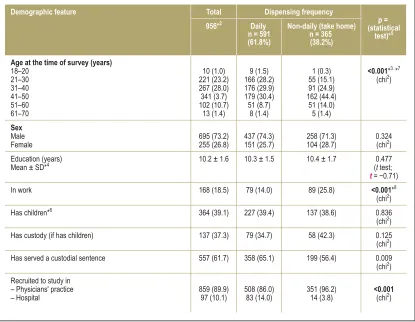
TABLE 1
Demographic data of the study population*1
*1 Data presented as n (%) unless otherwise stated. Percentages in parentheses always give the relative percentages in the columns.
*2 Of the 986 patients surveyed, 956 gave information about dispensing frequency. Of these, the following numbers gave no details about: age (2),
sex (4), work (48), children (24), custody (41), prison (49). These are not included in the relative percentages. *3 Subgroups for chi-square test: patients <30 years versus patients ≥ 30 years.
*4 SD = standard deviation
*5 Significant p-values are shown in bold. P-values are significant <0.00135.
*6 Patients with grown children are not listed;
*7 <0.000001
*8 0.00005
Demographic feature
Age at the time of survey (years) 18–20
21–30 31–40 41–50 51–60 61–70
Sex Male Female
Education(years) Mean ± SD*4
In work
Has children*6
Has custody (if has children)
Has served a custodial sentence
Recruited to study in – Physicians' practice – Hospital
Total
956*2
10 (1.0) 221 (23.2) 267 (28.0) 341 (3.7) 102 (10.7)
13 (1.4)
695 (73.2) 255 (26.8)
10.2 ± 1.6
168 (18.5)
364 (39.1)
137 (37.3)
557 (61.7)
859 (89.9) 97 (10.1)
Dispensing frequency
Daily n = 591 (61.8%)
9 (1.5) 166 (28.2) 176 (29.9) 179 (30.4) 51 (8.7)
8 (1.4)
437 (74.3) 151 (25.7)
10.3 ± 1.5
79 (14.0)
227 (39.4)
79 (34.7)
358 (65.1)
508 (86.0) 83 (14.0)
Non-daily (take home) n = 365 (38.2%)
1 (0.3) 55 (15.1) 91 (24.9) 162 (44.4)
51 (14.0) 5 (1.4)
258 (71.3) 104 (28.7)
10.4 ± 1.7
89 (25.8)
137 (38.6)
58 (42.3)
199 (56.4)
351 (96.2) 14 (3.8)
p = (statistical
test)*5
<0.001*3. *7
(chi2)
0.324 (chi2)
0.477 (t test;
t= −0.71) <0.001*8 (chi2)
0.836 (chi2)
0.125 (chi2)
0.009 (chi2)
To date, however, there has been no systematic study of the incidence of other substance use by patients on take home maintenance medication. Neither has there been any systematic study of existing clinical factors in opiate-dependent patients on take home maintenance medication that would show up physicians’ selection criteria.
We therefore carried out a survey of opiate-dependent patients on maintenance medication throughout the Berlin region. The main study question
was whether the patients on take home maintenance medication meet the GMA’s requirements regarding other substance use.
Secondary questions related to whether patients were in work, how long they had been on maintenance medication, and how the patients themselves assessed their treatment, in order to address the GMA’s criteria relating to being clinically stable and psychosocially reintegrated, and having completed the transfer of dependence to the substitute drug.
Clinical data of the study population*1
*1 Data presented as n (%) unless otherwise stated. Percentages in parentheses always give the relative percentages in the columns.
*2 Of the 986 patients surveyed, 956 gave information about dispensing frequency. Of these, the following numbers gave no details about: duration of dependence
(64), duration of maintenance treatment (53), methadone dose/–equivalent (117), other substance use (49), number of detoxification treatments (49). These are not included in the relative percentages.
*3 Subgroups for chi-square test: duration of opiate dependence <10 years vs ≥ 10 years.
*4 SD = standard deviation
*5 Levomethadone dose in equivalent methadone dose
*6 Subgroups for chi-square test: number of detoxification treatments <5 versus ≥ 5
*7 Subgroups for chi-square test: other substance use reported versus denied
*8 Multiple answers per patient possible. The relative percentages relate to the number of patients who gave information about other substance use:
907 overall, 555 with daily dispensing, 352 with non-daily dispensing (take home) *9 Significant p-values are shown in bold. P-values are significant <0.00135.
*10 Question related to other substance use within the past 4 weeks
*11 0.000315; *12 < 0.000001; *13 0.000026; *14 0.00003; *15 < 0.000001; *16 0.000013; *17 < 0.000001
Clinical feature
Duration of opiate dependence (years) ≤ 1
≥ 1–3 ≥ 3–5 ≥ 5–10 ≥ 10
Duration of maintenance treatment (years) Mean ± SD*4
Methadone dose/–equivalent (mg)*5 Mean ± SD
Number of detoxification treatments: None
Present use of other substances, overall*10
Of the overall number, those using multiple substances*10
Other substance use by substance type*8
– Benzodiazepines
Methods
Patient sampleThe study was approved by the local ethics committee. From May to October 2011, all 20 psychiatric hospitals and the 110 physicians’ practices licensed for opiate maintenance treatment in Berlin were contacted (34). Ten hospitals and 47 practices participated. Practices from 10 of Berlin’s 12 districts took part. Twenty-nine practices reported having no patients on maintenance treatment at the time, while 34 practices refused to take part. At the time of the survey, 5032 patients were reg-istered at the Berlin Medical Association as being on maintenance treatment. One of the purposes of registration is to prevent multiple maintenance treat-ments at different physicians’ practices. A total of 986 patients (19.9% of all maintenance patients in Berlin) took part in the study.
Information about the study was given orally and in writing. Participation was voluntary. The diagnosis of opiate dependence was made by the treating physician in accordance with ICD-10. Patients on maintenance treat-ment were enrolled in the study. In this anonymous sur-vey, carried out by means of questionnaires filled in by the patients themselves, demographic data were recorded and questions answered about clinical course, the frequency of dose dispensing, and data on other substance use. To preserve anonymity, questions about age and duration of dependence were formulated in ranges. The questionnaires were mainly filled out during the waiting period at the hospital or physicians’ practice. Hence, the
study conditions were comparable across practices. Patients assessed their maintenance treatment on a six-point scale from 1 “not at all” to 6 “very much”. Results as to the incidence of unwanted effects and the assessment of alternative therapies will be reported elsewhere.
Statistics
The SPSS 20 package was used for statistical analyses. Nominal variables are given as absolute and relative frequencies. Comparisons between groups used the chi-square test and Student’s t test. Before t tests, data were tested for normalcy of distribution and equality of vari-ances according to Levene. At a significance level of p = 0.05, in 37 statistical tests, after adjustment using Bonferroni’s method, p-values smaller than 0.00135 (0.05/37) were regarded as significant.
Results
Dispensing frequency of take home medication
Nine hundred and fifty-six patients provided in-formation about the dispensing frequency of their take home medication (Table 1); 30 patients gave no in-formation about frequency. For 591 patients (61.8%) dispensing was daily, while for 365 patients (38.2%) it was less frequent than daily. Among the patients on non-daily dispensing, weekly was the most usual (62.7%), followed by twice weekly (25.2%) and several times a week (12%). Patients receiving take home medication were more often being treated in physicians’ practices than in hospitals (p<0.00001),
TABLE 3
Patients’ subjective evaluation of maintenance treatment*1
*1 Data presented as n (%) unless otherwise stated. Percentages in parentheses always give the relative percentages in the columns
*2 SD = standard deviation
*3 Significant p-values are shown in bold. P-values are significant <0.00135
*4 <0.000001; *5 <0.000001 Subjective evaluation
(6-point scale: 1 = not at all, 6 = very much)
Maintenance treatment has improved my physical health
Maintenance treatment has improved my mental health
Maintenance treatment has reduced my rate of drug-related crime
Maintenance treatment has made it possible for me to work
The drug dispensing times make it difficult for me to take a job
Contact with other patients on maintenance treatment at the dispensing facility increases my other substance use
With hindsight, I would repeat my decision to start maintenance treatment
Total
956
Mean ± SD*2
4.0 ± 1.4
3.9 ± 1.5
5.2 ± 1.4
4.0 ± 1.7
3.4 ± 1.8
2.4 ± 1.6
4.3 ± 1.8
Dispensing frequency
Daily n = 591 (61.8%)
3.9 ± 1.3
3.8 ± 1.5
5.1 ± 1.5
3.8 ± 1.6
3.7 ± 1.8
2.8 ± 1.8
4.3 ± 1.8
Non-daily (take home) n= 365 (38.2%)
4.1 ± 1.4
4.0 ± 1.5
5.4 ± 1.3
4.2 ± 1.8
2.9 ± 1.8
1.8 ± 1.3
4.4 ± 1.8
p = (t test)*3
0.023 (t = –2.28)
0.010 (t = –2.68)
0.005 (t = –2.9)
0.001 (t = –3.33)
<0.001*4 (t = 6.07)
<0.001*5 (t = 9.3)
were more often in work (p = 0.0005), were older (p<0.00001), had been on maintenance medication for longer (p<0.00001), and had been dependent for longer (p<0.00315) than patients whose medication was dis-pensed daily (Table 1). There were no group differences between patients on take home versus daily dispensing in respect of sex, years of education, mean methadone dose equivalent, number of detox treatments, prison history, and the existence of any children (Table 1).
As regards patients’ subjective assessment of main-tenance medication, those on take home medication more often reported that the maintenance treatment has enabled them to work than did those on daily dispens-ing (p = 0.001) (Table 2). In turn, the latter reported more often than those on take home medication that the dispensing times at their treatment facility made it harder to be in a job (p<0.00001), and that the resulting contact with other patients on maintenance medication led to increased use of other substances (p<0.00001). Both patient groups (with and without take home medi-cation) reported an improvement in physical health (p = 0.023) and mental condition (p = 0.010)
Other substance use alongside maintenance medication Nine hundred and seven patients gave information about other substance use; 585 of those on maintenance treatment (64.5%) reported using other substances. Other substance use was reported by 197 patients (56.0%) on take home medication, compared to 388 (69.9%) of those on daily dispensing (p = 0.00026). This difference was also found for the individual sub-stances heroin (p<0.00001), cocaine (p = 0.00013), and benzodiazepines (p<0.00001), and also for multiple substance use (p = 0.0003) (Table 1).
Patients with children and other substance use alongside their maintenance medication
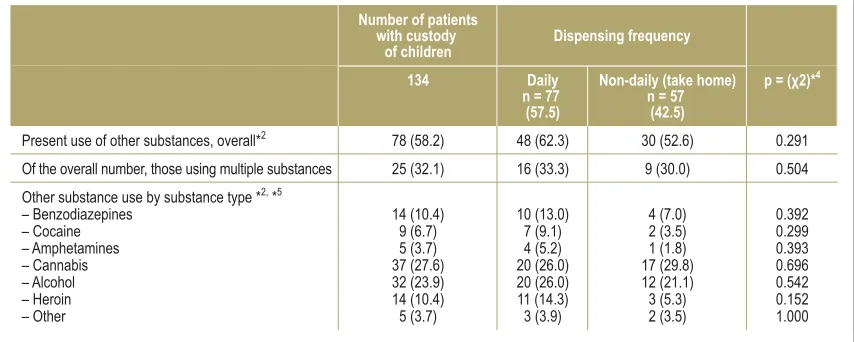
Three hundred and sixty-four patients (39.1%) reported that they had children, and of these, 137 (37.6%) had custody. With regard to other substance use among pa-tients with children, those on take home maintenance medication were statistically no different from those on daily dispensing (Tables 3, 4).
Discussion
Our data show that patients on take home maintenance medication have lower rates of other substance use than those not on take home medication. In particular, substances such as heroin, cocaine, and benzodiaze-pines are used less often in the take home group. These findings indicate that the majority of patients receiving take home maintenance medication show low rates of other substance use, in accordance with the GMA guidelines.
However, the number of patients who are both on take home medication and using other strong sedatives is not negligible; for example, 17 of 365 patients on take home maintenance medication report also using heroin, and 53 using multiple substances. This result might allow the conclusion that it is necessary to monitor the substance use of patients on take home maintenance medication. This would agree with the results of other studies that only showed take home medication to be effective when urine testing was regu-larly carried out (16, 17, 20, 21).
Apart from other substance use, our questionnaire also asked about other parameters relating to other of the GMA’s criteria for take home maintenance medi-cation.
Data on other substance use by patients who have custody of children *1, *3
*1 Data are given for other substance use by patients with custody of children for whom information as to dispensing frequency (daily or non-daily) is available
*2 Question related to other substance use within the past 4 weeks
*3 Data presented as n (%) unless otherwise stated
*4 Subgroups for chi square test: other substance use reported versus denied
*5 Multiple answers per patient possible. The relative percentages relate to the number of patients who gave information about other substance use: 134 overall,
77 with daily dispensing, 57 with non-daily dispensing (take home) Present use of other substances, overall*2
Of the overall number, those using multiple substances
Other substance use by substance type *2, *5
– Benzodiazepines – Cocaine – Amphetamines – Cannabis – Alcohol – Heroin – Other
Number of patients with custody
of children
134
78 (58.2)
25 (32.1)
14 (10.4) 9 (6.7) 5 (3.7) 37 (27.6) 32 (23.9) 14 (10.4) 5 (3.7)
Dispensing frequency
Daily n = 77
(57.5)
48 (62.3)
16 (33.3)
10 (13.0) 7 (9.1) 4 (5.2) 20 (26.0) 20 (26.0) 11 (14.3) 3 (3.9)
Non-daily (take home) n = 57
(42.5)
30 (52.6)
9 (30.0)
4 (7.0) 2 (3.5) 1 (1.8) 17 (29.8) 12 (21.1) 3 (5.3) 2 (3.5)
p = (χ2)*4
0.291
0.504
Our findings show that patients who are in work are more often selected for take home maintenance treat-ment, which corresponds to the GMA’s requirement for advanced psychosocial reintegration. The fact that it is mainly patients who had been on maintenance treat-ment for longer (average of 8.9 years’ dependence) who were on take home medication suggests that, through being on the maintenance treatment for a long time, they have completed transferral of dependence to the maintenance substance, e.g., in terms of dosage. Clinical stabilization due to the maintenance treatment was reported by patients with and without take home medication in the areas of improved physical and mental health. The fact that it was predominantly older patients with a longer history of dependence who were allowed take home medication indicates that these are further important selection criteria for patients for take home maintenance medication.
The results of our study allow the conclusion that, according to the patients’ self-reporting, the majority of patients on take home maintenance medication fulfill the requirements of the GMA investigated here. How-ever, this does not mean that this patient group fulfills all the GMA’s criteria (Box). A substantial proportion of patients do not.
However, several of our other findings are worth noting:
●
The rate of other substance use for the wholepatient sample is 64.5%.
At first glance, that looks very high. The use of cannabis, especially, was reported by one patient in three. However, only 15.6% of patients reported using benzodiazepines, 11.7% heroin, and only 8.8% cocaine.
The baseline goal of opioid replacement therapy is to reduce mortality, especially by reducing infectious diseases and serious intoxication (1). Scherbaum mentions abstinence from other addictive drugs and permanent opiate abstinence as intermediate-level and high-level goals (3).
That only some patients can achieve complete absti-nence is now widely accepted (1, 35, 36). Despite this, the high rates of other substance use are putting patients at risk. In individual cases, therefore, it is possible that a change in treatment regimen may be necessary, e.g., by regularly testing the urine and by reducing the dosage of the substitute drug (GMA guidelines, point 11) (5, 13, 37).
●
A surprising finding from the point of view of the hospital physician is that almost 40% of all studied patients reported being on take home medication, whereas only 14% of all patients re-cruited in hospital (14 out of 97 patients) reported being on take home medication. This agrees with our own everyday clinical experience. It may in-dicate that patients on take home medication are the more “successful” patients, who more rarely need to be treated in hospital.●
Our data show that over 50% of patients withcustody of children reported other substance use. However, only a minority of these reported using strong sedatives such as heroin and benzodiazepines, and use of multiple other substances. In particular, pa-tients with children who were on take home medication reported other substance use less often than patients with children who were on daily dispensing. However, the difference between groups was not statistically sig-nificant. Since every case is important when it comes to potential risk to children, patients with children should continue to be carefully selected for take home medi-cation, because the medication is accessible to the children at home.
●
It is a problem that patients on daily dispensing, especially, report increased use of other substances due to their contact at the dispensing facility with other patients on maintenance medi-cation.It might be supposed that dealers deliberately target the dispensing facilitys, or that patients use other sub-stances together immediately after receiving their maintenance medication.
●
Our data indicate that the take home regimenitself has a positive effect on other substance use, because patients have to go to the physicians’ practices less often.
In our survey, patients on take home maintenance medication reported increased other substance use due to regular contact with other patients less often than did patients on daily dispensing.
BOX
The German Medical Association´s
guidelines on opiate substitution
treatment
The German Medical Association´s guidelines on prescrib -ing substitution therapy in the treatment of opiate depen-dency (as of: 19th February 2010) requires that:
●
The patient robustly refrains from consuming anyadditional substances that may pose a risk to their health in combination with the ingestion of the opiate substitute drug
●
The patient’s dosage adjustment to the substitute drughas been completed successfully
●
Treatment to date has led to stabilization of the patient´s condition●
The patient’s psychosocial reintegration is welladvanced
●
The risk of self harm has been excluded as far as pos-sible
●
The patient has taken advantage of the mandatorycontacts to their physician and psychosocial services
●
There is no evidence that supplying the substitutioneffect on patients’ assessment of their ability to work: Those on take home medication report less often that their ability to work is restricted by medication dispens-ing times.
On all these points, however, it must be borne in mind that in this study there were differences in the se-verity of dependence of the patients who were on take home medication and those who were not, e.g., in terms of duration of dependence and of maintenance medication. Randomized prospective studies need to be carried out to identify the specific effective factors of take home maintenance medication.
Limitations
Our study has the following limitations:
●
The data on other substance use are based entirely on self-reporting by the patients in a question-naire. Despite the anonymity of the survey, it cannot be ruled out that patients gave socially desirable answers, and that the true rates of other substance use are higher. On the other hand, col-lecting data on other substance use in a different way, e.g., by urine testing, might have had a selec-tion effect on the study populaselec-tion.●
Since 34 physicians’ practices did not take part in the study, it cannot be ruled out that the rates of other substance use in these practices were differ-ent from those in the 47 participating practices.●
Given the participation rate of 19.9%, it cannot beruled out that it was predominantly motivated patients who took part in the survey, who may also have had lower rates of other substance use. However, this does not correspond to the impres-sion we received during study recruitment, be-cause the varying waiting times in the hospitals/ practices resulted in a wide variety of patients taking part in the survey.
●
In the comparisons of other substance use, some of the numbers in respect of individual other sub-stances were very low among patients with children, so the conclusions that can be drawn from comparisons between groups are limited.●
The factors being investigated in three secondaryquestions were not studied using dichotomized data (fulfilled/not fulfilled), but using the mean values of a 6-point scale and annual data. This allows a graded assessment of some subjective factors (“psychosocially reintegrated” or “clini-cally stabilized”). Percentages cannot be derived from these data.
Conclusion
The results of this large-scale investigation of take home maintenance medication indicate that the major-ity of patients on a take home program fulfill the requirements of the German Medical Association guidelines in regard to other substance use, clinical stabilization, psychosocial reintegration, and comple-tion of the transfer of dependence to the substitute drug
program who use other substances is non-negligible, including among those with children, our results allow the conclusion that monitoring of substance use is requried. This would agree with the results of other studies that showed take home programs to be effective only when urine testing was regularly carried out (16, 17, 20, 21).
Finally, the limitations imposed on the ambit of patients’ lives by daily dispensing should be taken into account, e.g. by limiting their ability to travel. To allow patients more room for movement, take home programs should continue to be used.
Acknowledgments
The authors wish to thank Isolde Daig, Thomas Riemer, Sarah Hahn, and the staff of Ward 34 for their help with the study design, data evaluation, and patient recruitment.
Conflict of interest statement
All authors declare that no conflict of interest exists.
Manuscript received on 26 September 2012, revised version accepted on 19 March 2013.
Translated from the original German by Kersti Wagstaff, MA.
REFERENCES
1. Ward J, Hall W, Mattick RP: Role of maintenance treatment in opioid dependence. Lancet 1999; 353: 221–6.
2. Kraus L, Augustin R, Ort B: Illegale Drogen, Einstiegsalter und Trends. Ergebnisse des Epidemiologischen Suchtsurvey 2003. Sucht 2005; 51(19–28).
3. Scherbaum N: Die Substitutionsbehandlung Opiatabhängiger. Nervenarzt 2007; 78(1): 103–9.
4. Drogenbeauftragte der Bundesregierung: Situation in Deutschland. www.drogenbeauftragte.de/drogen-und-sucht/illegale-drogen/her oin-und-andere-drogen/situation-in-deutschland.html. Last accessed: 26 September 2012
5. Ontario CoPSo: Methadone Maintenance Guideline. 2005.
KEY MESSAGES
●
In this study population, 365 (38.2%) of all patients onmaintenance medication were in a take home program.
●
Take home medication was prescribed predominantlyfor older patients who were in work, who had had a long duration of dependence and had been in the treatment program for longer.
●
Of the patients on take home medication, 197 (56.0%)reported other substance use, compared to 388 pa-tients (69.9%) on daily dispensing. This was particularly the case for substances such as heroin, cocaine, and benzodiazepines.
●
Patients on take home maintenance medication more6. Grönbladh L, Ohlund LS, Gunne LM: Mortality in heroin addiction: impact of methadone treatment. Acta Psychiatr Scand 1990; 82: 223–7.
7. Metzger DS, Woody GE, McLellan AT, et al.: Human immunodefi-ciency virus seroconversion among intravenous drug users in- and out-of-treatment: an 18-month prospective follow-up. J Acquir Immune Defic Syndr 1993; 6: 1049–56.
8. De Maeyer J, van Nieuwenhuizen C, Bongers IL, Broekaert E, Vanderplasschen W: Profiles of quality of life in opiate-dependent individuals after starting methadone treatment: A latent class analysis. Int J Drug Policy 2012.
9. Baharom N, Hassan MR, Ali N, Shah SA: Improvement of quality of life following 6 months of methadone maintenance therapy in Ma-laysia. Subst Abuse Treat Prev Policy 2012; 7: 32.
10. Karow A, Verthein U, Pukrop R, et al.: Quality of life profiles and changes in the course of maintenance treatment among 1,015 patients with severe opioid dependence. Subst Use Misuse 2011; 46(6): 705–15.
11. Maremmani I, Pani PP, Pacini M, Perugi G: Substance use and quality of life over 12 months among buprenorphine maintenance-treated and methadone maintenance-maintenance-treated heroin-addicted patients. J Subst Abuse Treat 2007; 33(1): 91–8.
12. Ullmann R: Substitutionsbehandlung heroinabhängiger: Behandlung wird wieder kriminalisiert. Dtsch Arztebl 2009; 106(18): 874–6. 13. Bundesärztekammer: Richtlinien der Bundesärztekammer zur
Durchführung der substitutionsgestützten Behandlung Opiatabhän-giger. www.bundesaerztekammer.de/downloads/RL-Substitution_ 19-Februar-2010.pdf.
14. Milby JB: Methadone maintenance to abstinence. How many make it? J Nerv Ment Dis 1988; 176: 409–22.
15. Ritter A, Di Natale R: The relationship between takeaway metha -done policies and metha-done diversion. Drug Alcohol Rev 2005; 24: 347–52.
16. Gerra G, Saenz E, Busse A, et al: Supervised daily consumption, contingent take-home incentive and non-contingent take-home in methadone maintenance. Prog Neuropsychopharmacol Biol Psychiatry 2011; 35: 483–9.
17. Kidorf M, Stitzer ML, Brooner RK, Goldberg J: Contingent metha -done take-home doses reinforce adjunct therapy attendance of methadone maintenance patients. Drug Alcohol Depend 1994; 36: 221–6.
18. Rhoades HM, Creson D, Elk R, Schmitz J, Grabowski J: Retention, HIV risk, and illicit drug use during treatment: methadone dose and visit frequency. Am J Public Health 1998; 88: 34–9.
19. Stitzer ML, Iguchi MY, Felch LJ: Contingent take-home incentive: effects on drug use of methadone maintenance patients. J Consult Clin Psychol 1992; 60: 927–34.
20. Chutuape MA, Silverman K, Stitzer ML: Use of methadone take-home contingencies with persistent opiate and cocaine abusers. J Subst Abuse Treat 1999; 16: 23–30.
21. Chutuape MA, Silverman K, Stitzer ML: Effects of urine testing frequency on outcome in a methadone take-home contingency program. Drug Alcohol Depend 2001; 62: 69–76.
22. Peles E, Schreiber S, Sason A, Adelson M: Earning „take-home“ privileges and long-term outcome in a methadone maintenance treatment program. J Addict Med 2011; 5: 92–8.
23. Walley AY, Cheng DM, Pierce CE et al.: Methadone dose, take home status, and hospital admission among methadone maintenance patients. J Addict Med 2012; 6: 186–90.
24. Schattauer G: Der absolute Renner. Focus online 28. 6. 2009. www.focus.de/gesundheit/news/rauschgift-studie-der-absolute-renner_aid_412052.html.
25. Kutter K: Schulbehörde strapaziert Datenschutz. TAZ, 3. 2. 2012. www.taz.de/!87027/.
26. Hamburger Abendblatt: Neue Regeln für den Kinderschutz. www.abendblatt.de/hamburg/kommunales/article2359892/Neue-Regeln-fuer-den-Kinderschutz.html. Last accessed: 26. 9. 2012
27. Green H, James RA, Gilbert JD, Harpas P, Byard RW: Methadone maintenance programs—a two-edged sword? Am J Forensic Med Pathol 2000; 21: 359–61.
28. Palmiere C, Staub C, La Harpe R, Mangin P: Parental substance abuse and accidental death in children. J Forensic Sci 2010; 55: 819–21.
29. Glatstein M, Finkelstein Y, Scolnik D: Accidental methadone inges-tion in an infant: case report and review of the literature. Pediatr Emerg Care 2009; 25: 109–11.
30. Boroda A, Gray W: Hair analysis for drugs in child abuse. J R Soc Med 2005; 98: 318–9.
31. Kintz P, Villain M, Dumestre-Toulet V, Capolaghi B, Cirimele V: Methadone as a chemical weapon: two fatal cases involving babies. Ther Drug Monit 2005; 27: 741–3.
32. Marcus SM: Accidental death from take home methadone mainte -nance doses: A report of a case and suggestions for prevention. Child Abuse Negl 2011; 35: 1–2.
33. Heinemann A, Iwersen-Bergmann S, Stein S, Schmoldt A, Puschel K: Methadonerelated fatalities in Hamburg 1990–1999: implica -tions for quality standards in maintenance treatment? Forensic Sci Int 2000; 113: 449–55.
34. Kassenärztliche Vereinigung Berlin. Arztsuche, Stichwort: Substitu-tion. Last accessed: on April 2011: www.kvberlin.de/60arztsuche/ index.html.
35. Wittchen HU, Bühringer G, Rehm J: Ergebnisse und Schlussfolge-rungen der PREMOS-Studie. Suchtmedizin in Forschung und Praxis 2011; 13: 200–300.
36. Wittchen H, Trautmann S, Träder A, et al.: Abstinenz als ein Behand-lungsziel der opiatgestützten Substitutionstherapie: Häufigkeit und Risiken. Suchtmed 2011; 13: 253–7.
37. Varenbut M, Teplin D, Daiter J, et al.: Tampering by office-based methadone maintenance patients with methadone take home privileges: a pilot study. Harm Reduct J 2007; 4: 15.
Corresponding author Dr. med. Stefan Gutwinski
Universitätspsychiatrie der Charité im St. Hedwig-Krankenhaus Klinik für Psychiatrie und Psychotherapie