APPLIED ANDENVIRONMENTALMICROBIOLOGY, July 2003, p. 4274–4277 Vol. 69, No. 7 0099-2240/03/$08.00⫹0 DOI: 10.1128/AEM.69.7.4274–4277.2003
Copyright © 2003, American Society for Microbiology. All Rights Reserved.
Design and Application of a New Cryptic-Plasmid-Based Shuttle
Vector for
Magnetospirillum magneticum
Yoshiko Okamura,
1Haruko Takeyama,
1Takumi Sekine,
1Toshifumi Sakaguchi,
1Aris Tri Wahyudi,
1Rika Sato,
2Shinji Kamiya,
2and Tadashi Matsunaga
1*
Department of Biotechnology, Tokyo University of Agriculture and Technology, Koganei, Tokyo,1 and TDK Akita Laboratory Corporation, Akita,2Japan
Received 10 October 2002/Accepted 23 April 2003
A 3.7-kb cryptic plasmid designated pMGT was found in Magnetospirillum magneticum MGT-1. It was characterized and used for the development of an improved expression system in strain AMB-1 through the construction of a shuttle vector, pUMG. An electroporation method for magnetic bacteria that uses the cryptic plasmid was also developed.
Magnetic bacteria synthesize intracellular, single-domain, nanometer-sized particles of magnetite (1) enveloped by lipid membranes that include numerous proteins. Aqueous disper-sion of bacterial magnetic particles (BMPs) allows the devel-opment of highly sensitive chemiluminescence-based enzyme immunoassays by the chemical coupling of antibodies onto BMP surfaces (4). We have also previously reported applica-tions of recombinant BMPs as novel bioassay platforms for protein display (12) and diagnosis of diabetes (19, 20). The enormous potential of BMPs for nanobiotechnological appli-cations calls for the development of cloning vectors for mag-netic bacteria to allow convenient gene transfer and maximum expression.
We have previously isolated two facultatively anaerobic
Magnetospirillum magneticumstrains, AMB-1 (ATCC 700264) (7) and MGT-1 (FERM P-16617) (8). The gene transfer sys-tem inM.magneticumAMB-1 magnetic bacteria was reported by our group (5). We have performed transposon mutagenesis in order to elucidate the molecular mechanism of BMP for-mation (11, 22). Electroporation has not been successfully applied in magnetic bacteria. Conjugative gene transfer was achieved (9) by using the broad-host-range vector pRK415 (3), but a low copy number was obtained. Replicons in the cryptic plasmids of magnetic bacteria may provide stable vectors yield-ing high copy numbers.
In the photosynthetic bacterium Rhodospirillum rubrum, which is genetically close toMagnetospirillumsp., broad-host-range vectors were unstable for replication (14). We previously screened small cryptic plasmids from marineRhodobacter iso-lates and reported the construction of stable shuttle vectors containing the minimal replicon from a marine Rhodobacter
isolate (10). In this study, a new cryptic plasmid designated pMGT was also found inM.magneticumMGT-1. This is the first report of a small-sized cryptic plasmid in magnetic bacte-ria. pMGT is extremely stable, even under nonselective condi-tions. This characteristic is valuable for the construction of shuttle vectors.
The strains and plasmids used in this study are described in Table 1. The complete nucleotide sequence of pMGT (submit-ted to the DDBJ database) was 3,741 bp, with a G⫹C content of 59.2%, which is lower than that of theMagnetospirillum ge-nome (62 to 65%). Two potential open reading frames (ORF1 and ORF2) were found. ORF1 (positions 1727 to 2554 relative to position 1 at theBamHI site) is 828 bp in size and encodes a predicted protein of 275 amino acids (30.4 kDa). The Shine-Dalgarno (AAG, AGG, or GGA) sequences (16) were at po-sitions 1711 to 1713. The deduced amino acid sequence showed significant homologies to the sequences of the Rep proteins in
* Corresponding author. Mailing address: Department of Biotech-nology, Tokyo University of Agriculture and TechBiotech-nology, 2-24-16 Koganei, Tokyo 184-8588, Japan. Phone: 88-7020. Fax: 81-423-85-7713. E-mail: [email protected].
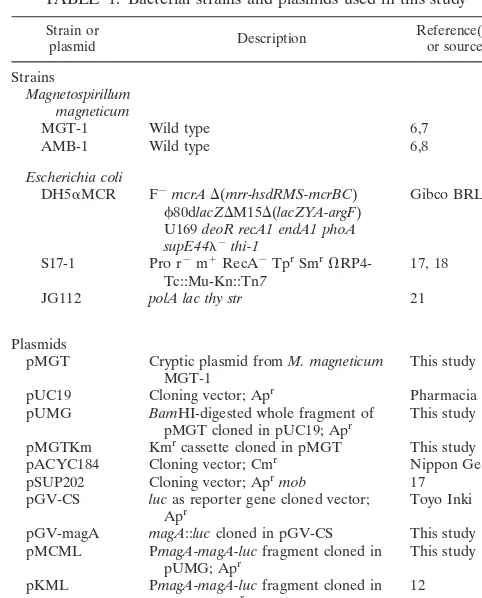
TABLE 1. Bacterial strains and plasmids used in this study
Strain or
80dlacZ⌬M15⌬(lacZYA-argF) U169deoR recA1 endA1 phoA supE44⫺
JG112 polA lac thy str 21
Plasmids
pMGT Cryptic plasmid fromM. magneticum MGT-1
This study
pUC19 Cloning vector; Apr Pharmacia
pUMG BamHI-digested whole fragment of pMGT cloned in pUC19; Apr
This study
pMGTKm Kmrcassette cloned in pMGT This study
pACYC184 Cloning vector; Cmr Nippon Gene
pSUP202 Cloning vector; Aprmob 17
pGV-CS lucas reporter gene cloned vector;
Apr Toyo Inki
pGV-magA magA::luccloned in pGV-CS This study pMCML PmagA-magA-lucfragment cloned in
pUMG; Apr
This study
pKML PmagA-magA-lucfragment cloned in
pRK415; Tcr 12
plasmid pNU73 fromPseudomonas fulva(percent identity and percent similarity, 33.0 and 55.8%, respectively; accession no. AB032348-1) and pLME108 fromPropionibacterium freuden-reichii(percent identity and percent similarity, 32.5 and 62.0%, respectively; accession no. AJ006662-1). ORF1 also has many amino acids that are conserved in all Rep proteins. ORF2 is 1,110 bp in size and is located at positions 2700 to 3741 and 1 to 64, corresponding to 369 amino acids with an estimated molecular mass of 40.3 kDa. The Shine-Dalgarno sequences were at positions 2694 to 2697. The deduced amino acid se-quence showed high homology with the sese-quence of the N-terminal 170 amino acids of the Mob protein in plasmid pIP823 fromListeria monocytogenes(percent identity and per-cent similarity, 31.5 and 58.6%, respectively; accession no. U40997-4) (2) and of the whole Mob protein in plasmid pTB19 fromBacillussp. (percent identity and percent similarity, 31.5 and 60.5%, respectively; accession no. JQ1212) (13). Align-ment of the deduced amino acid sequence of ORF2 with those of the Mob proteins from other plasmids showed weak but significant sequence identities; hence, ORF2 was putatively des-ignated themobgene. Thus, plasmid pMGT should be mobi-lizable.
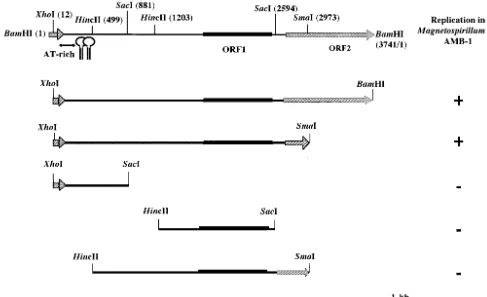
To identify the minimum replication region of pMGT, sev-eral segments of pMGT were inserted into theEcoRI site of pSUP202 (17) and transferred intoM.magneticumAMB-1 by conjugation (Fig. 1). The XhoI-SmaI region of pMGT can replicate inM. magneticumAMB-1, but theHincII-SmaI re-gion cannot. A typical plasmid replicon contains an origin
sequence (ori) and a repgene. The structural features ofori
include the AT-rich region (15). Positions 58 to 97 show a high A⫹T content of 70.7%. In addition, many repeated sequences consist of nucleotide sequences more than 10 bp long within theXhoI-HincII region. Two hairpin structures were found at positions 266 to 298, with a 15-bp stem (⌬G⫽ ⫺28.40 kcal/ mol) and a 5-bp loop, and at positions 350 to 388, with an 11-bp stem (⌬G⫽ ⫺16.60 kcal/mol) and a 17-bp loop. The 3.0-kb
XhoI-SmaI fragment containing the AT-rich region, and the putative Rep protein may therefore be the replication region.
FIG. 1. Determination of the minimum replication region of pMGT. The digested fragments were inserted into pSUP202. The replication ability of each recombinant plasmid inM.magneticumAMB-1 is shown at the right.
FIG. 2. Effect of electric field strength on transformation efficiency inM.magneticumAMB-1.
Recombinant plasmid pUMG was constructed by ligating pUC19 at the BamHI site of pMGT. In addition, plasmid pMGTKm was constructed by inserting a kanamycin resistance cassette into theBamHI site of pMGT. Both of the constructed plasmids were transformed intoEscherichia coli DH5␣MCR and JG112. Plasmid pUC19, containing pMB1 ori, was also used as a control. The replicon derived from pUC19 is unable to replicate in thepolAmutantE.coliJG112, which lacks the
polAgene, which encodes DNA polymerase I and is required for replication of ColE1 and pMB1ori(21). Therefore, repli-cation of pUMG, which contains pMGT and pUC19 replicons, depended on pMGToriinE.coliJG112. In addition, pMGTKm, containing only pMGTori, was able to replicate in bothE.coli
strains. Thus, pUMG and pMGTkm containing the pMGT rep-licon are capable of replicating both inMagnetospirillum spe-cies and inE.coli.
Molecular genetic analysis of the mechanisms of BMP syn-thesis requires DNA transfer to the cell since homologous recombination of target genes is essential for this purpose. Several preliminary experiments demonstrated that the exis-tence of intracellular BMPs caused cell death when electropo-ration was applied. Intracellular BMPs are not produced when strain AMB-1 is grown under aerobic conditions. Even though electroporation was performed with cells grown aerobically, transformants screened under anaerobic conditions retained the ability to synthesize BMPs. Electroporation was performed with a Gene Pulser (Bio-Rad Laboratories, Richmond, Calif.), at a capacitance of 25F and a resistance of 200⍀, and 0.1-cm cuvettes. Aerobically grown M.magneticum AMB-1 was har-vested and washed with 10 mM TES [N-tris(hydroxymethyl) methyl-2-aminoethanesulfonic acid] buffer containing 272 mM sucrose (pH 7.5) and resuspended in the same buffer at 109
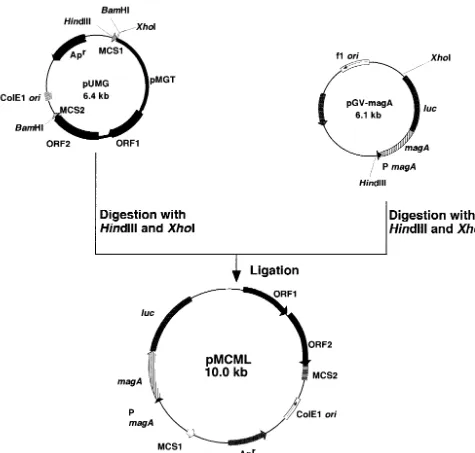
FIG. 3. Strategy for cloning and construction of expression vector pMCML.
cells/ml. A 50-l cell suspension was aliquoted as electrocom-petent cells. The cells were subjected to single-pulse electro-poration and immediately transferred to 500 l of magnetic
Spirillumgrowth medium (MSGM) supplemented with 20 mM Mg2⫹
and incubated at 27°C overnight with shaking at 100 rpm. Cells were diluted in 5 ml of MSGM containing 0.7% agar and plated on 1% agar in MSGM containing 5g of ampicillin per ml or 2.5 g of kanamycin per ml and incubated under anaerobic conditions.M.magneticumcells containing magnetic particles did not survive after the application of an electric pulse. On the other hand, the survival percentage of aerobi-cally cultured cells, which do not produce intracellular mag-netic particles, after application of a pulse was 10% of the number of CFU of aerobically cultured cells that had not been pulsed. Furthermore, the maximum transformation efficiency of 9.6⫻ 105
colonies/g of DNA was obtained at 10 kV/cm (Fig. 2). Transformation efficiency increased 10-fold after ad-dition of Mg2⫹under aerobic conditions with gentle shaking to
allow the cells to recover.
The copy number of plasmid pUMG in M. magneticum
AMB-1 was measured. Five nanograms of pACYC184 (Cmr , 4,244 bp), which was used as the standard for plasmid extrac-tion efficiency, was added to harvested transformant cells har-boring pUMG (Apr
, 6,327 bp) or pRK415 (Tcr
, 10.5 kbp). After extraction, the plasmid mixture was transformed intoE.
coli DH5␣MCR. The copy number was calculated from the following equation: copy number of pUMG⫽(number of Apr or Tcr
colonies/number of Cmr
colonies)⫻(molecular number of 5 ng of pACYC184/cell number). The copy number of pUMG containing the replicon of pMGT in AMB-1 was 39⫾
10 copies/cell, whereas the vector pRK415 yielded only 3⫾1 copies/cell.
Evaluation of pUMG as an expression vector was carried out through a reporter-luciferase expression system. The plasmid designated pMCML (10.0 kb, Tcr
) was constructed by the following procedure (Fig. 3). pGV-magA was constructed by ligating themagAgene promoter at the 5⬘end of the luciferase gene (luc) in pGV-CS (Toyo Inki, Tokyo, Japan). pGV-magA was digested withHindIII andXhoI and ligated to pUMG at the same sites. Constructed plasmid pMCML and previously constructed plasmid pKML, both containing PmagA-magA-luc
(12), were introduced into AMB-1 by conjugation (5). BMPs from transformants harboring pMCML or pKML were ex-tracted and purified as described by Nakamura et al. (12). Luciferase activities on BMPs from cells harboring pMCML were five times higher than those on BMPs from cells harbor-ing pKML (85,200 and 16,200 counts/mg of BMPs, respective-ly). These results indicated that a higher vector copy number resulted in higher protein expression. The plasmid containing the replicon of pMGT is more favorable for the production of useful proteins on BMPs.
Plasmid pUMG, containing the pMGT replicon, showed sta-bility and a high copy number and allowed higher expression of the reporter gene. These results are useful in improving the mass production of BMPs and protein A displayed on BMPs in batch-fed cultures, as we have previously described (9, 23). The data obtained from this study may be used to meet other chal-lenges in nanobiotechnology, like the manufacturing of more sophisticated and highly efficient biosensors and biomaterials at the nanoscale level that are useful in interdisciplinary fields.
This work was funded in part by Grant-in-Aid for Specially Pro-moted Research no. 13002005 from the Ministry of Education, Sci-ence, Sports and Culture of Japan.
REFERENCES
1. Bazylinski, D. A., R. B. Frankel, B. Heywood, S. Mann, J. W. King, P. L. Donaghay, and A. K. Hanson.1995. Controlled biomineralization of mag-netite (Fe3O4) and Greigite (Fe3S4) in a magnetotactic bacterium. Appl.
Environ. Microbiol.61:3232–3239.
2. Charpentier, E., G. Gerbaud, and P. Courvalin.1999. Conjugative mobili-zation of the rolling-circle plasmid pIP823 fromListeria monocytogenes BM4293 among gram-positive and gram-negative bacteria. J. Bacteriol.181: 3368–3374.
3. Keen, N. T., S. Tamaki, D. Kobayashi, and D. Trollinger.1988. Improved broad-host-range plasmids for DNA cloning in gram-negative bacteria. Gene 70:191–197.
4. Matsunaga, T., M. Kawasaki, X. Yu, N. Tsujimura, and N. Nakamura.1996. Chemiluminescence enzyme immunoassay using bacterial magnetic parti-cles. Anal. Chem.68:3551–3554.
5. Matsunaga, T., C. Nakamura, J. G. Burgess, and K. Sode.1992. Gene transfer in magnetic bacteria: transposon mutagenesis and cloning of geno-mic DNA fragments required for magnetosome synthesis. J. Bacteriol.174: 2748–2753.
6. Matsunaga, T., and T. Sakaguchi.1992. Production of biogenic magnetite by aerobic magnetic spirilla strains AMB-1 and MGT-1, p. 262–267.InT. Yamaguchi and M. Abe (ed.), Proceedings of the Sixth International Con-ference on Ferrites (ICF6). Japan Society of Powder and Powder Metallurgy, Tokyo, Japan,
7. Matsunaga, T., T. Sakaguchi, and F. Tadokoro.1991. Magnetite formation by a magnetic bacterium capable of growing aerobically. Appl. Microb. Biotechnol.35:651–655.
8. Matsunaga, T., F. Tadokoro, and N. Nakamura.1991. Mass culture of magnetic bacteria and their application to flow type immunoassays. IEEE (Inst. Electr. Electron. Eng.) Trans. Magn.26:1557–1559.
9. Matsunaga, T., H. Togo, T. Kikuchi, and N. Nakamura.2000. Production of luciferase-magnetic particle complex by recombinantMagnetospirillumsp. Biotechnol. Bioeng.70:704–709.
10. Matsunaga, T., K. Tsubaki, H. Miyashita, and J. G. Burgess.1990. Chlor-amphenicol acetyltransferase expression in marine Rhodobacter sp. NKPB 0021 by use of shuttle vectors containing the minimal replicon of an endog-enous plasmid. Plasmid24:90–99.
11. Nakamura, C., J. G. Burgess, K. Sode, and T. Matsunaga.1995. An iron-regulated gene,magA, encoding an iron transport protein of Magnetospiril-lum magneticumstrain AMB-1. J. Biol. Chem.270:28392–28396. 12. Nakamura, C., T. Kikuchi, J. G. Burgess, and T. Matsunaga.1995. Iron
regulated expression and membrane localization of themagAprotein in Magnetospirillum magneticumstrain AMB-1. J. Biochem.118:23–27. 13. Oskam, L., D. J. Hillenga, G. Venema, and S. Bron.1991. The largeBacillus
plasmid pTB19 contains two integrated rolling-circle plasmids carrying mo-bilization functions. Plasmid26:30–39.
14. Saegesser, R., R. Ghosh, and R. Bachofen.1992. Stability of broad host range cloning vector in the phototrophic bacterium Rhodospirillum rubrum. FEMS Microbiol. Lett.95:7–12.
15. Scott, J. R.1984. Regulation of plasmid replication. Microbiol. Rev.48:1–23. 16. Shine, J., and L. Dalgarno.1974. The 3⬘-terminal sequence ofE.coli16s ribosomal RNA: complementarity to nonsense triplets and ribosomal bind-ing sites. Proc. Natl. Acad. Sci. USA71:1342–1346.
17. Simon, R., M. O’Connell, M. Labes, and A. Pu¨hler.1986. Plasmid vectors for genetic analysis and manipulation of rhizobia and other gram-negative bac-teria. Methods Enzymol.118:640–659.
18. Simon, R., U. Priefer, and A. Pu¨hler.1983. A broad host range mobilization system for in vivo genetic engineering: transposon mutagenesis in gram-negative bacteria. Bio/Technology1:784–791.
19. Tanaka, T., and T. Matsunaga.2000. Fully automated chemiluminescence immunoassay of insulin using antibody-protein A-bacterial magnetic particle complexes. Anal. Chem.72:3518–3522.
20. Tanaka, T., and T. Matsunaga.2001. Detection of HbA1c by boronate affinity immunoassay using bacterial magnetic particles. Biosens. Bioelec-tron.16:1089–1094.
21. Terawaki, Y., Y. Itoh, H. Zeng, T. Hayashi, and A. Tabuchi.1992. Function of the N-terminal half of RepA in activation of Rts1ori. J. Bacteriol.174: 6904–6910.
22. Wahyudi, A. T., H. Takeyama, and T. Matsunaga.2001. Isolation of Mag-netospirillum magneticumAMB-1 mutants defective in bacterial magnetic particle synthesis by transposon mutagenesis. Appl. Biochem. Biotechnol. 91–93:147–154.
23. Yang, C.-D., H. Takeyama, and T. Matsunaga.2001. Iron feeding optimiza-tion and plasmid stability in producoptimiza-tion of recombinant bacterial magnetic particles by Magnetospirillum magneticum AMB-1 in fed-batch culture. J. Biosci. Bioeng.91:213–216.