-LEBIH BAlK
セ@
INDOCEMENT
Correct dtation:
PSMIL (Postgraduate Programme on Environmental Studies). 2015. Proceeding of the
International Symposium on Sustainability Sdence: Understanding Climate Change
Phenomena for Human Well-Being, 8-9 September 2014, Universitas Padjadjaran, West
Java, Indonesia.
Website:www.sss2014.unpad.ac.id
E-mail: [email protected]
Chair of Organizing Committee:
Prof. Oekan S Abdoellah, MA., Ph.D
Conference Reviewers:
Prof. Johan Iskandar, M.Sc., Ph.D
Dr. Tb. Benito A. Kurnani, Ir., Dip., EST.
Chay Asdak, M.Sc., Ph.D
Budhi Gunawan, M.Sc., Ph.D
Prof. Dr. Erri Noviar Megantara
Proceeding Editors:
Parikesit, M.Sc., P.hD
Sunardi, M.Si., Ph.D
Dr. Susanti Withaningsih, M.Si
Program Committee and Publications:
lka Anisya, M.I.L.
Nadia Istlqomah, M.I.L., M.Sc
Linda Yustikasari, M.I.L., M.Sc
Miranti Ariyani, M.I.L.
Gemilang Lara Utama, M.I.L.
Hafsah, M.I.L.
Ghea Sakti Maharani, M.I.L.
Rina Febriani, M.I.L., M.Sc.
M. Ramdhan Firdaus, S.Si.
PROCEEDING INTERNATIONAL SYMPOSIUM ON SUSTAINABILITV SCIENCE
ISBN :
978-602-72141..0·1
Proceeding International Symposium on Sustainability Science
ISBN : 978·602-72141·0·1
TABLE OF CONTENTS
PREFACE ...
i
THE CHAIR OF SYMPOSIUM MEMORIAL LECTURE ... -...
,
ii
TABLE OF CONTENTS ...
iii
-vi
KEYNOTE'S ABSTRACT
Prof. Dr.'P.
K.
Ramachandran Nair
Prof. Hans Bressers
Prof. Takao
Yoshimatsu
Sustainability Science :A New Emerging Field Beyond
Environmental Sciences
Sustainability Governance In
1\Glocalized World:
Governance Qualities To Meet The Challenges
Climate Change and Its Impact on Aquaculture
1
1
2
3
Dr. Osamu Saito
Sustainability Science in the Context of Biodiversity and
4
Ecosystem Services : Integrated Ecosystem Assessment In
Socio-Ecological Production Landscapes
Parikesit, Ph.D
Towards a New Generation of Sustainability :The Needs for
5
Trans-disciplinary Learning Process in Higher Education
Plenary session discussion note
6 - 9
JOURNAL
Scope 1 : Resilience, Adaptation, Mitigation, and Opportunities of
Climate Change
Efraim S, Saut Sand
Elizabeth R
joy Clancy
Sabrina H A, Nur K A
M, and Husniyah Y.
Asni I dan Agung H L
Dodon Y, Saut S,
Fernando Sand
Wahyu L
Praditya
A,Saut S,
Aplian A P, and Efraim
s
Engkus Kusnadi
Junia A P and Tri D K P
Merry A, Yuyun Y and
Tualar S
A B Susanto, Galih S A
and Nur IF
Kusdianti, lriawati,
Diky S D, Gagas P I,
Bhargavi P, M
Promoting Sister City Concept for Sustainable and Resilient
Cities: Indonesian Cities in the Face of Climate Change
Living with
A
Changing Climate: Vulnerability and
Resilience Viewed Through A Gender Lens
Education for Sustainable Consumption: An Analysis of the
Malaysian Secondary School Curriculum
Carbon Stock in Tree Biomass in Forest-Agricultural Land
Use in West Java (Case Study: Ci)endil Village, Cianjur)
Household Vulnerability to Environmental Change:
Examining Adaptive Capacity of Households of Flood Risks
in Palembang
Green Infrastructure Implementation in Flood Mitigation
Context (Case Study: Flood Canals in Semarang)
Towards Green Economy: The Development of Sustainable
Agricultural and Rural Development Planning, The Case on
Upper Citarum River Basin West java Province Indonesia
Seagrass Community Structure in Tunda Island Gulf of
Ban ten
Effect of Water Level Management on Yield of Lowland
Rice in Sobari System
Synthesis of Seaweed nanoparticles : Potential and
Application
Transcriptom Profiling Of In Vitro Culture Of Banana (Musa
acuminoto) Tolerant To Salt Stress10
11-18
19- 26
27-31
32 - 37 38-
4.4·
45-
so
51- 59
60-64
65-69
Proceeding International Symposium on Sustainability Science
ISBN : 978-602-72141-0-1
Genaleen D, Nocole Z,
John E C, and Sri N B
w
Lida A, Sri N B,
Widiyanto and
Taufikurahman
Nono C, Quddus AQM,
Rangga JW, Anas,
Dian! D, M Herman,
Ryo Ohsawa, Ayako S,
and Hiros hi E
The Growth and Chromium Content of Banana Plant (Musa
acuminata) cv. Ambon Lumut in Chromium Stress
Conditio n
Evaluation on Invasiveness and Agronomic Traits of
Transgenic Tomato with Miraculin Gene
Fitra Y, Sri B K P a nd
Heat Tolerance Identification on Adult Madura Breeds Cow
Eten M N
According to Rhoad and Benezra Coefficient
Scope
1
Seminar session discussion note
Scope
2 :
P l a nning, governance a nd m anagem ent cap acities
Wabyu W, Fabrice
RMainstreaming of Eco-DRR to Implement Integrated
a nd Karen S
Water Resources Management in Indonesia
Kamia Handayani
Opportunities for Climate Cha nge Mitigation in The
Indonesia's Power Sector
Juli Nurdiana,
AnAnalysis From Vlieland Consumer's Perspective: A
Suwa rdhika D, Iqbal
Step Forward to be Zero Waste Island
M
and Natawijaya
R77-80
81-86
87 - 90
91-93
94
95-100
101-107
108-118
NiLuh Widyaningsih, Household Solid Waste Management System Through
119 - 122
Prijono
Sustainable Cons umption
Tjiptoherijanto·
Sulistyoweni
Wida n arko,
Francisia
SS
Ery
Sed a
Fernando S, Saut S,
Dodon Y,and
Ayumas W
Akhmad F H, Be nny
), a nd Engku s K W
Linda Y a nd Luloffs
KRD
Annisa J A a nd Jon C
L
JokoT H
Atikah N, lsni N, and
lne
MHertien
Koos b andiab Sand
Syamsul B
Spatial model of Wetland Use Change and Flood
Occurrence in Residential Areas
The Region Development Planning Of Sustainable
Agropolitan (Case Study : Poncokusumo Sub District,
Malang. East Java)
Water Resource Management under Climate Change:
Implications for Sustainable Use on Karst Terrain
Globalization and Domestic Policy Change: The Case of
Ma ndatory Palm Oil Certification Policy In Indonesia
Development Special Allocation Fund for Energy
Efficiency in Indonesia
Resource Management analysis Of Aquaculture
Sustainability (Case Study: Floating Net Cages Reservoir
in Cirata)
Thematic Map of Cikapundung Catchment Based on
Bioindicator Benthos
Yonik MY a nd Leony Modelling Design and Parameters of Water Quality of
L
Cikapundung River, Bandung
Scope 2 Seminar session discussion note
123-130
131 - 136
Proceeding International Symposium on Sustainability Science
ISBN : 978-602-72141·0·1
Scope 3 :
Indigenous Knowledge, Local Initiatives, and Education related
to Climate Change
Elisabeth R
Community Based Wildfire Management in Indonesia
Ardini Rand Ahyani R Clean and Healthy Living Behavior at Household Setting
as an Important Determinant Health in Bandung Urban
Area
Jendra S, Prayatni S,
Tresna D K, Marisa H
Opan S
Napsiah
Dede Tresna W
Oot H, Paulus W,
Hadi S A, and Setyo M
Important Factors of Open Defecation Controlling Effol't:S
in Greater Ban dung Urban Slum Area
Climate Change and Plant Times (Studies in Rice
Cultivation Strategy Farmers, Case Study: Leuwihideung
Village Darmaraja Subdistrict, Sumedang)
Action of Local People to The Environment of Slope
Merapi Yogyakarta
Role of Women in Sustainable Agroforesty
Environmental Awareness, Interests, and Motives of
Bogar Botanic Gardens Visitors : Implications for
Interpretive Practices
Scope 3 Seminar session discussion note
Scope 4 : Applicable Innovation Technology to Encounter Climate
Change
Safrinal S, P
Purwanto and B
Riyanto
Nurrobman Wijaya
Annisa
J
A, Chay A,
Oekan SA, Jon C.
LMiranti A, Cbay A,
and TotokH
Saptarining W,
Haryoto K, Jatna S,
H.M.H. Bintoro D
Bob A, Titin S, Nia
R
a nd Kartini K
Hafsah, Chay A, and
Parikesit
Mocbamad R F, lin S
N, and Sunardi
Dewi S, Sandra A A,
Sudarsono, Atra
R,
Aline S H, and Erick
R
---7
Sandra A A, Dewi S,
Tuba gus K K A, Eka
MDR
Yayan S and Suhara
Devianti, Nurpilihan
Bafdal, Chay Asdak,
Edy Suryadi
Potential For C02 Emmision In Transpostation Sector and
Reduction Strategies Analysis Related to Greenhouse Gas
in Semarang
Current Practice and Performance of Climate Change
Adaptation Measures in the Coastal City ofSemarang,
Indonesia
The Development Of Local Ecological Criteria For
Sustainable Oil Palm Plantation in Belitung Island
Grey Water Footprint Analysis of Rice-Straw Pulp :
Toward an Adaptive Strategy to Climate Change
Assessment Of Agriculture Commodities: Sago Palm, Oil
Palm, and Paddy on Peatland in Effort to Mitigation of
Climate Change
Arbuscular Mycorrhizae Fungi and Sustainability of
Artisanal Gold Mining Waste Disposal Site Revegetation
Comparasion Of Consumptive Water On Conventional and
Semi Organic Method Potato Cultivation
Productivity of
Spirulinafusiformis,
(Vorinichin) in Plastic
Photobioreactor with Sunlight Filtering
Breeding, Clonal Propagation and Application of
Molecular Marker Analysis of
Phalaenopsis
Indonesian Phalaenopsis amabilis Poliploidization using
Colchicine
Diversity and Abundance of Collembola in UP! Botanical
Garden
Pattern of Land Cover Change Towards Total Erosion in
Cimanuk Upstream Sub Watershed
Proceeding International Symposium on Sustainablllty Science
ISBN : 978·602·72141-0·1
Proceeding International Symposium on Sustainablllty Science
ISBN: 978·602·72141·0·1
PLENARY SESSION DISCUSSION NOTE
Date: 8th September, 2014
Keynote Speaker : Prof. Dr. P.K. Ramachandran Nair (University of
Florida, USA)
Title : Sustainability Science: Beyond Environmental Sciences
Time of presentation: 10.30-11.00 WIB
Question and Answer
Titi (Social Department)
Q:
Sustainable development is development that meets the needs of the present without
compromising the ability of future generations to meet their own needs. Actually, what
standards we use to define those needs? Because each country has different standards, how do
we define equality oflife or standard of living?
A: One size is not fit to all. That is hard for us to equalize living standards across the country.
There are many standards, but equality is not the concept or goal of sustainable development
The important point is how to keep the quality oflife is maintained.
Gunawan (Universitas Padjadjaran)
Q:
Agroforestry is a traditional way in managing natural resources. In Indonesia, the
management of technology often fail. Sometimes local knowledge become good solutions. Why
technology and local knowledge is never in sync? In context of sustainable development, what
exactly is the traditional solution? To change the use of technology or for conservation efforts?
A: There is confusion about the concept of technology. Technology is the application of science
to improve the livelihood income. An example Is the mobile phone. A technology usually created
based on the suitability of human needs. The key to sustainable development is the concept of
basic human needs and limitations that can be supported with technology.
Dede Tresna (Anthropology lecturer, Universitas Padjadjaran)
Q:
How is your opinion of women role in meeting the needs of the household?
A: Women play an important role in various aspects, including in agroforestry. Sustainable land
use systems, often played by women. Dependence and the role of women in the use of forest
resources is greater than men. It is characterized by the increasing women workload around the
forest, both in domestic work and management of forest resources.
Nurrohman (lnstitut Teknologi Bandung)
Q: How the implementation of agroforestry to sustainable development?
Proceeding International Symposium on Sustainability Science
ISBN : 978·602·72141..0·1
Keynote Speaker : Prof. Hans Dressers (Twente University, the Netherland)
Title : Sustainability Governance in a Glocalized World: Governance Qualities
to meet the challenges
Time of presentation: 11.00·11.30 WID
Question and Answer
Hertu (Ministry of Law and Human Rights)
Q: How we can use sustainable energy for transportation sector?
A: Energy which can be used for transportation is renewable energy. Nevertheless, it should be identified
on the part of energy which are suitable for transportation.
Dede Tresna (Anthropology lecturer, Universitas Padjadjaran)
Q: How we can open their eyes about the effects when they cut down trees?
A: It is too naive if we blame them for cutting the trees. So we must thinking about issue of equality, we
need
tothink about alternatives behavior, change their livelihood to support them and their families. The
alternative plan is to meet the solution through the power of institutions, funding, policy and sustainable
alternative. It is our collective responsibility to maintain the sustainablllty of forests.
Dara Manuruk (Universitas Indonesia)
Q: Base on your presentation about collaborative strategic, when it can be applicate?
A: The collaborative strategic can be applied in mitigation or prevention policies. Collaborative strategy is
adaptation and prevention policies that can generate action or collaborative action.
Adela (Universitas Padjdjaran)
Q: What should we do if we want to do bottom-up or top down approach to people who are not educated
such as farmer??
A: You can do the combination of It, so the local farmer not as an individual but groups that representing
the local authorities. The important is
tocreate not just policy document but also policy act as a complete
of them.
Keynote Speaker :
Prof. Takao Yoshimatsu (MIE University, Japan)
Title :
Climate Change and Its Impact on Aquaculture
Time of presentation:
13.30-14.00 WIB
Question and Answer
A B Susanto (Universitas Diponegoro)
Q: Which one is the important issue? Aquaculture in Terrestrial or Seawater?
A: Both are Important For instance, a big storm coming In from the outside of the ocean can be caused by
Proceeding International Symposium on Sustainablllty Science
ISBN: 978·602·72141..0·1
Juli (Universitas Padjadjaran)
Q:
How the concept of aquaculture can avoid environmental degradation and extinction of several marine
organisms?
A: Currently aquaculture research and development are very limited. Therefore, it is need more research
and scientific reports.
Anwar Syarif
Q:
Climate change can have a negative impact on aquaculture. What should we do besides reducing COz?
A: COz is not a major problem. Climate change is a natural phenomenon that has lasted long time and the
increasing of COz caused by human activity. Therefore we need change the people to environment-friendly
behavior.
Zahra
Q:
Which is more important, the development of freshwater or marine aquaculture?
A: Both of them are important and need scientific report to conduct more detail.
Kamia Handayani (PT. PLN)
Q:
Which one is more danger? Temperature rice or acidification?
A: Both are equally dangerous.
Date:
9th
September, 2014
Keynote Speaker : Dr. Osamu Saito (United Nations University, Japan)
Title : Sustainability Science in the Context of Biodiversity and Ecosystem
Services Time of presentation : 09.00-09.20 WIB
lndra (Universitas Padjadjaran)
Q:
What do you think about
pekarangan
which planted in monoculture?
A: Not good due to lack of diversity. It is better to have more different plants.
Elisabeth (RDI)
Q:
Can Saotomi and Satoyama adapt
to
urban/city society?
A: Yes. It is a part of international agenda. .
Yeri(Universitas Padjadjaran)
Q:
Which one is better, village sustainability or city sustainability?
Proceeding International Symposium on Sustainability Science
ISBN: 978·602·72141·0·1
Keynote Speaker : Parikesit Ph.D (Deprtment Biology
&
Graduate Programme
on Environmental Studies, Universitas Padjadjaran)
Title : Towards a New Generation of Sustainability: The Needs for
Trans-disdpllnary Learning Process in. Higher Education
Time of presentation : 09.20-09.55 WIB
Indra (Universitas Padjadjaran)
Q:
How should education about sustainability science be taught? Teach it separately or integrated with
existing studies?
A: Depending on the circumstances. In Unpad, incorporate with relevant discipline.
Muhammad (Universitas Padjadjaran)
Q:
Do we have to distinguish between a generation and start sustainability science education on the next
generation? Or we can start now?
A: Sustainability science should be taught in formal and informal education. Sustainability science should
be part of our daily live.
Souphaline (Intitut Teknologi Ban dung)
Q:
Are organic farming and GMO was solution for sustainable agriculture?
Proceeding International Symposium on Sustalnablllty Science
ISBN: 978-602-72141.0·1
INDONESIAN
Phalaenopsis amabilis
POLIPLOIDIZATION USING
COLCIDCINE
Sandra Arifin
Aziz
1,Dewi Sukma
1,Tubagus
Kiki
Kawakibi
Azmi
1and Eka Martha Della Rahayu
21
Bogor AP.fcultural University, Bogor, Indonesia.
UP/,
Bogor Botanical Gardens.
[email protected]Abstract -The potted or cut Phalaenopsls sp. bas high economic value. The size, stalk length and Rower number, colour, sbelfUfe and pest resistant determined the plant quality. For Indonesia new varieties development Is Important, since moat of the
Plullamopsls hybrids In the market were Introduced. On the other band orchid Is suffering from uncertain future through over exploltadoo, habitat lou through human activities and Impact or c:Umate change. In nature endopolyploidy
oc:c:un
to cope with environment changes, such as Increasing temperature. drought and bigb radiation caused by global warming. Tbls reaearc:h was aimed to lind new varieties or Indonesian PhaiiUllopsls amaiJUls from poUploldlzatlon using c:olchldne. Tbe first experiment usedDower, bud, and spike with 0, 50, 500, 1000 and 2000 mg
r'
In c:olcbldne for 3 and 5 days arranged In Randomized Complete Block Design. Tbe second experiments were In vitro experiments In half strength of mオイ。ウィャァセォッッァ@ (112 MS) Uquld media, using: (a) protoc:orms lmmened with 0, 05, 5, 25, SO, and 75 mgr•
c:olchidne arranged In Randomized Complete Block Deslgo, (b) plant!ets lmmened with 0, 1000, 2000, 3000, 4000, and 5000 mg 1'1 colchldne arranged In Randomized Complete Block Design. Both experiments produced polyploid plants.Keywords -Colchicine, global warming, Indonesia, Phalaenopsls amabills, varie.(y.
I. INTRODUCTION
The potted or cut Phalaenopsls sp. has high economic wlue. The size, stalk length and flower number, colour, shelf life and pest resistant determined the plant quality. For Indonesia new varieties development is important, since most of the Phalaenopsls hybrids in the market were introduced. Orchid is suffering from uncertain future through over exploitation, habitat loss through human activities and impact of climate change. Climate change as abiotic factor affected most plant, and especially Pha/aenopsls sp. as one of orchid species through increased global temperature. In Asia, climate change occours rapidly due to compound pressures on natural resources and the environment associated with rapid urbanization, industrialization and economic development (Barman and Nevadas, 2013). Plant responses to water stress is becoming increasingly important. On global basis, drought in soil and/or atmospheric water deficit, in conjunction with coincident high temperature and radiation, poses as the most important environmental constrains to plant survival and crop productivity. The importance of time in shaping may change dramatically according to genotypes and environment. Long time responses to low humidity, high temperature, and high light were shoot growth inhibition, reduce transpiration area, gene responses, metabolic acclimatization in the shoot region, and turgor maintenance, sustained root growth, increased root/shoot, and increase absobtion area in the root region. In the ease of rapid dehydration, plants reacts by minimising water loss or exhibiting metabolic protection (induced or constitutive) against the damaging effect of dehydration or co-developing oxidative stress. Other the plastic adaptation of photosynthesis to drought occurs in inducible CAM plants (Chaves et al. 2003).
In Phalaenopsls amabl/13 var. Formosa young leaves or leaves from small juvenile plants had higher day time C02 fixation compared to mature leaves or large plants, suggesting
that leaves progressed from C3-CAM to CAM during the course of maturation (Guo and Lee 2006). CAM plant has
developed strategy to fix carbon dioxide for sugar production with minimum lou of water, with some of the characteristics are stomata are opened in the night, growth impaired and plants reduce their foliar area to limit evaporation, and has spongy tissues acting as reservoirs (Xoconostle-Cazares et al. 2011).
In nature endopolyploidy occurs to cope with environment changes, such as increasing temperature, drought and high radiation caused by global warming. Endopolyploidy could boost plant metabolism, with the result that improve yield and plant quality (Comai 2005), accelerate growth and encourage physiological function (Barow 2006). Endopolyploidy reported on some orchid species and hybrids, such as Dendroblum spp.
(Iones and Kuehnle 1998), Phalaenopsls spp. (Lin et al. 2001). On Phalaenopsls equestrls different level of nucleus polyploidy found on many tissue, such as in flower, leaf and root (Tang
and Chen 2007). Chen et al. (2011) also reported
endopolyploidy mostly found on mature tissue than younger tissue, in greenhouse plants than in in vitro culture, and in diploid plants than the tetraploid ones. Tetraploids on Phal. amabills found in 1930 (Vaughn and Vaughn 1973). Many efforts performed to find new polyploid orchids, some researchers used colchicines. Griesbach (1985) reported polyploid induction on orchid PLB using O.S mg 1'1 on MS
medium put in dark condition for I 0 days. Burun and
Emiroglou (2008) found 29.7% polyploid from tobacco anther culture immersed in 0.4% colchicines for 6 hours, and 6()0.4
polyploid from embryoids immersed in 0.2% colchicines for 3 hours.tn this research, new Pha/aenopsls hybrids being made to be able to cope with this global warming challenges and has big flower from polyploidization. The purpose of this research is to find new varieties of Indonesian Phalaenopsls amaiJIIIs from poliploidization using colchicines.
Proceeding International Symposium on Sustalnablllty Science
ISBN: 978-602·72141·0·1
0/o ーッャャQャャッャセᄋ@ of t'Oitbldntr エョZセャエイ、@ no\\u
t'Omp:.rtdto \\ilbout t'Okbklnt 40
,0 .JO
n
0n
n
!'OmrJI !'OOmWJ !'Omr/1 !'OOmr/1
.,
Jcbys セ」「ケウ@
GセB@ pol''J•Iold
or
(OIC'IIIdiK' frll'afC'ol I'LB (ORIJI:IR<I ro "lthout cGoォィャ」ゥョセ@
r----1.1
"
"• l'rob3 blf polyploid of bu1l frnlcod toldlktnt
n n n n n
セ@ mr/1 セP@ mvJ) JOOOmltfl !'DO mll/l JOOOmll/l
ウセョョ。@ t•ros:dn&
•to pot, plold of colcblda. rn.attd pbadtt (OIDpartd •• •llhllf "klalctnt
...
r·-
,
'
[image:12.593.98.545.50.345.2]lOGO lltr/1 ZOOO mefl JOOO meil 4000 atr/1 !oCICIO IDr/1
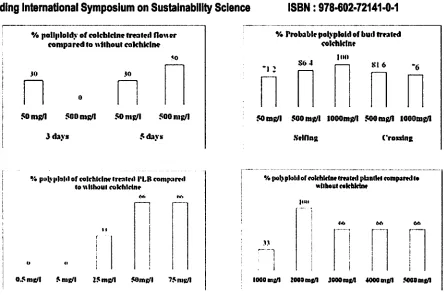
Figure I. %polyploid of colchicine treated flower, bud, PLB, and planlet compared to without colchicine
II.
MATERIALS AND METHODSThe first experiment used flower, bud, and spike with 0, SO, SOO, 1000 and 2000 mg 1"1 treated with colchicine for 3 and S
days arranged in Randomized Complete Block Design. Pod produced genninated in Knudson C media. Setting and crossing with untreated flower performed on flower from bud treated with colchicine. The second experiments were in vitro experiments in half strength of Murashige-Skoog (1/2 MS) liquid media, using: (a) protoconn like bodies (PLB) immersed with 0, 0.5, S, 25, SO, and 75 mg 1"1 colchicine arranged in
Randomized Complete Block Design, (b) plantlets immersed with 0, 1000, 2000, 3000, 4000, and 5000 mg 1'1 colchicine
arranged in Randomized Complete Block Design. Cytological chromosome counting observed at the end of each experiment, except for bud using % probable polyploidy based on shortened and thickened root observed.
% probable polyploid bud treated with colchicine
=
number of probable polyploid plantletl25 x IOQ11AtIII. REsULTS
Both experiments produced polyploid plants. Only flower and bud treated with colchicine produced polyploid plants in
the first experiment Percentage of pod fonned from flower treated with colchicine was 71.42-20.0Q11At (3 days treatment) and 85.71-0% (S days treatment). Number of pod fanned decline with higher colchicine concentration. Flower treated with colchicine 500 mg 1"1
for 3 days, 1000, and 2000 mg 1'1
produced pod with seeds that not germinated (Figure I). Spike treated with colchicine produced new lateral spike with Oowers, but not in the treated ones.
PLBs and plantlets treated with colchicine produced polypoid plants. Percentage of polyploid from colchicine treated Oower, bud, PLB, and planlet compared to without
colchicine can be seen in Figure I. Reduction of life percentage, number of roots, leaf and shoot, shortened and thickened root, and smaller plantlet height were observed in polyploid plants (Table 1).
Table l. Reduction of Mcnpbological Cbanlcteristics
Reduction Ia Pro iiHiiles Treated with Colcbldae
PLB Plaatfet Flower Bud
Ufc percentallc (%) 0-13 7-80 0-57.14 0-28.8
Root number 1.67- 0.82-2.12
-
-2.06
Leaf number 1.67- 0.43-1.6
-
-2.03
Shoot number 0-4.41 0.16-2.47
-
-Rootlenath (em)
-
-
0.93-1.12-Root width Cmml
-
-
-f0.07-0.37)-Not observed
IV. DISCUSSION
Many plant physiologists and morphologists found the inseparable relationship between fonn and function (Kaplan
2001). Morphological changes observed in two experiments in
all parumeters. The thickening and shortening of plantlets caused by colchicine application brought on some questions of plant mechanism to overcome higher temperature and drought
In Catt/eya walkerlana and Oncidlum • Aloha' water availability modulated CAM expression in organ-compartmented manner (Rodrigues et al. 2013). The photosynthetic characteristic of tropical On:hidaceae with leaf thickness < I mm typically perfonn C3 fixation, while those with thicker leaves usually perfonn crassulacean acid metabolism (CAM) (Neals and Hew 1975). Phalaenopsls that has thick leaves with large vacuole in
the parenchyma cells is expected to exlu'bit CAM
[image:12.593.327.556.437.565.2]Proceeding International Symposium on Sustainablllty Science
ISBN : 978-602·72141·0·1
photosynthetic specialization of CAM has evolved many times in response to selective pressures imposed by water limitation (Borland et al. 20 II).
Endopolyploidy caused by colchicine application, produced thickened and shortened plantlets, also probable CAM plantlets that has ability overcome global warming. Further study need to be established to prove that polyploids Phalaenopsis
produced in this research is CAM plants.
V. CONCLUSION
Both experiments produced polyploid plants that produced thickened and shortened plantlets.
ACKNOWLEDGEMENT
This research funded by Leading University Research 2013-2014, Ministry of Education Indonesia.
REFBRENCB
Bannan D, Nevadu R (2013) Climate change on on:hid population and conservation strategies: a review. J. Crop and Weed 9(2):1-12.
Barrow M (2006) Endopolyploidy in seed plants. BioEssays
28:271-281.
Borland AM, Zambrano VAB, Ceusten J, Shorrock K (2011) The photosynthetic plasticity of crassulacean acid metabolism: an cvolutioruuy innovation for SUS1ainable productivity in changing world. BUND B, Emiroglou U (2008) A comparative study on colchicine upplication methods In obtaining doubled haploids of tobacco
(NicotitJIIIl urbacum L.). Turk. J. Bioi. 32:105-111.
Chaves MM, MIIIOCO JJ, Pereira JS (2003) Review: Understanding plant responses to drought - tiom genes to the whole plant. Functional Plant Bioi. 30:239-264.
Chen WH, Kao YL, Tang CY, Jean GT (2011) Endopolyploidy in
on:hids and its upplication in orchid breeding. In: Chen WH and Chen HH (eds) On:hid Biotccbnology D, World Scientific Publ., pp 25-48 Comai L (2005) The advantages of being polyploid. Nature Rev. Oenet. 6:836-846.
Oriesbacb RJ (1985) Polyploidy in Phalaenopsis on:hlds improvement. J. Heredity 76:74-75.
Ouo WJ, Lee N (2006) Effect of leaf and plant age, and day/night temperature on net C02 uptake In Pluz/aenopsis 。ュエセ「ャャオ@ var. Formosa.
J Amer. Soc.
non.
Sci. 131(3):320-326.Hew CS. Young JWH (2004) The physiology of tropical on:hids in relation to the industry. Seconded, World Scientific Publ., Singapore
Jones WB, Kuehnle AR (1998) Ploidy identification using flow cytometry in tissues of Dendroblum species and cultivars. Llndleyana 13:11-18.
Lin S, Lee HC, Chen WH (2001) Nuclear contents of Pluz/aenopsu sp.
。ョ、dッイャエヲウーオャ」ィ・イイャュエセN@ J. Amer. Soc.
Hon.
Sci. 126:195-199.Kaplan DR (2001) The science of plant morphology: definition, history, and role In modem biology. Amcr. J. Bot. 88(10):1711-1741.
Neals TF, Hew CS (1975) Two types of carbon assimilation In tropical on:hids. Planta 123:303-306.
Ota K, Morioka K, Yamamoto Y (1991) Effect of leaf age, Inflorescence, temperature, light intensity and moisture conditions on CAM photosynthesis in Pholaenopsu. J. Jpn. Soc. Hort. Sci. 60:125-132.
Rodrigues MA, Matiz A, Cnlz AB,Matsumura AT, Takahashi CA, Hamacbi I.., Felix LM, Pc:rcira PN, Latansio-Aidar SR, Aidar MPM,
Demarco D, Fn:schi I.., Mercier H, Kabauy OB (2013) Spatial patterns of photosynthesis in thin- and thick-leaved epiphytic on:hids: unraveling C3-CAMplasticity In an organ-compartmented way. Annals ofBot. 112:17-29.
Silvera K, Santiago LS, Wmter K (2005) Distribution of crassulacean acid metabolism In orchids of Panama: evidence of selection for weak and strong modes. Functional Plant Blot. 32(5):397-407.
Tang CY, Chen WH (2007) Breeding and development of new varieties in Phalaenopsu. In: Chen WH and Chen HH (eds) On:bid Biotccbnology 11, World Scientific Publ., Singapore, pp 1-22.
Vaughn I.., Vaughn V (1973) The ascendary of white Plullmmopm.
Amer. Orchid Soc. Bull42:231-237.