Property Rights, Environmental Services and Poverty in Indonesia
A research proposal submitted to the BASIS CRSP by Michigan State University in cooperation with the World Agroforestry Centre (ICRAF), the International Food Policy Research Institute (IFPRI), and the University of Lampung, Indonesia
Principal Investigators John Malcolm Kerr Assistant Professor
Abstract
Project Narrative
1. Introduction
In a recent Science article, Balmford et al. (2002) estimated a global benefit-cost ratio of approximately 100:1 in favor of conserving key ecosystems, species and resources. Market fail-ures are the chief reason why these returns are not realized. While it is clearly recognized that markets for environmental services will remain imperfect, there is strong interest in harnessing market mechanisms to better match the demand for environmental services with the incentives of the land users whose actions modify supplies of environmental services. Potential benefits of such approaches include improved resource conservation, more sustainable sources of conserva-tion finance, greater environmental justice in the distribuconserva-tion of conservaconserva-tion benefits and costs, and new and sustainable sources of income for poor people in developing countries.
The last decade has seen a rapid increase in interest in payment for environmental ser-vices (PES) such as biological diversity conservation, carbon sequestration and watershed pro-tection, particularly in developing countries. A number of experimental programs have been ini-tiated, many with startup finance from private foundations (e.g. Shell Foundation, FACE Foun-dation, Mercedes-Benz, Dow Company Foundation) and support from development agencies in-cluding USAID. The United Nations Framework Convention on Climate Change (UNFCCC) is generating new interest in PES mechanisms that reward countries for reducing net carbon emis-sions.
mechanisms might bypass poor land users or even make them worse off. Challenges related to high transaction costs of dealing with small landholders and the unclear property rights in areas with high conservation value would need to be overcome. Moreover, where land rights are un-clear, there are concerns that PES systems might compel powerful people to usurp otherwise marginal lands and evict poor land users.
A range of PES mechanisms are operating in developing countries, particularly in Latin America, but they are still nascent in Asia. The RUPES (Rewarding Upland Poor for Environ-mental Services) project was established in 2001 to address possibilities for these mechanisms in Asia, with particular emphasis on potential for the upland poor to benefit. RUPES is led by ICRAF’s regional office in Indonesia with major funding from the International Fund for Agri-cultural Development (IFAD). The RUPES project is working with international, national and local partners in building working models of best practices for environmental transfer agree-ments adapted to the Asian context. It conducts action research at sites across Asia to examine the provision of environmental services, who benefits, who pays, and the institutional and policy environment to enable fair and equitable distribution. Special attention is given to the ecological basis of environmental service agreements: payments should be based on real cause-effect rela-tions between land use and environmental services. The RUPES program takes an inclusive view on payment, including rewards that provide upland farmers with enhanced land tenure se-curity in exchange for following land use agreements. To distinguish that broader class of mechanisms, we follow RUPES in referring to Rewards for Environmental Services (RES) rather than the narrower Payment for Environmental Services (PES). (www.worldagroforestrycentre.org/sea/Networks/RUPES).
for value-added research under the BASIS CRSP. This proposal presents a research program to investigate 1) the social-spatial placement of RES mechanisms, 2) the within-village distribution of costs and benefits of RES mechanisms, particularly those related to enhanced property rights, and 3) the most appropriate institutional mechanisms to enhance the benefits of RES mechans for the poor. The research program will be conducted in RUPES sites in Lampung and West Suma-tra, Indonesia, where RES mechanisms are being put in place for watershed protection and car-bon sequestration services. The research program will be a partnership between Michigan State University (MSU), the International Food Policy Research Institute (IFPRI), the World Agrofor-estry Centre (International Center for Research on AgroforAgrofor-estry -- ICRAF), and the University of Lampung.
The central hypothesis of this research is that environmental service reward mechanisms may provide marginalized social groups with new opportunities for generating income, obtaining more secure rights to land and water, and being included in environmental governance processes. There are three ancillary hypotheses. First, due to limited spread of information and incomplete appreciation of the opportunities, there is a tendency for RES mechanisms to be located in com-munities with high levels of interaction with the outside world, with their ability to actually effi-ciently provide the environmental service only as a secondary criterion. Second, there is a ten-dency for the benefits of RES to be captured by well-advantaged households within communi-ties. Third, RES mechanisms can be designed to reduce or overcome these tendencies. The re-search will revolve around these hypotheses.
protecting environmentally sensitive areas. Research findings will be of immediate relevance to the design of the RES mechanisms in the two sites and contribute to analysis and design of RES mechanisms across Indonesia and other parts of Asia through the RUPES network. The sites and focus of the research match USAID’s new country strategy for Indonesia (USAID 2004).
2. Research Issues and Theoretical Concerns
Environmental service reward mechanisms generally entail some shift in attitude toward rural people whose resource uses effect the environment. Traditionally, rural people living in or near protected areas have been viewed as troublesome squatters; evicting them or sharply curtail-ing their land use activities (through “fines and fences” approaches) were seen as the best way to improve land management. Rewards for environmental services represent a fundamental shift in perspective, with rural land users treated as land stewards who should be compensated for pro-viding positive externalities.
Rewards for environmental services builds on the idea of creating goodwill with residents of environmentally sensitive areas and takes the additional step of providing those residents with incentives to protect the landscape. While this represents an improvement over previous ap-proaches to protected area management, RES apap-proaches introduce challenges of their own. One of the key challenges is that performance-based payments require the quantification of environmental services. RUPES is leading ecological assessment efforts that will provide the proposed BASIS research with a solid foundation of cause-effect relationships.
2.1 Endogeneity of Program Placement
sites could be chosen to maximize the provision of environmental services, minimize the destruc-tion of environmental services, or maximize the contribudestruc-tion to poverty reducdestruc-tion. A more skep-tical poliskep-tical economy view, on the other hand, would suggest that enterprising communities or individuals will try to position themselves to capture the potential rewards from RES mecha-nisms. Communities best able to capture those rewards might be those that are able to mobilize the collective action necessary to ensure compliance with land use requirements. In addition, program managers might be drawn to some potential partners on the basis of considerations not strictly consistent with criteria related to expected program performance. In the initial phases of RES programs, lack of information on existing opportunities may lead to choices based on the existence of ‘links’ rather than on the strength of then ES provision per se. It will be important to consider this for the RUPES program, which seeks to draw general lessons from a limited number of action research sites.
The concepts of bridging and bonding social capital (Krishna, 2002) are helpful in ana-lyzing the conditions under which communities can attract RES programs and meet the require-ments of those programs. Bridging social capital – the ability of a group to establish links with other groups – may be needed to attract programs. Bonding social capital – cohesion of a group and the ability to work together – may enable a community to meet program requirements. 2.2 Who Gains and Who Loses?
ways that produce such outcomes.
First, where RES systems are organized as markets, large buyers will be drawn to large suppliers to reduce transaction costs. Collective action may provide a mechanism for farmers to coordinate over a large area to provide environmental services and reduce transaction costs. However, the nature of the environmental services will influence the scale and type of collective action needed, the bargaining power of smallholders, and the investment or reinvestment re-quirements. One of ICRAF’s objectives in the RUPES program is to develop reliable assessment methods that can reduce transaction costs associated with RES mechanisms.
Second, many smallholders may have difficulty participating in an environmental ser-vices market because they must meet subsistence production requirements from small land areas and cannot afford to set aside part of their land in a long term contractual arrangement. This would be a major concern for ES contracts requiring that land be left under natural vegetation. Evidence generated through the Alternatives to Slash and Burn Program (ASB), however, sug-gests that multistrata agroforestry systems can generate acceptable levels of environmental ser-vices and reasonable returns to land and labor (Tomich et al., 2001).
ef-fectively secured with group rights. Indeed, group title may be more effective for environmental services that have minimum scale and threshold effects, such as biodiversity conservation.
Insecure tenure may have the effect of excluding poor and marginalized populations from land with potential for ES provision. Greig-Grann and Bann (2003, p. 37) caution that if com-munities do not have secure rights in an area suited for RES mechanism, then it is possible that other more connected people will take over. Many countries consider the vast majority of their forest land as state-owned even if it is settled (White and Martin 2002), and private landowners often allow peasants access to their lands for forage and fuel (Wunder 2000: 41). It is easy to envision settlers being evicted when RES makes the land more valuable to landlords or other powerful people.
On the other hand, the necessity to have secure property rights may encourage agencies involved in the formulation of RES schemes to facilitate secure property rights. Grieg-Grann and Bann (2003, p. 37) note that “there are already signs that market development has spurred forest land tenure formalization in some disadvantaged communities in Bolivia, Costa Rica, Ec-uador and India.” In the RUPES context, tenure security is used as a reward for environmental services in Sumberjaya, Indonesia, one of the study sites for the proposed research.
A final concern about the distribution of gains and losses from RES concerns possible indirect effects associated with land use changes. Changes in land use and livelihood strategies in response to RES mechanisms will change the allocation of land, labor, and capital, and poten-tially change the scarcity and prices of these factors of production. It is not known how such changes will affect the poor.
3. Research questions
1. What factors determine which communities obtain RES mechanisms? To what extent is pro-gram placement endogenous, favoring better-connected communities? Addressing this question requires asking three sub-questions: a) Which locations make the most sense from the perspec-tive of efficiently supplying environmental services? b) What are the roles of intermediary or-ganizations – which communities do NGOs, ICRAF and others approach for RES mechanisms? What role does bridging social capital play in this, i.e., are communities with more external connections more likely to participate? c) Which communities accept RES mechanisms, and in which communities do they work? What role does bonding social capital play in this? For example, does the community have to have strong internal coherence, and willingness to accept communal land rights, rather than insisting on individual rights?
2. Who gains and who loses from the introduction of RES? What changes in livelihood strate-gies occur as a result of changes in allocation of land, labor, and capital that result from introduc-tion of RES? What particular issues arise when the reward mechanism involves secure land rights as opposed to monetary payments?
4. Setting
The proposed research will be conducted at RUPES’s action research sites at Singakarak Lake, West Sumatra Province, and Sumberjaya, Lampung Province, both on the island of Suma-tra in Indonesia. In Sumberjaya – a site of past conflicts over evictions and increasing poverty – the RUPES project is examining environmental service rewards for watershed functions, with domestic water users and hydropower producers as the demanders of water quality and migrant farmers without land tenure as the providers of watershed services. The RUPES project is under-taking research to better understand and support the provision of (1) land tenure security for farmers to plant trees and protect the remaining forest, (2) monetary rewards for upland people for delivering (drinking) water quality for people living lower in the subcatchment, and (3) community development of riparian vegetation.
Unlike Sumberjaya, the Singkarak Lake site has a strong base of local institutions. ICRAF is working with the local people’s organization and Bogor Agricultural University to ex-amine the links between land use, provision of watershed protection and the potential for carbon sequestration. Currently the hydroelectric plant that uses lake water makes payments to the local government that have an element of reward for maintaining watershed services such as buffering and water quality. RUPES’s work at the site involves developing the information and capacity required to negotiate environmental service transfer agreements, taking into account the needs of both providers (smallholder farmers) and buyers (hydroelectric company, forestry department) of the environmental service.
Land tenure in Singkarak Lake is secure and controlled under traditional customary (na-gari) rule, which was recently revived in this area. As a result, tenure security is not an
appro-priate reward for environmental services in Singkarak. The RES mechanism under consideration is the redirection of current revenue paid by the hydroelectric authority as a tax for surface and subsurface water to the local community and the providers of the environmental service.
5. Study Design
The questions to be addressed in this project require a combination of qualitative and quantitative research methods, integrated with ICRAF’s biophysical modeling work and the ac-tion research approach of the RUPES partners in the two sites. The research proposed to be con-ducted through BASIS will consist of the following activities:
5.1 Activity 1: Qualitative Investigation of Determinants of RES Program Placement (Re-search question 1)
under-standing of the social-political factors that influence program placement.
The investigation of the determinants of program placement will follow a qualitative ap-proach with four parts. Qualitative research will provide in-depth understanding of how program managers decide where to install a program and villagers decide whether to participate. Quantitative investigation is not feasible given the small number of program sites.
Key informant interviews with external/intermediary organizations: To identify which
commu-nities have been offered and not offered RES, we will begin by interviewing those who have been involved in designing such programs to identify the locations that can provide the services that are being demanded, and to identify other eligibility criteria. Potential respondents include the staff of government agencies, NGOs, universities, and ICRAF/RUPES who participated in program development. Particular attention will be given to social or other connections between the intermediary organizations and the participating communities.
Key informant interviews with village leaders: Corresponding information will be collected
from village leaders and agents who have been involved in RES program development. This will focus on the role of particular villagers in either seeking out RES, negotiating the terms of RES mechanisms, and selecting villagers to participate. Characteristics of key individuals will be identified by their wealth, standing in the community, internal and external social networks, and the strategies they use to obtain RES. If any communities have been offered and rejected RES, we will also seek out key informants in these sites to identify reasons for not participating. Focus group interviews in participating communities: To supplement the perspective of village
leaders and agents, we will conduct focus group interviews in each study village to discuss how the project is managed within the community and obtain views on the program, including:
out-side agencies, and any role they have had in implementation of RES mechanisms;
• views on tenure security in the village, the history of previous enforcement of state
prop-erty, evictions and the effects that has had;
• actual and potential impacts community members identify from the program (to be
fol-lowed up in the household surveys).
Analysis of networks and the role of social capital: We will use information from the key
infor-mant interviews, focus groups, and household surveys to identify the networks among village agents and intermediary organizations, and roles those networks have played in the placement of RES programs. In particular we will examine whether communities with more external connec-tions and bridging social capital are more likely to participate. Indicators of social organizaconnec-tions, past experience with collective action, and various forms of social capital from the focus groups will be combined with indicators of bonding social capital from the household surveys (follow-ing Krishna 2002). They will be used to examine the role and importance of bond(follow-ing social capi-tal in the development and implementation of the programs, particularly in securing agreement to participate and in reducing transaction costs in implementation. We will build upon the methods used by Geran (2000) to show how internally and externally oriented linkages play a role in the placement of programs within communities.
5.2 Activity 2. Household survey and analysis of impacts of land rights for social forestry program (HKm) in Sumberjaya watershed (Research question 2)
program, with particular emphasis on assets, human and social capital. The criteria distinguishing program participants from non-participants will be used to stratify the sample se-lected in non-program communities to enhance the statistical power of the quasi-experimental design.
Data collection approach
The sample of villages will include all 5 villages in the Sumberjaya watershed where farmer groups are currently participating in the HKm program and 5 villages where the HKm program is not operating. Non-participating villages will be selected to be as similar as possible to participating villages in terms of agricultural potential, access to markets and infrastructure, population density, and average household wealth. Within each selected program village, a stratified random sample of about 50 households will be selected for the survey: 25 members of a group participating in the HKm program, and 25 of who are not. Based upon initial key infor-mant and group interviews, researchers will identify any eligibility criteria determining participa-tion. If such criteria are not clearly identified, analysis of the survey in program villages will be used to identify exogenous factors that distinguish participants from non-participants, as dis-cussed below.
The criteria or factors will be used to select a stratified sample in the non-program com-munities, with the population of these communities stratified between those eligible (or likely to participate if an exogenous eligibility criterion is not identified) for the program and those ineli-gible (or not likely to participate). The purpose of this stratification will be to produce compara-tor groups that are as similar as possible to program participants and non-participants in the pro-gram communities.
human, financial and social capital prior to inception of the HKM program and at the beginning of the survey year, their livelihood strategies (allocation of land, labor and capital to different activities) during the survey year, and their income during the survey year.
Analysis strategy
The direct impact cod participants of participating in the HKm program may be thought of as the net income earned from social forestry activities associated with the program. How-ever, the program may have many indirect effects, both on program participants and non-participants. For example, participants may be induced to change the way they allocate land, bor and capital (i.e., change their livelihood strategy) as a result of participation. Changes in la-bor allocation or land investments may also affect factor availability and costs of non-participants (e.g., reduced access to forest land, changes in wages, etc.), affecting their behavior and incomes.
We will use an econometric approach to estimate impacts on program participants. The basic model to be estimated is:
vi v vi vi vi vi vi
y =α +βP +γX +χP X +u (1)
The main econometric problem in estimating equation (1) is the endogeneity of program placement and household participation (Pvi), which can cause these variables to be correlated with the error term. This problem is addressed by including village level fixed effects (αv), which control for all fixed differences across villages, including any factors determining program placement (Pitt and Khandker 1998). Maximum likelihood estimation will be used to account for the endogenous determination of Pvi. The equation determining Pvi will be specified as follows:
1 0; 0
vi vi vi vi
P = ifθZ +v ≥ P = otherwise (2)
where Zvi is a vector of household level factors determining household participation, θ is a vector of parameters to be estimated, and vvi represents unobserved random factors affecting these deci-sions. As shown by Pitt and Khandker (1998), identification of the model parameters is possible due to the quasi-experimental design, provided that the sample includes households in the pro-gram villages that are not participating in the propro-gram and households in non-propro-gram villages, and that some exogenous factors determine household participation. The likelihood function will account for possible correlation between uvi and vvi.
5.3 Activity 3: Tradeoffs in the design of environmental service mechanisms (Research question 3a)
Conjoint analysis is a quantitative technique that can be used to determine respondents’ preferences for the multiple attributes of a product or service. The conceptual foundation of con-joint analysis is Lancaster consumer theory (1991), which assumes that utility is derived from the properties or attributes of goods. Data for a conjoint study are generated through a survey in which respondents are asked to rate realistic but hypothetical products that have alternative lev-els of important attributes. Tradeoffs among attributes can be quantified and estimates devel-oped for the marginal value of specified levels of the attributes. The survey data can also be ana-lyzed to test whether there are significant differences in preferences among groups of respon-dents (Tano et al, 2003).
We propose that the utility that an individual will derive from a given reward mechanism will be a function of the attributes of the mechanism, the individual’s characteristics, and interac-tions between attributes of the mechanism and their personal characteristics. The general form of the empirical model is as follows:
R = α + X + Yλ+ e
Where R is a vector of preference ratings (0, 1, 2 …, n), X is a vector of non-stochastic variables capturing the levels of the attributes, Y is a vector of non-stochastic variables capturing the inter-action between the levels of the attributes and the respondent’s personal characteristics, is a vector of marginal utilities for the levels of the attributes, λ is a vector of marginal impacts of the interaction between the attributes and the respondent’s personal characteristics, and e is a distur-bance term. The marginal values and λ are estimated from observations on R, X and Y, using a discrete choice estimator such as ordered probit (Tano et al., 2003).
Data collection approach
mechanisms. Key informant and group interviews will be conducted with potential suppliers of environmental services (ie upland farmers), intermediaries (eg NGOs, Forest Department), and potential demanders of environmental services (eg hydroelectric power company) to determine the types of mechanisms which are most likely to be compatible with the incentives and expecta-tions of different stakeholder groups, the key attributes of those mechanisms, and the characteris-tics of the respondents likely to shape their preferences. Choices will need to be made regarding the relevant levels of each attribute and the characteristics of the respondents that discriminate them into sub-groups.
Profiles of a limited number of feasible RES mechanisms, incorporating different combi-nations of attribute values, will be developed. To best communicate with illiterate persons, the profiles will be displayed using simple verbal descriptions and drawings (following Tano et al., 2003). In Sumberjaya, the survey will be administrated to a sub-sample of 200 of the households involved in the survey described in activity 2 and in Singkarak a stratified random sample of 200 households will be selected. Respondents will be asked to rate about 8 of the RES profiles, using a scale of 1 to 8. An ordered probit model will be estimated, with rating as the dependent vari-able and attributes and the interaction of attributes with respondent characteristics as explanatory variables. Results will illustrate attributes of greatest importance to the samples in each study site and the way that preferences vary across key sub-groups, including people of different wel-fare and livelihood characteristics.
5.4 Activity 4. Ex ante evaluation of willingness to accept monetary compensation for pro-viding additional environmental services (Research question 3b)
in the two sites in order to estimate the monetary amounts that potential providers of these ser-vices would require in order to participate in a program that restricted their land uses. These amounts can be compared with the funds that would actually be available through different pay-ment mechanisms. The WTA study will also evaluate how willingness to accept is influenced by household characteristics, such as wealth and forms of land tenure. Care will be taken in the study design to ensure that the results of the conjoint analysis and WTA are complementary and not biased. The surveys may be conducted with the same households or different households.
Data collection approach
It is well recognized that contingent valuation techniques require a good deal of back-ground information and pre-testing if data collection is to avoid potential biases of understanding / cognition, framing, starting point and strategic positioning (DeShazo, 2002). To avoid that bias, it will be important to make WTA questions as simple and clear as possible. Most research suggests that the dichotomous-choice approach is most readily understood by respondents (Mitchell & Carson, 1989; in a developing country context, Altaf and Hughes 1994), and we will follow this approach. Furthermore, many people are already familiar with the concept of pay-ment for environpay-mental services, having been either directly involved with programs such as the HKm, paying for maintenance of domestic water supplies, etc. And, we expect that respondents will easily understand the required changes in land use practices and/or investments needed to participate in the program. For all of these reasons, biases associated with understand-ing/cognition should be mitigated.
the benefit that, even if it appears that a second-round question suffers some type of bias, an analysis can still be more easily undertaken on the first-round response data only, as the two starting bid values are chosen to represent best “guesstimates” of higher and lower bounds. On the other hand, if we use the first approach, the two starting bid values will both be toward the lower end.
Analysis strategy
The WTA is a measure of equivalent variation. From the standard respondent’s optimization problem, we can then state the following:
Pr(Yes) = Pr{ν[Y+P, E1
; p,ZHH]+ε 1 ≥ ν[Y, E0; p,ZHH]+ε0 or Pr(Yes) = Pr{ ε1- ε0 ≥ ν[ Y, E0; p,ZHH]- ν[Y+P, E1; p,ZHH] }.
where ν[] is the indirect utility function, Y is income, E1
is the proposed value of environmental
services provided, E0 is the current level of environmental services provided, p is a vector of market prices, and ZHH is a vector of household characteristics. The probability can be expressed:
Pr(Yes) = Fη(∆ν)
where Fη(.) is the cumulative distribution function of η, η ≡ ε1 - ε0, and ∆ν ≡ ν[Y+P, E1; p,ZHH )]-ν[ Y, E0
; p,ZHH] (Freeman III, 1993; Hanemann, 1984). We can thus analyze the first-question
responses using standard probit or logit models. To analyze the initial and follow-up question responses, we will use the model developed by Cameron and Quiggin (1994). Whether or not a respondent answers a second question depends on his/her response to the first question; thus the second-stage response is endogenous and a bi-variate probit (or logit) model can be employed. 6. Significance and Relevance to USAID Mission Objectives
USAID/Indonesia is supporting local governments and communities to create partnerships for the co-management of natural areas. It is felt that this participation in land use planning decision-making will result in resolving land tenure and access issues that now result in conflict. USAID/Indonesia is also supporting activities in forestry to broaden access to forestry benefits for forest dwelling communities. This will be partially accomplished through the reforestation of degraded forestlands through replanting and agroforestry.
7. References
Altaf, M.A., and J.A. Hughes. 1994. Measuring the demand for improved urban sanitation ser-vices: results of a contingent valuation study in Ouagadougou, Burkina Faso. Urban Studies, 31(4): 1763-1776.
Balmford, A., A. Bruner, P. Cooper, R. Costanza, S. Farber, R.E. Green, M. Jenkins, P. Jefferiss, V. Jessamy, J. Madden, K. Munro, N. Myers, S. Naeem, J. Paavola, M. Rayment, S. Rosendo, J. Roughgarden, K. Trumper, and R. K. Turner (2002). “Economic Reasons for Conserving Wild Nature”. Science 297(9): 950-953.
Bennet, Chris. 2001 PP 25, Indonesia’s Forests and the Forestry Ministry: Maintaining Overly-Centralised Authority, Increasing the Risk of Regional Civil Disobedience, World Bank Working Paper, World Bank Jakarta
Cameron, T. A. and Quiggin, J. (1994), 'Estimation using contingent valuation data from a "Di-chotomous choice with follow-up" questionnaire', Journal of Environmental Economics and Management 27(3), 218-34.
Cooper, J.C., W. M. Hanemann and G. Signorello. 2001. One-and-One-Half Bound Dichoto-mous Choice Contingent Valuation. Working Paper No. 921. Department of Agricultural and Resource Economics, University of California, Berkeley.
DeShazo, J.R. (2002), Designing transactions without framing effects in iterative question for-mats. Journal of Environmental Economics and Management 24: 360-385.
Fay, Chip and G. Michon. 2004. Redressing Forestry Hegemony. Agroforestry Systems (in press).
Ferraro, P.J. 2001. Global Habitat Protection: limitations of development interventions and a role for conservation performance payments. Conservation Biology 15(4): 1-12.
Freeman III, A. Myrick. 1993. The Measurement of Environmental and Resource Values: Theory and Methods Washington, D.C.: Resources for the Future.
Geran, J. (2000). Coping with crisis: social capital and the resilience of rural livelihoods in Northern Thailand. Unpublished PhD. Dissertation. Development Studies Department, Uni-versity of Wisconsin-Madison.
Hanemann, M. 1984. Welfare evaluations in contingent valuation experiments with discrete choices. American Journal of Agricultural Economics 67(3): 332-341.
Hanemann, WM and B. Kanninen, 1998. The Statistical Analysis of Discrete-Response Data. Krishna, A. (2002). Active Social Capital: Tracing the Roots of Development and Democracy.
Lancaster, K.J. (1991). Modern Consumer Theory. Edward Elgar, England.
Miranda, Miriam, Ina Porres and Mary Luz Moreno. 2003. The social impacts of payments for environmental services in Costa Rica. Environmental Economics Programme, International Institute for Environment and Development, London.
Mitchell, R.C. and R.T. Carson (1989). Using surveys to value public goods: the contingent valuation method. RFF Press: Washington.
Pitt, M. and S.R. Khandker. 1998. The impact of group-based credit programs on poor house-holds in Bangladesh: does the gender of participants matter? Journal of Political Economy 106(5), 958-996.
Subak, Susan. (2000). Forest Protection and Reforestation in Costa Rica: Evaluation of a Clean Development Mechanism Prototype. Environmental Management, 26(3), 283-297.
S. Suyanto, B. Leimona, R.P. Permana, FJC Chandler. 2004. Review of the Development of En-vironmental Services Markets in Indonesia, ICRAF, Bogor (unpublished draft).
S. Suyanto, Rizki Pandu Permana, Noviana Khususiyah and Laxman Joshi. 2004. Land tenure, agroforestry adoption, and reduction of fire hazard in a forest zone: A case study from Lam-pung, Sumatra, Indonesia. Agroforestry Systems. Forthcoming.
Tano, K., M. Kamuanga, M.D. Faminow and B. Swallow (2003). Using conjoint analysis to es-timate farmers’ preferences for cattle traits in West Africa. Ecological Economics 45: 393-407.
Tomich, T. et al in Barrett and Lee. Tomich, Thomas P, M van Noordwijk, S Budidarsono, A Gillison, T Kusumanto, D Murdiyarso, F Stolle and A M Fagi, 2001. Agricultural Intensifi-cation, Deforestation and the Environment: Assessing Tradeoffs in Sumatra, Indonesia. In Lee, D.R. and C.B. Barrett (eds). Tradeoffs or Synergies? Agricultural Intensification, Economic Development and the Environment. CABI Publishing.
USAID/Indonesia. 2004. Strengthening a Moderate, Stable and Productive Indonesia. DRAFT for comment.
White, Andy and Alejandra Martin. (2002). Who Owns the Worlds Forests? Forest Tenure and Public Forests in Transition. Washington D.C.: Forest Trends.
World Bank, 2001. Indonesia: Environment and Natural Resource Management in a Time of Transition. The World Bank. Washington DC. USA.
Outputs
The project will produce several outputs:• A report on the factors determining PES program placement and effectiveness, including the role of bridging and bonding social capital, based upon the qualitative analysis under Activity 1.
• A report on the household level impacts of the HKm approach to rewarding environ-mental services, based on the survey analysis under Activity 2.
• A one-week training course for Indonesian scientists in theory and application of conjoint analysis held at Lampung University.
• At least two masters theses by Indonesian graduate students and a synthesis report on tradeoffs associated with the design of RES mechanisms under Activity 3.
• A report on households’ willingness to accept alternative rewards for providing environ-mental services in the study sites, based on the analysis described under Activity 3.1. • Several study teams trained in methods of qualitative and quantitative data collection and
analysis related to social capital and provision of environmental services.
• Dissemination of research findings through local stakeholder workshops, publications, materials on internet sites, and presentations at international fora.
Timeline
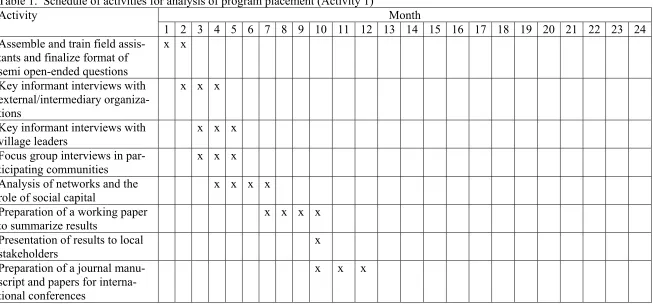
Activity 1Key informant interviews will be conducted throughout the course of the research, with initial interviews conducted to ensure good understanding of the program and its implementation. Separate field teams of two to four people will be convened in the two study sites, with input from key national collaborators and supervision from Suyanto. The teams will be trained in the field methods during the first month of the project. Interviews with the village representative groups will be conducted during months two, three and four of the first year and the outputs will be used to guide the development of the household survey instrument and sampling procedure used in Activity 2. The supervisor of the field team will then continue to conduct the focus group interviews and the historical analysis. The principal investigators will be involved in many of the key informant interviews.
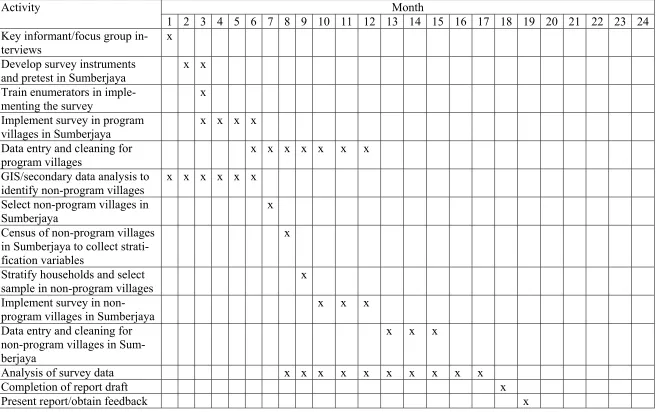
Activity 2
analysis, to enable identification of the stratification variables to be used in the non-program vil-lages (if necessary, in case a simple eligibility criterion is not identified) will require about two months. Concurrently with this process, analysis of GIS and other secondary data will enable identification of a population of non-program villages that are similar to the program villages, which will be used for selection of the sample of non-program villages. A short census will then be implemented in the non-program villages to collect information on the variables to be used in stratifying the sample (between likely participants and non-participants); this is expected to re-quire about one month. Implementation of the survey in the non-program communities will then require about two to three months. By the time the survey is completed in the non-program communities, final data checking and cleaning should be completed for the program communi-ties, and an additional two to three months may be needed to complete cleaning of the data from the non-program communities. The draft report is expected to be completed by the 18th month of the project, and will be presented to stakeholders in Indonesia and at IFPRI. Based on feedback received, the report will be revised and submitted for publication, and publications subsequently disseminated.
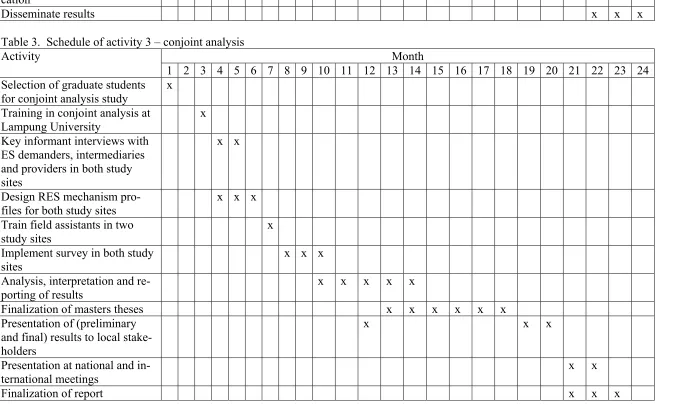
Activity 3
This activity will be conducted through engagement with graduate students at Lampung Univer-sity and possibly another Indonesian univerUniver-sity. Modular training in conjoint anlaysis will be provided as a short course at Lampung University and two Indonesian graduate students selected to implement the field studies and analysis in Sumberjaya and Singkarak. Data collection for the conjoint analysis studies will be integrated with the contingent valuation study described in ac-tivity 4. In Sumberjaya, this will require a followup survey in the same study villages as those involved in activity 2, possibly with the same households. In Singkarak, a new household survey with both the conjoint analysis and contingent valuation components will be implemented in a random sample of households that are actual / potential participants in the RES mechanisms that are under development. As with the contingent valuation survey, enumerator training will be very important.
Activity 4
TIMELINE TABLES
Table 1. Schedule of activities for analysis of program placement (Activity 1)
Month Activity
1 2 3 4 5 6 7 8 9 10 11 12 13 14 15 16 17 18 19 20 21 22 23 24 Assemble and train field
assis-tants and finalize format of semi open-ended questions
x x
Key informant interviews with external/intermediary organiza-tions
x x x
Key informant interviews with village leaders
x x x
Focus group interviews in par-ticipating communities
x x x
Analysis of networks and the role of social capital
x x x x Preparation of a working paper
to summarize results
x x x x Presentation of results to local
stakeholders
x Preparation of a journal
manu-script and papers for interna-tional conferences
Revise report/submit for publi-cation
x x
Disseminate results x x x
Table 3. Schedule of activity 3 – conjoint analysis
Key Qualifications of Researchers
Bustanul Arifin is an associate professor in the Department of Agricultural Economics and Social Sciences at the University of Lampung, Indonesia. He obtained his master and Ph.D. degrees in resource economics from the University of Wisconsin-Madison, USA, where he later served as a visiting professor. Dr. Arifin has published several books and articles on ag-ricultural and resource economics, political economy and economic development. In addi-tion, he is a policy analyst and has written more than a hundred popular articles in the na-tional media. Dr. Arifin is the Editor-in-Chief of the Quarterly Review of the Indonesian Economy or in Bahasa Indonesia Bisnis & Ekonomi Politik (BEP), a scientific journal de-voted to the study of political economy and business issues and economic decision-making process in Indonesia. He has also served as Director of the Institute for Development of Economics and Finance (INDEF), an independent research institution aimed at providing as-sessments on a wide-range of policy issues related to economics and finance. He was an eco-nomic adviser to the House of Representative (DPR-RI) in Indonesia for the commissions of agriculture, industry, and trade; and a senior policy analyst for the United Nations Develop-ment Programs (UNDP) and National DevelopDevelop-ment Council (BAPPENAS). He has served as a consultant to JBIC, The World Bank, ILO, USAID, GTZ, WWF and numerous other local organizations in Indonesia. He is currently conducting research on the institutional mecha-nisms of that are being tested in the RUPES (Rewarding Upland Poor for Environmental Services) action research sites in Indonesia implemented by ICRAF.
Fiona Chandler has over 12 years experience of research program and project administra-tion built on fifteen years of business experience in the private and public sector. She ob-tained her Masters Degree in Environmental Management and Development from the Austra-lian National University and a Bachelor of Applied Science from the University of New Eng-land. Ms Chandler is currently working with the World Agroforestry Centre (ICRAF) in Southeast Asia as the Program Manager for the RUPES project (Rewarding Upland Poor for the Environmental Services They Provide). She joined the RUPES program team in January 2003 after a two-year term as the Executive Officer for an independent advisory Board to the Minister for Natural Resources and Environment in Victoria, Australia advising on strategic planning of coastal and catchment issues in southwest Victoria. Prior to her work in Austra-lia, Ms Chandler was the Executive Officer for ICRAF based at the headquarters in Nairobi, Kenya. She provided executive support to the Director General in both his management and scientific responsibilities as well as providing support to the senior management in investor relations and to the Board of Trustees. Ms Chandler previously worked with the British Co-lumbia Ministry of Forests Research Branch (Canada) as a Program Administrator and Act-ing Program Leader in Forest Genetics and before that with the CSIRO Division of Forestry (Australia) on an ACIAR-funded project looking at the sustainability of Eucalypts in South-east Asia. During this time, she contributed to the work of a world-wide project on prove-nance trials for Casuarina equisitifolia.
live-lihood from and sustainably manage areas of the state-defined forest zone. Mr Fay undertook British and Soviet studies at Richmond College in London and Trinity College in Wales. He also studied international politics at the University of New Hampshire (USA). From 1992 to 1995 he was a Ford Foundation program officer responsible for developing, managing and evaluating the foundation's activities on community management of forestlands in Indonesia. Between 1987 and 1992, he worked with the Environmental Policy Institute as Director of their Southeast Asia office. He has also worked with Survival International, where he devel-oped and implemented programs for Southeast Asian countries.
John Kerr is an assistant professor in the newly established Department of Community, Ag-riculture, Recreation and Resource Studies at Michigan State University (MSU). For the past 15 years he has conducted research the roles of community development, collective action, property rights, economic incentives and policies in natural resource management, particu-larly related to developing country agriculture and watershed management. Much of his work has focused on economic and institutional aspects of watershed management in India. He also teaches classes on collective action and property rights and international develop-ment. Kerr received his PhD and MA from the Food Research Institute at Stanford Univer-sity and his BA in Economics from Swarthmore College. He worked as a Principal Econo-mist for five years at ICRISAT in Hyderabad, India, conducting research on soil and water conservation economics and coordinating a program to promote teaching and research in natural resource economics at Indian state agricultural universities. He worked as a Research Fellow and Visiting Research Fellow at IFPRI for four years, conducting an evaluation of watershed management in India and a review of the impact of agricultural research on pov-erty alleviation, among other projects. He has been at MSU for the last five years.
Nancy McCarthy, a US Citizen, joined IFPRI in 1996, after receiving her Ph.D. in agricul-tural and resource economics from the University of California, Berkeley. She has worked extensively on management of common pool resources, having done extensive fieldwork in Mexico, Ethiopia, Niger and Burkina Faso. Her main area of interest is in understanding fac-tors that affect the ability of community members, or groups within communities, to act col-lectively to manage and invest in common resources and to provide local public goods – with a specific emphasis on understanding collective action and resource management in highly risky environments, e.g. semi-arid rangelands.
ex-tensively in journals and book volumes, and is co-editor of Negotiating Water Rights and In-novation in Natural Resource Management: The Role of Property Rights and Collective Ac-tion in Developing Countries.
John Pender leads IFPRI's research program on policies for sustainable development of less-favored lands. His research at IFPRI focuses on the impacts of policies, institutions and technologies on livelihood strategies, land management, agricultural production, poverty and natural resource sustainability in less-favored areas having low agricultural potential or low access to markets and infrastructure. The research also seeks to understand the trade-offs or synergies among these outcomes resulting from different policy and program interventions. Most of his research has focused on the highlands of East Africa, the hillsides of Central America, and semi-arid parts of India. Pender joined IFPRI in 1995 after working as an assis-tant professor of economics at Brigham Young University. He received a Bachelor's degree from the California Institute of Technology, a Master's in public policy from the University of California, Berkeley, and a Ph.D. in agricultural economics from Stanford University. He is the author of numerous publications, including "Strategies For Sustainable Development in the Ethiopian Highlands", and the coeditor of the IFPRI 2020 Focus Brief series "Promoting Sustainable Development in Less-Favored Areas." He is a U.S. citizen.
majoring in development economics and resource economics. Prior to joining ICRAF in 1998, Brent Swallow spent seven years as a research scientist at the International Livestock Research Institute (ILRI). While with ILRI, he led research on the economic impacts of ani-mal disease control and rangeland property rights.