THE INFLUENCE OF REFORM ADMINISTRATION TAX AND EMOTIONAL
INTELLIGENCE TOWARD AWARENESS OF INDIVIDUAL TAXPAYERS
(AT SUB- SUB DISTRIC WEST PAMULANG)
THESIS
Submitted to Faculty of Economics and Business as Partial Requirement for Acquiring the
Bachelor Degree of Economics
By:
Wike Vidya Paramita
107082103606
DEPARTEMENT OF ACCOUNTING
INTERNATIONAL CLASS PROGRAM
FACULTY OF ECONOMICS AND BUSINESS
SYARIF HIDAYATULLAH STATE ISLAMIC UNIVERSITY
JAKARTA
CERTIFICATION OF TIIESIS EXAM SHEET
Today is Monday, June 20, zo11 has been conducted on student
thesis examination :
1.
Name2. Student Number
3.
Department4.
Thesis TitleDistrict West pamulang)
After careful observation and attention to appearance and
process,
it
was decidedthat the
above student passedrequirements
to
obtaina
Bachelorof
Economicsin
the Hidayatullah State lslam ic Unive rs ity Ja ka rta.Jakarta, June 20, 20L1
Prof. Dr. Abdul Hamid, MS
tD.19570617 198503 1 002
Rahmawati Dahyar, SE, MM
rD. 197708142A0604 2 003
Prof. Dr. Azzam Jasin, MBA
Prof. Dr. Ahmad Rodoni rD. 1 9690203 2001 12 1 003
Wike Vidya Paramita 107082103606 Accounting
The lnfluence of Reform Administration Tax and Emotional
lntelligence toward Awareness
of
lndividual Taxpayer (at sub- subcapabilities relevant for thesis examination and
the
thesis was accepted as one of Facultyof
Economics and Business SyarifSecretarv /
lJ
.M,
Examiner ExpertChoirulAnwar, MBA, MAFiS, CpA
SHEET STATEMENT
AUTH ENTICITY SCIENTI FIC WORKS
Signatures below: Name
Students Number
Faculty Department
Wike Vidya Paramita 107082103606
Economics and Businesss Accounting
Hereby declare that in the writing of this thesis, l;
1.
Not use other people's ideas without being able to develop and accountable2.
Do not do plagiarism of other people,s work manuscrlpt3.
Do not use other people's work without mentioning the original source or without theowner'$ permission
4,
Do not manipulate and falsify the data5.
Own work and able to work responsible for this worklf in the future there is a demand from the other side of my work, and have been accountably proved, was indeed found evidence that I have violated the above statement, then i am ready to be sanctioned according to rules applicable in the Faculty of Economics and Business Syarif Hidayatullah State lslamic University Jakarta.
CURRICULUM VITAE
PERSONAL DATA
Name : Wike Vidya Paramit a
Gender : Female
Place/ Dat e of Birt h : Tangerang/ Nov, 25,1989
Nat ionalit y : Indonesian
M arit al St at us : Single
Religion : M oeslem
Address : Komp. Pamulang Permai 1 Blok B 11 no.9 West Pamulang- Sout h
Tangerang
i
ABSTRACT
This research to find out significant the reform administration tax and
emotional intelligence influenced awareness of individual taxpayers also to
reveal the level of awareness of taxpayers in the Sub- Sub district West
Pamulang. This research use Regression Multiple Linier. Sampling technique
is taken by the proportional random sampling area. Based on the result
regresion multiple linier that Reform Administration Tax has a positif and
significant on Awareness. Emotional Intelligence has a negative and
significant influence on Awareness. Significant Awareness various is 65, 0%
can be explained by all of independent. However the others 35, 0% are
explained by the other factors that are not calculated in this research.
ii
PREFACE
Bismillaahirrahmaanirrahiim
Assalamualaikum Wr.Wb
Praise be to God Almighty who always gives His grace and guidance and
blessings infinite, so I can finish this paper with the title "The Influence of Reform
Administration Tax and Emotional Intelligence toward the Awareness of Individual
TaxPayers (At Sub-Sub-District West Pamulang)" as one a prerequisite for
completing educational programs Strata Bachelor Level One (S-1) merger
Accounting Program at the Faculty of Economics and Business Syarif Hidayatullah
State Islamic University Jakarta. With the weaknesses that exist, the author will not
be fully realized apart from the mistakes and shortcomings. Therefore, the authors
deliver to apologize as much as possible when writing there are many shortcomings.
To complete this thesis, the author gets of many highly valuable assistance in
the form of moral and material from various parties with a single-minded. On this
occasion, with all humility there is no better word to convey the author, except Praise
and thanks are very sincere to:
1. Beloved family, mother, father and my sisters (Anne Destiany, SE, Wenny
Listyawati, SE) dear beloved who have provided moral and material assistance,
so I can finish this thesis.
2. Mr. Prof. Dr. Abdul Hamid, MS as the Dean of the Faculty of Economics,Syarif
Hidayatullah State Islamic University Jakarta.
3. Mr. Prof. Dr. Ahmad Rodoni as Vice Dean I of the Faculty of Economics,Syarif
Hidayatullah State Islamic University Jakarta and as Supervisor I who has
provided much direction and guidance and motivation to the author so I can finish
iii
4. Mr. Indo Yama Nasarudin, MAB as Vice Dean II of the Faculty of
Economics,Syarif Hidayatullah State Islamic University Jakarta.
5. Mrs. Rahmawati, SE, MM as Chairman of the Accounting Studies Program
Faculty of Economics Syarif Hidayatullah State Islamic University Jakarta.
6. Mr. Arief Mufraini, Lc,M.Si as Chairman Head of International Program Faculty
of Economics Syariff Hidayatullah State Islamic University Jakarta.
7. Mr. Choirul Anwar MBA, MAFiS, CPA as Supervisor II who has provided much
direction, guidance and motivate to the author. However I can finish this paper as
appropriate.
8. Mr. and Mrs. lecturer UIN International, which has provided guidance to the
author, and all staff employees of the Faculty of Economics Syariff Hidayatullah
State Islamic University Jakarta, which has provided assistance to the author.
9. Kak Sugih Waluyo, friends batch 4 and the International Accounting, Management
International UIN and colleagues that can not be mentioned one by one, which has
a lot of help in completing this thesis.
Finally, the author realizes that this thesis is far from perfect because the
author just ordinary people who did not escape from all sin. Therefore, suggestions
and constructive criticism is the author expected. Hopefully this paper can increase
knowledge for the benefit of all parties who read it.
Wassalamualaikum Wr.Wb.
Jakarta, May 2011
iv
BRIEF TABLE
NO
Explanation
Page
2.1 The differences in domestic taxpayers and foreign taxpayers…... ..23
2.2 SPT 1770...34
2.3 SPT 1770 S ... 34
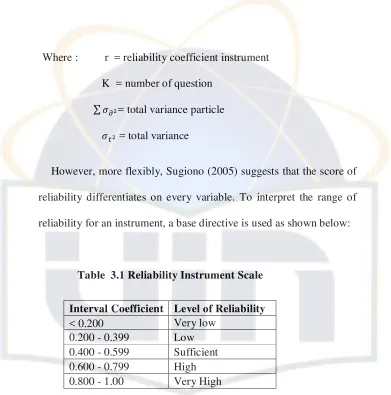
3.1
Reliability Instrument Scale …...49
3.2
Research Operational Variable………...58
4.1
Respondents Characteristics……….. ...61
4.2
Validity Test: Reform Administration Tax ………...63
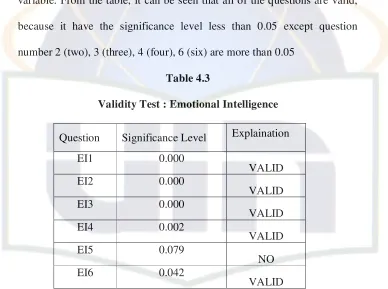
4.3
Validity Test: Emotional Intelligence ...………...64
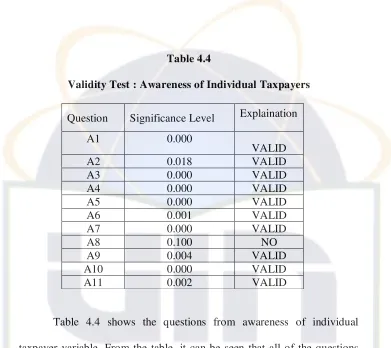
4.4
Validity Test: Awareness …...65
4.5
Validity Statistics... 65
4.6 Reliability Statistic………...66
4.7
Autocorrelation Statistics ...69
4.8 Multicollinearity Statistics...71
4.9 Coefficient Determination ...72
4.10 F test ...73
v
BRIEF FIGURE
NO
Explanation
Page
2.1
Research Design ………...39
3.1
Theoretical Framework...59
4.1
Normality Test Result………...67
4.2
Histogram………...68
vi
BRIEF ATTACHMENT
ATTACHMENT
A
QUITIONAIRES
ATTACHMENT
B
DATA RESULT
ATTACHMENT
C
VALIDITY AND REABILITY TEST
ATTACHMENT
D
CLASSIC ASSUMPTION
vii
BRIEF CONTENTS
SUPERVISOR SHEET
ENDORSEMENT SHEET (COMPREHENSIVES EXAMS)
CERTIFICATION OF THESIS EXAM SHEET
SHEET STATEMENT (AUTHENTICITY SCIENTIFIC WORKS)
CURICULUM VITAE
ABSTRACT ………...i
PREFACE ………..ii
BRIEF TABLE ………..iv
BRIEF FIGURE ……….v
BRIEF ATTACHMENT ...………vi
BRIEF CONTENT ………...vii
CHAPTER I INTRODUCTION
A.
Background...1
B.
Research problem ………..7
C.
Research objectives ………...7
CHAPTER II THEORITICAL FRAMEWORK
A.
Literature Review...9
1. Definition of Tax ………...9
2. Tax Administration Reform... 13
3. Emotional Intelligence...16
4. Taxpayers Awareness...18
5. Income Tax...20
B. Previous research...36
C. Effect of the Reform Administration Tax toward
Awareness of Individual Taxpayer ...38
viii
E.
Hypothesis ………..40
CHAPTER III RESEARCH METHODOLOGY
A
.
Research Scope...41
B. Sampling Method...41
C. Data Collection Techniques ………....42
D. Analysis Method ...46
E. Operation Variables...58
F.
Theoretical Framework ...59
CHAPTER IV ANALYSIS
A.
General Description of Research Object ...60
B.
Analysis and Discussion ………...62
1.
Validity Test ...62
2.
Reliability Test...66
3.
Classic assumption ...67
4.
Hypothesis Test ………...72
C.
Interpretation ...75
CHAPTER V CONCLUSION
A.
Conclusion ………...79
B.
Implication ………...80
C.
Recommendation ………81
1 CHAPTER I
INTRODUCTION
A. Background
In an effort to finance the construction of the government is
absorbing the tax sector, though no less important income from various
sectors of other income. In the atmosphere of the country still covered by
remnants of the economic slump, the government carried the burden
which is currently very heavy. To finance the government's national
development can not only rely on external debt with interest rates that are
not minor or from natural resources are increasingly depleted oil and gas.
Hope the one that can be counted on to finance national development is
taxation revenue.
The Government has reformed tax. Actually it aims to support the
tax sector for better future. There are two significant leaps in tax reform.
First is the open of the large taxpayer’s office, followed by testing for
medium and small taxpayers with a modern tax system. At these large
taxpayers office, established an account representative which aims to
know all behavior, business scope, and all things related to view the
rights and obligations of taxpayers who monitored (knowing your
Taxpayer) and services to the taxpayer can be done completely on a
single table. Leap second is a proposal to change or amendment of tax
2 Act (Income Tax), and the Law on Value Added Tax (VAT). The point is
to change the tariff, subject, and subject to tax in order to competitive.
Anggito Abimanyu (2009)
With reform is launched in taxation that is marked with law (UU)
Number 16 year 2009 about number 5 year 2008 change four on law (UU)
number 6 year 1983 about general roles and tax roles; UU. Number 36
year 2008, about change three on law (UU) No.7 year 1983 about income
tax. Although perfect a reform tax policy, so that the result did not satisfy
if was not followed by reform administration tax. Nasucha (2004: 8).
Sophar Lumbantoruan (2005: 19) in Suryana (2010: 6) Administrative tax
is manner or procedure collection tax.
Indonesia's tax reform aimed at improving the efficiency of tax
collection in order to support the national revenue; improve services, legal
certainty and justice for the society to enhance competitiveness in the field
of investment to continue to support the development of small and
medium enterprises; adjust the demands of socio-economic development
of society and development in the field of information technology;
improve the balance between rights and obligations; simplify tax
administration procedures; improve the application of the principle of
self-assessment in an accountable and consistent and supportive business
climate towards a more conducive and competitive. Siti Resmi (2009: 20)
Chaizi Nasucha (2004) the government of Indonesia has done
3 procedures, namely change organization to tax inspection office be tax
service office. That change occurred because there was reform tax in
1983, namely change in system to official assessment be self assessment.
The change caused a major access for the taxpayer. One of them is
the decrease taxpayer compliance and awareness of his duty because
basically bad service. Besides that there is no transparan and simple
about procedure. Awareness to be abiding taxpayers is one of adherence
to the law. Compliance with tax payments, including rules against tax
law where the law mentioned indiscriminate taxation and a not exception
either escapes from anywhere or anyone all the same under the
provisions of the applicable tax law to avoid administrative sanctions that
would harm its own taxpayers.
In 2010, the number of registered taxpayers reached 15,911,576
people both personally and corporately, but only 14,101,933 are required
to submit tax return that the SPT is 8,202,309 taxpayers or by 58.16
percent compliance rate. It's still up significantly compared to the year
2008 which is only 33.08 percent and 54.15 percent in 2009. A total of
5,899,624 taxpayers reported individuals and entities do not meet their
obligations to obey a notification letter announcing the annual Income
Tax in 2010. Erlangga Djumena, kompas.com (May 20: 2011)
When compared with the percentage of taxes last year mandatory
compliance has decreased which in 2010 amounted to 61.91% while for
4 taxpayers who report an increase, which for 2010 individual taxpayer
who reports by 320,488 while the year 2011 amounting to 443,159
individual taxpayer. humaspajak.co.cc (May 20: 2011)
Indonesia tax revenue from Income Tax (Income Tax) of the
Personal in 2008 only amount 22.89%. While revenue from corporate
income tax to the realization of non-oil tax revenue reached 77.11%. In
2009 Indonesia tax revenue from Income Tax (Income Tax) of the
Personal is 61.28%. While revenue from corporate income tax to the
realization of non-oil tax revenue reached 38.72%. State revenue from
income taxes (Income Tax) private persons (OP) to the new 1-2010
semesters reached Rp 1.94 trillion or 45.22% of the target in APBNP
2010 amounted to Rp 4.29 trillion. Realization of revenue from corporate
income tax until the semester 1-2010 reached Rp 72.62 trillion or 57.34%
of target. Corporate income tax revenue in 2011 reached 70% of the total
tax revenue while only 30% of an individual. (Investor Daily Indonesia)
Still quite a lot of people are not aware of the obligations. They do
not realize to meet income tax obligations, even though income taxes
have been prepared in accordance with the law. This means a collective
agreement that must be obeyed.
Reduced awareness on taxpayers can be caused due to poor control
of their emotion. In a good emotion, the taxpayers can control his
emotions in the act for paying as aware and the taxpayer does not feel
5 intteligence. Goleman (2005) emotional intelligence is the ability to
motivate yourself and the ability to manage emotions well in ourselves
and in relationship to others. Meanwhile, according to Yunita (2005) in
Sukma Adiatma (2010) Emotional intelligence or Emotional Quotation
(EQ) includes the ability to express feelings, awareness and
understanding of the emotions and the ability to regulate and control it.
Mayer and Salovey (1995: 197) in
Elizabeth et al (2010)
defineEI as the capacity to process emotional information accurately and
efficiently, including that information relevant to the recognition,
construction, and regulation of emotion in oneself and others. According
to Morehouse (2007) in James Thomas Kunnanatt
(2008)
EI can alsoraise the level of individual and team performance. Perhaps due to an
enhanced ability to recognize and manage emotions and brace against
distracting emotions, EI skills connect both to individual cognitive-based
performance and team task performance skills.
So taxpayer’s emotional intelligence must be implemented well in
order to raise awareness of the taxpayer. Because the more control EI, the
better relationship between officer tax payer and taxpayers.
Consciousness to become taxpayers and meet all obligations that
need to be fostered in every heart that lived socializes taxpayers. Thus,
the wheels of government will run smoothly for the benefit of the
taxpayer's own and smooth the wheels of government will also launch
6 just and prosperous country within the scope of value - the value of
Pancasila and the 1945 Constitution. Each of the people and residents
should be aware that the obligation to individual income tax is not to
another party, but to streamline the way the wheels of government which
deals with all the interests of the people themselves. So a conscious is
needed a sacrifice and it is for its own interests from generation to
generation.
Therefore, the role of consciousness and forces the taxpayer is
required to participate in paying individual income tax, thereby
increasing state revenues. Therefore, with the change in taxation (reform
administration tax) and emotional intelligence are expected to taxpayers
awareness of self can arise from the taxpayer. So that taxpayers are aware
of obligations in terms of paying taxes, especially individual income tax.
So the writer was intrigued when a study was written under the title
"THE INFLUENCE OF REFORM ADMINISTRATION TAX AND
EMOTIONAL INTELLIGENCE TOWARD AWARENESS OF
INDIVIDUAL TAXPAYER (AT SUB- SUB DISTRICT WEST
7 B. Research problem
Based on the description above, the authors formulate the
problem as follows:
1. Do reform administration tax and emotional intelligence or partial
effect to awareness of individual taxpayers?
2. How is significant of awareness of individual taxpayers at the sub
sub-district west Pamulang?
C. Research objectives and Usefulness of research
1. Objective:
a. To find out significant the reform administration tax and emotional
intelligence influenced awareness of individual taxpayers.
b. To reveal the level of awareness of taxpayers in the Sub- Sub
district West Pamulang.
2. Usefulness of research
The uses of this research are:
a. As a regulation to achieve undergraduate in international
program, accounting, faculty economic and business, state Islamic
University Syarif Hidayatullah Jakarta.
b. As an application and applying knowledge that already get from
accounting merger and give the writer understanding about tax.
c. Theoretically, this research can have a function in knowledge
development especially in taxation subject. Beside that can be use
8 d. Taxpayers can obtain knowledge about efforts to increase taxes,
especially individual income tax.
e. As the input material which can be considered by the agency in
9 CHAPTER II
THEORITICAL FRAMEWORK
A. Literature Review
1. Definition of taxes
According to Rochmat Soemitro in Siti Resmi (2009: 1):
“Tax is cash contributions to the people of the State based on the law (Can be forced) to not get behind the timbale services (contra) Which is shown by direct cans and it is Used to paying the common expenses”.
According to N.J.Feldman in Siti Resmi (2009: 2):
“Taxes are imposed unilaterally by the achievements and outstanding to authorize (based on the stipulation of norms in general) without the there is a contraprestasi and is solely Used to cover general expenses”.
Under Article 1 of Law No.28 of 2007 is as follows:
“Tax is a compulsory contribution to the State which are payable by the individual or entity that is enforceable under the law by not getting benefits directly and used for the purposes of the State for maximum benefit and prosperity of the people”.
For Standard Chartered Bank can be taken fourth definitions that
conclusion:
a. Tax levied based on the power of the law and the role of exercise.
b. On paying the tax can not be showed there is an individual contra by
government.
c. Taxes levied by the State for both central and local government.
d. Taxes destined for government expenditure, which if there is still a
10 Tax has budgetary function meaning that tax is one source of
government revenue to finance both routine and development
expenditures. Taxes have regulatory functions, meaning that tax as a
means to regulate or doing government policy in the field of social and
economic as well as achieving certain objectives outside the financial
sector. Siti Resmi (2009: 3)
There are third kinds of taxes. It is classified Based on Class, its
collector Characteristics and Institutions. Based on class, tax is classified
Became two, namely Direct taxes have to be paid or borne solely by
taxpayers and cannot charge or delegated to others or other parties, tax
burden taxpayers should be concerned (Income Tax). Indirect tax, the tax
would ultimately be charged or transferred to another person or a third
party. Indirect tax occurs if there is an activity, event, or act which causes
the tax becomes due. Siti Resmi (2009: 7)
Based on Characteristics, tax classification became can be two,
there are Subjective tax; the tax imposition is notice of personal
circumstances or the taxation of taxpayers who watched a state subject
(Income Tax). Objective tax, the tax imposition is noticed either in the
form of objects, things, actions, or events that result in liability to pay tax,
regardless of personal circumstances subject to tax (tax payers) or place of
residence. Siti Resmi (2009: 8)
Based on Institutional collectors, tax is classified became two,
11 used to finance the State households in general. Local tax, the tax levied
by local governments both local provincial (provincial tax) and local level
II (tax district and city) and used to finance local households each.
Includes provincial taxes and motor vehicle tax on water; vehicle
registrations of motor vehicles and vehicles on water, motor vehicle fuel
tax, and tax collection and utilization of underground water and surface sea
water. Tax district include hotel tax, restaurant tax, entertainment tax,
advertisement tax, street lighting tax, tax collection minerals group C, and
parking tax. Siti Resmi (2009: 9)
Siti Resmi (2009: 9) states that Procedures for tax collection consists
of stelsel tax, the principle of tax collection, and tax collection system.
Stelsel tax; tax collections can be done in three stelsel, namely Stelsel real
(Real); stelsel hereby declare that the imposition of taxes based on the
object that actually happened (hence the object is to tax income).
Therefore, the new tax collection can be done at the end of the fiscal year,
i.e. after all the real income in a tax year is known. Stelsel assumed
(fictitious). Stelsel hereby declare that the imposition of taxes based on the
assumption regulated by law. With this stelsel means the amount of tax
payable in the current year can already determined or known at the
beginning of the year. Stelsel mix; stelsel stated that taxation is based on a
combination of real and stelsel assumption.
There are three principles of tax collections, namely Domicile
12 to tax all income tax payers who are resident in its territory (domestic or
foreign). Principle source, this principle states that the country of right to
tax income sourced in territory without notice residential taxpayers. The
principle of nationality is stating that the imposition of taxes associated
with the nationality of a State. Siti Resmi (2009: 10)
Tax collection system has three systems namely Official
Assessment System is tax collection system that gives the tax apparatus
authority to determine their tax returns each year in accordance with
legislation applicable taxation. Self Assessment system is system of tax
collection which empowers taxpayers in determining their own amount
payable each year in accordance with laws, and regulations that apply, and
therefore taxpayers entrusted to: calculate your own tax returns, calculate
their own tax returns pay, reporting, and account for their tax returns. With
a holding system is tax collection system that gives authority to a third
party designated to determine the amount of tax payable by taxpayers in
accordance with taxation legislation requirements. Siti Resmi (2009: 11)
According to Adam Smith in his book The Wealth of Nations that
in order to attempt the collection of tax fairness objective. That is, the
underlying principle of the collection is general and equitable. The
principle of taxation is known as The Four Maxims or Smith's Cannon,
namely:
a.Equality, equality in tax burden, according to the ability of the
13 b.Certainty, run a firm, clear and definite.
c.Convenience, not pressing the taxpayer, pays taxes willingly.
d.Economy, tax collection costs are not greater than the total tax
revenue.
2. Tax Administration Reform
Tax Reform includes two areas namely the first is regulation Reform
consist of tax amendment and the second is administrative tax. Strategies step
is done by Service Office. Sugihartini Rahayu (2008). According to Sri
Mulyani Indrawati, finance minister "was designed tax reform
comprehensively categorized in four ways:
a. Improve legislation, ranging from income tax laws (Income Tax), Law of
value added tax (VAT). Improvement Act with the spirit and
responsiveness between the rights and obligations between taxpayers and
officials.
b. Improvement of organizational structure, standard operates procedures so
that there is certainty to the process of service and good governance,
increased efficiency and productivity.
c. Fix the data base and information technology systems to support tax
potential. This is to prevent the interaction between officials and taxpayers
are not required.
d. Sector reform and improvement of quality, competence and integrity of tax
14 reform process is a tough task that must be followed Tjiptardjo", Heri
Susanto, Nur Farida Ahniar VIVAnews (July29:2009)
From the above definition can be concluded that under existing tax
reform in Indonesia aims to Revising the regulations on taxation,
Preventing the things that will damage the corporate-tax value of existing,
As well as to make it easier for taxpayers to pay taxes, Tax return
reporting the tax offices so as to create service processes and governance
that is much better than before.
According to Hendi Haryadi (2009: 2) Administration covers all
activities, from setting up the maintenance of a group of people who have
a differentiation of work to achieve a common goal as well as more widely
used for matters relating to state.
According to encyclopedia taxation which is written by Sophar
Lumbantoruan (2005: 19) in Suryana (2010: 6)
“Administrative tax is manner or procedure collection tax”.
Although perfect a reform tax policy, so that the result did not satisfy if was not followed by reform administration tax. Nasucha (2004: 8)
Bird and Jantscher (1992: 1) in Chaizi Nasucha (2004: 8) suggested that
“Policy change without administrative change is nothing and that it is critical to ensure that change in tax policy are compatible with administrative capacity. In a very real sense tax and administration is tax policy”.
Based on developed countries experience, there are three main
context that is needed to tax administration reform be success, namely
15 Reform strategy which is proper to special condition each country must be
developed; and There is a political commitment which is strong toward
increase tax administrative. According to Chaizi Nasucha (2004)
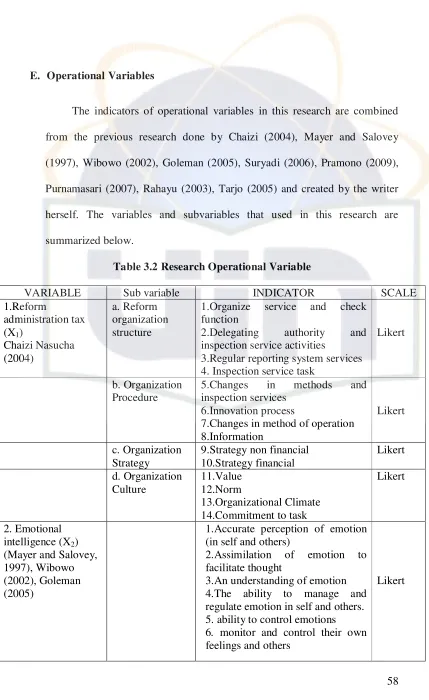
dimensions of reform administration tax, namely:
a. Organization structure
Organization Structure is formal plan to create divide work
which is efficiency and effective coordinate of activities organization
member. Organization structure content about how work task will be
divided, classified, and coordinated as formal. Robbins (2001: 217).
Quoting Adiwisatra (1998) is explained by Nasucha (2004: 69) that
organization structure is element that related to role had fixed and
relationship among role and activity allocation to separate sub-units,
authority’s distribution in between administrative position and
formal network communicate.
b. Organization Procedure
Every society organization facilities in process socialization
as formal in other hand in form education and training activity.
Organization Procedure related to communicate process, decision
making, reward choosing, socialization and carrier. Schein
(1997:210-232) in Nasucha (2004: 9) stressed that organization
socialization is process to teach something, process about something
which is indoctrinated, and process which is learned about what is
16 c. Organization Strategy
Organization Strategy is viewed as strategy, behavior
viewing and act that aimed take benefit every conditions, factors,
opportunities and sources that exists so that organization goal can be
achieved as successful and safety. Koontz (1984: 18) in Chaizi
(2004: 9) mentioned that strategy related to wise. Strategy is general
program of acting and commitment on stressed and sources to
achieve goal. Robbins (1990: 138) in Nasucha (2004: 9), states that
dimension of strategy which show implication toward organization
structure is innovation, differentiation, breadth, cost control.
d. Organization Culture
Culture contains as trust, value and behavior together which
is received by several people. Schemerhorn (2001: 101). Quoted by
Edgar Schein, Schemerhorn (2001: 273) stressed that organization
culture is mentioned as a system trust spread and values which is
develop and about behaviors organization member.
3. Emotional Intelligence
According to Wibowo (2002) in Arsinawati (2010)
“Emotional intelligence is emotional intelligence for use in accordance with the desire, ability to control emotions so as to provide a positive impact”.
Salovey and Mayer in Goleman (2005) define
17 Mustofa and Agus (2007) define that
“Emotional intelligence include abilities are different, but complementary to academic intelligence, the purely cognitive abilities measured by intelligence”.
Goleman (2005) defines that
“Emotional intelligence is the ability to motivate yourself and the ability to manage emotions well in ourselves and in relationship to others.”
Emotional intelligence is the ability to listen and communicate
orally, adaptation, creativity, mental resilience to failures, self-confidence,
motivation, teamwork and desire to contribute to the company. Goleman (1999: 14) in Ary Ginanjar Agustian (2001: 56) and use self-awareness.
Covey (1990: 109) in Ary Ginanjar Agustian (2001: 57)
Mayer and Salovey (1995: 197) in Elizabeth J. Rozell and Wesley
A. Scroggins (2010) defineEI as
“The capacity to process emotional information accurately and efficiently, including that information relevant to the recognition, construction, and regulation of emotion in oneself and others”
The ability models focus on traditional forms of Intelligence
combined with emotion and is the composite of four separate dimensions.
Mayer and Salovey (1997) in Elizabeth J. Rozell et al (2010: 3):
(1) Accurate perception of emotion (in self and others);
(2) Assimilation of emotion to facilitate thought;
(3) An understanding of emotion; and
18 From definition above can be conclude that emotional intelligence
related to our ability to control and manage our emotion in order to keep
emotion stable and well, to motivate ouselves in order to get positive
impact. However it can be increased awareness of taxpayers.
4. Taxpayers Awareness
According to Tarjo, et al (2005)
"Awareness of taxation is an attitude toward the meaning and function of the tax, a component of a constellation of cognitive, affective, and co native that interact in understanding, feeling and behaving to the meaning and function of tax”.
Widjaja (1984: 14) in Fanie (2009: 24)
“Awareness is defined as an attitude or behavior to know or understand, obey and comply to the rules of existing legislation, is also an attitude or behaviour know and understand, obey and comply with the customs and traditions and habits of living in society”.
Siti Resmi (2009: 21)
“Taxpayers are individuals or entities include taxpayers, tax collectors and tax cutters who have rights and tax obligations in accordance with the provisions of tax legislation”.
According to Tarjo and Sawarjuwono (2005: 21) in order to increase
awareness of taxpayers within related to taxation that government
through connect to Mayor Directorate Tax always increase intensities
socialization tax which focused in awareness taxpayers to tax.
Individual taxpayer’s awareness will grow either if they had known
or understood besides that there have to punish which is tiding. If only
know and understand, but there is no punishing so that there is no scared.
19 perception by taxpayer can open knowledge them that it is implemented
as fairness to all of taxpayers. However it can grow awareness taxpayers
to report theirs tax as punctual.
Someone will be aware if understand. Its mean that theirs have
to know first related to tax. After knowing it then understanding so that
appear to be aware even though either can obey or fulfill their tax duty.
Rahayu (2003: 19). According to Mangkoesoebroto (1999: 52) in
Purnamasari (2007: 20) taxpayer’s awareness always is related to
compliance through hold tax’s right and obligation as role especially for
The higher society knowledge’s, the easier taxpayer understands
especially related to relationship between cost and benefit of every
government activities, The Knowledge levels, Fair of tax system and
administrative system are either easy or simply.
According to Reza Mardian (2009), awareness of taxpayers so
often associated with compliance and compliance in implementing the
rights and obligations taxation accordance with existing regulations,
especially in terms of the following are Knowledge society, the higher
the public's knowledge of tax neighbors then the easier the government to
explain to the public (taxpayer) related to regulatory and tax benefits
from the public and government. Education level, this is necessary in
understanding the tax and the tax filing in odd moments seems
20 question is a fair tax system for all parties and system is administration
simple and easy.
Pramono (2003: 16) in Reza Mardian (2009) stressed that indicator
of the consciousness of taxpayers are Knowledge of Taxation,
Knowledge about tax regulations, Patterns of behavior toward the
taxpayer tax payments. Suryadi (2006) mentions that indicators of
awareness have four type, namely Taxpayers Perception, Knowledge of
Taxation, Taxpayers Characteristic, and Socializations Taxation.
Based on expert opinions, we can conclude that consciousness is
an activity or behavior of someone who is influenced by education,
knowledge, habit patterns of behavior and socializations. Awareness is a
conscious act of doing certain activities. Growing awareness on the
individual taxpayer is required to be carried taxation. Taxpayers must
have an awareness of paying taxes so the tax system in Indonesia can be
run well and the source of government revenue can be increased in
developing countries.
5. Income Taxes
The word "Income Tax" has two meanings together with the other.
The First is understanding of the meaning of "tax" itself and second is
sense of the meaning of "income". Understanding tax is free to do as a
state obligation in the form of devotion and the active role citizens and
21 implementation of national development which is set in legislation and
regulations for the purpose of welfare of the nation and the State.
In other words, understanding the tax can be considered as fringe
benefits provided by society to the government for the facilities that we
can enjoy being able to live well in a State. Despite of income is the
amount of money received for work done by individuals, agencies and
other business forms that can be used for economic activities such as
eating and or hoarding and increasing wealth.
According to article 4 paragraphs 1 of the Income Tax Act No. 36
of 2008,
“which meant the income which is any additional economic capability received or accrued by a taxpayer, whether originating from Indonesia and outside Indonesia, which can be used for consumption or to increase the wealth of taxpayers concerned, with the name and in any form”.
So understanding the income tax is a levy directed to the public
official whose income or on income received and earned in the fiscal year
for the interests of the State and society in the life of nation and state as an
obligation that must be implemented. It should be emphasized here, is the
object of income tax, in accordance with article 4 above, is income that is
economical and additional capabilities that can be used for consumption or
to increase the wealth of the taxpayer. In other words if the income
received is not an economical or not additional ability to increase property
22 The legal basis for income tax in Indonesia is a plus Act
regulations that support under it include the following are Government
Regulation (PP), Regulation of the President (Presidential), Regulation of
the Minister Finance (PMK), DGT Regulation (Per.DJP). Laws governing
the income taxes in Indonesia at this time began with the law No. 7 of
1983. Later the law was amended several times, changed into law No.7 of
1991, then changed again into law No.10 of 1994 and last amended to Act
No.17 of 2000. The last Act, i.e. Act No. 36 of 2008 becomes effective
from 1 January 2009. Paryan (2009: 2). Here there are the income tax
explanations, we first need to learn about the subject of taxes and income
tax object.
The principle relating to the subject of Tax is the principle of
domicile which is a principle of taxation based on domicile or residence
subject to tax. The principle of source, namely the principle of taxation
based on source of income derived subject to tax. The principle of
nationality is the principle of taxation based on citizenship subject to tax.
The tax liability of an individual or agency or heritage begins and
ends at when an individual who resides in Indonesia, an individual
residing in Indonesia for more than 183 (one hundred and eighty-three)
days within any 12 (twelve) months, or an individual who in a tax year are
in Indonesia and has the intention to reside in Indonesia. Board was
23 longer domiciled in Indonesia. The emergence of inheritance and ending at
the time of the inheritance is distributed.
At the start and end of subjective tax liabilities in the income tax is
very important because income tax is a subjective kind of tax that the tax
liability attached to the subject of taxes is concerned, meaning that tax
liabilities are not intended to be delegated to other tax subjects. Because
state taxes are attached to the subject in question, it is important to know
for sure about when to start and when to end one's subjective tax liability.
The tax liability of an individual as written above begins when the
individual is born, it means simply to say that individuals can obtain tax
ID when she was born with a birth certificate showing proof of or letter of
his birth, especially in this modern age is not income monopoly only
adults only, but anyone regardless of age can earn revenue from various
types of work and activities. For example: a toddler, even a baby can earn
not less than the ads that is role.
In accordance with the principles above, the subject of individual
tax and or general body may be subject to tax in domestic or foreign tax
subject. Here are the differences in domestic taxpayers and foreign
[image:37.612.148.526.62.438.2]taxpayers, among others are:
Table 2.1
The differences in domestic taxpayers and foreign taxpayers
Taxpayer Taxpayers overseas
Subject to income tax on both Received outside Indonesia Just or obtained from Indonesia.
Imposed tax on income from income derived from sources in Indonesia.
24
Subject to tax based on net income.
The tax rate used is the general tariff (rate of Income Tax Law Article 17).
Obligation to submit tax returns SPT.
Tax rate used is the rate worth (tariff Income Tax Law Article 26).
Not required to submit tax returns SPT.
Based on the explanation above regarding the subject of domestic
taxes and foreign tax subject, that it is clear that, for payers in the country,
subject to income tax whether received or obtained from Indonesia and
outside Indonesia, in accordance with the principle of nationality, while
WP's foreign taxable only on income derived from sources of income in
Indonesia, according to the principle source. For an individual who is the
subject of taxes in the country and abroad is an individual who resides in
Indonesia counted since its presence in Indonesia for 183 (one hundred
and eighty-three) days within a period of 12 (twelve) months may be taxed
as a subject of domestic taxes in accordance with the principle of domicile.
For more details, this included in the Personal category as the
subject of taxes is as follows:
a. Employees in general, namely an individual who did the work under an
employment agreement or agreements either written or unwritten,
including those that do the work in the office of the country or state
owned enterprises and state owned areas;
b. Permanent employees, i.e. an individual who works at the employers
who receive salary or earn a certain amount on a regular basis,
25 supervisory board who regularly participate directly manage the
company's activities;
c. Employees separated, i.e. an individual who works at the employers
who only receive benefits if the individual in question worked;
d. Employees with WP status abroad that is an individual who does not
reside in Indonesia or are in Indonesia for not more than 183 days
within a period of 12 months who receive or earn a salary, honorarium
and other benefits related to employment, services, and activities;
e. Pension recipients, the individuals or their heirs who receive or obtain
compensation for work performed in the past, including private
persons or their heirs who receive Old Age Savings or Retirement
Allowances;
f. Honorarium Recipient, the individuals who receive or obtain
compensation in connection with, positions or activities that do;
g. The recipient of wages, i.e. individuals who receive daily wages, weekly
wages, piece rate, or wage unit;
From what has been described above, it can be concluded that the
subject of taxes is the all-income persons or entities in Indonesia, both as
an Indonesian citizen who earn income abroad either individually or in the
form of the body.
While that does not include tax subjects that first is the
representatives of foreign countries. Second is The official representatives
26 and those who assisted to those who work in and live with them, provided
that; No citizen of Indonesia and in Indonesia does not receive or obtain
other income outside his office in Indonesia and The States concerned to
provide reciprocal treatment. Third is International organizations referred
to in the decision of the Minister of Finance Number 574/KMK.04/2000
dated 26 December 2000 as last amended by Decree of the Minister of
Finance Number 243/KMK.03/2003 dated 4 June 2003, provided that
Indonesia is a member organization and not conducting business or other
activities to earn income from Indonesia other than lending to the
government whose funds come from contributions of members.
Last is The official representatives of international organizations as
referred to in the Decree of the Minister of Finance Number
574/KMK.04/2000 dated 26 December 2000 as last amended by Decree of
the Minister of Finance Number 243/KMK.03/2003 dated 4 June 2003,
provided that No citizen Indonesia, Not conducting business or doing any
activity or other work to earn income in Indonesia.
According to Article 4 paragraph (1) states that the object the income
tax is earn. Income is any additional economic capability received or
accrued by taxpayers, whether they come from Indonesia and outside
Indonesia, which can be used for consumption or increase the wealth of
Taxpayer, with the name and in any form.
What is included in the definition of income is:
27 Received or accrued, including salaries, wages, honoraria,
commissions, bonuses, gratuities, pensions, or compensation in other
forms, unless otherwise provided in this Act;
b. Gifts from the lottery or work or activities, and awards;
c. Operating income;
d. Gains from the sale or transfer of property including;
1) Gain due to transfer of property to the company, partnership and
other agencies in lieu of shares or equity participation.
2) Gains derived by the company, partnerships and other entities for
the Transfer of property to shareholders, partners, or members.
3) Gain in liquidation, merger, consolidation, expansion, split, or Take
over attempt.
4) Gain in the transfer of property in the form of grants, aid or
donation, except given to blood relatives in a straight line one
degree, and religious bodies or agencies of education or social
agencies or small businesses, including cooperatives established by
the Minister of Finance, as long as there is no correlation with
business, occupation, possession, or control between the parties
concerned.
e. Refunds of tax payments that have been charged as an expense;
f. Interest, including premiums, discounts and other benefits for loan
28 g. Dividends, by whatever name and form, including dividends from
insurance companies to policyholders, and the distribution of
cooperative effort;
h. Royalty;
i. Rental and other income in connection with the use of property;
j. Acceptance or obtaining periodic payments;
k. Benefits Due to debt relief, except to a certain amount determined by
government regulation;
l. Foreign exchange gains from foreign currency;
m. Difference from revaluation of assets;
n. Insurance premiums;
o. Contributions received or obtained from part association consisting of
the taxpayer are engaged in business or professional services;
p. Wealth net additional income derived from that has not been taxed.
Income can be grouped into four namely Income from
employment in employment and independent work, such as salary,
honorarium, income from the profession of experts. Income comes from a
business or an activity. Income from capital or the use of property, such as
rent, interest, dividends, royalties, gains from the sale of unused property,
and so forth. Other income, i.e. income that can not be classified into one
of three income groups above, such as Gains due to debt relief; Foreign
exchange gains due to foreign currency; Difference from revaluation of
29 For taxpayers is the country which became taxable income is
good income coming from Indonesia and outside Indonesia. Whereas for
foreign taxpayers, who becomes a taxable income only income comes
from Indonesia alone.
While that does not include a taxable income in accordance with
the provisions of Article 4 paragraph (3) of the Income Tax Act are:
a. Aid donations, including alms received by the agency alms charity or
institution established or approved by the government and is entitled to
alms recipients;
b. The property gift received by family incest in a straight line one degree,
and by religious bodies or agencies or educational charities or small
businesses, including cooperatives established by the Minister of
Finance, as long as there are no relationships with business,
employment, ownership, or mastery between the parties concerned;
c. Heritage;
d. Assets including cash deposits received by the agency as an exchange
for shares or capital;
e. Replacement or compensation in connection with work or services
received or acquired in kind and or enjoyment of the taxpayer or the
government;
f. Payment of an insurance company to an individual in connection with
health insurance, accident insurance, life insurance, endowment
30 g. Dividends or share of profits received or accrued by a limited liability
company as a Taxpayer, cooperatives, state enterprises, or enterprises,
from investments in other business entity established and domiciled in
Indonesia with the following requirements are Dividends from retained
earnings reserve. For limited companies, SOEs and enterprises that
receive the lowest dividend of 25% (twenty five percent) of the paid up
capital and must have an active business outside the ownership of
these shares;
h. Contributions received or accrued pension fund which establishment
was approved by the Minister of Finance, be paid by the employer or
employee;
i. Income from capital invested by pension funds as referred to in number
7, in specific areas determined by the Minister of Finance;
j. Equity in net income received or accrued by a member of a limited
partnership whose capital is not divided into shares, partnership,
association, firm, and the joint venture;
k. Interest received or accrued by a member of a limited partnership
whose capital is not divided into shares, partnership, association, firm,
and joint venture;
l. Interest received or accrued bond mutual fund companies during the
first 5 years since the founding of the company or business
31 m. Income received or accrued by venture capital firms for a share of
income from agency business partner, founded and run a business or
activity in Indonesia, provided that such business partner agencies: a
small, medium, or which carries on business in the business sectors
determined by the decision of the Minister of Finance and its shares are
not traded on stock exchanges in Indonesia.
The obligation to submit and report annual tax return (SPT) is a
means for taxpayers to report on matters relating to tax obligations. SPT
must be filled in correctly, completely, and clearly in the Indonesian
language using Latin letters and Arabic numbers, the currency of rupiah and
sign and submit it to the Tax Office (KPP) and any other place determined
by the Directorate General of Taxation.
Function returns for taxpayers income tax is as a means to report and
account for calculating the amount of tax actually owed and to report on:
a. Payment or repayment of tax which has been implemented alone and or
through the withholding or collection of other parties within one (1) tax
year or the tax year;
b. Income subject to income tax and or subject to tax;
c. Property and liability;
d. Payment of the cutter or collector of tax cuts or individuals or other
entities within one (1) the tax period in accordance with the provisions of
32 Individual taxpayers each year must report income received or
obtained during one year. Income reported is any additional economic
capability in the form of taxpayer’s money and the form of goods (in
accordance with article 4 paragraph 1 of Act KUP). If there is a net income
that has not been reported in previous years, it can be reported by organizing
includes in the SPT have been reported. Required to submit annual tax
returns are:
a. Individual taxpayers who receive or earn income from business activities
and or independent;
b. Individual taxpayers who receive or obtain income from capital and
others;
c. Employees who receive or earn income other than in connection with
work, service or activity and or who earn income in relation to
employment, services or activities of more than one employer;
d. Authorization for an undivided inheritance;
e. State officials, civil servants, members of the Armed Forces and
employees of state-owned companies;
f. Indonesian citizen who works in a foreign country representatives and
representatives of international organizations;
g. Foreigners residing in Indonesia for more than 183 days within a period
of 12 months or person in a tax year are in Indonesia and have the
33 h. Each husband and wife is taxed separately in terms of income; Husband
and wife have lived apart. Required in writing by the husband and wife
under the separation agreement and property income (in this case
husband and wife must have tax ID).
Income Tax Act of 2008 requires public and private employees
whose income above PTKP must have a Taxpayer Identification Number
(TIN). As a consequence because they have a TIN to report income in the
Personal Income Tax Return a year. Excluded from the obligation to submit
annual tax returns:
a. Individual taxpayers who are exempt from the obligation to submit the
income tax returns and annual tax section 25 income taxes. (PMK
183/KMK.03/2007); "individual taxpayer in a tax year to receive or
obtain net income does not exceed non taxable income referred to in
Article 7 third law changes the income tax 1984";
b. Individual taxpayers who are exempt from the obligation to submit
income tax returns the article 25 but must submit annual income tax
returns. (PMK 183/KMK.03/2007): "an individual taxpayer who does
not carry on business or not doing the job free.
In accordance with PER-81/PJ/2007 and PER-8/PJ./2008
(PER-161/PJ./2007 changes) can be explained that for the Personal Income Tax
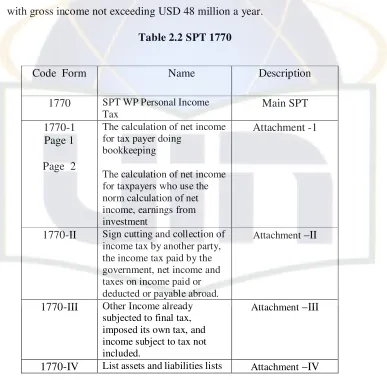
Annual tax return since tax year 2007 and subsequent years there were two
types of namely SPT 1770 is intended for individual taxpayers who carry on
34 taxpayers who do not conduct business activities and independent. SPT 1770
SS is intended for individual taxpayers who have income from one employer
[image:48.612.151.538.154.534.2]with gross income not exceeding USD 48 million a year.
Table 2.2 SPT 1770
Code Form Name Description
1770 SPTWPPersonalIncome Tax
Main SPT
1770-1 Page 1
Page 2
The calculation of net income for tax payer doing
bookkeeping
The calculation of net income for taxpayers who use the norm calculation of net income, earnings from investment
Attachment -1
1770-II Sign cutting and collection of income tax by another party, the income tax paid by the government, net income and taxes on income paid or deducted or payable abroad.
Attachment –II
1770-III Other Income already subjected to final tax, imposed its own tax, and income subject to tax not included.
Attachment –III
1770-IV Listassetsandliabilitieslists Attachment –IV
Table 2.3 SPT 1770 S
Name Description
PersonalIncome TaxAnnualReturn SPT Main SPT
Income related to employment, net income in another country, a list of deductions or tax collection by other parties and the Income Tax borne by the government
Attachment I
35 On SPT 1770 SS consist only of parent annual corporate tax returns
for individuals. While the attachment of Personal Income Tax Annual tax
return is as follows:
a. Balance sheet and income statement (if using bookkeeping);
b. List the calculation of depreciation and or amortization of fiscal;
c. The calculation of compensation for losses in the event of any remaining
losses in previous years can still be compensated;
d. Summary of monthly gross turnover (if using norm calculation of net
income);
e. SSP income tax article 29 of the under payment of tax, unless there is
permission to move or postpone;
f. Special power of attorney if tax return not signed by the taxpayer, or in
the case of a death certificate signed by the heirs;
g. Copy of Form 1721-A1 from the employer (if private sector employees,
including SOEs and enterprises);
h. Copy of Form 1721-A2 from the employer (if civil servants, police, or
State Officials);
i. Calculation of income tax by each party for married taxpayers with
property separation agreement;
j. List of family structure that became taxpayer burden;
k. Proof of payment of alms on income paid by the taxpayer to the Agency
36 The deadline for payment for the types of Personal annual tax
return is the 25th of the third month after the end of the year or the year of
tax and reporting deadlines are no later than 3 months after the end of the tax
or the tax year. Tax payments made by several methods, namely pay tax due,
through withholding and collection by other parties, through tax payments
abroad, and payment of other taxes. Implementation of tax payments to be
School of payment using Tax Payment (SSP) that can be taken by at the Tax
Service Office (KPP) or the nearest KP4, or by other means through tax
payments electronically (e-payment).
Mail tax payments (SSP) is a letter by the taxpayer is used to make a
payment or deposit of tax payable to the state treasury through the Office of
Payment Receipt. Payments Office is a post office or bank and State Owned
or Bank Owned Enterprises Regional or other place of payment designated
by the finance minister as the recipient of payment or tax deposit.
B. Previous research
Results from previous research conducted a few researchers are as follows:
Chaizi Nasucha (2004) entitled the tax administrative reform toward
compliance taxpayers. The Reform tax administration variable with sub
variable: reform organization structure (X1), reform organization procedure
(X2), reform organization strategy (X3), reform organization culture (X4).
There is positive effect of tax administrative reform toward compliance
37 (X3), and reform organization culture (X4) do not affect to compliance but
reform organization procedure (X2) does. For all variabels as simultaneous
affect to compliance. The method used regression Linier analysis and
correlation analysis. All count coefficients is done by SPSS and Likert Scale.
Myleen M. Leary, Michael D. Reilly and F. William Brown (2008) with
title are a study of personality preferences and emotional intelligence. Results
support the relationship between extroversion and the components of EI. A
positive and significant relationship between a preference for the use of
feeling in decision making and an individual’s EI is also found. MBTI, Form
G, and EQI data are collected in a population of over 500 managers and
professional workers in an international manufacturing facility. Both
categorical and continuous analysis of variance is utilized to test ten
hypothesized relationships between personality preferences and EI constructs.
Fenie Oktaliana (2009) entitled headman leadership influence on the
increase of public awareness in paying property tax. Independent variable in
this research is the leadership (X) and dependent variable is the awareness of
society in paying property tax (Y). The method used is a quantitative analysis
method, while for the data analysis technique used is the technique of
correlation between variables to prove the effect of leadership on the public
consciousness in paying property tax. Based on the explanation of the
research showing that there is a very significant impact if the leadership of the
headman upgraded automatically pay more to increase public awareness in
38 Suryadi (2006) The Kausal relationship model among awareness, service,
compliance and its effect toward Tax Receipt Performance at East Java Area.
The result is awareness has positive effect toward Tax Receipt Performance.
With indicator of awareness are Taxpayers Perception, Knowledge of
Taxation, Taxpayers Characteristic, and Socializations Taxation. With used
area random sampling, cluster random sampling, and structural equation
modeling (SEM).
C. Effect of the Reform Administration Tax and Emotional Intelligence
toward Awareness of Individual Taxpayer
The existence of tax administration reform to help taxpayers and
tax authorities in the payment cycle, can simplify the payment. According to
Soebagyo (2005) in Reza Mardian (2009) consciousness to fulfill tax
obligations can arise when people have knowledge of the tax that is why
you should pay taxes, knowing the nature of the tax, knowing the
punishment if they do not pay taxes and therefore knowledge needed to
create communities that are aware of the tax.
A good Emotional intelligence taxpayers can arise their awareness.
According to Goleman (2005) emotional intelligence is the ability to
motivate yourself and the ability to manage emotions well in ourselves and
in relationship to others. Thus, it can be concluded if taxpayers can manage
their emotion as well so it can arise a good relationship, its mean awareness
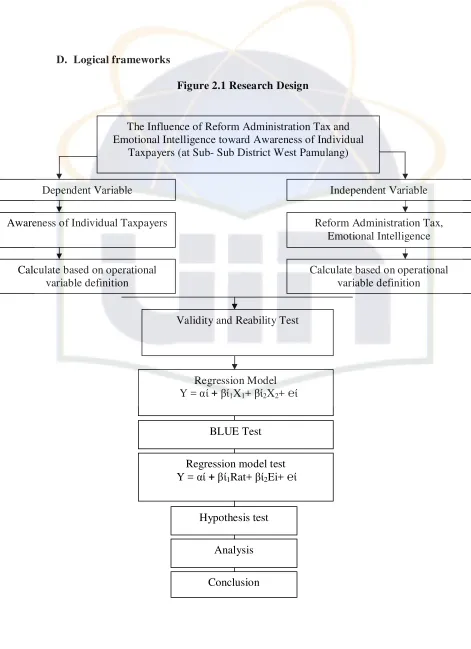
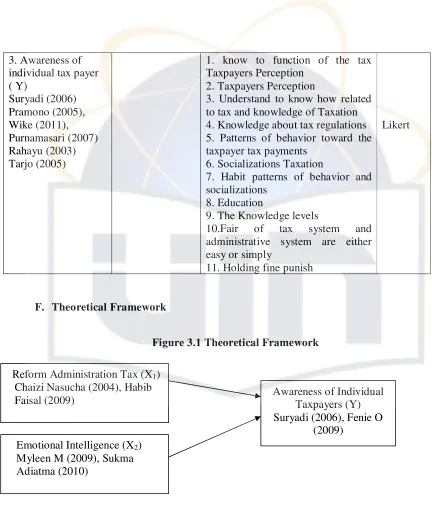
39 D. Logical frameworks
Figure 2.1 Research Design
Dependent Variable Independent Variable
Awareness of Individual Taxpayers Reform Administration Tax,
Emotional Intelligence
Calculate based on operational variable