AN ANALYSIS OF GRAMMATICAL UNIT SHIFTS IN THE TRANSLATION OF AGATHA CHRISTIE’S “WHY DIDN’T THEY ASK
EVANS” INTO “PEMBUNUH DI BALIK KABUT” BY MARETA
A THESIS
BY:
SISKA OKTARIA GINTING 040705018
UNIVERSITY OF SUMATERA UTARA FACULTY OF LETTERS
ENGLISH DEPARTMENT MEDAN
ABSTRAK
ABBREVIATIONS SL : Source Language
TL : Target Language ST : Source Text TT : Target Text
TABLE OF CONTENTS
ACKNOWLEDGEMENTS... i
ABSTRACT ... ii
ABBREVIATIONS... iii
TABLE OF CONTENTS ... iv
CHAPTER I INTRODUCTION 1.1 Background of the Analysis ... 1
1.2 Problem of the Analysis ... 4
1.3 Objective of the Analysis ... 5
1.4 Scope of the Analysis ... 5
1.5 Significance of the Analysis... 5
CHAPTER II REVIEW OF RELATED LITERATURE 2.1 The Understanding of Translation... 6
2.1.1 The Definition of Translation... 6
2.1.2 The Kinds of Translation... 9
2.1.3 The Function of Translation ... 12
2.1.4 The Process of Translation ... 13
2.1.5 The Shifts in Translation ... 18
2.2 The Grammatical Units of English and Bahasa Indonesia... 21
2.2.1 The Grammatical Units of English 2.2.1.1 Morpheme ... 23
2.2.1.2 Word... 24
2.2.1.3 Phrase ... 28
2.2.1.4 Clause ... 31
2.2.1.5 Sentence ... 33
2.2.2.1 Morfem (Morpheme) ... 34
2.2.2.2 Kata (Word) ... 35
2.2.2.3 Frase (Phrase) ... 41
2.2.2.4 Klausa (Clause)... 43
2.2.2.5 Kalimat (Sentence) ... 43
2.3 Related Studies ... 44
CHAPTER III RESEARCH METHODOLOGY 3.1 Research Method... 47
3.2 Population and Sample... 47
3.3 Data Collecting Method ... 48
3.4 Data Analysis Method ... 48
CHAPTER IV ANALYSIS OF THE DATA 4.1 Shifts from Morpheme Unit in English to the Other Units in Bahasa Indonesia... 50
4.2 Shifts from Word Unit in English to the Other Units in Bahasa Indonesia... 54
4.3 Shifts from Phrase Unit in English to the Other Units in Bahasa Indonesia... 58
4.4 Shifts from Clause Unit in English to the Other Units in Bahasa Indonesia... 63
4.5 Shifts from Sentence Unit in English to the Other Units in Bahasa Indonesia... 68
CHAPTER V CONCLUSIONS AND SUGGESTIONS 4.1 Conclusions ... 72
4.2 Suggestions ... 73
ABSTRAK
CHAPTER 1 INTRODUCTION 1.1 Background of the Analysis
There are some acceptable definitions which describe what translation is. Hornby (2000: 1382) defines that translation is the process of changing something that is written or spoken into another language while Hartley (1982:186) says that translation can never be more than approximation to the original message and Larson (1984:1) explains that translation is basically a change of form.
From the three definitions above we may conclude that translation is a process of changing the form of the source language into the target language as well as possible so that the final result will approximate the form of the source language while the meaning is constant. That is why translation is not an easy process. To do this process well needs a qualified translator who knows both the target language (TL) and the source language (SL). The translator must be able to transform the structure of SL to the appropriate structure of TL. Finlay (in Simatupang, 1999:20) stated, “Ideally, a translation should have a sense of the original in such a way that the reader is unaware that he is reading a translation.” It means that a translator should make a reader of the translation not feel that he is reading a translation.
of translation. It means there can be no fully exact translations. The maximum result of a translation may be reasonably close to the original, but there can be no identical in detail. However, a translator is hoped to be able to adjust the structure of SL to the appropriate structure in TL and to produce a natural translation which communicate as much as possible to the TL that was understood by the speakers of the SL.
Bahasa Indonesia and English have different grammatical structure. This
fact causes some difficulties for translators to find the same equivalent and the exact structure in TL, in their effort to convey the message from SL to TL. Such condition forces the translator to shift from one unit to the other unit in the grammatical hierarchy so that the translation could be natural and communicative. As Catford (1965:20) stated that when the two concepts diverge, a translation shift is deemed to have occurred.
Grammar is a description of the structure of a language and the way in which linguistic unit, such as words and phrases are combined to produce sentences in the language (Richards 1985:125). English grammar has units; they are sentence, clause, phrase, word and morpheme. Bahasa Indonesia grammar also has units; they are morpheme, word, phrase, clause and sentence. As what Machali (2000:20) says, “Dalam tata bahasa, kita mengenali adanya hierarki lima satuan bahasa: kalimat, klausa, frase, kata, dan morfem”. (Bahasa
Indonesia grammar has units; they are sentence, clause, phrase, word and
Since English and Bahasa Indonesia have different structures, it is very possible that a unit at one level in the SL is shifted to a unit at different level in the TL. For example, the word-level in SL must be translated to the clause-level in TL, or vice versa. The shifts may occur either up or down level. It means an SL unit can be substituted either by a higher or lower level in TL unit. Such shifts are known as grammatical unit shift.
Grammatical unit shift is one of the translation procedures which is introduced by Catford. Catford (1965: 79) stated that by unit shift we mean changes of rank that is departures from formal correspondence in which the translation equivalent of a unit at one rank in the SL is a unit at a different rank in the TL. For example: these days is translated into sekarang (from phrase to word). The grammatical unit shifts are done because an idea or expression which is usually conveyed in word level in SL, for example, must be conveyed in phrase level in TL or vice versa. If the translator does not do the shifts, then he/she preserves the form of the SL, the result of the translation might not be good, rigid/inflexible and make the readers confused or even the translation would lead them to the wrong understanding.
The fact that the translator faces the condition that forces him/her to make shifts, especially shift in the grammatical units or hierarchy units of language to keep the meaning constant so that the message can be conveyed naturally and communicatively makes the writer interested in analyzing the grammatical unit shift which usually occurs in the translation from English into Bahasa Indonesia.
For examples:
Shifts from morpheme unit to word unit
ST: Bobby could not see him clearly.
TT: Bobby tidak bisa melihat dia dengan jelas.
The bound morpheme ly- in clearly is translated with the word dengan. It means that there has been unit shift in the grammatical level, that is the bound morpheme level in English becomes the word level in Bahasa Indonesia.
Shifts from word unit to phrase unit
ST: “You got a warrant?”
TT: “Kau punya surat perintah?”
The noun word warrant does not have the same equivalence in Bahasa Indonesia (the equivalence which is also the word level). So, it must be explained
by using the noun phrase in Bahasa Indonesia., i.e., surat perintah. It means there has been unit shift from word level in English to the phrase level in Bahasa Indonesia. This fact makes the writer interested in analyzing the grammatical unit
shifts occur in the translation of the novel “Why Didn’t They Ask Evans” to “Pembunuh di Balik Kabut”.
Problem of the Analysis
The problems of this analysis are:
1. How are grammatical unit shifts in Agatha Christie’s novel “Why Didn’t They Ask Evans” translated to “Pembunuh di Balik Kabut”?
1.3 Objective of the Analysis
The objectives of this analysis are:
1. To analyze the grammatical unit shifts in the translations of Agatha Christie’s novel “Why Didn’t They Ask Evans” to “Pembunuh di Balik Kabut”.
2. To find out the frequency of each unit of the grammatical unit shifts in Agatha Christie’s novel “Why Didn’t They Ask Evans” and its translation “Pembunuh di Balik Kabut”.
1.4 Significance of the Analysis
The analysis has significance to expand knowledge of the readers, especially for those who are interested in this subject. Besides that, the result of this analysis will be useful for teaching and training of translation. Further, this analysis is expected to be useful as reference for those who are interested in the same subject.
1.5 Scope of the Analysis
In this thesis, the writer would like to discuss about the grammatical units shift found in the translation of Agatha Christie’s novel “Why Didn’t They Ask Evans” to “Pembunuh di Balik Kabut” which is translated by Mareta. The
CHAPTER II
REVIEW OF RELATED LITERATURE
2.1 The Understanding of Translation
This thesis talks about the grammatical unit shifts in a translation work in the case of the translation from English to Bahasa Indonesia, so the writer wants to explain about translation in brief first.
2.1.1 Definition of Translation
According to Manser (1996:441), translation is the activity of changing something spoken or written into another language. It means that whatever we are doing with something (e.g. information, idea), when changed into another language is called translation. Next we will see some other definitions stated by some linguists.
Nida and Taber (1974 : 12) state that translating consists of reproducing in the receptor language (RL) the closest natural equivalent of the source language (SL) message, first in terms of meaning, and secondly in terms of style. Here, we know that in reproducing the message there is a good relationship between RL and SL that should be equivalent.
Catford (1965:1) defines that translation is an operation performed on languages: a process of substituting a text in one language for a text in another. The writer assumes that all of the activities of transferring a text from one language to another are called translation.
text, analyzing it in order to determine its meaning, then reconstructing the same meaning using the lexicon and grammatical structure which appropriate in the RL and its cultural context. Larson also says that translation has three steps; they are studying the source text, analyzing it and reconstructing the meaning.
Newmark (1988:28) says that translation is rendering the meaning of a text into another language in the way that the author intended the text. In short, the meaning of a text should be the same with the author’s aim when it is translated.
Yusuf (1994 :8) says that “terjemahan dapat diartikan sebagai semua kegiatan manusia dalam mengalihkan seperangkat informasi atau pesan baik verbal maupun non-verbal- dari informasi asal atau informasi sumber ke dalam informasi sasaran” (translation can be defined as all of human activities in transferring information or message-verbal or non-verbal- from original information into target information). It means that when we transfer information from one source to another then we do translation.
Simatupang (1999:2) defines translation as “menerjemah adalah mengalihkan makna yang terdapat dalam bahasa sumber ke dalam bahasa sasaran dan mewujudkannya kembali di dalam bahasa sasaran dengan bentuk-bentuk sewajar mungkin menurut aturan-aturan yang berlaku dalam bahasa sasaran” (translating is transferring the meaning of SL into RL and rewaken it in RL with natural forms that follow the valid rules in RL). It means that translation is closer to the meaning than the style (form) but translation should follow the rules of target language.
the target language. For instance, when a teacher explains his idea to the students, he does a translation activity, i.e. he transfers the idea (the material of the lessons) from his mind to the students by using language that can be understood by them. In short, in wider meaning translation is the process of transferring the meaning of the idea, verbally and non-verbally from one to another.
The RL reader’s response to the translation work has to be the same with the SL reader’s response to the original text itself. Actually, the response of the SL and the RL readers will never be identical because the difference in both readers (cultural and historical settings). The following example shows how a translation work makes the different response we put our head together. If the sentence is translated into Bahasa Indonesia as kami meletakkan kepala kami bersama-sama, the response or idea is different from English. In other words, the
response of the English people and Indonesian people is not the same. The response or understanding will be the same if it is translated as bermusyawarah. The same response between the source and receptor readers can reach the goal if the message expressed as natural as possible in the RL.
2.1.2 The Kinds of Translation
Many linguists make the divisions on translation. Catford divides some broad types or categories of translation in terms of the extent, levels, and rank of translation. Below the writer explains them one by one.
a. In Terms of the Extent
The extent type relates to full versus partial translation. In full translation, the entire text is submitted to the translation process that is every part of the SL text is replaced by RL text material.
In partial translation, some parts of the SL text are left no translated; they are simply transferred to and incorporated in the RL text. So, not all of the text is translated.
b. In Terms of the Levels
According to Catford (1965: 22), the levels type relates to total versus restricted translation of language that involved in translation. Total translation can be defined as the replacement of SL grammar and lexis by equivalent RL grammar and lexis with consequential replacement of SL phonology/ graphology by non-equivalent RL phonology/graphology. Whereas restricted translation means replacement of SL textual material by equivalent RL textual material, at only one level, that is translation performed only at the phonological or at the graphonological level, or at only one of the two levels of grammar and lexis.
c. In Terms of the Rank
The rank type relates to the rank of translation in grammatical (or phonological) hierarchy at which translation equivalence is established. Here, Catford (1965:25) divides this type into three distinctions. They are: Free Translation, Word-for word Translation, and Literal Translation.
Free translation is always “unbounded-equivalences shunt up and down the rank scale, but tend to be at the higher ranks-sometimes between target units than the sentences”. It reproduces the matter without the manner, or the content without the form of the original. It is usually a paraphrase much longer than the original. It is also called as ‘intralingual translation’.
allowance for grammatical or lexical difference between them. This type is usually used in case of translating poems.
Literal Translation lies between these extremes; it may start, as it were, from a word-for-word translation, but make changes in conformity with RL grammar (e.g. inserting additional words, changing structures at any rank, etc); this may make it a group-group or clause-clause translation. This type is usually used if the structure of SL is different with the structure of RL. Below is the example of the three distinctions (English-Bahasa Indonesia).
SL text: Her mouth is parch
RL text: 1. Mulutnya kering (Word-for-word translation) 2. Mulut perempuan itu kering (Literal translation) 3. Dia haus (Free translation)
After explaining the Catford’s type translation, the writer wants to explain the other types that are made by another linguist. Larson (1984: 15) says that there are two main kinds of translations. They are: Form-based Translation and Meaning-based Translation.
a. Form-based Translation
Form-based translation attempts to follow the form of the SL. It is also known as literal translation. Literal translation will cause meaningfulness if SL and RL have different forms.
For example : SL: Dimana sekolahmu? (Indonesian) RL: Where School-your? (Literal English)
and RL are related (have similar forms). However, it still causes a problem, the literal choice of lexical-items makes the translation sounds strange. Actually, this type has little communication value and also it has little help to the readers of the RL. Because it only can be understood when the structure of the two languages may be similar generally. This type may be very useful for purposes related to the study of the SL.
b. Meaning-based Translation
Meaning-based translation communicates the meaning of SL text in the natural forms of the RL. It is usually called as idiomatic translation. An idiomatic translation does not sound like a translation but it like a text written in the RL originally.
For example : SL: The business is dead this year. (Literal English) RL: Bisnis itu lagi sepi tahun ini. (Idiomatic Indonesian)
2.1.3 The Function of Translation
Duff (1989: 5) states “As a process of communication, translation functions as the medium ‘across the linguistic and cultural barriers’ in conveying the messages written in the foreign languages”. It functions as a bridge to carry the messages (meanings) from the SL to the RL. This function is very useful for someone who faces a foreign-language barrier when he/she wants to know the meaning or content of the foreign language text. In other words, the language of the original text is the barrier for him/her to know the content of the text. This problem can only be overcome by translation which functions as the medium between SL and RL.
2.1.4 The Process of Translation
As a process of interlingual communication, translation transfers the meaning from SL idea into RL idea. It means that translation involves two different languages. This process begins by analyzing the source text into grammatical and semantic structure of the SL, transferring the meaning and at last by reconstructing the grammatical and semantic structure into the appropriate RL forms in order to create an equivalent RL text.
However, the process of translation mentioned above is a very general way of looking at the translation procedure. Translation procedure is actually more difficult and complicated than such an overview might indicate. Larson
(1984:476-490) divides the process of translation into 8 steps. They are: a. Preparation, b. Analysis, c. Transfer, d. Initial Draft, e. Reworking the Initial
a. Preparation
There are two kinds of preparation that has to be done by translator. The first is the preparation before beginning the translation task. It includes training in writing, in linguistics and in translation principles. In this preparation, a translator must have training in writing the RL, then he has to study linguistics so that he can discover the features of the RL which indicate the groupings, cohesion, and prominence in that language. Finally he has to study the principles in doing a translation work.
The second preparation is the preparation which the translator undertakes as he begins work on a specific translation project. It means that the translator begins to do preparation related to the text to be translated. In order to be able to understand the message intended by the author, the translator should read the text through several times and mark any section which seems unclear. Then he/she studies the background material which is available. It can be done by doing the same steps such as finding out about the author, about the circumstances of the writing of the text, about the purpose for which it was written, about the culture of the source text, whom the text was written for, and about the study of linguistic matters related to the text. For example: if a text is about historical, the background material should be a study of the period of history in which the events took place and in which the text was written.
b. Analysis
In this process, the translator should study the key words of the text carefully. It aims to find a natural lexical equivalent in RL and it can be done by consulting dictionaries and encyclopedias.
It is important to divide the text into smaller units, and work one of these at a time if the text is very long. The smaller units division can be a section or a chapter. Therefore it is necessary for the translator to study the groupings of the text. He must give a special attention to identify the opening and closing of the text. He also needs to note the relations between various units, discover what the cohesive divides used are indicating and also identify the units which are most prominent.
Even though the analysis begins with the smaller unit and moves up to the whole discourse, the actual analytical process is the opposite. Commonly, the translator analyzes the larger unit first, identifying the units and the relation between the units, deciding which are more prominent. Then he/she moves down to the smaller ones. Though he does that way, but also be constantly moving back to look at the larger units and to reevaluate his analysis on the basis of the analysis of smaller units. The more difficult the text, the more need there will be for a careful rewrite into semantic structure before any transfer is begun.
c. Transfer
equivalent. It is done by finding the good lexical equivalence for concepts and the culture of SL; deciding whether some adjustment are needed or not; considering what grammatical forms to use best communicates the correct meaning, and considering how to signal cohesion and prominence. The transfer process can be very difficult without an adequate study on translation principles. And the results can also be unsatisfactory. The transfer process will result in an initial draft. d. Initial Draft
The translator begins making his initial draft after moving back and forth from the source to the receptor text. He may need to go back for more background reading and check again in the dictionary. In this process, the translator should be working at paragraph level. He must be sure of what the paragraph communicates, then he composes the draft naturally, without looking at the SL or even the semantic rewrite. He should just let it flow naturally and expressing the meaning clearly. The translator will not find difficulty in expressing the meaning in the RL if the analysis has done well.
e. Reworking the Initial Draft
The reworking the initial draft checks for naturalness and for accuracy. The first thing that the translator will do is to read through the manuscript of larger unit that he is checking. In doing this, he should be looking for:
Wrong grammatical forms or obscure constructions
Places that seem too wordy
Wrong order, awkward phrasing
Places where the connections do not seem right and it does not flow easily
Collocation clashes
Questionable meaning Style
The second thing is checking for accuracy of meaning. The translator compares the source text and the semantic analysis carefully. He also looks at the meaning of words, the sentences, and the relations between the sentences and the paragraphs and larger units. The third thing is checking whether the theme comes through clearly or not.
f. Testing the Translation
and correcting use of translation principles. He can train the translator in how to do other kinds of testing. He also encourages the translator throughout the project. A consultant can often help with difficult exegetical questions. The tester tests the translation with people whether the source text is familiar or not. The reviewer reads through the translation and makes comments concerning clarity and naturalness.
g. Polishing the Translation
After doing all the steps above, the translator needs to polish the translation. He needs to know whether he makes an adequate translation or not. h. Preparing the Manuscript for the Publisher
In this last step, the translator checks the translation by having it tested over and over again until he is sure that there is no any missing information from the source text.
2.1.5 The Shifts in Translation
unique patterns of phrase order, techniques for linking clause into sentences, etc. (Nida and Taber, 1974:4). In this case, the translator should be able to adjust the structure of the translation in accordance with the rules and grammar of the TL.
In adjusting the structure of the language, the translator is sometimes forced to make some changes or shifts in the translation. Say for example, something conveyed properly and naturally in one language might not be properly conveyed in another by using the same structure; it is because every language has different systems. This is where shifts need to be done in order to produce natural translation. Thus, the occurrence of shifts in any translation activity is an unavoidable phenomenon. Therefore, ‘shift’ should be redefined positively as the consequence of the translator’s effort to establish translation equivalence between different language systems.
Catford (1965 :73) states that by ‘shifts’ we mean departures from formal correspondence in the process of going from the SL to the TL. There are two major types of ‘shift’. They are level shifts and category shifts.
A.Category Shift
Catford (1965: 76) states that category shifts, which are departures from formal correspondence in translation, consist of structure-shift, class shift, unit shift (rank-changes), and intra system-shift.
a. Structure Shift
Catford (1965:77) states that a structure shift involves a change in grammatical structure between the source language and the target language.
b.Class Shift
Catford (1965: 78) states that class shift occurs when the translation equivalent of a SL item is a member of a different class from the original item.
SL: The neighbours were hostile to the family. Adjective
TL: Para tetangga memusuhi keluarga tersebut. Verb
c.Unit Shift
Catford (1965 : 79) states that by unit-shift we mean changes of rank-that is, departures from formal correspondence in which the translation equivalent of a unit at one rank in the SL is a unit at a different rank in the TL.
Example: These days translated into sekarang (from phrase to word). d.Intra-system shift
Catford (1965: 80) uses the term intra-system shift for those cases where the shift occurs internally, within a system; that is for those cases where SL and TL posssess systems which approximately correspond formally as to their constitution, but when the translation involves selection of a non-corresponding term in the TL system.
For example: Cans translated into kaleng-kaleng.
B. Level Shift
Catford (1965: 73) states that by a shift of level we mean that a SL item at one linguistic level has a TL translation equivalent at a different level.
Meanwhile, according to Peter Newmark (1988: 85), a ‘shift’ (Catford’s term) or ‘transposition’ (Vinay and Darbelnet) is a translation procedure involving a change in the grammar from SL to TL. Transposition is the only translation procedure concerned with grammar, and most translators make transpositions intuitively.
One type, the change from singular to plural, e.g. ‘furniture’; des meubles; ‘applause’, des applaudissements; ‘advice’, des conseils; or in the position of the adjective: la maison blanche, ‘the white house’ is automatic and offers the translator no choice. A second type of shift is required when an SL grammatical structure does not exist in the TL. Here there are always options. The third type of shift is the one where literal translation is grammatically possible but may not accord with natural usage in the TL. The fourth type of transposition is the replacement of a virtual lexical gap by a grammatical structure.
2.2 The Grammatical Units of English and Bahasa Indonesia
Both English and Bahasa Indonesia grammar set up a hierarchy of five units, they are: morpheme, word, phrase, clause, and sentence. As what Machali(2000:20) says “dalam tata bahasa kita mengenali adanya hierarki lima satuan bahasa: (1)kalimat; (2)klausa; (3)frase; (4)kata; (5)morfem. “The highest level is the sentence and the lowest one is the morpheme. The sentence is a unit of higher level than the clause; the clause is a unit of higher level than the phrase; the phrase is a unit of higher level than the word; the word is a unit of the higher level than the morpheme. In other words, every sentence contains at least one clause; each clause is made of at least one phrase; each phrase contains at least one word; every word contains at least one morpheme.
2.2.1 The Grammatical Units of English 2.2.1.1 Morpheme
The word ‘morpheme’ is derived from the Greek word morphe, which means ‘form’. A morpheme (Fromkin and Robert, 1983:114) may be also defined as the minimal linguistic sign, a grammatical unit in which there is an arbitrary union of a sound and a meaning and that can not be further analyzed.
Morpheme can be classified into free and bound forms. Free morpheme is a linguistic form which can be used alone as an independent word. For example: Betty, horse, red, town, and appear. Bound morpheme is a linguistic form which is never used alone but must be used with another morpheme, e.g as an affix. In other words, free morphemes can occur as separate words, but bound morphemes can not occur on their own.
Morphemes cannot be equated with syllables. On the one hand, a single morpheme can have two or more syllables, as in harvest, grammar, river, gorilla, and Indonesia. On the other hand, there are sometimes two or more morphemes in a single syllable, as in judged (judge + -ed), dogs (dog + -s), and men (man + plural), with two morphemes each and men’s, with three morphemes (man + plural + possesive).
the affix which functions to build verb. Confix is a pair of morphemes which has one meaning.
English just recognizes three types of affixes: prefixes, suffixes, and confixes. E.g.: prefixes un-(unhappy), il-(illegal), im-(impolite), ex-(exchange); suffixes –fy (codify), -ness(bitterness), -al (instrumental), -er (leader); confixes il- + -al (illogical), in-+ -ion (indecision), im-+ -al (immaterial).
2.2.1.2 Word
A word can be a free morpheme or the combination of morphemes which are considered by the linguists as the smallest unit and can be used as a free (single) form (Kridalaksana, 1996:98). In other words, a word can be a free morpheme or the combination of free and bound morphemes. For example, blue and sky are free which constitute the smallest meaningful unit and can be used as a single (free) form. The word unemployment is an example of a word as the combination of three morphemes, i.e. two bound morphemes un- and -ment and a free morpheme employ.
1. Noun
Noun is the name of thing, quality, person, and place (Manser; 1996:281). Nouns can be classified into:
A. Common Noun
Common Noun is a name given in common to every person or thing of the same class or kind, for example: girl, boy, book, and city.
Common Nouns can be classified into Collective Nouns and Abstract Nouns. A Collective Noun is the name of a number (collection) of persons or things taken together and spoken of as one whole, for example: crowd, mob, team, flock. An Abstract Noun is usually the name of a quality, action, or state considered apart from the object to which it belongs; for example:
Quality: goodness, holiness, and honesty Action: movement, laughter, and hatred State: poverty, death, and sickness B. Proper Nouns
Proper Noun is the name of some particular person or place. Proper Nouns are always written with a capital letter at the beginning; for example: Jenny, Jakarta, and Indonesia.
2. Pronoun
Pronoun is a word that is used instead of a noun (Manser, 1996:330). It can be divided into:
A. Personal Pronoun
Objective form (me, you, us, them, him, her, it)
B. Possesive Pronoun, examples: mine, your, ours, theirs, his, hers, its.
C. Reflexive Pronoun, examples:myself, yourself, ourselves, their selves, himself, herself, itself.
3. Adjective
Adjective is a word that describes noun (Manser; 1996:5). There are some kinds of adjective. They are:
a. Demonstrative : this, that, these, those b. Distributive : each, every
c. Quantitative : some, any, little, much, many
4. Verb
Verb is a word that shows what a person or thing does or is (Manser; 1996:458). Verb can be divided into four forms, namely:
1. Present or Simple Form of the verb such as drink, and talk 2. Past Form of the verb such as drunk, and talked
3. Continuous Form such as drinking, and talking 4. Past Participle such as drank, and talked.
5. Adverb
Adverb is a word that adds information to a verb, adjective, phrase, or another adverb (Manser; 1996:6). There are some types of adverbs, they are:
1. Adverb of manner such as quickly, fast, well, etc. 2. Adverb of place such as here, there, etc.
3. Adverb of time such as now, soon, today, yesterday, etc. 4. Adverb of frequency such as always, never, seldom, etc. 5. Adverb of degree such as too, rather, fairly, very, etc.
6. Adverb of affirmation and negation such as certainly, surely, etc. 7. Adverb of reason such as hence, therefore, etc.
6. Preposition
Preposition is word normally placed before noun and pronoun and also can be followed by verb (A.J. Thomson 1986: 91). It can be simple (consists of only one word) and complex (consists more than one word).
Examples: Simple Preposition : at the time, from you, in the house.
Complex Preposition: because of going there, instead of staying here.
7. Conjunction
Conjunction is word that joins words, phrases, or sentences (Manser; 1996:84). It can be divided into:
B. Subordinating Conjunction that introduces subordinates adverb or noun clauses and provides information on when, why, or how an event occurred.
Example: The teacher is angry because the student speaks loudly
8. Interjection
Interjection is word that expresses emotion, greeting, and surprise, (Manser; 1996:220). It takes no part of the structure of the sentence. It stands alone.
Examples: Hi! Shalom! Oh! Ouch!
2.2.1.3 Phrase
Phrase is a group of words that lacks either a subject or a predicate or both. Phrase is usually classified into types, depending on the word class of the head (the most important or the most essential word in the phrase). A phrase does not contain a finite verb and does not have a subject predicate structure, for example smart boy, expensive new car, etc.
Based on the central word or head, phrases can be classified into noun phrase, verb phrase, adverb phrase, prepositional phrase, and numeral phrase. Each kind of phrases increases its identity from the word-class of the head word.
1. Nominal Phrase
Object (O) and Complement (C). On below examples the letter M stands for Modifier and H stands for Headword.
Examples:
a. Two eggs are just enough for me. NP: S M H
b. She bought red shoes yesterday NP: O M H
c. He is a good policeman NP: C M H
2. Adjectival Phrase
Adjectival Phrase is a group of words that does the function of an adjective.
Examples: a. Very slow M H b. Extremely hot
M H
c. Too old M H
3. Adverbial Phrase
a. Very quickly M H b. So hard M H
c. Rather quietly M H
4. Prepositional Phrase
Prepositional phrase is a group of words that contains no verb and that begins with a preposition and ends with a noun or pronoun (the object of the preposition).
Examples:
a. After the show we had dinner. b. A page with no writing on it. c. A boy with blue eyes.
5. Verbal phrase
Verbal phrase contains a verb part that functions not as a verb, but rather as a noun or an adjective. Verbals are either infinitives, present participles, or past participles (non - finite verb forms). As opposed to absolute phrases, verbal phrases modify part of a sentence but not the whole sentence.
Examples:
a. We used the last day of our trip to visit the Berlin zoo [Infinitive phrase modifying]
[Present participial phrase functions as an adjective modifying we]
c. The children, amazed by the animal exhibits, didn't want to leave the Berlin zoo.
[Past participial phrase functions as an adjective modifying the children]
2.2.1.4 Clauses
A group of words that forms part of a sentence and has a subject and a predicate of its own is called a clause.
These are clauses: These are not clauses: ecology is a science to protect the environment
because pollution causes cancer after working all day
There are two kinds of clauses: independent and dependent. An independent clause contains a subject and a verb and expresses a complete thought. It can stand alone as a sentence by itself. An independent clause is formed with:
subject + verb (complement)
Examples: -Students normally spend four years in college. - Jim studied in the Sweet Shop for his chemistry quiz.
A dependent clause begins with a subordinator such as when, while, if, that, or who. A dependent clause does not express a complete thought and cannot stand alone as a sentence by itself. A dependent clause is formed with:
Subordinator + subject + verb (+complement) Examples: -when they come to Hollywood…
Based on the function in the sentence, dependent clause can be divided into noun clause, adjective clause, and adverb clause.
Noun clause is a dependent clause which functions like a noun or noun phrase (Richards et al, 1985:192). It is used in the same way that any noun is used. Noun clauses are generally introduced by who, whom, which, that, etc. Noun clauses are used as:
a. Subject of the sentence
Examples: How to make a good presentation will be our topic next week. b. Direct object of the verb
Examples: Do you know what he did to the girl last night. c. Predicate noun
Examples: Your biggest fault was why you let the door unlocked. d. Object of a preposition
Examples: Everything depends on what the director will decide in that meeting. Adjective clause is a dependent clause which functions like adjective and used to modify or describe noun or pronoun and object. Adjective clauses are generally introduced by the conjunction of the clause such as who, whose, that, etc. For example, The boy whose father is a director in that office was arrested by the police yesterday. In this complex sentence, the simple sentence is the boy was
arrested by the police yesterday, the adjective clause modifies or describes the
subject of the sentence, boy. Another example of the adjective clause that modifies the object of the sentence : She is wearing a skirt which she just bought this morning. The simple sentence of the complex sentence is she is wearing a
Adverb clause is a dependent clause which functions as an adverb and used to modify or add the meaning to the verb (predicate) of the complex sentence. It modifies verb from various aspects such as reason, place, time, degree, manner, purpose, etc. For example:
a. She went home because she was sick. (adverb clause of reason) b. It is the office where he works. (adverb clause of place)
c. We arrived before they came. (adverb clause of time)
d. She will come here as soon as she can. (adverb clause of degree) e. They danced as if they were birds. (adverb clause of manner)
f. I woke up early so that I could catch the bus. (adverb clause of purpose)
2.2.1.5 Sentence
Many grammarians define what sentence is. Matthews (1980: 26) in his book Syntax states, “Sentence is a series of words in connected speech or writing, forming the grammatically complete expression of a single thought.” Morever Richard et al (1985: 255) says, “sentence is the largest units of grammatical organization within which parts of speech (e.g. nouns, verbs, adverbs) and grammatical clauses (e.g. word, phrase, clause) are said to function.”
Based on the types, sentence can be classified into:
a. Simple sentence. It contains only one predicate or an independent clause. For example: They bring the money.
however, besides, moreover, etc. For example: I’ll either phone you or I’ll send you a letter.
c. Complex sentence. It contains one independent clause and one or more dependent clause in addition to its independent and they are joined by the subordinating conjunction. For example: Everyone is happy because the girl found the dog that had been lost.
d. Compound-complex sentence. It contains two or more independent clauses and one or more dependent clauses. For example: Because the work was finished, the workers went to the office and asked for the money they had
earned.
2.2.2 The Grammatical Units of Language in Bahasa Indonesia 2.2.2.1 Morfem (morpheme)
Chaer (1994 : 146) states that morfem adalah satuan bentuk bahasa terkecil yang mempunyai makna secara relatif stabil dan tidak dapat dibagi atas bagian bermakna yang lebih kecil (morpheme is the smallest meaningful unit of a language). It consists of:
1. Morfem Bebas (free morpheme)
Yaitu morfem yang secara potensial dapat berdiri sendiri dalam suatu bangun kalimat (morpheme that can stand alone as a word in a sentence)
2. Morfem Terikat (bound morpheme)
Yaitu morfem yang tidak mempunyai potensi untuk berdiri sendiri dan yang selalu terikat dengan morfem lain untuk membentuk ujaran (morpheme that cannot stand alone as an independent word but must be attached to another morpheme/ word)
Example: berjalan ( the word berjalan consists of two morphemes, i.e. bound morpheme ber- and free morpheme –jalan).
2.2.2.2 Kata (word)
Kata adalah satuan bahasa yang dapat berdiri sendiri, terjadi dari morfem tunggal ataupun gabungan morfem (word is a single unit of a language that can stand alone, that is formed from a single morpheme or more).
According to Kridalaksana (1990: 49-103), there are 12 parts of speech in Bahasa Indonesia. They are: verba, ajektiva, nomina, pronominal, numeralia, adverbial, interogativa, demonstrativa, artikula, preposisi, konjungsi,and interjeksi.
1. Verba (verb)
Verb is a word that expresses an action or state of existence. Verba divided into 2 parts by form. They are: verba dasar bebas and verba turunan.
A. Verba Dasar Bebas (free verb)
B. Verba Turunan (verb that has some processes)
Yaitu verba yang mengalami afiksasi, reduplikasi, and gabungan proses (the verb that gets affixation, reduplication, and combining process).
verba berafiksasi (affixation)
examples: bernyanyi (prefix ber-) ajari (suffix-i)
verba reduplikasi (reduplication)
examples: makan-makan, jalan-jalan, minum-minum (the verba dasar bebas reduplicates)
verba berproses gabung (affixation + reduplication)
examples memukul-mukul, berjalan-jalan, bernyanyi-nyanyi (there are reduplication of verba dasar bebas and prefixes me-, ber-)
2. Ajektiva
Ajektiva adalah kata yang memberi keterangan tentang sifat khusus, watak, atau keadaan benda (word that describes noun). It divided into 2 parts. A. Ajektiva dasar Bebas (base adjective)
Examples: bodoh (stupid), besar (big), cemburu(jealous), miskin (poor) B. Ajektiva Turunan (Adjective that has some processes)
Ajektiva turunan berafiks (adjective that has affixes)
Example: terhormat (prefik ter-follows the adjective hormat) Ajektiva turunan bereduplikasi (adjective that reduplicates)
Ajektiva turunan berasal dari berbagai proses (adjective that comes from
some process)
Examples: tertekan (deverbalisasi/ adjective comes from the verb tekan) mendua (denumeralia/ adjective comes from the numeral dua)
3. Nomina (Noun)
Nomina adalah kata yang menyatakan nama benda (word that describes things). It consists of:
A. Nomina Dasar (base noun)
Examples: buku (book), pensil (pencil), cermin (mirror) B. Nomina Turunan (noun that has some processes)
Nomina berafiks (noun that has affixation)
Example: keuangan (uang exist between prefix ke and suffix-an) Nomina reduplikasi (noun that has reduplication)
Examples: rumah-rumah, baju-baju (reduplication of nomina dasar)
Nomina yang berasal dari berbagai proses (noun that comes from some
processes)
Example: pemandian (deverbalisasi/ noun comes from the verb mandi)
4. Pronomina (Pronoun)
Pronomina adalah kata yang berfungsi untuk menggantikan nomina (word that used instead of noun). It can be divided into:
Pronomina Persona I : saya, aku (singularis); kami, kita (pluralis) Pronomina Persona II : kamu, engkau, anda (singularis); kalian (pluralis) Pronomina Persona III : ia, beliau (singularis); mereka (pluralis)
B. Pronomina Tak Takrif, yang tidak merujuk pada orang atau benda tertentu (pronoun that does not consider to anyone or anything, does not have clear references)
Examples: sesuatu (something), seseorang (someone)
5. Numeralia (Numeral)
Numeralia adalah kata yang dipakai untuk menyatakan jumlah benda (word that used to state the quantity of things). It can be divided into:
A. Numeralia Takrif, yang menyatakan jumlah yang tentu (numeral that considers the certain count)
e.g. numeralia utama (main numeral) : satu (one), dua(two) numeralia tingkat (degree numeral) : kedua (second) numeralia kolektif (collective numeral) : ribuan (thousand)
B. Numeralia Tak Takrif, yang menyatakan jumlah tak tentu (numeral that considers the uncertain count)
Examples: beberapa (some), tiap-tiap (each), semua (all), sebagian (half).
6. Adverbia (Adverb)
A. Adverbia Dasar (base adverb)
Examples: selalu (always), pernah (ever), jarang (seldom) B. Adverbia Turunan (adverb that has some processes) Examples: belum-belum, agak-agak (reduplication) terlalu, terlampau (adverb that has prefix ter-)
7. Interogativa (Interrogative)
Interogative adalah kata interogatif yang berfungsi menggantikan sesuatu yang ingin diketahui oleh pembicara (word that replaces something that want to be known by the speaker). There are 3 kinds of interrogative, they are:
A. Interogativa Dasar (base interrogative)
Examples: apa (asking something), kapan (asking time)
B. Interogativa Turunan (interrogative that has some processes) Examples: berapa (has prefix ber-), apa-apaan (has reduplication)
8. Demonstrativa (Demonstrative)
Demonstrativa adalah kata yang berfungsi untuk menunjukkan sesuatu di dalam maupun di luar wacana (word that refers to something). There are two kinds of demonstrative, they are:
A. Demonstrativa Dasar (base demonstrative) Examples: itu (that is), ini (this is)
9. Artikula (Article)
Artikula adalah kategori yang mendampingi nomina dasar, nomina deverbal, pronominal, verba pasif (word that follows base noun, noun, pronoun, and passive verb). It can be divided into:
A. Artikula yang bertugas untuk mengkhususkan nomina singularis jadi bermakna spesifik (to specify noun).
Examples: si, sang, sri
B. Artikula yang bertugas untuk mengkhususkan suatu kelompok (to specify group of things)
Examples: para, kaum, umat
10. Preposisi (Preposition)
Preposisi adalah kata yang terletak sebelum noun atau pronoun dan berfungsi untuk menyatakan tempat (word that placed before noun or pronoun to show place). It can be divided into:
A. Preposisi Dasar (base preposition) Examples: di, ke, dari
B. Preposisi Turunan (preposition that has some processes)
Examples: sepanjang (deajektiva/ preposition comes from adjective)
11. Konjungsi (Conjunction)
A. Konjungsi Intra-kalimat, yang menghububgkan kata dengan kata, frase dengan fase, atau klausa dengan klausa (word that relates word and word, phrase and phrase, or clause and clause)
Examples: aku dan kamu (word and word), para guru atau para murid (phrase and phrase)
B Konjungsi Ekstra-kalimat, yang menghubungkan kalimat dengan kalimat atau paragraf dengan paragraph (word that relates sentence and sentence or paragraph and paragraph)
Examples: Rosmauli makan nasi kemudian dia pergi ke kampus (sentence and sentence)
12. Interjeksi (Interjection)
Interjeksi adalah kategori yang bertugas mengungkapkan perasaan pembicara (word that used to express speaker’s feeling).
Examples: aduh! (to express illness) ah, yaa! (to express disappointed)
2.2.2.3 Frase (phrase)
Kridalaksana (1984 : 53) states “Frase adalah gabungan dua kata atau lebih yang bersifat non predikatif”. (Phrase is a group of words that does not
contain predicate). There are few kinds of phrases: 1. Frase Nominal (noun phrase)
Examples: baju baru (new clothes)
gedung sekolah (school building) musik klasik (classic music)
2. Frase Verbal (verbal phrase)
Frase verbal atau frase golongan V ialah frase yang mempunyai distribusi yang sama dengan kata verbal (phrase that functions as a verb)
Examples: akan pergi (will go)
sudah datang (already come) dapat menyanyi (can sing) 3. Frase Bilangan (numeral phrase)
Frase bilangan ialah frase yang mempunyai distribusi yang sama dengan kata bilangan (phrase that function as a numeral).
Examples: dua buah rumah (two houses) lima botol bir (five bottles beer)
tiga puluh kilogram beras ( thirty kilograms rice) 4. Frase Keterangan (adverbial phrase)
Frase keterangan ialah frase yang mempunyai distribusi yang sama dengan kata keterangan (phrase that function as an adverb).
5. Frase Depan (prepositional phrase)
Frase depan ialah frase yang terdiri dari kata depan sebagai penanda, diikuti oleh kata atau frase sebagai aksisnya (phrase that always starts with a preposition and functions as a modifier).
Examples: di sebuah rumah (in a house) dari Surabaya (from Surabaya)
2.2.2.4 Klausa (Clause)
Kridalaksana ( 1984: 100) states “Klausa adalah satuan gramatikal yang berupa kelompok kata, sekurang-kurangnya terdiri atas subjek dan predikat dan
berpotensi menjadi kalimat”. (Clause is a group of words that forms part of a
sentence and has a Subject and a Predicate of its own). Clauses can be classified into two classes:
1. Klausa Bebas (independent clause)
Klausa bebas adalah klausa yang secara potensial dapat menjadi kalimat bebas (clause that may stand alone as a sentence).
Examples: Nenekku masih cantik. (My grandma is still pretty)
Saya bangun pukul enam setiap pagi. (I wake up at six every morning) 2. Klausa Terikat (dependent clause)
Klausa terikat adalah klausa yang tidak dapat berdiri sendiri sebagai kalimat tunggal mandiri, menjadi bagian klausa lain atau bagian dari kalimat majemuk bertingkat (clause that cannot stand alone as a sentence).
- ketika kami sedang belajar (cannot stand alone) 2.2.2.5 Kalimat (sentence)
Kridalaksana (1984 :83) states “Kalimat adalah satuan bahasa yang mengungkapkan pikiran secara utuh dan telah dibubuhi intonasi atau tanda
baca”. (Sentence is a set of words which are tied together and convey an idea
begin with a capital letter and end with a full stop). There are some kinds of sentence, they are: 1. Kalimat Sederhana (Simple sentence)
Kalimat sederhana adalah kalimat yang terdiri dari satu klausa (simple sentence is a sentence which only contains of one clause)
Examples: Dia sedang membaca majalah.(She is reading a magazine) Saya pergi ke sekolah setiap hari. (I go to school everyday)
2. Kalimat Luas (Compound sentence)
Kalimat luas adalah kalimat yang terdiri dari dua klausa atau lebih (sentence which contains two or more clauses)
Examples: Ia mengakui bahwa ia jatuh cinta kepadaku. (He admits that he loves me)
2.3 Related Studies
In process of writing this thesis, the writer uses some information supplied in the relevant book, research and thesis. Some of them can be mentioned here as follows:
Haryanti (2006) in “Translation Shifts of Noun in The Old Man And The Sea, A Farewell To Arms, and Their Translation Versions”. Based on the
analysis, the findings are as follows: (a) nouns in the two novels are translated into verbs, verb phrases, clauses, adjectives, functional word-nya, nouns, compound nouns, noun phrases, plural nouns into singular, singular nouns into plural nouns, nouns are adopted, and nouns are not translated; (b) the translations are accurate although there are some translation shifts; and (c) there are some differences and similarities of nouns category shifts in the two novels.
Sahrial (2003) in An Analysis of Grammatical Unit Shifts in The Translation of John Grisham’s The Street Lawyer to Pengacara Jalanan presents
CHAPTER III
RESEARCH METHODOLOGY
3.1 Research Method
In writing this analysis, the writer applies the library research method. The method is done by reading and studying some books concerned with the topic of the problem.
3.2 Population and Sample
A population is a group of individuals persons, objects, or items from which samples are taken for measurement while a sample is a finite part of a statistical population whose properties are studied to gain information about the whole (Webster, 2003: 966). The data of the analysis are collected from Agatha Christie’s novel “Why Didn’t They Ask Evans” and also from the translation of this novel into bahasa Indonesia “Pembunuh di Balik Kabut” translated by Mareta. The novel Why Didn’t They Ask Evans consists of 361 pages and 35 chapters. The first page starts on page 9, so the exactly number of pages consist of 352 pages. For the sake of efficiency the writer chooses some pages as the sample of the analysis. By using systematic sampling which is introduced by William G. Cochran (1977:205), the samples can be selected by using formula N = nk, where N is number of populations, n is number of samples, and k is interval. Thus, with N = 352, k = 10, the numbers of samples are:
n = 10 352
n = 35.2
n = 35 (rounded off downward)
So, if the first sample is page 9, then the next samples are page 19, 29, 39 …349. The population of this analysis is all sentences that contain shifts in the novel of Agatha Christie’s “Why Didn’t They Ask Evans” and also from the translation of this novel into bahasa Indonesia “Pembunuh di Balik Kabut” translated by Mareta. The sample of this analysis is all sentences that contain shifts in the 35 pages of sample. There are 607 sentences in the 35 samples and there are 410 sentences that contain shifts in the 35 page of samples. 3.3 Data Collecting Method
During the process of collecting data, the writer applied what Dede Oetomo says in Suryanto’s Metode Penelitian Sosial that there are three methods of collecting data, i.e. interview, observation, and analysis on written documents such as quotation, notes, memorandum, publications and official reports, diaries, and written answer to questioner and survey (Suryanto 1995: 186).
Since the data of this analysis are collected from Agatha Christie’s novel “Why Didn’t They Ask Evans” and also from the translation of this novel into
bahasa Indonesia “Pembunuh di Balik Kabut” translated by Mareta, the method of collecting the data can be classified into the third method, it is analysis on written documents.
The writer uses descriptive quantitave method in analyzing the data. Lexy in his book Metodologi Penelitian Kuantitatif (2005:3) states that penelitian kuantitatif mencakup setiap jenis penelitian yang didasarkan atas perhitungan persentase, rata-rata, kuadrat, dan perhitungan statistik lainnya. In the quantitative method the writer calculate the occurrences of unit shifts in each page of sample of the novel in order to find out the frequency of each unit of the grammatical unit shifts in Agatha Christie’s novel “Why Didn’t They Ask Evans” to “Pembunuh di Balik Kabut”.
Besides the quantitative method, the writer also uses descriptive method to analyze the translations of grammatical unit shifts. Lexy in the same book Metodologi Penelitian Kuantitatif (2005:4) states that penelitian deskriptif sebagai
prosedur penelitian yang menghasilkan data deskriptif berupa kata-kata tertulis atau lisan dari orang-orang dan perilaku yang diamati.
The steps of the analysis are as follows: 1. Reading the original novel in SL. 2. Reading the translated novel in TL.
3. Deciding and underlining the grammatical units of the ST.
4. Analyzing the equivalence in the translated novel and deciding the grammatical units in higher or lower level of the TT.
5. Classifying the data based on their level in the grammatical units shifts 6. Explaining the grammatical unit shifts (changes of rank/level) of some of
the data which represent the unit shifts for each level.
7. Calculating the occurrences of each unit shift of the grammatical unit shifts by using the formula.
8. Drawing the tables which show the frequency of the grammatical unit shifts for each unit from each page of samples.
CHAPTER IV
ANALYSIS OF THE DATA
After collecting and analyzing the data taken from the novel “Why Didn’t They Ask Evans” and “Pembunuh di Balik Kabut” , the writer tries to describe the
result of the unit shifts from the aspect of grammatical level.
Refer to the method of analysis; the writer uses the descriptive quantitative method. However, the writer describes only some unit shifts of each level, while the others are in the form of table.
4.1 Shifts from Morpheme Unit in English to the Other Units in Bahasa Indonesia
As we know that the unit shifts in the level of morpheme can only occur to the higher level since morpheme is the lowest level in the hierarchy of grammatical units. In translating the novel ““Why Didn’t They Ask Evans” to “Pembunuh di Balik Kabut”, the translators mostly shift the morpheme level to
the word level, whereas the shifts from morpheme level to the phrase level are very rare.
1. Bound morpheme unit in ST to word unit in TT
1. ST (WDTAE. 19) : Bobby could not see him very clearly… TT (PDK.14) : Bobby tidak bisa melihat dia dengan jelas… 2. ST (WDTAE. 169): ‘The alternative being,’ said Frankie thoughtfully TT (PDK.146) : “Sebuah alternative,” sela Frankie sambil berpikir 3. ST (WDTAE. 199): Moira was listening attentively
TT (PDK.172) : …dan dengan bijaksana mengalihkan pandangan matanya dari wajah Moira.
5. ST (WDTAE. 209): It’s a frightfully queer feeling.’
TT (PDK.181) : Ini perasaan yang amat aneh dan sedikit mengerikan.” 6. ST (WDTAE. 269): He told himself repeatedly…
TT (PDK.237) : Dia menenangkan hatinya dengan mengatakan… 7. ST (WDTAE. 279): The proceedings were very tactfully conducted. TT (PDK.246) : Proses pemeriksaan itu dilakukan dengan baik.
8. ST (WDTAE. 289): …and her head nearly collided violently with a battered coal-box.
TT (PDK.255) : …dan kepalanya hampir saja tertumbuk pada keranjang arang yang sudah rusak.
In the above eight sentences of the SL, the bound morpheme –ly in English is translated differently from each sentence into the word dengan (1,3,4,6 and 7), sambil (2), sedikit (5), and saja (8) in bahasa Indonesia. However, those translated sentences are correct since bahasa Indonesia does not have the bound morpheme that can be added to a word to form an adverb as in English.
9. ST (WDTAE. 239) : It’s extraordinary how men like helpless women.
TT (PDK.255) : Aneh ya, kenapa sih laki-laki kok senang wanita yang tak berdaya.
10.ST (WDTAE. 309) : …the impossible had been achieved. TT (PDK.272) : …dan yang tak mungkin telah tercapai.
The English bound morphemes –less (9), and im- (10) in the above ST have the same equivalence in the word tak in bahasa Indonesia to describe negative statement. The unit shifts that occur in this translation are from morpheme unit to word unit.
2. Bound morpheme unit in ST to phrase unit in TT 11. ST (WDTAE. 59) : …and free and irresponsible.
TT (PDK.49) : …cukup bebas dan tak perlu terlalu bertanggung jawab. The bound morpheme –ir which is attached with the word responsible becomes irresponsible in the above ST is translated with the phrase tak perlu terlalu in bahasa Indonesia.
12. ST (WDTAE. 279) : The Bentley swerved dangerously.
Table A
The Frequency of Unit Shifts from Morpheme Unit to the Other Units Source Text (ST) Target Text (TT)
Morpheme Unit Word Unit Phrase unit No.
Sample
Page Total Page Total Page Total 1 9 1 7 1
2 19 2 15 2 3 29 1 23 1 4 39
5 49
6 59 1 49 1
7 69 1 59 1
8 79 9 89 10 99 11 109 12 119
13 129 2 111 1 111 1
14 139 15 149
16 159 4 138 4 17 169 1 146 1 18 179
19 189 5 164-165 5 20 199 2 172 2 21 209 1 181 1 22 219
23 229
24 239 2 209 2 25 249 1 217-218
26 259 1 227 1
27 269 1 237 1
28 279 3 246 2 245 1
29 289 1 255 1 30 299 2 264 2 31 309 2 272 2 32 319
33 329 34 339 35 349
4.2 Shifts from Word Unit in English to the Other Units in Bahasa Indonesia The unit shifts in the level of word may occur either in the higher or lower level. The word unit in the SL can be shifted to the other unit in the TL. It can be shifted to the lower level, i.e. morpheme unit, and it can also shifted to the higher levels, such as phrase, clause, and even sentence unit if it is possible.
1. Word unit in ST to bound morpheme unit in TT 1. ST (WDTAE. 189) : Go on.
TT (PDK.165) : Teruskan.
The preposition on in English is translated into suffix –kan in bahasa Indonesia.
2. ST (WDTAE. 189) : I just jump aside in time.
TT (PDK.165) : Aku sempat meloncat pada waktu yang tepat.
The word aside in the ST phrase jump aside has the equivalence of bound morpheme me- in the TT word meloncat.
3. ST (WDTAE. 209) : Go ahead with your plan. TT (PDK.181) : Lanjutkan rencanamu.
The word ahead in the ST phrase go ahead has the equivalence of suffix –kan in bahasa Indonesia.
The word through in the ST phrase passed through has the equivalence of bound morpheme me- in the TT word melewati.
5. ST (WDTAE. 339) : And I looked through four hundred and eighty Evans. TT (PDK.298) : Dan aku mencari empat ratus delapan puluh Evans di
buku.
The word through in the ST phrase looked through has the equivalence of bound morpheme men- in the TT word melewati.
The unit shifts from the word unit to the morpheme unit in the translations above are correct since they can preserve the meaning/message of the ST properly and they sound natural.
2.Word unit in ST to phrase unit in TT
6. ST (WDTAE. 59) : …father gives me an allowance. TT (PDK.49) : …ayah memberiku uang saku. 7. ST (WDTAE. 69) : Then there’s revenge.
TT (PDK.59) : Lalu ada kemungkinan balas dendam.
8. ST (WDTAE. 39) : …and how he himself had driven into the chasm. TT (PDK.30) : …dan bagaimana dia sendiri sampai di tepi jurang. 9. ST (WDTAE. 99) : George Arbutnot did the same and the bed groaned
protestingly.
TT (PDK.85) : George Arbuthnot ikut duduk dan tempat tidur itu berteriak memprotes.
10. ST (WDTAE. 159) : …her eyelids halfly closed.
The noun word allowance (6), revenge (7), chasm (8), bed (9), and eyelids(10) do not have the equivalence from the same unit in bahasa Indonesia.
So, there is no other choice, they must be translated by using the phrases to transfer the meaning from English to bahasa Indonesia. In the above translations, uang saku, balas dendam, tepi jurang, tempat tidur and kelopak mata are noun
phrases.
11. ST (WDTAE. 99) : George Arbuthnot spoke for the first time.
TT (PDK.86) : George Arbuthnot untuk pertama kali buka mulut. 12. ST (WDTAE. 279) : …she were admiring a performance at a theatre.
TT (PDK.246) : …ia mengagumi sebuah pertunjukkan bagus di sebuah teater.
13. ST (WDTAE. 279) : Difficult circumstances… TT (PDK.246) : Situasi yang tak memungkinkan.
The English verb spoke (11), the noun performance (12), and the adjective difficult (13) in the above ST actually could also be translated with the word unit
2.Word unit in ST to clause unit in TT
1. ST (WDTAE. 189) : …the answer came promptly
TT (PDK.165) : …jawaban itu ternyata dia terima langsung. 2. ST (WDTAE. 239) : He’ll like Moira nearly any man would.
TT (PDK.209) : Dia akan suka pada Moira-aku rasa semua laki-laki akan menyukainya.
3. ST (WDTAE. 279) : The Bassington-ffrenches were popular locally… TT (PDK.246) : Keluarga Bassington-ffrenches merupakan keluarga
yang cukup terkenal di daerah itu.
4. ST (WDTAE. 9) : The solitary witness of the shot manifested no surprise TT (PDK.7) : Satu-satunya penonton yang melihat pun tidak merasa
heran.
5. ST (WDTAE. 19) : …the stranger made shocked comments.
TT (PDK.15) : …orang itu memberikan reaksi-reaksi seperti orang tekejut.
6. ST (WDTAE. 219) : …and recognizing body as that of a convenient brother. TT (PDK.192) : …dan dengan enak mengaku mayat itu sebagai mayat
saudaranya.
7. ST (WDTAE. 239) : …that sits and waits to be eaten by a snake without doing anything about it.
TT (PDK.209) : …yang hanya bisa duduk dan menunggu dimakan ular tanpa mau berbuat apapun.
the word in the TL. This means that unit shift is done to preserve the whole meaning in the sentences.
3. Word unit in ST to sentence unit in TT
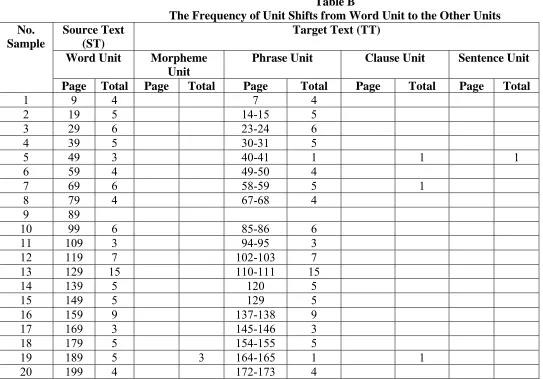
The unit shift from word level to the highest level of the grammatical unit , i.e. sentence level as can be seen below :
Table B
The Frequency of Unit Shifts from Word Unit to the Other Units Source Text
(ST)
Target Text (TT) Word Unit Morpheme
Unit
Phrase Unit Clause Unit Sentence Unit No.
Sample
Page Total Page Total Page Total Page Total Page Total
1 9 4 7 4
2 19 5 14-15 5
3 29 6 23-24 6
4 39 5 30-31 5
5 49 3 40-41 1 1 1
6 59 4 49-50 4
7 69 6 58-59 5 1
8 79 4 67-68 4
9 89
10 99 6 85-86 6
11 109 3 94-95 3
12 119 7 102-103 7
13 129 15 110-111 15
14 139 5 120 5
15 149 5 129 5
16 159 9 137-138 9
17 169 3 145-146 3
18 179 5 154-155 5
19 189 5 3 164-165 1 1
Source Text (ST)
Target Text (TT) Word Unit Morpheme
Unit
Phrase Unit Clause Unit Sentence Unit No.
Sample
Page Total Page Total Page Total Page Total Page Total
21 209 8 1 181-182 7
22 219 9 191-192 9
23 229 7 200-201 7
24 239 13 209-210 12 1
25 249 4 217-218 4
26 259 5 227 5
27 269 4 237 4
28 279 12 245-246 11 1
29 289 7 255 7
30 299 9 264-265 9
31 309 5 272-273 5
32 319 7 280 7
33 329 4 2 291-292 2
34 339 1 298 1
35 349 15 307-308 15
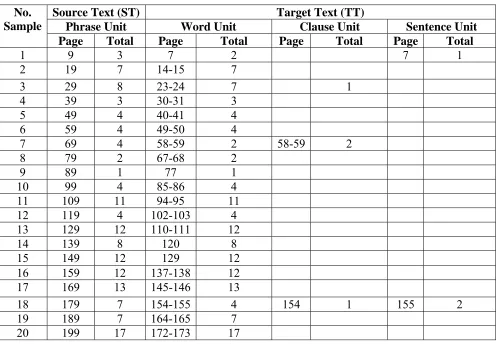
4.3 Shifts from Phrase Unit in English to the Other Units in Bahasa Indonesia In the level of phrase, the unit shifts may occur to the lower unit, t