Publisher: Rout ledge
I nform a Lt d Regist ered in England and Wales Regist ered Num ber: 1072954 Regist ered office: Mort im er House, 37- 41 Mort im er St reet , London W1T 3JH, UK
Journal of Risk Research
Publicat ion det ails, including inst ruct ions f or aut hors and subscript ion inf ormat ion:
ht t p: / / www. t andf online. com/ loi/ rj rr20
Neoliberalism and work-related
risks: individual or collective
responsibilization?
P. Mascini a , P. Acht erberg a & D. Hout man a a
Depart ment of Sociology, Erasmus Universit y of Rot t erdam, Rot t erdam, The Net herlands
Version of record f irst published: 08 Feb 2013.
To cite this article: P. Mascini , P. Acht erberg & D. Hout man (2013): Neoliberalism and work-relat ed risks: individual or collect ive responsibilizat ion?, Journal of Risk Research, DOI: 10. 1080/ 13669877. 2012. 761274
To link to this article: ht t p: / / dx. doi. org/ 10. 1080/ 13669877. 2012. 761274
PLEASE SCROLL DOWN FOR ARTI CLE
Full t erm s and condit ions of use: ht t p: / / w w w.t andfonline.com / page/ t erm s- and-condit ions
This art icle m ay be used for research, t eaching, and privat e st udy purposes. Any subst ant ial or syst em at ic reproduct ion, redist ribut ion, reselling, loan, sub- licensing, syst em at ic supply, or dist ribut ion in any form t o anyone is expressly forbidden.
The publisher does not give any warrant y express or im plied or m ake any represent at ion t hat t he cont ent s w ill be com plet e or accurat e or up t o dat e. The accuracy of any
RESEARCH ARTICLE
Neoliberalism and work-related risks: individual or collective
responsibilization?
P. Mascini*, P. Achterberg and D. Houtman
Department of Sociology, Erasmus University of Rotterdam, Rotterdam, The Netherlands
(Received 13 September 2012;final version received 4 December 2012)
Based on a representative sample of the Dutch population (N= 2467), we test four hypotheses about how utilitarian individualism influences the responsibili-zation of work-related risks (i.e. the risk of dropping out of work because of unemployment, disability, or sickness). The risk society hypothesis understands utilitarian individualism as a laissez-faire ideological orientation and assumes it to lead to individual responsibilization. The blame culture hypothesis conceives utilitarian individualists as consumer citizens and predicts the reverse – that
those concerned expect to be protected by the government. The resentment hypothesis assumes that particularly utilitarian individualists with a vulnerable labor-market position individualize responsibility, because they distrust those who share their fate more than others do. The narcissism hypothesis reverses this logic, because it assumes that utilitarian individualists’ narcissistic
self-centeredness entices them to make others responsible for their own risks. The two hypotheses predicting an individualization of work-related risk due to utilitarian individualism are both confirmed, whereas the two hypotheses predicting it to result in their collectivization are both rejected.
Key words:culture of blame; utilitarian individualism; work-related risks
Introduction
Local and private collective provisions that have been created to compensate for the loss of income as a result of unemployment, sickness, disability, or old age, have steadily developed into national social security systems that have emerged in wes-tern countries during the twentieth century (De Swaan 1988). However, as a result of the spread of a neoliberal ideology across the globe since the 1970s (Dobbin, Simmons, and Garrett 2007; Peck and Tickell 2002), the self-evident collective responsibility of national governments for handling the risk of dropping out of work, has increasingly become controversial.
Making a shift from income protection to social activation of those who do not, or not yet, participate on the labor market, so as to effectively develop or mobilize their labor potential, is central to the neoliberal policy discourse about the welfare state (Gilbert 2002). This discourse implies that even when external factors are major determinants of the risk of dropping out of work, citizens are still held per-sonally responsible for their participation on the labor market. It hence understands citizens as rationally calculating individuals who try to acquire, maintain, or
*Corresponding author. Email: [email protected]
Ó2013 Taylor & Francis
recapture a secure position on the labor market rather than as members of a community that aims to share work-related risks evenly (Stone 1997). Enforcement agencies, for example, no longer only see to the protection of employees by employers, but also force the former to refuse unsafe work themselves and to actually make use of available personal protective equipment (Gray 2009). This transformation of the welfare state entails a shift from Emile Durkheim’s ‘moral individualism’, which emphasizes the humanity that individuals have in common, to what he calls ‘utilitarian individualism’, and that considers people as self-centered rationally calculating individuals (Durkheim 1973 [1898]; Bellah et al. 1985). As such, this type of utilitarian individualism constitutes the ideological kernel of neoliberalism.
The extent to which supporters of utilitarian individualism are actually inclined to render individuals themselves responsible for the risk of dropping out of work because of unemployment, sickness, or disability– i.e. work-related risks –is how-ever quite contested. Whereas some scholars have indeed argued that utilitarian individualism results in individual responsibilization of work-related risks, others have contended that it results precisely in its opposite, i.e. in a collective responsibi-lization of risks, as exemplified by the conviction that the state should make sure that people can participate on the labor market irrespective of whether they are to blame for their misfortunes themselves. Again others assert that the extent to which support of utilitarian individualism correlates with either individual or collective responsibilization depends on the vulnerability of their own labor-market position. Remarkably, then, the various theories all link utilitarian individualism to the responsibilization of work-related risks, yet do so in strikingly different ways. Therefore, in this article, we study to what extent utilitarian individualism actually leads to either individual or collective responsibilization of work-related risks and to what extent this relationship depends on the vulnerability of one’s own labor-market position. We will do so on the basis of a self-administered questionnaire among a representative sample of the Dutch population.
We start with an elaboration of the various theories about the impact of utilitar-ian individualism on the responsibilization of work-related risks. We then proceed with a discussion of the data collection and the measurement. Finally, on the basis of our findings pertaining to the tenability of the various hypotheses, we will reflect upon the implications of our study and its limitations.
Explaining the responsibilization of work-related risks Individual responsibilization
Beck (1992) relates reflexive modernization to individual responsibilization of work-related risks. Reflexive modernization signifies that inequalities between the sexes and classes characteristic for the industrial society gradually and uncon-sciously disappear and make way for a risk society with a more universal, individ-ual obligation to participate on a flexibilizing labor market (Beck 1995). Beck maintains that the central position of the nuclear family with a male breadwinner and a female spouse who takes care of the household is gradually giving way to a situation in which both spouses participate on the labor market. Moreover, lower class descent is no longer accepted as an excuse for an unfavorable and insecure labor-market position. Instead of increasing freedom of choice, reflexive moderniza-tion hence entails a convicmoderniza-tion that individuals are themselves responsible for the
course of life they choose in terms of the risks these choices incur for under schooling, sickness, labor insecurity, and unemployment (Zinn 2008): ‘In essence, the burden of risk migrates from the jurisdiction of institutions to the individualized sphere of personal decision making’ (Mythen 2005, 130). Even though Bauman (2000) and Giddens (1990) connect the process of reflexive modernization to individual responsibilization of work-related risks too, they understand the former differently from Beck. Whereas Beck (1995) defines reflexivization primarily as a structural transformation process that partly takes place unconsciously, Giddens conceives of it as a constant appropriation of new knowledge as the basis for social organization and self-identity. Individuals are thus increasingly left to their own choices due to the disappearance of traditions. Without the safety and security provided by preexisting traditions and predetermined social identities, individuals have no choice but to make choices about their self-identity, their relations with others and about how to plan and live their lives: ‘we have no choice but to choose how to be and how to act’ (Ekberg 2007, 346; see also Heiskala 2011, 11). This consciousness is closely linked to the perception of individual responsibility for work-related risks: we are increasingly supposed to present ourselves as the creators of our own biography, so that unemployment and poverty are experienced as individual failure and private fate, or, as Bauman (2000, 38) formulates it‘being an individual de jure means having no one to blame for one’s own misery’ (see also Giddens 1991, 81).
These authors have taken up an ambivalent stance towards the desirability of reflexive modernity. Besides (involuntary) freedom of choice, Giddens and Bauman observe it brings existential insecurity, while Beck even denies the existence of free-dom of choice in reflexive modernity, since choices primarily have to be made in terms of optimizing one’s own position on the labor market. This means none of these authors conceive of reflexive modernity merely as desirable. However, they all assume reflexive modernity supplies a social context in which individuals citizens increasingly take for granted that they have to take into account their self-interest while making choices: ‘… there is an emphasis on responsible risk-taking, which requires entities to learn to choose among appropriate risk management techniques that will yield security and prosperity’(Ericson 2005). This focus on the personal consequences of individual choices brings along that work-related risks are designated an individual responsibility:
Hence, the cultural ubiquity of risk in everyday life–from the problem of crime to
wel-fare and pension provision–feeds a process of individualization through which
individ-uals become responsibilized into a perpetual process of decision-making and inured to making personal risk assessments. (Hudson 2003, 44, cited in Mythen 2007, 798).
Hence, according to all definitions of reflexive modernization the idea of the centrality of self-interests in the choices people make has increasingly become institutionalized and results in an individual responsibilization of work-related risks.
The risk society hypothesis hence predicts that utilitarian individualism leads to an
individualization of work-related risks.
Collective responsibilization
Lau (2009) explicitly opposes those who link utilitarian individualism to individual responsibilization of work-related risks. According to him, neoliberalism has
brought forth a so-called‘blame culture’as an outgrowth of the ‘claim culture’ that has spread from the USA to other western countries since the 1960s.1 This claim culture has allegedly provided fertile soil for the introduction of business-like mod-els in the public sector. Consequently, Lau asserts that the opinion has taken root that citizens are entitled to protection by the state and that it is the duty of the state to offer this protection (‘duty of care’). Individual citizens are held to increasingly behave as ‘consumer-citizens’ who automatically scapegoat the government for untoward events, irrespective of whether these concern industrial or natural disas-ters, criminality, or unemployment. Hence,‘contrary to Giddens, Bauman and Beck, in the culture of blame, uncertainty is rejected, and individual responsibility decid-edly takes a backseat’(Lau 2009, 680). In a follow-up article, Lau (2012) writes
… there is a general retreat of individual responsibility today concerning the
conse-quences of life choices and decisions and the handling of life’s contingencies. State
protection against such consequences is sometimes sought by ‘victims’. Contrarily,
Giddens, Beck, and Bauman all argue that contemporary modernity is characterized by individuals actively assuming responsibility for their own life choices and deci-sions, and facing the risks/consequences accordingly.
Lau hence hypothesizes that an utilitarian-individualistic attitude rather leads to a
collective responsibilization of risks: ‘Neoliberalism emphasizes individual
responsi-bility; ironically, partly as an unintended consequence of its program, individual responsibility has given way to blaming others’ (Lau 2009, 679; see also Furedi 2004). The blame culture hypothesis hence predicts that utilitarian individualism results in acollectiveresponsibilization of work-related risks.2
Labor-market vulnerability and responsibilization of work-related risks
The theories of the risk society and of blame culture both assume that the rise of utilitarian individualism has universal consequences for the responsibilization of work-related risks. Whereas only the theory of the risk society has been critiqued for this (Mythen 2007, 800), the theory of blame culture entails exactly the same assumption of an undifferentiated trend towards a collective responsibilization of work-related risks. These universalistic claims stem from their insufficient attention to the distribution of risks. Lau’s theory of the blame culture does not pay any attention to this at all, while Beck is inconsistent in this respect: he simultaneously states that risks are unevenly distributed and that the so-called new risks are equal-izing, because not even the privileged classes can evade these risks because of their invisibility, incalculability, and border and generation transgressing nature. Hence, he is inconsistent, or undecided, on whether exposure to risk in the risk society is egalitarian or hierarchical (Ekberg 2007, 361).
However, research unequivocally points in the direction of a strong correlation between class and risk, with those less able to acquire the goods being more adversely affected by bads (Mythen 2005, 141, 144; 2007, 799).3 Although it has been demonstrated that younger generations are more successful than older ones in planning their personal lives and realizing their occupational ambitions, these outcomes are less likely for members of the working class than for those of more privileged classes. Even though contemporary risk society hence offers ample opportunities for ‘writing one’s personal biography’, success in doing so clearly
remains socially structured (Taylor-Gooby and Cebulla 2010; see also Threadgold and Nilan 2009) in the sense that work-related risks reproduce class differences (Lash 1995, 120, 127–35; Achterberg and Snel 2008).
Two theories have been proposed to counter the universalistic pretenses of the theory of the risk society and the theory of the blame culture. They both propose specifications of the latter by assuming that the impact of utilitarian individualism on the responsibilization of work-related risks is stronger for those in vulnerable labor-market positions than for those in more privileged ones.
Vulnerability and individual responsibilization
The third theory relates the responsibilization of work-related risks to increasing resentment among the lower socioeconomic strata. The reasons given for this increase are that social status has become increasingly visible, while its legitimacy has steadily declined because the link between status and personal achievement has loosened and because success is increasingly attributed to chance (Turner 2011). Hence, the subordinate strata want to be compensated for their unfortunate position and, in the absence of compensation, they want revenge. However, since class loy-alties have disappeared to a large extent in western societies, ‘resentment in modern times is an individualized emotion or disposition which, while it might be shared by a large number of people, does not lend itself to collective action’(Turner 2011, 88). In other words, people in weak labor-market positions are assumed to consti-tute not so much a solidary and cohesive social class, but rather a loose collection of poorly qualified people who fiercely compete with one another on an ample labor market (Kochuyt and Derks 2003) – an ‘acid bath of competition’ that ‘causes the isolation of individuals within homogeneous social groups’(Beck 1992, 94).
This competitive battle between people in vulnerable labor-market positions elicits forced individualism, because they feel entirely left to themselves in this struggle with distrusted others who share a strained economic position. The latter explains, for example, why poor black jobholders are reluctant to assist job seekers in finding work. They are preoccupied with preserving their own reputations at work and are afraid that job seekers will‘bring the street to the job’ by engaging in drug and alcohol abuse and related, untrustworthy behaviors at the workplace (Smith 2007, 94). Moreover, it also explains why people who are dependent on social benefits not only suspect each other of social benefit fraud and undeclared work but also vehemently reproach each other for doing so because this would ren-der the welfare state unaffordable. Therefore, they support a stringent social security system (Kochuyt and Derks 2003). Furthermore, the disadvantaged tend to think they deserve redistribution of wealth and blame social benefit services for their lack of success of elevating themselves from their deprivation (Kochuyt and Derks 2003). Hence their distrust in the welfare state: an instrument to provide well-paid and comfortable jobs to self-interested civil servants who cater to a class of‘welfare scroungers’that freeloads on the hard work of the common man (conform Andersen 1992). This implies that people in weak labor-market positions combine support for economic equality and redistribution with a marked ‘anti-welfarism’, a highly critical view of the welfare state (Achterberg, Houtman, and Derks 2011). The well to do are rather in search of legitimacy for their privileged position than for income and are as such less plagued by resentment and disappointment about what the wel-fare state has to offer to them (Turner 2011). As a consequence, they are less
inclined than the deprived to combine support for economic redistribution with anti-welfarism and an individual responsibilization of work-related risks (Achterberg, Houtman, and Derks 2011).
The foregoing suggests that utilitarian individualism is especially linked to an individual responsibilization of work-related risks among the disadvantaged, because they will be most inclined to perceive welfare dependency as resulting from laziness that is encouraged by social workers and civil servants who need the poor to secure their own jobs (Sefton 2003). The resulting resentment hypothesis hence predicts that supporters of utilitarian individualism with insecure labor-market posi-tions are more inclined to individual responsibilization of work-related risks than supporters of utilitarian individualism with more economically secure positions.
Vulnerability and collective responsibilization
The fourth and last theory is diametrically opposed to the previous one. It links the responsibilization of work-related risks to the rise of a narcissistic culture, in which traditional hierarchical relationships have given way to more egalitarian relationships (Dalrymple 2010; Lasch 1979; Van den Brink 2002; Van Stokkum 2010). This tran-sition has allegedly led to abundant attention for personal feelings and experiences, to overconfidence, and to inability to adjust. This means that, on the one hand, those concerned resent the liberties that others can afford themselves, while, on the other hand, they refuse to compromise their personal freedom and maneuvering space (Boutellier 2003). Narcissists hence demand security and disciplining, but prefer to be provided by others (Boutellier 2005), so that double standards are applied: responsibility for the risks run by others is individualized, whereas responsibility for risks run by oneself is collectivized. From this follows the narcissism hypothesis, according to which supporters of utilitarian individualism collectivize the responsi-bility for work-related risks if they occupy vulnerable labor-market positions, while they individualize these same risks if they occupy secure economic positions.
Hypotheses
All four theories link utilitarian individualism to the responsibilization of work-related risks, although they do so in strikingly different ways. According to the risk
society hypothesis, utilitarian individualism represents a laissez-faire political
ideol-ogy that results in an individual responsibilization of work-related risks. The blame
culture hypothesis understands utilitarian individualism as a role definition as
demanding consumer citizen and, hence, a collective responsibilization of work-related risks. The resentment hypothesisconceives of utilitarian individualism as the
frustration expressed by people who find themselves unwillingly left in vulnerable labor-market positions. As such, it predicts that supporters of utilitarian individual-ism with a vulnerable labor-market position are more inclined to an individual responsibilization of work-related risks than supporters of utilitarian individualism who occupy a more privileged economic position. The narcissism hypothesis,
finally, conceives of utilitarian individualism as an egoistic strategy of always serv-ing self-interests at its best, resultserv-ing in the expectation that supporters of utilitarian individualism with a vulnerable labor-market position are more inclined to a collec-tive responsibilization of work-related risks than supporters of utilitarian individual-ism with a more privileged economic position. We will test the tenability of these four hypotheses by way of a questionnaire survey.
Data, measurement, and method Data
In order to test the hypotheses, we used data that were collected in 2006 in the Netherlands. The data collection was done using Centerdata’s panel (University of Tilburg), which is respresentative for the Dutch public. A total of 2682 individuals were selected to participate in the study, of which 1972 respondents completed the questionnaire, giving a response rate of 73 percent. A comparison with official statistics from Statistics Netherlands (Centraal Bureau voor de Statistiek) showed that older people, higher income groups and higher educational groups were slightly overrepresented in the sample, which we corrected using a weighting factor.4
Measurement
We used eight items to measure responsibilization.We expected that individual and
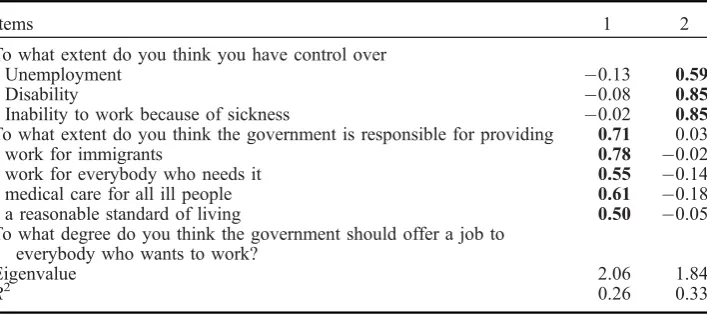
collective responsibilization constituted the end points of one and the same dimen-sion, but from our factor-analytic results, this proved not to be the case. The eight items we used to measure the responsibilization of dropping out of work loaded on two underlying latent factors instead of one (see Table 1). Moreover, the correlation between the scales for individual and collective responsibilization was rather low ( 0.20; p< 0.01). Hence, we decided to measure both kinds of responsibilization with separate scales.
Individual responsibilization was measured with three items that together
constitute a highly reliable scale (Cronbach’s α= 0.92). Assuming that the belief of
having the power to control labor risks such as unemployment, disability, and inability to work because of sickness implies the responsibility to do so, we asked respondents to indicate to what extent they thought they had control over these risks. The answering categories were: 1. No control at all, 2. No control, 3. No clear opinion, 4. Some control, 5. Total control, 6. Do not know, with the loadings on the first factor given in brackets: 1. ‘Unemployment’ (0.59), 2. ‘Disability’ (0.85), 3. ‘Inability to work because of sickness’ (0.85). Scale scores were calculated as the mean score for every respondent having a valid score on at least
Table 1. Factor analysis of items indicating responsibilization (varimax-rotated solution, N= 1771).
Items 1 2
To what extent do you think you have control over
•Unemployment 0.13 0.59
•Disability 0.08 0.85
•Inability to work because of sickness 0.02 0.85
To what extent do you think the government is responsible for providing 0.71 0.03
•work for immigrants 0.78 0.02
•work for everybody who needs it 0.55 0.14
•medical care for all ill people 0.61 0.18
•a reasonable standard of living 0.50 0.05
To what degree do you think the government should offer a job to everybody who wants to work?
Eigenvalue 2.06 1.84
R2 0.26 0.33
two of the three items used to measure individual responsibilization. Higher scores on this scale indicate that respondents think work-related risks are an individual responsibility.
Collective responsibilization was measured with five items that together
consti-tute a reliable scale (Cronbach’s α= 0.63). In this case, respondents were asked to
indicate to what extent they think the government is responsible for four different tasks (1. Certainly not, 2. Perhaps not, 3. Perhaps so, 4. Certainly so, 5. Do not know), with the loadings on the first factor given in brackets: 1. ‘Provide work for immigrants’ (0.71), 2. ‘Provide work for everybody who needs it’ (0.78), 3. ‘Providing medical care for all ill people’ (0.55), 4. ‘Providing a reasonable standard of living’ (0.61). Moreover, they were asked to what degree they agreed or disagreed with the statement that ‘the government should offer a job to everybody who wants to work’ (0.50). For those respondents having at least three valid scores on these five items, mean scores were calculated to create a scale for collective responsibilization. A high score indicates much collective responsibilization.
We conceive of utilitarian individualism as the internalization of the norm that people have to make rational calculative choices which optimize their life chances. We have measured this independent variable withfive items that together constitute a barely reliable scale (Cronbach’s α= 0.59). Respondents were asked to what
degree they agreed (1. Strongly disagree, 2. Disagree, 3. Neither disagree nor agree, 4. Agree, 5. Strongly agree, 6. Do not know) with the following statements (the loadings on the first factor are given in brackets): 1. ‘I prioritize my personal inter-ests above those of others’(0.61); 2. ‘I enjoy it when I can do a favor to other peo-ple’ (0.67; inverted item), 3. ‘Whenever I do something for somebody else, I want to get something back for it’(0.66), 4.‘I hardly ever think of the interest of others’ (0.69), 5. ‘I tend to feel involved with the problem of others rather quickly’ (0.45; inverted item). In order to create a scale, we calculated mean scores on at least four out of five items measuring utilitarian individualism. It goes without saying that utilitarian individualists score high on this scale.
Labor-market vulnerability was measured with four items that together
consti-tute a highly reliable scale (Cronbach’sα= 0.92). We asked respondents to indicate
how real they deemed the chance of having to invoke a particular social security benefit (1. No chance, 2. Very small, 3. Small, 4. Neither small, nor large, 5. Large, 6. Very large, 7. I already receive it) with the following statements (the loadings on thefirst factor are given in brackets): 1.‘Sickness benefit’ (0.81), 2.‘Unemployment benefit’ (0.88), 3.‘Disability benefit’(0.79), 4.‘Social benefit’(0.72). Factor scores were used to measure labor-market vulnerability. People scoring high on this scale are more vulnerable on the labor market.
As control variables we used age, gender, level of education, and net household income. Age is measured in years, ranging from 16 through to 91. 49.9% of the respondents are malesand 51.1% are females.Net household income is measured in Euros per month and has been coded into four categories: 1. 1150 Euros or less, 2. 1151–1800 Euros, 3. 1801–2600 Euros, 4. more than 2600 Euros. Educational level was measured using the highest level attained. Respondents have been recoded into six educational categories (percentages in brackets): 1. Primary education (11.4); 2. Lower secondary education (23.8); 3. Higher secondary education (11.4); 4. Intermediary tertiary education (30.4); 5. College (13.9); and 6. University (9.0).
Method
We tested the hypotheses with a linear ordinary least square regression analysis, entering all variables at the same time (method enter). Furthermore, in order to provide a test for hypotheses 3 and 4, which assume interactions between utilitarian individualism and labor-market vulnerability, an interaction term was calculated by multiplying utilitarian individualism with labor-market vulnerability. This interac-tion term was added to the regression models. Since we basically want to test two sets of contrary hypotheses (hypotheses 1 and 2 predict opposite outcomes, as well as hypotheses 3 and 4 do), we applied two-sided tests for significance. As the factor analysis presented above shows that there are two dependent variables, one tapping collective responsibilization and one tapping individual responsibilization, regres-sion analyses have been done separately for each dependent variable. The results are shown in Table 2. As the interpretation of interaction terms is harder than say direct effects, we presented the significant interactions we found graphically using the estimations in the models to predict the effect of utilitarian individualism on responsibilization for different levels of labor-market vulnerability.
Results
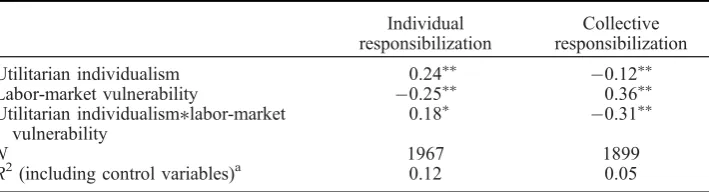
The first two hypotheses bear upon the direct effects of utilitarian individualism on the responsibilization of work-related risks. The risk society hypothesis emphasizes the centrality of people making their own choices serving their self-interest, and hence predicts that utilitarian individualism leads to an individualization of work-related risks. Conversely, the blame culture hypothesis predicts that utilitarian individualism results in rendering the government responsible for untoward events, and, hence, a collective responsibilization of work-related risks. Table 2 shows that utilitarian individualism increases an individual responsibilization of work-related risks and decreases a collective responsibilization. This means our findings support
therisk society hypothesisbut do not support the blame culture hypothesis. In other
words, our findings are in line with the idea that utilitarian individualism plays a role as a laissez-faire ideology that emphasizes individual responsibility, but are contradictory to utilitarian individualism conceived of as a role definition as a consumer citizen which renders the government responsible for the management of work-related risks.
Table 2. Individual and collective responsibilization explained by utilitarian individualism, labor-market vulnerability and their interaction (Beta’s).
Individual
responsibilization responsibilizationCollective
Utilitarian individualism 0.24⁄⁄ 0.12⁄⁄
Labor-market vulnerability 0.25⁄⁄ 0.36⁄⁄
Utilitarian individualism⁄labor-market
vulnerability 0.18
⁄ 0.31⁄⁄
N 1967 1899
R2(including control variables)a 0.12 0.05
a
R2 denotes the percentage of the differences in the dependent variable that can be attributed to utilitarian individualism, labor-market vulnerability, their interaction term, and four other independent variables used as covariates (i.e. age, gender, educational level, net household income).
⁄p< 0.05;⁄⁄p< 0.01 (two-tailed tests for significance)
Besides Table 1 shows, the more vulnerable one’s labor-market position, the less inclined one is to perceive work-related risks as an individual responsibility and the more inclined one is to perceive it as a collective responsibility.
The last two hypotheses bear upon the interaction effect of an insecure labor-market position and utilitarian individualism. The resentment hypothesis predicts
that supporters of utilitarian individualism with a vulnerable labor-market position are more inclined to an individual responsibilization of work-related risks than sup-porters of utilitarian individualism who occupy a more privileged economic position out of frustration of their own deprivation. The narcissism hypothesis predicts that supporters of utilitarian individualism with a vulnerable labor-market position are more inclined to a collective responsibilization of work-related risks than supporters of utilitarian individualism with a more privileged economic position, because this serves their self-interests best. Table 1 shows a positive interaction effect of an inse-cure labor-market position and utilitarian individualism on the individual responsibi-lization of work-related risks and a negative one on the collective responsibiresponsibi-lization of work-related risks. This supports the hypothesis stating that supporters of utilitar-ian individualism with a vulnerable labor-market position tend to perceive work-related risks more as an individual and less as a collective responsibility than those whofind themselves in a more secure labor-market position. Figures 1 and 2 graph-ically depict these two interaction effects. Conform the interaction terms in Table 1, Figure 1 shows that the more vulnerable the labor-market position, the stronger the positive effect of utilitarian individualism on individual responsibilization, while Figure 2 shows that the more vulnerable the labor-market position, the stronger the negative effect of utilitarian individualism on collective responsibilization. This means that our findings do not support the narcissism hypothesis but do support the
resentment hypothesis. Hence, utilitarian individualism does not seem to operate as
an egocentric strategy used to buck-pass the responsibility for risks run by oneself on to the community, while it may play a role as distrust of people who share their fate among the disadvantaged.
0 0,05 0,1 0,15 0,2 0,25 0,3 0,35 0,4 0,45
Labor market vulnerability
Strength of effect
Figure 1. Effect utilitair individualism on individual responsibilization.
Conclusion and discussion
We have tested the tenability of four theories about the consequences of utilitarian individualism on the management of work-related risk and found that it leads to indi-vidual rather than collective responsibilization. Furthermore, we have found that this tendency is strongest among supporters of utilitarian individualism who occupy a vulnerable labor-market position. Hence, both hypotheses pertaining to an individual responsibilization of work-related risks are supported by our findings, while those concerning a collective responsibilization of these risks are not supported by them. This implies that utilitarian individualism may operate as an ideological neoliberal doctrine rather than a self-centered attitude that privileges personal interest.
The latter tallies with Foucault’s analysis of neoliberalism as explicated by Lazzarato (2009). Central to neoliberalism, Foucault maintains, is an instituted competition that is constantly nourished and maintained by an inequality that serves to sharpen the appetites, minds, and instincts to drive individuals into permanent rivalry (see also Doogan 2009). It as such understands individuals as‘entrepreneurs’ who maximize themselves as ‘human capital’ in competition with others, while ‘government “becomes a sort of enterprise whose task it is to universalize competition and invent market shaped systems of action for individuals, groups and institutions”’ (Shamir 2011, 315/316 citing Lemke 2001, 197). The individual responsibilization of work-related risks does not only add to the general insecuriti-zation promoted by the neoliberal government of conduct, but also destroys social bonds and conditions for social cohesion (Lazzarato 2009, 111). Because economic relationships are by themselves unable to achieve being-one-with-the-other or being-together (l’être-ensemble), the neoliberal market logic intensifies the need for social and political integration, with disgust and animosity contributing to the con-stitution and fixing of territories and ‘identities’ which ‘capital’ lacks (Lazzarato 2009, 130). The institutionalization of competition thus contributes to an individual responsibilization of work-related risks, with especially the defeated inclined to attribute responsibility for work-related risks to others who share their own sorry
-0,35 -0,3 -0,25 -0,2 -0,15 -0,1 -0,05 0
1 1,1 1,2 1,3 1,4 1,5 1,6 1,7 1,8 1,9 2
Labor market vulnerability
Str
e
ngth of e
ffec
t
Figure 2. Effect of utilitair individualism on collective responsibilization.
fate. This enables them to dispel suspicions that their failure in the competitive battle may results from their denouncement of the norms that underlie neoliberal-ism. The fact that particularly people in vulnerable labor-market positions emphasize individual responsibility for work-related risk underscores that even those who suffer most from neoliberalism accept its ideology.
However, our study is limited in five respects. First, not all of our measurements have been optimal. We have measured individual responsibilization with a question concerning the extent to which respondents think they have control over the risks of unemployment, disability, and inability to work because of sickness. In doing so, we have assumed feelings of control automatically imply feelings of personal responsibility to control these risks as well. It would have been better to have asked for perceived personally responsibility more directly. Moreover, the reliability of the scale for utilitarian individualism was weak and is in need of improvement. Second, we have focused on work-related risks only. Follow-up research is needed to find out to what extent our findings are generalizable to other kinds of risks as well. Third, we have assumed ourfindings pertain to modern, western societies in general but have limited our study to the Netherlands only. Since the Netherlands is a highly individualized country (Van der Veen, Achterberg, and Raven 2012, 27–8) and has been a vanguard when it comes to the implementation of activating labor-market policies emphasizing individual responsibility in a traditionally elaborate welfare state (Lindsay and McQuaid 2008, 354), the Dutch case has offered a good opportunity to study the impact of utilitarian individualism on the responsibilization of work-related risks. However, it should be tested whether ourfindings can be gen-eralized to other modern, western countries as well. Four, because all four theories are based on the assumption that utilitarian individualism has increased, longitudinal follow-up research should investigate whether or not this is actually the case; if so, whether work-related risks have increasingly come to be understood as an individ-ual responsibility because of this; and whether the latter notion has particularly increased among citizens who occupy the most vulnerable labor-market positions. Finally, even though we have tested hypotheses about the consequences of utilitar-ian individualism for responsibilization of work-related risk, we have not explicitly studied the mechanisms assumed to underlie these consequences. Successively, the theory of the risk society assumes utilitarian individualism to function as a
laissez-faire political ideology, the theory of the blame culture as a role definition as
con-sumer citizen, the theory of lower class resentment as a strategy to cope with the negative feeling of being left to oneself unwillingly, and the theory of the culture of narcissism as a drive to serve self-interest best at all times. In order to decrease the gap between these theories and their empirical test, follow-up research should include measures for these explanatory variables themselves.
The limitations of our study are significant. This means our conclusions are provisional. Nonetheless, we have undertaken a serious attempt to empirically test theoretical assumptions underpinning ongoing debates about changes in contempo-rary modernity. This is what our study contributes to the literature. Whereas Beck has been extensively criticized for the lack of empirical underpinning of his theory of the risk society (Alexander 1996; Draper 1993; Mythen 2007, 802; Taylor-Gooby and Cebulla 2010, 732; Zinn 2008, 47/48), representatives of the other strains of modernization theory can be criticized for this as well. As such, conflicting grand narratives about modernization can be found abreast peacefully in the literature, which means that they need to be revised if they run into conflict withfindings from
empirical social research (Heiskala 2011, 16). Accepting this motto, our tentative
findings suggest theories about the rise of a blame culture and a culture of narcissism, both assuming increased collective responsibilization of work-related risks driven by increased utilitarian individualism, areflawed and need to be revised. The practical relevance of our findings is not self-evident. If public support of the individual responsibilization of work-related risks has indeed increased, then this does not imply public support of the collective responsibilization of these risks has decreased to the same extent. After all, we have shown that the negative correlation between supports of both kinds of responsibilization is not strong. In other words: weakening collective forms of protection against work-related risks does not auto-matically yield as much support as strengthening the individual responsibilization of these risks (see also Van der Veen, Achterberg, and Raven 2012).
Moreover, the assumed increased support of the individual responsibilization of work-related risks corresponds with the way the Dutch welfare state and that of other developed countries has been transformed during the last few decades; social rights have been curtailed and rights to social benefits have been combined with obligations to work (Raven 2012). However, according to the resentment theory, supporting the individual responsibilization of work-related risks does not automati-cally imply a willingness to take personal responsibility for these risks. Allegedly, supporters of utilitarian individualism in vulnerable labor-market positions allocate individual responsibility for these risks to others who share their fate, but do not apply this responsibility to themselves to the same extent. This implies supporters of utilitarian individualism in vulnerable labor-market positions support the individ-ual responsibilization of work-related risks in a general sense, but not or much less when it applies to themselves. Moreover, supporting individual responsibility for work-related risks can undermine feelings of solidarity. After all, Foucault suggests that people in vulnerable labor-market positions who support the individual respon-sibilization of work-related risks tend to favor a harsher treatment of others who share their fate in order to improve their own competitive position on the labor mar-ket. This implies that although increasing support of the individual responsibiliza-tion of work-related risks corresponds with the way welfare states have been transformed, it simultaneously instigates political conflict.
In short, increasing support of the individual responsibilization of work-related risks does not automatically imply decreasing support of the collective responsibili-zation of these risks, does not automatically imply that supporters of utilitarian indi-vidualism in vulnerable labor-market positions apply individual responsibilization to themselves, and may nourish political conflicts.
Acknowledgments
Thanks to Christine Parker, Luigi Pellizzoni, and Peter van Dam for their helpful comments on the previous version of this article that has been presented at the Risk, Uncertainty and Policy Conference, Sociology of Risk and Uncertainty Research Network (ESA), Mid-Sweden University, Östersund, 23–25 March 2011.
Notes
1. Two empirical studies conclude that at least in the Netherlands (Eshuis 2003) and the UK (Hand 2010) no such thing as an increased claim culture exists, which is consistent with the suggestion by Silbey (2009) and Almond (2009) that such a notion is basically a myth.
2. De Tocqueville (1986) had already foreseen the possibility of a collective responsibiliza-tion of risks in his De la démocratie en Amérique. Herein he argues that the USA were an example of a democracy that combines attention for individual liberty with active cit-izenship. The latter he primarily attributed to the prominent role of Christian religion that was translated in participation in charity organizations and social clubs. As such, he held secularization to result in citizens increasingly acting out of pure self-interest, ren-dering the government responsible for unforeseen events damaging this self-interest. Hence, it is understandable that the decreased dominance of traditional Christian faith in the USA and most other western countries has provoked a collective responsibilization of risks, as assumed by Lau (2009).
3. This also holds for new risks like climate change (Alario and Freudenburg 2010). 4. Not weighing the sample, though, does not yield any different results from those
presented in this article.
References
Achterberg, P., and E. Snel. 2008. Het einde van duurzame armoede? Over‘vertijdelijking’
en‘verduurzaming’van armoede [The end of durable poverty? On‘temporarization’and ‘durabilization’of poverty]Sociologie4: 53–68.
Achterberg, P., D. Houtman, and A. Derks. 2011. Two of a kind? Anti-welfarism and economic egalitarianism among the lower-educated Dutch. Public Opinion Quarterly 75, no. 4: 748–60.
Alario, M.V., and W.R. Freudenburg. 2010. Environmental risks and environmental justice, or how Titanic risks are not so Titanic after all.Sociological Inquiry80: 500–12.
Alexander, J.C. 1996. Critical reflections on ‘reflexive modernization’. Theory, Culture &
Society13: 133–8.
Almond, P. 2009. The dangers of hanging baskets: ‘regulatory myths’ and media
representations of health and safety regulation.Journal of Law and Society36: 352–75.
Andersen, J.G. 1992. Denmark: The progress party – populist neo-liberalism and welfare
state chauvinism. In The extreme right in Europe and the USA, ed. P. Hainsworth, 193–205. London: Pinter.
Bauman, Z. 2000.Liquid modernity. London: Polity Press.
Beck, U. 1992.Risk society: Towards a new modernity. London: Sage.
Beck, U. 1995. Replies and critiques: Self-dissolution and self-endangrement of industrial society. What does this mean? InReflexive modernization. politics, tradition and aesthet-ics in the modern social order, ed. U. Beck, A. Giddens, and S. Lash, 174–83. London:
Polity Press.
Bellah, R.N., R. Madsen, W.M. Sullivan, A. Swidler, and S.M. Tipton. 1985.Habits of the Heart: Individualism and Commitment in American Life. New York, NY: Harper & Row. Boutellier, H. 2003. De veiligheidsutopie: Hedendaags onbehagen en verlangen rond mis-daad en straf [The safety utopia: Contemporary discomfort on crime and punishment]. Den Haag: Boom Juridische Uitgevers.
Boutellier, H. 2005. De aanslag kwam van onderen [The attack came from under]. In Leven in de risicosamenleving [Living in the risk society], ed. E. Drayer, 43–6. Amsterdam:
Amsterdam University Press, Salomé.
Dalrymple, T. 2010. Spoilt rotten: The toxic cult of sentimentality. London: Gibson Square Books.
De Swaan, A (1988). In care of the state: Health care, education and welfare in Europe and the USA in the modern era. Cambridge: Polity Press.
De Tocqueville, A. 1986. De la démocratie en Amérique [Democracy in America]. Paris: Gallimard.
Dobbin, F., B. Simmons, and G. Garrett. 2007. The global diffusion of public policies: Social construction, coercion, competition, or learning? Annual Review of Sociology33: 449–72.
Doogan, K. 2009.New capitalism: The transformation of work. Cambridge: Polity. Draper, E. 1993. Risk, society, and social theory.Contemporary Sociology22: 641–4.
Durkheim, E. 1973 [1898]. Individualism and the intellectuals. In Emile Durkheim on morality and society, ed. R.N. Bellah, 43–57. Chicago, IL: University of Chicago Press.
Ekberg, M. 2007. The parameters of the risk society.Current Sociology55: 343–66.
Ericson, R. 2005. Governing through risk and uncertainty.Economy and Society34: 659–72.
Eshuis, R.J.J. 2003.Claims bij de rechtbank[Claims at court]. The Hague: Boom Juridische uitgevers.
Furedi, F. 2004. Therapy culture: Cultivating vulnerability in an uncertain age. London: Routledge.
Giddens, A. 1990.Consequences of modernity. Stanford, CA: Stanford University Press. Giddens, A. 1991.Modernity and self-identity. Stanford, CA: Stanford University Press. Gilbert, N. 2002.Transformation of the welfare state. Oxford: Oxford University Press. Gray, G.C. 2009. The responsibilization strategy of health and safety: Neo-liberalism and the
reconfiguration of individual responsibility for risk. British Journal of Criminology 49: 326–42.
Hand, J. 2010. The compensation culture: Cliché or cause for concern?Journal of Law and Society37: 569–91.
Heiskala, R. 2011. From modernity through postmodernity to reflexive modernization: Did we learn anything?International Review of Sociology21: 3–19.
Kochuyt, T., and A. Derks. 2003. Bitter als de brakke morgen: Over het ressentiment van ondergeschikte posities (Bitter as can be: On the resentment of the underprivileged). Amsterdams tijdschrift voor Sociologie30: 463–97.
Lasch, C. 1979. The culture of narcissism: American life in an age of diminishing expecta-tions. New York, NY: Warner Books.
Lash, S. 1995. Reflexivity and its doubles: Structure, aesthetics, community. In Reflexive modernization: Politics, tradition and aesthetics in the modern social order, ed. U. Beck, A. Giddens, and S. Lash, 110–73. London: Polity Press.
Lau, R.W.K. 2009. The contemporary culture of blame and the fetishization of the modern mentality.Current Sociology 57: 661–83.
Lau, R.W.K. 2012. Understanding contemporary modernity through the trends of therapy and life-‘skills’training.Current Sociology60: 81–100.
Lazzarato, M. 2009. Neoliberalism in action: Inequality, insecurity and the reconstitution of the social.Theory, Culture & Society26: 109–33.
Lemke, T. 2001. The birth of ‘bio-politics’: Michel Foulcault’s Lecture at the Collège de
France on neo-liberal governmentality.Economy and Society30: 190–207.
Lindsay, C.R., and McQuaid. 2008. Inter-agency co-operation in activation: Comparing experiences in three vanguard“active”welfare states.Social Policy & Society7: 353–65.
Mythen, G. 2005. Employment, individualization and insecurity: Rethinking the risk society perspective.The Sociological Review53: 129–49.
Mythen, G. 2007. Reappraising the risk society thesis: Telescopic sight or myopic vision? Current Sociology55: 793–813.
Peck, J., and A. Tickell. 2002. The urbanization of neoliberalism: Theoretical debates –
neoliberalizing space.Antipode34: 380–404.
Raven, J. 2012. Popular support for welfare state reforms. Rotterdam: Rottterdam Erasmus University.
Sefton, T. 2003. What we want from the welfare state. InBritish social attitudes 20th report, ed. A. Park, 1–28. London: Sage.
Shamir, R. 2011. Socially responsible private regulation: World-culture or world-capitalism? Law & Social Inquiry45: 313–36.
Silbey, S.S. 2009. Taming prometheus: Talk about safety and culture. Annual Review of Sociology35: 1–17.
Smith, S.S. 2007.Lone pursuit: Distrust and defensive individualism among the Black Poor. New York, NY: Russell Sage Foundation.
Stone, D.A. 1997. Policy paradox: The art of political decision making. New York, NY: W. W. Norton.
Taylor-Gooby, P., and A. Cebulla. 2010. The risk society hypotheses: An empirical test using longitudinal survey data.Journal of Risk Research13: 731–52.
Threadgold, S., and P. Nilan. 2009. Reflexivity of contemporary youth, risk and cultural capital.Current Sociology57: 47–68.
Turner, B.S. 2011. Max Weber and the spirit of resentment: The Nietzsche legacy. Journal of Classical Sociology11: 75–92.
Van den Brink, G. 2002. Mondiger of moelijker? Een studie naar de politieke habitus van hedendaagse burgers[More assertive or more difficult? A study into the political habitus of contemporary citizens]. Den Haag: Sdu Uitgevers.
Van der Veen, R., P. Achterberg, and J. Raven. 2012. Contested solidarity: Risk perception and the changing nature of Welfare State solidarity. In The transformation of solidarity: Changing risks and the future of the Welfare State, ed. R. Van der Veen, M. Yerkes, and P. Achterberg, 31–47. Amsterdam: Amsterdam University Press.
Van Stokkum, B. 2010. Wat een hufter! Ergernis, lichtgeraaktheid en maatschappelijke verruwing[What a bastard! annoyance, touchiness, and societal coarsening]. Amsterdam: Boom.
Zinn, J.O. 2008. Risk society and reflexive modernization. In Social theories of risk and uncertainty: An introduction, ed. J.O. Zinn, 18–51. Malden, MA: Blackwell.