RELATIONSHIP OF HOFSTEDE' S DIMENSIONAL CULTURE TOWARDS PERFORMANCE (FINANCIAL) OF MELAKA SME ' s SERVICE SECTOR COMPANY
MUHAMAD FIRDAUS ABO. RASHID
This report is submitted
as
partial requirement for the fulfillment of the Degree of the Bachelor in Technopreneurship with Honours.'\ Faculty of Technology Management and Technopreneurship
Universiti Teknikal Malaysia Melaka
I hereby declared this report entitled
"Relationship of Hofstede 's
Dimensional Culture towards (Financial) Performance of Me/aka SME 's from
the Service Sector"
and found that it has comply the partial fulfillment for awarding the degree ofBachelor of Technopreneurship with Honor"
Signature
Supervisor's Name Date
セ
ᆳ
I declared that this report entitle
"Relationship of Hofstede 's Dimensional
Culture towards (Financial) Performance of Me/aka SME 's of the Service
Sector" is the result of my own research except as cited in the references. The
report has not been accepted for any degree and is not concurrently submitted in
candidature of any other degree.
Signature
Name
Date
ᄋᄋᄋ ᄋᄋᄋᄋ ᄋᄋ ᄋᄋ セᄋᄋᄋᄋᄋᄋᄋᄋᄋᄋᄋᄋᄋᄋᄋᄋᄋᄋᄋᄋᄋᄋᄋᄋᄋᄋᄋᄋᄋᄋᄋᄋ@
..••.•••.••. •iJ..
セQセ@
( ').()
1j.: .• : .• : •.. : •• :.
:
'
To Muhammad pbuh, the coming Khilafah governance, my beloved Abdul Rashid Samudin and Sa'odah binti Ibrahim also the muslim worldwide
ACKNOWLEDGEMENT
Special thanks for my beloved supervisor, Prof. Madya Dr. Ahmad Rozelan Yunus by the cause of his gifted supervision and support, I finally making this final year project with full of ease and passion. Thank God, having him as a supervisor helping me settle and passing over all the circumstances and hard times.
To my housemate, class and roommate, especially to Fahimi Sofian, Amiruddin Abdul Manam , Haikal Abd Rahim, Nazirah Md. Zainun, Nur Azri Mahmud, Farhynne Kami! , Azmirah Mohamad, Wan Luqman Razali, Afiq Amin, Ridhwan Salamun, Nik Mohd Fariz and all people that helping and giving big aid to this project with their gold contribution. My great deals and appreciation go to the faculty members, and the faculty itself - Faculty of Technology Management and Technopreneurship (FPTT) . Wish we all luck.
ABSTRACT
After 16 years of operation, Small Medium Enterprise (SME) Malaysia have the undeniable great deeds towards supporting Malaysia economic growth, as well as providing a conducive business environment. This draw a big chances for entrepreneurial value to have its sustainability in Malaysia. However, there are few company that meet failure in even though being supervised by SME Corp. Among the factor known that threatened SME's sustainability, is the cultural practiced inside the company itself What kind of culture plays by a failure company? And what is the culture practiced by the leader company that make them surpassing their competitor? Professor Greet Hofstede 's with his cultural dimensions provide a clear way of culture classification, on helping market entity mastering a best way of handling culture problems. With this concept, a best working culture can be extracted and share in order to have a better future ·of entrepreneurial environment. With Melaka SME as a respondent, this paper focus on enhancing Melaka SME growth.
'
ABSTRAK
Setelah 16 tahun beroperasi, Perusahaan Kecil Sederhana (SME) Malaysia
tanpa diragukan mempunyai rekod cemerlang lerhadap memberikan sokongan dan
sumbangan dalam perlumbuhan ekonomi Malaysia, lermasuklah menyediakan
suasana perniagaan yang kondus{f lni memberikan peluang yang besar bagi
syarikat-syarikat yang bernaung di bawahnya untuk berkembang menjadi lebih pesal. Namun
setelah beberapa tahun beroperasi, masih lagi wujud syarikat-syarikat yang gaga!
menjadi antara yang terbaik, malah ada yang semakin mengecil. Hal ini diakui sendiri
oleh pihak pengurusan SME Corp. dan sememangnya berlaku. Di sana pasli wujud
beberapa faktor penyebab yang menjadi punca dan mengancam perkara tersebut
daripada berlaku. Anlaranya adalah budaya kerja yang diamalkan dalam
syarikat-syarikat tersebut. Apakah jenis budaya kerja yang menyebabkan gagalnya
keberlangsungan syarikat-syarikat di dalam pasaran mereka? Dan apa pula budaya
kerja yang diamalkan oleh syarikat-syarikat yang beraksi cemerlang? Professor Greet
Hofstede dengan teori dimensi budayanya telah menyediakan jalan yang jelas untuk
pengelasan budaya kerja, bagi membantu pengurusan budaya yang leih berkesan.
Melalui konsep-konsep tersebut, suatu budaya kerja yang- lengkap dan terbukti
berkesan boleh dikefuarkan dan dikongsikan dalam membantu mempergiat dan
memperluaskan demi keadaan pasaran yang lebih baik di masa akan datang. Dengan
menggunakan syarikat-syarikat SME di Me/aka sebagai responden, kajian ini
bertzljuan untuk mempermudah tumbesaran .syarikat-syarikat SME di sekitar Me/aka.
TABLE OF CONTENT
SECTION ITEMS PAGE
SUPERVISOR APPROVAL
RESEARCHER DECLERATION II
DEDICATION Ill
ACKNOWLEDGEMENT IV
ABSTRACT v
ABSTRAK VI
TABLE OF CONTENT VII
LIST OF TABLES x
LIST OF FIGURES XI
LIST OF ABBREV IATIONS XII
LIST OF APPENDICES XIII
SECTION 1 INTRODUCTION
1.0 Background of the Study
1. 1 Problem Statement 4
1.2 Resea rch Questions 4 1.3 Research Objectives 5 1.4 Scope, Limitat ion and Key Assumption 5 1.5 Importance of Research 6
SECTION 2 LITERATURE REVIEW 7
2.1 Hofstede 's Cu ltu ra l Dimensions 6
2.2 Performance 9
2.3 Theory Research and Review 10 2.3. 1 Power Di stance (POI) 10 2.3 .2 Individualism (IDV) 11 2.3 .3 Ma sc ulinity 11 2.3.4 Unce1tainty Avo id ance 12
2.4 Theoretica l Framework 14
2.6 Summary 15
SECTION 3 METHODOLOGY
16
3.0
Introductio n16
3 .1
Research Design17
3.
I.I
Deductive Research Design17
3.1.2
Exp lanatory Research Design18
3.1.3
Samp le population process18
3.2
Data Co llection19
3.2.l
Primary Data19
3.2.2
Secondary Data20
... Technique Used for Research
20
J.J
3.4
Questionnaire Development20
3.5
Reliability and Validity22
3.5.1
Construct Validity22
3.5 .2
Reliability22
3.5.3
Interna l Validity 223.6
Research Framework22
3.7
Summary23
SECTION 4 RESULT AND DISCUSSION
24
4.0
Introductio n24
4. 1
Result Findings25
4.1.1
First Research Objective25
a) Questionnaire Ana lysis
25
b) Respondent Background
23
c) Ana lys is for Demographic
24 - 32
Jn formation
d) Independent Variables
33 - 38
4.1.2
Second Research Objective'
39
a) Co rrelation between Variab les
4.5
Summary43
SECTION 5 CONCLUSION AND RECOMMENDATIONS
44
5. 1
Conclus ion of F indings: Answering the45
Objectives
5.1.1
First Objective45
a) Distribution of Dem ogra phic
45
Profile
i) Gender
46
ii) Age Range
46
iii) Working Positions
46
iv) Years Workin g
47
b) Culture Implemented by the
47
High Performance SME's
i) Power Distance
48
ii) Individualism
48
iii) Masculinity
48
iv) Uncertainty Avoidance
49
5.1.2
Second Objective50
c) Correlation
50
5.1.3
Recommendation and Suggestions for52
Future Resea rch
5.2
Summary53
BIBLIOGRAPHY
54
APPENDICES
56
LIST OF TABLE
TABLE
TITLE
PAGE
1.0
Number of people a business employs based on ..., .)number of full -time employees
1.1
Annual sales turnover that act as guide of SME3
classification
4.0
Cronbach Alpha table of Internal Consistency26
4.1
Reliability Statistics of Data Gathered26
4.2
Gender Proportion in the Company26
4.3
Age Propo1tion of Respondent28
4.4
Respondent According to the Positions29
4.5
Respondent according to Years of Working30
4.6
Range of Mean in the Variables32
4.7
Range of Mean in the Variables33
4.8
The Pearson Correlation Scale39
4.9
Correlations of Independent and Dependent40
Variable
'
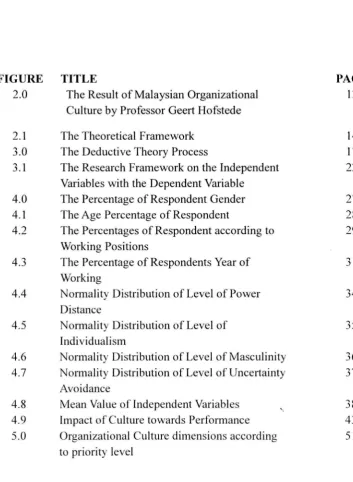
LIST OF FIGURES
FIGURE
TITLE
PAGE
2.0
The Result of Malaysian Organizational12
Culture by Professor Geert Hofstede
2.1
The Theoretical Framework14
3.0
The Deductive Theory Process17
3. 1
The Research Framework on the Independent22
Variables with the Dependent Variable
4.0
The Percentage of Respondent Gender27
4.1
The Age Percentage of Respondent28
4.2
The Percentages of Respondent according to29
Working Positions
4.3
The Percentage of Respondents Year of31
Working
4.4
Normality Distribution of Level of Power34
Distance
4.5
Normality Distribution of Level of35
Individualism
4.6
Normality Distribution of Level of Masculinity36
4.7
N01mality Distribution of Level of Uncertainty37
Avoidance
4.8
Mean Value of Independent Variables38
'
4.9
Impact of Culture towards Performance43
5.0
Organizational Culture dimensions according51
to priority level
SME POI IDV MAS
UAI IBM SPSS
LIST OF ABBREVIATIONS
Small Medium Enterprise Power Distance
Individualism Masculinity
Uncertainty Avoidance
IBM Statistical Product and Service Solutions
APPENDIX
A
B
LIST OF APPENDICES
TITLE
Questionaire
Kriejci and Morgan Table of Population
PAGE
56
60
SECTION I
INTRODUCTION
1.0 Background of the Study
Since the first time of operation o n 2 May 1996, Ma laysia mall Medium
Enterprise (SME) relatively play huge respo nsibility on developing the best support
for small and medium company development. With the importance o f developing a
group of diverse and competitive small and medium enterprises (SMEs) towards
sustainable economic growth, SMEs are cruc ia l to the economic growth process and
play an important role in the country's overall production network.
Although the numbers might be lower in Malaysia, SMEs have the potential
to contribute subs tantia lly to the economy and can provide a strorrg foundation for the
growth of new industries as well as strengthening ex isti ng ones, fo r Malaysia's future
development. Thousands of company were success and create a big name under SME
Corp. supervision, and some unluckil y, onl y appear on their first step in business.
The year of 1996 witnessed a specialised agency was established to spur the
development of small and medium enterprises (SMEs) by providing infrastructure
facilities, financial assistance, advisory services, market access and other suppo1t
programmes. Known as the Small and Medium Industries Development Corporation
(SMIDEC), its aim was to develop capable and resilient Malaysian SMEs to be
competitive in the global market.
The establishment of the National SME Development Council (NSDC) in
2004 presented yet another chapter in SME development in Malaysia. As the highest
policy-making body, its role was to formulate strategies for SME development across
all economic sectors, coordinate the tasks of related Ministries and Agencies,
encourage partnership with the p1ivate sector, as well as ensure effective
implementation of the overall SME development programmes in this country.
Initiatives under NSDC included enhanced access to financing, financial restructuring
and advisory services, infonnation, training and marketing coordination, and a
comprehensive SME database to monitor the progress of SMEs across all economic
sectors.
2007, the NSDC were then decided to appoint a single dedicated agency to
formulate overall policies and strategies for SMEs and to coordinate programmes
across all related Ministries and Agencies. SMIDEC was tasked to assume the role
and the official transformation into Small and Medium Enterprise Corporation
Malaysia (SME Corp. Malaysia) commenced on 2 October, 2009. SME Corp.
Malaysia is now the central point of reference for information and advisory services
for all SMEs in Malaysia .
2
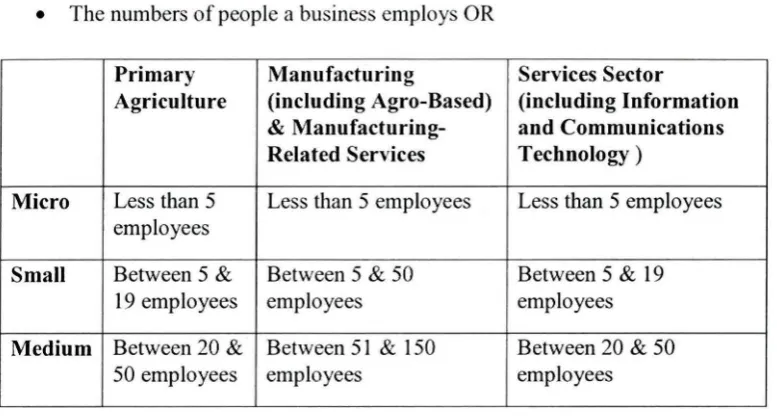
Malaysian SMEs can be grouped into three catego1ies: Micro, Small, or
Medium. These groupings are decided based on either:
• The numbers of people a business employs OR
Primary Manufacturing Services Sector
Agriculture (including Agro-Based) (including Information & Manufacturing- and Communications Related Services Technology )
Micro Less than 5 Less than 5 employees Less than 5 employees employees
Small Between 5 & Between 5 & 50 Between 5 & 19 19 employees employees employees
[image:17.526.81.470.123.333.2]Medium Between 20 & Between 51 & 150 Between 20 & 50 50 employees employees employees
Table 1.0: The numbers of people a business employs based on the number of
fi1ll-time employees
• Or Annual Sales Turnover
Primary Manufacturing Services Sector
Agriculture (including Agro- (including Information Based) & and Communications
Manufacturing- Technology
Related Services
Micro Less than Less than RM250,000 Less than RM200,000 RM200,000
Small Between Between RM250,000 & Between RM200,000 & RM200,000 & less than RM I 0 million less than RM I million less than RM 1
"'
millionMedium Between RMJ Between RMIO million Between RM 1 million & million & RM5 & RM25 million RM5 million
million
Table 1.1: Annual sales turnover that act as a guide on SME classification. (Source:
smeinfo.com.my)
3
[image:17.526.79.465.399.648.2]1.1 Problem Statement
SME's programme is such a brilliant idea and also an excellent ways on
supporting the small and medium business growth and sustainability. Through all this
year of operation, Malaysian SME's company, as research focus, Melaka SME' s
exposed freely to exchange happen in the global market. Foreign Direct Investment
(FDI) repeatedly occur and penetrating local market, threatening local product
existence. This is the effect of globalization era, where technology has brought the
world much closer together. As the effect, local company and product does not have
a place on the market of their own country.
Only few SME's famous ly known with their comprehensiveness. All the
company develops themselves under one same aim, to become a successful company
at the end of the day. But, important thing like working culture rather turning their
path to go down. A deja vu on failure is unforgiveable, due to the cost of money and
time it takes. Preventing a same failure to be happen again is one of the aims of this
research, in order to have a best organizational culture develop on the company. This
research focusing on exploring the practised culture on high performance company.
1.2 Research Questions
The research questions will basically rolling on:
1.2.1 What is the culture practised by successful SME's company 1n
Melaka?
1.2.2 How well do culture contribute to the sustainability of the Melaka
SME?
4
1.3 Research Objectives
This research mainly focusing on this objectives as the guidance of its approval:
1.3.1 Identifying the working culture that proven effective in contribution of
the comprehensiveness of any service sector company of Melaka
SME's.
1.3.2 Suggesting a best working culture to be implemented in new SME's
service sector company.
1.4 Scope, Limitation and Key Assumption
This research will only providing and suggesting the best culture to be
developed in order to increasing the performance service sector SME' s company in
Melaka context, according to Professor Geert Hofstede 's culture dimensions. There
are lot of culture views to be focused in comparison with Hoftede's. The finding of
this research will only valid in usage new corner under SME's company. Thus its
affectivity on SME 's of other region is uncertain. Furthermore, the result of thi s
findings only proven effective for business of the same sector, as SME Corp has other
two class of company and three level of company classification criteria which not be
covered on this study.
5
l.5 Importance of the Research
This project importance clearly seen as it is focusing on providing the
guidelines of best culture implemented in high performance company, thus make
swift of the new comer or newly develop company to act without the necessity of
experimenting the best culture to be used in order to reach the optimum performance. In short, this project a best solution of cutting the cost of finding a best culture to be
implemented and becoming a high performance company in shorter time period.
SECTION 2
LITERATURE REVIEW
2.1 Hofstede's Cultural Dimensions
These inputs were gathered from boo ks, journals and few reli abl e academi cs
websites. On understanding the importance of developing one culture, it was a
necess ity to understand the meaning of o rganizational culture.
Pettinger (2000) states that culture in organizati o n is a summ ary o f the ways
in whi ch acti viti es are co nduc ted and stand ard s and va lues adopted. It enco mpasses
'
the c limate o r a tmosphere sun-ounding the organiza tion, preva iling a ltitudes w ithin ,
standard s, mo rale, strength of fee ling towards it and general levels o f goodw ill
present. It is an essential feature o f e ffec ti ve organi zati on crea ti on and perfo rma nce.
(Pettinger, 2000)
The culture of a company normally comes from the ultimate source o f an
o rgani za tio ns; the fo unders. Founders of an o rgani zation traditio nally have maj o r
influence as they are the one who start a ll the process, initiatives from th e very scratch.
(Robbins & Judge, 2008). They owned a vision o f what orga nizatio n should be. The
cul ture at Hyundai, the giant Korean conglomerate, is la rge ly a re fl ec ti o n of its
fo und er Chung Ju Yun g. H yund ai's fi erce co mpetitive sty le and its di sc iplined,
authoritarian nature are the same characteristi cs often used to desc ribe Chung .
(Robbins & Judge, 2008).
How could the management team deal with critica l stakes like culture? The
fac t is that culture de fin es company's future ex istence. A ll thi s questi ons were then
answered by a psychologist, named Dr Geert Hofstede, have done an internationa ll y
recognized standard on the best method to mastering o ne culture, managing w ithout
los ing company identity as well as developing a perfect company culture fo r company
purposes. (Mind Too ls). Professo r G eert Hofstede conducted o ne of the mos t
comprehensive studies of how values in the workplace are influenced by culture.
Through the publication of his scholarl y book "Culture's Consequences"
(J 980, new edition 200 I), Geert Hofstede in titl e of Phil osophy Doctor a t thetim e
became the fo under o f comparative intercultu ra l research. His most popul ar boo k
"Cultures and Organizati ons: Software of the Mind " ( 199 1, new editi on 20 I 0,
co-authored with G ert Jan Hofstede and Michae l Minkov) has so fa r appea red in about
20 la nguages .
W ith access to people working fo r the sa me orga ni za ti o n in over 40 countri es
of the wo rld , Hofstede co llected cultural da ta a nd analysed hi s find ings by initi a ll y
identifi ed fo ur di stinct cultu ra l dimensions that served to disting uish one culture from
another. Later he added a fifth dim ension and that is how the mode l stands today . He
scored each country using a sca le o f roughl y 0 to I 00 fo r eac h dim ension. The higher
the sco re, the more that dimension is ex hibited in soc iety. T hose studi es foc used o n
identified cultural similarities and difference among the 116 000 staff of IBM located
in 40 countries. (Pettinger, 2000)
Developing a culture of a company take a few factors of consideration, which
include the bad and benefit contains in that particular culture. Mastering the
dimensions ruled by Hofstede ' s is the most simplest and reliable way of classifying
organizational culture of working.
2.2 Performance
The primary target of adopting effective management is measured by the
company performance. What actually the performance, how to tell about its measure
ability and what is the best way of looking towards it. As such, some methods of
measuring performance are needed to determine how well an organization functioning
as the result of implementing the best culture dimensions studied by Hofstede's.
Good performance is the criterion whereby an organization determines its
capability to prevail. Performance measurement estimates the parameters under which
programs, investments, and acquisitions are reaching the targeted results (OCIO,
2007). Mandy 2009 identified company performances can be measured in many
criteria which including the effectiveness, growth and productivity. · Several
perfonnance measurement systems are in use today, and each has its own group of
supporters. For example, the Balanced Scorecard (Kaplan and Norton, 1993, 1996,
2001)
Although the Balanced Scorecard has become very popular, there is no single
version of the model that has been universally accepted. The diversity and unique
requirements of different enterprises suggest that no one-size-fits-all approach will
ever do the job. Gamble, Strickland and Thompson (2007, p. 31) list ten financial
objectives and nine strategic objectives involved with a balanced scorecard.
On measuring the company performance, thi s study will focus on .financial
scope as the measurement of performance, using the guide provided by SME Corp.
2.3 Theory Research and Review
Pettingger (2000) on his books state that, Professor Geert Hofstede ' s on his
global culture study and classification, classified the world culture into four reliable
dimensions. Starting with four dimensions - Individualism, Power Distance,
Uncertainty avoidance, and Masculinity - Hofstede's were then found another new
dimensions which also viable in term of cultural analysing and classification; the so
called Long Term Orientation.
The dimension that Hoftede 's came out with is basically used for a company
with the vision of penetrating foreign market, which has different culture like they
did. In other words, these dimensions are used as a tool to understanding the foreign
culture, so the management can easil y engage and penetrating that particular market
with the wananty of sustainability.
Hofstede's came with the conclusions as stated below:
2.3.1 Power Distance (POI)
The study looked at the extent to which managers and supervisors were
encouraged or expected to exercise power to provide order and discipline
among workers. In other words, power and influences distributed across the