INDONESIA’S RICE PRICE STABILISATION: POLICY
RESPONSES TO THE STAPLE FOOD PRICE SPIKES OF
2007–2008
TESA LISTYA KUSUMAWARDANI
POSTGRADUATE SCHOOL
BOGOR AGRICULTURAL UNIVERSITY BOGOR
STATUTORY DECLARATION
I, Tesa Listya Kusumawardani, hereby declare that the master thesis entitled
“Indonesia’s Rice Price Stabilisation: Policy Responses to the Staple Food Price Spikes of 2007–2008” is my original work under the supervision of Advisory Committee and has not been submitted in any form and to another higher education institution. This thesis is submitted independently without having used any other source or means stated therein. Any source of information originated from published and unpublished work already stated in the part of references of this thesis.
Herewith I passed the thesis copyright to Bogor Agricultural University.
RINGKASAN
TESA LISTYA KUSUMAWARDANI. Stabilisasi Harga Beras di Indonesia: Respon Kebijakan Terhadap Kenaikan Harga Pangan Pokok pada Tahun 2007– 2008. Di bawah bimbingan HERMANTO SIREGAR and KYM ANDERSON.
Sebagaimana lonjakan kenaikan harga beras internasional pada tahun 2007– 08 diduga telah mengakibatkan timbulnya berbagai permasalahan ekonomi dan politik di banyak negara berkembang, banyak pemerintah telah mengubah pembatasan perdagangannya untuk mengurangi transmisi dampak lonjakan harga tersebut terhadap pasar domestik. Selain itu, mereka juga menerapkan berbagai kebijakan dalam negeri untuk menjaga stabilitas harga beras di pasar domestik. Studi ini mengevaluasi kebijakan stabilisasi harga beras yang diterapkan oleh Pemerintah Indonesia dalam merespon naiknya harga beras internasional, guna menyelidiki tujuan dan konsekuensi dari kebijakan tersebut.
Hasil evaluasi menunjukkan bahwa tidak mungkin untuk menjamin tercapainya ketahanan pangan (beras) negara dengan harga terjangkau bagi konsumen sekaligus meningkatkan kesejahteraan petani secara bersamaan dengan hanya menggunakan langkah-langkah kebijakan perdagangan. Studi ini menekankan pentingnya perjanjian perdagangan internasional. Beberapa altenatif kebijakan seperti pencegahan degradasi sekaligus ekspansi lahan pertanian, investasi dalam infrastruktur pedesaan, R&D, dan ICT pertanian, serta pengembangan aspek kelembagaan, seperti yang diusulkan dalam studi ini, dapat meningkatkan ketahanan pangan dan mengurangi kemungkinan terjadinya lonjakan harga beras internasional di masa depan.
SUMMARY
TESA LISTYA KUSUMAWARDANI. Indonesia’s Rice Price Stabilisation:
Policy Responses to the Staple Food Price Spikes of 2007–2008. Under Supervision of HERMANTO SIREGAR and KYM ANDERSON.
As the upward spike of international rice prices in 2007–08 might have generated a wide range of economic and political problems in many developing countries, the governments altered their trade restrictions to reduce the transmission of its impact to the domestic market. In addition, they applied various domestic policies to maintain the stability of the domestic rice prices. The aim of this study is to evaluate the rice price stabilisation policies applied by the Government of Indonesia in response to the soaring international rice prices in order to investigate the objectives and consequences of the policies.
The findings show that it is impossible to ensure the country’s food (rice) security at affordable prices for consumers and improve farmers’ welfare
simultaneously using just trade policy measures. The study also stresses the importance of international trade agreements. It suggests the prevention of agricultural land degradation, agricultural land expansion, high-payoff investments in rural infrastructure, R&D, and ICT for agriculture, and institutional development could increase food security and reduce the likelihood of international rice prices spiking in the future.
© Copyright belongs to IPB, 2015
All Rights Reserved Law
Prohibited quoting part or all of this paper without including or mentioning the source. The quotation is only for educational purposes, research, scientific writing, preparation of reports, writing criticism, or review an issue; and citations are not detrimental to the interests of IPB.
INDONESIA’S RICE PRICE STABILISATION: POLICY
RESPONSES TO THE STAPLE FOOD PRICE SPIKES OF
2007–2008
TESA LISTYA KUSUMAWARDANI
Master Thesis
as a requirement to obtain a degree Master of Science in Economics Program
POSTGRADUATE SCHOOL
BOGOR AGRICULTURAL UNIVERSITY BOGOR
Thesis Title : Indonesia’s Rice Price Stabilisation: Policy Responses to the Staple Food Price Spikes of 2007–2008
Name : Tesa Listya Kusumawardani
NIM : H151120181
Approved Advisory Committee,
Prof Dr Ir Hermanto Siregar, MEc Prof Kym Anderson
Agreed
Coordinator of Major Economics Dean of Postgraduate School
Dr Ir Nunung Nuryartono, MSi Dr Ir Dahrul Syah, MScAgr
ACKNOWLEDGEMENT
Above all, my greatest gratitude goes to Allah SWT God almighty for the multitude of His mercies. I would also like to take this opportunity to express my immense gratitude to all those persons who have given their invaluable support and assistance. In particular, I am profoundly indebted to my supervisors, Professor Hermanto Siregar and Professor Kym Anderson, who were very generous with their time and knowledge and assisted me in each step to complete the dissertation. Without their supervision and constant help, this dissertation would not have been possible.
I also extent my gratitude to all lecturers and staff at the University of Adelaide especially Athena Kerley, Niranjala Seimon, Augustine Bhaskarraj and Nicole Rizzo-Gray for their support and contribution to my study at The University of Adelaide.
I would like to acknowledge with thanks to the Ministry of Trade Republic of Indonesia and the Australian Award Scholarship for sponsoring my entire studies. I would also like to thank Bogor Agricultural University and The University of Adelaide for giving me the opportunity to study my master degree.
I would also like to acknowledge Elite Editing for giving me editorial assistance to improve the quality of my thesis. The editorial intervention was restricted to Standards D and E of the Australian Standards for Editing Practice.
Also I want to thank all my friends, especially lima sekawan plus one (Shanty, Nadya, Indra, Meindro, and Ari) and my friends in Indonesia (Tresna, Renita, Ratna, Lia, Alfie, Ricky, and Angga) for their help and spiritual support.
Notwithstanding all of the above support for this thesis, any errors and/or omissions are solely my own.
Finally I would like to thank my parents, my beloved husband, Aulia, and our lovely children, Nadia & Alta, for their love, prayers, sacrifice and support throughout entire process. This thesis is dedicated to them.
Bogor, March 2015
TABLE OF CONTENTS
LIST OF FIGURES ... xi
LIST OF TABLES ... xi
LIST OF ABBREVIATIONS ... xi
1. INTRODUCTION ... 1
2. BACKGROUND ... 2
3. LITERATURE REVIEW ... 4
Theoretical Framework ... 4
Impact of Rising International Rice Prices ... 4
The Approaches of Stabilising Domestic Rice Prices ... 5
The Impact of Governments’ Interventions on World Rice Prices ... 5
Empirical Framework ... 6
4. DISCUSSION ... 7
The Evaluation of Indonesia’s Rice Price Policy Responses ... 8
Reduction in Import Restrictions ... 8
Export Ban ... 9
Raising the Government Reference Purchase Price ... 11
Consumer Subsidy for the Poor ... 11
Suggested Implementation ... 13
Prevention of Agricultural Land Degradation ... 14
Agricultural Land Expansion ... 14
Investment ... 15
International Trade Agreement ... 17
Institutional Aspect ... 17
5. CONCLUSION ... 18
REFERENCES ... 19
LIST OF FIGURES
Figure 2.1:International Rice Prices and Indonesia’s Producer Support Estimates
on Rice, 2000–2013... 3 Figure 3.1: Effect of Offsetting Export Barrier Increases and Import Barrier
Reductions in the International Food Market ... 6 Figure 4.1:Indonesia’s Imported Quantity of Rice (HS 1006), 2001–2008 ... 9 Figure 4.2:Indonesia’s Exported Quantity of Rice (HS 1006), 2001–2008 ... 10 Figure 4.3: International and Domestic Wholesale Rice Prices, 2000–2008 .. 12 Figure 4.4: Perceptions of the Quality of Local Road Infrastructure in
Indonesia,
by Province, 2011 ... 15 Figure 4.5:The Share of Indonesia’s GDP in Improving Telecommunication
Services, 2000–2013 ... 16
LIST OF TABLES
Table 4.1: Policy Responses to Rising Commodity Prices in 2007–08 ... 8
LIST OF ABBREVIATIONS
ASEAN Association of Southeast Asian Nations GDP Gross Domestic Product
GOI Government of Indonesia GPP Government Purchase Price
ICT Information and Communication Technology IMF International Monetary Fund
NTB Non-tariff Barriers
1
1
INTRODUCTION
Staple food price spikes in 2008 triggered panic situations in many developing countries. Since then, global commodity prices have fallen. However, they still fluctuate above the prior price levels, which causes uncertainty and leads to higher prices for domestic foods, including rice, in many countries. Rice is one of the staple foods that play an important role in the economic, social and political stabilisation of most Asian developing countries, including Indonesia. Higher rice prices can harm poor net buyers of rice, thereby inducing economic and social chaos (Ahsan, Iftikhar & Kemal 2012). Therefore, governments attempt to stabilise the domestic price of rice.
There is an intense polemic about the approaches governments can take to stabilise food prices. Due to the international staple price spikes of 2007/2008, this issue has recently become a major concern in many international forums, such as G20 annual meetings. One approach is for countries to agree multilaterally to trade liberalisation. Another approach is for national governments to intervene by varying their border restrictions on trade. Trade liberalisation is theoretically considered to be the best way to provide efficient resource allocation. However, many governments, especially in developing countries, argue that the existence of market failures, such as imperfect markets and the low quality of infrastructure (which commonly occur in these countries, including Indonesia) requires government intervention to help stabilise domestic prices of staple foods.
Hence, the question arises as to whether the market intervention applied by the Indonesian government is effective in stabilising the prices of staple foods, particularly rice. The next questions are:
What are the real objectives of Indonesia’s rice price stabilisation policy?
What are the costs and benefits of the implementation of these policies? An effective policy applied by the government is expected to reduce the adverse impact of the global rice price spikes that occurred in 2007–2008 and prevent it from occurring in the future. This would be beneficial to the economic welfare of Indonesia.
This study aims to evaluate the implementation of rice price stabilisation policies in Indonesia. It also investigates what factors should be considered in applying these policies. The next section of the paper outlines the background of
Indonesia’s rice price policies. Following this, the literature review focuses on the
2
2
BACKGROUND
Rice is the staple food of more than 90 per cent of the population of Indonesia (McCulloch & Timmer 2008). Thus, a high weight of expenditure (or earnings spent on rice sellers) for the majority of Indonesian households, especially the poor, is allocated to rice consumption. This could be the reason why rice prices have become one of the important factors that affect the economic and social stability of Indonesia. Therefore, rice price stabilisation is an important goal for the Government of Indonesia (GOI). Government policies have non-trivial effects on other countries however, because, in terms of rice consumption, Indonesia is the third largest consuming country in the world after China and India (USDA 2014).
Prior to the staple food price spikes of 2007–2008, the changes in the rice policies applied by the GOI can be divided into four broad phases. These phases include the period of import substitution (the late 1960s–1984), export orientation (1985–1996), crisis (1997–1999), and recovery (2000 onwards) (Fane & Warr 2009). The first phase started in the late 1960s, when the New Order regime, under Suharto's leadership as the second president of Indonesia, began. At the beginning of this period, the rice policies implemented by the Government were directed at maintaining the stability of rice prices in the domestic market. The purpose of these policies was to prevent the occurrence of high inflation due to rising prices in staple foods on a large scale, as had occurred at the end of the Old Order regime. In order to achieve this goal, the Government attempted to boost domestic rice production and reduce rice imports by supporting the local market with the provision of input subsidies, better infrastructure, irrigation systems, and innovation, such as the green revolution programme (McCulloch & Timmer 2008).
In the early 1970s, protection for agricultural commodities, mainly rice, was largely increased. At that time, the Government put forth import reductions as it aimed to achieve rice self-sufficiency and started to implement import-substituting industrialisation (Fane & Warr 2008). By organising a massive guidance programme called Bimas, the Government provided input and credit subsidies for farmers. This assistance was financed by additional oil export revenue earned from rising world oil prices in the 1970s.
During 1985–1996 however, the Government phased out protection for rice. The first reason for the change was the falling international oil price in the
mid-1980s, which led to a decline in the Government’s export revenues. Thus, the
Government could no longer afford to provide the same level of subsidies to farmers. As a result, the domestic production of rice continued to decline until the Asian financial crisis of 1997–1998 (McCulloch & Timmer 2008). The other reason is Indonesia became a member of the World Trade Organization (WTO) in 1995. Since then, several trade reforms, such as reductions of tariffs or non-tariff barriers (NTBs), and cuts to agriculture input subsidies, have been implemented for most of
Indonesia’s import-competing commodities.
3 Fund (IMF) (van Dijk & Szirmai 2006). However, The IMF gave a conditional loan that required the Government to remove its restrictions on imports, especially for agricultural commodities such as rice and sugar. Moreover, the Government was obliged to abolish the rice import monopoly of the national logistics agency (Bulog). Thus, during the period of debt repayment to the IMF, the Government implemented a pro-market mechanism as an approach to rice price stabilisation.
However, in the recovery period after the Asian financial crisis of 1997–1998, there has been a reversal of the rice policies applied by the GOI. The Government again intervened to stabilise domestic rice prices. In 1999, the Government began to impose rice import tariffs of 20 per cent, which was then changed to a specific tariff (Rp430/kg). Further, in 2002 the Government returned a mandate to Bulog regarding the monopoly on rice imports. Finally, in 2004, restrictions on rice imports were again imposed by the Government.
After 2004, there has been an upward trend in international rice prices. As shown in Figure 2.1, the real annual prices of rice increased gradually from US$279/mt in 2004 to US$342/mt in 2007, and rose sharply to US$632/mt in 2008. During this period, the international rice price rose by more than 200 per cent. This price surge has led to the higher domestic prices of rice in many countries, depending on the price transmission mechanism and the exchange rate movements of each country (Abbott & de Battisti 2011).
Figure 2.1 International Rice Prices and Indonesia’s Producer Support Estimates on Rice, 2000–2013
Source: (World Bank 2014a & OECD 2013a)
Since the transmission of price is closely related to government protection policies, the GOI reversed its protective trade policy during the upward spike of international rice prices in 2008 in order to minimise the impact on the domestic
market. It can clearly be seen from Figure 2.1 that the movements of Indonesia’s
-50.00
2000 2001 2002 2003 2004 2005 2006 2007 2008 2009 2010 2011 2012 2013
In
4
Producer Support Estimates (PSE) on rice were mostly positive between 2000 and 2013, except for the rice price spike in 2008. The PSE fell from 25 per cent in 2007 to -40 per cent in 2008, and rose again to 30 per cent after the international rice price had declined in 2010 (OECD 2013a). This means that the Government policy was not only aimed at assisting farmers in low price periods, but also preventing a spike in domestic consumer rice prices when there is an international price shock as occurred in 2008.
3
LITERATURE REVIEW
Volatile world food prices, especially for rice, such as those from 2008, can be problematic for countries due to the high degree of risk for poor economic agents (FAO 2011). This section discusses the impacts of rising international rice prices from the microeconomic and macroeconomic perspectives, and theoretically describes two approaches to stabilising domestic rice prices. This discussion is supported by various empirical studies.
Theoretical Framework
Impact of Rising International Rice Prices
From a microeconomic perspective, higher rice prices will have a different impact on consumers (net buyers) and producers (net sellers of rice). For consumers, rising rice prices will reduce their welfare and lead to substitution and income effects (Dorward 2012). The substitution effect suggests that consumers will reduce their consumption of rice and substitute it with lower-price food. The income effect suggests that the real income of consumers will decrease as a result of the higher cost of buying this important product. In this case, poor consumers tend to suffer most from the drop in real income because a large portion of their income is spent on rice.
Moreover, Dorward (2012) states that an increase in rice prices will benefit the producers of the good through profit and substitution effects. Higher rice prices give the producers higher revenue, leading to more profit. It can then create a substitution effect in which the higher prices of the good encourage other producers of competitive products, which give less profit due to relatively cheaper prices, to produce the now higher-priced and more-profitable good.
In terms of the macroeconomic perspective, in the absence of government policies, such as taxes and subsidies, higher international food prices will have a different impact across countries depending on whether they are rice-importing or -exporting countries. A rice net-importing country will suffer from a welfare loss as increases in the prices of imported food will raise the import bills, which could
result in the depreciation of the country’s currency (Dorward 2012). Conversely,
5 However, besides the direct impact of higher rice prices described above, in the long run there is also an indirect impact of higher rice prices through the wages of farmers and non-farmers (McCulloch 2008). As rising rice prices give incentives for farmers to enhance their production, it would raise the demand for labour, which benefits farm workers due to a higher wage. It might also draw non-farm labour into the agricultural sector, leading to a rise in wage for labour outside the agricultural sector to maintain employment in the rural non-farm sector. However, the impact of rising rice prices on the welfare of both farm and non-farm workers would be ambiguous depending on whether it offsets the increase in their cost of living. Even so, many governments are likely to implement policies that can minimise the negative impact of rising international food prices on urban net buyers of rice.
The Approaches of Stabilising Domestic Rice Prices
There are two approaches used by governments to stabilise domestic rice prices. The first approach is a pro-market mechanism through trade liberalisation. This approach considers the efficiency in resource allocation based on the comparative advantage of each country (Markusen et al. 1995). In a perfect competitive market, this approach can work effectively. If there is an increase in international rice prices, which results from an expanded demand for the commodity, with an invisible hand or market mechanism, the price can return to its earlier equilibrium level since a supply response to the high price will lead to a reduction in quantity demanded of the commodity. In contrast, if international rice prices fall resulting from excess supply of rice, through the market mechanism, the price will go back to the equilibrium level due to fewer incentives for the producers to grow and sell the good.
The second approach is market intervention through government trade policies. In order to maintain domestic price stability, exporting countries use different policies from importing countries in terms of responding to the changes in international commodity prices (Anderson & Nelgen 2012b). In the case of an increase in international food prices, food net-exporting countries attempt to stabilise domestic markets by raising their export taxes or quantitative restrictions on food exports, so there will be relatively greater supply of food in the domestic market, leading to a lower prices for food than in the international market. Conversely, food net-importing countries will reduce their restrictions on food imports, leading to a relatively lower food prices in the domestic market.
Overall, the effect of the trade measures applied by both exporting and
importing countries will be the same on the rice producers and consumers’ welfare
in these countries, as these policies will reduce the welfare of domestic rice
producers, but increase domestic rice consumers’ welfare. Nevertheless, the net impact on the countries’ net welfare might be ambiguous depending on whether the increase in consumers’ welfare is greater than the loss in producers’ welfare.
The Impact of Governments’ Interventions on World Rice Prices
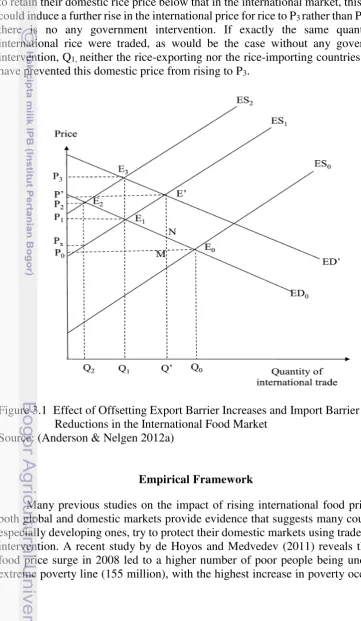
6
price for food compared with the international market equilibrium price in which there is no intervention from any government. An increase in export barriers applied by exporting country governments will shift up the supply curve from ES0 to ES2,
while import barrier reductions applied by importing countries will simultaneously shift up the demand curve from ED0to ED’.
Although this collective action allows both exporting and importing countries to retain their domestic rice price below that in the international market, this action could induce a further rise in the international price for rice to P3 rather than P1 when
there is no any government intervention. If exactly the same quantity of international rice were traded, as would be the case without any government intervention, Q1, neither the rice-exporting nor the rice-importing countries would
have prevented this domestic price from rising to P3.
Figure 3.1. Effect of Offsetting Export Barrier Increases and Import Barrier Reductions in the International Food Market
Source: (Anderson & Nelgen 2012a)
Empirical Framework
7 in East Asia. The level of poverty incidence in Mexico increased by 9.94 per cent during the upward spike of global food prices between 2006 and 2008 (Valero-Gil & Valero 2008). Fears of an increase in the incidence of poverty caused by global food price escalation in 2008 could be the main reason governments attempted to stabilise their domestic food prices by implementing protectionist trade policies, such as export bans for exporting countries and the reduction of import restrictions for importing countries.
However, most governments may be unaware of the consequences of their
policies’ impacts on the international market. A recent empirical study shows that
the collective action undertaken by rice exporting and importing countries to stabilise their domestic price of rice as a response to the international rice price hikes of 2007–2008 eliminated the effectiveness of each country’s change in trade restrictions. In addition, it contributed to a further 45 per cent increase in international rice prices (Martin & Anderson 2012). Moreover, this study has been extended by Anderson, Ivanic and Martin (2014) to show these interventions did not prevent extra people falling below the poverty line. This is because such collective action leads to a more fluctuated price of rice in the domestic markets (Ivanic & Martin 2014).
At a regional level, such as in South Asia, Dorosh (2008) found that restrictions on exported cereal imposed by India and Pakistan in responding to the staple price spikes of 2007–2008 led to a further increase in imported cereal prices in Bangladesh and Afghanistan. Therefore, such protectionist policies that attempt to insulate the domestic market are wasteful and could in fact exacerbate the impact of rising international food prices. This is because it may even increase global poverty, even though the initial objective of this policy ostensibly is to alleviate the possibility of rising poverty (Anderson 2012). Further, based on the evidence from 14 developing countries, Watson (2013) has revealed that the real objectives behind
the governments’ protectionist policies are mostly driven by political interests, which include preventing social unrest that would threaten the political position at the next election, rather than by considerations of the cost and impact of the policy on other countries.
4
DISCUSSION
To help the Government cope with rising global rice prices over the last decade, this study aims to evaluate the rice price stabilisation policies that have been implemented in response to the staple food price spikes of 2007–2008. This will determine the real objectives of the policies, and determine what factors should be considered in applying these policies (costs and benefits). Although evaluating these policies is challenging, due to political interests, it may be possible to find some solutions to mitigate the impact of rising global rice prices on the domestic
market and prevent it from occurring in the future, which would benefit Indonesia’s
8
The Evaluation of Indonesia’s Rice Price Policy Responses
Under the sectoral strategic plan (Renstra) of the National Development Plans (Rencana Pembangunan Nasional), food security and improvements in farmers’ welfare are still the two main targets for development in Indonesia’s agricultural sector (MoA 2010). When there was an upward spike in global food prices, including rice prices, in 2007–2008, the Government applied several trade and domestic policies to stabilise the domestic price of rice. This is because it is an
important factor in achieving Indonesia’s agricultural sector development target as
stated in the Government Decree 68/2002 on Food Security. Table 4.1 gives a sequenced list of the Government policy responses to rising global rice prices in 2007–08.
Table 4.1 Policy Responses to Rising Commodity Prices in 2007–08
Commodity Policy response Period
Rice Permission given to BULOG to import significant quantities of rice
Between January 2007 and April 2008 Lowered tariff from IDR 450/kg (USD
49/tonne) to IDR 200/kg (USD
Restrictions placed on exports Between April 2008 and May 2009 Source: (OECD 2012)
Reduction in Import Restrictions
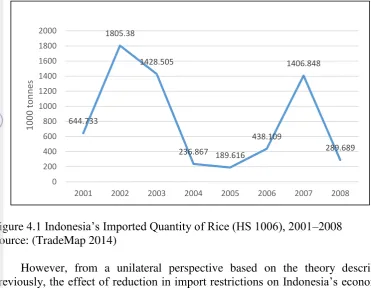
One of the Government trade policy responses to the rising international rice prices was to change its import policies by reducing import restrictions on rice. For example, Bangladesh removed its import duty on rice in 2007 (Raihan 2013), while the Philippines increased its rice imports by approximately two million tonnes per year during 2006–2008 (Balisacan, Sombilla & Dikitanan 2010). Similarly to these countries, the GOI also responded by giving permission to Bulog to import a significant quantity of rice from January 2007 to April 2008, and reducing the specific tariff on rice imports during March–May 2007 as shown in Table 4.1.
From Figure 4.1, it can be seen that in 2007, this policy increased Indonesia’s
9
Figure 4.1 Indonesia’s Imported Quantity of Rice (HS 1006), 2001–2008 Source: (TradeMap 2014)
However, from a unilateral perspective based on the theory described
previously, the effect of reduction in import restrictions on Indonesia’s economic
welfare is ambiguous. In addition, from a global perspective, Anderson, Ivanic and Martin (2014) found that such policies applied by many governments to insulate their domestic markets from the soaring global commodity prices in 2008 lead to an even higher global food price. Further, they estimate this raised the number of global poor by eight million people.
There are two other points to consider in implementing this policy. First, the reduction in import barriers, particularly by reducing import tariffs, would be costly for the Treasury, as it would reduce Government tax revenues. Second, there is no guarantee that Bulog would not seek to profit from the sale of imported rice in the domestic market, as it is no longer a non-profit institution. Since it became a private agency (Perum) in 2003, based on the Government Decree 7/2003, it is allowable for Bulog to make a profit by purchasing imported rice from the international market at a relatively cheaper price, and selling it to the domestic market at a price that is relatively more expensive.
Export Ban
The other trade measure applied by the Government to protect the domestic rice market from the rising global food prices was the export ban on rice exports during April 2008–May 2009. The application of the export ban was based on the Regulation of the Minister of Trade 12/M-DAG/PER/4/2008 concerning the regulation of rice imports and exports. This policy followed the prior application of export bans imposed by major rice-exporting countries, such as India and Vietnam, between 2007 and 2008 (Dorosh 2009).
644.733
2001 2002 2003 2004 2005 2006 2007 2008
10
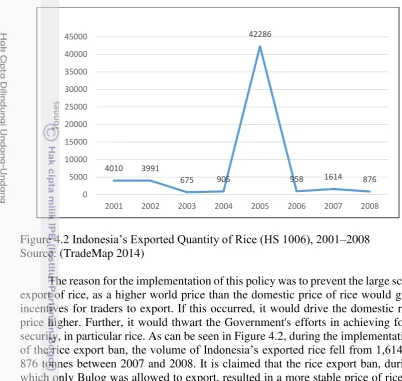
Figure 4.2 Indonesia’s Exported Quantity of Rice (HS 1006), 2001–2008 Source: (TradeMap 2014)
The reason for the implementation of this policy was to prevent the large scale export of rice, as a higher world price than the domestic price of rice would give incentives for traders to export. If this occurred, it would drive the domestic rice price higher. Further, it would thwart the Government's efforts in achieving food security, in particular rice. As can be seen in Figure 4.2, during the implementation
of the rice export ban, the volume of Indonesia’s exported rice fell from 1,614 to
876 tonnes between 2007 and 2008. It is claimed that the rice export ban, during which only Bulog was allowed to export, resulted in a more stable price of rice in the domestic market during the global food price surges in 2008 (Saifullah 2010).
However, from the implementation of the rice export ban, it can be concluded that the Government did not pay much attention to the welfare of rice farmers when responding to the soaring global food prices in 2008. This policy eliminated the incentive for farmers to obtain higher profits. Therefore, it might reduce the motivation for farmers to produce more rice, which would ultimately have a
negative impact on Indonesia’s food security. This situation could become worse because the increase in the price of other food commodity prices would require rice farmer households to allocate greater budgets for their consumption, thereby reducing the production of rice because they cannot finance the costs of farming (Susilowati & Rachman 2009).
The lack of attention given by the Government to farmers is also proven by the low rate of Government support for rice farmers during the global food price surges of 2007–2008, as depicted in Figure 2.1. Thus, once again, such trade
measures cannot be used to achieve both targets of the developments in Indonesia’s
agricultural sector at the same time.
In addition, the export ban is a costly policy, as it will reduce Government export revenues. Meanwhile, from the global perspective, even though the volume
of Indonesia’s exported rice is only a small portion of the world's total rice exports,
as Indonesia is typically a net importer of rice, it still potentially contributes to the further increase in global rice prices. This is due to the spill-over effect from
2001 2002 2003 2004 2005 2006 2007 2008
11 collective action among other countries as explained earlier in the theoretical framework.
Raising the Government Reference Purchase Price
Beside the two types of trade policies discussed above, the Government also implemented two domestic policies in order to pursue domestic rice price stability during the global food price surges between 2007 and 2008. One of them was raising the government purchase price (GPP). It was aimed at maintaining the incentives for farmers since their welfare was reduced by the implementation of export restrictions and the reduction in import barriers on rice.
The GPP was commonly applied by many countries as a measure in response to the soaring global rice prices. For example, during the rising rice prices in 2008, the Government of Vietnam also raised the GPP to buy rice from its domestic sellers
in order to increase the country’s stocks of rice (Nguyen & Talbot 2013). Thus, the GPP was not only useful to support domestic rice farmers, but also to increase the
domestic rice stocks in order to ensure the countries’ food security.
However, if a government raised the GPP too high, it would push rice prices at the consumer level, leading to the volatility of domestic rice prices, which could harm poor households. Therefore, the important factors that need to be considered in the implementation of GPP is the determination of GPP, in which the reference purchase price should provide sufficient incentives for farmers to continue or increase their production of rice at a level that remains affordable for domestic consumers. According to Saifullah (2010), the increase in the GPP for milled rice and paddy, for approximately 7.5 per cent and 10 per cent respectively, set by the Government as a response to the soaring world food prices during 2007–2008, remained at levels that did not trigger a rise in consumer prices, so as not to harm poor consumers. Moreover, Sembiring et al. (2012) estimate that an increase in the GPP for paddy of 15 per cent would lead to a rise in the rice production of 17.907 per cent, causing the domestic rice supplies rose by 10.880 per cent. Thus, it would
help achieve Indonesia’s food security.
Consumer Subsidy for the Poor
The other domestic policies applied by the Government to protect the domestic market, especially poor households, from the soaring global food price between 2007 and 2008 was the provision of a rice consumer subsidy for the poor (Raskin). The goal of this policy was to reduce the expenditure burden of poor households by fulfilling their need for rice as the main staple food as stated in the Presidential Decree 8/2008 on Rice Policy. Total Raskin distributed by Bulog for the full 12-month period in 2008 was 3.3 million tonnes to 19.1 million targeted households with an allocation of 15 kg per targeted household (Bulog 2008). The similar programme was also adopted in the Philippines. The Government of the Philippines allocated 0.1 per cent of the country’s gross domestic product (GDP) to fund the rice subsidy programme in 2007 and increased the allocation to 0.6 per cent of the GDP in 2008 as international rice prices rose significantly (Ramesh 2014).
12
drawbacks in the implementation of this policy. Besides being difficult to define the categories of eligible poor families who could receive the subsidised rice, through a survey, it has been found that by more than 18 per cent of the total distributed subsidised rice was not received by the targeted poor households due to corruption (OECD 2012). Therefore, in order to make this policy more effective in achieving its goal, it is necessary to design a transparent mechanism for its implementation as well as monitoring and evaluating it periodically to determine whether the policy is being run in accordance with the target set.
Overall, during the upward spike of staple food prices during 2007–2008, in particular of rice, the GOI gave higher priority to ensuring food security for the poor consumers with an affordable level of rice prices than it gave to the improvements
in farmers’ welfare. Hence, Indonesia’s rice policy was directed at maintaining the
stability of domestic rice prices. Applying a mix of the policy response, including the tariff reduction on rice imports, the export ban, GPP and Raskin, the GOI was successful in maintaining the stability of the domestic rice prices (Saifullah 2010). It can be seen from Figure 4.3 that during 2007–2008, the domestic price of rice was more stable than the international price of rice.
Figure 4.3 International and Domestic Wholesale Rice Prices, 2000–2008 Source: (Saifullah 2010)
Despite the fact that the Government could maintain the stability of the domestic rice prices to achieve food security, by analysing these policies, it has
been shown that it is difficult to improve farmers’ welfare at the same time using
13 contributed to an increase in the number of Indonesian poor people by 0.7% (1.5 million people) (Anderson, Ivanic & Martin 2014). Further, the collective action of altering trade policies applied by other countries could lead to spill-over effects that would exacerbate the increase in rice prices in the future. Thus, it would be more effective for the Government to stabilise rice prices without altering its trade restrictions.
However, to what extent can Indonesia rely on trade liberalisation to support
the stability of domestic food prices, particularly rice as Indonesians’ staple food?
This question arises because in the absence of government intervention, rising international food prices might lead to higher inflation in domestic food prices, which can cause more hunger and poverty, especially for developing countries that tend to spend a higher share of their budget on food (Abbott & de Battisti 2011). Therefore, government intervention still plays an important role in controlling the domestic price. The following subsection will discuss some of the policy proposals that could be used to stabilise domestic food prices, in particular rice, without having to isolate the country from international trade.
Suggested Implementation
As discussed above, the trade policies applied by the GOI in response to the
soaring rice prices in 2008 cannot be used to simultaneously achieve the country’s food security with stable domestic rice prices and improve rice farmers’ welfare.
Such trade measures hindered the international rice prices to be fully transmitted to the domestic market, so that it would harm farmers due to lower prices of rice in the domestic market and loss of incentives to produce more rice (Abbott & de Battisti 2011). This could in turn have a negative impact on the country’s food security. Meanwhile, such insulation policies would trigger collective action among other countries, which generates the spill-over effect, leading to less stable rice prices in the domestic market.
Therefore, it is better to stabilise the domestic price of rice without using trade measures. In the short term, the GOI is expected to optimize the management of public stockholding to achieve food security with more stable domestic prices of rice in accordance with the agreement of the Ministerial Conference of the World Trade Organization IX which was held on 3-6 December 2013 in Bali, Indonesia. This can be attained by revitalizing the role of Bulog in handling procurement, storage, process and rice trading among districts, provinces, and also trading with other countries (Maisyarah 2013).
In addition to the better implementation mechanism of the two domestic rice price stabilisation policies described previously, prevention of agricultural land degradation, agricultural land expansion, high-payoff investment in rural infrastructure and improvement in agricultural technology can be applied by the
GOI as a better policy alternative to improve farmers’ welfare and simultaneously
14
Prevention of Agricultural Land Degradation
Indonesia has been experiencing problems of agricultural land degradation from year to year. This could threaten the sustainability of domestic food production, including rice, which would have a negative impact on food (rice) security and farmers' welfare. The primary factor causing land degradation in Indonesia is deforestation which is triggered by the increase in the number of population of Indonesia (Winoto & Siregar 2008). Further, this study finds that deforestation has led to climate change, floods during rainy seasons, and drought during dry seasons resulting in poor quality of the river flowing areas, which in turn lowers the efficiency of irrigation system. This ultimately reduces the capacity of domestic rice production, thereby disrupting food (rice) security.
To be able to address the agricultural land degradation issues in Indonesia, the GOI should improve the implementation of soil conservation policies. It is crucial to be done because according to the results of the analysis and calculations, it is found that during 2000–2012 the historical deforestation rate in Indonesia reached 671.420 ha per year (BPREDD+ 2014). In this case, the GOI can increase research and development programs of conservation technologies, especially for controlling soil pollution and forest fires. In addition, the GOI should develop the technology of land erosion control, and promote agricultural innovation as well. Agricultural Land Expansion
To maintain rice price stability and prevent rice crisis in the future, the government needs to increase domestic rice production. It can be done by expanding paddy fields, and maintaining productive agricultural land by limiting the conversion rate of such land into residential or industrial. In fact, the GOI targeted the expansion of paddy fields of 14,500ha in 2009, but the government only succeeded to expand the area of paddy fields by approximately 80 per cent of the target set (MoA 2013). Factors that caused this failure was the unpreparedness of local governments in terms of human resources and the design or zoning in conducting the program.
15
Investment
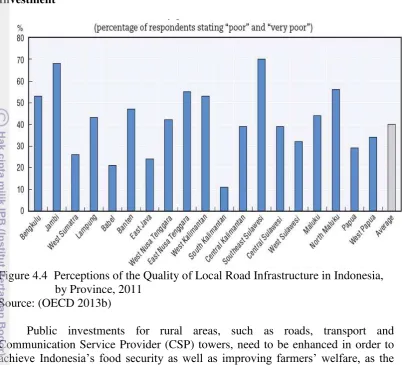
Figure 4.4: Perceptions of the Quality of Local Road Infrastructure in Indonesia, by Province, 2011
Source: (OECD 2013b)
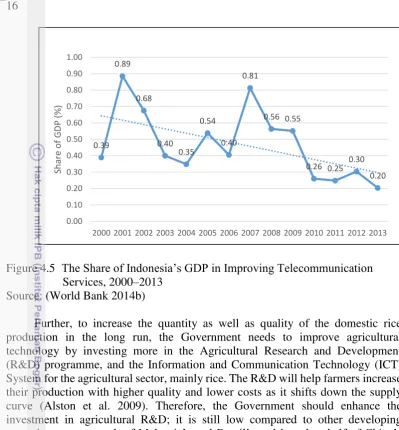
Public investments for rural areas, such as roads, transport and Communication Service Provider (CSP) towers, need to be enhanced in order to
achieve Indonesia’s food security as well as improving farmers’ welfare, as the
quality of infrastructure in Indonesia is still relatively poor. Figure 4.4 illustrates that in 2011, more than 40 per cent of respondents in half of the 19 surveyed regions in Indonesia perceived that these regions had poor quality roads. Indeed, better quality roads and transport is needed to facilitate farmers to sell their products with
maintained quality and lower costs; this can raise farmers’ income without raising
consumer prices (Hofman, Jones & Thee 2004).
16
Figure 4.5:The Share of Indonesia’s GDP in Improving Telecommunication Services, 2000–2013
Source: (World Bank 2014b)
Further, to increase the quantity as well as quality of the domestic rice production in the long run, the Government needs to improve agricultural technology by investing more in the Agricultural Research and Development (R&D) programme, and the Information and Communication Technology (ICT) System for the agricultural sector, mainly rice. The R&D will help farmers increase their production with higher quality and lower costs as it shifts down the supply curve (Alston et al. 2009). Therefore, the Government should enhance the investment in agricultural R&D; it is still low compared to other developing countries—one-seventh of Malaysia’s and Brazil’s and less than half of China’s
and India’s (ASTI 2012 cited in Anderson 2013).
In addition, the ICT system allows all stakeholders along the agricultural supply chain to access data more easily, including input management, harvesting, post-harvesting storage, marketing and distribution of agricultural products. However, the Government needs to develop a user-friendly and easily accessible ICT system as many Indonesian farmers are not yet ready for the implementation of agricultural ICT systems (Purnomo & Lee 2010).
Regarding the direct transfer payment, the ICT system can help the Government directly reach the targeted farmers or poor households by providing an effective transfer mechanism based on the bank account detail database of both farmers and poor households. Thus, it can eliminate the ineffectiveness in the implementation of direct cash transfer programme of the Government due to corruption or inefficient administrative mechanism. Further, together with the R&D programme, such a transfer payment mechanism would have a significant positive
impact on the country’s food security (Anderson & Strutt 2014).
0.39
2000 2001 2002 2003 2004 2005 2006 2007 2008 2009 2010 2011 2012 2013
17
International Trade Agreement
To prevent a spill-over effect that results in higher and fluctuated international rice prices in the future, a collective agreement from both rice-exporting countries, such as India, Thailand and Vietnam, and rice-importing countries, such as Indonesia, China and the Philippines is required. The nations must agree not to change their trade measures as a way to insulate their domestic rice markets from a sharp rise in global rice prices. However, this action needs a strong commitment from each country. Therefore, the role of international trade organisations, mainly the WTO, in this case becomes very crucial to accommodate these countries in negotiating and communicating in order to achieve a mutual agreement.
Moreover, a regional or multilateral trade agreement is also needed to establish international rice reserve stocks in order to ensure sufficient international rice supply. This will lead to more stable rice prices in the future. Regarding regional rice reserve stocks, the Association of Southeast Asian Nations (ASEAN) Secretariat has developed an integrated rice reserve stock among its members, although the amount of rice stock is still not enough to ensure food security as well as rice price stabilisation in each ASEAN country (Sarris 2010).
Institutional Aspect
Another important aspect that needs to be improved to achieve food (rice) security and improve farmers’ welfare is institutional development. Weak institutions would result in inefficient agricultural system, and low profits received by farmers. Therefore, according to Winoto and Siregar (2008) there are several institutional aspects that need to be developed. First is extension service institution that can link farmers with private sector. Such extension services provided by the Ministry of Agriculture and local governments could enhance contract farming that will ultimately benefit farmers. Second is tax incentive mainly given to both governments and the private sector who participate in developing the Agricultural R&D. This tax system is expected to encourage farmers to generate added value to their commodities as well as establish business networks with the private sector.
In addition to the institutional aspects described above, Winoto and Siregar (2008) assert that the GOI should help farmers with access to finance by promoting subsidised land certification programme, and continue the credit guarantee programme. This is necessary because farmers usually have difficulty getting access to credit from financial institutions due to collateral problems. Besides, data from Bank Indonesia (BI) in 2012 showed that credit allocated to the agricultural sector was only 7.73% of Credit Microfinance (KUR). Most KUR was used for trade, which reached 47.2%, of the total KUR in 2012 (Sindonews 2014). Therefore, the GOI is expected to continue and develop programs that can improve farmers' access to financial resources.
While the alternative policies proposed in this study would help the Government achieve Indonesia’s food security at stable domestic rice prices and
improve rice farmers’ welfare at the same time, there are still potential challenges
18
although the international trade agreement is the best solution to prevent soaring international rice prices in the future due to the spill-over effect caused by the
countries’ collection action, it is very difficult to reach an agreement as there are different economic and political interests across countries.
However, by analysing the cost and benefit of the government policy responses to the soaring international rice prices during 2007–2008, this study provides better alternative solutions for the Government to respond to the changes in international rice prices. Further, this study also helps the policymakers in designing more effective domestic policies to achieve food security at affordable prices and improving farmers’ welfare in the future.
5
CONCLUSION
The upward spike of staple food prices, mainly rice, in 2007–2008 raised fears for many developing countries, including Indonesia, of the potential adverse impact on the economic and political conditions of the countries. Therefore, it was natural that the governments applied various policies to ensure the stability of the domestic rice prices in the countries. This study has evaluated the consequences of the policies applied by the GOI in responding to the soaring international rice prices based on theory review and empirical evidence.
As food (rice) security, with a low consumer price, and improving farmers’ welfare are the real objectives of Indonesia’s rice price stabilisation policy, this
study finds that it is difficult to achieve both targets using a single policy. This is despite the fact that a mix of the government policies was successful in mitigating the impact of soaring international rice prices during 2007–2008, resulting in more stable domestic rice prices compared with the international rice prices. Moreover, the finding suggests that the change in the border restrictions on trade applied by the Government to insulate the domestic rice market from the elevated international rice prices would in fact exacerbate the volatility of international rice prices in the future.
Therefore, a better implementation mechanism of the domestic rice price stabilisation policies is more like to be an effective solution to mitigate the impact of rising international rice prices on the domestic rice market, without having to insulate the domestic market. Further, the prevention of agricultural land degradation, agricultural land expansion, high-payoff investment in rural infrastructure, R&D, and ICT for agriculture, and institutional development, as proposed in this study, would help the GOI achieve food security and improving
farmers’ welfare at the same time. One other important solution to prevent the
soaring international rice prices from occurring in the future is an agreement with other countries to commit to not insulating domestic rice markets by changing restrictions on trade, and to establish an international rice reserve stock to achieve international food (rice) security in the future.
Thus, there is a necessity for further research to investigate the extent of the
Government’s capability to invest in the development of rural infrastructure and
19 organisation is able to accommodate the member countries to mutually commit to not insulating domestic rice markets from international markets. Only when the governments from both rice-exporting and importing countries realise the consequences of their insulation policies will it lead to increasing participation of each country to open up its domestic rice market to international trade.
REFERENCES
Abbott, P & de Battisti, AB 2011, 'Recent global food price shocks: Causes, consequences and lessons for African governments and donors', Journal of African Economies, vol. 20, 2011, pp. I12–I62.
Ahsan, H, Iftikhar, Z & Kemal, MA 2012, 'The determinants of food prices in Pakistan', Lahore Journal of Economics, vol. 17, no. 1, pp. 101–128.
Alston, JM, Pardey, PG, James, JS & Andersen, MA 2009, 'The economics of agricultural R&D', in Annual Review of Resource Economics, vol. 1, pp. 537– 565.
Anderson, K 2012, 'Government trade restrictions and international price volatility', Global Food Security, vol. 1, no. 2, pp. 157–166.
Anderson, K 2013, Indonesia's Food Law of 2012: Prospective impact on domestic markets and food security, the United States Agency for International Development.
Anderson, K, Ivanic, M & Martin, W 2014, 'Food price spikes, price insulation, and poverty', in JP Chavas, D Hummels & B Wright (eds), The economics of food price volatility, University of Chicago Press for NBER, Chicago and London. Anderson, K & Nelgen, S 2012a, 'Agricultural trade distortions during the Global
Financial Crisis', Oxford Review of Economic Policy, vol. 28, no. 2, Summer, pp. 235–260.
Anderson, K & Nelgen, S 2012b, 'Trade barrier volatility and agricultural price stabilization', World Development, vol. 40, no. 1, pp. 36–48.
Anderson, K & Strutt, A 2014, 'Food security policy options for China: Lessons from other countries', Food Policy, vol. 49, Part 1, no. 0, pp. 50–58.
Balisacan, A, Sombilla, MA & Dikitanan, RC 2010, 'Rice crisis in the Philippines: Why did it occur and what are its policy implications?', in D Dawe (ed.), The rice crisis: Market, policy and food security, FAO and Earthscan, London and Washington DC, pp. 123–142.
BPREDD+ 2014, National Forest Reference Emission Level for Deforestation and Forest Degradation in the Context of Decision 1/CP. 16 (REDD+) under UNFCCC, Badan Pengelola Pengurangan Emisi dari Deforestasi dan Degradasi Hutan dan lahan Gambut Republik Indonesia, viewed 4 February 2015, <http://www.reddplus.go.id/>.
Bulog 2008, Stabilitas harga beras di Indonesia tahun 2008: Operasional Bulog dalam stabilisasi harga, Beaureau of Logistic, Jakarta.
20
Dorosh, PA 2008, 'Regional trade and food price stabilisation in South Asia: Policy responses to the 2007-08 world price shocks', Pakistan Development Review, vol. 47, no. 4, Winter, pp. 803–813.
Dorosh, PA 2009, 'Price stabilization, international trade and national cereal stocks: world price shocks and policy response in South Asia', Food Security, vol. 1, no. 2, 2009/06/01, pp. 137–149.
Dorward, A 2012, 'The short- and medium- term impacts of rises in staple food prices', Food Security, vol. 4, no. 4, Dec, pp. 633–645.
Fane, G & Warr, P 2008, 'Agricultural Protection in Indonesia', Bulletin of Indonesian Economic Studies, vol. 44, no. 1, pp. 133–150.
Fane, G & Warr, P 2009, 'Distortions to agricultural incentives in Asia: Indonesia', in K Anderson & W Martin (eds), Distortions to agricultural incentives in Asia, Washington, D.C.: World Bank, pp. 165–196.
FAO 2011, Price Volatility in Food and Agricultural Markets: Policy Responses. FAO 2014, Faostat, Food and Agriculture Organization of the United Nations,
viewed 4 November 2014, <http://faostat.fao.org/>.
GOI 2002, 'Peraturan Pemerintah Republik Indonesia nomor 62 tahun 2002 tentang ketahanan pangan', (the Government of Indonesia Decree number 68/2002 on Food Security).
GOI 2003, 'Peraturan Pemerintah Republik Indonesia nomor 7 tahun 2003 tentang pendirian perusahaan umum (Perum) Bulog', (the Government of Indonesia Decree number 7/2003 on the establishment of Bulog as a private agency). Hofman, B, Jones, ER & Thee, KW 2004, 'Indonesia: Rapid growth, weak
institutions', in The scaling up poverty reduction: A global leaning process and conference, Shanghai.
Ivanic, M & Martin, W 2014, 'Implications of domestic price insulation for global food price behavior', Journal of International Money and Finance, vol. 42, no. 0, pp. 272–288.
Maisyarah, S 2013, Analisis impor beras Vietnam terhadap cadangan beras nasional, Master Thesis, Graduate School, Bogor Agricultural University. Markusen, JR, Melvin, JR, Kaempfer, WH & Maskus, KE 1995, International
trade: Theory and evidence, International edition edn, McGraw-Hill, Inc, the United States of America.
Martin, W & Anderson, K 2012, 'Export restrictions and price insulation during commodity price booms', American Journal of Agricultural Economics, vol. 94, no. 2, pp. 422–427.
McCulloch, N 2008, 'Rice prices and poverty in Indonesia', Bulletin of Indonesian Economic Studies, vol. 44, no. 1, pp. 45–63.
McCulloch, N & Timmer, CP 2008, 'Rice policy in Indonesia: A special issue', Bulletin of Indonesian Economic Studies, vol. 44, no. 1, pp. 33–44.
MoA 2010, Strategic Plan of The Ministry of Agriculture 2010-2014, Jakarta. MoA 2013, Data Realisasi Cetak Sawah 2006-2010, Direktorat Jenderal Prasarana
dan Sarana Pertanian Kementerian Pertanian Republik Indonesia, viewed 5 January 2015, <http://psp.deptan.go.id/>.
21 MoT 2008, 'Peraturan Menteri Perdagangan Republik Indonesia nomor:
12/M-DAG/PER/4/2008 tentang ketentuan impor dan ekspor beras', (the Regulation of Trade Minister of the Republic of Indonesia number: 12/M-DAG/PER/4/2008 on the regulation of rice imports and exports).
Nguyen, MH & Talbot, T 2013, 'The political economy of food price policy: The case of rice prices in Vietnam', WIDER Working Paper, vol. 2013/035.
OECD 2012, OECD Review of Agricultural Policies: Indonesia 2012, OECD Publishing.
OECD 2013a, 'Producer and Consumer Support Estimates Database', <www.oecd.org>.
OECD 2013b, Southeast asian economic outlook 2013: With perpectives on China and India, OECD Publishing.
Purnomo, SH & Lee, Y 2010, 'An assessment of readiness and barriers towards ICT programme implementation: Perceptions of agricultural extension officers in Indonesia', International Journal of Education and Development using Information and Communication Technology, vol. 6, no. 3, pp. 19–36.
Raihan, S 2013, 'The political economy of food price policy: The case of Bangladesh', WIDER Working Paper, vol. 2013/002.
Ramesh, M 2014, 'Social protection in Indonesia and the Philippines: Work in progress', Journal of Southeast Asian Economies, vol. 31, no. 1, pp. 40–56. Saifullah, A 2010, 'Indonesia's rice policy and price stabilization programme:
Managing domestic prices during the 2008 crisis', in D Dawe (ed.), The rice crisis: Market, policies and food security, The Food and Agriculture Organization of the United Nations and Earthscan, London, pp. 109–122. Sarris, A 2010, 'Trade-related policies to ensure food (rice) security in Asia', in D
Dawe (ed.), The rice crisis: Markets, policies and food security, The Food and Agriculture Organization of the United Nations and Earthscan, London, pp. 61– 87.
Sembiring, SA, Harianto, Siregar, H & Saragih, B 2012, 'The impact of government policy of Presidential Instruction in 2005-2008 for rice policy and food security', Forum Pascasarjana, vol. 35, no. 1, pp. 15–24.
Sindonews 2014, Capres, Bank Pertanian, dan Ketahanan Pangan, Sindonews Metro, viewed 12 February 2015, <http://nasional.sindonews.com/>.
Susilowati, SH & Rachman, B 2009, 'Perkembangan harga pangan dan implikasinya bagi masyarakat pedesaan', in K Suradisastra, Y Yusdja & AR Nurmanaf (eds), Seminar Nasinal Dinamika Pembangunan Pertanian dan Perdesaan: Tantangan dan Peluang bagi Peningkatan Kesejahteraan Petani, Pusat Analisis Sosial Ekonomi dan Kebijakan Pertanian, Bogor, pp. 1–24. TradeMap 2014, International Trade Centre, viewed 15 October 2014,
<http://www.trademap.org/>.
USDA 2014, United States Department of Agriculture, viewed 2 October 2014, <http://www.usda.gov/>.
Valero-Gil, JN & Valero, M 2008, 'The effects of rising food prices on poverty in Mexico', Agricultural Economics, vol. 39, pp. 485–496.
22
Watson, DD 2013, 'Political economy synthesis: The food policy crisis', WIDER Working Paper, vol. 2013/050.
Winoto, J & Siregar, H 2008, 'Agricultural development in Indonesia: Current problems, Issues, and Policies', Analisis Kebijakan Pertanian, vol. 6, no. 1, pp. 11–36.
World Bank 2014a, Pink Sheets, viewed 2 October 2014, <http://econ.worldbank.org>.
23
BIOGRAPHY
The Author named Tesa Listya Kusumawardani was born in Jakarta on 17 July 1984 as the second child of Mrs. Endang Suhartyah and Mr. Dody Agus Rijadi. The author graduated from SMA Negeri 1 Bekasi in 2002. In the same year, the author began her diploma study in Hospital Management, The University of Indonesia, graduated in 2005, and continued her undergraduate study in Economic Management, The University of Indonesia, graduated in 2008. In 2009, the author started to work at Bureau for Finance, Secretariat General the Ministry of Trade Republic of Indonesia. In 2012, the author was accepted in a double degree program between Master of Science in Economics, Bogor Agricultural University, and Master of Applied Economics, The University of Adelaide, Australia, funded by the Ministry of Trade RI and the Australia Award Scholarships.