IMPACTS OF RECREATIONAL ACTIVITIES ON MARINE
AND COASTAL AREAS IN GILI TRAWANGAN, INDONESIA
VLADIMIR CIRJAKOVIC
GRADUATE SCHOOL
BOGOR AGRICULTURAL UNIVERSITY
BOGOR
DECLARATION
I hereby declare that the thesis titled “IMPACTS OF RECREATIONAL ACTIVITIES ON MARINE AND COASTAL AREAS IN GILI TRAWANGAN, INDONESIA” is true of my work under the guidance of the supervising committee and has not been submitted in any form to any college. Resources derived or quoted from works published and unpublished from other writers mentioned in the text and listed in the Bibliography at the end of this thesis.
I hereby bestow the copyright of my papers to the Bogor Agricultural University.
ii
SUMMARY
VLADIMIR CIRJAKOVIC. Impacts of Recreational Activities on Marine and Coastal Areas in Gili Trawangan, Indonesia, Supervised by RICKY AVENZORA and RITA ROSTIKA
This research aims to identify the impacts of marine and coastal recreational activities on the island of Gili Trawangan, one of the three small islands located in the protected area called marine tourism park „Gili Matra‟, Indonesia. In the last decade the island has faced a rapid tourism growth, due to the phenomenon of recreational activities based on the marine and coastal environment. These activities as a non-consumptive sector promote an ideal combination of economical income and natural conservation. However, recent tourism growth led the marine recreational sector towards mass tourism, implying threats to the quality of the environment and its role for conservation.
The method to identify the impacts of marine and coastal recreational sector on the environment, economy, and socio-culture, have been recognized through management strategy approaches including regulatory, physical, economical and educational approach as the main parameter for marine ecotourism management. In addition, analyses of the outcomes, thus, tourists, local residents, and employees of the recreational sector based on Likert scale questionnaire method where responders could rank 7 different stages of satisfaction and opinion was also conducted. The environmental conditions were analyzed by general observation and by the technique of coral reef transect on the popular dive site Halik. The finding of the coral reef transect was compared with data from 2012, which was conducted by Gili Eco Trust, who utilized the same method.
Therefore, this study has identified the current position and impacts of marine and coastal recreational sector, its role of conservation and contribution to the social community. Recognizing potential of the management‟s ability and willingness to face challenges and organize the recreational sector in manner of ecotourism to protect the nature and provide long term economical development in the future.
RINGKASAN
Dampak Aktivitas Rekreasi Terhadap Kawasan Perairan dan Pesisir di Gili Trawangan, Indonesia oleh Vladimir Ćirjakovir Dibimbing oleh RICKY AVENZORA DAN RITA ROSTIKA
Penelitian ini bertujuan untuk mengidentifikasi dampak kegiatan rekreasi laut dan pesisir di pulau Gili Trawangan, salah satu dari tiga pulau kecil yang terletak di kawasan terlindung yang disebut taman wisata bahari Gili Matra, Indonesia. Dalam dasawarsa terakhir pulau tersebut menghadapi pertumbuhan pariwisata yang pesat, dikarenakan fenomena kegiatan rekreasi berdasarkan lingkungan kelautan dan pesisir. Kegiatan tersebut sebagai sektor non-konsumptif mempromosikan kombinasi sempurna antara pendapatan ekonomi dan konservasi alam. Namun, pertumbuhan pariwisata dewasa ini mengarahkan sektor rekreasi laut terhadap pariwisata massal, menyiratkan ancaman terhadap kualitas lingkungan dan perannya dalam proses konservasi.
Metode untuk mengidentifikasi dampak sektor rekreasi laut dan pesisir terhadap lingkungan, ekonomi, dan sosial-budaya, telah dilaksanakan melalui berbagai pendekatan strategi manajemen termasuk pendekatan regulasi, fisik, ekonomi, dan pendidikan sebagai parameter utama untuk menajemen ekowisata bahari. Selain itu, analisis hasil, dengan demikian, wisatawan, masyarakat lokal, dan karyawan di sektor rekreasi, juga diselenggarakan berdasarkan metode kuesioner skala Likert, di mana para responden bisa dapat peringkat tujuh (7) tahapan kepuasan serta pendapat yang berbeda. Keadaan lingkungan dianalisis dengan pengamatan umum dan dengan teknik transek terumbu karang di Halik, situs menyelam yang termasyhur. Temuan transek terumbu karang dibandingkan dengan data yang ada dari tahun 2012 yang dilaksanakan oleh Gili Eco Trust, yang memanfaatkan metode yang sama.
Oleh karena itu, penelitian ini telah mengidentifikasi posisi saat ini dan dampak dari sektor rekreasi laut dan pesisir, perannya dalam proses konservasi dan kontribusi kepada masyarakat sosial. Penelitian ini mengenali daya potensial kemampuan dan ketersediaan manajemen untuk menghadapi tantangan dan mengatur sektor rekreasi dengan cara ekowisata supaya dapat melindungi alam dan menyediakan pengembangan ekonomi jangka panjang di masa depan.
iv
© All Rights Reserved IPB, 2015
Copyright Reserved
Thesis
as one of the requirements to obtain the degree of Master of Science
in Study Program of
Ecotourism & Environmental Services Management
IMPACTS OF RECREATIONAL ACTIVITIES ON
MARINE AND COASTAL AREAS IN GILI TRAWANGAN,
INDONESIA
GRADUATE SCHOOL
BOGOR AGRICULTURAL UNIVERSITY BOGOR
2015
ACKNOWLEDGMENT
First of all I would to give thanks to the Great Lord for giving me the life opportunity to live and experience this beautiful country and chance to provide a micron part in ocean conservation through ecotourism development. Definitely, I would never be here without a good diplomatic realtion between Serbia and Indonesia and long tradition in students exchange program. Thus, I would like to acknowledge the Indonesian Second secretary for education and culture in Belgrade Mrs. Srianri Diponegoro, His Excellence the Amabassdor of Indonesia in Serbia „10/‟14 Mr. Samuel Samosn and Serbian consul in Indonesia Mr. Vladan Soskic„10/‟14 for the improvement the program of student exchange between two countries. At the first I would like to acknowledge Mrs. Prof. Dr E.K.S Harini Muntasib, Mrs Sarah and Prof. Dr Ir Muladno MSA providing me with information about the Ecotourism department at IPB and convincing me to come.
The crucial person for redirecting my research from the rainy forest to the blue ocean is a marine biologist Mareike Huhn. She made me aware of the importance of ocean protection and the role of tourism in conservation This thesis would never be possible without the great team of my supervisors made of ecotourism expert Mr. Dr. Ir. Ricky Avenzora MScF. and marine biologist Mrs Dr. Ir. Rita Rostika MP, together with my classmate Mrs.Ghoitsa they were more than supervisors, thank you very much for your patience and advice during my studies. Big thanks to the International Coastal and Marine Tourism Society (ICMTS) and its founders Dr. Mrak Orams and Dr. Michael Luck for sharing with me the various literature and providing access to publications. I would like to acknowledge the energy and help of Mrs. Delphine Robbie (the head of Gili Eco Trust) as a crucial person for my field work and decision for the case study, the young team of BKKPN (Pak Lubis, Ibu Hottmaria and Pak Hadrin) and staff of Diversia dive club, they were always up to share data and give an answer for all my questions. For the reef check and eco license I received big support from the Gili Eco Trust and Marko Vraz but crucial support was given by Mr. Ali Sahami (manager of PT. Lorax) who financially and technically supported the reef check. Dear Ali thank You so much for your understanding and help. My time in Indonesia would never be that nice without the great host mom Ibu Ing Sarajar, she made me feel at home, thanks Ibu. The most of all i would like to thank to my parents, especially to my mom Vesna for her love, belief and prayers. I love you Mom. There are a lot of people that I would like to acknowledge and thank for their contributions for this work that is not possible to frame one page. However, I am sure they are going to recognize themselves.
TABLE OF CONTENTS
LIST OF TABLES XV
LIST OF ILLUSTRATIONS XV
LIST OF APPENDIXS XVI
LIST OF ACRONYMS XVI
1 INTRODUCTION 1
Background 1
Research Problems 2
Benefits of Research 3
2 LITERATURE REVIEW 4
Sustainable Tourism Development and Ecotourism 4
Ecological Aspect of Marine and Coastal Environment 5 Tourism Impacts on Environment and Socio-culture 7 Characteristics of Marine and Coastal Tourism Management 9
3 RESEARCH METHOD 11
Place and Time of Research 11
Study Approach 12
Method of Data Collecting & Analysis 12
4 RESULTS AND DISCUSSION 15
Natural and Anthropological Characteristics of Gili Trawangan 15 Development and Condition of the M&C Recreational Sectoron Gili
Trawangan 17
Management of the Marine Tourism Park „Gili Matra‟ 21
Management Strategy Approaches 23
Management Future Strategy 30
Impacts of M&C Recreation on Environment 31
Impacts of the M&C Recreation on Economy 34
Impacts of M&C Recreation on Socio-culture 38
Tourists‟ Perception and Motivation 39
5 CONCLUSIONS AND SUGGESTION 48
Conclusions 48
Suggestion 49
REFERENCES 50
APPENDIX 55
ANOVA 55
LIST OF TABLES
1. Conceptual model for the marine tourism management 3
2. Spectrum of marine recreational opportunity 11
3. Regulations for the recreational activities in the Integrative Marine
Zone Management in Gili Matra 25
4. The index mean of perception of the local residents about positive and negative environmental impacts of the M&C recreational sector
on Gili Trawangan 34
5. The profile of local employees in marine recreational sector 35 6. The index mean of perception of the local residents about positive
and negative economic impacts of the M&C recreational sector on
Gili Trawangan 38
7. The index mean of perception local employees about postive and negative socio-cultural impacts of M&C recreational sector on Gili
Trawangan marine 39
8. The profile of tourists on Gili Trwangan 40
9. The index mean of tourists‟ imortance and satisfaction about
recreational activities 42
10.The perception between divers about diving industry on Gili
Trawanagan 47
LIST OF FIGURES
1. Technique the coral reef transect 14
2. Dive sites around Gili Trawangan 18
3. The annual growth of water sport agencies since 1989 on Gili
Trawangan 20
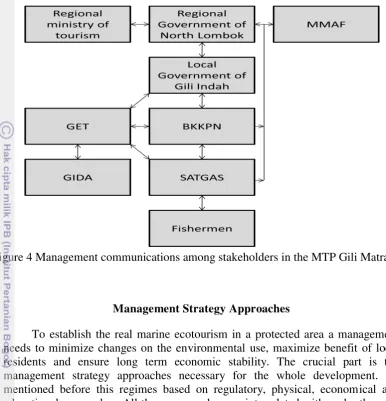
4. Management communications among stakeholders in the MTP Gili
Matra 23
5. The map of the Integrative Marine Zoning Management of Gili
Trawangan 26
6. The map of the Integrative Marine Zoning Magement of the MTP
„Gili Matra‟ 26
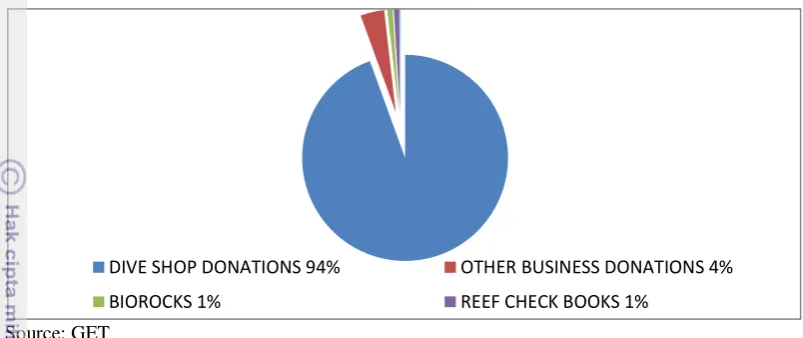
7. Donations for the environmental and social programs on Gili
Trawangan January/July 2012 29
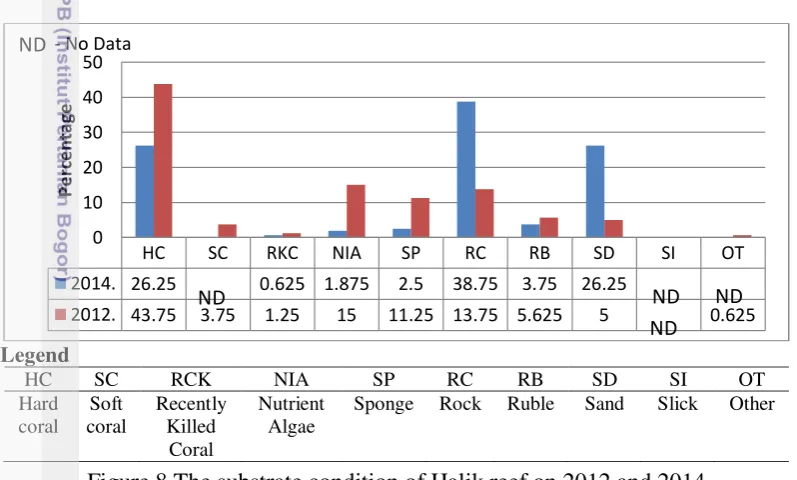
8. The substrate condition of Halik reef on ‟12 and „14 32
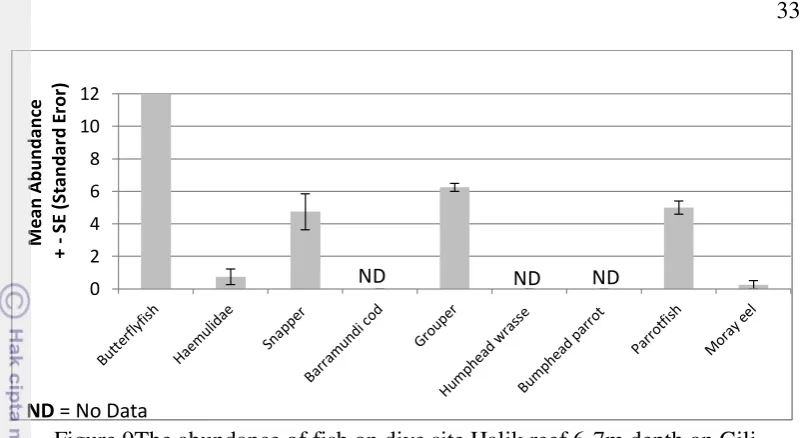
9. The abundance on dive site Halik reef 6-7m depth on Gili
Trawangan 33
10.Positions versus incomes of the local employees in marine
recreational sector on Gili Trawangan 36
12.The index mean of perception of the local residents about potential
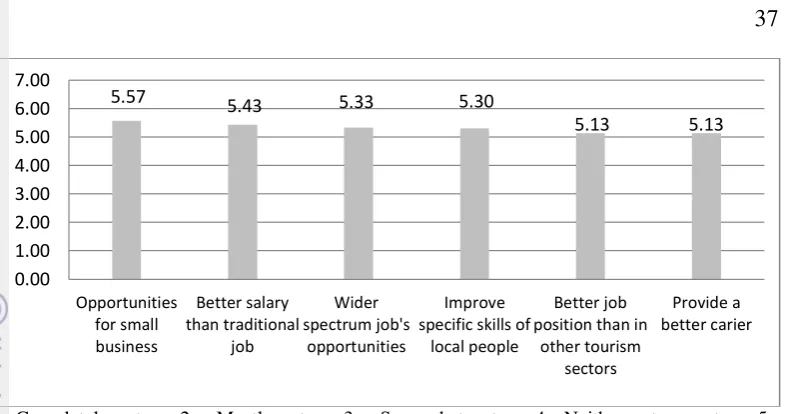
negative influences of the M&C recreational sector on economy 37 13.The index mean of tourists‟ motivation to visit Gili Trawangan 41 14.The index mean of tourists‟ perception about environmental condition on
Gili Trawangan 41
15. The percentage of utilization of recreational activities by tourists 42
16. Importance – Performance index analysis of recreational activities
on Gili Trawangan 42
17. The index mean perception of tourists about condition in M&C
sector (except diving) on Gili Trawangan 43
18. Times of visit and perception of tourists about environmental
condition on Gili Trawangan 44
19.The length of stay and perception of tourists about the environment
on Gili Trawangan 44
20. The mean of tourists‟ perception about negative impacts of marine
recreatiom on Gili Trawangan 45
21. The mean of tourists‟ perception about positive impacts of marine
recreation on Gili Trawangan 45
22. The percentage of certified divers among tourist on Gili Trawangan 46
23. Divers‟ perception about the environment on Gili Trawangan 46
24. The reason to choose again Gili Trawangan for holiday 47
LIST OF APPENDIXS
1. ANOVA 55
2. QUESTIONNAIRES 56
LIST OF ACRONYMS
1. BKKPN : Balai Kawasan Konservasi Perairan Nasional (the National Institute for Aquatic Conservation) 2. GET : Gili Eco Trust
3. GIDA : Gili Islands Dive Association
4. IMZM : Integrative Marine Zoning Management 5. M & C : Marine & Coastal
6. MMAF : Ministry of Marine Affairs and Fisheries 7. MTP : Marine Tourism Park
1
INTRODUCTION
Background
Tourism as the fastest growing industry presents a real economic, cultural and social phenomenon of 20th century, having influence on many sectors (Miller, 1990). The phenomenon has become a necessary part of the modern society and a way to broaden people‟s awareness of the natural and anthropological World‟s heritage. Since 1950, the tourism industry was recording an annual growth of 6.5% on average (WTO, 2006) and in 2012 reached a historical milestone of 1 billion international tourists‟ arrivals globally (WTO 2013). Apart from positive social and economic influences, tourism also causes a lot of issues threatening to degrade environmental resources, social values and be self-destructive (Pigram, 1991).
In the beginning of the new millennium and century, humanity is looking forward to actions and solutions, especially the ones „How to decrease negative human influences on environment?‟ (Orams, 2004). A solution to manage tourism in a sustainable manner is commonly called ecotourism. This type of tourism is less conventional and the opposite of the mass tourism with the main aim to protect natural resources, to improve tourist awareness of conserving nature, to involve and promote identity of local people as well as to achieve long term economic and environment sustainability (Fannel, 1999, WTO, 2004).
Therefore, in this topic is not possible to skip the coast and the sea which attracts millions of tourist annually worldwide. A type of travel that occurs on the coast and in the marine environment is commonly referred as the coastal and marine tourism. The phenomenon of marine and coastal tourism is that it is growing at a faster rate than the rest of the tourism industry and presenting significant negative environmental influence (Orams, 1999). As is shown on an example of European development in the marine and coastal tourism growth 3% per year from 2005 to 2009 for the whole European Union EU GDP (OSPAR Commission, 2008).
Besides the allure of sandy beaches, the sea and sunny days, marine and coastal ecosystem varies; from coral reefs to coastal mangrove, rich range of species; from whales to sea horses and on range of activities based on these areas varies from whale watching to scuba diving (C.Cater & E.Cater, 2001). Thus, it includes wide spectrum of recreational activities: scuba diving, surfing, fishing, sailing, water skiing, windsurfing, observing, mammal and bird watching, cruising, beach activities, sea kayaking, visits to fishing villages and lighthouses, maritime museums, sailing and motor yachting, maritime events, Arctic and Antarctic tourism, and much more‟(ICMTS, 2009). The specific character of Marine and Coastal (M&C) recreational activities mostly occurs in an environment where people cannot survive and requires proper equipment and well trained skills to be applied (Orams, 1999).
2
waste disposal, anchoring, wildlife disturbance, lack of tourist awareness of underwater biodiversity and an irresponsible approach of operators, increasing boat traffic, led to the decline of marine environment (Graci, 2010).
Similar issues were encountered on the small Indonesian island of Gili Trawangan, where the economical sector is primarily focused on marine and coastal tourism. The island belongs to a marine protected area with status of Marine Tourism Park (MTP) „Gili Matra‟ located north of the island of Lombok, Indonesia. The MTP Gili Matra consists of three small islands Gili Air, Gili Meno and Gili Trawangan offering turquoise color of the sea, white sand beaches and rich marine biodiversity (Cahyadi, 2012). Gili Trawangan is the largest and most valorized island in marine tourism industry and faces the growth stage toward to mass tourism (Graci, 2013).
In general, these issues can be addressed as consequences of a lack of management collaboration among stakeholders, inefficiency of planning systems, decision-making policy and complicated bureaucracy (Garrod & Wilson, 2005).Therefore, it is crucial to establish a good management policy created by various institutions, which support the recreational use of marine and coastal resources to maintain their health and viability. Otherwise, the consequences of recreational activities might be devastating for the environment and social economy in the future. However, as a non-consumptive sector, recreational activities based on marine areas still have a potential to create small scale of impacts and provide huge beneficial effects on ecotourism aspects by contributing to environmental protection, education and conservation.
Research Problems
The M&C recreational activities as a part non-consumptive industry promote a perfect mix of natural preservation and economical viability for the island of Gili Trawangan. The tourism industry has however developed recently and rapidly at Gili Trawangan, implying negative threats and impact for the natural environment, socio-economical sector and tourists‟ satisfaction for the future. Thus, it is important to recognize the ability of the management of the MTP Gili Matra to closely monitor and follow the development of this sector and set the standards of ecotourism to secure a sustainable industry.
Goals of Research
1. To identify regulations base of the M&C recreational sector through various stakeholders
2. To identify support by the facilities necessary for the M&C recreational development
3. To identify economical contribution from M&C recreational sector to the local community and environment protection
4. To determinate potential negative and positive environmental impacts on the M&C recreational sites
3
Objectives of research
The objectives of this research paper are to better understand the influence of the M&C recreational sector on crucial aspects of ecotourism. To recognize the challenges for the management in arranging the M&C recreational activities at Gili Trawangan and keep the environmental purity, economical viability, prosperity of the local community and preserve the uniqueness of tourists‟ experience as further base of development.
Benefits of Research
Implementing management strategies designed to direct tourism toward the achievements:
1. Recognition of the management current policy of M&C recreational sector 2. Identifying position and role of the M&C recreational activities in conservation with all advantages and disadvantages and direction of the further development.
3. Use the data to inform the management decisions of local stakeholders, improve the system of information sharing among them and set flexible regulations toward sustainability
4. Improving the awareness of readers about the M&C recreational activities on fragile resources and tiny islands
Conceptual model
A similar following model that represents a conceptual framework is used by Orams (1999) as a base for understanding and accessing the effectiveness of marine tourism management. Thus, between different types of activities and their outcomes there is a management with its various regimes, which is crucial to manage and control potential impacts (See Table 1).
4
2
LITERATURE REVIEW
Sustainable Tourism Development and Ecotourism
Tourism is the largest business sector of the world economy, accounting for 10% of global GDP and 35% of the world‟s export services. Since 1985, tourism has been growing an average of 9% annually and reached 1 billion international tourist arrivals in 2012 (WTO2013). International tourism receipts grew up to 1.03$ trillion (€740 billion) in 2011, corresponding to an increase in real terms of 3.8% comparing with 2010 (WTO 2012). This data presents the significant contribution and impacts of tourism to the economy, culture and environment with a new challenge for the modern human society to minimize negative environmental, social impacts and simultaneously maximize economical benefit for the long term. Due to the complexity of the industry, World Tourism Organizations (WTO), The United Nations and governments are trying to stop negative trends and redirect tourism towards sustainable tourism development. The initial step of sustainable ecotourism development is to increase the awareness of negative tourism impacts (Smith, 1977, Grady, 1990) and improving partnership and collaboration among various stakeholders as an essential requirement for managing the actual process of tourism (Weaber, 2003).
The definition of sustainable tourism development has been interpreted in many different ways by various organizations, authorities and tourism experts. Anyway, each of them involves preservation of natural resources, protection of indigenous cultural identity, and benefit for the local community.
The WTO (2004) defines three following principles necessary for sustainable tourism development:
1. Make optimal use of environment resources that constitute a key element in tourism development, maintaining ecological processes and helping to conserve natural biodiversity
2. Respect the socio-cultural authenticity of host communities, promote their cultural heritage and contribute to inter-cultural understanding
3. Establish the long-term economic operators, providing socio-economic benefit to all stakeholders, by contributing to poverty alleviation through the stable employment and income opportunities to local communities.
5
Definitions selected by Encyclopedia of Ecotourism (Weaver 2001)
1. Traveling to relatively undisturbed or uncontaminated natural areas with the specific object of studying, admire, and enjoying the scenery and its wild plants and animals, (Ceballos – Lascurain, 1987)
2. Responsible travel to natural areas which conserves the environment and improves well being of local people The Ecotourism society (1991)
3. Ecologically sustainable tourism that fosters environmental and cultural understanding appreciation and conservation (Ecotourism Association of Australia 1992)
These definitions recognize ecotourism development as based on ecological and socio-cultural components as the key of sustainability with the appropriate return to the local community and long term natural conservation. However, there are many new definitions with slightly modified principals of money generation, tourism quality and local participation (Ross & Wall 1999). Nowadays ecotourism slowly takes a role and is becoming internationally accepted as a not only as the naturally based tourism, but also as tourism in highly modified human areas such as plantations, farms, and urban zones (Higham & Luck 2002).
Marine & Coastal Ecotourism
Marine and Coastal tourism is a selective kind of tourism based on a unique resource combination at the interface of land and sea offering amenities such as water, beaches, scenic beauty and rich coastal and marine biodiversity. Orams (1990)defines marine tourism as including ‟those recreational activities that involve travel away from one‟s place of residence and which have as their host or focus the marine environment (where the marine environment is defined as those waters which are saline and tide-affected)‟ Regarding the same at there are several facts which distinguish this type of tourism from others.
1. Occurs in an environment in which humans cannot live and are strongly dependent on equipment to survive.
2. Growing at a faster rate than most of the rest of the tourism industry. 3. Significant negative impacts
4. Presents special management which is involving multidisciplinary sector Marine tourism presents the allure and tradition of the sea, sand and sunny holidays, presenting an attraction for millions of people worldwide. Thus, it is a challenge for humanity with potential to destroy or protect coastal and marine environment (Miller & Auyong 1991).
Ecological Aspect of Marine and Coastal Environment
6
This environment reflects the enormous complexity and diversity of natural resources necessary for our planet.
Coast and island environments share many of the same challenges and opportunities, which can be labeled as critical, vulnerable, environment with similar changes. This understanding is recognized in 25 of the Program of Action from the United Nations Conference for sustainable development of small islands developing states, says: “Sustainable development in small islands developing States depends largely on coastal and marine resources, because their small land area means that those States are effectively coastal entities”. Thus, coasts and islands are sharing the same challenges of human effects which degrade natural marine and coastal resources such as coral reef, sea grass, marine life forms and mangrove. This practice is highly critical on small islands which possess very limited resources and space, but definitely better opportunity in controlling the waste management and negative impacts from the land (Halpeny, 2001).
Characteristics of Coastal and Marine Ecosystem in Indonesia
The Indonesian archipelago lies along the equator from the south of Thailand up to the northeast coast of Australia, thus, has undoubtedly enormous treasure of marine and coastal biodiversity and huge potential to develop ecotourism industry. The largest archipelago in the world consisting of 17,480 islands and the fourth longest coastline of the world, with the tropical climate and its rich biodiversity, it presents an immense potential to become the world‟s leading country in marine ecotourism industry (Avenzora & Teguh, 2013). The Indonesian coastal zone characterized by the tropical marine ecosystem, such as, estuarial beaches, mangroves, lagoons, coral reefs, sea grass and algal beds and small island ecosystems which are home of varieties of living communities with various types of mode association as well as richness in species diversity.
Coral reef
Indonesian archipelago has approximately 75,000km² of coral reef ecosystem which are distributed throughout the archipelago. All types of coral reef including fringing reefs, barrier reefs, atolls, and patch reefs occur in Indonesian marine waters. These marine life forms are one of the most ecologically diverse, valuable and productive living systems on the planet that faces the decline in the health globally and requires immediate action for conservation. (Bellwood, Hughes, Folke & Nystrom 2004; Dearden, Bennett & Rollins 2006.)
Unfortunately, a rapid decline of coral reef worldwide brings up the question, why are they important? Coral reefs are important for a number of reasons: to protect coast from storms, erosion, remove a tremendous amount of carbon dioxide from the water, provide habitat for a huge diversity of invertebrates and fish, human food, necessary connections with pharmacological industry, and is favorite place for recreation which attracts millions of tourists worldwide (Karlskint , 2006).
7 very diverse around the Indonesian archipelago, as well. The number marine fish is 3,215 species only around Flores island and from Komodo there are 736 species of 254 genera based on unpublished data and six sea turtle species occur in Indonesia, including the green (Chelonia mydas), hawksbill (Eretmochelys imbricate), Olive ridley (Lepidochelyes olivaceae), and Letherback turtle. (Dermochelys coriceae) which do nest loggerhead and flat back turtle. The green turtle is the most abundant species and is valued particularly for its meat, and its eggs. It seems that over 25,000 females are breeding annually in western Indonesia (Hutomo & Kasim 2004).
Tourism Impacts on Environment and Socio-culture
Any form of tourism involves travel to and from site, accommodation on site or on tour, and various recreational activities depending on areas (Andreak 1995). Globally tourism makes many environmental issues in terms of carbon dioxide, but locally tourism can be potential to preserve the nature and provide long economical prospective. Regarding ecological perspective, a critical part is the impact of ecotourism on the natural environment, which depends on the ecosystem as well as the activity. Thus, different activities, under various management regimes, cause different impacts in different ecosystems (Nail, 2009).
Tourism activities on Aquatic biota or Water-based recreation mostly depends on vessels and they can cause of a lot of negative impacts by propeller-driven boats affecting aquatic species, over-frequency, increased turbidity, petroleum, anchoring and so on (Arthington,1989). Common picture on touristic destination is overcrowded by activities and people on spots, improper waste disposal, anchoring and direct docking of marine vessels on the beach, lack of tourists‟ awareness of biodiversity, irresponsible approaches by operators, high frequency of boat traffic, and an overuse of the environment by recreation (Graci and Dodds 2010). This trend is a typical example for a mass tourism destination where crowds ultimately shift services for lower cost which leads to environmental degradation and downscale the economic profitability, and whole value of destination itself (Wearing and Neil, 2009).
Tourism activities on large marine species
Whale, dolphins, manatee rays and dugong nowadays support a large scale tourism industry worldwide. Watching these animals includes helicopter, boats, air craft and makes very close distance to the wildlife. In Florida, USA, where manatees support a major recreational boating industry, over 10% of the total population were killed by propeller cuts and boat impacts in 1989: this was more than the population replacement rate (Shackely, 1992). The risk of boats and ships cause colliding and noise disturbance to the large marine species from maritime traffic - which affects the behavior of these mammals - have become a cause for concern (Gonzalvo, 2014). This fact presents the complexity of marine tourism industry and its challenge to control impacts and follow the future direction.
Socio-cultural Aspects of Tourism Development
8
of different services. One crucial fact of sustainable development is the interaction between tourists and the local people which is a necessity for economic development and preservation of natural & cultural heritage.
Demographic segmentation involves defining the market by variables such as: age, gander, life cycle stage, occupation, income and education. Along with these socio-economical (demographic) characteristics are range of attitudinal and behavioral patterns (psychographic characteristics) that significantly allow us to differentiate eco-tourists. Generally, eco-tourists demonstrate the following, seven psychographic characteristics:
1. Possession of an environmental ethic 2. Willingness not to degrade the resources 3. Anthropological orientation
4. Aiming benefit to wildlife and environment
5. Striving for the first-hand experience with the natural environment 6. Education and appreciation
7. High cognitive and affective dimension (Ballantine and Eagles, 1994)
Tourist Motivation
Motivation is aroused when individuals think of certain activities that potentially satisfy their needs, and motivate them to travel away (Pyo, 1989). Motivational research is based on the early works had identified that „push‟ and
‘pull’ factors of motivation. „Push‟ factors are motives concerned with the social and psychological status of the individual, while „Pull‟ factors, on the other hands, are motives aroused by the destination rather than emerging exclusively from the traveler himself. Push motives are: Escape from urban environment, exploration and evaluation of self, relaxation, prestige, regression, enhancement of kinship relationship, facilitation of social interaction. Pull motives novelty and education (Dann, 1981).
Host Communities
A host community refers here to a group of people who share a common identity such as geographical location, class and ethnic background. The host community is a necessary part of any development and there are numerous reasons why host communities may consider an ecotourism approach to tourism development. The main principles or elements of ecotourism are designed to maximize the social benefits of tourism while minimizing the socio-cultural impacts. Some of these principles are:
1. Increase demand for accommodation facilities
2. Provide additional revenue to local retail business and other services 3. Increase the market for local products
4. Involve labor and expertise (eco-tour guide, retail sales assistant)
5. Conservation and maintenance of natural attractions and symbols of cultural heritage
6. Increase Education
9
Conservation and Community
Ecotourism significantly contributes potential for the benefit to the communities in remote areas without environmental and social destruction (Taylor, 2003). Local communities are significantly vulnerable to the deleterious impacts of tourism development – particularly indigenous cultures – as they directly experience the socio-cultural impacts of tourism (Mabawia, 2004). The subsequent impact of tourism‟s dynamic growth on communities has in some cases caused strong protest by community groups, which, being sensitive to the impacts of tourism, have actively opposed large – scale tourism development locally (Brammen, 2004). The issues and problems are commonly expressed by representatives of the host communities to tourism development generally fall into a number of interrelated categories. Lack of opportunities for involvement in decision-making and financial befit, inadequate responses from governments and in many cases it significantly accelerates social change (Wearing and Nail, 2009)
Despite a large potential role of conservation and protection of the cultural heritage and natural resources, ecotourism commonly faces uncontrolled planning, irresponsible approach and lack of cooperation among stakeholders, placing tourism as a potential threat to future development. Therefore, ecotourism management needs to place priority on environment protection, local benefit and tourism experience on higher level as a base of development.
Characteristics of Marine and Coastal Tourism Management
Ideally, marine ecotourism management should be a link between tourism and the natural marine environment. As a subset of ecotourism, it has considerable global significance in terms of its economic, social, cultural and environmental impacts. This ideal stage of management can be reached through strong partnership and collaboration among stakeholders as a key of a good policy and planning though cross-sector of partnership (Bramwell & Lane, 2000).
The specific position of marine tourism management is first of all the necessity of collaboration with stakeholders among various fields including non-economic based natural and socio-cultural aspects as the base of future development. Secondly, by involving stakeholders from various fields of activity, with related interests, there may be greater potential for the integrative approaches to policy- making that can help to promote sustainability. Thirdly, an involvement of multiple stakeholders affected by tourism development should raise awareness of negative impacts. Fourthly, broad participation in policy-making could help democratize decision-making, empower participants, and lead to capacity building and skill acquisition amongst participants and those whom they represent (Bramwell & Lane, 2000).
10
Management Strategy Approaches
The model explained in the introduction defines a couple of necessary stages of well established management regimes that are been divided into four main categories of approaches: Regulatory, Physical, Economic, Educational approach.
Regulatory management practices traditional methods of controlling tourist activities in a marine setting (Plimmer 1992). Rules and regulations are commonly utilized to restrict visitor action, access, times, and numbers, and are usually posted on signs, notices, and written material. Examples of regulations commonly used to manage tourists are: Visitor number restriction limit: time and location, types of visitor activity permitted: spatial and temporal zoning, Types of equipments permitted: Noise level, speed level, permits, licenses permit requirements. Techniques: Limit of visitors‟ number, prohibit certain activities,
separate activities, requiring minimum skill level.
Physical approaches to management are those human made structures that control human activity by restricting the movement or type of activity which can be undertaken. Additional examples include underwater observatories, mooring, buoys for vessel in coral reefs areas. Techniques: site hardening, facility placemen and design, sacrifice areas remove attraction rehabilitation
Economic strategies use prices as incentives or disincentives to modify people‟s behavior. Although these techniques have received little explicit recognition, they have been used in many natural areas for many years.
Techniques: Differential fees, damage bonds, fees, rewards.
The goals of education – based management strategies are to reduce the incidence of inappropriate tourist behavior. View of education as a potential “win-win” situation for both the marine environment and the tourist (Forestell, 1990). These factors include the diverse characteristics of tourist group, such as different group size, age and educational attainment.
Classification and Spectrum of Marine Recreational Activities
11 Table 2 Spectrum of marine recreational opportunity
Characteristics Class I
The SMRO provides a diverse range of opportunities for tourists to recreate in the marine and coastal environment and its distance from shore strongly influences the activities. At one extreme of the spectrum, near the shore where tourists are able to undertake a wide variety of coastal activities which are easily accessible and commonly influenced by human-built structures (Orams, 1999).
Marine Tourism Park
A popular and successful management regime utilizes protection of natural resources and facilitates recreational use of them is the establishment of marine parks. The most popular is the „multi –use‟ marine protected area (Slam and Clark 1990). These marine parks seek to manage recreational and commercial use of the marine resources while protecting them from unacceptable damage. Considering data of the Indonesian Ministry of Marine Affairs and Fisheries (MMAF) which aims to reach 20 million hectares of marine protected area around Indonesia by 2020 and integrate the multiple use of resources to reach long term environmental protection and economical sustainability (Sale, 2005. The implementation is going to be conducted through different protection models. One protection model for integrative use of fishing and marine tourism is the (MTP) which includes six areas around Indonesia. One of them is the MTP Gili Matra with three islands of Gili Meno, Gili Air and Gili Trawangan, surrounded by fringed coral reefs, rich in marine diversity (Yulianto, 2007).
3
RESEARCH METHOD
Place and Time of Research
12
Study Approach
In the frame of a case study, the positive and negative impacts and the sustainability of the M&C recreational sector on Gili Trawangan were investigated. Due to the complexity of the ecotourism industry, it is always a question how to estimate the impacts of a particular activity among many other activities at same environment. Thus, this research involved several methods of data collection, separated on several phases involving quantitative and qualitative methods. The qualitative methods included a case study, semi formal and informal interviews, while the quantitative methods included a site survey, Likert scale questionnaires and secondary data.
The approaches consisted of five phases:
1. The first phase was a pilot study to identify the case study and tourism development based on the marine and coastal environment
2. The second phase was an observation on each M&C recreational activities based up to the class II (100/m offshore) and the survey of tourist‟s perception and motivation about the recreation
3. The third phase was to identify the position and sustainability of the M&C recreational sector based its policy, institutional background, and management approaches
4. The fourth phase was based on method of direct observation of the environmental condition with a focus on coral reef check based on snorkeling and dive sites
5. The fifth phase was an investigation of the impacts of the recreational industry in economic and socio-culture. Including a survey of the local residences and local employees of M&C recreational sector.
Method of Data Collecting & Analysis
Pilot study
A number of formal and informal qualitative interviews were conducted in order gain additional information and opinions about marine ecotourism on the Gili islands. Interviews were conducted with Mrs. Irma Provincial Tourism Office of the province of Nusantara Barat in Mataram, Mr. Wahy head by the Ministry of the Marine Affairs and Fisheries (MMAF) department of North Lombok in Tanjung, Mr. Lubis, National Institute for Aquatic Conservation Areas (BKKPN) in Bangsal and Mrs. Delphine the head of local organization Gili Eco Trust (GET) main non-governmental organization for the Gili Islands. Due tothe diversity of the M&C tourism development, complexity of tourism management, numbers of tourist arrivals and support during the field work Gili Trawangan was the most appropriate selection.
Observation of the M&C recreational activities
13 on marine and coastal environment and its position in conservation through tourism development and evaluation as a tourism attraction. Observation of each recreational activity involved the secondary data by determining the history of development, number of economical providers, density of recreationists on the sites, implementation of the activity, general environmental condition of the sites, and survey of tourists by informal interviews and the of Likert scale questionnaires. The questionnaire comprised of 30 samples and express tourist‟s opinion through different valued aspects that can be scored on seven different levels from the smallest to highest value.
The questionnaire was used to show the level of motivation and perception that can be obtained by a visitor: (1) The number of activities which can be performed by visitors to obtain the perception in enjoying the object, and (2) the level of satisfaction and experience of marine and coastal recreational activities.
Identifying the management and its approaches
The third phase of the research has identified the management strategy approaches of the MTP management. This using the simplify model through crucial management‟s approaches of regulation, physical, economical and educational.
Regulatory approach identified various stakeholders Governmental Institutions, Non-Government Organizations (NGOs) and tourism sector. The method for identifying this segment was based on an in-depth and semi – interviews and obtaining the secondary data. The interviews were conducted with the main governmental bodies for marine matters of the MTP Gili Matra BKKPN and the MMAF of North Lombok as main institutions for creating and applying the zoning system and main NGO‟s, GET, and Wild Life Society Indonesia. The aim of the interviews was to identify the policy orientation and the barriers toward sustainable development, position in zoning system, determining the position and role of recreation in conservation and specific regulation.
While physical, economical and educational approaches management approaches were recognized through the direct observation and on secondary data, including the multi sector of observation of stakeholders. These aspects identify the necessary support for the M&C recreational sector in facilities, direct economical contribution and encouraging appropriate behavior of the recreationalist
Environmental condition monitoring
14
of reef check had been done by the GET in 2012, which will be the parameter for data comparison.
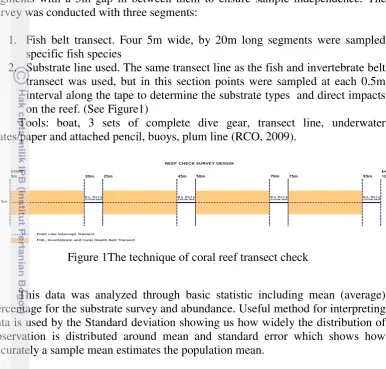
The technique was conducted with 100m line, divided into four 20m segments with a 5m gap in between them to ensure sample independence. The survey was conducted with three segments:
1. Fish belt transect. Four 5m wide, by 20m long segments were sampled specific fish species
2. Substrate line used. The same transect line as the fish and invertebrate belt transect was used, but in this section points were sampled at each 0.5m interval along the tape to determine the substrate types and direct impacts on the reef. (See Figure1)
Tools: boat, 3 sets of complete dive gear, transect line, underwater slates/paper and attached pencil, buoys, plum line (RCO, 2009).
Figure 1The technique of coral reef transect check
This data was analyzed through basic statistic including mean (average) percentage for the substrate survey and abundance. Useful method for interpreting data is used by the Standard deviation showing us how widely the distribution of observation is distributed around mean and standard error which shows how accurately a sample mean estimates the population mean.
Impacts of M&C recreational industry on community
15
4
RESULTS AND DISCUSSION
Natural and Anthropological Characteristics of Gili Trawangan
The village of „Gili Indah‟ is composed of three islands Gili Air, Gili Meno, and Gili Trawangan located northwest of the island of Lombok. Administratively belong to the regency of North Lombok, province of Nusa Tenggara Barat (NTB), Indonesia. The marine area of the village is an environmentally protected area with status of the MTP Gili Matra with 2.954ha, which includes terrestrial area of 169.73ha, where Gili Trawangan is more or less 340ha with a circumference of 7.5 km (Cahyadi, 2012).
Topography and Oceanographic
The island of Gili Trawangan is mostly flat area 1- 3m on the north and central part, with the hill on the south part of the island height of ± 20m (Yulianto , 2007). Oceanographic conditions in the three islands have the same pattern, which have generally flat and sandy beaches with water depth of 1-3m with tidal range of ± 3m. Direction of surface flow between the months of December to April/May move from the north with an average speed of 0.25 m/sec. while in June and November flow heading to south with the same speed. The highest waves occur during the rainy season in the months of December and January with the velocity flow reaches ± 0.40 m/sec (WLS, 2012)
Climate
The MTP Gili Matra has the same type of the climate like others areas on the west part of Indonesia with less rain fall. According the Ferguson‟s classification, on Gili Trawangan the dominate climate is „type C‟ (Regional somewhat wet) and „type D‟ (regional average) with a component of the west monsoon (BKKPN, 2012). During the west monsoon, wind blows from the northwest with a peak speed of 35 knots which occurred in rainy season. The average air temperature vary between 20-30ºC during the year, while maximum air temperature occurred in November of 32ºC and the minimum temperature occurred in June of 20ºC. During the wet season, the average monthly solar irradiation is below 60%, while in dry season the solar irradiation reaches above 70 % (WLS, 2012).
Natural Characteristics of Marine and Coastal Environment
16
for accounting fish species richness. The coastal area of Gili Trawangan is surrounded by sandy beaches, with a few mangroves on the south part of the island (BKKPN, 2012).
Demography
Gili Trawangan was an uninhabited island until the mid-seventies. A colony of ten families was sent to the island to be the farmers of coconut plantations after a war in central Lombok (Soemodinoto and Wong, 2004). The last record of number residence Gili Indah village numbered 3,561 inhabitants. Most of the residents of Gili Indah village are Muslims (99%), the rest are Hindus and Christians. Majority of ethnical composition are Bugis (75%) from South Sulawesi, Sasak form Lombok, Balinese, Javanese and Maduranese. The level of education level in the village of Gili Indah is on low stage with junior high school 23%, senior high school by 11%, and only 2% college education (BKKPN, 2012). The educational level most of time is crucial aspect about the readiness of the local community to be involved in tourism industry.
Tourism Development
The first flow of tourists started with snorkeling trips from the island of Lombok at beginning of the 80s, while the significant tourism development occurred between 1984 and 1991, together with industry of hospitality and diving and snorkeling sector which is still on leading position for the local economy. At the beginnings of the nineties the government stepped in with the aim of relocating uncontrolled tourism facilities and providing control and well sustained future of the island, which marks the first conflict between the public and private sector (Somodinoto and Wong, 2004).
Nowadays, Gili Trawangan according the travel book of „Lonely Planet’ (2012) is one of the top ten destinations recommended to be visited in Asia. The uniqueness of the attractions on the Gili islands are three constitutional rules of the village, which are: no motor vehicle, no dogs and the height of buildings up to palm tree (personal communication with the head of the village of Gili Indah Pak Taufik 21.01.‟14). These rules placed this destination on better position than others islands. Thus, the Gili Islands contributes to the province of Nusa Tengara Barat 23.3% of international tourist arrivals, and this percentage of international arrivals getting higher after the liberalization of tourism industry for the ASEAN countries in 2010 (Cahyadi 2012).
17
Development and Condition of the M&C Recreational Sectoron Gili Trawangan
Recreational opportunity spectrum focuses on the environmental setting where recreation occurs with the combination of physical, social, biological and managerial conditions that give value of the peace (Clark and Stankey, 1979). The environmental setting estimates the carrying capacities for possible recreational areas establishing conditions of use which are considered for each type, and provides means of assessing relative numbers of persons and activities (Stankey, 1991).
Surrounded by the coral reefs and sandy beaches the island of Gili Trawangan provides perfect conditions for a wide spectrum of the M&C recreational activities. Along the east coast lies the main beach of the island is well protected from the open ocean and presents the most appropriate place for human activities and access to the island. The easy access to the east side causes a high frequency of marine traffic and human activities which directly affect the coastal development and increase tourism facilities. The island‟s north coast is mostly suitable for snorkeling and diving on the site called „Halik reef‟, while the beach activities strongly depend of the ocean‟s tide due to the effect of beach erosion. The west and south coasts of the island are exposed to the open ocean with its big waves, mostly appropriate for coastal recreational activities with the highlight of attraction of sunset watching with very limited tourism facilities.
As it mentioned before according Orams‟s classification of the SMRO, activities can be separated by type of activities, locations and environmental conditions. Among the five classified groups, on Gili Trawangan the most common are first two categories of the SMRO.
Easy accessible (based on the shore)
The first category of marine recreation is commonly called Easy Accessible
activities, mostly located on the beach or intertidal zone, with the high tendency of facilities and services. On Gili Trawangan easy accessible activities are mostly distributed along the main beach on the east and southeast side, supported by beach front bars and restaurants.
Accessible (intertidal – 100 m)
The second class of recreational opportunity spectrum are accessible
activities characterized from intertidal zone until 100m off shore, such as: snorkeling, swimming, diving, surfing, stand up paddling, kayaking, glass bottom boats, wind surfing, marine walking and etc. All these activities are mostly occurring on the east side among the high frequency of activities. Due to location and necessity of equipment, the second class of recreational activities presents a challenge for the management to arrange them in a safe and sustainable manner.
Beach activities
18
directly located on the beach front. Sunbathing as the main activity is directly connected with the industry of hospitality limiting space for beach‟s sports and other coastal recreational activities. Along the beach there is the main street, called „Jalan Raya Gili T‟, where there are numerous cafes, restaurants, stores, market, the harbor, dive shops, snorkeling and water sport gear renters, and many others economical subject of tourism industry.
This situation, gives a picture of a typical mass tourist destination where all services are based for human joy and needs, without paying attention on the environmental degradation. Much quieter sides are the west and south coast of the island, along these sides are facilitated by several bungalows, one big resort, and several small cafés. As has been mentioned before, due to the open ocean these sites are not appropriate for the accessible activities (100m off shore), thus, the highlight of attraction on these sides are coastal activities: sun set watching, horse riding. The North coast is very affected by erosion, thus beach activities are strongly depending on the ocean tide, but 50m offshore, there is an attractive reef „Halik’ suitable for snorkeling and diving. Despite of opportunity south and west sides are still not valorized in the beach sports, there is only one proper court for beach volley, according to the BKKPN northwest site is common place where turtles laying the eggs but still there are no signs for that. One of the positive sites of coastal activity is Turtle Conservation Centre, based on the east site with free access for everyone. The center provides opportunity for everyone to release turtle for contribution of 20$.
SCUBA Diving
The richness of the marine biodiversity of the area placed this sport as a highlight of tourists‟ attraction on the island with high chance to see reef shark, green turtles, stingrays, bumphead parrotfish, lion fish and other unique form of the marine tropical Indo-pacific region. There are eleven dive sites around the island, Deep Turbo, Shallow Turbo, Halik reef on the north, Shark point, Manta point on the east side of the island, Biorocks, Good Heart, Surfpoint and Meno Slope, Turtle Heaven, Bounty Wreck on located west reef slope of the island of Gili Meno (See Figure 2).
19
The high intensity of tourism development in the last seven years has doubled the number of dive operators and in 2014 reaching 18 SCUBA operators and one for Free diving, equipped with 30 marine vessels and various services offered. All dive operators on the island are supported by the international standards of PADI (Professional Association of Dive Instructors) and SSI (SCUBA School International) that provides the offer of internationally accepted diving certifications. These standards are attracting tourists to get first touch with the marine world and get „Discover SCUBA Dive‟ or „Open water dive‟ certification, as well as experienced divers to stay longer on island and gain better dive skills.
A decade ago diving entrepreneurs had played a crucial role in stopping destructive fishing practices on the island by providing financial and technical support to the local community and involving NGOs for environmental and social projects. Nowadays, this sector is still most organized on the island, the new alliance of divers is called Gili Islands Dive Association GIDA. It is an association of professional and responsible dive operators on Gili Trawangan. GIDA is a non-profit organization striving for regulated diving professionalism and safety by providing high standards of equipment, instruction and its members have obligation to join the system of dive tax (personal communication: with head of GET 19.01.2014). There are three dive shops that do not support GIDAs rules and do not contribute the eco tax. According one of them, „GIDA is only a business organization suitable for big dive operators to control competition and for me personally dive eco tax are not solution for the environment‟ (personal communication with the owner of dive shop Gili SCUBA – non members of GIDA 14.07.2014)
Despite the unity operators and their willingness to contribute to the environment, the recent development of the diving industry on the island is obviously based on business priority, which leads diving to be a part of mass tourism. Thus, unlimited numbers of divers on the site, open site access for divers outside, large group of divers, unregulated distance to wildlife, unregulated dive sites for beginners and experienced divers, anchoring and improper docking vessels on the beach site, a lack of educational briefing and interpretation of dive guides are some of the issues common on the island in diving industry. Especially during the peak tourism season when many people do this sport for the first time and they commonly have problems with keeping buoyancies kicking and stepping on corals.
Based on the testimony of an experienced recreational diver says:
‘I counted more than 50 divers on area of 100m² and I think it is a lot. It was hard to see the wildlife; many turtles were obviously stressed and unmovable while divers petting and taking a picture of them. Most of time, I was surrounded by bubbles and divers. Although, it was overcrowded, this dive site is still beautiful, but I am afraid with a uncontrolled number of divers the quality of the environment might be decreased, because I
20
Hence, an unlimited number of divers obviously make the diving industry head towards mass activity with an increasing pressure on the environment and a loss in providing the unique experience and education to the customers. The fact of a decreasing marine wildlife is also referred to by the one of the oldest dive instructors on the island who has lived on Gili Trawangan for more than for 30 years.
’Only fifteen years ago it was possible to feed reef sharks and manta rays
from the jetty. I would go snorkeling and see them close to the shore. Gili Meno and Trawangan were connected with the coral reefs. Today, with all these development and human activities, had decreased more than 60% of corals. Still is common to see shark on the east side, while Manta and other bigger rays are
very rare seen around Gilis’Mr. Herman, dive instructor and guide of “Diversia” dive shop.
Snorkeling and other water sports agencies
This sector as relatively cheap and easy to set is recording the highest rate of growth on the island. In the last three years the curve shows a doubled number of snorkeling operators and renters of water sports gears (see Figure 3). There are 39 agencies equipped with 27 glass bottom vessels providing jobs for 120 employees permanently involved in renting, training and guiding.
Figure 3 The annual growth of water sport agencies since 1989 on Gili Trawangan Since 2013 new water sports on the island are: stand up paddling, sea kayaking, kite surfing and marine walking. Marine walking has increased on four operators in only three months. These facts show the huge economical influence and interest of the people in marine sports, but considering the fact that most of these activities are located on the overcrowded east coastline, the question arises „how sustainable and safe they are?‟
Most people are able to do some of these activities individually, thus, proper physical approach is crucial to control more and inform about potential danger and appropriate behavior hazards increase. Considering the east shore as the busiest side of the island, with the high frequency of marine vessels, numerous activities and common strong currents seriously threatening the safety and satisfaction of the snorkelers, swimmers and other recreationalists. During the Christmas and New Year holidays the average number of snorkelers after 4pm was more than 50 on 100m. Based on the testimony of a snorkeler, saying:
21
and safer to mark snorkeling areas. Anyway, I am happy I touched a turtle’
Jeremy, in front of „Gili Divers‟ café. 20.12.2013. This testimony shows the position of the snorkeling industry in environmentally protected which is an alarming call for the governmental sector to support activities by proper facilities and inform of the tourists about an appropriate behavior and approach to the wildlife.
The suitable wave-breakers for surfing occur on the southeast and northwest reef breaks. The southeast one is very popular among tourists and mostly appropriate for recreational surfers. A lack of signs, flags and knowledge of the service providers, commonly causes the mismatch of surfers‟ abilities and the actual wave break. There is only one place for surfboard renting available, in a Surf bar where people on the sandy beach can enjoy surf watching.
Recreational and Spearfishing are another popular sport on the island. Normally, this recreational activity should not exploit the fish, but the lack of proper regulations this activity is a new threat for fish density and endangered species. Fishing rods and spearfishing gear are available for rent in seven shops on the island, where tourists can independently rent a spear gun beside snorkeling gear. Due to lack of law enforcement regulations about ways of fishing and specific rules for endangered species, this activity has increases the hazard for other recreationalists. Renters are usually young and low educated which complicates providing important information about safety standards and endangered species. Apart from destructive environmental practices this threatens human safety, which shows the low level of the management awareness.
As is seen, the recreational industry based on the marine and coastal areas on Gili Trawanagan presents the sector which supports economical income, employment, and other sectors, however, increasing development presents another threat for the environment with high potential to increase in the future. Anyhow, all these activities as non-consumptive sector with better institutional background and responsible policy have a huge potential to reduce its negative impacts and redirect development toward conservation and economical incomes.
Hence, the question arises. Where is the position of the recreational sector in institutional organizations? Who regulates recreational marine industry in the MTP Gili Matra? Whether the participation of the recreational industry is based on the principles of ecotourism to protect the environment and raise people‟s awareness about the ocean?
Management of the Marine Tourism Park ‘Gili Matra’
22
involved in the system even though that was an original activity of the locals (Satria 2006).
Due to the inefficiency to preserve the marine environment and stop destructive fishing practices on the island. Since 2009 the management of MTP Gili Matra has been officially transferred to the jurisdiction of the MMAF (No.:BA.01/Menhut-IV/2009- BA. 108/MEN. KP/III/ 2009). The MMAF has established a new regulatory body called „the National Institute for Aquatic Conservation –Balai Kawasan Konservasi Perairan Nasional - BKKPN (Cahyadi 2012). The technical body of BKKPN mandates to be the link between the regional government of North Lombok, ministry of tourism and MMAF on one side and NGOs and the local community on the other side (WLS, 2012). BKKPN has aim to arrange fisheries and marine recreational activities in sustainable manner.
Non-governmental sector
The environmental destructive practices at the beginning of 2000‟s encouraged the Non Governmental Organizations (NGOs) to step into action and improve the policy of the park. The local community of Gili Islands has established the first organization called „Yayasan Front Pemuda Satgas Gili Indah’
(SATGAS – Security Task), registered as a local organization. Their task was to monitor and implement local regulations in response of the government‟s unwillingness to stop destructive environment practices by fishing methods (Bottema 2010). In 2002, dive operators established the organization called Gili Eco Trust (GET), which initially had the role of collecting the diving eco tax of 3$ and 1$ from snorkeling operators, in order to help SATGAS for patrolling around islands (Graci, 2013). Nowadays, GET is an independent NGO which has expanded its activity to many other environmental and social programs, such as: the biorock reef restoration program, fisherman agreement, patrolling the marine park, clean up days, beach anti-erosion program, turtle hatchery, vet clinic and many others. The NGOs play a very important role in linking the marine recreational sector and governmental institutions.