ISSN 1682-8356
© Asian Network for Scientific Information, 2015
Corresponding Author: Niken Ulupi, Department of Animal Production and Technology, Faculty of Animal Sciences, Bogor Agricultural University, Jl Agatis IPB Campus, Darmaga, Bogor, West Java-16680, Indonesia
Growth Performance and Production of Ammonia and Hydrogen Sulfide in
Excreta of Broiler Chickens Fed Basil (
Ocimum basilicum
) Flour in Feed
Niken Ulupi , Salundik , Dwi Margisuci , Rini Hidayatun and Bagus Sugiarto1 1 2 1 1
Department of Animal Production and Technology, Department of Nutrition and Feed Technology,
1 2
Faculty of Animal Sciences, Bogor Agricultural University, Jl Agatis IPB Campus, Darmaga, Bogor, West Java-16680, Indonesia
Abstract: The aim of this study was to determine the effect of basil flour in feed on the growth performance
and production of NH3 and H2S in excreta of broiler chickens. The study was arranged in a completely randomized design. The treatment levels of basil flour in commercial feed consisted of 4 levels: 0, 1, 2 and 3% (P0, P1, P2, P3). A total of 128 day old commercial broiler chicks were reared until 5 weeks of age in 4 groups. Each group was reared in individual pens measuring 2x3 m . Data of performance were statistically2 analyzed, while data of NH3 and H2S production were analyzed descriptively. No significant differences (p>0.05) were detected in terms of feed intake, body weight gain, feed conversion ratio and final body weight among various treatment groups. Highest body weight gain of 1481.7 g was achieved in the group fed 2% basil flour in feed (P2). Mortality (3.12%) was observed only in the group fed diets without basil flour (P0). NH3 production in P1, P2, P3 were lower than P0, whereas H2S production was otherwise with highest production of 1.37 ppm in P3. In conclusion, addition of basil flour in the feed of broiler chickens doesn’t improve growth performance and NH3 and H2S production in excreta were well below the safe threshold level recommended for chicken health and environment.
Key words: Basil flour, ammonia, hydrogen sulfide, excreta, broiler chicken
INTRODUCTION
Meat is one of the sources of animal protein whose demand is increasing from year to year. Based on Indonesian Statistic in 2012 to 2013 the demand for meat in Indonesia has increased from 2,658,123 tons to 2,880,340 tons (increased by 8.36%). In 2013 as much as 52% of total demand for meat in Indonesia was met from broiler chicken. In this year, the population of broiler chickens in Indonesia reached 1305 million (BPS, 2014).
However, the negative impact of this escalating population is environmental pollution, particularly from chicken manure (excreta). Excreta is the result of the body's excretion from undigested feed in the digestive tract and the waste products of metabolism. Excreta production of broiler chicken is 11 g/chicken/day/kg of body weight (Ensminger et al., 2004). Chicken excreta contains protein, carbohydrates, fats and other compounds (Rohaeni, 2005), besides a moisture content of 60-80% (Leeson and Summers, 2005). Excreta can cause odor and spread of gas. This odor comes from the decomposition of nitrogen and sulfides resulting in the formation of gases like ammonia (NH3), nitrate, nitrite and hydrogen sulfide (H2S). Excreta degradation process is mainly affected by temperature and humidity of environment (Esteves,
2002). The higher the ambient temperature, greater is the intensity of decomposition.
The air polluted with NH3 and H2S can cause health problems to chickens, especially respiratory disorders leading to CRD (Chronic Respiratory Disease). It also increases the activity of Newcastle Disease virus. This contaminated air, it also pollutes the society around the farm. If concentration of NH3 and H2S gas in the shed goes above 0.05%, it can cause the death of chickens (Rahmawati, 2000).
According to Pauzenga (1991), H2S gas is not only toxic to livestock, but also harmful to humans. At concentration of 10 ppm, it causes irritation to eyes and at 50-100 ppm, symptoms caused are nausea, retch and diarrhea. At concentration of 500 ppm at about 5 h, it causes fainting and at concentration of 600 ppm can lead to death.
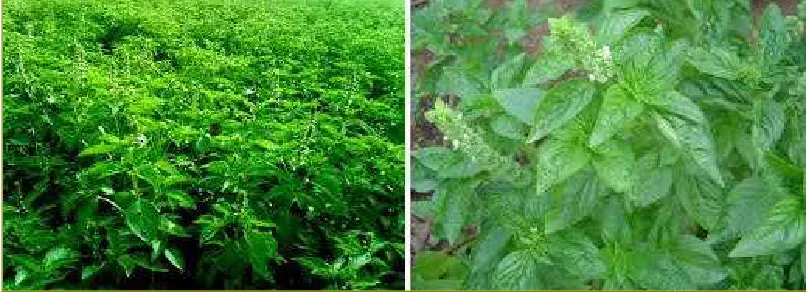
Some efforts can however be made to mitigate the negative impact of raising of broiler chicken. Such efforts include the repair of rearing management, setting of temperature and humidity of rearing environment or through the provision of feed with certain herbs such as basil plants. Figure 1 is presented a picture of basil plant.
Division : Spermatophyta for 24 h and milled the next day which resulted in the
Species : Ocimum basilicum (Agusta, 2000) Sisca (2003) stated that as per the results of research of the Center for New Crops and Plant Products (Purdue University, USA), basil leaves have proven to cure diarrhea, constipation and kidney disorders. Volatile oils of basil plants can serve as effective tool against bacterial infections such as Escherichia coli, Salmonella enteritidis and Staphylococcus aureus.
Some of the compounds contained in the volatile oil of basil, among others, are osinema, cineol, farcena, apigenin and cafeat acid (Massimo et al., 2004; Telci
et al., 2006). Adiguzel et al. (2005) stated that ethanol, methanol and hexane extracts of basil plants contain antimocrobial compounds that can be effective against several important pathogenic bacteria. Basil leaves also contain C and E vitamins, which serves as the primary antioxidant (Riana, 2000). Further, basil presence in feed is expected to minimize the watery excreta due to high ambient temperatures.
Therefore, the purpose of this study was to evaluate the possibility of using basil flour in feed of broiler chickens to see its impact on production of ammonia gas, hydrogen sulfide gas and water content in excreta besides growth performance.
MATERIALS AND METHODS
This study consisted of two experiments. The first experiment was conducted in the field laboratory of Poultry Division, laboratory of Nutrition and Feed Technology, Faculty of Animal Science, Bogor Agricultural University. The second experiment was conducted in the laboratory of Toxicology, Veterinary Research Institute, Bogor.
Experiment 1: The study was conducted on 128 day old
Cobb broiler chicks. The birds were vaccinated against ND and IBD during the experimental period. The birds were distributed in 4 treatment groups having 32 birds each and were reared in individual pens measuring 2x3 m . Each treatment pen was further divided into 42 swaths measuring 1x1 m with 8 birds in every swath.2 The basal feed consisted of commercial feed containing 22% crude protein and 3200 kcal/kg metabolizable energy. The basal flour was added to this feed: 0, 1, 2 and 3% (P0, P1, P2, P3). Feed and water were given
ad libitum.
To obtain the basil flour, basil was withered indoors for 24 h, followed by drying in the sun (dry air) for 3-4 h. Afterwards, the material was kept in Hot Air Oven at 60°C
formation of basil flour. Then, it was mixed with the basal feed in the aforementioned quantities. Nutrient content analysis of basal flour and treatment feeds were done.
The birds were reared untill 5 weeks of age. At the end of the trial, birds were individually weighed and feed consumption was recorded per replicate. Body weight gain and feed conversion ratio were then calculated. Mortality was recorded throughout the experimental period.
Experiment 2: After 5 weeks of age, 3 birds per swath
were transferred and reared in individual cages for a period of 3 days. Afterwards, excreta were collected from each individual cage. 100 grams of wet excreta from each swath were homogenized and analyzed for production of NH3 and H2S gas by Nessler method (Suryana, 2002). Water content of excreta was analyzed by the method of AOAC (1988).
Data analysis: The experiment was arranged in a
Completely Randomized Design (CRD). The treatment in this study was the level of basil flour in commercial feed: 0, 1, 2 and 3%, respectively as P0, P1, P2 and P3. Each of treatments was replicated 4 times. Statistical model was used:
Yij = µ + Pi + gij
Yij, is the total of all observations taken under treatment I in replicate j. µ is an overall mean. Pi is the effect of the i treatment (I: 0, 1, 2, 3). th gij is the usual random error term (Mattjik and Sumertajaya, 2002).
Data of production performance were analyzed by ANOVA, whereas data of production of NH3 gas, H2S gas and water content of broiler excreta were analyzed descriptively.
RESULTS AND DISCUSSION
Nutrient content of feed: The results of nutrient analysis
of basil flour and treatment feeds is presented in Table 1 and 2, respectively.
Fig. 1: Plant basil (Ocimum basilicum)
Performance of broiler chickens: The performances of
broilers during the 35-day of rearing with supplement of basil flour in feed were presented in Table 3.
The result of statistical analysis showed that the addition of basil flour 0, 1, 2 and 3% in commercial feed in this study were not significantly different on feed intake, body weight gain, feed conversion ratio and final body weight of broiler chickens. This fact was caused by the content of the nutritional value of treatment feed (P0, P1, P2 and P3) presented in Table 2, were in accordance with the requirements of broiler chickens. In this study, basil flour in feed produced the production performance in accordance with the standard of strain according to Charoen (2005).
Out of total 128 broiler chicken, only one bird dies on 34th day in the group fed diet without basil flour (P0). Results of postmortem obtained from laboratory of Pathology, Faculty of Veterinary Medicine, Bogor Agriculture University, stated that the bird had died due to Chronic Respiratory Disease (CRD). CRD is caused by the bacteria Mycoplasma gallisepticum (Retno, 2008). Incidence of CRD is increased by high ambient temperature and humidity in the shed and also by increased air pollution (Retno, 1998).
Thus it could be stated that the level of air pollution in the treatment group where basil flour was not used (P0) might have been higher, thereby resulting in the death of said bird. In other words, it may be said that the level of air pollution in the treatment groups where basil flour was used (P1, P2 and P3) was lower, thus confirming that basil flour has antibacterial activity which suppressed the incidence of deaths due to CRD. This is in accordance with the hypothesis of Adiguzel et al. (2005) that the active substances in basil plant (phenolic, volatile oils, carotenoids, ethanol, dan
methanol) have antibacterial activity.
Production of NH3, H2S and water content of excreta:
The results of production of NH3 gas, H2S gas and water content in excreta of broiler chicken fed basil flour are presented in Table 4.
Table 1: Nutrient content of basil flour*
Nutrient Content *Results of the proximate analysis in laboratory of Nutrition and Feed Technology, Faculty of Animal Science
**Estimation of the energy value of feed materials according to NRC (1994)
The results revealed that the NH3 production among different treatment groups was higher (0.54 ppm) in the group fed diet without addition of basil flour (P0). Lowest NH3 production (0.27 ppm) was observed in the group fed high level of basil flour in feed (P3). This showed that basil flour has ability to reduce the NH3 production in the excreta of broiler chickens. The higher level of basil flour in the diet, the NH3 production from excreta was lower. H2S production per 100 g of excreta in broiler chicken was lower (1.24 ppm) in the group fed feed without the basil flour (P0). It was observed that as the level of basil flour was increased in the feed, level of H2S production in excreta decreased. Highest H2S production was recorded in the group fed 3% basil flour in feed (P3). Hydrogen sulfide gas is the result of degradation of sulfur-containing amino acids into simpler components. Sulfur is mainly present in cystine and methionine. About 85-95% of sulfur is removed from the body through excreta of broiler chicken in inorganic form (Winarno, 1992). According to Riana (2000), 100 g of basil contains cystine and methionine as much as 0.028 g and 0.036 g, thus resulting in increased sulfur component and its subsequent degradation and increased production of H2S. Therefore, in view of this reference, it could be hypothesized that increased basil flour in feed results in increased availability of sulfur and subsequent H2S production.
Table 2: Nutrient content of treatment feed*
Nutrient P0 P1 P2 P3
Dry matter (%) 82.72 82.82 82.92 83.02
Ash (%) 5.01 5.08 5.14 5.21
Crude protein (%) 22.66 22.68 22.70 22.72
Crude fiber (%) 3.40 3.54 3.67 3.81
Fat (%) 3.25 3.26 3.26 3.26
Gross energy (kcal/kg) 4087.00 4080.94 4074.96 4068.94
Metabolizable energy (kcal/kg)** 2963.08 2958.71 2954.35 2949.98
*Results of the proximate analysis in laboratory of Nutrition and Feed Technology, Faculty of Animal Science **Estimation of the energy value of feed materials according to NRC (1994)
Table 3: Performances of broiler chickens during the study
Treatment Feed consumption (g/chicken) PBB (g/ekor) Feed conversion Mortality (%) Body weight (g/chicken)
P0 2328.15±53.74 1480.37±46.91 1.57±0.02 3.12a 1530.50±47.01
P1 2240.22±106.83 1397.59±40.04 1.60±0.05 0.00b 1447.50±39.95
P2 2313.58±58.82 1481.74±65.37 1.56±0.05 0.00b 1531.52±65.17
P3 2327.31±23.43 1441.16±31.11 1.62±0.03 0.00b 1491.25±30.74
P0, P1, P2 and P3 were basil flour level in broiler chicken feed, respectively 0, 1, 2 and 3%
PBB: Body weight gain. Different letters in the same column indicated statistically differences (p>0.05)
Table 4: Production of NH3, H2S and moisture content of broiler excreta
*P0, P1, P2 and P3 were basil flour level in broiler chicken feed, respectively 0, 1, 2 and 3%
within the safe limits (<5 ppm for NH3 and <10 ppm for H2S) as reported by Pauzenga, 1991, thus showing that addition of basil flour in the feed does not interfere with the health of broiler chickens and the environment. The results revealed that the water content in excreta of broiler chickens was almost similar among all the treatment groups, thus showing that basil flour had no effect on the water content of excreta in broiler chickens. However, the amount of excreta water content as found in this study was higher than the results obtained by Leeson and Summers (2005) who reported it as 60-80%. It might be due to the reason that the birds were reared in hot weather condition in the present study. The high environmental temperature has an impact on the acceleration of metabolic processes resulting in excess heat production in the body. One of the efforts to reduce the excess body heat is to increase the water consumption, which in turn causes more watery excreta as reported by Riis (1983).
Conclusion: It is concluded that addition of basil flour in feed up to 3% has no effect on the feed consumption, body weight gain and feed conversion ratio, but may have role in reducing the mortality in broiler chickens. Further, the excreta NH3 and H2S gases are generated well within the safe limits posing no threat to broiler chickens or the environment. However, further study in this regard is mandatory.
ACKNOWLEDGEMENTS
Author would like to thank Mr. Murshid and team for facilities and mentoring during analyzing the concentration of NH3 and H2S at Laboratory of Toxicology, Institute of Veterinary Research, Bogor.
REFERENCES
Adiguzel, A., M. Gulluce, M. Sengul, H. Ogutcu, F. Sahin and I. Karaman, 2005. Antimicrobial effects of
Ocimum basilicum (Labiatae) extract. Turk J. Biol., 29: 155-160.
Agusta, A., 2000. Essential Oils of Indonesian Tropical Plant. Bandung. ITB Press.
AOAC (Association of Official Analytical Chemist), 1988. Official Methods of Analysis. 13th Ed. Washington, D.C.
BPS (Badan Pusat Statistik), 2014. Indonesian Statistics 2004. Jakarta.
Bell, D.D. and W.D. Weaver, 2002. Commercial Chicken Meat and Egg Production. 5th Ed. New York. USA. Springer Science and Business Media Inc.
Charoen, P., 2005. Manual Manajemen Broiler CP 707. Charoen Pokphand Indonesia. Jakarta.
Direktorat Bina Produksi, 1997. Indonesian National Standards Collections of Rations. Directorate General of Livestock. Agriculture Ministry of Indonesia Republic. Jakarta.
Ensminger, M.E., C.G. Scanes and G. Brant, 2004. Poultry Science. 4th Edition. New Jersey. Pearson Prentice Hall.
Esteves, I., 2002. NH3 and poultry welfare. Poult. Perspectives, 4: 1-3.
Massimo, L., M. Miele, B. Ledda, F. Grassi, M. Mazzei Retno, W., 2008. Animal Health. Cirebon. Swagati and F. Sala, 2004. Morphological characterization Press.
essential oil composition and DNA genotyping of Riana, A., 2000. Basil. http://www.asiamaya.
Ocimum basilicum L. cultivars. J. Plant Sci., 167: com/nutrients/kemangi.htm. PT Asiamaya Dotcom
725-731. Indonesia [19 Mei 2013].
Mattjik, A.A. and M. Sumertajaya, 2002. Experimental Riis, P.M., 1983. Dynamic Biochemistry of Animal Design with Applications of SAS and Minitab. 2nd Production. Amsterdam. Netherlands. Elsevier
Ed. Bogor. IPB Press. Science Publishers B.V.
NRC (National Research Council), 1994. Nutrient Rohaeni, E.S., 2005. The impact of environmental Requirements of Poultry. 9th Revised Edition. pollution and efforts to overcome. Poult. Indonesia. Washington, D.C. National Academy Press. Maret, 58-61.
Pauzenga, 1991. Animal production in the 90’s in Sisca, D., 2003. Various of the efficacy of basil leaf. harmony with nature: A case study in the Solusisehat.net. [9 Oktober 2013].
Netherlands. In : Biotechnology in TheFeed industry Suryana, 2002. Ammonia, hazards and counter-(T.P. Lyons Ed). Proc. Alltech’s Seventh Annual measures. Poult. Indonesia Juni., 56-57.
Symposium. Nicholasville, Kentucky. Telci, I., E. Bayram, G. Yilmas and B. Avci, 2006. Rahmawati, S., 2000. Management efforts Variability in essential oil composition of Turkish
environmental of chicken farm. Wartazoa. Vol. 9. No basils. Biochem. Sys. and Ecol. J., 34: 489-497. 2. Bogor. Puslitbang Peternakan. Winarno, F.G., 1992. Food Chemistry and Nutrition. Retno, F.D., 1998. Important Diseases in Chickens. 4th Jakarta. Gramedia Pustaka Utama.