E-LEARNING ON RESIDUAL CURRENT DEVICES
Nurul Nadia Bt Janudin
“ I hereby declare that I have read through this report entitle “E-Learning On Residual Current Devices (RCD)” and found that it has comply the partial fulfilment for awarding the degree of Bachelor of Electrical Engineering (Industrial Power)”
Signature :
Supervisor‟s Name : Mrs Aida Fazliana Bt Abdul Kadir
E-LEARNING ON RESIDUAL CURRENT DEVICES (RCD)
NURUL NADIA BT JANUDIN
A report submitted in partial fulfillment of the requirements for the degree of Electrical Engineering
Faculty of Electrical Engineering
UNIVERSITI TEKNIKAL MALAYSIA MELAKA
“ I declare that this report entitle “E-Learning On Residual Current Devices (RCD)” is the result of my own research except as cited in the references. The report has not been accepted for any degree and is not concurrently submitted in candidature of any other degree.
Signature :
Name : Nurul Nadia Bt Janudin
ACKNOWLEDGEMENT
I would like to acknowledge and extend my heartfelt gratitude to Allah S.W.T for His guidance and blessing throughout this final year project even I met an accident at week thirteen, 25th March 2009. I would also like to express my deepest gratitude and thank to my patient supervisor, Mrs Aida Fazliana bt Abdul Kadir for her advices, critics, patient in guide me for this project and willingness dealing with me to help me completing this project.
The helpful lecturer, Mr. Aminudin bin Aman, my Design System Distribution‟s lecturer from Faculty of Electrical, his help about Residual Current Devices (RCD) was gratefully acknowledged. For my beloved mother, Zainah bt Md Jali, thank for your support neither in moral nor money and also thank to my kindness friends that had supported me since the beginning till the end of this project. Without their support, pray and help, this project will not be successful as it was.
ABSTRACT
ABSTRAK
TABLE OF CONTENT
CHAPTER TITLE PAGE
ACKNOWLEDGEMENT vi
ABSTRACT vii
TABLE OF CONTENTS ix
LIST OF TABLES xii
LIST OF FIGURES xiii
LIST OF APPENDICES xv
1 INTRODUCTION 1.1 Background 1
1.2 Problem Statements 2
1.3 Project Objectives 3 1.4 Project Scopes 3
2 LITERATURE REVIEW 2.1 Introduction 4
2.2 Domain 5 2.3 Previous Project 5
CHAPTER TITLE PAGE
2.3.4 Example 4 : An Interactive Learning On AC Power System
2.4 Conclusion 8
3 THEORITICAL BACKGROUND
3.1 Introduction 10
3.2 Component Of RCD 11
3.3 Operation Of RCD 13
3.4 Types Of RCD 14
3.5 Application Of RCD 14
3.6 Limitation Of RCD 15
3.7 Sensitivity Of RCD 15
3.8 RCD Testing 16
3.9 Nuisances-Tripping 18
3.10 Example Type For RCD 19
4 PROJECT METHODOLOGY
4.1 Introduction 20
4.2 Project Methodology 20
4.2.1 Interaction Design
4.3 Flow Chart Project 23
4.3.1 Learning Outcomes 4.3.2 Learning Design 4.3.3 Story Board
4.4 Project Requirements 43 4.4.1 Software Requirements
4.4.2 Hardware Requirements 4.4.3 Other Requirements
CHAPTER TITLE PAGE
5 RESULT AND DISCUSSION
5.1 Introduction 45
5.2 Results 45
5.2.1 Introduction About RCD 5.2.2 Application For RCD
5.2.3 Components And Principles For RCD
5.3 Test Plan 49
5.3.1 Test User
5.4 Test Implementation 50
5.4.1 Test Data
5.3.2 Analysis Testing
5.5 Analysis For RCD‟s Price 56
5.6 Discussion 57
6 CONCLUSION 58
REFERENCES 60
LIST OF TABLES
TABLE TITLE PAGE
3.10 Two Pole F362 And F662. Class AC 19
4.3.1 Learning Outcomes 25
4.3.2 Example for Learning Design 26
4.3.3 Example For Story Board 32
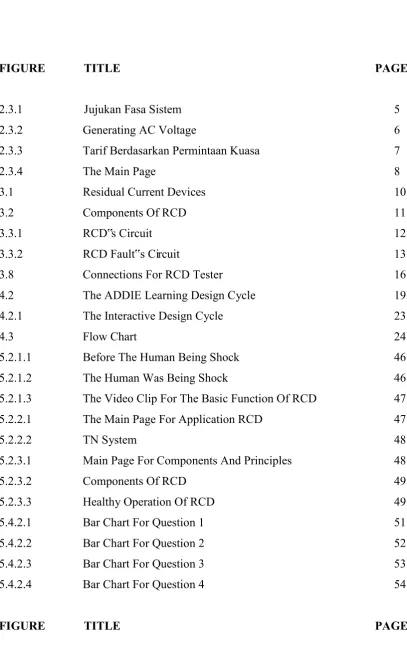
LIST OF FIGURES
FIGURE TITLE PAGE
2.3.1 Jujukan Fasa Sistem 5
2.3.2 Generating AC Voltage 6
2.3.3 Tarif Berdasarkan Permintaan Kuasa 7
2.3.4 The Main Page 8
3.1 Residual Current Devices 10
3.2 Components Of RCD 11
3.3.1 RCD‟s Circuit 12
3.3.2 RCD Fault‟s Circuit 13
3.8 Connections For RCD Tester 16
4.2 The ADDIE Learning Design Cycle 19
4.2.1 The Interactive Design Cycle 23
4.3 Flow Chart 24
5.2.1.1 Before The Human Being Shock 46
5.2.1.2 The Human Was Being Shock 46
5.2.1.3 The Video Clip For The Basic Function Of RCD 47
5.2.2.1 The Main Page For Application RCD 47
5.2.2.2 TN System 48
5.2.3.1 Main Page For Components And Principles 48
5.2.3.2 Components Of RCD 49
5.2.3.3 Healthy Operation Of RCD 49
5.4.2.1 Bar Chart For Question 1 51
5.4.2.2 Bar Chart For Question 2 52
5.4.2.3 Bar Chart For Question 3 53
5.4.2.4 Bar Chart For Question 4 54
5.4.2.5 Bar Chart For Question 5 54
5.4.2.6 Bar Chart For Question 6 55
LIST OF APPENDICES
APPENDICES TITLE PAGE
A Questionnaire 63
CHAPTER 1
INTRODUCTION
1.1 Background
Nowadays, technology is very advanced compare 10 years ago. The same thing happened to learning process. Study by book is a second choice because of technology, student prefer study by surfing internet.
E-learning (or electronic learning) is a one type of education where the medium of instruction is computer technology. This is also one of the new technologies among the student nowadays. E- Learning furnishes user with the self-paced modules, knowledge of the internet and computer skills, an opportunity to become independent and self reliant, flexibility of time-tabling and scheduling. E-Learning is important because there is simple note and attractive technology while the users gain knowledge.
This project used an E-Learning on Residual Current Devices (RCD) is one of the latest learning system using e-Learning approach in Faculty of Electrical Engineering (FKE), Universiti Teknikal Malaysia Melaka (UTeM). This project is to make the study about RCD attractive and interactive.
The interactive is capable of acting on or influencing each other [2]. In this project the user can answer some question in the tutorial and the answer will be given. Furthermore, the user also can answer the animation situation either the RCD will trip or not.
1.2 Problem Statements
First of all, the problem statement is to increase consistency among reader when learning is captured and delivered by technology. The manual learning process just one way interaction study. Sometimes this learning process make the student feel bored and sleepy. The result, student will take a long period to finish their study for one subject. So, this courseware was built to help the student enjoy their study about RCD without feel sleepy and bored. They also could finish and understand about RCD just in a few minutes.
Then, the second problem statement is study through the book sometimes unclear. Study through the book is unclear because sometimes student cannot imagine what happened actually. Its mean, the book just can tell us about the principle and operation for the RCD by the operation circuit but the circuit is just a pictures. The reader cannot relate between the knowledge about the operation in real situation. In the e-Learning, the user can understand and see the operation for the RCD because the operation of RCD will be solving by animation in the e-Learning.
The third problem statement is to applicate an interactive and attractive way in study about RCD by using Macromedia Flash 8 Software. Study through the book is manual learning process which is one way interaction study. E-Learning is two way studies which mean the user can give the answer and the system will tell either the answer is true or false quickly. The user also can repeat the animation for the RCD operation frequently. So, this courseware was using Macromedia Flash 8 Software to make the study about RCD more fun and easy to understand.
1.3 Project Objectives
Make a survey among final year students of Faculty of Electrical Engineering (FKE), Universiti Teknikal Malaysia Melaka (UTeM).
The analysis for the price of RCD among the electrical shops around Malacca also must be survey and analysis.
1.4 Project Scopes
This project was cover about nine subtopics that related to the RCD. First of all, the user was given briefly knowledge about RCD in the introduction about RCD. Then, the user was slowly understand more about RCD such as the components and the principles operation of RCD, the types and example type of RCD, application and specification, nuisance-tripping and RCD testing. The user will know more about RCD when they going through this e-Learning project on RCD in attractive and interactive way with an animation, related videos and also a simple explanation.
CHAPTER 2
LITERATURE REVIEW
2.1 Introduction
E-Learning on Residual Current Devices (RCD) is a new technology of learning which programmable system and the domain is Macromedia Flash 8 Software. This software will make the learning through e-Learning interactive and attractive by sound effects (musical), audio instructions (linguistic), simple example with animation, and the tutorial about the topic.
2.2 Domain
The domain for this project is aim for education and learning using technology. Based on the domain that has been selected and this project was related to the syllabus of engineering subject especially for Electrical Engineering students.
2.3 Previous Project
The existing example is a one of the research and references that must to make a case study in finding what the advantages and disadvantages which are related to this project. Here have four example e-Learning in a different interface.
2.3.1 Example 1: Sistem Tiga Fasa [4]
Figure 2.3.1: Jujukan Fasa Sistem
2.3.2 Example 2 : Generating AC Voltage [5]
Figure 2.3.2: Generating AC Voltage
This example “Generating AC Voltage” was uploading by Mrs Aida Fazliana Bt Abdul Kadir in website for e-Learning classroom. This example is very interactive and attractive which also include voice. The voice is female voice which was very clear and the user can easily understand about what was her talking about. Furthermore, this example also includes the tutorial and simple and attractive animation. But the problem is the loading for this e-Learning sometimes take a few moments to go other slide to another slide.
2.3.3 Example 3 : Kecekapan Tenaga [6]
Figure 2.3.3: Tarif Berdasarkan Permintaan Kuasa
2.3.4 Example 4 : An Interactive Learning On AC Power Transformer [7]
Figure 2.3.4: The Main Page
This last example is about „An Interactive Learning On AC Power Transformer‟ by Mrs Aida Fazliana Abdul Kadir and Mr Gabriel Jatu. This example of e-Learning is very colourful and simple to understand while gain knowledge. This example also includes simple experiments to make user easy to understand the topic discuss. Besides that, this example also has the tutorial to make sure the user understand after going through this page.
2.4 Conclusion
CHAPTER 3
THEORITICAL BACKGROUND
3.1 Introduction
A residual current device is, first and foremost, a safety device. A residual current device or earth leakage circuit breaker is known by many acronyms throughout the world. The main factor in determining the name is the end use and the environment in which the product is to be installed. Some of the most common acronyms are [8]:
RCD - Residual Current Device (New Zealand/Australia/Europe)
ELCB - Earth Leakage Circuit Breaker (New Zealand/Australia and Asia) RCBO - Residual Current Circuit Breaker with integral over-current protection
(Europe)
RCCB - Residual Current Circuit Breaker (Europe) GFCI - Ground Fault Circuit Interrupters (USA/Canada)