“We acknowledge that we have read this thesis and in our opinion this thesis is sufficient in terms of scope and quality for the award of Bachelor of Technology Management
(Innovation Technology)”
Signature : ………
Name of Main Supervisor : Puan Murzidah binti Ahmad Murad
Date : 24 June 2013
Signature : ………
Name of Joint Supervisor : Dr. Norain binti Ismail
i
THE FINANCING OF SMALL AND MEDIUM SIZED ENTERPRISES (SMEs) AND THE IMPACT TO BUSINESS PERFORMANCE IN MELAKA FOOD
INDUSTRY
SITI RASYIDAH BINTI BASIRON
This report submitted in
partial fulfillment of the requirements for
the award of Bachelor of Technology Management (Innovation)
Faculty of Technology Management and Technopreneurship
Universiti Teknikal Malaysia Melaka
ii
“I truly admit that this report is my own writing except the summary and citations that I have mentioned their sources.”
Signature : ………
Name : Siti Rasyidah binti Basiron
iii
This thesis is dedicated to my parents;
Mak and Abah
iv
ACKNOWLEDGEMENT
In the name of Allah, the Most Gracious and the Most Merciful
Alhamdulillah, all praises to Allah for the strengths and His blessing in
completing this research. I would like to extend my deepest gratitude to all those who
have directly and indirectly guide and help me to complete this research.
Special appreciation to my supervisor, Puan Murzidah binti Ahmad Murad
for the patient guidance, encouragement and advice she has provided throughout my
time as her student. I have extremely lucky to have a supervisor who considers and
cared about my research. I appreciate all valuable information that make easier to
write the report.
I would like to convey my gratitude to my Research Method lecturer, Dr.
Chew Boon Cheong for his priceless guidance directly and indirectly: whether in
class or his blog about a research method subject toward making a good research. I
feel so grateful to be his student as he always support and encourage all students with
invaluable words.
Sincere thanks to all my housemate especially Naziatul, Zarin, Izzati and
Syahirah for their kindness and moral support throughout my study. Thanks for
friendship and memories.
Last but not least, a special thanks goes to my parents, sister and elder
v ABSTRACT
Nowadays, one of Malaysia’s key drivers for economic growth is Small and Medium Enterprises (SMEs). Based on SME Master Plan launched two years ago, the government target for SMEs contribution is 41% of country’s Gross Domestic Product (GDP) by 2020. Although the number might be lower in Malaysia, SMEs
have the potential to contribute substantially to the economy and can provide a strong foundation for the growth of Malaysia’s future development. According to Doing Business Report by World Bank, Malaysia record for ‘getting credit’ is ranked number one for four consecutive years (SME Master plan 2012-2020). Financing is
necessary for SMEs to help them set up and expand their operations or production
facilities. In this research food industry was selected among SMEs to identify the
types of financing involved whether the sources can enhance the performance of the
SMEs. Specifically, this study was initiated to investigate the impact and examine
the relationship between financing and business performance. In order to examine
the food industry at Melaka, some survey was conducted among SMEs, while data
collected was analysed through quantitative by using frequency, descriptive and
correlation analysis. The result showed there is moderate to strong impact of
financing toward business performance and the relationship is significant for all
vi ABSTRAK
Kini, salah satu daripada pemacu utama Malaysia bagi pertumbuhan ekonomi ialah
daripada Perusahaan Kecil dan Sederhana (PKS). Berdasarkan kepada Pelan Induk
PKS yang dilancarkan dua tahun lalu, sasaran kerajaan bagi sumbangan PKS adalah
41% dalam Keluaran Dalam Negara Kasar negara (KDNK) pada tahun 2020.
Walaupun jumlah itu mungkin lebih rendah di Malaysia, PKS mempunyai potensi
untuk menyumbang dengan ketara kepada ekonomi dan boleh menyediakan asas yang kukuh untuk pertumbuhan pembangunan masa depan. Menurut Laporan ‘Doing Business Report oleh Bank Dunia, rekod Malaysia untuk mendapat kredit berada di
kedudukan nombor satu untuk empat tahun berturut-turut (PKS Pelan Induk
2012-2020). Pembiayaan adalah perlu bagi PKS untuk membantu mereka menubuhkan dan
mengembangkan operasi atau bagi kemudahan pengeluaran. Industri makanan telah
dipilih bagi menjalankan penyelidikan di kalangan PKS untuk mengenal pasti
jenis-jenis pembiayaan yang terlibat sama ada sumber-sumber yang boleh meningkatkan
prestasi PKS. Khususnya, kajian ini telah dimulakan untuk menyiasat kesan dan
mengkaji hubungan antara pembiayaan dan prestasi perniagaan. Dalam usaha untuk
mengkaji industri makanan di Melaka, beberapa kajian telah dijalankan di kalangan
PKS, manakala data yang diperolehi dianalisis melalui kaedah kuantitatif dengan
menggunakan kekerapan, deskriptif dan korelasi analisis. Hasil menunjukkan
terdapat kesan yang sederhana kepada tinggi mengenai pembiayaan dengan prestasi
vii
LIST OF CONTENT
CHAPTER TOPIC PAGES
CONFESSION ii
DEDICATION iii
ACKNOWLEDGEMENT iv
ABSTRACT v
ABSTRAK vi
LIST OF CONTENT vii
LIST OF TABLE x
LIST OF FIGURE xi
LIST OF ABBREVIATION xii
LIST OF APPENDIX xiii
CHAPTER 1 INTRODUCTION 1
1.1 Introduction/Background of Study 1
1.2 Statement of Problem / Research Question 2
1.3 Research Objective 2
1.4 Scope 3
1.5 Limitation 3
1.6 Importance of The Project 4
viii
CHAPTER 2 LITERATURE REVIEW 5
2.1 Introduction 5
2.2 Small and Medium-sized Enterprises (SMEs) 6
2.3 SMEs Financing 8
2.4 Capital Structure theory 10
2.5 Business performance 11
2.6 Theoretical Framework 12
2.7 Hypothesis 13
2.8 Summary 14
CHAPTER 3 RESEARCH METHOD 15
3.1 Introduction 15
3.2 Research Design 15
3.3 Quantitative Research 16
3.4 Primary and Secondary Data Sources 16
3.5 Location of The Research 17
3.6 Method of Primary Data Collection 17
3.7 Questionnaire Design 18
3.7 Data analysis 18
3.8 Summary 20
CHAPTER 4 RESULT AND DISCUSSION 21
4.1 Introduction 21
4.2 Reliability test 22
4.3 Organizational Profile 23
4.4 Respondents Financing Preferences 25
4.5 Impact to Business Performance 27
4.6 Relationship between independent variable
and dependent variables and hypothesis testing
30
ix
CHAPTER 5 CONCLUSION AND SUGGESTIONS 33
5.1 Introduction 33
5.2 Summary of main finding 34
5.3 Suggestion to overcome / improve something 35
5.4 Recommendation for further studies 36
References 37
x
LIST OF TABLE
NO TOPIC PAGES
2.1 SMEs definition based on number of full-time
employees 5
2.2 SMEs definition based on annuals sales turnover 6
2.3 Performance of Government Funds and Schemes as at
December 2010 9
4.2.1 Reliability Statistics 22
4.5.1 Mean and standard deviation for Turnover and
financial management
27
4.5.2 Mean and standard deviation for Return on Investment 28
4.5.3 Mean and standard deviation for revenue, profit and
margin
28
4.5.4 Mean and standard deviation for productivity 29
4.6.1 Correlation table for finance and turnover 30
4.6.2 Correlation table for finance and return on investment 31
4.6.3 Correlation table for finance and return on revenue 31
xi
LIST OF FIGURE
NO TOPIC PAGES
2.2 Theoretical Framework 11
4.3.1 Firm’s Age 23
4.3.2 Firm’s Size 24
4.4.1 SMEs Financing Preferences by Size 25
xii
LIST OF ABBREVIATION
SMEs Small and Medium Enterprises
GDP Gross Domestic Product
SMIs Small and Medium Industries
SMIDEC Small and Medium Industries Development Corporation
SPSS Statistical Package of Social Sciences
xiii
LIST OF APPENDIX
NO TOPIC PAGES
1. Appendix A : Permission Letter 40
2. Appendix B : Questionnaire 41
3. Appendix C : Gantt Chart I 46
1 CHAPTER 1
INTRODUCTION
1.1Introduction/ background of the study
Without doubt, Small and Medium Enterprises (SMEs) is important to the
Malaysian contribution economy to strive high-income nation from the medium-high
income nation. One of the strategic goals to be achieved by SMEs is to increase
business formation and expand the number of high growth and innovative firms.
According to Ministry of International Trade and Industries (2012), SMEs represent
the largest percentage of establishment in Malaysia at 99.2 % while for economic
contribution, SMEs contributes 32% to Gross Domestic Product (GDP), 56.4 % of
total work force and 19% of total export. Budget 2013 represents 1 Billion will be
provided under the development of SMEs to be handled by SME Bank to facilitate
the access of SMEs to obtain financing. Financing is necessary for SMEs to help
them set up and expand their operations or production of facilities. Based on the fund
provided by the government and non-government sector, there will be a variety of
financial sources involved by the firms. So that, the main purpose of this this study is
to investigate how far financing sources can impact business performance. Besides
that, this project will identify the relationship between financing and business
2
1.2 Statement of the problem/ Research Question
Based on the contribution of SMEs to GDP in the economy, the government
realized the importance of SMEs and provide RM1 billion in 2013 Budget for
entrepreneur in accessing the funding. Compared to previous research about SMEs,
this topic is concerned about challenges for SMEs in financing. Since the
government is encouraging entrepreneur with the allocation to get funding to expand
the business, the researcher is interested to investigate about financing preferences
adopted by SMEs and how far the financing can impact business performance. The
research questions of this case study are as stated below:
1. What are the types of SMEs financing preferences in Melaka food industry?
2. What is the impact of financing sources to business performance?
3. Does SMEs financing have a positive relationship to business performance?
1.3 Objectives
There are three objectives of this research study as stated below:
1. To identify types of SMEs financing preferences in Melaka food industry.
2. To investigate the impact of financing sources to business performance.
3. To examine the relationship between financing and business performance.
1.4 Scope
The focus of this study is to investigate the impact of financing sources to the
business performance of SMEs in food industry. For the case study itself, this topic
only covers the sources of financing involved and its impact on business
performance. The other factors which influence the performance of Malaysian SMEs
such as human capital development, market access, legal and regulation
environment, innovation and technology adoption, and infrastructure are not to be
3 1.5 Limitation
1.5.1 Time constraint
The major limitation in conducting this research is due to time constraint.
Since this study only takes about one year, there is a time limitation to complete this
research. As a degree student, the researcher has another commitment to do. In order
to get accurate data, it is a must for the researcher to allocate a long period of time in
order to obtain all necessary information. However this research has limited time to
gather relevant information on selected topics upon conducting this study hence
makes time constraint obviously is the utmost limitation for this case study.
1.5.2 Lack of respondent’s co-operation
Some of the respondents refused to give full co-operation during the
questionnaire survey distribution since the times used to distribute the questionnaire
were during office hours.
1.5.3 Cost to conduct the research
In order to prepare and finish this research, the cost involved is quite high
especially for printing, photocopy of questionnaire for the entire respondent and
transportation cost used for questionnaire distribution.
1.6 Importance of the Project
The importance of the project is to determine how far the financial factor can
impact to business performance of the SMEs. Other than that, this study will
investigate which types of sources of financing preferences among SMEs. It includes
government step in budget 2013 to increase the funding is the best way to increase
4
(SMIs) is about 1 million under SME bank. The value of this project can be
appraised based on the result of the finding.
1.7 Summary
The main basis of conducting research on firms in the SME industry sector is
significant to economic contribution in which about 41% to GDP by 2020. In order
to achieve the target of high income nation, there are a lot of strategies that have been
provided by the government. The obvious effort is to empower Small and Medium
Industry. Without doubt, nowadays SMEs is performing well best on its current GDP
which is about 32%. The previous research of financing is concerned with the
5 CHAPTER 2
LITERATURE REVIEW
2.1 Introduction
Many theories have been proposed to explain financial issues about SMEs.
However, this research aims to study about the impact of financial sources to the
business performance. According to Little S.S. (2005) it is stated that big or small
organization needs to build a system about the financial health of an organization for
people to run the organization that is able to deliver time and consistent information.
The other way, corporate financial structure literature is concerned with debt
explanations or equity choice (Bhaird, C.M.A., 2010), followed with Ross Levine
(2004) which stated that there are huge implication for international flows and
economic growth rates based on different in quality of financial intermediation
across country (Boyd, J.H. and Smith, B.D., 1992). This chapter will explain the
details about the definition of SMEs, types of finance available in Malaysian SMEs,
6
2.2 Small and Medium-sized Enterprises (SMEs)
There are different parameters about definitions in SMEs based on the
researchers in earlier studies. However, according to Bhaird,M.A. (2010), “definitions are not static and will change constantly to reflect to economies condition, productivity, and technology change”.
SME is defined as a company with no more than 500 employees (Oxford
Dictionary, 2012). A general definition specified by the Small and Medium
Industries Development Corporation (SMIDEC) can be grouped into three categories
which are Micro, Small or Medium. There are two main factors to consider whether
the numbers of people a business employs or according to total sales or revenue
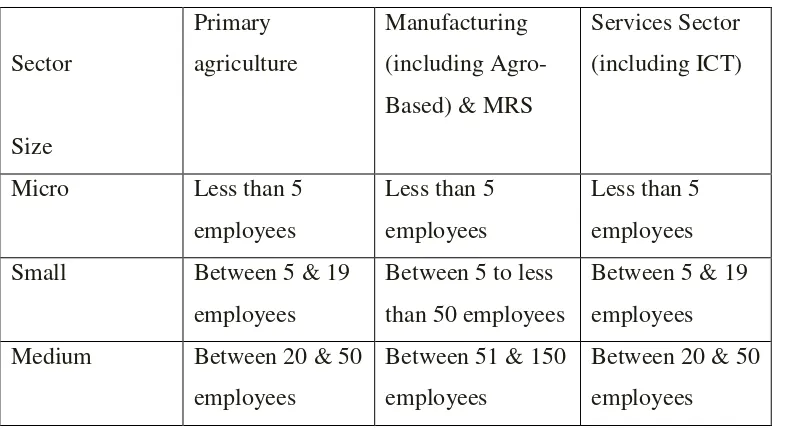
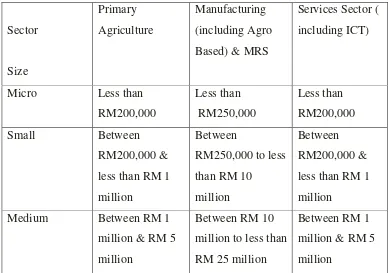
generated by a business in a year. Table 2.1 and Table 2.2 show the SMEs definition
[image:20.595.126.527.439.654.2]based on two factors stated.
Table 2.1: SMEs definition based on number of full-time employees
(Sources: Small Medium Industries Development Corporation)
Sector Size Primary agriculture Manufacturing (including
Agro-Based) & MRS
Services Sector
(including ICT)
Micro Less than 5
employees
Less than 5
employees
Less than 5
employees
Small Between 5 & 19
employees
Between 5 to less
than 50 employees
Between 5 & 19
employees
Medium Between 20 & 50
employees
Between 51 & 150
employees
Between 20 & 50
employees
7
Table 2.2: SMEs definition based on annuals sales turnover
(Sources: Small Medium Industries Development Corporation)
Sector Size Primary Agriculture Manufacturing (including Agro
Based) & MRS
Services Sector (
including ICT)
Micro Less than
RM200,000
Less than
RM250,000
Less than
RM200,000
Small Between
RM200,000 &
less than RM 1
million
Between
RM250,000 to less
than RM 10
million
Between
RM200,000 &
less than RM 1
million
Medium Between RM 1
million & RM 5
million
Between RM 10
million to less than
RM 25 million
Between RM 1
million & RM 5
million
The researchers refer to SMIDEC to determine the size of the firm whether
the firm size is micro, small or medium firm. It is based on two main factors: annual
8 2.3 SMEs Financing: Types of Resources
The sources of capital available in Malaysian SMEs can be found in three
types which are personal saving (bootstrap) , equity financing, bank loans, financing
with debt, and the government (SMIDEC,. 2012)
2.3.1Bootstrap Financing
Personal saving or bootstrap financing is categorized as internal sources.
Basically this source is used to start-up the business. It is important to note some
basic different between small to medium sized enterprises (SMEs) and large firm in
relation to financing. Compared to large firms, they are mostly rely on more heavily
bootstrap financing in the form of retained profit (Tim,M., 2011).
2.3.2Equity financing
Equity financing is the money that investor puts into a private company in
return for a share in the ownership of that business (Black, A.,2007). According to
SME Corporation, Bank loans can be defined as bank lends money to existing
business but for a start-up, it may be very difficult to get a bank loan as they do not
have a track record. This includes a track record of good cash flow to allow for
repayments plus adequate shareholder funds or working capital that can cover any
short term cash requirement and ensure the solvency (Tim,M.,2011).
Venture Capital
Venture capital usually used to finance high-risk, and seeking high return
investment ( Brutonand Bamford, 2006: Axman, A.,2007). Venture capitalist usually
invests in business in every kind, and also known as angels. The angel investor
9 2.3.3 Non-Equity financing
Debt Financing
Financing a business with debt involves securing a loan. This can be
happened in the form of unsecured or secured debt. Unsecured debt refers to a taken
without having to put up any specific form of security or collateral (SMIDEC, 2012).
Loans
Loans are repaid monthly from cash flow and are secured by an asset or
personal. The sources of loan can be getting from personal loan, mortgage loan, and
insurance loan.
Government/ Grants
Government is one of the important sources to access finance. According to
SMIDEC there are a variety of loans provided by the government in order help an
entrepreneur especially to Bumiputeras. These types of loans are under the Financial
Institution like Development Financial Institutions (DFIs) and commercial bank.
While grant means a special fund, neither equity debt or equity designed to aid
business in a specific area( Bruton and Bamford, 2006).
The researcher analysed that the firm needs to decide which types of
financing is right for their business. With debt financing, the money that the firm
borrow need to repay, such as a bank loan. Equity financing decision is necessary
capital from the investor of the firm. While by personal saving and bootstrap, the owner’s take risk on their money and did not to repay to other parties. Informal finance and trade secret on the private firm can be influence to the net income and
10
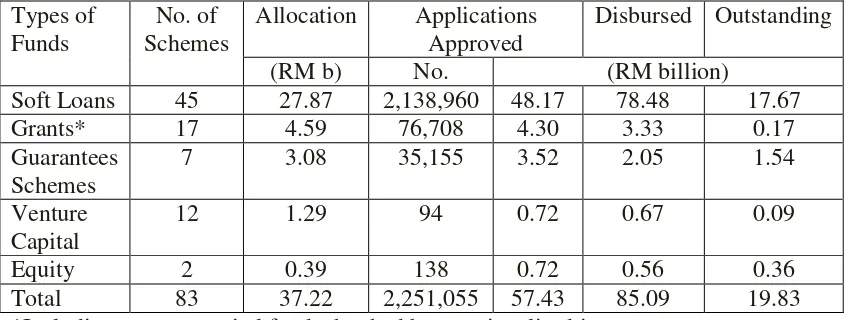
Table 2.3: Performance of Government Funds and Schemes as at December 2010 (Source: SME Corporation Malaysia; Annual Report 2010/2011)
Types of Funds
No. of Schemes
Allocation Applications Approved
Disbursed Outstanding
(RM b) No. (RM billion)
Soft Loans 45 27.87 2,138,960 48.17 78.48 17.67
Grants* 17 4.59 76,708 4.30 3.33 0.17
Guarantees Schemes
7 3.08 35,155 3.52 2.05 1.54
Venture Capital
12 1.29 94 0.72 0.67 0.09
Equity 2 0.39 138 0.72 0.56 0.36
Total 83 37.22 2,251,055 57.43 85.09 19.83
*Including venture capital funds that had been rationalised into grants
Based on table 3, Malaysia SMEs involved types of funds approved to 2.2
Million SMEs which are from soft loans, grants, guarantee schemes, venture capital
and equity. Based on the annual report employed by SME Corporation Malaysia, the
total amount is about RM 57.4 billion. The researcher will investigate how far the
finance by government and non-government can impact to business performance.
According to Bhaird, C.M.A.,(2010) stated that the youngest age firm are employed
from external sources in term of short and long term debt to run the business.
2.4 Capital Structure Theory
According to Modigliani and Miller (1958) trade-Off theory is about capital
structure theory which focused on the irrelevance proposition of debt versus equity
observed on the right-hand side of corporations’ balance sheet. When firm chooses a certain proportion of debt and equity to finance its assets, all that it does is to divide
up cash flow among investors. This theory explains the mix of securities and
financing sources used by corporations to finance real investment (Zabri, S. M ;
2012).The most profitable firms should potentially benefit most from employing an
optimal level of debt. According to Frank, M.Z. and Goyal, V.K., (2005) Pecking
order theory comes out with approaches to defining the capital structure of a
company. Firms use internal funds that are less costly than external funds. When