131 | F a s c i c u l e 1
ANNALS of Faculty Engineering Hunedoara
– International Journal of Engineering
Tome XV [2017] – Fascicule 1 [February]
ISSN: 1584-2665 [print; online]
ISSN: 1584-2673 [CD-Rom; online]
a free-access multidisciplinary publication
of the Faculty of Engineering Hunedoara
1.
Germán VALENCIA GARCÍA,
2.Ştefan ŢĂLU
DIHEDRICAL ANGLE BETWEEN TWO OBLIQUE
PLANES LINE OF INTERSECTION NOT GIVEN USING
THE VALENCIA & ȚĂLU METHOD
1. Universidad del Valle, School of Architecture, Department Projects, Cali, COLOMBIA
2. Technical University of Cluj-Napoca, Faculty of Mechanical Engineering, Department of Automotive Engineering and Transportation, Discipline of Descriptive Geometry and Engineering Graphics, Cluj-Napoca, ROMANIA
Abstract: One of the most frequent problems presented in descriptive geometry consists in the determination of the dihedrical angle between two oblique planes without knowing its intersection line; the conventional method consists in building a dihedrical projection or view in which both planes are projected as edge view each one; to do so it is necessary to draw five views in total. The Valencia & Țălu method we have developed allows to get the same result using only three and a half projections in total. On the other hand, the Valencia & Țălu method has next advantages: a reduced working time and for analysis, and drawing area is saved (28% approximately); - it is very intuitive and the possibility of using colors helps to a quick and accurately identification of the objects under work. Keywords: Valencia & Țălu method, director plane, relative strike of a plane, relative dip of a plane, dihedrical angle between two oblique planes
INTRODUCTION
Geometry is the essential component of any formal art, and it is the main reference of design, which means the creation of shapes, and design drawing, which concerns their representation [1].
On the other hand, geometry is the privileged tool for the representation of cognitive models that can express different elements; it displays concepts in the relationship between shape and number, which manifests the association between the arts of space (and time), which share the concept of harmony and proportion with mathematics [2].
Descriptive Geometry is a method to study three-dimensional (3-D) geometry through two-dimensional (2-D) images thus offering insight into structure and metrical properties of spatial objects, processes and principles [3].
The representations of the constructions and obtaining detailed geometric solutions with the help of descriptive geometry play an important role in spatial investigation and object measurement in the practice of civil engineering, architecture, engineering and engineering design [4-10].
The introduction of 3-D modeling software creates a new potential for studies of geometrical forms, their features and representation and has deeply affected the representational tools of design, shifting attention from the two dimensions of drawing to the three dimensions of virtual spaces. It also performs operations with high-performance ray-tracing for rendering and geometric analysis [1, 11-13]. The 3-D solid modeling provides a framework to model and represents an object's shape in the computer. It improves product quality and has helped to lower product development costs and to shorten the design process. [14-18]
132 | F a s c i c u l e 1
This paper aims is to offer a novel contribution, based on the use of the methods of descriptive geometry, in the determination of the dihedrical angle between two oblique planes without knowing its intersection line.
GRAPHICAL METHOD
The conventional method in the determination of the dihedrical angle between two oblique planes without knowing its intersection line consists in building a dihedrical projection or view in which both planes are projected as edge view each one (Figure 1); to do so it is necessary to draw five views in total [4, 20, 21].
The method proposed in this work (the Valencia & Țălu method) allows getting the same result using only three and a half projections in total.
Figure 1. Dihedrical angle between two oblique planes line of intersection not given using the conventional method
133 | F a s c i c u l e 1
The Valencia & Țălu method consists in applying together three objectives as follows:
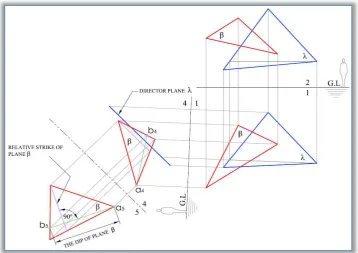
1. Designate one of the planes as a director plane: The director plane (λ) when projected as an edge acts as a conditioner plane in order to draw straight parallel lines in the other given plane (β), in this way the relative strike of plane β is obtained regarding the director plane λ; Figure 2.
2. Determine the right angle to the relative strike of plane β regarding director plane λ: The AB line contained in plane β is perpendicular to its relative strike, which represents the dip of plane β regarding the director plane λ; Figure 2.
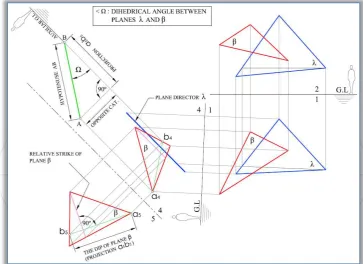
3. Apply the Pythagorean theorem: The line with slope AB of plane β regarding the director plane λ projected as an edge, represents the dihedrical angle wanted (Ω), in the end the real magnitude of the hypotenuse AB is determined regarding the director plane λ (auxiliary ground line) using the Pythagorean theorem; Figure 3.
Figure 3. Determination of the dihedrical angle Ω using the Pythagorean theorem
3. CONCLUSIONS
An analysis of the conventional method highlights next disadvantages: it is laborious, requiring more time and attention to be executed.
On the other hand, the Valencia & Țălu method has next advantages: the working time, analysis, and drawing area is saved (28% approximately); - it is very intuitive and the possibility of using colours helps to a quick and accurately identification of the objects under work.
Based on new conclusions and applications of descriptive geometry and mathematics can be derived that enables efficient exploration of a wide range of computer graphics possibilities, and rapid production of computer generated animated demonstrations in descriptive geometry. Furthermore, all these steps in graphical construction can be included in an algorithmic mathematical model on the computer graphics and provide a good basis for development of improved graphical constructions in design applications with accessible interface.
References
[1.] Rossi M. (ed.). The relation shape/color in design. Digital procedures for color management and representation, in: “Descriptive Geometry and Digital Representation: Memory and Innovation”, 1st ed., New York, USA: McGraw-Hill, 2012.
[2.] Rossi M. (ed.). The gometry of colour. Shape as a measuring tool. in: “Descriptive Geometry and Digital Representation: Memory and Innovation”, 1st ed., New York, USA: McGraw-Hill, 2012.
[3.] Stachel H. What is Descriptive geometry for ? DSG-CK Dresden Symposium Geometrie: konstruktiv & kinematisch, TU Dresden; pp. 327–336, 2003.
134 | F a s c i c u l e 1
[5.] Florescu-Gligore A, Orban M, Ţălu Ş. Dimensioning in technological and constructive engineering graphics. Cluj-Napoca, Romania: Lithography of The Technical University of Cluj-Napoca; 1998.
[6.] Niţulescu T, Ţălu Ş. Applications of descriptive geometry and computer aided design in engineering graphics.
Cluj-Napoca, Romania: Risoprint Publishing House; 2001.
[7.] Ţălu Ş, Niţulescu T. The axonometric projection. Cluj-Napoca, Romania: Risoprint Publishing house; 2002.
[8.] Suciu A-A, Ţălu Ş. Descriptive geometry. Problems and applications. Cluj-Napoca, Romania: Risoprint Publishing House; 2003.
[9.] Ţălu Ş. Architectural styles. Cluj-Napoca, Romania: MEGA Publishing house; 2009.
[10.] Ţălu Ş. Descriptive geometry. Cluj-Napoca, Romania: Risoprint Publishing House; 2010.
[11.] Florescu-Gligore A, Ţălu Ş, Noveanu D. Representation and visualization of geometric shapes in industrial drawing. Cluj-Napoca, Romania: U. T. Pres Publishing house; 2006.
[12.] Ţălu Ş, Racocea C. Axonometric representations with applications in technique. Cluj-Napoca, Romania: MEGA Publishing house; 2007.
[13.] Racocea C, Ţălu Ş. The axonometric representation of technical geometric shapes. Cluj-Napoca, Romania: Napoca Star Publishing house; 2011.
[14.] Ţălu Ş. Computer assisted technical graphics. Cluj-Napoca, Romania: Victor Melenti Publishing house; 2001. [15.] Ţălu Ş. Computer assisted graphical representations. Cluj-Napoca, Romania: Osama Publishing house; 2001. [16.] Ţălu Ş. AutoLISP programming language. Theory and applications. Cluj-Napoca, Romania: Risoprint
Publishing house; 2001.
[17.] Ţălu Ş. AutoCAD 2005. Cluj-Napoca, Romania: Risoprint Publishing house; 2005.
[18.] Ţălu Ş, Ţălu M. AutoCAD 2006. Three-dimensional designing. Cluj-Napoca, Romania: MEGA Publishing house; 2007.
[19.] Aouad G, Wu S, Lee A, Onyenobi T. Computer Aided Design Guide for Architecture, Engineering and Construction. New York: SPON Press; 2012.
[20.] Wellman L. Descriptive geometry. 2nd ed., Barcelona, Spain: editorial Reverte, S.A; 1973. pp. 135-138. [21.] http://www.youtube.com/user/gervalengar/videos (Tutorial 12th).
ANNALS of Faculty Engineering Hunedoara – International Journal of Engineering