Ahmad S. Shaarani and Daniela M. Romano
Department of Computer Science Regent Court, 211 Portobello Street
Sheffield, S1 4DP, UK
{shaarizan,d.romano}@dcs.shef.ac.uk
http://www.shef.ac.uk/dcs/research/groups/graphics
Abstract. The modelling of affective behaviour and appropriate bodily expression to make synthetic characters more believable becomes impor-tant in many types of applications such as games, story telling, training environment, virtual therapy and interactive conversational agents. This paper describes report on the results of an experiment designed to study the empathy inspired to users when looking at static human images. An experiment was carried out with 36 participants who were asked to categorized 30 cards of static human images into six basic categories of emotions and using the rating scale, subjects judge the compatible of each posture into each emotional category. Emotional categories are dif-fered in term of groups and level of emotional for every posture. The approach of the study is to find out which human posture of body move-ment represent specific emotion and the state of emotional level represent by each posture.
Keywords:Basic emotions, human character, nonverbal communication
1
Introduction
Human synthetic characters in any computer simulated environment need to be capable of behaving the appropriate way of expressing emotion like normal human do. Such characters need to appear to have goals and emotions and they need to interact naturally and reasonably with their environment [1]. If the characters fail to express the suitable emotional expression, they will likely to break the users’ mood and belief. These imply that the key problems in designing synthetic characters are to make them believable and life-like in their overall behavior. Therefore the proposed research is directed to construct human synthetic characters that can improve humans’ respond as well as the level of empathy.
proposed study will adapt Ekman’s six emotional expressions [2], which are hap-piness, sadness, anger, surprise, fear and disgust/contempt because these basic emotions are clear, widely accepted and sufficient for this study.
This paper describe work in progress, covering phase one of our research which focus on evaluating the perception of emotion and determined how suc-cessful humans’ postures are at conveying empathy. An experiment was con-ducted to measure believable emotion expression from static images. Sets of virtual human static images of posed expressions of emotion (or spontaneous expressions) were shown to the subjects. The subjects were asked to recognise the expressions by grouping them into six basic emotions and provide the level of emotion for each posture.
2
Background
A few researchers have argued that incorporating emotions in characters is essen-tial to create intelligence and reasoning [3], [4] and [5]. For example, [3] expressed that it is impossible to implement intelligence without emotions. In addition, [4] has argued that the inclusion of emotions and affective behaviours may con-tribute to a richer interaction and give impact on the participants’ ability to interact in an intelligent manner. The perception of innate emotions and be-haviours in a character is important to impart a sense of unique characteristic and genuine responsiveness to it [6].
In our daily life, interactions with socially unskilled individuals are often incongruent and difficult. An uncomfortable communication can often lead to anxious appraisals by those involved [7]. A similar phenomenon will occur in virtual environments. An individual’s perceived behaviour realism of synthetic characters is positively associated with their experience with the characters [8]. Lack of emotional expression in synthetic characters surely will result negative impact on the perceived communication in any computer applications.
Another remarkable human social skill is the ability to recognise another’s emotions through body posture even if seen from far and when vocal cues are absent and the facial expression is difficult to be seen [9], [10], [11] and [12]. For example observers may be alarmed when seeing a person seeking for cover while running with body bend forward [9]. This indicates a strong fear signal and illustrate that body posture is capable to express a person’s mental state in order to invoke an emotional response to others. This is because human are sensitive to the signals made by others and conduct their own behaviour through these signals [13].
not only of the intensity of an emotion but in some situations may act as more dominant source of information in the perception of affect [16] which suggests that human bodies may regard as ideal channels for emotional communication. A person may display gestures without the conscious intention to communica-tion affect [17] is another statement to support body gesture as ideal emocommunica-tional communication channel. Normally, human pay less conscious attention to the control of posture than facial expressions especially in a social context [8]. It can be considered an adaptive advantage to be able to interpret others emotional displays, nevertheless [18] views that there are still challenges in recognizing emotion in body posture as body posture is consider one of the weak nonverbal communication.
The emotional state of synthetic character is defined through values for each of its emotional categories. It is necessary that this emotional state to be ex-pressed through all available channels such as speech, facial expressions as well as body expression. It is not suitable if the characters would smile, but at the same time his/her body posture shows in a different way. However, the systematic manipulation of gesture and body expression of emotions remains a challenge for any research.
A systematic study was carried out by [18] to group common attributes shared by postures to the six affective states. The study explored on six emotions which is anger, disgust, fear, happiness, sadness and surprise. He use attribute of six joint rotations which include head bend, chest bend, abdomen twist, shoul-der forward/backward, shoulshoul-der swing, and elbow bend to help recognize the six emotions. From his findings, the attributes could clearly discriminate emo-tional state especially for anger, sadness and happiness. He suggested that the low recognition of some emotions such as fear showed the need for features de-scribing motion such as direction, velocity, and amplitude [18]. This indicates that dynamic body gestures are important to distinguish the emotion that oth-ers want to convey. His assumption of the relative contributions of posture and movement to the attribution of emotion is not to be taken lightly and should give a starting point to create emotional expression in synthetic characters.
3
Method
The objectives of this experiment are to evaluate the perception of emotion and determine how successful the postures and gestures of human postures at conveying empathy. The aims of the study are to investigate the attribution of emotion from static body postures and to measure the level of emotion for any particular posture. The emotions from the postures and gestures have been initially medelled for six basic emotions. Thirty images of human figures that express these six basic emotions were produced.
packages. There are five images representing each emotion. The human postures were created based on two main sources which are (i) from the literature (mostly in the psychology studies) that offer more or less descriptions of emotional pos-tures [14], [18], [19], [20], [21], and (ii) from the database collection of images in the web pages. The expressions as well as the groupings have been experimented earlier and agreed by the authors and two other participants who did not take part in the main study. This posture grouping will later be label as predefine postures emotion group.
A total of 36 thirty-six volunteers (18 men and 18 women) took part in this experiment. The mean age was 29. The participants were from mixed ethnic background and status of education/occupation. On arrival for the study the participants were asked to sign a consent form, which give them information about the study. They were told that they could withdraw from the study at anytime without giving any reason. The participants were then giving a simple questionnaire asking them to provide information about their background for demographic purposes. Before the experiment began, the participants were given a short instruction of how they should undergo the experiment.
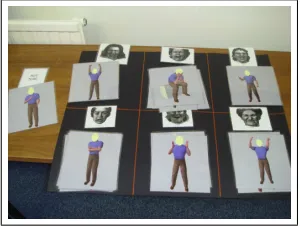
The experiment is limited to examining postures and gestures associated with Ekman’s six basic emotions, which are happiness, sadness, anger, fear, surprise and disgust [22]. The participants were asked to complete two main tasks in this experiment. In the first task, the participants have to group all 30 cards of images representing human expression into six categories of emotions. In addition, the ‘not sure’ category has been used as a control mechanism. The picture of human face taken from [23] together with the label of six emotions was display on a piece of board. An example of grouping by one of the participant is illustrated in Figure 1. The aim of this task was to evaluate how well the participants could convey the basic emotions identification task based on the postures and gesture from static images of human expression.
Fig. 1.An example of grouping
the perceived emotion conveyed by each of the picture. In this study, a 5-point Likert-type scale was used to gather responses for all the selected posture where participants believe that those postures represent certain emotion. In this scale, 1 corresponded to strong disagreement or represent lowest level of emotion and 5 represent strong agreement or highest level of emotion. The participants were allowed to choose more than one postures and put under the same level if they feel that those images represent the same level of emotions.
4
Result
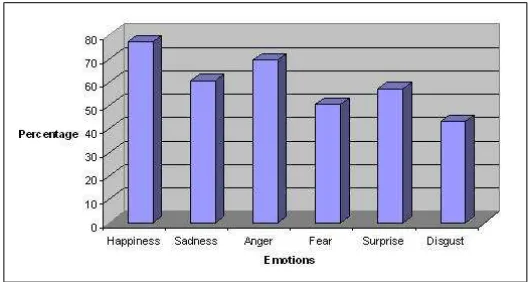
In general, the postures of happiness and anger gain the highest accurate iden-tification by the participants with 77.2% and 69.4% respectively. Sadness and fear are less identified and disgust represents the lowest acceptable identification with only 43.3%. Detail of the percentage identified for all six emotions is shown in Figure 2.
Fig. 2.Percentage of posture identification
The results for three posture that represent highest identification of accu-rate posture associate with each emotions is demonstaccu-rated in Appendix A. For expression of happy, H2 (posture of body held erect and both hands high up-right with fist) get the highest score with 92%, this is follow by H3 with 86% and H4 (clapping hands up high) 72%. For expression of sadness, S3 and S1 get the highest score with 97% and 86% respectively. The third highest score is S5 (bent arms and pressed closely against chest) with only 50%. For the expression of anger, all three postures performance are very high. Image A1 that pointing finger to something and clinch fist with another hand has 92% while image A5 (intend to strike violently with elbow squared) has 88%. Image A2 that portrays arms rigidly suspended by the side get 83%.
hands clench and pressed closely to the mouth. Another two posture, F1 and F3 only gain 58% and 53% respectively. The first two postures of surprise expression, which are S3 and S4, get the same rating of 75% from the subjects. In both expressions, the body held erect to the back and chest well expended but in S3, both arms were widely open to the side whereas for the S4, both arms were at the upper side, more closed to the body with open palm. As mention earlier, out of six basic expressions that are being used in this experiment, disgust retain the lowest rating from the subjects. For this type of expression, D5, which shows turning away of the whole body with one shoulder raised as when to stop something retain 67% from the participants. This is follow by D2 (posture like denying or pushing something with both hands in front of the body) gets 61% and posture D3 which shows both elbow raised to the side and open palms gets only 36% from the subjects.
The most similar study to compare is the study of attribution of emotion to static body posture conducted by [18]. In his study, Coulsan try to get some evidence that viewer can read emotions from static body posture with reasonable levels of accuracy. The difference between this study and Coulsan study is that Coulsan use stick figure where as this study use the images of static characters that look mostly like real human. By doing this, the detail of the body part such as fingers and foot position can be shown to the participants. Another dissimilar approach is that Coulsan studies the look of the posture from three viewpoints, which are front, side and rear, where as this study only focus from the front or slightly few degrees from the frontal view. This approach is use based on the suggestion made by Coulsan that frontal views lead to more consensual attributions. In other words, emotions to body posture is a great deal easier when the person adopting posture is facing the perceiver.
Result from Coulsan study suggest that anger, happiness and sadness are being attributes to large number of postures with some identified by 90% or more of the sample [18] but current study only identified happiness and anger that gain the high accurate identification where as sadness and surprise gain slightly lower identification. Both of the study agreed that disgust is the lowest acceptable or the most difficult posture to recognize with less than 50% of identification.
In this experiment, non-parametric test using Friedman analysis is used to measure if there are different levels of empathy for each emotion. Friedman’s test was chosen since this type of analysis is suitable to analyst group of data with quantitative response variables. The Friedman test should be used for a related design when the same subjects are used for three or more condition [24].
4.1 Hypothesis
In general, to identify whether the sample of six emotional sample of posture has an equal distribution, the null hypothesis has to be measure.
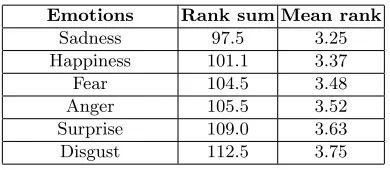
Result from the analysis shows that the value for 30 postures is 1.487, which is bigger than p value (chi-square approximation, corrected for ties), 0.914. This indicates that H0 is accepted or in other words, sample for six conditions of
emotions that was used in this experiment have the same distribution. The mean rank for each emotion is show in the Table 1 below.
Table 1.Rank sum and Mean rank using Friedman analysis
Emotions Rank sum Mean rank
Sadness 97.5 3.25
In the second task, the experimenters predict that there would be a differ-ent level of empathy for differdiffer-ent posture in all six basic emotions. H0 for each
category of emotion is elaborate below. All the six emotions have the same H0
hypothesis. An example of oneH0hypothesis is as follow:
H0: Sample for all 5 postures of happiness has the same distribution
(there is no different in level of empathy)
Since different participant produce different rating score for all conditions, first of all rating 0 are giving to the blank field. Rating 0 represents the lowest ranking in this analysis. Then the score for each posture are rank horizontally across the rows for the five conditions. After that, critical value ofFwas compute using the following formula.
N determine number of subjects, N = 36 K determine number of condition, k = 5
R2
determine square of rank totals
Lastly, the value of F and critical chi-square values (df = 4) was compared to determine whether to retain or reject the null hypothesis. The result of cal-culation for all six emotions is shown in Table 2.
Chi-square (df = 4, p = 0.05) =9.49
Table 2.Friedman’s F values
Emotions F values Happiness 31.294
Sadness 87.461 Anger 49.722 Fear 28.944 Surprise 28.828 Disgust 20.294
are actually different levels of empathy for each posture in every type of six emotions.
5
Discussion
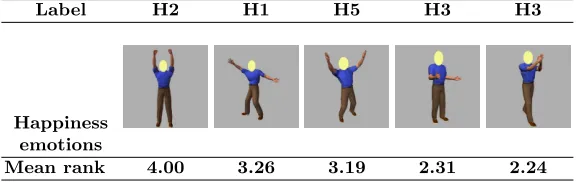
The main result of this experiment shows that subject could distinguish between different postures of expressive emotions. In general, happiness gains the highest percentage of recognition. This is follow closely by anger. The most difficult emotion to recognise by the subjects is disgust. The second findings from this experiment is there appear to be different level of emotion for each posture in the same group. By using Friedman analysis, researcher could measure the level of acceptance and put an order of sequence for each posture. For example the mean rank and order of sequence for happiness is illustrate in the Table 3.
Label H2 H1 H5 H3 H3
Happiness emotions
Mean rank 4.00 3.26 3.19 2.31 2.24
Fig. 3.Order of sequence for happiness emotion
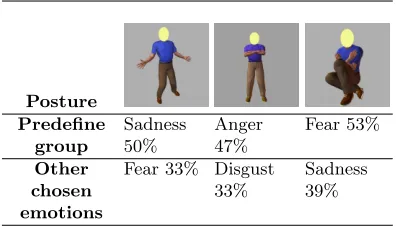
images, five postures fall into the first condition and the other three is because of the second condition. Table 4 and 5 show all the postures that can be put under these two conditions.
Fig. 4.Condition 1 (same or higher percentage than predefine group)
Even though, S3 and A2 represent the third highest accurate identified pos-ture by the subjects, these two pospos-ture still can be considered as confuse pospos-tures since 33% of the subject categorised those two as fear and disgust emotion as well.
Fig. 5.Condition 2 (more than one group of emotion)
References
1. O’Reilly, W. S. N.: Believable Social and Emotional Agents. PhD Thesis, Carnegie Mellon University. Pittsburgh, PA (1996)
2. Ekman, P.: Handbook of cognition and emotion in T. Dalgleish and M. Power (Eds). Wiley and Sons. Ltd. Sussex, U.K (1999)
3. Minsky, M.: The Society of Mind. Simon and Schuster. New York, USA (1986) 4. Picard, R. W.: Affective Computing: Challenges. International Journal of
Human-Computer Studies, Vol. 59(1-2). (2003) 55-64
5. Biocca, F., Harms, C., and Burgoon, J. K.: Toward a More Robust Theory and Measure of Social Presence: Review and Suggested Criteria, Vol. 12(5). Presence: Teleoperators and Virtual Environments, MIT Press (2003) 456-480
6. Vinayagamoorthy, V., Steed, A., and Slater, M.: Building Characters: Lessons Drawn from Virtual Environments. In: Towards Social Mechanisms of Android Science: A CogSci 2005 - XXVII Annual Conference of the Cognitive Science So-ciety workshop (2005) 119-126
7. D. T. Mullins, D. T., and Duke, M. P.: Effects of Social Anxiety on Nonverbal Ac-curacy and Response Time in Facial Expressions. Vol. 28(1). Journal of Nonverbal Behaviour (2004) 3-33
8. Vinayagamoorthy, V., Brogni, A., Gillies, M., Slater, M., and Steed, A.: An In-vestigation of Presence Response Across Variations in Visual Realism. In: The 7th Annual International Presence Workshop (2004) 148-155
9. Gr`ezes, J., Pichon, S., and de Gelder, B.: Perceiving Fear in Dynamic Body Ex-pressions, Neuroimage (in press, 2007)
10. Walk, R. D., and Walters, K. L.: Perception of The Smile and Other Emotions of The Body and Face at Different Distances. Vol. 26(6). Bulletin of the Psychonomic Society (1988) 510-510
11. Brownlow, S., Dixon, A. R., Egbert, C. A, and Rdcliffe, R.D.: Perception of Move-ment and Dance Characteristics From Point-Light Display of Dance. Vol. 47. The Psychological Record (1997) 411-421
12. Dittrich, W. H.: Action Categories and The Perception of Biological Motion. Vol. 22. Perception (1993) 15-22
13. de Gelder, B.: Towards The Neurobiology of Emotional Body Language. Vol. 7. Nature Reviews Neuroscience (2006) 242-249
14. Montepare, J., Koff, E., Zaitchik, D., and Albert, M.: The Use of Body Movements and Gestures As Cues to Emotions in Younger and Older Adults. Vol. 23(2). Jour-nal of Nonverbal Behaviour (1999) 133-152
15. Kipp, M.: Gesture Generation by Imitation. Boca Raton. Florida, USA (2004) 16. Ekman, P., Friesen, W. V., and Ellsworth, P.: Emotion in The Human Face.
Perg-amon Press. New York (1972)
17. Bull, P. E.: Posture and Gesture. Pergamon Press (1987)
18. Coulsan, M.: Attributing Emotion to Static Body Postures: Recognition, Accuracy, Confusions and Viewpoint Dependence. Vol. 28(2). Journal of Nonverbal Behavior (2004) 114-139
19. Wallbott, H. G.: Bodily Expression of Emotion. Vol. 28. European Journal of Social Psychology (1998) 879-896
21. de Meijer, M.: The Contribution of General Features of Body Movement to The Attribution of Emotions. Vol. 13(4). Journal of Nonverbal Behaviour (1989) 247-268
22. Ekman, P.: An Argument For Basic Emotions. Vol. 6 (3-4). Cognition and Emotion (1992) 169-200
23. Faigin, G.: The Artist’s Complete Guide to Facial Expression. Watson-Guptill Publications. New York, USA (1992)
Appendix A
Happiness
H2 (92%) H3 (86%) H4 (72%)
Sadness
S3 (97%) S1 (86%) S5 (50%)
Anger
A1 (92%) A5 (89%) A2 (83%)
Fear
F2 (83%) F1 (58%) F3 (53%)
Surprise
SR3 (75%) SR4 (75%) SR5 (53%)
Disgust
D5 (67%) D2 (61%) D3(36%)