THE LEGEND OF DEWI RIMBA
A PAPER
BY
CICIK CHAIRANI NOER
REG.NO. 082202054
UNIVERSITY OF NORTH SUMATERA
FACULTY OF CULTURE STUDIES
DIPLOMA - III ENGLISH STUDY PROGRAM
MEDAN
It has been proved by Supervisor,
Dr. Matius C.A. Sembiring, M.A NIP. 19521126198112 1 001
Submitted to Faculty of Culture Studies, University of North Sumatera
in partial fulfillment of the requirements for DIPLOMA (D-III) in English
Approved by
Head of Diploma III English Study Program,
Dr. Matius C.A. Sembiring, M.A. NIP. 19521126198112 1 001
Approved by the Diploma III of English Study Program
It has been accepted by:
The Board of Examiners in partial fulfillment of the requirements for the D-III of Examination of the Diploma III of English Study Program
Faculty of Culture Studies University of North Sumatera.
The examination is held on June, 2011
Faculty of Letters, University of Sumatera Utara Dean,
Dr. Syahron Lubis, M.A. NIP.19511013197603 1 001
Board of Examiners : Signature
AUTHOR'S DECLARATION
I, CICIK CHAIRANI NOER, declare that I am the sole author of this paper.
Except where the reference is made in the text of this paper, this paper contains no
material published elsewhere or extracted in whole or in part from a paper by
which I have qualified for or awarded another degree.
No other person’s work has been used without due acknowledgement in the main
text of this paper. This paper has not been submitted for the award of another
degree in any tertiary education.
Signed : ………….. ...
COPYRIGHT DECLARATION
Name : CICIK CHAIRANI NOER
Title of Paper : The Legend of Dewi Rimba.
Qualification : D-III / Ahli Madya
Study Program : English
I am willing that my paper should be available for reproduction at the discretion
of the Librarian of the Diploma III English Department Faculty of Culture Studies
USU on the understanding that users are made aware of their obligation under law
of the Republic of Indonesia.
Signed :
ABSTRACT
ABSTRAK
ACKNOWLEDGEMENT
First of all, the writer would like to thank and praise to the Almighty
God, Allah SWT for blessing and giving me health, knowledge, and opportunity
to finish her study as well as the completion of this paper.
In particular, the writer wishes to convey her deepest gratefulness to the
writer consultant, Dr. Matius C.A. Sembiring, M.A who given many valuable
ideas, comment, and guidance in improving this paper.
Her thanks also extended to Dr. Syahron Lubis, M.A, as the dean of
Faculty of Culture Studies, University of North Sumatera who had given me the
opportunity and facilities as long as in Faculty of Culture Studies.
The writer expresses her deepest thanks to the library of University of
North Sumatera, the public library, BPS, and Gramedia bookstore.
The best gratitude and deepest appreciation of the writer dedicated to her
beloved parents, H.Muhammad Noer and Alm.Suparni Kinik Ardian for their
attentions, advices, supports, materials, and attention along accomplished her
education and also to her dearest sisters: Syahfitri Nurdiani, Syahriani Handayani,
Erika Suryani Noer, and Ainal Nurdiah, and to her brother: Yafizham Noer, and to
her brothers and sister in law: Rahmat, Dony Cahyadi, and Mariam.
The special thank to my best friends forever, Hanim Fauziah Nst,
Mailiana Soraya, and Chairunisah W.H who always give the writer big support
and spirit continue to writer this paper when the writer almost surrender fixing and
The writer also thanks all her beloved friends, Nila Trisnawati, Tira
Syahrina, Viranti Rahasti, Mariyadi, Agung Fahmi Pribadi, Rahmat, Feri Irawan,
Amelia Pratami, Magda Reni Sitorus, Johenro PT Silalahi, Hotden, and the others
for their support during writing this paper.
Finally, the writer really realizes that this paper is still far from being
perfect. Therefore, she welcomes any constructive critics and suggestions towards
this paper.
Medan, 14th June 2011
The writer,
Cicik Chairani Noer Reg. No. 082202054
TABLE OF CONTENTS
AUTHOR’S DECLARATION………... i
COPYRIGHT DECLARATION………... ii
ABTRACT………... iii
4 CONCLUSION AND SUGGESTION 4.1 Conclusions . ... ... 24
4.2 Suggestions ... ... 25
ABSTRACT
ABSTRAK
1. INTRODUCTION
1.1Background of the Study
Indonesia is an archipelago country which has a beautiful nature that
makes people of other countries interested in coming to Indonesia. Indonesia also
has many tribes and ethnic groups with their own living cultures. One of them is
Malay Langkat. Malay Langkat has rich cultures such as dancing, wedding
ceremony, legend, hikayat, Games, and the others.
Among the cultures mentioned about Malay Langkat. The writer chooses
the legend for topic in this paper.
Mois (1991:261) says, “Legend is a description or statement which is
usually patterned story or narrative, the background or historical period that is still remembered by the community concerned, which may connect past experience with the contemporary, which is usually believed to be true by those who deliver it, and also by those who accept delivery of the story especially when the form of signs on the face of nature that seemed to validate the original content of the story or narrative”.
The quotation means that the history of Dewi Rimba is one of the legends
in Indonesia. Her life was taken place long time ago, and it is still believed by the
society. So it is very important to write and discussed about the Dewi Rimba life
to keep it well known by the young generation.
Sometimes, the term legend is much abused synonymously with myth, tall
tale, and history. Legend is different from myth. Myth to be focused on explaining
natural phenomena answering in the natural world and legend is focused on
individuals and their accomplishments. Legend is also different from tall tales
the sake of the history. Finally, legend is separated from history by the fact that its
content.
The legend of Dewi Rimba is one of traditional stories found in Tanjung
Lenggang, Langkat. The writer is interested to raise the legend of Dewi Rimba as
her topic since the writer wants to know deeply and also to give useful
information to the public.
1.2Problem of the Study
Actually, it is difficult to get information about the Legend of Dewi rimba
because there are many people who do not know about the legend of Dewi Rimba.
Besides it is very interesting story to be known by us. It has varieties of meaning
practiced on going of the legend, therefore it is very important to be written and
sharing the ideas to the students.
1.3Purpose of the Study
In conducting this study, the writer has some purposes. Firstly, to enrich
the writing of Malay Langkat culture in English language. Secondly, to know
much about Dewi Rimba. Thirdly, to perpetuate the cultural values so that it is not
extinct. Finally, to introduce the legend of Dewi Rimba to the readers or the
1.4Scope of the Study
There are many things that can be discussed in Malay Langkat society. It
has various cultures, many beautiful places, and many unique customs that can be
talked about. But in this case, the writer realized that the writer is far from perfect,
so the writer limits the paper just to the legend of Dewi Rimba, as one of its
culture. This paper divided into four chapters. The first chapter deals with
introduction, the second chapter gives a brief explanation about the view of
Tanjung Lenggang, the third is concerns with the life of Dewi Rimba, and the last
one gives us some conclusions and suggestions.
1.5 Significance of the Study
This paper tells about a true love story between Umar and Sariah. But,
their love was forbidden because the different of status. Besides there was belief
of Orang Bunian in Malay Langkat community.
The writer believes and hopes that this writing will be useful and enrich
information on Indonesian culture, especially Langkat. Besides, it can be used a
reference for the readers or students who are interested in analyzing Langkat
traditional stories, especially the legend of Dewi Rimba.
1.5The Method of Writing
Method used to write this paper is field research. Therefore, all the data
Lenggang Langkat as Malay people. All of the informants have the criteria to be
used as the sources of data.
To complete this paper, the writer has also done library research and
gotten some data at BPS. In doing the library research, the writer went to the
library of North Sumatera University and the public library. These method are
2. THE VILLAGE OF TANJUNG LENGGANG
2.1Geography of Tanjung Lenggang
Langkat Selayang Pandang is one of the regencies in North Sumatera
Province. Langkat regency has an area of 6.263 KM2 or 626.329 Ha, and Langkat
Regency is located at 30141 - 40131 North Latitude and 980451 East Latitude. For
the topography of Langkat Regency, located at a height of 0 to 104 meters above
sea level. Population was 892,533 in the 2000 national Census, and official
internal estimate in 2007 of 1,027,414 people.
Administratively, boundaries of Langkat are as follows:
1. Northern borders with The Malacca Straits and Aceh province
2. Southern borders with Karo Regency
3. Western borders with Aceh Tamiang Regency
4. Eastern borders with Deli Regency and Karo Regency
This condition makes the Langkat regency is economically able to develop
various cooperation and partnership are equal, mutually beneficial, mutually
reinforcing with the surrounding areas.
The capital city of Langkat regency is Stabat, which is being prepared as
Administrative city. Langkat regency consist of 23 the sub-districts, there are:
1. Sub district Babalan, its capital city is Pelawi Utara.
2. Sub district Bahorok, its capital city is Pekan Bahorok.
3. Sub district Batang Serangan, its capital city is Batang Serangan.
4. Sub district Besitang, its capital city is Pekan Besitang.
5. Sub district Brandan Barat, its capital city is Sei Tualang.
6. Sub district Gebang, its capital city is Pekan Gebang.
7. Sub district Hinai, its capital city is Tanjung Beringin.
8. Sub district Kuala, its capital city is Pekan Kuala.
9. Sub district Kutambaru, its capital city is Kutambaru.
10. Sub district Padang Tualang, its capital city is Tanjung Selamat.
11. Sub district Pangkalan Susu, its capital city is Pangkalan Susu.
14. Sub district Sawit Seberang, its capital city is Sawit Seberang.
15. Sub district Secanggang, its capital city is Hinai Kiri.
16. Sub district Sei Bingai, its capital city is Namu Ukur Selatan.
17. Sub district Sei Lepan, its capital city is Alur Dua.
18. Sub district Selesai, its capital city is Pekan Selesai.
19. Sub district Sirapit, its capital city is Sirapit.
20. Sub district Stabat, its capital city is Stabat Baru
21. Sub district Tanjung Pura, its capital city is Tanjung Pura.
22. Sub district Wampu, its capital city is Bingai.
23. Sub district Binjai, its capital city is Kuala Begumit.
According to wide of area by sub district in Langkat Regency. The widest
area is Bahorok sub district with wide of area 1.101,84 km2 or 17, 59 percent. The
sub district of Bahorok is consisting of 22 villages. One of them is Tanjung
Lenggang. Tanjung lenggang is an area that has a legend of Dewi Rimba.
Actually, the legend of Dewi Rimba is found in Bandar Muda village. But, after
the expansion areas, Bandar Muda is belongs to Tanjung Lenggang.
Climate
Like all area in North Sumatera, Tanjung Lenggang village has tropical
climate, therefore it has only two seasons. The climate in Tanjung Lenggang
village including tropical climate indicators as follow:
1. Dry Season: February to August.
2. Rainy Season: September to January.
The temperature throughout the year average 28oC to 30oC, but the north
coastal plains are usually hotter up to 34oC. Humidity averages a high 75%. The
average rainfall is 2.205,43 mm / year.
In other hand, Tanjung Lenggang is one of the richest villages. This
village is rich with natural resources, particularly rubber, agriculture and palm oil.
Besides that, this area has fresh climate. Almost at all areas of Tanjung Lenggang
a rain fall regularly every year, that is why this factor supports the success of
agriculture in the region. The fertility of the land becomes the pride of Malay
Transportation
Tanjung Lenggang, the location of the legend of “Dewi Rimba”, we can
go there by mini bus which takes about ±20 KM from Medan-Binjai. Then from
Binjai to Tanjung Lenggang, we can take a bus such as Pembangunan Semesta
(PS) or a mini bus (L 300) that takes about two hours.
2.2 Religion and beliefs of the society
The original religion in Langkat is Islam. According to the historian, Islam
had entered Indonesia especially Aceh and Sumatera in the 13th and 14th century.
Since in Khulafaur Rasyidin time Arab’s trade was through Malaka straits to
Tiongkok, before Portuguese (1511 A.D). Based on a Tiongkok’s calendar, in 674
A.D the sailor and Tiongkok trader could be found in Sumatera and a group of
Arab community in North Sumatera.
How and wherever Islam came to Malay Langkat. Masindan (1987:10-11)
says, “The religion professed by the Malay population was the religion of Islam which reached heyday during the reign of Sultan Abdul Azis”.
There are some versions according to historian said Malay people is
Muslim, that is:
A) E. Godhino de Eredia (1613 M) says, “ Malaios are all serracenos or
moriscos”.
B) Dr. Vivien Wee (1985) says, “Islam seemed to be the only reliable
criterian since all those who declared themselves Melayu were Muslim”. C) R.J Wilkinson (1959) says, “A Malay occationally Moeslem”.
D) Aanvullingsnota Van Toelicthing Betreffende Het Rijk V. Langkat (T.v. Ind T.L. en Vk, III, afl. 3 en 4, 1909) says, “ De Maleische bevolking
The quotation means that Malay people is Islam. Many opinions of the
experts say that Malay is Islam and Islam is the Malay. So the majority of religion
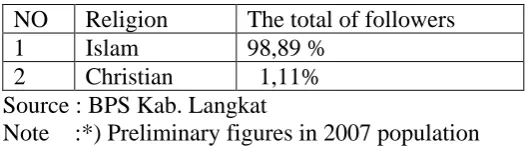
in Tanjung Lenggang is Islam. Besides, Christian is the second religion. We can
see the total religion in Tanjung Lenggang, in the following table:
TABEL 1.1 the Total of religions in Tanjung Lenggang
NO Religion The total of followers
1 Islam 98,89 %
2 Christian 1,11% Source : BPS Kab. Langkat
Note :*) Preliminary figures in 2007 population
Although majority of Malay is Islam, the tradition or animism traces are
still found in some of people. There is belief in Malay that we should greet the
inhabitants of jungles, rivers, big trees, and hilly land, and some others are
inhabited by spirit.
Corder (1973:68) says, “Describes culture as sets of beliefs and behavior
common to the members of a society. They share to a large extent of the way they see the world around them, interpret events, and consider what is important to them. They agree about the right and wrong ways getting things done, of dressing, eating, marrying, worshipping, educating their young people, and so on. All of those are their culture. Accordingly, culture includes beliefs, norms, values, assumptions, expectations, and plans of action”.
And Koentjaraningrat (1981:231) says, “why humans believe in something
that is considered a higher power from him, and why humans do things and diverse ways to make contact with the forces that are believed to neutralize a situation where they have been shown to feel the threat of nature, then they make a ceremony intended to seek peace with the powers so that in the ceremony can be seen some activity, such as praying, bersaji, sacrifice, and others”.
able to communicate with the people who living and among the spirits. There are
good spirits and bad spirits. That is way they are who still alive worship the spirits
of their forefathers and they believe that the spirits will give them livelihood and
blessing. Besides, they believe that the spirits also can disturb them.
There are still many definitions of tradition in Indonesia. Tradition is a
story or a custom that is memorized and passed down from generation to
generation, originally without the need for a writing system (Mark: 1980). Every
tradition is practiced at certain time and based on legal procedure of course. Those
tradition also have a different meaning based on the community believe. They will
give them prosperity, healthy, far from disaster, safety, etc. Therefore, if they do
not hold this tradition which had been their custom or habit, they will be afraid
and worry something will happen to them.
But, nowadays, some of Malay communities do not want to follow it
because this tradition is against Islam teachings. Windstedt, “The Saman’s
Possession” (JRASMB Vol. V, Pt. II, 1927) says, “The pious Moslem Malays
dismissed the trance of the modern Shaman as make believe”.
2.3 Languages used by the society
To develop the culture, the members of society use language as a
communication tools and the possess a distinctive way of communicating through
of language.
Nababan (1984:50) mentions the language, as a communication system
which is a part of culture and it is always involved in the whole aspects of culture.
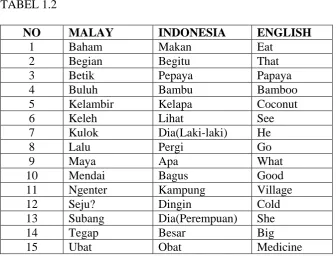
The mother tongue which is called Malay. It is the local language of used
by the people who line in the village of Tanjung Lenggang.
For example:
A language, however, has its meaning only in culture, as Newmark
(1981:183) states that a language is partly the repository and reflection of a
culture. Thus, different languages may contain different cultures or different ways
of thinking.
Malay people use Malay language as communication in daily activities
and Malay language is used in ritual or traditional events. Malay languages
especially in Langkat have many dialect versions such as Bahorok Dialect, Stabat
dialect, and Pangkalan Susu dialect. Langkat Malay dialect is one of the local
right to receive coaching position and function of language is still feasible to be
used.
Malay Langkat language is one of a language as a communication tools
has a same status like another language in Indonesia, must be safe and must learn
so that it is became to be expression and communication tools for the native
speaker. Malay Langkat language is National unsure culture.
R. Ramlan dkk. (1991:1) says, “Bahasa Indonesia yang berkedudukan
sebagai bahasa nasional sejak tahun1928 dan diangkat pula sebagai bahasa Negara sejak tahun 1945 berasal dari bahasa Melayu”.
The quotation means that Indonesia has been declared a national language
since 1928, long before Indonesia’s independence. It was declared as the
Indonesia national language and used the Indonesia language as the glue of the
nation. The first President of Indonesia, Ir.Soekarno, choosed Malay language
become Indonesia language. Then Indonesia language was inaugurated in
Indonesia’s independence, in 1945.
2.4 Population of Tanjung Lenggang
The majority people of Tanjung Lenggang are Malay people. But actually,
not only Malay people who living in Tanjung Lenggang because many Malay
people live in other land out side Langkat or in out side of Sumatera. For
example, there are Malay people that life in Medan, Aceh, Jakarta, and other
place. The people living in the Tanjung Lenggang consist today of two big
groups: 56, 21% are still original Malay and 35, 19% are Javanese. The rest are
Malay Langkat in Tanjung Lenggang had community which has a good
life and land. Tanjung Lenggang village has an area of 26, 50 Km2. Based on BPS
Kab. Langkat is known to have increase in population Tanjung Lenggang village
of 2.982 inhabitants in 2005 to 3.115 inhabitants in 2006. While in 2007, the
population of Tanjung Lenggang village is expected to increase to 3.159
inhabitants to 3.226 inhabitants in 2008. Judging from the rate of its growth, the
population of Tanjung Lenggang village experienced fluctuating growth. It is
caused by natural factors, such as birth rates, death, and urbanization. As for
efforts to reduce birth rates by is trough family planning program (FP), and raising
awareness about the concept of Small Family Norm Happy and
Prosperous (NKKBS) to community especially for young couples. We can see the
total population in Tanjung Lenggang, in the following table:
TABEL 1.3 Total Populations and Population Density Tanjung Lenggang
Year 2005-2008
NO Year Population Population Density
1 2005 2.982 people 112,52 people
2 2006 3.115 people 117,55 people
3 2007 3.159 people 119 people
4 2008 3.226 people 123 people
Source : BPS Kab. Langkat
TABEL 1.4 Total Population by Gender in Tanjung Lenggang
NO Year Male Female Total
1 2005 1.450 1.532 2.982
2 2006 1.515 1.600 3.115
Malay community in Tanjung Lenggang also like working together based
on tradition and religion. They built some facilities together such as places to
pray, and school. They also help their neighbors if they get troubles or they are in
difficulties. Moreover, if a wedding party held in their area, they will help and
work together prepares everything that they need in that wedding party.
In The Book of Duarte Barbosa Vol. II (1518 M), Portugis source,
Longsworth Dames’s translition, Hakluyt Society London, says, “These as I say
are Moors with their own distinct language and are called Malaios. These Malaios hold the Alcoran and Mafamede in great veneration. They are polished and well bred, fond of music, and given ti love”.
So that, Malay community also have good personality such as loyal, fair,
efficient, wary, polite, thoughtful, wise, patient, diligent, and brave because right,
all of these personalities are reflected in Tanjung Lenggang community daily life,
so that they have a good relationship that make them live harmoniously and
peacefully.
2.5 Earning of the society
Malay people generally earn their living from agriculture. Rice is the main
product. The fertility of the land and the good nature are the factors which support
the success of the agriculture. They have been using modern tools. But most of
Besides Agriculture, they also breed some kind of the animals. Chicken
are their livestock. Some people breed chicken as their main job and some people
breed them as part-timer job.
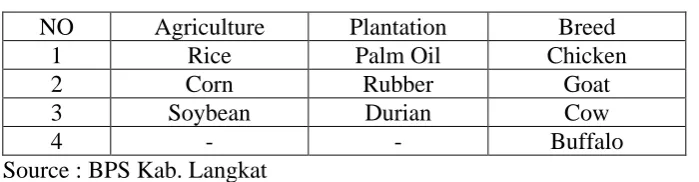
We can see agriculture commodities, plantation commodities, and breed in
Tanjung Lenggang village, in the following table:
TABEL 1.5 Earnings
NO Agriculture Plantation Breed
1 Rice Palm Oil Chicken
2 Corn Rubber Goat
3 Soybean Durian Cow
4 - - Buffalo
Source : BPS Kab. Langkat
The distribution of the occupation of society can be mapping in the table
bellow:
TABEL 1.6 Classification of the Occupation
NO Classification of the Occupation Population
1 Agriculture 975 people
2 Industry 45 people
3. THE LIFE OF DEWI RIMBA
At Bandar Muda village in Langkat Regency, there a lived a girl, whose
name was Sariah. Sariah is a daughter of Panglima Perang Besi.
Panglima Perang Besi was a commander from Land of Alas (Aceh). He
was very strong and his body was insensitive. So he called Panglima Perang Besi.
After war was over, he began new life become a farmer at Bandar Muda village.
Sariah had a boyfriend; he was a clerk at Salapian office. He was about
twenty years old. The son of Mat Daga, local chief of the Bandar Muda village. he
was born in Binjai city. When he was twelve years old, he and his family moved
into Bandar Muda, a new village was found by Datuk Setia Muda. They started
the love when they learned the Koran together in mosque with Muhammad Lebai
Akir.
Umar thought to make a deep relationship with Sariah. So he intended to
marry Sariah. Then he met Lebar (the Telangkai prince) to express his willing and
asked him to explain his willing to his parents. Unfortunately Lebar refused his
willing because Lebar thought that Sariah was not suitable with Umar. She was a
lowly station but Umar was a son of noble. Umar forced Lebar. Finally Lebar
agreed to meet his parents.
The next day, Lebar met Umar’s parents and told Umar’s willing. But
Umar’s father did not agree. He indeed expelled and taunted Lebar. With shame
Hearing Lebar’s explanation, Umar was really sad and disappointed with
his father. In addition his father had paired him with Mariah, his niece at
Hamparan Perak. Umar did not know what he must do. He could not refuse his
father’s willing.
So 23rd nights of fasting. He met Muhammad Akir (Caddy Master) to
marry him with Sariah, but the caddy refused to marry them. Caddy master told to
Umar that he met with Panglima Banding (the youngest brother of Panglima
Perang Besi) at eleven o’clock. He reported that Sariah had married with her
cousin. Umar really surprised to hear that, his heart was broken.
The next day, about Ashar time, Panglima Perang Besi and his family
came to Bandar Muda. Umar did not care about Sariah. Although Sariah wanted
to move at Land of Alas.
On 2nd Idul fitri, Sariah and her family had packed their luggage. They
wanted to move to Land of Alas. They went from Tanjung Lenggang and took the
ship to Bahorok across Wampu River.
The ship was big, it was containing ten persons. An hour later, they arrived
in the meeting of Polka River and Wampu River. When arriving at Ulak water, in
the other place, they heard the sound loudly. They were looking for to the sound
curiously, but they did not see anything. Suddenly they were really afraid with
this situation. They thought that it was Orang Bunian. Then Panglima Perang Besi
read something about the spell, Panglima Banding also read well.
the goddess was Dewi Pematang. Dewi Pematang shook the ship so that the ship
sank. An hour later, the river’s had been flowing as usual. It took seven boat
crues. Only two people that remerges, Panglima Banding and the helmsman.
At Umar’s house, he did not live because Sariah left him. He wanted to
kill himself. When he did it. It was so crowd in the yard. Umar listened carefully
what was going on. The fact, Sariah sank. As soon as possible he jumped.
Hurriedly opened the door and he went to meet Panglima Banding and asked for
the truth news. That was really true, Sariah and her family swept away.
All of Tanjung Lenggang people were busy looking for them over there
and over here but they did not find them. Umar was busy too. He ran faster like a
crazy man. On the way he met Yusuf, Pandal, and Mat Aman. Then they went to
the forest.
On the way, they met many people. The people were busy and did not care
about them. Then, they followed the people. As soon as they arrived in the big
yard. There was big stage. The stage from the thatch and adorned a variety of
flowers such as Jasmine, Frangipani, Kenanga, Kantil, Orchid, Rose, and the
others.
Suddenly, the old man went up on the stage. He said that this preparation
did it to welcome a new goddess. Everyone eyes looked to the stage. Looked very
beautiful woman on that stage. She was dressed all in white and sat on a gold
chair, then looked old seven men and white long hair. Seventh people were
After that four men came again. They brought a gold gong which was
almost as big as winnowing. The gong was hung in front of Dewi Pematang and
sparkled irradiate the lights.
Umar’s friend spoke to Umar about gold gong, it named Kencana Gold
Gong (Gong Emas Kencana). Made of gold, saved in stone cave in the middle of
this forest, only one in three years, it was brought here, and hit three times by
Dewi Pematang. Reputedly, if there was a child born near this village when the
gong sounded, then her face was very beautiful, like Dewi Pematang who hit the
gong. But, after eighteen years old, she would be bringing here, and would
become Orang Bunian. Umar silent to hear his friend explanation. He
remembered when Sariah born in the time the gong sounded.
Dewi Pematang stood up, and then she hit the gold gong three times. Very
good and soundly heard by Umar. Did not know where it came from, suddenly
another woman stood beside Dewi Pematang, she was very beautiful and dressed
white. They both were very beautiful, like twins. Umar shocked, his face was
pale. The heart palpitation because the woman who came was Sariah.
Sariah stood up in that place too. He realized that she was really beautiful,
younger, and more beautiful than Sariah at Bandarmuda village. Even more
glamour than Dewi Pematang who had gone. Then she sat on the gold chair of
Dewi Pematang. The old man said that she would continue as a replacement Dewi
Pematang become a goddess, called Dewi Rimba.
died if he was so closed at the goddess. There was one way; he must hug Sariah
because in three days, she could not breathe. She would exchanged become the
clouds and fogs. When someone hugged her and breath seven times to her nose,
she would become human being again.
In midnight, he lifted his head, he saw his friend was lying in sleep, so
with the other Orang Bunian. Without turned left and right he went to the big
banyan tree ( Pohon Beringin).
Ten feet was almost there, he looked Dewi Rimba stood under the tree and
people who guard her. Without thought longer, he closed the goddess, then he
hugged her tightly with the two hands while breathing into the girl’s nose.
The next day, the villagers came together to Datuk setia Muda’s house.
They said that they had found the body of Panglima Perang Besi and his wife’s
corpse, but not with Sariah corpse and two canoe builders. And they also reported
that Umar did not return home too.
Everyone did not know where Umar was. Only a few people looked him
went with Yusuf. Then they asked about the truth news to Yusuf. But he said that
almost four days he did not meet Umar.
Mat Daga and Datuk Setia Muda looked each other, crowed was stunned.
Misgiving arose him within their hearts. It was very noisy all night sounding
noises in the jungle like celebrated something. In case of people who seem to walk
premises Umar was Orang Bunian, could not be denied he already taken or eaten.
Because of worried of Umar, Pandal and the villagers went to look for him
missing man. Polka river a crossed, so with another small river. Days and days
past, even past one o’clock and the journey far away too, but the one that they
looked did not meet too.
Not while after that the banyan tree in the river bank was seen. Not far
away from that there was another banyan, shed big and great too. They went to the
second tree. They heart ware beaten. Far about a hundred steps they walked, the
banyan tree was seen clearly. Light under it, not even a grass too. Not even leave
fell, the ground slippery like already swept.
Suddenly Lebar stopped and pointed to the tree. There was someone in
that tree, he said. When they arrived there, he found the young man hugged the
tree with his hands hard. The young man was Umar. But the young man did not
move, his eyes did not blink. The presumption was lost because Umar were still
breathing and his arms tighten, even though his hand is lifted. He thrashed and
screamed vigorously.
Umar said that he did not go from the banyan tree because he was hugging
Dewi Rimba, hugging Sariah, his lover.
Hard they brought him home. At 5 p.m. they arrived home. But what he
did was like a crazy people. Sariah’s name and Dewi rimba was always he said.
Umar’s house was crowded. Everyone came to see him. The tears were not
dry, then Umar like this! Everyone thought that he was taunting by Orang Bunian.
About his words to call Sariah and Dewi Rima that things made a prejudice that
Then Mat Daga and his wife intended to call the shaman. But the shaman
could not able to cure Umar. Mat Daga felt sorry and his wife too because they
did not let Umar to marry Sariah.
Umar was not well too. It was almost six months on the bed. Almost
everyday he cried with sad face and asked to bring back to Dewi Rimba that he
had been hug.
His mother was afraid of Umar disease. She cured Umar to shaman. After
one shaman to another one. He did not cure too. His body dried, the bone of his
chest was seen. His face paled, his hair was fallen. The handsome man changed,
his handsome must gone.
People prejudiced, Umar liked man in the middle of rice field
(Orang-Orangan Sawah) did not leave anymore. But his age still long, so many had to do
and his suffering that had lived on this earth. He seemed to have recovered, could
walk but his mind was not perfect anymore. People said that he was crazy, even
he himself did not confess that.
He did not care to his cloth anymore. If he must dress, he chose the worst
dress, tattered and dirty. He walked away from the crowd of people. Slow face,
straight, no matter left or right. Did not care about people. He was taciturn,
dreamer, and if he was to speak, only must of this word he said : “Dewi Rimba,
4. CONCLUSIONS AND SUGGESTIONS
4.1 Conclusions
The majority societies in Tanjung Lenggang are Islam. Even though they
believe that there is only one God to be praise, but they also believe of Orang
Bunian. Orang Bunian has a super power to influence the people’s life, such as Orang Bunian can cure the sickness or illness one, to take care of their plants, to
get the best proceeds and produces, and help or kill people. To proof this believe it
can be seen through the conversation the practiced by the society.
This paper also tells about the goddess of Orang Bunian, namely Dewi
Rimba. Dewi Rimba is actually an ordinary girl called Sariah. She lived in the
Bandar Muda village. She was very beautiful, kind, easy going, and friendly. She
was a daughter of Panglima Perang Besi. Panglima Perang Besi was a nickname
from his father because he has a strong body and also resistant body.
Sariah has a boyfriend named Umar who is the son of Mat Daga, the chief
of Village in Bandar Muda. He was about twenty years old. The son of Mat Daga,
local chief of the Bandar Muda village. He was born in Binjai city. When he was
twelve years old, he and his family moved into Bandar Muda, a new village was
found by Datuk Setia Muda. They started the love when they learned the Koran
together in mosque with Muhammad Lebai Akir. But their love was not approved
both of their parents because of difference in status.
(Aceh). On the way, they met Dewi Pematang then Sariah was kidnapped by
Dewi Pematang, the goddess of Orang Bunian.
In the jungle, Sariah will be raise become a new goddess continue as a
replacement Dewi Pematang. Her new name is Dewi Rimba. Hearing that, Umar
was really sad and disappointed. He chased Sariah in the jungle but he met Orang
Bunian. So Orang Bunian made him confused and he was gettings crazy. He did
not know who was he and he just wanted to kill himself.
That is why Orang Bunian can influence the Tanjung Lenggang society
with their super power and their magic power to help or kill people on
4.2 Suggestions
According to Malay culture, the legend is important because Malay people
think that their next generation must know about their culture. In Malay, the
people who do not have good manners or less understand about their culture are
assumed much uncivilized and can be abandoned from society group.
The writer hopes the problem of the division of the inheritance, they must
believe with the God who created everything in the world.
The writer suggests that based on the legend of Dewi Rimba, Malay
people should believe with another spirit, but not always worship the spirit.
It is attitude for us, especially for Malay society not to differ a different of
REFERENCES
Antonius Simanjuntak, Bungaran. 2008. Tradisi, Agama, dan Akseptasi
Modernisasi pada Masyarakat Pedesaan. Medan: Bina Media Perintis.
Baried, St. Baroroh, dkk. 1985. Memahami Hikayat dalam Sastra Indonesia. Jakarta: Pusat Pembinaan dan Pengembangan Bahasa.
Bonvillain, Nancy. 2003. Language, Culture, and Communication: The Meaning
Of Messages (Fourth Edition). New Jersey: Prentice Hall.
Brannen, Julia. 1997. Memadu Metode Penelitian Kualitatif dan Kuantitatif (Terjemahan oleh Kurde, N.A). Yogyakarta: IAIN.
Effendi, Sofian. Metode Penelitian Survey. Jakarta: LP3ES.
Endraswara, Suwardi. 2001. Metodologi Penelitian Sastra. Jogyakarta: CAPS.
Iskandar, Nur Sutan. 2001. Dewi Rimba. Jakarta: Balai Pustaka.
Jayawati, Maini Trisna. 1997. Analisis Struktur dan Nilai Budaya dalam Cerita
Rakyat Sumatera Utara. Jakarta: Pusat Pembinaan dan Pengembangan
Bahasa.
Nawawi, Hadari. 1993. Social Science Research Methodology. Gajah Mada University Press.
Ruslan, Rosadi. 2003. Methodology of Public and Communication Research. Jakarta: Raja Grafindo Persada.
Sihotang, H. 1990. Metode Penelitian Geography. Jakarta: Pustaka Sari.
Sinar Basyarsyah II, Tuanku Lukman, S.H. 2002. Kebudayaan Melayu Sumatera
Timur. Medan: USU PRESS
Singarimbun, Masri. 1985. Metode Penelitian Survai. Jakarta: LP3ES.
Yunus, Umar. 1981. Mitos dan Komunikasi. Jakarta: Sinar Harapan.
_________. Peta Kabupaten Langkat. ________. Medan : CV. Inti Fajar Baru.
5. Nama : Syahriani Handayani
Alamat : Jln. Prona 1 Gg. Keluarga No 10/39
Pb. Sel II Medan
Umur : 35 tahun
Pekerjaan : Kerani
Telepon : 085276114114
6. Nama : Amat
Alamat : Simpang Bahorok
Umur : 32 tahun
Pekerjaan : Petani