1
DEIXIS EQUIVALENCE ON “TEXAS GLORY” BY LORRAINE HEATH INTO “JALANKEBAHAGIAAN” BY ELLIYANTI JACOB
Leli Surayda Aviani
English Department, Dian Nuswantoro University
ABSTRACT
This study directs to find the types of deixis and to explain the equivalences of deixis in the target language. The researcher used a descriptive qualitative method during the research since since the data engaged are displayed in the form of sting of words. Generally, there are 143 words of deixis. The equivalent shows 117 words of deixis or 82%. On the other hand, the unequivalence shows 26 words of deixis or 18%. Based on the data, type of deixis which shows the highest percentage of equivalent is person deixis with 64 words or 45%. And type of deixis which shows the highest percentage of unequivalent is Social deixis with 13 words or 9%. According to the analysis, it is concluded that the bilingual novel entitled “Texas Glory” into “Jalan Kebahagiaan” has more equivalence words of deixis than the unequivalence ones. And then, person deixis is type of deixis which tick out in the finding of equivalent and social deixis which is unequivalent.
Keywords: Deixis, Equivalence, Unequivalence.
Penelitian ini mengarahkan untuk menemukan jenis deixis dan untuk menjelaskan ekuivalensi dari diksi dalam bahasa target . Peneliti menggunakan metode deskriptif kualitatif selama penelitian sejak sejak data bergerak akan ditampilkan dalam bentuk sengatan kata-kata . Secara umum, ada 143 kata-kata diksi . Setara menunjukkan 117 kata-kata deixis atau 82 % . Di sisi lain , unequivalence menunjukkan 26 kata-kata deixis atau 18 % . Berdasarkan data, jenis deixis yang menunjukkan persentase tertinggi setara adalah orang deixis dengan 64 kata atau 45 % . Dan jenis diksi yang menunjukkan persentase tertinggi tidak equivalen adalah diksi Sosial dengan 13 kata atau 9 % . Menurut analisis , dapat disimpulkan bahwa novel bilingual berjudul "Texas Glory" ke "Jalan Kebahagiaan " memiliki kata-kata kesetaraan lebih dari deixis daripada yang unequivalence . Dan kemudian , orang deixis adalah jenis deixis yang centang dalam temuan deixis setara dan sosial yang tidak equivalen.
INTRODUCTION
2
someone is using a language, he automatically delivers some messages, information, intentions and purposes. Manser defines language as, “a system of communication in speech and writing used by people of particular country (1995:233).”It can be concluded that every country has own language and it is different between each other. Besides that, every language has different rules which are not the same as the ones of other language. In addition, Crystal (2005:35) said that, “English has big impact for communication around the world.” It is well-known that nowadays English is an international language which is broadly used as a second and foreign language. Based on that English becomes one of the important aspects to be learned and it means people have to know well about translation issues.
Translation is a process of rendering the ideas from the source language into the target language. In translation activity, it is noticed as Source Language (SL) or the language that will be translated into Target Language (TL) or the language as the works that are being structured by translators. Therefore, translation can be defined as the action of interpretation of the meaning a text, and production of an equivalent text that communicates the exactly same message in another language. Nida and Tader (1969:12) said that translation consist of reproducing in receptor language the closest natural equivalence of the source language message, first in terms of meaning and secondly in terms of style.
Translation task is not easy to do. In translating a text, a translator is going to face some barriers. Both of SL and TL have their own structures which are different. Moreover, the important thing of translation process is to find the equivalence meaning of TL. In fact, languages do not differ only in grammar and structure, but also have different cultures of term. Languages are an expression of culture and individually of its speaker which influences the way of the speaker perceive the world.
Manning (1995:66) on his journal explain that some cultures have elaborated systems of deixis, system of signaling social distance through linguistic means. It is true that translation is related with culture. The human culture means all those historically created designs for living, explicit and implicit, rational and irrational which exist at any given time as potential guides for the human behavior. There is a system which is called by deixis that is particularly important in communication.
Levinson (1983:54) states that, “deixis belongs within the domain of pragmatics because it directly concerns the relationship between the structures of languages and the context which they are used.” The term „deixis‟ is from Greek word for pointing, refers to a particular way in which the interpretation of certain linguistic expression („deictic‟ and „indexicals‟) dependent on the context in which they are produced or interpreted. All „pointing‟ expressions have to be related to the person who has uttered them, „pointing‟ in a particular place at a particular item.
3
spatiotemporal region. The role of deixis is spelled out from the reality that in a discussion the speaker conveys his/her utterance to addressee or to him/herself, or conveys the utterance about thing which is talked about by using personal pronoun, proper name and demonstrative pronoun.
A word can be called as a deictic if its referent is inconsistent depending on who the speaker is, when and where the word is uttered. In verbal communication, however, deixis in its narrow sense refers to the contextual meaning of pronouns, and in broad sense, it refers to what a speaker‟s intention by a particular utterance in a given speech context. According to Levinson (1983:65), there are five categories of deixis; those are: Person deixis, Time deixis, Place deixis, Discourse deixis, and Social deixis.
Actually, deixis is one of studies from linguistic section, especially in pragmatics; it can be combined with translation studies. It can be proved that linguistic cannot be separated from translation studies. Moreover, deixis has variable referent; it means that deixis must be translated based on the context situation of deixis. If the translator makes a mistake in translating deixis, it will be very crucial error because the meaning of deixis (referent) will change from SL to TL. Based on the reason, the researcher wants to analyze of deixis equivalence on “Texas Glory” into “JalanKebahagian”.
METHOD
Research Design
The study of this research is a descriptive qualitative method since the data engaged are displayed in the form of sting of words. It does not give the numeral statistics but it depends on how is the knowledge of the researcher analyzing the data. It aims to describe the types of deixis found in bilingual novel entitled “Texas Glory” into “Jalan Kebahagiaan”. It also explains the equivalences and unequivalences of deixis into the TL.
Data
The data of this research were taken from novel entitled “Texas Glory” by Lorraine Heat into “Jalan Kebahagiaan”. The English novel is taken from http:/www.processtext.com/abclit.htm in pdf version. This Indonesian novel was published by Dastan Books in 2012. It was written data. In this research the researcher would like to choose a hundred sentences randomly that belong to deixis equivalences from page 6 to page 469.
Unit of Analysis
The unit of analysis in this study is the words of deixis in the sentences or utterances of bilingual novel entitled “Texas Glory” into “Jalan Kebahagiaan”. The SL is English and the TL is Bahasa Indonesia as the data to be analyzed.
Data Collection
4
Kebahagiaan” translated by Elliyanti Jacob, reading the source text: English version entitled “Texas Glory” by Lorraine Heat and the target text: Bahasa Indonesia version “JalanKebahagiaan” translated by Elliyanti Jacob as the Target Language, identifying deixis in the novel “Jalan Kebahagiaan” translated by Elliyanti Jacob, and classifying the deixis with their equivalence and non-equivalence.
Data Analysis
They were analyzed by using several steps as follows: categorizing the deixis found in the data based on the type of deixis using Levinson‟s frame work, categorizing the deixis based on the criteria of equivalences, analyzing deixis of both languages to describe the equivalences, and drawing conclusion.
FINDING AND DISCUSSION
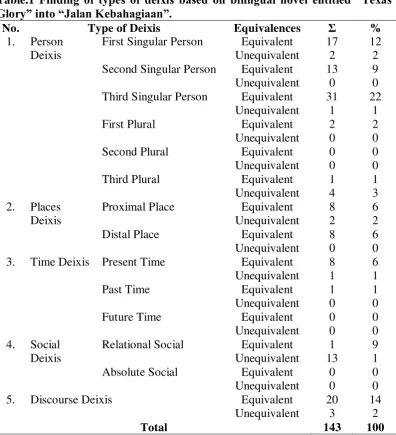
Table.1 Finding of types of deixis based on bilingual novel entitled “Texas Glory” into “JalanKebahagiaan”.
No. Type of Deixis Equivalences Σ %
1. Person Deixis
First Singular Person Equivalent 17 12
Unequivalent 2 2
Second Singular Person Equivalent 13 9
Unequivalent 0 0
Third Singular Person Equivalent 31 22
Unequivalent 1 1
First Plural Equivalent 2 2
Unequivalent 0 0
Second Plural Equivalent 0 0
Unequivalent 0 0
Third Plural Equivalent 1 1
Unequivalent 4 3
2. Places Deixis
Proximal Place Equivalent 8 6
Unequivalent 2 2
Distal Place Equivalent 8 6
Unequivalent 0 0
3. Time Deixis Present Time Equivalent 8 6
Unequivalent 1 1
Past Time Equivalent 1 1
Unequivalent 0 0
Future Time Equivalent 0 0
Unequivalent 0 0
4. Social Deixis
Relational Social Equivalent 1 9
Unequivalent 13 1
Absolute Social Equivalent 0 0
Unequivalent 0 0
5. Discourse Deixis Equivalent 20 14
Unequivalent 3 2
[image:4.595.117.514.314.750.2]5
From the table above, it can be seen that equivalent third singular person deixis show the highest percentage and then followed by Equivalent Discourse Deixis. Second singular person deixis, Future time deixis, and Absolute social deixis both equivalent and unequivalent are not found in the data. Moreover, Unequivalent Second Singular Person deixis, Unequivalent First Plural deixis, and Unequivalent Present Time Deixis are also not found in this bilingual novel. Generally, there are143 words of deixis. The equivalent shows 117 words of deixis or 82%. On the other hand, the unequivalence shows 26 words of deixis or 18%. Based on the data, type of deixis which shows the highest percentage of equivalent is person deixis with 64 words or 45%. And type of deixis which shows the highest percentage of unequivalent is Social deixis with 13 words or 9%. According to the analysis, it is concluded that the bilingual novel entitled “Texas Glory” into “Jalan Kebahagiaan” has more equivalence words of deixis than the unequivalence ones. And then, person deixis is type of deixis which tick out in the finding of equivalent and social deixis which is unequivalent.
Equivalence Deixis
Equivalence plays a crucial role in the translation. In this thesis, the researcher describes the equivalence of deixis used on novels entitled “Texas Glory” into “Jalan Kebahagiaan”. Some types of deixis are translated well into Indonesian; translation process has transferred word of English deixis into Indonesian without changing its types of deixis and its form. But there are still several cases found in the translation process of deixis. Several words of deixisare not translated into Indonesian. Moreover there is also translation shift of deixis. Some of the analysis can be seen below:
Excerpt 1: Data 13
Source Language
Line and Page
Target Language
Line and Page
Referent
“I don‟t know how you can be sure that they‟re gonna cut the wire right here,” Austin said...
10, 2 Aku tidak tahu bagaimana kau bisa yakin bahwa mereka akan memotong kawat yang sama,” kata Austin...
Line1 9, page 8
Austin
6
situation is informal. In the SL, the word “I” is categorized as person deixis. And in the TL, pronoun “aku” is called as person deixis. “I” as first singular person deixis is translated into “aku” as first singular person deixis. The equivalent of data above is known by the translation of deixis type. There is no changing of deixis type. From the explanation above, it is known that the translation of the deixis type is similar and equivalent.
Excerpt 2: Data 34
Source Language
Line and Page
Target Language
Line and Page
Referent
Be grateful you‟re not riding out here, Dee.
Line 24, page 14
Bersyukurlah kau tidak perlu berkuda kemari, Dee.
Line 22, page 35
Castle
In this utterance, the word “here” is encoded to the place which is close to the speaker. The sentence on page 14 give the explanation; “... The crenellated design of the roof reminded her of a castle she’d once read about”. From those sentences, it is known that the speaker of the utterance is Cameron and the utterance happens close from the castle. So, “here” refers to the castle. In TL,“here” is translated into “kemari”. Both of those words have the same function as adverb of place which is pointing to the close area from the speaker. The word “kemari” means a placearound the speaker. “Here” as the word of proximal place deixis is translated into “kemari” as the word of proximal place deixis in the TL, so there is no changing of the deixis type. It can be concluded that the translation of data 34 is equivalent.
Excerpt 3: Data 33
Source Language
Line and Page
Target Language Line and
Page Referent
Now he was
demanding.
Line 1, page 13
Sekarang laki-laki itu menuntut Codelia.
Line 17, page 31
The Present Time
The word “now” shows the temporal point of sentence. “Now” explains the adverb of time, it describes the information of time relating to the sentence. In the TL, the word “now” is translated into the word “sekarang”. Both “now” and “sekarang” have the same function to describe adverb of time in the sentences. Both of those words have the same meaning as “at the present time”. The word “now” as time deixis is translated into “sekarang” as time deixis in the TL. Concerning on that reason, it is known that the translation of the type of deixis from English is equivalent into Indonesian.
Excerpt 4: Data 79
7 and
Page
Page
“Ladies and
gentlement,”
Reverend Tucker‟s voiced boomed.
Line 3, page 22
“Hadirin sekalian,” suarapendeta Tucker berkumandang.
Line 21-22, page 50
The Guests
“Ladies and gentlemen” represents the addressing term of English in formal way. In informal form it can change into “hello, Guys” or “Hey yo, brother”. It shows the relationship between the speaker and addressee which is not close enough. This utterance happens between a Reverend named Tucker and the guests who attend Dallas‟ wedding. In the SL, “Ladies and gentlemen” is included into social deixis. The phrase “Ladies and gentlemen” is usually used to show politeness. “Ladies and gentlemen” is translated into “Hadirin sekalian”. Both of those words have the same function which is encoded to young person in formal way to show polite feeling. The word “Hadirin sekalian” is known as social deixis in the TL, because that word describes about the relationship between the speaker and addressee. Word of social deixis is translated into word of social deixis. Concerning on that, it is known that the translation of data 79 is equivalent.
Unequivalence Deixis
Based on the criteria of equivalence, it is known that unequivalent translation of deixis is translation deixis which has different meaning between SL and TL, or different types between both languages. It can be translation shifting of deixis types, or missing types of deixis in one of both languages. The analysis can be seen below: Excerpt 5: Data 53
Source Language
Line and Page
Target Language Line and
Page Referent “I can‟t do this,”
she whispered hoarsley.
Line 29, page 25
“Aku tidak bias melakukan ini,” bisiknya parau.
Line 13-14, page 59
Cordelia
In the SL, the word of deixis is “she” as the subject pronoun. But, the word of person deixis is found in the TL as possessive adjective. Pronoun “-nya” is in possessive form. The sentence on page 59 explains this data; “Aku tidak bisa melakukan ini,” bisiknya parau. From this sentence, the context of the text shows that pronoun “dia berbisik” represents “bisiknya”. Pronoun “dia” is encoding to the third person. In this data, a person deixis is being changed to the translation. Person deixis in the SL becomes “-nya”, that usually it is for showing possessive. Concerning on that, data 53 is unequivalent.
Excerpt 6: Data 42
8 and
Page
Page
Dallas‟s brown eyes darkned, and she imagined Satan would like an angel standing next to this man when he was consumed with rage.
Line 11-12, page 18
Mata cokelat Dallas menggelap, dan Cordelia
membayangkan Setan akan terlihat seperti malaikat berdiri di sebelahnya saat laki-laki itu sedang dikuasai amarah.
Line 25-27
Dallas‟ position in a place
The word “this” in this data is not translated into the TL. The word “this” is encoding to place near the person of the character in the story. From the data it is clearly known, that this sentence shows an action which happens to Dallas. The word “this” represents to Dallas position in a place. But in the TL, the word of place deixis as the translation result of place deixis is translated into “itu”. The SL and the TL have different interpretation. In the TL,”this man”, means person who near from Cordelia. But, in the TL “this man” is translated into “laki-lakiitu” It means that Dallas is far from Cordelia. Therefore, both SL and TL have same information and meaning. But the type of deixis is missing in the translation ofthis data, so it is concluded that data 42 is unequivalent.
Excerpt 7: Data 85
Source Language
Line and Page
Target Language Line and
Page Referent “Well, now, what
are you doing?” Line 5, page 61
“Well, apa yang
sedang kau
lakukan?”
Line 6, page 130
Present Time
In the SL, “now” is found as the temporal conjunction. In fact, no temporal conjunction in the TL. In English language, “now” is as time deixis to complete the information of time. The word “now” literally means as the present time. “The word “now” shows the temporal point of sentence. It shows the information of time relating to the sentence. There surprisingly, no time deixis found in the TL data but time deixis exists in its translation. This changing of deixis type does not change the translation of meaning in those sentences.
Excerpt 8: Data 22
Source Language
Line and Page
Target Language Line and
Page Referent
Yes, Ma’am. Line 31, page 6
Ya, Ma’am. Line 1, page 19
9
The word “Ma‟am” is generally used for addressing term to call someone older. In this data, the utterance happens between Austin as the speaker and Cordelia. She is Austin‟s sister in-law, that‟s why the speaker (Austin) uses “Ma‟am” to address Cordelia. It is because Austin wants to show politeness to his sister. In the TL, the word “Ma‟am” is still used by the translator. The translator does not change it based on the TL‟s term. Both SL and TL have same meaning, but the word of social deixis is not transferred in the culture of TL. Therefore, data 22 is concluded as unequivalent.
Excerpt 9: Data 29
Source Language
Line and Page
Target Language Line and
Page Referent
That‟s what this is all about.
Line 18, page 13
Semua ini karena satu hal.
Line 19-20, page 32
Dallas‟ problem
In the SL, the word of discourse deixis is “that” and “this”. But, in its translation, the word of discourse deixis exists. The word “itu” explains about the information based on the context of story. In this data, the word “itu” is described The problem of Dallas. Here, the translator translates the word “that” into “ini” and the word “this” with “itu”. It opposes each other. Even, they are not changing the meaning, but it is unequivalent translation.
CONCLUSION
The conlusion is made based on the data analysis in chapter IV. From the data, the number of deixis words found in “Texas Glory” into “Jalan Kebahagiaan” is 143 words. Each type of deixis which is found in this novel is variety in amount and its percentage. It can be concluded that there are 5 types of deixis found in the bilingual novel entitled “Texas Glory” into “Jalan Kebahagiaan”. It can be found equivalent and unequivalent deixis translation in the data.
Equivalent third singular person deixis show the highest percentage and then followed by Equivalent Discourse Deixis. Second singular person deixis, Future time deixis, and Absolute social deixis both equivalent and unequivalent are not found in the data. Moreover, Unequivalent Second Singular Person deixis, Unequivalent First Plural deixis, and Unequivalent Past Time Deixis are also not found in this bilingual novel. Generally, there are 143 words of deixis. The equivalent shows 117 words of deixis or 82%. On the other hand, the unequivalence shows 26 words of deixis or 18%.
10
than the unequivalence ones. And then, person deixis is type of deixis which tick out in the finding of equivalent and social deixis which is unequivalent.
REFERENCES
Baker, M. 1992. A Coursebook on Translation. London: Routledge Bassnett-McGuire, S. 1980. Translation Studies. London: Methuen Ltd. Bell, Roger T.1991. Translation and Translaling: Theory and Practice.
London and New York: Longman.
Catford, J. C. 1965. A Linguistic Theory of Translation. London: Oxford University Press.
Crystal, David. 2005. How Language Work. United Kingdom: Penguin Books Cutting, Joan. 2002. Pragmatics and Discourse: A Resource Book for Student.
London: Routledge
Dooley, Roberta A. PH.D. 2008. Relevance Theory and Discourse Analysis: Complementary Approaches for Translator Training.
Fawcet, P.1997. Translation and language: linguistic theories explained. Manchester: St. Jerome.
Gutt, Ernst-August. 1991. Translation and relevance: Cognition and context. Oxford: Basil Blackwell.
Hasan, A.B. 2011. Literary Translation:Aspects of Pragmatic Meaning. New Castle: Cambridge Scholarship Publishing
Heath, Lorraine. 1998. Texas Glory, taken from
http:/www.processtext.com/abclit.htm retrieved on March 1st, 2013 Heath, Lorraine. 2012. Jalan Kebahagiaan penerjemah Eliyanti Jacob. Jakarta:
Dastan Books
Larson, M.L. 1984. Meaning-Based Translation: A Guide to Cross Language Equivalence. Lanham Md: University Press of America
Leech, G, N. 1983. Principle of Pragmatics. London. Longman.
Levinson, Stephen C. 1983. Pragmatics. Cambridge: Cambridge University Press. Manning, H. Paul. 1995. Social Deixis and Social Change in North Wales. Texas:
Texas University Press.
Meyer, J. 1997. What is Literature? Work papers of the Summer Institute of Linguistics. Universityof North Dakota Session (41), 24–37
Newmark, Peter. 1988. A Textbook of Translation. London: Prentice Hall.
Neubert, A. 1968. Pragmatische Aspekte der Ubersetzung in Grundfragen der Ubersetzungswissenschaft. Leipzig:VEB Verlag Enzyklopadie
Nida, E. A. 1964. Toward A Science of Translating. Netherlands : E.J. Brill. Nida, Egene A. and Charles R. Taber. 1974. The Theory and Practice at
Translation. Netherlands : The United Bible Society.
Nord, Christiane. 2007. Translating as a Purposeful Activity:Functionalist Approafches Explained. Manchester: St. Jerome Publishing.
Quitlong, Ruby Casama and Soerjawardana. A. 2002. A Workbook for Student of Translation 3. Semarang.
11
Sager, Juan. 1994. Language Engineering and Translation:Consequences of Automation. Amsterdam & Philadelphia : John Benjamins Publishing Company.
Smith. K, G. 2000. Bible translation and relevance theory: the translation of Titus. Unpublished doctoral dissertation, University of Stellenbosch. Venuti, Lawrence. 1995. The Translator’s Invisibility. London and New York:
Routledge.
Wills, W. 1978. Ubersetzungswissenschaft: Probleme und Methoden. Stuttgart: Ernst Klett.
Wilson, Dreidner & Spelberg, Dan. 2002. Paper of Relevance Theory pg. 249-290. California: Stanford University Press.
Zhou, F. Z. 2004. On plurality of translation. Beijing: China Translation and Publishing Corporation.
www.jostran.org Retrieved in October,2012