SHAPE CHARACTERIZATION ON TURTLE DETECTION
Sunardi
1*, Anton Yudhana
1,
Nur Atika Nadhira Mohd Nasir
2,
Noor Zirwatul Ahlam Naharuddin
2, Azrul Mahfurdz
3 1Department of Electrical Engineering, Universitas Ahmad Dahlan, 55164 Yogyakarta, Indonesia 2
Faculty of Electrical & Electronics Engineering, Universiti Malaysia Pahang, 26600 Pekan, Malaysia 3
Department of Electrical Engineering, Polytechnic Sultan Haji Ahmad Shah, 25350 Kuantan, Malaysia *
Email: [email protected]
Abstract
All sea turtles are considered as endangered and threatened that is affected by some natural and other caused by human activities. One of the problems faced on fishing operation is caught on gill net. Turtle Excluder Device (TED) is developed to prevent turtle approaches the net by dispels the sound signal. The objectives of this research project is to develop a system for identify the presence of turtle by using shape characterization. Turtle identification deployed by using underwater video camera with implementation of MATLAB software. The Green turtle (Chelonia Mydas) for various ages are used. The parameters are the head, tail, flippers and carapace of orientation. The characterization of parameters identified based on the analysis on image processing. The shape parameters of flippers are shown as the most identified. The orientation front and side easily to recognize the turtle present. In addition, for detection of turtle should over than 5000 number of pixels is identified as a turtle. This information will used to identify the turtle and prevent caught in the fishing net using improvement of TED with sound signal and image detection. Therefore, the endangered turtle can be protected and fisherman also can improve their efficiency and help to safeguard marine ecosystems.
Keywords: Image Processing, Shape, Turtle, TED, Underwater
INTRODUCTION
Conservation of sea turtles are affected by a range different factor, natural and others
caused by human activities, including fishing operation. There are seven species of sea turtle in
official Red List of International Union for conservation of Nature (ICUN 2004) classified at
endangered species or critically endangered species [1]. The most critically endangered sea turtle
species were Green Turtle, Hawksbill, Loggerhead and Olive Ridley.
Fisheries activities have been contributed to be a major factor of death for juvenile and
mature sea turtles. During their long lifetimes, they are swimming hundred thousands of ocean
miles and exposed of many threats. They are unintended catch of non-target species in shrimp trawl
nets and fishing gillnets. Although there are method to avoiding turtle from trapping in fisheries net
such as gear modification, material, fishing method, and prohibits for fishing activities using gill
net, but these methods seems not affectively way to avoid the turtle trapping in fisheries net.[2]
There are many research of fishing equipped by using Turtle Excluder Device (TED) to
reduce the number of turtle catch and dispels the turtle using sound signal [3]. Method of target
strength using Echo sounder has certain cases of similar signal sound between fish and juvenile
turtle [4]. There were certain cases of overlapping signal between fish and juvenile turtles. From
the research, the started overlapping values of target strength signal between fish and juvenile turtle
about -37.103dB due to the small size of juvenile turtle. Therefore, underwater video camera will
be used to detect the presence of turtle based on its shape is the second method to protect the sea
turtle from get caught it approaches the net [2].
TURTLE IDENTIFICATION
In the 1970’s a fisherman named Sinkey Boone was the first person developed the Turtle
Excluder Device (TED). But in 1980’s United States required all their trawling shrimping boat use
and put TED to their net. TED was created to save the fuel costs, help save on net repair, can
improve the quality of catch and can release turtle. Unfortunately, there are problems uses this TED
which all their catches are decreasing. This is because in TED have a trap door use for turtles and
other huge animal to release the fish net but the same time all fish also follow and it makes the
fisherman reducing their catches [5][6].
Turtle is classified at endangered species or critically endangered, therefore need to
conservation [1]. These marine reptiles are characterized by a large, streamlined shell (carapace),
and non-retractable head and flippers. In all species except the leatherback, the body is covered
with hard, keratinized plates called “scutes”. The number and arrangement of scutes on the
carapace and head are used to identify between the species. Sea turtles range in color from pale
green to almost black. Jaw shape also varies among species, adapted to its diet. There is no sexual
dimorphism (physical differences between males and females) with the only difference in adult
turtles being the size of tail. Adult males have a much wider and longer tail than females [7]. Thus,
different of turtle will be different key of identification and characterization of species.
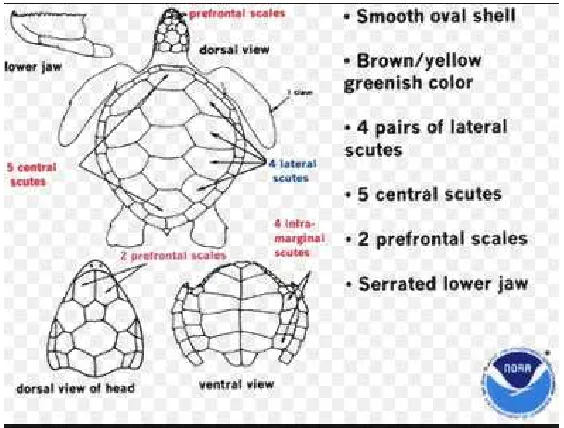
Green turtle (
Chelonia Mydas
) can be distinguished from one another by the scales on top of
the snout, called the prefrontal and by the scutes on the carapace. The green turtle has one pair of
prefrontal scales). The carapace is smooth with 4 pairs of lateral scutes. Carapace colour changes
with age. It is black in hatchlings, then turns brown and tan in juveniles, and in adults, it is olive or
gray-green, sometimes with speckles of yellow and brown. The plastron is white in hatchlings. It
turns creamy yellow, sometimes temporarily pink or grey depending on the population [8]. With
their characterization identification, the sea turtle can easily distinguished and differentiate with the
fish because their share the same habitat in the sea. The characteristic of Green turtle is shown in
Figure 1.
Figure 1.
The characteristic of Green Sea Turtle [9]
Underwater Video Camera
organisms and their natural aggregation pattern. Now days, the research for automated the
measurement and counting task in order to improve the efficiency of the process and expand the
use of underwater video camera within marine science. The automated process will require the
detection and identification of target for measurement followed by counting and tracking [10]. This
tools are useful to observe such sea turtle behavior but difficult to obtain clear and bright visual.
However, the data of video and image is needed to be analysis to identify the shape of the
image. Therefore, to make the task of identifying the image easier, image pre-processing
techniques can be performed. Through the use of specific image enhancement techniques, the
image may be taken to the stage where computer can start to identify objects within that image. The
ultimate goal of such a system is autonomously detect an object, identifying it and classify it within
a database of known object in real time [10] [11]. To get the real and specific image of object
detected, the analysis segmentation is most important at real-time.
Image processing is needed to be applied through certain types of filters to preserve the
image information but at the same time improving the image by removing the noise. Image
processing generally targets on better identification of object of interest, which can distinguish
from other objects or region, and background [12]. There were many methods in image processing
that can be used in any types of images. Identification can be made only for single turtle for
cheaper purposes by feature extraction using MATLAB software. The feature extraction mainly
comprises of length, breadth, shape and color to identify the particular species of the sea turtles.
Color extraction is applied to extract specific color of the image by the image pixels as 0 to 255.
The range threshold value of image RGB reaches the threshold value it is considered as turtle
otherwise images will be rejected. Morphological operation had been used to remove small patches
and smoothing the image of turtle. The morphological operation is more effective while compared
with filtering technique since it will reject the certain types of noise were the individual pixel is
cleared from images and will be more effective. The method chosen to detect the presence and the
characterization of turtle is threshold values with morphological operation. The concept of this
method is simple and can be apply by user easier.
METHODOLOGY
The main idea of this research is to detect the presence of turtle based on shape
characterization and parameters of orientation with implemented of MATLAB software. The
automatic detection using of image processing is proposed to detect the characteristics of Green
turtle. In processing stage, the color recognition using threshold in HSV method to detect the type
of parameters of turtles within different of orientation. The process is continued with feature
extraction and classification stage. The image of turtle is obtained based the parameters of head,
tail, side and carapace of orientation. This research was deployed in a sea water pool of 7meter
length, 2meter width, and 1 meter depth.
The equipment used was underwater video camera as a cheaper technology and affordable
for people. The underwater video camera will capture images and record videos. Model of Gopro
Hero 3+ was chosen as the equipment of this research. The resolution of video 848X480 pixel with
60 frames per second will shoot the sharp images and high speed recording. The maximum depth
of this equipment is up to 197 ft. In addition, it also provided wireless connection (LAN) and can
controlled via Android and IPhone devices.
The equipment of underwater video camera was located static at the end of pool and it was
controlled via Android system. In addition, the placed of equipment was changed if the turtle
suddenly become aggressive. The freely movement of turtle created the different parameter
obtained from different of orientation. The image of turtle was also taken by the burst images
which are 15 images per once press of button capture mode. Total of sample video recorded were
20 video and will be extracted frame by frame. Then, the presence and the parameters will be
obtained by the image processing method.
stages which were threshold in HSV and morphological operation. Next, the decision presence of
the turtle is based on the number of pixel image. The number of pixel more than 5000 pixels
identified as a turtle instead of fish or other object. The block diagram of this research shown in
Figure 2.
Figure 2.
Block diagram of research
Data Acquisition
The turtles from juvenile until mature at ages 2, 5, and 12 years are used as listed in Table 1.
All the turtles are same species of Green turtle. The video is recorded the movement of turtle within
1 minute from different orientation.
Table 1.
Characteristic of turtles
The video will be extracted frame by frame by using MATLAB code. All the type of video
file format can be extracted and saved as PNG format. When the video is executed, the command
prompt will be displayed the output of extracting and saving frame of video file. When the video is
executed, the command prompt will be displayed the output of extracting and saving frame of
video file.
Processing Stage
Hue, Saturation, Value (HSV) is a color model that describes colors in terms of their shade
and their brightness as the color features extraction. This method is used to convert the RGB color
to HSV color space. The 30 samples of turtle were used to obtain the ranges of HSV based on the
parameters of head, tail, flippers and carapace and the ranges value of HSV was between 0 until 1.
There are 3 values of Hue color which were brown, gray and yellow. The fraction between 0 and 1
Turtles
Age (years)
Weight (kg)
Shell Length (cm)
1 2 2.5 29
x
28
2 5 10 43
x
41
3 12 25 58.5
x
51
Gopro
MATLAB
were described the Hue by specified the position of the corresponding pure color on the color
wheel.
The grey in color space was indicated by the saturation of range 0 to 1. The value of 0 was
the color grey and when more the color grey, the saturation level is lower and will become faded
color. The saturation value of 1 is a primary color. The brightness of color space is depending on
the ranges value of luminance or value and the ranges is 0 to 1. The 0 values is describes the color
space is totally black and increasing the value toward 1 shows the color brightness up. Then HSV
in pixels ranges was pointed and the mask is applied during filtered the image. In a binary image,
while the HSV range value of image was satisfied and show black and white color image. All the
pixels that appointed by the HSV range are marked as foreground which are in white color and
otherwise showed in black as the background marked.
Erotion and Dilation
From the HSV color method, the binary regions were distorted by noise and texture due
contain numerous imperfections. Morphological image processing pursues the goals of removing
these imperfections by accounting for the form and structure of the image [10]. For minimize the
output pixel, the structuring element of disk was choose to remove the small shape at all location
with corresponding neighborhood of pixels.
Se=strel(‘disk’,1);
Erode=imerode(fill,se);
The morphological opening with disc structuring element will smooth the corners from the
inside and closing with discs smooth corner from the outside. The portion of ‘1’ is blocked and
excluded the output image. It was thinning the desired image shape and act as filters of shape. The
size of output image value is ‘fill’ was computed the full erosion to close the background.
Dilation function is to make the image become larger or smaller without change the shape of
image. After erosion process, the image should be restored to their original sizes by the same
structuring element.
Sel=strel(‘disk’,1);
Dilate=imdilate(erode,sel);
All sides of image will be foreground by 1-by-1 disk structuring element. The basic effect of
the operator on a binary image is to gradually enlarge the boundaries of regions of
foreground pixels typically white pixels. In this project, the structuring element disk due rounded
off the corners and boundaries become rounded. The shape of disk argument will be affected the
output image.
RESULTS & DISCUSSION
The results were discussed one by one based on each processes done according to the
method proposed. There are 10 samples of turtles were used for the analysis process and the
characterization parameters of head, carapace, flippers and tail was determined. Besides, the
effectiveness of this project was testing with different condition. The obtained results were
compared and noted in order to improve the lacking part of the project developed.
Analysis of Processing Stage
The main principle behind threshold in HSV is that image pixels, falling into a predefined
range of intensity values, are assigned a single intensity value, and the remaining pixels are
assigned a different intensity value. The threshold is depended each pixel on the image
characteristics. For this project, the image characteristics is standardize and easily for performance.
Thresholding in HSV technique is suitable for allow only the setting shape remain in the
picture while the shape out of wetting will be removed. The intensity value for the characteristic of
turtle is different for head, flippers, carapace and tail. They are include 4 type of color for detection
which are brown color for carapace, gray color for head, yellow for flippers and tail. The blue color
of water as the background is removed but remains the shape of turtle found. The pixels of hue,
saturation and luminance (value) for HSV are manually determined by using paint with color
picker.
By using Thresholding in HSV, we can match the turtle by describing colors and allow
independent control over hue, saturation and luminance (value). In HSV, the highest value among
RGB numbers is divided by 240 to scale between 0 and 1 because the maximum value in paint
configuration for the hue, saturation and value. The brighter colors have near 1 and become darker
when color near to the 0.
Table 2.
Threshold value for each parameter color in HSV
Color
Parameter
Hue(H)
Saturation (S)
Value(V)
Brown
Carapace
0.15-0.40
0.00-0.60
0.20-0.98
Gray
Head
0.15-0.45
0.00-1.00
0.00-1.00
Yellow
Flippers
0.50-0.98
0.02-0.30
0.00-0.90
Yellow
Tail
0.02-0.40
0.00-0.40
0.00-0.70
After 30 image selected, the standardize range is determined for hue, saturation and value. If
the brown color patch is taken the hue value is 58, saturation value is 120 and value or luminance is
240. After divided by 240, hue value became 0.24, saturation value is 0.5 and value or luminance is
1. Table 2 shows the value of yellow patch is satisfied the threshold value and the yellow color can
be detected. If there out of the range, the color cannot be detected.
The gray image is generated from threshold in HSV color image. The MATLAB function
rgb2gray
is used. The Grayscale image is converted to binary image which easier to detect the
shape of parameters. Binary image typically black and white which are image binary BW has
values of 1 (white) for all pixels in the input image and 0 (black) for all other pixels.
The erosion is deleted that having a radius less than 4 pixels by opening it with the
disk-shaped structuring element. Morphological operations run much faster when the structuring
element uses approximation (N>0). However, structuring elements that do not use approximations,
(N=0) are not suitable. The structuring image of ‘disk’ and value of 1 is used to eliminate the noise
and smooth the corners of the image. Erosion removes small-scale details from a binary image but
simultaneously reduces the size of regions of interest, too. By subtracting the eroded image from
the original image, boundaries of each region can be found.
By using dilation the image should expand and larger for clearly detect the shape of
parameters.
Bwboundaries
traced the exterior boundaries of objects as well as boundaries of holes
inside in the binary image
, BW.
For the better performance,
Logical(bw)
assigned regions in the
label matrix. The code read in and threshold an intensity of object.
Regionprops
to obtain estimates
of the area all of the objects. The label matrix returned by
bwboundaries
can be reused by
includes noise. At the end of the processing stage, the mean value, number of pixels and area in
pixel is calculated using this formula.
Numberofpixels1=sum(erode(:));
Numberofpixels1=bwarea(bw);
Meanpixel=mean(gray(erode));
Classification and Testing Stage
Once the object boundaries have been recognized, the area can be calculated easily by
summing the number of pixels within the boundary extent. Objects correspond to noisy pixels that
may have been treated as object pixels during the thresholding process. It is necessary to remove
these pixels before further processing by erosion. By using an if-else condition, those objects
whose summation of erode are below a numbers of pixels value, can be converted to background
pixels. For the testing stage, video analysis frame by frame and image selected for 3 different of
orientation which are front, side and back detected are used to define the system detection the
object and recognized the present of turtle and the characterization based on parameters.
Video is displayed as input and analyzed frame by frame. Each frame is analyzed the
detection and the status of detection will indicate either ‘Turtle Found’ if the number of pixels id
greater than 5000 pixel and less than 5000 pixel is for ‘Turtle not Found’. Through the processing
stage, the image of turtle can be obtained from each frame on video. The extraction of frame is
saved in a folder. From the status of detection, the frame number will be recognized and the image
selected to study the characterization of turtle based on the parameters.
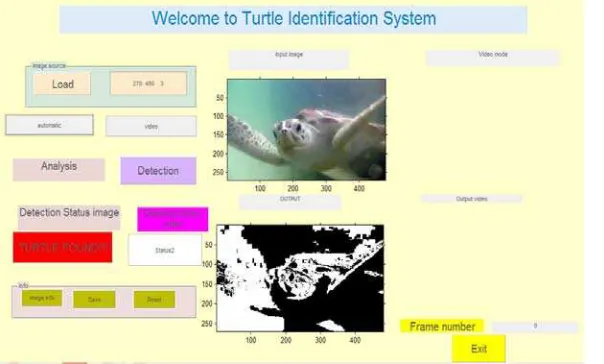
The Turtle Identification System is tested by the picture of turtle and the detection status
indicated the “Turtle Found” as shown in Figure 3. At the end of the process the mean value area is
150.656, Number of Pixels is 59550 pixels and area in pixels is 57169.3. The characterization of
turtle based on parameters is checked. Each parameter is manually observed and ticked fulfilled as
a turtle. If the characterization of parameters as a turtle not satisfy but the status indicates ‘Turtle
Found’, it considered as noise and need to select other of frame to have accurate result. However,
the noise also is there because the color of flipper is look same with the intensity light (noise) of
water. The parameters can be detected, the Threshold in HSV of hue, saturation and luminance or
value when they are satisfied in the standardize range of value.
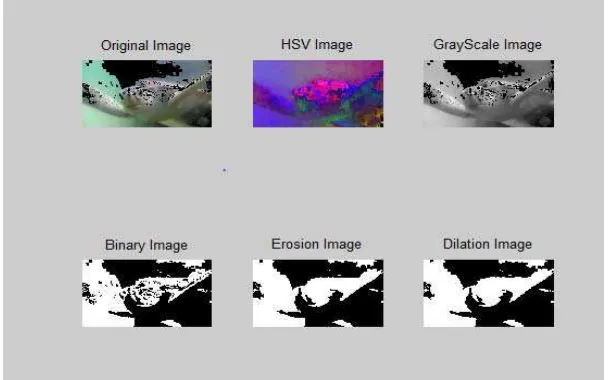
Figure 4 shows the summary of processing stage that include the Thresholding in HSV,
Grayscale Image, Binary Image, Erosion and the last is dilation process. The characterization of
parameters can be obtained by the
BoundingBox
at the area detected. The characterizations
Figure 3.
GUI for system detection
Figure 4.
Front orientation
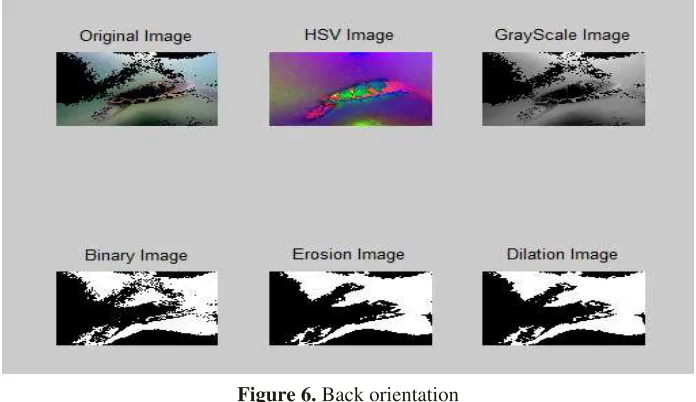
Figure 6.
Back orientation
The 10 samples of turtle also tested. The parameters of head are the most identified.
Parameters of carapace are half of samples can be recognized and flippers 7 samples. Different of
orientation view, have different parameters obtained, such as side orientation in Figure 5, the
parameters obtained are head, carapace and flippers. The status detection indicates ‘Turtle Found’
with the number of pixels is 6612. At the side orientation, the parameters of flippers are clearly
recognized as a turtle and followed with carapace and head. For back orientation, the parameters
identified are carapace and flippers as shown in Figure 6. The 10 samples of turtle at side and back
were tested and the result of parameters identified
The parameters of carapace are the most identified at the back orientation. The parameters of
flippers also can be obtained for the 8 samples but none identified of parameters for head and tail.
All the samples of turtle orientation summarized as shown in Table 3. From all orientation, the total
identified of parameters for head, carapace and flippers were 18, 19 and 22 respectively. The
parameters of tail for all orientation are no identified.
Table 3.
Summary of parameters identified of all orientation
Orientation
Head
Carapac
e
Tail Flipper
s
Front 10
8
0
10
Side 9
10
0
10
Back 0
10
0
10
Total 19
28
0
30
Percentage (%)
63.3%
93.3%
0%
100%
The parameters of flippers are the most identified with 22 found and the percentage is 73%
for all the orientation. While the total parameters found for head and carapace are 18 and 19 with
the different 3% among them. Unfortunately, parameters of tail could not found for all the sample
and orientation because their size is small and under the carapace. Usually, the size of tail can
determine the gender of turtle either female or male. In this project, the gender of turtle cannot be
determined and the shape of tail cannot be recognized. Overall of the samples, at the front
orientation the head parameters are most recognized and the flippers for the side orientation.
saturation and luminance or value is not satisfied in the standardize range of value. Therefore the
detection status indicates “TURTLE NOT FOUND”.
The mean value area is 144.482, number of pixels is 4719 and area in pixels is 6154.88. The
shape parameters cannot be detected, the threshold in HSV of hue, saturation and luminance or
value is not satisfied in the standardize range of value. However, we can detect the area of
parameters according to the range value of HSV. But the parameter is not the turtle characteristic
because it is a fish. Therefore the status indicates “TURTLE NOT FOUND”.
In the overall processes, the 30 images tested showed positive result for detecting the turtle
found and shape of turtle is recognized. However, the shape detected is different according to the
size of turtle and the edge of captured the image. For additional needs, a case of none turtle and fish
is also tested. Thresholding in HSV, the color between the turtle with the fish can be differentiated.
The system indicated the status of the detection depend on the value of pixels. The decision of
turtle detected when the number of pixels is greater than 5000 after analyzed of 30 images. It
proven that the values of pixels without turtle and with the fish give different value pixels and less
than the value of the decision. However, the number pixel obtained included with noise due to the
milky water and shallow depth. The milky water causes the image hard to recognize after process.
The characterization of parameters based on head, carapace, tail and flippers were manually
recognized by compared the parameters obtained. If the one of parameters are satisfied identified,
the image will be categorized as the turtle found.
CONCLUSION
Turtle is endangered species in the world, and most factors for decreasing the population is
from the fishing activity. As we know, the turtle commonly trapped in gillnet of fisherman. Turtle
Excluder Device (TED) is developed to reduce the number of turtle trapped in gillnet by dispels
signal of sound for them. However, the overlapped signal between fish and turtle is cause of the
detection not accurate. Improvement of this system, the detection by image processing is developed
as the second method to detect the turtle. The color and the shape between the fish and turtle are
different. As a starting point for the development of image processing analysis technique for
detecting the present of turtle, 1920x1080 is produced pixels by underwater video camera but for
the easier and fast analysis of image then was resize to 480x270 pixels. From the analysis of
processing stage, the shape of turtle can be recognized based on the parameters of head, carapace,
tail and flippers. The shape parameters after the processing stage is not properly look like the
original image but the shape still recognized. It was cause by the intensity of light and condition of
water as the noise. In addition, from the analysis between the turtle, the range number of pixels is
obtained and makes it different with the fish. The range number of pixels for turtle is greater than
for fish. In this rsearch, the GUI system is successfully developed to detect the present of turtle and
analyzed the parameters of turtle.
The result also has an undetected the shape of turtle, this situation may occur due to the
depth of water because the depth in the pool and the distance is small make the data obtained not
from several of distance. For the future, the research can identify the shape of turtle from the
several of distance. In addition, the real time for the detection using live streaming video and
combination of signal of turtle is suggested for more improvement on turtle detection.
REFERENCES
1.
Red List of International Union for Conservation of Nature (ICUN), 2004
2.
Sunardi, Noor Zirwatul Ahlam, Azrul Mahfurdz, Anton Yudhana, 2013. Prevent Turtle Trap
in the Fishing Gear Using Ultrasound, IEEE Conference on Industrial Electronics
andApplications, Melbourne, 19-21 June 2013
4.
Azrul Mahfurdz, Sunardi, Hamzah Ahmad, 2013. Acoustic Strength of Green Turtle and Fish
Based on FFT Analysis,
International Journal of Advanced Computer Science and
Applications(IJACSA), Volume 4 Issue 9, 2013
5.
G. Schofield, 2008. Identification Tree: Group Assignation of the right facial scales
6.
Food and Agriculture Organization Of The United Nations Rome, Guidelines To Reduces Sea
Turtle Mortality, 2009.
7.
Bastiaan J. Boom, Phoenix X. Huang, Cigdem Beyan, 2008.
Long-term underwater camera
surveillance for monitoring and analysis of fish populations.
8.
National Marine Fisheries Service and the Atlantic States Marine Fisheries Commission, 2013.
Workshop on Sea Turtle and Atlantic Sturgeon Bycatch Reduction in Gillnet Fisheries.
9.
Jeanette Wyeken, December 2001. The Anatomy of Sea Turtles.
10.
Chong Soon, Tan Phoo Yee Lau, Detect of marine species on under water video image, 2014.
11.
R.N.Williams, A.F.Kelsall, T.J.Lambert, T.Pauly, 2006. Detecting Marine Animals in
Underware Video.