Vol 5, No 4, October - December 1996 Comparison between Albend.azole and Pyrantel
t95
Comparison
between
Albendazole
and Pyrantel
Pamoate Once
and
Twice
Yearly
in Urban Slum School
Children in Ujung
Pandang
Veni Hadjul, Lani
Steph"nron2,
Satriono3,Dwight
Bowman4,Hussni
Mohammed4,
Kunar Abadi3
Abstrak
Penelitian ini rnembandingkan efikasi
dai
pemberian obat cacing pyrantel dan albendazole satu atau dua kali per tahun pada anak sekolah dasar di daerah kumuh Kotamadya Ujung Pandang. Anak sekolah (n=507) dibagi secara random ke dalam 4 group yang menerima obat cacing (pyrantel satu atau dua lcali, albendazole satu atau dualali)
dan satu group lainnya yang menerima plasebo, berdasarkan jenis kelamin dan intensitas Ascaris lumbicoides. Anak meneima dosis hnggal pyrantel atau albendazol"e atau plnsebo pada awal penelitian dan 6 bulan sesudahnya sesuai dmgan groupnya. Prevalensi dan intensitas infel<si Ascaris lumbricoides dan Trichuris trichiuradiukurpada0, 3,6, dan 12 bulan setelahpemberian obat cacing pertama, Tidakditemukanperbedaanyang bermakna diantarakelima group di awalpenelitian. Setelah 12 bulan, intensitas darikeduainfeksimenurltn secara drastis pada groupyang diberiobat cacing (P <
0,0U)
dan sedikit menurun pada group yang mendapat plasebo (P < 0,05). Pemberian dua kali dalam senhun darikedua obat yang digunakan dapat menurunkan prevalensi dan intensitas A. Iumbricoides lebih besar dibanding group Ininnya.
Di
samping itu, dua group yang memperoleh albendazole ntemperlihatkan penurunan prevalensi dan intensitas dari T. trichiura lebih besar dari group lainnya. Penelitian ini menunjukkan bahwa dua knli pernberian obat cacing per tahun dari kedua jenis yang digunakan lebihefektif dan pada pemberian satu kali dan pemberian albendazole baik satu nwupun dua kali per tahun menurunkan intensitas dari T.
trtchiura.
Abstract
This sndy examined the comparison between pyrantel and albendazole, in terms of their effectiveness by once and nvice yearly in school-age children. School children (n=507)were assigned randomly tofour anthehninthic groups (pyrantel once or tvvice; albendazole once or twice) and a placebo group, according to gender and Ascaris lumbicoides egBS counts. Chillren received singlc doses of either pyrantel, albendazole, or placebo at baseline and again at 6 mo. The prevalence and intensity of Ascaris lumbicoides and Trichuris
trichiura infections were determined at baseline, 3, 6, and 12 mo. No dffirences were found between the five groups at baseline in prevalence and intensity ofbothinfections. At 12 mo, the intensity ofbothinfectionswas greatly reducedin the dewormed groups (P < 0.001) andreduced slightly in the control group (P < 0.05). Bothpyrantel andalbendazole fwice reduced the prevalence and intensity ofA. lumbricoides greater than other groups. However, albendazolelreatedchildrenreduced the prevalence andintensity ofT. trichiura greater than other groups. This study suggests thot two doses yearly of both drugs are more effective than once dose yearly and albendazole treatment once or tvvice coulà decrease the intensity ofT.
tichiura
infection.Key words : albendazole, pyrantel, hehninthiasis, children
INTRODUCTION
A
high incidence
of
transmission
of Ascaris
lumbri-coides
andTrichuris trichiura infection
together
hasbeen
found
in
mostly
urban areas
in
developing
countries.l This is very
much related to
thevery poor
sanitation and
high
population density
observed
in
t
School of Public Heahh, Hasanuddin University,UjwS
Indonesin2
Diuki
Sciences,4College of Veterinary _Medicine, Cornell University, Ithaca, NY 14853, USA 3 School of Medicine, Hasanuddin University,
Ujung Pandang 90245, Indonesia
many
slum
areas.Controlling
for
the
helminth
infec-tions
with
masschemotherapy,
thus oneof
thepriority
in
this
such areas.196 Hadju et al.
A randomized
intervention
trial
was designed
to
ex-amine theeffectiveness of different intervals
ofpyran-tel and albendazole
in school-age
children
living in
anurban slum.
We
hypothesized
that
groups receiving
oneor
two doses of anthelmintic
drug
per year wouldhave a
significantly lower
prevalence
and intensityof
A.
Iumbricoides
and
T.
trichiura
infections
and that
two doses
per year
would
bemore
effective
than
one dose.MATERIALS
AND METHODS
Study population
This study was carried out
in
a slum
areaof
Ujung
Pandang
municipality,
South Sulawesi,
Indonesia.
Overcrowding
and lack of sanitation are evident in this area.Two primary
schools, close oneto
another, werechosen
for the study.
There
were several reasons
for
choosing
these
schools:
l)
Parasitologically,
a
high
prevalence
and
intensity
of A.
lumbricoides and
Z.trichiura
infections were found
in
both
schoolsduring
a preliminary study;
2)
no deworming program
has been done in thecommunity
in the last
two years;
3) ahigh
prevalence
of
malnourished
children
was found
during
the
preliminary
study;
4)
there was
a willing-nessof school
principals and teachers to
participate
in
the study;
and 5) thenumber
of children
available
for
the study was
sufficient. Details of
the study site and
the population are described elsewhere.6Permission
from the local
government
was obtained
prior
to the study.A meeting with
parents, teachers, the headof local health department, and
investigators
washeld
to clarify theobjectives
and benefitsof the study.
Informal
parental
consentfor the children's
participa-tion
wasobtained.
The studyprotocol
was approvedby
theHuman Subjects Committee
of
Cornell
University
and theIndonesian Government. Children
were freeto
withdraw
atany time.
Experimental design
The study design was a randomized,
placebo-control-led
intervention
trial.
All
primary
school
children
(6-1I
yearsold)
in Grades
I,2, and 3 in
both schools werescreened
to
be eligible
for
the study. Children with
signsof
severeprotein
energymalnutrition (marasmus
and kwashiorkor) orhad any
deformity or
congenital
abnormality were excluded.
All
eligible children were
randomly allocated
to five
treatment groups.
Ran-domization
wasperformed
based on sex and egg countof A.
Iumbricoides.
A. lumbricoides was chosen since
the anthelmintic drugs
used
in
the study
are
highly
effective in
treating
A. lumbricoides infection.
TheseMed J Indones
five
groups consisted
of
placebo,
pyrantel
once
(pyr.lx),
pyrantel
twice
(pyr.2x),
albendazole
once(alb-lx),
and albendazoletwice
(al2x).
Children in
thealb.lx
and
pyr.lx
groups were treated
(albendazole
400 mg
andgyrantel pamoate
10mglkg body
weight,
respectively;'
after
thebaseline exam,
whereas thosein
the
alb.2x andpyr.2x
groups were treated after
thebaseline and also after the 6-mo exam.
For
ethical
reasons,
at
the end
of
12
mo,
all
groups
received
pyrantel
pamoate.Children were
followed
for
12 mo. Fecal examinationwere
performed
at
0, 3, 6, and
12
mo following
the same standardizedprotocol. During
the study period,
children
had
free access
to
a Primary Health Centrelocated
just
in
front
of
the schools
and
run by
onephysician
and several nurses.Single doses of albendazole and pyrantel pamoate
(400
mg
and
l0
mg/kg body weight, respectively)
wereused, as
recommended
for areas
where
A.
lumbri-coides infections are
predominant.T
In
addition,
asingle
dose of albendazole has beenreported
as usefulfor T. trichiura.s'e'10It
was
thought ihat both
drugscould be
comparedin
the study sincepyrantel
pamoate has alower efficacy against
T.
trichiura.
The placebo tablet was
similar
to the albendazoletablet
(provided
by
SmithKline
Beecham,
Indonesia), but
pyrantel pamoate was different
(Kimia
Farma,
In-donesia). Children and
field
workers were
not
in-formed
of
the
actual name
of
both
drugs.
Each
treatment,
albendazole,pyrantel,
and theplacebo,
wasput
in
three
different
boxes
labeled
A,
B,
and
C for
albendazole,
pyrantel,
and placebo,
respectively.
No
one, except the principleinvestigator,
was made awareof the
labels.
Field
workers administered
the assigneddrug
(4,
B,
or C) to each
child during
school hours an
investigator's supervision: When
a child had difficultyswallowing the tablets, the
drug
was crushed and thengiven to
the child via a spoon.Children
were asked
to
open
their
mouths
to
check
if
the drug had
actually
beenswallowed. Absent
children
were
visited at their
homes by fieldworkcrs.
Forthis
activity, field
workers
were given
thedrug
in
an envelopefor each child.
Fecal
examination
Vol 5, No 4, Ocnber - December 1996
under the
supervision of
oneof
theinvestigators
(KA).
Stool samples were examined
for the
presence
of
parasite eggs
using a modified Kato-Katz
technique
recommended
by
WHO.Il
A
cardboard template
with
ahole
of
known capacity (28 mg)
and a cellophane
coverslip
soakedin
glycerin-malachite
greensolution
were used. Eggs
of
A.
lumbricoides
andT. trichiura
were counted about
onehour after
smearpreparation
and
expressed
as eggs per gram (epg)
of feces,
as estimatedof
worm burden, or
asintensity of
infection.
Statistical Analysis
Data
analyses
were performed using the
statistical
package
SYSTAT version
5.2"
for Macintosh.
The
intensities of A. lumbricoides
andT.
trichiura
infec-tions, indicated
as eggsper gram (epg)
of
feces, have a negativebinomial distribution
and weretransformed
by
conversion
to
natural logarithms
(log
x
+1)
wherever possible.
To
assessthe differences
betweentreatment groups, one-way
analysesof
variances
andchi-square
test wereperformed.
In
addition, Scheffe's
test was used for multiple mean
comparisons. The
changes
in
prevalence
andintensity of
both helminth
infections
between
two
exams
were
assessed by
McNemar's
test andStudent's
paired t test,respective-ly. The
percentage
of egg
reduction
rates of
A.Iumbricoides
andL
trichiura infections
between
two
exams was calculatedfrom
geometric
mean egg countswith
theformula:
7oeggreduction
=[(initial
epg -final
epg)
:initial epgl
x
100.Comparison between Albendazole and
Pyrantel
197RESULTS
Initially, a total
of 507 children were
measured
atbaseline. However,
during
the
12mo follow-up, only
330
children
(65Vo)completed
all
exams.
Of the
177children
who did not complete
all
examinations,
28children were not
fully
examined beyond
the baseline exam, whereas 24children
werenot
measuredbeyond
the 3-mo exam.
In
addition,55
children
werefollowed
up only to 6 mo.
It
should be noted
that, during
thestudy
period,24
children
quit
school,
l0
moved
to
other
schools, and
22
refused
to participate.
Absen-teeism,
either
sickness
or for
unrecognized
reasons,and22
refused toparticipate. Absenteeism, either
sick-ness
or
for
unrecognized
reasons,and compliance
of
stool
sample submission were theforemost
reasonsfor
the other
incompletely
measuredchildren. No
impor-tant differences were noted
atbaseline between
thesechildren
and thosewho complete the
study.Comparison of
baseline
characteristics
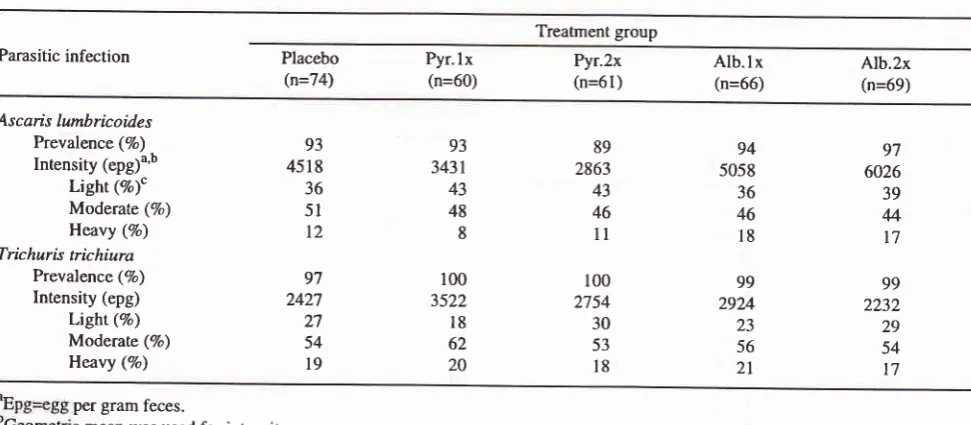
The baseline characteristics
of parasitic infection
are presentedin Table
l. As
expected,no significant
dif-ferences
were found
in
prevalence and
intensity for
both
A. lumbricoides
and
T.
trichiura
infections.
Children
in
the
alb.lx
and
alb.2x groups
had higher
mean egg counts and also a higher
proportion
of heavy
A. lumbricoides infections compared
to
the
other
groups,but
thesedifferences were not
significant.
Table 1. Baseline comparison of parasitic infections of children in five treatment groups
Treatment group
Parasitic infection Placebo
(n=74) Pyr. (n=60)
lx
Pyr.2x(n=61)AIb.lx
(n=66) Alb.2x(n=69)Ascais lumbricoi.des Prevalence (7o) Intensity (epg)u'b
Light (Vo)c Moderate (7o) Heavy (Vo) Trichuris trichiura
Prevalence (7o) Intensiry (epg)
Light (Vo) Moderate (Vo) Heavy (Vo)
93 4518 36
5l
t2
97 242'l 27 54
l9
93 3431 43 48 8
100 3522
l8
62 20100 2754 30 53
l8
99 2232 29 54 t7 89
2863 43 46
ll
97 6026 39 44 17 94
5058 36 46
l8
99 2924 23 56
2l
per gram feces.
c mean was used for intensity.
[image:3.595.44.530.488.700.2]7
198
Hadjuetal.
Changes
in prevalence
The
change
in
prevalence
of
A.
lumbricoides
and
Z.trichiura infections
at 3,6,
and
12mo
afterthe
initial
anthelmintic drug administration in all five
groups is
shown
in
Table
2. Overall,
the
prevalence
of
A.lumbricoides infection
in
the
four
dewormed
groupscombined
(pyr.1x, pyr.2x,alb.lx,
andalb.2x)
was4gVo andTTVo at 3 and 6 mo after thefirst
deworming.
These prevalenceswere
significantly lower
than thosein
theplacebo
group,
87Vo and 89Voat
3
and6
mo,
respec-tively.
After 3 mo
of
deworming,
the prevalence
of
A.lumbricoides
in the
albendazole
groups (alb.lx
andalb.2x)
andin
thepyrantel
groups(pyr.lx
andpyr.2x)
wassignificantly
lower
thanin
the placebogroup
(par-titioned
chi-square,
both
atP <
0.0004).
At
the 6-mo
exam,
there wasno significant
difference
between thealbendazole
and the placebo group, but
there
was
asignificant difference
betwee-nthe pyrantel and
theplacebo groups (partitioned
Xz,p
< 0.003).
At
the endof
the study,
as seenin
Table
2, the
alb.2x group
did
not
group
but
thepyr.2x
group
was
an the
pyr.lx
group
(parti_tion
ever,
both
albendazole
andpyrantel groups were
significantly lower
than
the placebogroup
(parritionedY, p
< 0.005andp
< 0.01,respectively).
The prevalence
of
T.
trtchiura infection in
the
alben-dazole
group after 3 mo of deworming
was
not
dif-ferent from that in the pyrantel
and placebo
groups.Med J Indones
Similar
results were also observed
after
6
mo
of
deworming. However,
at
the end
of the study,
theprevalence
in the
albendazole groups was
significant
lower
than
it
groups (partitioned
X2,
f <O.OZ1
r thanin
theplacebo
group
(partiti
The difference
be-tweenthe
alb.2x andalb.lx
groups was notsignificant.
Changes
in intensity
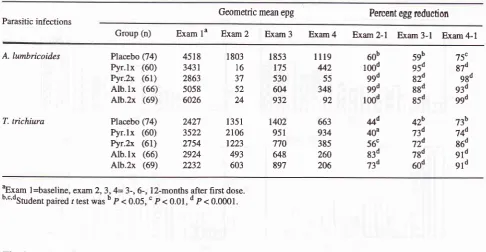
The
changes
in intensity
of
A. lumbricoides
and
T.trichiura infections
are presentedin
Table
3.As
seen,the
intensity of
both
A. lumbricoides
andT.
trichiura
wasgreatly
decreasedin
thedewormed
groups(paired
ftest,
P< 0.001)
andslightly
decreasedin
theplacebo
group (paired /
test,P < 0.05).
At the 3-mo
exam,
the intensity
of
A.
Iumbricoides
infection in
thefour
dewormed groups wassignificant-ly lower
thanin
the placebo group (Scheffe,p
<0.003).
At
the 6-mo exam, nosignificant difference
inintensity
of
A.
lumbricoides was
seenbetween the
albendazoleand
the placebo
groups,
but there was a significant
difference
between thepyrantel
and the placebo groups(Scheffe,
P <
0.005).
At the l2-mo
exam,
as seenin
Table 3, the intensity
of
ascariasisin the alb.2x
andpyr.2x
groupsdiffered significantly from
theintensity
in the placebo group (Scheffe,
P < 0.005 and
p
<
0.0005, respectively).
The
pyr.2x
group marginally
differed
from
thepyr.lx
group (Scheffe,
p <0.06), but
no difference
existed between
the alb.2x
and
alb.lx
groupsin
A.
lumbricoides intensity.
Table 2. Changes in prevalence of infections after once and twice yearly of albendazole and pyrantel pamoate in all children
Percent Positive Change, McNemar P Parasitic infections
Group(n)
Examla
Exam2 Exam3
Exam4 Exam2-l Exam3-l
Exam4-lNS 0.0002 0.0002 0.0002 0.0002
NS 0.0004
NS 0.029 0.004
0.059 0.003 0.0004 0.005 0.0004
0.034 NS 0.05 0.001 0.0004
NS
NSNS
NSNS
NS0.005
0.102NS
NS93
87
89
8293
38
62
7389
48
80
5694
56
80
7497
48
83
6497
96
99
89100 95
92
95100 95
93
8799
86
92
8099
93
96
80 Ascaris lumbrtcoidesTrichuris trichura
Contr. (74)
Pyr.lx
(60) Pyr.2x (61)Alb.lx
(66) Alb.2x (69)Contr. (74)
Pyr.lx
(60) Pyr.2x (61)Alb.lx
(66) Alb.2x (69)aExam 1=baseline,
[image:4.595.56.549.538.725.2]Vol 5, No 4, October - December 1996 Comparison between Albendazole and Pyrantel 199
Table 3. Changes in intensity of infections after once and twice yearly albendazole and pyrantel pamoate in all children
Geometric mean epg Percent egg reduction Parasitic infections
Group (n) Exam
la Exan2
Exam3
Exam4 Exam2-l
Exam3-1
Exam4-l
75c 87d 98d g3tl g9d
lllg
60b
59b442
l00d
95d55
ggd
82d348
ggd
88d92
lood
85d663
44d
4zb934
40u
73d385
56c
724260
83d
78d206
73d
60dt402
951
770 648
897 2427
3522
n54
29VI 2232
73b 74d 86d
9ld 9td
451 8
3431 2863
5058
6026
1803 16 37 52 24
l35l
2106 1223 493
603
1853
175 530 604 932 A. lumbrtcoides
T. trtchiura
Placebo (74)
Pyr.lx
(60)Pyr.2x
(61)Alb.lx
(66)Alb.2x
(69)Placebo (74)
Pyr.lx
(60)Pyr,2x
(61)Alb.lx
(66)Alb.2x
(69)aExam
1 =baseline, exam 2, 3, 4= 3-, 6-, L2-months after first dose.
b'''dstud"nt paired l rest was b p < 0.05,'
p<
0.01, dp<
0.0001.The intensity
of
T.
tichiura
infection
in
the
alben-d,azole groups wassignificantly lower
than thatin
thepyrantel
groups (Scheffe,
P <
0.002)
andthe
placebogroup (Scheffe,
P <0.03)
at the3-mo
exam.However,
atthe 6-mo exam, there
wasno significant
difference
between
the
albendazole and the
pyrantel
groups, or
betweenthe albendazole
and theplacebo
groupsin
T.trichiuraintensity.
As expected, at the end of the study,the alb.2x
group had
the
lowest intensity
of
T.trichiura, followed
by
thealb.lx
group and
thenby
theother
groups,but
thedifference
wasnot significant.
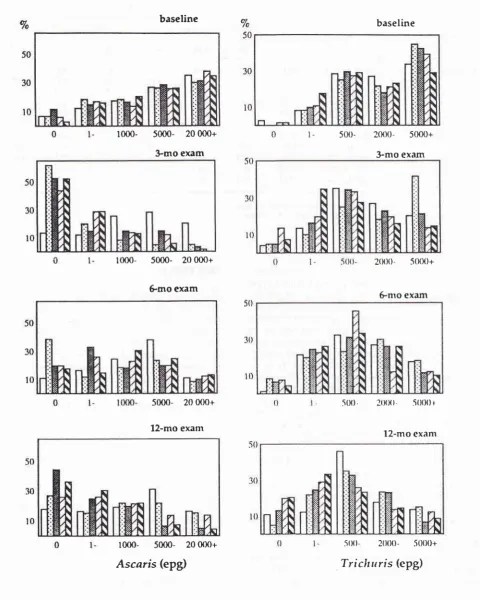
The changes
in
intensity
by
different
categoriesof
egg counts at baseline, 3, 6, and 12-mo exams are presentedin Figures
I
and2for
A.
lumbricoides
andT.trichiura,
respectively.
As
seen,after 3 mo
of
deworming,
thenumber
of heavily A. lumbricoides
infected children
(>
20000 epg) was
reduced
significantly
in
all
dewormed groups
and,to
someextent,
in
the placebo group.However,
after 6 mo ofdeworming,
thepercent-age
of
heavily infected children was similar
in
all
groups.
At
the endof
the study, groupsof children who
received
a secondtreatment at 6
mo showed less heavyA.
Iumbricoides infection (Figure 1). The heavy
T.trichiura infections were
also reduced
in
all
groupsthroughout
the study,
although the
lowest
number
of
infection
in
children
at
the
end
of
the exam (12-mo)
were
in
the groups who received a
second dose
of
albendazole.Both figure
show
thereduction
of
inten-sity in all
groups,
including
the placebo group,
partly
due
to the
decreasednumber
of
the heavily-infected
children.
DISCUSSION
This
study showed that,after
12 moof deworming,
theprevalence
andintensity of A. lumbricoides infection
was markedly reduce
in all
dewormed groups
and decreasedslightly in
theplacebo group.
Similarly,
theprevalence and
intensity
of T. trichiura
infection
definitely
decreased
in all
groups, although
it
decreasedmore
markedly in the
albendazole
groups.The
two
dose groups decreased
significantly
in
prevalence and intensity more than the other
group
did
for
A.
lumbricoides, but
not for
T.trichiura.
These
result are
in
agreementwith
a community-basedstudy
conducted
in
Okpo village
in
rural
Burma.l3
These authors compared onewith
two
yearly
doses(6-with
l2-monthly)
in areas
where the prevalence
andintensity
ofA.
lumbricoides
infection
are very high,but
T.
trichiura
and
hookworm infections
are
very low.
They
reported
that 6-monthly deworming
markedly
reduced
the intensity of
A.
lumbricoides infection
in
children
and adults, whereas a 12-monthly deworminglowered
theintensity
in
adults
only. Another
study,in
Kenya,l4
reported tËat the secondàor" p",
schoolyear
further
decreasedthe prevalence
andintensity
of
the threehelminth infections (hookworm,
T.trichiura,
andA.
lumbricoides) prevalent in
that area,while
one dosedid
not.
Repeated treatments
works
well to
prevent
newinfections
and to decrease thetransmission
rate of [image:5.595.40.527.100.352.2]200 Hadju et al. Med J Indones
baseline
lm0-
5000-
20 000+}mo
exam
1000-
5000-
20 fiD+Êmo
exam
5mO-
20 fiD+lfin-
50m-
20 ffX)+Ascaris
(epg)
baseline
500- 2fin-
5000+3-mo exam
20(X)-
5000+500.
2(XX)-
5(XX) +5(X)-
2(XX)-
.50()0+ [image:6.595.63.544.85.685.2]Trichuris
(epg)
Figure 1. Frequency distrtbution ofegg per gram offeces (epg) categoryforA. lumbricoides (left) andT. trichiura (right) infections at baseline, 3, 6, and 12 months after deworming infive groups; placebo (fl,), pyrantel once (l;1), pyrantel twice
(A
), albendazole once(A), and
albendazol.e rwice (f,1); n = 330.Gmo
exam
Vol 5, No 4, October - December 1996
It is interesting to
note that theintensity of both
infec-tions
in
the placebo
group
decreasedthroughout
thestudy, although
asignificant
reduction
of intensity
of
T. trichiura infection was also
seenin
the pyrantel
groups over theperiod of
the study.This
phenomenoncontradicts
whai we expected. Siudies
in
Kenyala'15found that the intensity
of T. trichiura infection
after
deworming
in_th_e placebo groupi
in
other
studies I Ô' r'lit hardly
change
as
been
related
to
seasonal
variat
nt
variation,lg
and
the effect of
the treatment
itself
on untreated g.orpr.20'21'22 Seasonalvariation
can beex-cluded
sincethis study
was donefor
anentire
year, sothat the baseline and
final
exams were performed
during
the same season.Basically,
measurementvaria-tion can also
be excluded since
the reductions
hap-pened atall
exams, andall
stool exams were conductedby
the sameanalyst
andidentical protocols. However,
thereduction likely
can berelated to the effect of
thetreatment itself
on untreated groups,
asdeworming
in
targeted
children
has been reported
to
decreasehel-minth transmission
within
astudy population.
Studiesin
Bangladesh,20in
Jamaica,zrundln^gu.-
u,4'22hau"
shown thatanthelmintic
drugs administered to targetedchildren
also had an impact
on
the
non-targeted
population. The authors showed
that deworming in
targeted children,
particularly from
I
to
l5
yearsold,
also decreased the prevalence and
intensity
ofhelminth
in
adult orin
the entirepopulation. They
suggestedthat
most of the helminth
eggs
in
the environment
were decreasedsince
1-15 yearsold children
are thehighest
risk group
andharbor the most worms
in
thepopula-tion. Thus,
thereduction ofboth
prevalence andinten-sity shown in the placebo group
in this
present studycould
be dueto
a decreaseof
thetransmission
rate, asa
result
a decreasein infection of the treated
groups.The impact may be even
more marked
in
this
study sincechildren
live
close to eachother,
and thenumber
of children in
theplacebo group
wasmuch lower
than thenumber of
those treated.It
should
bepointed
out
thatthe
advantageof using
asingle 400 mg
doseof albendazole, compared with
asingle dose
of
pyran tel,for reducing
T.trichiura
infec-tion
wasonly statistically significant in this study
at 3mo. As efficacy
studies haveshown varying results,
it
has been accepted
that regional
or
local conditions
affect the amount and frequency
of
dosesof
alben-dazole
neededin order
to have
ahigh
cure ratefor
Z.trichiura.
A
recent study
in
2294 Tanzanian
schoolchildrenf
0found
that the cure ratefor
T.trichiura
wasonly
llVo,but
the eggreduction
rate was 73Vo.Another
study of Bangladeshi
children23found only
oneout of
ComparisonbetweenAlbendazoleandPyrantel
2Ol
128
children
was cured, and the eggreduction
rate was49Vo.
In this study, we
measureda
subsampleof
98boys at 6 weeks
after deworming
and found that
the cure rate and the eggreduction
rate \ilere 6Vo and67Vo,respectively. Some investigators have observed
ahigher efficacy
when they
used400 mg
for more
thanoie
duy23'2aor
asingle
doseof more than 400
mg.25Other authors have observed no difference in results
by using two
doses onconsecutive
days26 and asingle
dose
of
600 mg;rahowever, both
studies had alimited
sample size. As one study showed that
worm expulsion
of
T.
trichiura
)1occtJfied
more
than
two
days
after
.
deworming,'-
it is possible that
asingle 400 mg
dosefor two
consecutive days may get a higher cure rate anda lower reinfection
rate.
The optimum
dose regimen
still
needsto
beelucidated
further for
thecommunity
reported
here.In summary, this study
showedthat
two
dosesof
an-thelminthic
drugs reducedprevalence
andintensity of
Ascaris
infection
more than
onedose,
andthe
reduc-tion of Ascaris intensity was
associatedwith
aheight
increment, while a
decreasedintensity
of
Trichuris,
seenover a
yea;.period,
was highly correlated with
increasesin midarm circumferences.
This study
sup-ports thenotion
thatdeworming
should beprovided
to
children
in
areaswith
ahigh transmission
of helminth
infections
and ahigh
prevalenceof malnutrition.
Acknowledgments
The study
wasfinancially
supportedby Directorate
of
Higher Education, Ministry of Education
andCulture,
Indonesia, Through "Hibah
Bersaing"
project
199211993.
We wish
to
thank Smithkline
BeechamPharmaceuticals Indonesia
for providing the
Alben-dazole and placebo
in this study.
Also
thanks
to
theprincipals of
theprimary
schools, the teachers andall
thechildren
and parentsfor their willing participation
in
the study.REFERENCES
l.
Bundy DAP, Cooper ES, Thompson DE, Didier JM, Sim-mons I. Epidemiology and population dynamicsof
Ascaris Iumbricoides andTichuris
trichiura infection in the samecommunity. Trans Royal Soc
Trop
Med Hygiene 1987;81:987-93.
2. Anderson RM, Medley GF. Community control of helminth infections
of
manby
mass and selective chemotherapy. Parasirol 1985;90:629-60.7
202
Hadjuet al.rural community in Iran. Trans Royal Soc Trop MedHygiene
1982;76:187-97.
4.
Thein-Hlaing;
Thane-Toe, Than-Saw, Myat-Lay-Kyin. Controlof
ascariasis through age-targeted chemotherapy:impact of 6-monthly chemotherapeutic regimes. Bull World
Health Org 68:747-53.
5. Bundy DAP, Thompson DE, Cooper ES, Golder ES, Golden
MHN,
Anderson
RM.
Population dynamics
andchemotherapeutic control of Irichuris trichiura infection
of
children inJamaica and St. Lucia. Trans Royal Soc Trop Med
Hygi ene 1985 ;7 9 :7 59 -64.
6. Hadju V, Abadi
K,
Sûephenson LS, Noor NN, MohammedHO,
BowmanDD.
Intestinal helminthiasis, nutritionalstatus, and their relationship; a cross-sectional study in urban
slum school children
in
Indonesia. Southeast Asian TropMed Public Health 1995;26:719-29.
7.
WHO. Model
prescribinginformation.
Drugs used inparasitic diseases. Geneva:
World
Health Organization,1990.
8. Pane P, Mojon
M,
Garin JP, Couland JP, Rossignol JF.Albendazole: A new broad spectrum anthelminthic
double-blind multicentre clinical trial. Amer J Trop Med Hygiene 1982;31:263-6.
9. Abidin SAN, Mochtar A, Margono SS, Rukmono S.
Alben-dazole
in
the treatmentof
intestinal helminthiasis. MajKedokt Indones 1986;36:37 7 -82.
10. Albonico
M,
Smith PG, HallA.
A
randomized controlledtrial comparing mebendazole and albendazole against
As-caris, Trichuris, and hookworm infections. Trans Royal Soc
Trop Med Hygiene 1994;88:585-9.
ll.
\ryHO. Basic Laboratory Methods in Medical Parasitology.Geneva: World Health Organization, 1991.
12. Wilkinson L,
Hill
M, Vang E. Systat: statistics, version 5.2edition. Evanston, IL:SYSTAT, lnc, 1992.
13.
Thein-Hlaing,
Than-Saw,Myint-Lwin.
Reinfectionof
people with As caris ltmtbicor'les following single, 6-month
and l2-month interval mass chemotherapy in Okpo village,
rural Burma.
Trans
Royal
SocTrop Med
Hygiene1981;81:140-6.
14. Stephenson LS, Latham MC, Adams EI, Kinoti SN, Pertet
A.
$/eight gainof
Kenyan School children infected withhookworm,
Tichuris
trichiura, ardAscais
hsnbrtcoidesinfections is improved following once or twice yearly
treat-ment with albendazole. Nutrition 1993; 123, 103646.
15. Stephenson LS, Latham MC, Kurz KM, Kinoti SN, Brigham
H.
Treatmentwith
single doseof
albendazole improvesgrowth
of
Kenyan school children
with
hookworm,Tricharis
tichiura,
ardAscais
funbicoides
infections.Amer Trop Med Hygiene 1989;41:78-87.
Med J Indones
16. Totoprajogo OS. Effects of deworming treatment on
nutri-tional status in primary school children in Kabupaten Sikka,
Nusa Tenggara Timur Province, Indonesia. Master thesis,
Cornell Univenity, Ithaca, New York, 1989.
17. Adams EJ, Stephenson LS, Latham MC, Kinoti SN. Physical
activity and growth
of
Kenyan schoolchildren withhook-worm, Trichuris trtchiura and Ascarts fumbrtcoides
tnfec-tions are improved after treatment
with
albendazole. JJNutrition 199 4;124;1 199 -2O6.
18. Cabrera BD. Reinfection and infection rates of ascariasis and
trichuriasis among school children
in
relation to seasonalvariation in the Philippines. Southeast Asian Trop Med Publ
Health 1984; l5:395-401.
19. Hall A. Quantitative variability of nematode egg counts in
feces: a study among rural Kenyans. Trans Royal Soc Trop
Med Hygiene l98l;7 5:682-7 .
20. Cabrera BD, Cruz AC.
A
comparative study on the effectsof
mass treatmentof
the entire community and selectivetreatment of children on the total prevalence of
soil-trans-mitted helminthiasis in two communities, Mindoro,
Philip-pines. In : Collected papers on the control of soil-transmitted
helminthiasis, Yokogawa
M
et al
(editors), Volume 2.Tokyo: Asian Parasite Control Organization 1983;266-87.
21. Bundy DAP, Wong MS, Lewis
LL,
Horton J. Controlof
geohelminths by delivery oftargeted chemotherapy though
schools. Trans Royal Soc Trop Med Hygiene 1990;84: I
l5-20.
22. Thein-Hlung, Thane-Toe, Than-Saw, Myat-Lay-Kyin. The
impact of three-monthly age-targeted chemotherapy on
As-caris lwnbrtcorZes infection. Trans Royal Soc Trop Med
Hy giene 199 I :85,5 19 -22.
23.Hall
A,
Anwar
KS.
Albendazole andinfections
withTric huris trichiura and Giatdia intestinalis. Southeast Asian
I
Trop Med Public Health 199l;22:84-7.24. Bundy DAP,.Thompson DE, Cooper ES, Blauchard J. Rate
of expulsion of Trichuis trichiura with multiple and single
dose regimens of albendazole. Trans Royal Soc Trop Med Hygiene, 1985 ;7 9 :641 - 4.
25.Hall A,
Nahar Q. Albendazole and infection with Ascarrslumbricoides and,
Trtchuris trichiura
in
children
in
Bangladesh. Trans Royal Soc Trop Med Hygiene 1994;88,
tlo-z.
26. Ramalingan S, Sinniah
B,
KrishnanU.
Albendazole, aneffective single dose, broad spectrum anthelminthic drug.
AmerJ Trop Med Hygiene 1983;32:984-9.
27. Abidin SAN. Albendaz ole pada pengobatan Nematode usus.