ISSN: 2252-8806 220
Benefit of Brown Rice Feeding on Elderly Insomnia
Titiek Hidayati, Nevi Seftaviani, Hastin Munifah T.F.F.S., Ardhitapramesti A.H.P., Nurisa Fikriyani L.
Medical and health science faculty, Universitas Muhammadiyah Yogyakarta (UMY), Indonesia
Article Info ABSTRACT
Article history:
Received Jul 24, 2015 Revised Aug 21, 2015 Accepted Aug 29, 2015
Difficulty falling asleep or insomnia is one of health problems in elderly. Age is one of the risk factor of insomnia. Tryptophan in brown rice can stimulate the formation of serotonin. Serotonin is a neurotransmitter that causes someone sleeps easily. This research used quasi-experimental design with pretest posttest without control group. Population in this research is 20 elderly persons in Budi Luhur Nursing House unit of Kasihan, Bantul. Result experiment shows that 7 elderly persons have improvement in difficulty falling asleep or insomnia. Improvement of insomnia degree in elderly may be caused by the tryptophan in brown rice. Elderly persons can consume brown rice as alternative food for improving insomnia.
Keyword:
Brown Rice Elderly Insomnia Serotonin
Tryptophan Copyright © 2015 Institute of Advanced Engineering and Science.
All rights reserved.
Corresponding Author:
Titiek Hidayati,
Department of Epidemiology, Public Health and Family Medicine,
Medical and Health Science Faculty of Universitas Muhammadiyah Yogyakarta, West Ring Road of Yogyakarta, Kasihan, Bantul, Yogyakarta, Republic of Indonesia. Email: [email protected]
1. INTRODUCTION
Increasing number of elderly is still a problem in all developed and developing countries. Developed countries have higher increase in the number of elderly than in developing countries. But number of elderly in developing countries is still greater than in developed countries. According to the Badan Pusat Statistik (BPS) in 2007, the number of elderly in Indonesia was 18.96 million and increased to 20.547.541 people in 2009. By 2025, the numbers of elderly are predicted to 40 millions. Even in the year 2050, the numbers of elderly reach almost 716 million in Indonesia [1].
Indonesian law no. 13 of 1998 on the welfare of the elderly establishes that the age limit of elderly in Indonesia is 60 years and over (Social Departement of RI, 2004). In addition, Indonesian law no. 36 of 2009 Article 138, paragraph 1 specifies that the efforts of health care for the elderly maintain the health status and productive life socially and economically in accordance with human dignity.
In the elderly and in all ages, sleep not only means "time out" from the routine bustle but also have important functions for the health, emotional, mental, and safety. Lately, researchers have found that people who suffer from insomnia more often suffer from psychiatric problems than normal people. Sleep disorder is one of the health problems in elderly. Sleep disorders attacks 50% of people aged 65 or older who lived in the home and 66% of people who live in nursing facilities. Most elderly people experience sleep disorder that is caused by the growing vulnerability of physical and psychological conditions of the elderly. However, age increasing is not an absolute factor onset of sleep disorders in the elderly. Another factor is retired, death of a spouse or close friend, the increase in drugs and disease experienced [2].
gastrointestinal motility in the elderly. Decreasing kidney function in the elderly is aggravated by the continuous drug consumption and will causes kidney failure. This has led to a mortality increasing in the elderly. A non-pharmacological therapy is required for an effective and safe to improve sleep quality in elderly [2].
Chinese study showed that the brown rice extract solution containing unsaturated fatty acids, beta-sterol, cambeta-sterol, stigmabeta-sterol, isoflavones, sap Onin, Zn and Fe, lovastatin and mevinolin-HMG-CoA [3]. Meanwhile, according to FAO, each 100 gr of brown rice contains 7.3 gr protein, 2.2-gr crude fat, 71.1 gram Carbohydrate, 4.0-gr dietary fiber and 384 kcal of energy. In addition, brown rice contains many amino acids like Lysine, Threonine, Methionine, Tryptophan, and Tannin [4]. Brown rice flour prevents various diseases, including colon cancer, kidney stones, insomnia, constipation, hemorrhoids, blood sugar, and cholesterol [3].
2. RESEARCH METHOD
This research has been conducted in Budi Luhur Nursing Home of Kasihan, Bantul for four weeks from the date of March 31, 2014 until April 27, 2014. The method is quasi-experimental design with pre-test post-test without control group design to determine the influence of feeding brown rice. The population in this study is the elderly people in Budi Luhur Nursing Home of Kasihan, Bantul.
Total sampling method got 20 elderly as the experiment group who met the inclusion and exclusion criteria. The inclusion criteria were elderly who was recorded joined Budi Luhur Nursing Home of Kasihan, Bantul, agreed to be the survey respondents, agreed to consume brown rice, and agreed to answer the questionnaire. Elderly who did not follow the full course of the study were excluded from the study sample.
The independent variable was the feeding of brown rice while the dependent variable was the degree of difficulty falling asleep. Tools and materials used in this research are the informed consent form, a questionnaire PSSQ_I, and brown rice. Brown rice given as much as 150 grams daily for four weeks from 15.00- 16:00 o'clock (afternoon meal breaks).
PSSQ_I Questionnaire (Pittsburgh Sleep-Insomnia Symptom Questionnaire) also known as the Insomnia Symptom Questionnaire (ISQ) has 13 self-rated questions. Only questions 1, 2 or 5 are used to determine the presence, frequency and duration of sleep symptom criteria [5]. PSSQ_I was used as pretest before elderly ate brown rice and as posttest after elderly ate brown rice for 4 weeks. In this research, collecting data only used PSSQ_I scores in question 1 or difficulty falling asleep category. In addition, the frequency of insmonia as never, seldom, sometimes, often, and always is taken from PSSQ_I. The definition of never is never experienced insomnia, rarely is less than once per week, sometimes is 1-2 times per week, frequently is 3-4 times per week, and always is 5-7 times per week.
After the posttest got the result, which is applied from scoring criteria in PSSQ_I [5], there are 2 type of change in elderly insomnia, they are 'improvement type' which is marked by constant frequency in ‘never’, ‘rarely’, or ‘sometimes’, or improvement frequency of falling asleep in posttest. Then 'impairment type' which is marked by worsening frequency of falling asleep or the frequency in diificulty falling asleep is ‘frequently’ or ‘always’ in posttest.
3. RESULTS AND ANALYSIS
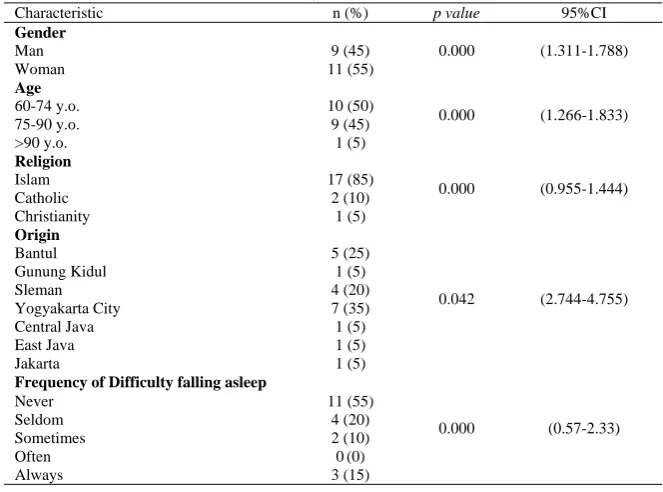
Table 1 presents the initial characteristics of the gender, age, religion and origin of population before consumed brown rice which was got from the pretest. Table 1 shows that the majority of sex is women (55%), the majority of age is 60-74 years old (50%), the majority of religion is Islam (85%), the majority of origin is the City of Yogyakarta (35%), and the initial majority frequency of sleep disorders in difficulty falling asleep aspect is never (55%). The p values result show that elderly who became the sample of this study had different initial characteristics in sex, age, religion, origin, and in frequency of difficulty falling asleep.
Table 1. Initial Characteristic of the gender, age, religion and origin of elderly in Budi Luhur Nursing Home of Kasihan, Bantul in 2014
Characteristic n (%) p value 95%CI
Frequency of Difficulty falling asleep
0.000 (0.57-2.33)
Table 2. The Changes of frequency in difficulty falling asleep from pretest to posttest on elderly
Frequency Posttest
Never Rarely Sometimes Frequently Always
Pretest
Table 3. Elderly’s number in each type of elderly’s insomnia frequency Type of Change Number of elderlies p-value (CI 95%)
Improvement 14 elderlies
Figure 1. Percentage of the type of of elderly’s insomnia frequency change
3.1. Brown rice mechanism
After the feeding of brown rice was completely done regularly in 4 weeks, as in Table 3 and Figure 1, 14 elderlies experienced improvement or easier falling asleep than before. Again, statistical result (p = 0.000) proved that it was happened because of the brown rice feeding therapy which had been given to the elderly in Budi Luhur Nursing Home of Kasihan, Bantul.
Brown rice contains many amino acids like Lysine, Threonine, Methionine, Tryptophan, and Tannin. Of the amino acids, only tryptophan is found significantly with sleep status, with increasing levels during acute sleep disturbance [6]. Tryptophan is vital for the formation of serotonin and melatonin. Tryptophan itself, as well as 5-hydroxytryptophan has also been used to treat depressive disorder [7],[8]. The increasing levels of tryptophan measured during sleep deprivation may contribute to the antidepressive effect of sleep deprivation, directly or indirectly via serotonin synthesis.
Serotonin is a neurotransmitter which regulates sleep and wake time [9]. Furthermore a low level of serotonin has long been associated with major depressive disorder [10]. And based on previous research, the raised levels of serotonin during sleep deprivation may provide a possible antidepressive mechanism for this intervention in humans [11],[12]. Then it also supports recent human in vivo evidence showing increased cerebral serotonin 2A receptor binding during 24 hours of wakefulness [12]. Besides serotonin and tryptophan, taurine is increasing during acute sleep deprivation and have been implicated in the etiology of depression [10]. In addition, all three metabolites have high concentrations in the pineal gland and significantly increased being observed during sleep deprivation.
3.2. Brown rice benefits
In addition to an improvement, as in Table 3 and Figure 1, there were 6 elderly persons who experienced impairment in falling asleep after they ate brown rice in 4 weeks. These things happened because there were many factors which can’t be controlled by the researcher in this study as initial characteristic of elderly in Table 1. According to Doghramji et al (2009) and LeBlanc et al (2009), many risk factor can trigger insomnia, are: a) Emotion. Especially anxiety and depression can induce transient and recurrent insomnia. This study showed that most of elderly persons in this population worry about their family economic. b) Habit. Consuming caffeine, alcohol, over sleep, smoking before sleep, aspartame, or lack of sun shine and less activity can cause insomnia by inhibitation the production of serotonin. c) Environment factor like noisy, extreme temperature or environmental changes can cause insomnia. d) Age more than 50 years old. e) Gender. Insomnia attacks (20-50% happen in woman more than man) f) Previous insomnia episode. g) Chronic illness which causes pain or breathing disturbance (COPD).
Beside of that, the quality of sleep is also influenced by sleep habit or sleep hygiene which is applied by elderly. It's about health practices (eg, diet, exercise, substance use) and environmental factors (eg, light, noise, and temperature) that might promote or interfere with sleep like avoiding the stimulants (eg, caffeine, nicotine) for several hours before bedtime, avoiding alcohol around bedtime as it fragments sleep during the second half of the night, exercising regularly, not watch the clock, and keep the bedroom environment dark, quiet, and comfortable [13],[14].
4. CONCLUSION
Brown rice feeding gave benefit in elderly insomnia by improved the degree of difficulty falling asleep because contains of tryptophan. Elderly persons can consume brown rice as alternative food for improving insomnia. It needs further study to know the benefit of combination therapy between brown rice feeding and sleep hygiene for insomnia elderly.
ACKNOWLEDGEMENTS
The authors thank to Indonesian Directorate General of Higher Education (DIKTI), 2015 Student Creativity Program.
REFERENCES
[1] Ministry of health of republic of Indonesia, “The main topic of the Elderly's health Picture in Indonesia”, The bulletin window of Data and information, vol/issue: 7(4), 2013.
[2] Stanley, M., Beare, P. G., “Textbook of nursing Gerontik Edition 2nd”, EGC of Jakarta, 2006.
[3] News, “Rice Brown rice Food, the neglected nourishing”, Agricultural Research and development, 2005.
[5] Okun, M. L., Kravitz, H. M., Sowers, M. F., Moul, D. E., Buysse, D. J., Hall, M., “Psychometric evaluation of the Insomnia Symptom Questionnaire: A self-report measure to identify chronic insomnia”, Journal of Clinical Sleep
Medicine, vol/issue: 5(1), pp. 41-51, 2009.
[6] Doghramji, K., Grewal, R., Markov, D., et al., “Evaluation and Management of Insomnia in the Psychiatric Setting”, Focus, vol/issue: 7(4), pp. 441-451, 2009.
[7] LeBlanc, M., Mérette, C., Savard, J., et al., “Incidence and risk factors of insomnia in a population-based sample”,
Sleep, vol/issue: 32(8), pp. 1027, 2009.
[8] Turner E. H., Loftis J. M., Blackwell A. D., “Serotonin a la carte: Supplementation with the serotonin precursor 5-hydroxytryptophan”, Pharmacol Ther, vol/issue: 109(3), pp. 325–338, 2006.
[9] Monti, J. M., “Serotonin control of sleep-wake behaviour”, Sleep Med Rev, vol/issue: 15(4), pp. 269–281, 2011. [10] Ressler K. J., Nemeroff C. B.. “Role of serotonergic and noradrenergic systems in the pathophysiology of
depression and anxiety disorders”, Depress Anxiety, vol/issue: 12(1), pp. 2–19, 2000.
[11] Davies, S. K., Ang, J. E., Revell, V. L., et al., “Effect of sleep deprivation on the human metabolome”, Proceedings of the National Academy of Sciences, vol/issue: 111(29), pp. 10761-10766, 2014.
[12] Elmenhorst, D., Kroll, T., Matusch, A., et al., “Sleep deprivation increases cerebral serotonin 2A receptor binding in humans”, Sleep, vol/issue: 35(12), pp. 1615–1623, 2012.
[13] Fuller, J. M., Wong, K. K., Krass, I., “Sleep disorders screening, sleep health awareness, and patient follow-up by community pharmacists in Australia”, Patient education and counseling, vol/issue: 83(3), pp. 325-335, 2011. [14] Morin C. M., Benca R., “Chronic insomnia”, Lancet, vol/issue: 379(9821), pp. 1129–1141, 2012.