DEVELOPMENT OF SINGLE-WHEELED BALANCING
SCOOTER
UNIVERSITI TEKNIKAL MALAYSIA MELAKA
DEVELOPMENT OF SINGLE-WHEELED BALANCING
SCOOTER
This report submitted in accordance with requirement of the Universiti Teknikal
Malaysia Melaka (UTeM) for the Bachelor Degree of Manufacturing Engineering
(Robotics and Automation)(Hons.)
UNIVERSITI TEKNIKAL MALAYSIA MELAKA
BORANG PENGESAHAN STATUS LAPORAN PROJEK SARJANA MUDA
TAJUK: Development of Single-Wheeled Balancing Scooter
SESI PENGAJIAN: 2012/13 Semester 2
Saya MUHAMMAD AMIR LUFTI BIN RADZALI
mengaku membenarkan Laporan PSM ini disimpan di Perpustakaan Universiti Teknikal Malaysia Melaka (UTeM) dengan syarat-syarat kegunaan seperti berikut: 1. Laporan PSM adalah hak milik Universiti Teknikal Malaysia Melaka dan penulis. 2. Perpustakaan Universiti Teknikal Malaysia Melaka dibenarkan membuat salinan
untuk tujuan pengajian sahaja dengan izin penulis.
3. Perpustakaan dibenarkan membuat salinan laporan PSM ini sebagai bahan pertukaran antara institusi pengajian tinggi.
4. **Sila tandakan ( )
(Mengandungi maklumat yang berdarjah keselamatan atau kepentingan Malaysia sebagaimana yang termaktub dalam AKTA RAHSIA RASMI 1972)
(Mengandungi maklumat TERHAD yang telah ditentukan oleh organisasi/badan di mana penyelidikan dijalankan) TIDAK TERHAD
Alamat Tetap:
DECLARATION
I hereby, declared this report entitled “Development of Single-Wheeled Balancing
APPROVAL
This report is submitted to the Faculty of Manufacturing Engineering of UTeM as a
partial fulfillment of the requirements for the degree of Bachelor of Manufacturing
Engineering (Robotics and Automation) (Hons.). The member of the supervisory is
as follow:
………
ABSTRAK
Projek ini bertujuan untuk membangunkan skuter beroda satu. Setiap rekabentuk dan
idea adalah untuk penambahbaikan skuter beroda satu yang telah dibina. Kajian ini
adalah penting untuk menyelesaikan masalah yang dihadapi oleh pencipta skuter
sebelum ini. Keberkesanan dan jalan penyelesaian untuk perjalanan dari satu tempat ke
destinasi lain dapat diatasi. Melalui projek ini, skuter beroda satu telah dikaji untuk
penambahbaikan dari idea yang mudah sehingga siap dibangunkan menjadi satu skuter
yang lengkap. Pada permulaan laporan ini, secebis maklumat mengenai skuter beroda
satu akan didedahkan. Ini adalah termasuk objektif dan matlamat utama yang perlu
dicapai pada pengakhiran reka nbentuk dan pembuatan skuter beroda satu. Beberapa
masalah telah dihadapi pada awal pembuatan seperti rekabentuk, barang, dan
kekurangan maklumat akan diberitahu. Terdapat beberapa perbandingan antara skuter
beroda dua dan satu. Kelemahan dan kekuatan, kelebihan dan kekurangan kedua-dua
jenis skuter akan didedahkan. Skuter beroda satu yang telah dibangunkan pada masa kini
akan diberi penerangan sepenuhnya. Setiap cebisan maklumat dan keputusan serta butir-
butir perincian ciptaan seperti rekabentuk, sistem elektronik, prestasi, dan pengawalan
ABSTRACT
The purpose of this project is to develop a single-wheeled scooter. Each design and idea
for improvement of single-wheeled balancing scooter has been made. This development
is important to provide problem solving from a previous unicycle scooter. In this project,
the single-wheeled unicycle has been researched for enhancement from a simple idea
into a complete scooter. At the beginning of the report, a piece of information regarding
a single-wheeled scooter has been enlightened. This will include the main objective and
goal to be achieved at the end of design and development of single-wheeled balancing
scooter. Several problems in early stage of development such as design, part, and lack of
information has been notified. There is a comparison between two-wheeled and single-
wheeled balancing scooter. The weaknesses and strength, advantages and disadvantages
of both type of balancing scooter has been enlightened. A single-wheeled unicycle that
has been developed in this early day has been illustrated. Each piece of info including
detail and result of the invention such as design, electronic system, performance, and
controllability has been gathered.
DEDICATION
This report is lovingly dedicated to my respective parent, Radzali Bin Md. Yusof and
Fatimah Wati Binti Mohd Ali. An appreciation to my Supervisor, Dr. Fairul Azni Bin
Jafar, lecturers and friends that have been my constant source of inspiration. They have
given me the drive and discipline to tackle any task with enthusiasm and determination.
ACKNOWLEDGEMENT
All Praise to Allah and prayers and peace be upon Muhammad Rasulullah S.A.W. I
would like to acknowledge the contributions of the individuals to the development of
this report. I am also heartily thankful to my supervisor, Dr. Fairul Azni Bin Jafar,
whose encouragement, guidance and support from the initial to the final level enabled
me to develop an understanding of the subject. To my truly great family who has made
available their support in a number of ways. Lastly, I offer my regards and blessings to
all of those who supported me in any respect during the completion of the project.
TABLE OF CONTENT
List Abbreviations, Symbols and Nomenclatures xi
CHAPTER 1: INTRODUCTION 1
2.2.1 The Single-Wheeled Bike 8
CHAPTER 3: METHODOLOGY 14
CHAPTER 4: RESULT AND DISCUSSION 25
4.1 Design 25
4.5 Advantages and Disadvantages 41
4.6 Discussion 42
4.7 Summary 42
CHAPTER 5: CONCLUSION AND FUTURE WORK 43
5.1 Introduction 43
5.2 Conclusion 43
5.3 Future Work 44
REFERENCES 45
APPENDICES 48
A Project Flow Chart
B Project Gant Chart
LIST OF TABLES
4.1 Comparison of Price List 40
LIST OF FIGURES
1.1 Single Wheel Future Concept 2
1.2 Two-Wheeled Balancing Scooter 3
2.1 The Segway 6
2.2 The Enicycle 8
2.3 The RYNO 9
2.4 The Solowheel 10
2.5 The Thing 11
3.1 Accelerometer and Gyro Sensor 15
3.2 Flow Chart 16
3.3 Schematic Model 18
3.4 Base Support 19
3.5 Brushless Hub Motor 20
3.6 Microcontroller and Motor Driver 21
3.7 Gear Drive Load 22
4.1 Finish Product 26
4.2 Wiring Board 28
4.3 Etching Board 29
4.11 Experimental Layouts 34
4.12 Test Road 36
4.13 Pendulum Concept 37
4.14 Time vs. Voltage 38
4.15 Time vs. Distance 39
LIST OF ABBREVIATIONS, SYMBOLS AND
NOMENCLATURE
BLDC - Brushless Direct Current
C++ - Programming Language
PIC - Peripheral Interface Controller
RM - Ringgit Malaysia
V - Volt
vs. - Versus
CHAPTER 1
INTRODUCTION
The new invention, design, and manufacturing are all come from a single idea that is to
generate into a bigger concept and futuristic thinking. It is not about how to invent a new
product, but the idea is to improve existing product for better performance. To improve
the product, it required certain stages to achieve and required a lot of budgets and times
that need to be considered or it can slow down the process. The development of single-
wheeled balancing scooter is an invention to improve the scooter from the aspect of
performance and quality.
The goal in this project is to construct a single-wheeled transport stabilizes itself while
idle. The word stabilizes means to make or keep in equilibrium (steady state). However,
if the system is not balanced, it can fall off. Therefore, a simple mechanism is needed to
provide an input into the microcontroller, with the program inside as a balancing
algorithm.
1.1 Background
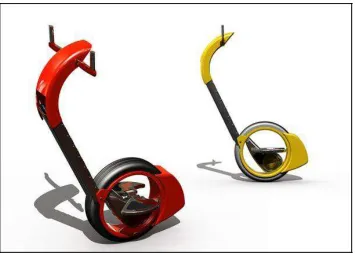
Figure 1.1: Single Wheel Future Concept
[Souto, C., (2012). http://www.chrissoutodesign.com/orbis-urban-mobility-vehicle/]
This project is an inspiration from future concept to develop a single wheel balancing
mobile or scooter. An attraction with this kind of technology gives a different kind of
idea and different ways of a design and an interface. Nowadays, a lot of two wheel
balancing scooters and personal transporter introduced in the market. So that, in a
1.2 Problem Statement
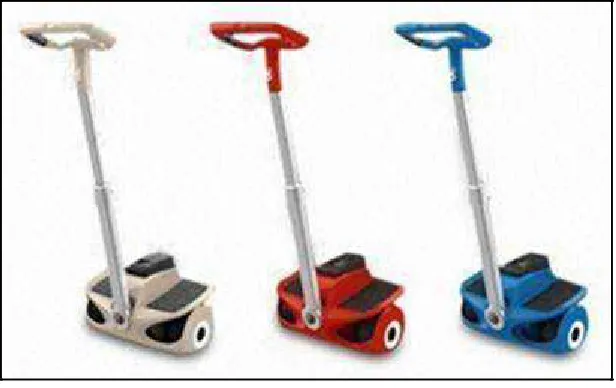
Figure 1.2: Two-Wheeled balancing Scooter
[FreeGo. (2012). http://freegochina.en.busytrade.com/selling_leads/info/2417200/Two-
Wheel-Electric-Scooter-uv02-.html]
The innovation of balancing scooter has a progression of many stages. But, there are a
few difficulties need to be considered to construct this invention. The two wheel
balancing scooter product required an extra cost then producing a single wheel balancing
scooter. By adding two wheels, gear system, body frame structure, etc. required a lot of
time for production and required additional cost to invest so that it meet the design
requirement. Furthermore, the two wheeled design required more space, hence, it
required big area to keep it.
1.3 Objectives
The objectives of a single-wheeled balancing scooter are;
a) To develop a single-wheel balancing scooter.
b) To analyze the performance of the developed scooter.
1.4 Scope
This project consists of body frame, single wheel, microcontroller, and a motor. The
concept of single-wheel transporter initiate from a drawing and a simple design to
illustrate a rough sketching of the scooter. This is a crucial part where all the
components must be placed at the right position so that it has a smooth and comfortable
interface for usage. All the design and drawing has been gathered and a selection has
been made. The finest design has been improved so that it can be the requirement needs.
After that, all the parts can assemble and a single-wheeled scooter can produce. Each
part of the scooter has been analyzed to check the performance, strength, durability, and
the important is can carry the load size of an adult person and stabilize when idle. The
torque and motor performance, shaft connected between tire and a body frame,
microcontroller are important to be tested so that, the performance must be at the
optimal state.
Another significant part in developing a single-wheel scooter is about how the user can
attracted to ride the invention concept of the single - wheel scooter. This is able to
allocate problem issue regarding the project. Improvement has been made to achieve a
1.5 Report Structure
In the beginning of this report, it is categories into three main chapters which are the
introduction, literature review, and methodology. For an introduction, it is explained in
this chapter. Firstly, a background which tells the motivation that generates an idea for
this project is described. The project inspiration has been stated in this section.
Secondly, it is a problem statements brief description of the issues that need to be
addressed before solving the problem. Similar products are compared to the single wheel
transporter in this project. Thirdly is objectives that are something which are intended to
be attained or accomplish, purpose, and goal. In this section, the aim is to fulfill the
requirement needed. Fourthly, it is a scope that covers the extent or range of view. The
project brief has been explained in this chapter. Lastly, for report structure, each chapter
has been explained.
In chapter 2, literature review is a body of text that aims to review the critical points of
current knowledge including substantive findings as well as theoretical that contribution
to a particular topic. The comparison of product, technique used, limitation and etc. have
been clarified in this chapter.
In chapter 3, methodology is a guideline system for solving problems. The flow of the
process from beginning to the end of the project has been illustrated in a chart. It has
been an explanation regarding a process of making this project.
In chapter 4, it is about result and discussion. Required information such as testing part
and problem take place within the time taken to build this scooter has been discussed.
The result can be used for further research and improvement.
Lastly, chapter 5 is a conclusion and future works. In general, the outcome of the
research from beginning till the end has been discussed. Any value of information such
as advantages, disadvantages, and any relevant point of view have been stated.
CHAPTER 2
LITERATURE REVIEW
This chapter is discussing the related works on double and single-wheeled scooter. The
advantages and disadvantage of each model are discussed, while the basic concept of the
scooter is introduced.
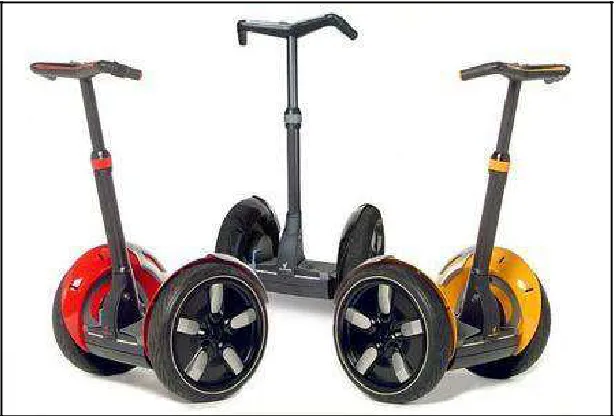
The basic idea for a two-wheeled balancing scooter is a simple concept by moving the
motor in a direction to counter the direction of fall. A two wheeled balancing scooter
such as the Segway invented by Dean Kamen (Kamen. D, 2001) is an example of this
type of product (Figure 2.1). It uses such as computers and motors in the base of the
device to keep the Segway upright when powered on and balance while a user is
standing on top of it. Moreover, this product used a simple command to move forward
by shifting their weight forward and moving backward by shifting their weight
backward. To turn, the user can manipulate a control on the handlebar whether left or
right. The Segway had driven using a two electric motor and a speed of 20.1 km per
hour. The battery is made of lithium ion batteries. The battery need to be checked
regularly and recharge it timely. By using two drive electric motors, it consumes extra
power for a single battery. The lithium ion batteries should be suitable for this
application, but the effect is totally on the price tag.
2.2 Single-Wheeled Scooter
Apart of the development of the two wheeled scooter as explained in sub-chapter 2.1,
there were also a few developments of single-wheeled scooter, in which only one tire is
used rather than two tires.