1 THE INFLUENCE OF ISLAMIC VALUE TOWARDS SOCIAL
REPORTING (A CASE STUDY: BSM AND BMI)
Submitted By: Sholatia Dalimunthe Student ID: 604082000015
INTERNATIONAL PROGRAM ACCOUNTING DEPARTMENT
FACULTY OF ECONOMICS AND SOCIAL SCIENCES UNIVERSITAS ISLAM NEGERI SYARIF HIDAYATULLAH
2 THE INFLUENCE OF ISLAMIC VALUE TOWARDS SOCIAL
REPORTING (A CASE STUDY: BSM AND BMI)
Thesis
Submitted to Faculty of Economics and Social Sciences
As Partial Requirement for Acquiring the Bachelor Degree of Economics
Submitted by:
Sholatia Dalimunthe Student ID: 604082000015
Under Guidance of
Thesis Advisor I Thesis Advisor II
Prof. Dr. Abdul Hamid, MS Ade Wirman Syafei, SE., MSc NIP. 131 474 891
INTERNATIONAL CLASS PROGRAM ACCOUNTING DEPARTMENT
FACULTY OF ECONOMICS AND SOCIAL SCIENCES STATE ISLAMIC UNIVERSITY SYARIF HIDAYATULLAH
3 THE INFLUENCE OF ISLAMIC VALUE TOWARDS SOCIAL
REPORTING (A CASE STUDY: BSM AND BMI)
Thesis
Submitted to Faculty of Economics and Social Sciences
As Partial Requirement for Acquiring the Bachelor Degree of Economics
Submitted by:
Sholatia Dalimunthe Student ID: 604082000015
Under Guidance of
Thesis Advisor I Thesis Advisor I
Prof. Dr. Abdul Hamid, MS Ade Wirman Syafei, SE., MSc NIP. 131 474 891
Professional Examiner
Drs. Abdul Hamid Cebba, Ak., MBA NIP. 132 055 044
INTERNATIONAL CLASS PROGRAM MANAGEMENT DEPARTMENT
FACULTY OF ECONOMY AND SOCIAL SCIENCES STATE ISLAMIC UNIVERSITY SYARIF HIDAYATULLAH
4 Today, we administered a comprehensive examination to Sholatia Dalimunthe ID 604082000015. The title of her thesis is: “The Influence of Islamic Value towards Social Reporting” (A Case Study: BSM and BMI). After proper examination of the work student, we have decided that she has met all of the requirements for the title of Bachelor of Economics on the field of Accounting, State Islamic University (Universitas Islam Negri) Syarif Hidayatullah Jakarta.
Jakarta, August 1st 2008
Comprehensive Examination Team
5 AUTO BIOGRAPHY
I. IDENTITY
Name : Sholatia Dalimunthe
Place/ Date of Birth : Medan, 26 April 1987
Religion : Islam
Address : Jln Kenanga No 257 Yogyakarta
Post Code: 55282.
Phone No : 0274-485384/ 081574897998
E-mail :[email protected]
II. EDUCATIONAL BACKGROUND
1. SDN Maguwoharjo 1 Yogyakarta (1992-1998)
2. SLTP N 4 Depok Yogyakarta (1998-2001)
3. SMU N 11 Yogyakarta (2001-2004)
4. UIN Syarif Hidayatullah Jakarta (2004-2009)
III. ORGANIZATIONAL EXPERIENCE
English Club – LIA Pramuka
IV. FAMILY BACKGROUND
1. Father : Danas Dalimunthe
2. Place/ Date of Birth : Sihepeng, 21 August 1945
3. Address : Jln Kenanga No 257 Yogyakarta
4. Phone No. : 0274 - 485384
6 6. Place/ Date of Birth : Sihepeng, 08 August 1954
7. Address : Jln Kenanga No 257 Yogyakarta
8. Phone No. : 0274 - 485384
7 ABSTRAK
Bank Islam merupakan bank yang berdasarkan prinsip-prinsip syariah dimana diharapkan bank Islam dapat memberikan kesejahteraan kepada masyarakat sesuai dengan prinsip syariah. Oleh karena itu, bank Islam diharapkan dapat memberikan informasi yg berkaitan dengan kegiatan sosial.
Tujuan penelitian ini untuk mengidentifikasi pengungkapan sosial dan pengaruh nilai-nilai Islam terhadap pengungkapan sosial dalam laporan tahunan Bank Syariah Mandiri dan Bank Muamalat Indonesia dari tahun 2003 sampai 2007. Penelitian ini menggunakan instrumen dari Haniffa dan Maali dkk.
Dari hasil penelitian, menyatakan bahwa pengungkapan sosial Bank Syariah Mandiri dan Bank Muamalat Indonesia lebih tranparan dan dipengaruhi nilai-nilai Islam yang sesuai dengan prinsip syariah.
8 ABSTRACT
Islamic Bank is a bank based on shari’ah principles whereas Islamic bank is expected can produce prosperity to community based on shari’ah principle. Therefore, Islamic Banks are expected to provide information related with social activity.
The objective of this research is to identify the social disclosure and the influence of Islamic value towards social reporting in annual report of Bank Syariah Mandiri and Bank Muamalat Indonesia from 2003 until 2007. This research uses instrument from Haniffa and Maali et al.
Result of the research indicates that social reporting in Bank Syariah Mandiri and Bank Muamalat Indonesia is more transparent and influenced by Islamic value which is according to shari’ah principle.
9 PREFACE
Alhamdulillahirabbil’alamin, In the name of Allah, the beneficent, the
most merciful. All praises be to him, the lord of the World, as benefits His glory
and the greatness of His Power. I am grateful to Him for the blessings bestowed
upon me, and for honoring me with His aid in finishing this thesis in order to fulfill one of the requirement programs in order to graduate as a bachelor of
economy, on the topic I have chooses on “The Influence of Islamic Value towards
Social Reporting (A Case Study: BSM and BMI)”, where the thesis has been
well-made and can be easily understandable as what I have been expected.
This thesis finishes with support and help from many people. Therefore, in
this opportunity I want to say thanks to;
1. My great family, my lovely parents and all my sister, kak butet, kak eni,
kak epi, kak dewi, and kak ito, who always give a support, love, advice etc
during my thesis process.
2. Mr. Prof. Dr. Abdul Hamid, MS as my first supervisor who gives
knowledge and advice in finishing the thesis, therefore this thesis can
finish as the expectation.
3. Mr. Ade Wirman Syafei, SE, Msc as my second supervisor who always
be patient in guiding me and giving me an advice in every step in this
thesis.
4. Mr. Moh. Faisal Badroen, SE, MBA as the Dean Faculty of Economics
10 5. Mr. Junino Jahja as the Head of International Program.
6. Mr. Arisman M.Si as the Secretary of International Program.
7. Mr. Dr Abdul Hamid Cebba, Ak, MBA as the Head of Accounting
Department.
8. Mr. Amilin, Ak. as the Secretary of Accounting Department.
9. My friend demo, lala, sinta, novita, tantra, who always give me a support
and fun moment when I give up.
10.My lovely friends fitry the lambreta girl that always company me, ica who
always scream in my ears an advice and support, iyah who has same
problem with me, nada who always bring me to a great event, and kiki
who always give an advice to me.
11. My college friend especially accounting class: virul, sofyan, mamat,
faqih, and nada. I hope we can make that company together as we expect and all my classmates who always give me a fun moment.
12.Last but no Least a Special thanks to all Management Divisions of
International Class Program Bu Hayati, Mbak Muty, K’Sholatia, K’Yazid,
K’Fitri and K’Ilham who sacrifices their full time in Secretariat of Int’l
Class and giving us support, patient managing Int’l Class students.
Jakarta, 24 December 2008
Sholatia Dalimunthe
11 TABLE OF CONTENTS
Page of Thesis Approval ... i
Page of Thesis Examination Approval ... ii
Page of Comprehension Test... iii
Auto Biography…... iv
Abstrak.…………... vi
Abstract…………... vii
Preface……… ... viii
Table of Contents... x
List of Tables………... xii
List of Appendix…………... xiii
CHAPTER I INTRODUCTION A. Background ... 1
B. Problem Identification ... 4
C. Purpose of Study and the Use of Study... 4
CHAPTER II THEORETICAL FRAMEWORK A. Islamic Bank ... 5
B. Islamic Value ... 7
1. Tawhid... 8
2. Khilafah... 10
3. Al Adl... 11
4. Halal and Haram, Ummah, and Maslahah ... 15
C. Social Reporting in Islamic Perspective... 16
1. Corporate Social Responsibility……… ... 16
2. Social Reporting………... 18
3. Scope of Disclosure……… ... 21
D. Benchmark for Social Disclosures by Islamic Bank………... 24
CHAPTER III METHODOLOGY A. Scope of The Research ... 36
B. Sampling Method ... 36
C. Data Collection Method... 36
D. Data Analysis Method ... 37
1. Coefficient Determination……….... 39
2. T test………... 39
12 CHAPTER IV RESULT AND FINDING
A. Company Profile ... 43
1. Bank Muamalat Indonesia ... 43
2. Bank Syariah Mandiri... 44
B. Result and Findings ... 46
1. Coefficient Determination ... 46
2. T test ... 47
CHAPTER V CONCLUSION AND IMPLICATION A. Conclusion ... 50
B. Implications ... 51
13 List of Tables
Number Explanation Page 2.1 Objectives and Ethical Statement of Islamic Social Reports 20
3.1 Instrument of Independent Variable ... 41
3.2 Instrument of Dependent Variable... 42
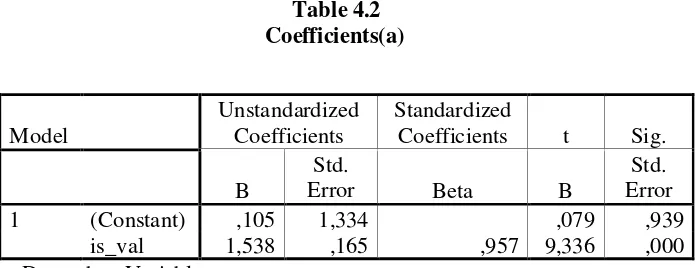
4.1 Coefficient Determination …. ... 46
14 List of Appendix
15 CHAPTER I
INTRODUCTION A. Background of Study
Islamic banking is a worldwide phenomenon involving a variety of
institutions instruments rather than one “project” or institution (Timberg,
2000: 2). In Indonesia, the development of Islamic bank is a phenomenon and
has a significant role in the economy. According to Alfi wijaya, the head of
research and management project division in Karim Business Consultant,
Islamic Bank shows quick development from year to year although it is new in the banking business and year of 2008 is predicted as a successful Islamic
bank development year in Indonesia.
The fast development of islamic bank in indonesia has begun since the
legalize UU no 10 1998. This recognizes the practice explains the law and
kind of business that can be operated and implemented by islamic bank.
Beside that, this UU gives a direction for conventional banks to provide
shari’ah bankin services by establishing an independent islamic branch.
This opportunity has been responsed with high antusiasm by the banking
community in Indonesia. It can be seen from the establishment of shari’ah
bank that is a convertion from conventional bank such as Bank Syariah
Mandiri (convertion from Bank Susila Bakti), and the establishment of conventinal bank that has Shari’ah Business Unit such as Bank Bukopin, Bank
16 development of Shari’ah Bank is supported by the addition of office
channeling of Shari’ah Bank and Shari’ah Business Unit (Antonio, 2005:25). Islamic Bank is a business unit that is focus in finance to mobilize society
fund and give services to other banks based on islamic principle (shari’ah)
from Al-Qur’an and Al-Hadist. Shari’ah is concerned with promoting justice and welfare in society (Al-adl and Al-ihsan) and seeking God’s blessings (Barakah), with the ultimate aim of achieving success in this world and
hereafter (Al-falah) (Haniffa and Hudaib, 2007:99). This statement is
supported by Alwosabi who says that the purpose of Shari’ah is to promote and protect the interest of individuals and societies by bringing benefits and
preventing harm in relation to their necessities, needs and wants.
The differential principle and operation between Islamic bank and conventional bank gives a difference implication in the accounting principles on both disclosure and reporting. While conventional financial institution follows the accounting standards of the International Accounting Standards,
American Financial accounting Standards, and British Accounting Practices,
the AAOIFI was created in 1990 to design and disseminate accounting and
auditing standards that can be applied internationally by all Islamic
institutions.
According to AAOIFI (2004: 65) the financial statement should disclose
all material information that is necessary to make those financial statements
17
objective of corporate reporting is to allow Islamic enterprises to show their compliance with Shari’ah (Baydoun and Willett, 1997: 6).
According to Farook and Lanis (2005: 356) the social role of Islamic
Banks that entails social justice and accountability, requiring the banks to
disclose corporate social responsibility (CSR) information. It is appropriate with shari’ah principle that business transactions can never be separated from
the moral objectives of society. According to Farook and Lanis (2005: 356) a
number of scholars have developed a normative standard for reporting and
indeed social reporting for Islamic businesses based on Islamic principles
(Haniffa 2001; Maali et al, 2003). Governments in Muslim populated
countries such as Malaysia and AAOIFI have also voiced their support for the
development and adoption of such CSR reporting standards encouraged and
propagated by Islam (Sharani and Yunus, 2004).
The objective of this study is to measure the annual report social
disclosure levels of Islamic banks based on a benchmark derived from Islamic
principles. Second objective is to know whether there is an influence of
Islamic value to social reporting in Islamic bank. This study will discuss the
role of Islamic bank and the Islamic value that imply in Islamic bank. Besides
that, this study will explain the disclosure from the Islamic perspective. The
scope of this study is Bank Muamalat and Bank Syariah Mandiri. These two
18 B. Problem identification
In this research, the writer identify main problem that are:
1. How the social disclosure and reporting in Islamic Bank is?
2. Does Islamic value influence social reporting of Islamic Bank?
C. Study objective and Benefit
Based on the problem identification, it is expected:
1. Study objective
a. To analyze the social disclosure and reporting in Islamic Bank.
b. To analyze the influence of Islamic value to social reporting.
2. Benefit
a. For Shari’ah bank, this study can be a reference whether
Shari’ah bank is compliance with Shari’ah and the Islamic
value has been applied in social reporting.
b. For community, this study gives the information that is related
to Islamic value in bank and its impact.
c. For Islamic Economic development, this study is expected to
19 CHAPTER II
THEORETICAL FRAMEWORK A. Islamic Bank
Islamic Banking act (2008):
“Islamic banking business means banking business whose aims and operations
do not involve any element which is not approved by the Religion of Islam.”
While Ariff (2007:3) defines Islamic bank as an institution that deals in money and its substitutes and provides other financial services. Banks accept
deposits, make loans, derive a profit from the difference in the profits-shares,
and fee incomes that are consistent with the Shari’ah common law principles
governing such a bank. According to Haniffa and Hudaib (2007: 99) Islamic banking refers to a system of banking which is consistent with the principles of Islamic law. Shari’ah bank is one of national banking which operates according to shari’ah principle. Shari’ah prohibits transaction involving
interest (riba), uncertainty (gharar), and unlawful (haram) and it requires muslim to pay zakah. Riba refers to the addition in the amount of the principal of a loan. The prohibition of interest means that Islamic banks cannot incur or
earn interest in any of their financial transactions. Beside that, riba is
prohibiting in Islam because it’s established injustice and exploitation in
economic system. Sulaiman (2003: 6) argue that the moral motive behind the
prohibition of interest is based on the principle of not exploiting the poor and
the needy through charging interest on loans extended to them. According to
20 welfare in society (Al-adl and Al-ihsan) and seeking God’s blessings (Barakah), with the ultimate aim of achieving success in this world and hereafter (Al-falah). It describes that the purpose of Shari’ah is to promote and protect the interest of individuals and societies by bringing benefits and
preventing harm in relation to their necessities needs and wants.
Consequently, the various financial instruments develop by Islamic bank
base on two principles: the profit-and-loss sharing principle and the mark-up
principle (Aggarwal and Yousef, 2000: 95). According to Haniffa and Hudaib
(2007: 100) Financing instruments based on the former principle include
mudharabah (venture capital) and musharakah (partnership arrangement); While instruments based on the latter include murabahah (resale with stated profit), bay’al-salam (forward sale contract), ijarah and ijarah wa iqtina (operating and financial lease) ;
1. Mudharabah is a form of partnership where one party provides the
funds and the other provides the expertise and management.
Mudharabah is based on profit sharing.
2. Musharakah is involving places capital with another person and both
sharing the risk and reward. Musharakah is based on profit and loss
sharing.
3. Murabaha is a contract of sale between a buyer and a seller in which a
seller purchases the goods needed by a buyer and sells the goods to the
buyer on a cost-plus basis. Both the profit and the time of repayment
21 4. Salam is a sale of goods where the price is paid in advance and the
goods are delivered in the future.
5. Istisna’ is a contract for manufacturing (or construction) whereby the
manufacturer (seller) agrees to provide the buyer with goods identified
by description after they have been manufactured or constructed in
conformity with that description within a pre-determined time-frame
and price.
6. Ijara (operating lease) is a form of leasing. It involves a contract where
the bank buys and then leases an item. The duration of the lease, as
well as the basis for rental, are set and agreed in advance
7. Ijarawa- igtina (lease with optional ownership) is another form of Ijara,
except that included in the contract is a promise from the customer to
buy the equipment at the end of the lease period, at a pre-agreed price. B. Islamic Value
According to Chapra (1992: 200) Islamic worldview is based on three
fundamental principles: Tawhid (unity), khilafah (vicegerency, free will & responsibility), and Adalah (justice, equilibrium). Haniffa and Hudaib (2004: 7) argue that there is some important concepts in understanding Islamic
22 1. Tawhid (Unity)
According to Naqvi (1992: 15) unity is a concept where the political, economic, social and religious aspects of an individual's life
are integrated into a homogeneous whole, consistent from within the
individual himself as well as integrated with the vast Universe. The
doctrine of Unity preserves the absolute monotheism of Islam where
God's sovereignty is recognized. This dominates Islamic belief and
practices and consequently affects how Muslims view religion. The
concept of Unity is Tawhid.
Tawhid is the highest principle of Islam. Tawhid is the basis on which the Islamic worldview and strategy are founded. Sulaiman
(2005:3) defines Tawhid as the Unity of God and the belief that the universe is consciously designed and created by God and do not come into existence by chance or accident. Tawhid is the highest principle of Islam. The belief in Tawhid or the oneness of god constitutes the most important principle of an Islamic society. In simple terms, it expresses
the conviction that there is only one source of power that is worthy of
worship and reverence. It also constitutes the basis of all other
principles of the faith. Tawhid is held to arm the faithful against the worship of false gods, such as other men, nations, money or ideas
(Nomani and Rahnema, 1994: 34).
23 of resource mobilization, production and their financing in ways that
bring about complementary linkages between the Shari’ah determined possibilities. The external meaning of Tawhid is now explained in terms of an increasingly relational, participatory and complementary
developmental order wherein possibilities unify among themselves
(Choudhury and Hussain, 2005: 204). According to Nomani and
Rahnema (1994: 35) the traditional and formalistic Islamic man,
concerned only with private Islamic junctions, has to experience three
different forms of liberation before he can transform into an
unalienated social being armed with an Islamic mission that gives
meaning and directions to his life.
First, man has to emancipate himself from all his inner instinctual
sources of temptation. Self-purification or tazkiyah cleanses the individual from attachment to the pleasures of wealth, power, fame and
the sense. This individual and psychological aspect of Tawhid compels the new Islamic want to liberate his oppressed inner self, attaining a
mystical spirit of total freedom and emancipation.
Second, at social level, Tawhid requires the new Islamic man to reject all submission and subservience to other men. In the economic
realm, Tawhid is interpreted as a call to abolish the exploitation of the weak by the strong, for the eradication of feudalism, capitalism, or
24 Third, at the cultural level, Tawhid engages the new Islamic man in a constant struggle against cultural imperialism and blind allegiance to all the fads, fashions and forms of artistic and individual expression
that originate in the west.
2. Khilafah (vicegerency, free will & responsibility)
The concept of Khilafah (vicegerency) defines a person's status and role, specifying the individual's responsibilities to himself and his
responsibility to the ummah. Chapra (1992: 203) suggests four
implications emanating from the concept of khilafah:
The first is universal brotherhood where mutual sacrifice and
cooperation are the social order. Such a social order allows the
development of the entire human potential. Accordingly, from the
perspective of business enterprises, competition is encouraged if it is healthy, raises efficiency, and helps promote the well-being of
society. Competition that results in jealousy, ruthlessness and
destruction must be avoided.
The second implication of khilafah is that the individual is regarded as the trustee for God's resources. This leads to a totally
different meaning to private ownership as understood in the secular
world. Although private ownership is recognized in Islam, ownership
is not absolute. The property owner recognizes his responsibility of
using his resources in a manner that will provide benefits not only to
25 The third implication of khilafah is the emphasis on a humble lifestyle. A lifestyle of extravagance may result in unnecessary pressure on resources which, in turn, may lead to the
inability to satisfy the basic needs of society.
Finally, khilafah also implies the concept of human freedom in Islam. An individual's freedom to act is not curtailed by any other
individual but is constrained by the bonds of social responsibility.
Hence there is a qualification as to what individual freedom entails in
Islam. Unlimited freedom goes hand in hand with unlimited
responsibilities. Consequently, it is inconceivable that anyone would
want unlimited freedom.
3. Al Adl (justice, equilibrium)
Al Adl or justice is a combination of moral and social values denoting fairness, balance, temperance and straightforwardness. There
are three basic criteria for the attainment of social justice:
absolute freedom of conscience, complete equality of all men and
the permanent mutual responsibility of society and individuals. It
follows that if the social behavior pattern and the economy of
Islamic societies are strictly in accordance with Islamic teachings,
there cannot exist extreme inequalities of income and wealth. In
Economics term Al Adl means the profit not only for individual that
can harm people but to society (Karim, 2007: 50). However, Islam
26 efforts, as well as risk. Injustice and Islam are at variance with each
other and cannot coexist without either of the two being uprooted or weakened. Chapra (1992: 210) gives an important framework that
must be discussed:
a. Need Fulfillment
The logical fulfillment of brotherhood and the trust nature of
resources is that these resources must be utilized to satisfy the
basic needs of all individuals and to assure everyone a standard of
living that is compassionate and respectable, and in harmony with the dignity of man inherent in his being the khalifah of God. Since
resources are relatively limited, this goal cannot be actualized
unless claims on the available resources are made only within the
limited of humanity and general well-being. Need fulfillment must
be within the framework of simple-living and, while it should
include comforts, it cannot take the dimension of waste and
snobbery which have been prohibited by Islam but which have
nevertheless become uncontrolled in Muslim countries.
This stress on need fulfillment in Islam received an important
place in the fiqh and other Islamic literature throughout Muslim
history. The jurists have unanimously held the view that it is the
collective duty (fard kifayah) of Muslim society to take care the
27 b. Respectable source of earning
The dignity attached to the status of khalifah implies that need
fulfillment must be through the individual’s own effort;
accordingly, the jurists have emphasized the personal obligation of
every Muslim to earn a living to support himself and his family. Since a Muslim may not be able to fulfill the duty of earning an
honest living unless opportunities are available for
self-employment or unself-employment, it may be inferred that it is the
collective obligation of a Muslim society to ensure for everyone an
equal opportunity to earn an honest living in keeping with his
ability and effort.
Only when these are unable to fulfill their collective
obligation, should the state enter into the picture. This will impose
a smaller economic burden on the Islamic state. The ultimate
objective of all help should be to enable those so helped to stand
their own feet through an increase in their ability to earn more. But
until this becomes a reality, the help must also include income
supplements. Islam has a built-in institutional arrangement to get
the necessary wherewithal for this purpose through the obligatory
28 c. Equitable Distribution of income and wealth
In spite of need fulfillment, there can be extreme inequalities
of income and wealth. Inequalities can be admitted in a Muslim
society primarily insofar as they are more or less in proportion to
skill, initiatives, effort and risk. These are bound to be normally distributed in a society where Islamic teachings are sincerely
followed. Hence Islam not only requires the fulfillment of
everyone’s needs, primarily through a respectable source of
earning, but also emphasizes an equitable distribution of income
and wealth.
The Islamic stress on equitable distribution has been so intense
that there is some Muslims who have held the opinion that equality
of wealth is essential in a Muslim society. It is the general opinion
of Muslim scholars that if the social behavior pattern and the
economy are restructured in accordance with Islamic teachings,
there cannot be extreme inequalities of income and wealth in a
Muslim society.
d. Growth and sustainability
It may not be possible for the Muslim ummah to realize the objectives of need fulfillment and a high level of self-employment
29 rate of economic of growth. Even the goal of equitable distribution
of income and wealth will be realized faster and with smaller sacrifice on the part of the well-to-do if a higher rate of growth is
attained and the poor are enabled to obtain a proportionately larger
share of the fruits of that growth. A better performance in terms of
economic stability will also help reduce the suffering and
inequities that recession, inflation and unpredictable movements in
prices exchange rates necessarily bring about.
4. Halal and haram, ummah, and maslahah
Shariah aspects of Islamic banking and finance revolve around
Shariah requirements. The purpose of the Shari’ah requirements is to ensure that the products are permissible (halal) and to ensure that the trading in them becomes permissible and valid (halal and sahih). According to Deraman Islamic banking products are based on and
developed from permissible (halal) contracts which do not involve gharar, maisir, and riba.
The concept of ummah (community) in Islam implies unity and harmony in social, economic and political affairs. In many Islamic
activists, the notion of ummah is an important and integral part of the
modern Muslim consciousness. While the concept is part of the
Qur’anic revelations, its meaning and usage has evolved with the
30 (2002: 4) Ummah can be viewed at least from two analytical
perspectives.
From the first perspective, the Ummah can be viewed as a
community. In sociology, community types of social organizations are
characterized by social homogeneity, and they are largely based on
primordial and organic ties and have a moral cohesion, often founded
on common religious sentiments. These types of social organizations
are transformed and dissolved by the growing social differentiation
caused by the increasingly complex division of labor, individualism
and modern capitalistic competitiveness, which gives rise to a society
based on associational types of relationships.
From the second perspective, the Ummah can be viewed as a
collective identity. Collective identity is grounded in the socialization process in human societies Individuals develop it by first identifying
with the values, goals and purposes of their society and by
internalizing them. This process, besides constructing the individual
identity, also constructs the collective identity.
As such, Islam gives preference to the needs of the ummah over those of the individuals. Whenever conflict of interest arises, the
needs of the ummah must be met first (maslahah). Therefore,
economic goals must be pursued for the betterment of the ummah.
Haniffa argues (2004: 9) by adhering to Shari’ah Islami’iah, mankind
31 al-haraj), prevention of the forbidden (Daf al-darar) and striving for the
truth (Haqiqiyah) before pursuing self-interest. Such promotion of equality and virtues in society would guarantee the achievement of A l-adl (justice) and Al-falah.
C. Social Reporting: In Islamic Perspective
1. Corporate Social Responsibility
According to Kotler and Lee (2005: 15) Corporate Social Reporting is a commitment to improve community well being through business practices and contributions of corporate resources. Ararat and
Göceno lu (2006: 2) define CSR as institutionalized corporate practices and behavior drives by the acceptance of moral obligation
and accountability for the consequences of corporate activity for all of
the stakeholders and society at large. In the other side, Emily (2008: 3) defines CSR is a voluntary form of regulation over the potentially negative impacts of business activities on society and the natural
environment. According to Al Khater and Naser (2003: 539)
Corporate Social Responsibility is a responsibility of actions which do not have purely financial implications and which are demanded of an
organization under some (implicit and explicit) identifiable contract. In
general term, Corporate Social Responsibility is a voluntary commitment undertaken by a company (or a public institution) to
contribute to the improvement of the environment and society. Thus,
32 aligned with the priorities of sustainable development. It stated in the
UU no 40 2007 about CSR and environment is a company commitment in the economic development (Anshori, 2008: 30).
2. Social Reporting
Social Accountability is the responsibility to account for actions for which one has under an established contract. In the former context,
responsibility must be clearly defined to satisfactorily discharge
accountability arising from that responsibility (Sulaiman and Willet,
2002: 23).
Gray et al (1987: 9) define corporate social disclosure as the process of communicating the social and environmental effects of
organization’s economic actions to particular interest groups within
society and to society at large. At such, it involves extending the accountability of organizations (particularly companies), beyond the
traditional role of providing a financial account to the owners of
capital, in particular, shareholders. Such an extension is predicated
upon the assumption that companies do have wider responsibilities
than simply to take money for their shareholders.
In Islamic perspective, Haniffa and Hudaib (2004: 18) define
disclosure as disclosing information that would aid economic as well as religious decision-making. It means disclosing any information
deemed relevant and should be rightfully given to members of the
33 According to the definition above, it can be concluded that social disclosure is disclosing information concerning the impact of an entity and its activities on society.
Voluntary social reporting is highly valuable exercises for a variety of reasons, not the least of which is its usefulness for experimentation purposes (Gray, 2001: 13). Al-khater and Naser (2003: 540) argue that Corporate Social Responsibility reporting is important to various users of corporate information such as employees,
consumers, local community, and government and its agencies, and
pressure groups and society at large. According to Haniffa and Hudaib
(2004: 17) the purpose of social information is to determine and
communicate to relevant user groups the social impact of business
activities. Besides that, it has a function to determine the effects corporate actions have on the quality of life of society and hence the
emphasis on accountability. As it is generally understood in
non-Islamic accounting, the primary objective of social responsibility
accounting may be similar to Islamic accounting but it should have a
wider focus. Haniffa (2002:141) argues the objectives of social
responsibility and accountability are addressed in both instances but
the underlying principle is different. The concept of accountability in
islam is different as it extends beyond human superiors to God, as
34 Table 2.1
Objectives and ethical statements of Islamic social reports
Objectives:
1. To demonstrate accountability to God and community 2. To increase transparency of business activities by providing
relevant information in conformance to the spiritual needs of Muslims decision makers
Ethical statements: To demonstrate accountability
1. To Strive to provide excellent lawful products/ service as trustee of God
2. To fulfill obligations to God and society
3. To create reasonable profits in conformance with Islamic principles
4. To attain the objectives of the business venture
5. To be just with employees and communities
6. To ensure that business activities are ecologically sustainable 7. To recognize work as form of
workship To demonstrate
transparency
1. To provide information regarding all lawful and lawful activities undertaken
2. To provide relevant information regarding financing and
investment policy
3. To provide relevant information regarding employees policy 4. To provide relevant information
regarding relationships with communities
5. To provide relevant information regarding the use of resources and protection of the
environment
35 3. Scope of disclosure
Haniffa (2007: 101) gives a benchmark of ideal ethical identity based on the Islamic precepts follows that is focus on developmental
and social goals:
Islamic Bank is expected to be more socially responsible than their
conventional counterparts, as Islam emphasizes social justice. One of
the indicators is their contribution to and management of Zakah (religious levy), Saddaqa (charity) and Qard Hassan (benevolent loans) funds. Zakah is one of the five pillars of the Islamic faith and the spending of the proceeds and the beneficiaries are specified in the
Qur’an. However, there have been mixed opinions as to which party is
liable for Zakah: banks or individuals (i.e. shareholders and
depositors). Regardless of who is liable, what is more important is for the Islamic Bank to communicate the following details:
a. A statement showing the sources and the uses of the Zakah fund.
b. The balance of the Zakah fund not yet distributed, and the reasons
for the delay in distribution, if the amount is material.
c. An attestation by the Shari’ah Supervisory Board (either in the
report of the Board or separately) that the amount of Zakah has
been properly computed and these funds have been distributed
36 Unlike Zakah, which is obligatory, Saddaqa (charity) is voluntary in nature and can be used for purposes allowed by Shari’ah for the benefit of society. Hence, Islamic Bank should communicate:
a. The amount and the sources and uses of charity funds, separate
from the Zakah funds.
Public duties in Islam are seen as a part of the general meritorious and
ethical tendency of the faith. The concepts of Ummah, Amanah and Adl stress on the importance of sharing a common goal and removal of hardship in society and this could be achieved via Saddaqa ( charities), Waqf ( trusts) and Qard Hassan ( lending with no profit). As such, Islamic Bank should ideally communicate the following in their annual
reports:
a. The amount and the sources and uses of such funds;
b. The banks’ policies in providing such funds and how
non-repayment of such funds will be dealt with.
Matters on employees should also be given due attention as they are
related to the ethical concept of Amanah and Adl. Employees are the greatest asset of the business and their welfare should be given due
attention. It is the responsibility of employers to ensure that employees
are paid fair wages, not overworked and have the opportunity to fulfill
their spiritual obligations. Equal opportunity is also stressed in Islam.
Hence, the following should be communicated in the annual report:
37 b. Training and development (especially on Shari’ah awareness),
amount spent on training, provision of special training or recruitment schemes.
c. Equal opportunity
d. Reward to employees.
Debtors receive special attention in Islam. Lenders are asked to be
lenient with their debtors and in certain circumstances, debtors are
entitled to receive Zakah and debts should be written off as charity. As
such, Islamic Bank is expected to demonstrate and communicate such
commitments in their annual reports:
a. Debt policy and type of debt
b. Amount of debts written off.
Public duties in Islam are seen as a part of the general meritorious and ethical tendency of the faith. The circumstantial needs of the
community within which the Islamic Bank operate should first be
catered to. Hence, Islamic Bank should ideally communicate the
following to indicate their commitments to society:
a. Creating job opportunities;
b. Supporting organizations that benefit society and participating in
government social activities;
38 D. Benchmark for Social Disclosures by Islamic Banks
Maali et al (2006: 272) assert that Fundamental to an Islamic perspective on social reporting is an understanding of the concepts of accountability, social justice and ownership that are central to social relations.
1. Accountability
Al-Khater and Naser (2003: 540) define accountability as the relationship between two parties, the accounter and the accountee, when the latter is accountable to the former for his/her activities and the consequences.
Gray (2001: 11) defines accountability as identifying what one is responsible for and then providing information about that responsibility to those who have rights to that information.
Al-Khater and Naser (2003: 540) refer to three basic elements of the accountability concepts.
a. The accountee has an obligation to provide the accounter detailed information.
b. The responsibilities of those who are held accountable for their action and the consequences must be spelled out clearly.
c. Stating accounts of action and related consequences will be used by the accounter as a yardstick to assess the accountee. This is expected to have implications for his/her decisions.
Yet accountability also has broader economic and social purposes,
39 politics, religious and social affairs, especially accounting, fall under
the jurisdiction of the divine law of Islam, the Shari’ah (Lewis, 2006:2)
The Islamic view of accountability creates different objectives for
accounting and reporting. Napier (2007: 10) divides the Islamic view
of accountability based on two main themes. The first of these is the
concept of Tawhid. Baydoun and Willett (1997: 6) argue that the concept of the unity of God gives rise to a different and broader concept of accountability than that implied by Western models
In the Islamic framework, all people are accountable to God on the
Day of Judgment for their actions during their lives. The second main
theme is the concept of ownership in Islam. God has appointed man
his vice-regent (Khalifa) on earth and entrusted him with stewardship of God’s possessions. This does not imply that Islam does not
recognize private ownership. Everyone has the right to own property,
but the ownership is not absolute. (Napier, 2007: 10).
In a business enterprise, both management and the providers of
capital are accountable for their actions both within and outside their
firm. Accountability in this context means accountability to the
community (Ummah) or society at large (Lewis, 2006:2).
2. Social Responsibility and Justice
Individuals are expected to feel socially responsible for others in
40 to allow people to earn their living in a fair and profitable way without
exploitation of others, so that the whole society may benefit. Islam also emphasizes the welfare of the community over individual rights
(Lewis, 2006:4).
Responsibility sets limits to what man is free to do by making him
responsible for what he does and as such. In Islam, there should be no
contradiction between individual freedom and collective freedom. The
difference between the two is bridged by the sense of social
consciousness and Responsibility (Sulaiman, 2005: 7).
Islam stresses the concept of social responsibility. The term ‘brotherhood’ (Akhowa) is widely used in Islamic societies. In this context, justice refers to being fair with everyone (Maali et al, 2006: 272). Justice in Islam also includes the equitable distribution of wealth. The prohibition of Riba (Usury), Infaq, the requirement to pay Zakah
and the provision of Qard Hassan (interest-free loans) are clear examples of the Islamic emphasis on social justice (Maali et al, 2006: 272). Infaq emphasizes benevolence by voluntarily spending one’s wealth on the poor and the needy, while the various institutions are
considered as formal obligations for all Muslims. The most
important institution for the equitable distribution of wealth is the alms
tax (Zakah). It is one of the pillars of Islam that requires each Muslim to pay a fixed minimum percentage over his or her wealth, property as
41
requirement to deal justly encompasses all dealings with employees, customers and all members of the society in which these businesses operate (Maali et al, 2006: 272).
3. Ownership and Trust
Islam perceives ownership as a trust (Amanah). There is no an absolute ownership for human beings, rather it is relative. A part of
one’s assets is a right of other people (Triyuwono, 2004: 4).
In Muslim trade, the concept of Amanah (trust) is significant. Amanah comes very close to the concept of fiduciary responsibility and stewardship function (Malik et al, 1999: 4). This trustee-ownership principle implies that ownership should be exercised for the benefit of society as well as for the benefit of the owner (Maali et al, 2006: 272).
God’s commandments and the benefits of society should be given priority when dealing with properties. The owner is responsible for using the available resources according to the will of God and to the benefit of society.
According to Maali et al (2006: 16) there are three broad objectives that can be set as the bases for identifying the social disclosures of
Islamic business enterprises:
1. To show compliance with Islamic principles, in particular dealing
justly with different parties.
2. To show how the operations of the business have affected the
42 3. To help Muslims to perform their religious duties.
Such objectives will now be used as the basis for proposing a benchmark for social reporting by Islamic banks.
Maali et al (2006: 16) set out the number of items that should be disclosed in islamic banks’ annual reports.
1. Disclosure of Shari’ah Supervisory Board opinion
One distinct feature of the modern Islamic banking movement
is the role of the Shari’ah board, which forms an integral part of an
Islamic bank. A Shari’ah board monitors the workings of the
Islamic bank and every new transaction that is doubtful from a
Shari’ah standpoint has to be cleared by it. Therefore, the first
measure that an institution is in compliant with Shari’ah is to
appoint a Shari'ah Supervisory Board (SSB) or Shari'ah Supervisory Committee (SSC).These boards include some of the
most respected contemporary scholars of Shari’ah and the opinions
of these boards are expressed in the form of fatwas. The users of
Islamic banks’ annual reports will interest in the report of the
Shari’ah Supervisory Board because it shows whether the bank has
complied with Islamic principles or not and whether it has dealt
justly with different parties.
2. Unlawful transactions
Islamic banks should not enter into any transaction that
43 uncertainty in contracts example entering into a transaction whose
consequence is out of usual trade norms. Hence, any contract base on a future uncertain event such as hedging, dealing in derivatives,
etc, within Islamic banking, is not generally allowable. Where a
bank is entered into transactions that are inconsistent with Shari’ah
principles, and hence regarded as unlawful (Haram) by Islam, the
duty of accountability to God and society implies that information
about these transactions should be disclosed to the community. It
considers that the bank should disclose the following:
a. The nature of these transactions
b. The reasons for undertaking such transactions
c. The opinion of the Shari’ah Supervisory Board regarding the
necessity of undertaking such activities
d. The amount of revenue (expenses) earned (paid) in such
transactions
e. How the bank disposed, or intends to dispose, of such revenues
f. Disclosing such items would help the Islamic community in
assessing whether the bank has violated Islamic principles and
the reasons for such violation. In addition, disclosure will help
in assessing the materiality of such prohibited transactions, and
hence the magnitude of the impact on the well-being of the
44 3. Zakah
Zakah is a tax that every Muslim, whose wealth exceeds a certain nisab (minimum amount), has to pay. The Shari'ah specifies
that only individuals are liable for zakah. It is the individual
owners who are responsible for determining the amount that should
be paid out as zakah (Gambling and Karim, 1991:103).
Islamic banks may be required by law to pay zakah or the
shareholders and/or the depositors may require a bank to pay zakah
on their behalf. For those banks that are required by law or their
shareholders to pay zakah, Islamic Bank should ideally
communicate the following in their annual reports:
a. A statement showing the sources and the uses of the zakah
fund. This statement will show from which sources the funds were collected (shareholders, depositors, others) and to which
uses they have been applied. It is important to provide detailed
disclosures of such uses to assure readers of annual reports that
these funds is used according to God’s will.
b. The balance of the zakah fund not yet distributed, and the
reasons for the delay in distribution, if the amount is material.
c. An attestation by the Shari’ah Supervisory Board (either in the
report of the Board or separately) that the amount of zakah is
properly computed and these funds are distributed according to
45 4. Qard Hassan
Qard Hassan is a non-profit bearing financing intended to allow the borrower to use the loaned funds for a period of time with the understanding that the same amount of the loaned funds will be repaid at the end of the Qard period (Haniffa and Hudaib, 2004: 25). Qard Hassan is a sort of loan which does not require borrowers to pay interest or even someparts of profits earned from
their businesses, except repaying the principal loan to the banks
(Triyuwono, 2004: 9).
Providing Qard Hassan (benevolent or interest-free loans)
for socially beneficial causes is an important social contribution
that Islamic Bank may make, especially to the local community in
which they operate. As such, Islamic bank should ideally communicate the following in their annual reports:
a. The sources from which such loans are financed: these sources
may include the bank own funds and depositors’ funds. Users
need to know whether the bank finances such activity from its
own resources or from the depositors’ resources, and whether
or not the bank operates a formal scheme whereby depositors
may designate funds to be used for Qard Hassan.
b. The amount advanced to beneficiaries during the year, and the
purposes for which these loans were given.
46 d. Its policy for dealing with those who are unable to repay their
loans.
5. Charity and other social activities
In addition to Qard Hassan, Islamic banks should engage in
other social activities, such as making charitable donations
(charity) is voluntary in nature and can be used for purposes
allowed by Shari’ah for the benefit of society (Haniffa and Hudaib, 2004: 25). It is not obligatory but strongly recommended Islamic banks, which usually control large funds, are expected to
participate in providing such charitable donations. Islamic society
and the stakeholders of the bank should know about the bank’s
contribution to the well-being of society and whether the bank
fulfils society’s expectations regarding this issue. Rather, such activities should be genuine, and not undertaken for publicity
purposes. We therefore recommend that Islamic Bank should
disclose:
a. The nature of charitable and social activities financed by the
bank
b. The amount spends on these charitable and social activities.
c. The sources of funds use for charity: the sources may include
the bank’s own funds and revenues from sources prohibited by
Shari’ah
47 Other revealing indicators of an organization’s ethical stand
from an Islamic perspective are the ways it treats its employees and debtors as well as its commitments to society. Employees are the
greatest asset of the business and their welfare should be given due
attention.
The Islamic community needs to know if the bank deals
justly with its employees: exploitation and discrimination are not
acceptable, as these are strictly prohibited by the Qur’an and
Sunah. In addition, education and training are important as Islam
encourages the search for knowledge. So, the bank must disclose:
a. Payments of wages and bonuses.
b. Education and training for employees.
c. Equal opportunities. d. The working environment.
7. Late repayments and insolvent clients
Islamic banks, when utilizing mark-up financing
arrangements such as Murabaha and Ijara, may face situations in
which clients are unable to pay amounts when they fall due.
It will expect users to be interested in how the bank deals
with insolvent clients, and whether the bank deals with them in an
ethical way, consistent with Islamic principles. Therefore, it
considers that the Islamic bank should disclose:
48 b. The amounts charged as late penalties, if any.
c. The opinion of the Shari’ah Supervisory Board regarding whether charging penalties is permissible.
d. How the bank deals with such penalties (allocation to charity or
revenue).
8. The environment
Destruction or damage of the physical environment, if it is
considered harmful to an individual or community, is prohibited in
Islam. As Haniffa (2001:18) observes that there are about 500
verses in the Qur’an giving guidance on matters related to the
environment and how to deal with it, which indicates the
importance of taking care of the environment.
Banking is unlikely to cause direct harm to the environment in the way that the oil and nuclear industries might, but Islamic
Bank is not expected to finance activities that lead to harming the
environment, because such projects will harm the Islamic society.
In addition Islamic Bank is able to provide donations to help
preserve the environment. Users will require assurance that the
activities of Islamic Bank affect positively the wellbeing of the
Islamic society. Therefore it is expected that Islamic Bank report
on the following issues:
a. The amount and nature of any donations or activities
49 b. Disclosures indicating whether the bank has financed any
projects that may lead to harming the environment. 9. Other community involvement aspects
In addition to their zakah and charitable activities, Islamic
Bank is expected to undertake other activities which enhance the
well-being of the Islamic community in which the Islamic Bank is
allowed to operate and make profits. Thus, Islamic Bank should
respect the requirements of their community. Because of this,
Islamic Bank should give priority in their investments to those areas
that help in solving the problems of the society, even if this will
lead the Islamic Bank to sacrifice some of their profits. Thus, it is
expected that Islamic Bank will disclose its role in:
a. Enhancing economic development in the communities in which it operates.
b. Solving the social problems (such as housing and literacy) of the
50 CHAPTER III
RESEARCH METODOLOGY A. Scope of Research
Scope of this research is on social reporting in annual report of
Islamic bank. Using Haniffa and Maali et all benchmark, this research will
evaluate annual report of Islamic bank to determine the item that is
disclosed by Islamic bank.
B. Sampling Method
Sample that will be collected in this study is annual report of bank period of year 2003-2007 (Syariah Mandiri Bank and Muamalat Bank).
The reason of using that period is based on the effective of accounting
standard in Indonesia (PSAK no 59) which is on January 1, 2003. After
the effective of PSAK in year 2003, Shari’ah Bank in Indonesia has its own accounting standard in disclose their operation.
C. Data Collection Method
Process data collection will be done by collecting the annual report of
bank period of year 2003-2007. Data collection is obtained from the
website of both banks. In order to gain information that will support this
research, hence technique data distribution is library research. This
research is used in order to collect data from present literature, past
research and other information that related to the topic of this research.
The type of data that will be collected and used in this research is
51 related or relevant to the variable of the research (books, journals, articles,
internet and other media information). D. Data Analysis Method
This research uses analysis variance (ANOVA). According to
Faraway (2002: 169) ANOVA is a hypothesis-testing procedure that is used to evaluate mean differences between two or more treatments (or
populations). ANOVA is used because its original thinking is trying to
partition the overall variance in the response to that due to each of the
factors and the error. In ANOVA independent variable is called a factor. In
this research the independent variable is one, therefore this research uses
one-way ANOVA.
The result of one-way ANOVA test gets F test result. F-test is any statistical test in which the test statistic has an F-distribution if the null hypothesis is true. The F distribution has two degrees of freedom, d1 for
the numerator, d2 for the denominator. For each combination of these
degrees of freedom there is a different F distribution. Test of ANOVA will
indicate the influence of independent variable toward dependent variable if
the computed value is larger than the critical value.
The variables in this research are measured using dummy variables since most of the variables are qualitative in nature. According to Amran
and Devi (2004: 21) dummy variables can be incorporated in the
52 that a regression model may contain variables that are all exclusively
dummy, or qualitative in nature.
To know the influence of Islamic value towards social reporting,
this research uses linear regression model. Lind et al (2005: 440)
Regression equation is an equation that expresses the linear relationship
between two variables.
General form of linear regression equation is
Y= a + bX + et
Where:
Y = Predicted value of the Y variable for a selected X value (social reporting)
a = Estimated value of where the regression line crosses the
Y- axis when X is zero.
b = Slope of the line, or average change in Y for each change of one unit in the dependent variable X.
X = Any value of the independent variable that is selected (Islamic value).
et = Error term
In this research, Islamic value is a dummy variable. In order to use
this variable using linear regression, it needs to know the quantifiable
variable to make researchable. This research use 1 for any Islamic value
had by Islamic bank and 0 for none.
53 H0: Islamic value not influence social reporting
HA: Islamic value influence social reporting
In order to calculate linear regression for this research uses
quantitative analysis. Quantitative analysis gives the information and
explanations on the coefficient determination and T-test to answer the
formulation of the problems;
1. Coefficient determination
Coefficient determination is the proportion of the total variation in the dependent variable Y that is explained, or accounted for by the
variation in the independent variable X. The coefficient determination
measures the strength of independent variable influence the dependent
variable. The value of coefficient determination is 0 and 1. The small
value of R2 means the limited ability of independent variable to explain dependent variable. Value of R2 that approaches to 1 means
independent variable almost gives all the information to predict
dependent variable.
2. T-test
T test is aimed to understand how big the influence each independent variables individually/ partially towards dependent
variable. According to Bhuono (2005:54) the result of this t-test is
from the output of SPSS by looking at the table of coefficients. The
score from t-test can be seen from p-value (in the sig column) in each
54 significant that has been determined, or t-test (in t column) larger than
t-table (counting from two tailed α = 5% df = n – k, k is a total
independent variable.
E. Operational Variable
In understanding the research, therefore it must be an understanding in
the variable of the research:
1. Independent Variable
The independent variable is Islamic value which follows the
benchmark of Haniffa (2002: 101). Haniffa benchmark considers in developmental goals that relate with Islamic value. The independent
variable is variable that will influence the other variable.
2. Dependent variable
Dependent Variable is variable that changes because of the
independent variable. The dependent variable is social reporting which
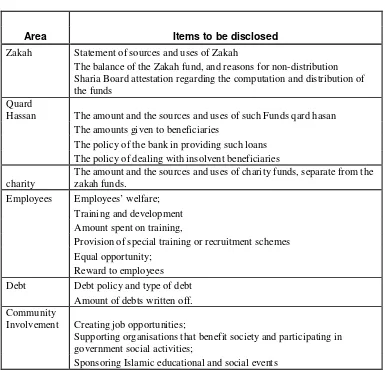
55 Table 3.1
Instrument of Independent Variable
Area Items to be disclosed
Zakah Statement of sources and uses of Zakah
The balance of the Zakah fund, and reasons for non-distribution
Sharia Board attestation regarding the computation and distribution of the funds
Quard
Hassan The amount and the sources and uses of such Funds qard hasan
The amounts given to beneficiaries
The policy of the bank in providing such loans
The policy of dealing with insolvent beneficiaries
charity
The amount and the sources and uses of charity funds, separate from the zakah funds.
Employees Employees’ welfare;
Training and development
Amount spent on training,
Provision of special training or recruitment schemes
Equal opportunity;
Reward to employees
Debt Debt policy and type of debt
Amount of debts written off.
Community
Involvement Creating job opportunities;
Supporting organisations that benefit society and participating in government social activities;
Sponsoring Islamic educational and social events
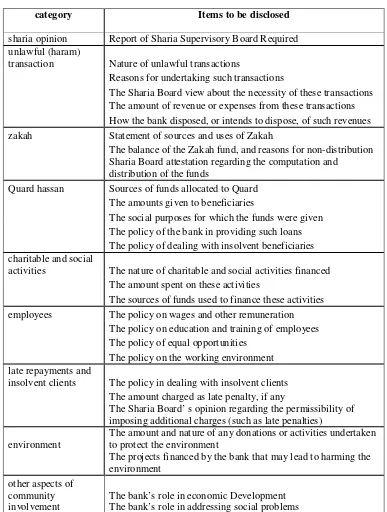
56 Table 4
Instrument of Dependent Variable
category Items to be disclosed
sharia opinion Report of Sharia Supervisory Board Required
unlawful (haram)
transaction Nature of unlawful transactions
Reasons for undertaking such transactions
The Sharia Board view about the necessity of these transactions
The amount of revenue or expenses from these transactions
How the bank disposed, or intends to dispose, of such revenues
zakah Statement of sources and uses of Zakah
The balance of the Zakah fund, and reasons for non-distribution
Sharia Board attestation regarding the computation and distribution of the funds
Quard hassan Sources of funds allocated to Quard
The amounts given to beneficiaries
The social purposes for which the funds were given
The policy of the bank in providing such loans
The policy of dealing with insolvent beneficiaries
charitable and social
activities The nature of charitable and social activities financed
The amount spent on these activities
The sources of funds used to finance these activities
employees The policy on wages and other remuneration
The policy on education and training of employees
The policy of equal opportunities
The policy on the working environment
late repayments and
insolvent clients The policy in dealing with insolvent clients
The amount charged as late penalty, if any
The Sharia B