FABRICATING PROCESS AND MECHANICAL PROPERTIES OF
ELASTOMERIC MOUNT
Mohd Noor Arib Rejab1, Roslan Abd Rahman1, a , Raja Ishak Raja Hamzah1,Jawaid Iqbal Inayat
Hussain2,Nazirah Ahmad3, Asyraf Ismail3,Azma Putra4
1Department of System Dynamic and Control, Faculty of Mechanical Engineering, Universiti
Teknologi Malaysia, 81310 Skudai, Johor, Malaysia.
2
Department of Mechanical Engineering, College of Engineering, Universiti Tenaga Nasional,
43009 Kajang, Selangor, Malaysia.
3Malaysian Rubber Board (MRB), Engineering & Product Design Unit, Technology & Engineering
Division, 47000 Sungai Buluh, Selangor, Malaysia.
4Faculti of Mechanical Engineering, Universiti Teknikal Malaysia Melaka, 76109 Durian Tunggal,
Melaka, Malaysia.
ABSTRACT
This paper presents the fabricating process of elastomeric mount and their mechanical properties results. Four types of rubber were used to fabricate elastomeric mounts. They are from types of natural rubber (SMR CV-60), synthetic rubber, ekoprena and pureprena. SMR CV-60 is conventional rubber normal grade products from natural rubber. Synthetic rubber is rubber products from petroleum. Ekoprena and pureprena are advance rubber products from natural rubber. Before fabricate elastomeric mount, the rubber compound is designed based on actual mount such as shear modulus, hardness and static stiffness. A few processes have done to make the elastomeric mount such preparation of raw materials, mixing and curing process. Cured compound rubber and elastomeric mount were tested in the laboratory in order to determine their mechanical properties such as hardness, tensile strength, compression set, static stiffness and dynamic stiffness. The results from static tests showed that elastomeric mount from SMR CV-60 rubber, ekoprena and pureprena closed to actual mount except elastomeric mount from synthetic rubber.
Keywords: Elastomeric mount, rubber compound and mechanical properties.
1. INTRODUCTION
To attenuate unwanted vibration from powertrain transfer to the body structure vehicle, the various isolator has been proposed and developed such as elastomeric mounts, hydraulic mounts, semi-active hydraulic mounts and active mounts. Elastomeric mount based on rubber has been used as isolator since 1930s, but hydraulic,
semi-active and active were mounting based on the combination of rubber, fluid and electronic started during the early 1970s. Most vehicles use elastomeric mount as isolator to reduce vibration from powertrain to structure. This is due to the fact that, mounts based on the combination of rubber, fluid and electronic are more expensive, require higher maintenance and cause higher vehicle weight than elastomeric mount. In addition, properties of elastomeric mount including compactness, cost-effectiveness and low maintenance make it highly attractive for low price vehicle (Lee and Youn, 2004; Yu et al., 2001).
Most of the medium and small size passenger car use elastomeric mount as powertrain isolator because it is less expensive and allows the manufacturer to reduce the car price to cope with increasing demands of the market. In this paper, the fabricating process of elastomeric mount and their mechanical properties results are presented. The presentation began by designing rubber compound, followed by a few processes to form elastomeric mount, and finally presentation of mechanical properties results from elastomeric mount for four types of rubber.
2. METHODOLOGY
2.1 Designing Rubber Compound
Fig. 1 Actual elastomeric mount
Table 1 Dimension and mechanical properties of actual elastomeric mount. displacement and G is the shear modulus.
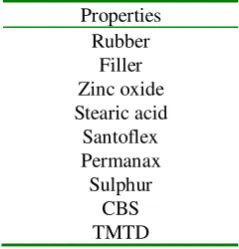
Rubber compound was designed based on parts per hundred (PPH). In this study, four types of rubber were used to form elastomeric mount. They are from types of natural rubber (SMR CV-60), synthetic rubber, ekoprena and pureprena. SMR CV-60 is conventional rubber normal grade products from natural rubber. Synthetic rubber is rubber products from petroleum. Ekoprena and
pureprena are advance rubber products of research and development by MRB to increase properties of natural rubber depended on conventional grade such as SMR CV-60. Ekoprena is commercial named for epoxidised natural rubber (ENR) which developed and commercial by MRB. It is a type of advance rubber, which is obtained from chemical changing through epoxidation of natural rubber latex. Pureprena is a new generation of deproteinized natural rubber (DPNR) which is produced by treating fresh natural latex with industrial enzyme, which hydrolyses all natural-occurring proteins in the latex into water-soluble forms. It contains about 96% rubber hydrocarbons compared to 93% in conventional grade such as SMR CV-60 (Mardec Berhad, 2012). Both ekoprena and pureprena are category as green material because their production using natural material, not as synthetic rubber, which products from petroleum based. The proposed development of ekoprena and pureprena is to produce natural rubber that have the same or overcome characteristic of synthetic rubber (Berita Getah, 2009). In this study, rubber compound were designed based on PPH which were added by a few of ingredient as follow in natural rubber engineering data sheet (EDS). The objective in this designing is to obtain the same static stiffness at the same load apply for all elastomer mounts after fabricated. In this study, the elastomeric mount is
Fig. 2 Elastomeric mount in the form of cylinder type and their dimensions
Table 2 Ingredients of rubber compound
2.2 Mixing Ingredients and Curing Rubber Compound
2.2.1 Mixing Ingredients. Internal Mixer method
was used to prepare masterbatch. The advantage using internal mixer is process is fast depending if using two roll mixer. However at the second state mixing, two roll mixers were used to mixing masterbatch, sulphur, CBS and TMTD. Figure 3, 4 and 5 show the ingredients preparation before mixing, internal mixer and two roll mixers.
Fig. 3 Ingredients preparation
Fig. 4. Internal mixer
Fig. 5 Two roll mixers
2.2.2 Curing Rubber Compound. Figure 6 shows the
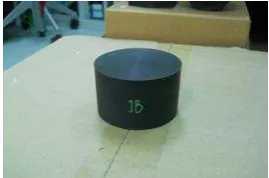
rubber compound after completed process using two roll mixers. Before curing rubber compound, two process need to be done to form elastomeric mount in form cylinder was shown in Figure 2. The first process was that rubber compound must determine it curing time. This curing time was determined by rheometer test. After curing time was determined, the rubber compound was cured in the form of piece proposed for hardness, tensile strength and compression set tests. The final processes were rubber compound were cured to form elastomeric mount in form cylinder. Figure 7, shows rubber compound were cured in the form of the piece, and Figure 8, shows elastomeric mount was cured of rubber compound.
Fig. 6 Rubber compound
Fig. 7 Cured rubber compound for hardness test
Fig. 8 Elastomeric mount
2.3 Mechanical Testing
Four type rubber compounds were cured in the form of hardness, tensile strength, compression set while elastomeric mount were tested to determine static stiffness and dynamic stiffness. Hardness, tensile strength, compression set were tested followed the standards ISO 48, ASTM D412 and ISO 815 respectively. Static stiffness and dynamic stiffness were tested followed the standard JIS K6385-1997.
3. Result and Discussion
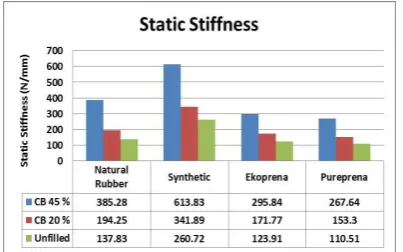
synthetic rubber. However to get the static stiffness from synthetic elastomeric mount close to actual elastomeric mount, carbon black need to be reduced by 10% from original contain and it maybe more or less depend on applied load.
Fig. 9 Graph static stiffness for four types of elastomeric mounts
CONCLUSION
A few processes were presented to fabricate elastomeric mount and form of test-piece. The result from static tests showed that elastomeric mount from SMR CV-60 rubber, ekoprena and pureprena closed to actual mount except elastomeric mount from synthetic rubber. However to get the static stiffness from synthetic elastomeric mount close to actual elastomeric mount, carbon black need to be reduced by 10% from original contain and it maybe more or less depend on applied load.
REFERENCES
Lee, W. S., Youn, S. K., Topology optimization of rubber isolators considering static and dynamic behaviours, Structural Multidisciplinary Optimization, vol. 27, pp. 284-294, 2004.
Yu, Y., Naganathan, N. G. and Dukkipati, R. V., A literature review of automotive vehicle engine mounting systems, Mechanism and Machine Theory, vol. 36, pp. 123-142, 2001.
Lindley, P. B., Engineering Design with Natural Rubber, The Malaysian Rubber Producers’ Research
Association, 1984.
Products, Mardec Berhad, Access November 10, 2012 from http://www.merdec.com.my
Advanced rubber for engineering and eco-efficient application. Berita Getah, vol. 1, pp 4, 2009.
ACKNOWLEDGEMENTS
The authors would like to thank Ministry of Higher Education of Malaysia for its financial support. Gratitude is also extended to Malaysian Rubber Board for facility support and advice during rubber testing.
M. N. Arib Rejab received his Bac. Mech. Eng. (2002) and MSc. Mech. Eng. (2005) from Univ. Putra Malaysia, Malaysia. Now he is a postgraduate student at Department of System Dynamic and Control, Faculty of Mechanical Engineering, Universiti Teknologi Malaysia, Malaysia.
A. R. Roslan received his BSc.
(Hons) Mech. Eng. (1980) from Sunderland Poly. U.K., MSc. Marine Eng. (1983) from Newcastle Upon Tyne Univ., U.K. and PhD Mech. Eng. (1996) from Univ. Teknologi Malaysia, Malaysia. He is a Professor at Department of System Dynamic and Control, Faculty of Mechanical Engineering, Universiti Teknologi Malaysia, Malaysia.
R. I. Raja Hamzah received his Bsc Mech. Eng. (1997) from Arizona Univ. USA, MSc. Rotating Machine (2004) from Crarfield Univ. UK and PhD Condition Monitoring (2008) from Crarfield Univ. UK. He is a Senior Lecturer at Department of System Dynamic and Control, Faculty of Mechanical Engineering, Universiti Teknologi Malaysia, Malaysia.