KARYA TULIS
JOURNAL REPORT
ON INTREMEDIATE TREATMENT
(THINNING)
A Critique on
Growth Expectations from Alternative Thinning Regimes and
Prescribed Burning in Naturally Regenerated Loblolly-Shortleaf
Pine Stands through Age 20
BY:
RAHMAWATY
DEPARTEMEN KEHUTANAN
FAKULTAS PERTANIAN
KATA PENGANTAR
Puji syukur penulis panjatkan kepada Tuhan Yang Maha Esa, yang telah
memberikan segala rahmat dan karunia-Nya sehingga KARYA TULIS ini dapat diselesaikan. Judul yang dipilih adalah “A Critique on Growth Expectations from Alternative Thinning Regimes and Prescribed Burning in Naturally Regenerated
Loblolly-Shortleaf Pine Stands through Age 20”.
Tulisan ini merupakan suatu kritik mengenai TECHNOLOGY JOURNAL REPORT ON Intermediate Treatment (Thinning), Penulisnya adalah : Michael D. Cain (USDA Forest
Service Southern Research Station, Forestry Sciences Laboratory, Monticello, AR
71656-3516, USA) dan bersumber dari Journal Forest Ecology and Management 81 (1996) 227-241
Kami menyadari bahwa karya tulis ini masih jauh dari sempurna, oleh karena itu
kami mengharapkan saran dan kritik yang bersifat membangun untuk lebih menyempurnakan karya tulis ini. Akhir kata kami ucapkan semoga karya tulis ini dapat bermanfaat.
Medan, 25 April 2010
CONTENTS:
I Title of the Study 1
II Rationale, Background and Objectives of the Study 1
2.1. Rationale of the Study 1
2.2. Background of the Study 1
2.3. Objectives of the Study 2
III Materials and methods 2
3.1.Study area 2
3.2. Cultural Treatment 3
3.3. Measurement 4
3.4. Data analysis 5
IV Results and Discussion 6
4.1. Result 6
4.2. Discussion 10
V Conclusion 11
VI General Comments on the Paper 12
6.1. Strengths 12
6.2. Weakness/Limitation 12
6.3. Suggestion 12
A Critique on
Growth Expectations from Alternative Thinning Regimes and
Prescribed Burning in Naturally Regenerated Loblolly-Shortleaf
Pine Stands through Age 20
BY:
RAHMAWATY
Author: Michael D. Cain (USDA Forest Service Southern Research Station, Forestry Sciences Laboratory, Monticello, AR 71656-3516, USA)
Journal: Forest Ecology and Management 81 (1996) 227-241
I. Title of the Study
• As a researcher, the title provided by the authors has the element of simplicity, brevity, specificity and location and subject matter focused. The readers easily determine what the study is all about and what it tries to investigate (Growth Expectations from Alternative Thinning Regimes and Prescribed Burning) on what? Naturally Regenerated Loblolly-Shortleaf Pine Stands. Brief title but very informative. It would be better if the author mention the location in southeastern Arkansas, USA on the title.
• The keywords used such as “Growth Expectations from Alternative Thinning Regimes and Prescribed Burning”. The title give the meaning that the title about intermediate treatment (Thinning), so the reader can easily understand that the concern of the research study is related to silviculture. Clearly indicate that the subject matter is in the field of silviculture.
II. Rationale, Background and Objectives of the Study
2.1. Rationale of the Study
• The authors looked into the Growth Expectations from Alternative Thinning Regimes and Prescribed Burning in Naturally Regenerated Loblolly-Shortleaf Pine Stands through Age 20 in southeastern Arkansas, USA.
• Pine growth was monitored for 14 years after mechanically strip-thinning a dense,
naturally regenerated, even-aged stand of 6-year-old loblolly pines
(Pinus taeda L.) and shortleaf pines (Pinus echinatu Mill.) that averaged 41000 trees per hectare.
• Prescribed winter bums were conducted biennially between ages 9 and 20 years.
2.2. Background of the Study
ha-1 by the third growing season (Grano, 1967).
• Quadrat stocking of these natural seedlings should range from 40% (Campbell and Mann, 1973) to 60% (Trousdell, 1963).
• An often-cited disadvantage for natural regeneration of southern pines is the inability to control density at the time of establishment (Bamett and Baker, 1991). • Loblolly pines, for example, tend to produce good seed crops during 3 out of 5
years (Cain, 1991) or 7 out of 10 years (Cain, 1993a) in the Upper Coastal Plain of the West Gulf Region, southeastern USA.
• When these seeds are disseminated onto receptive sites during above-average seedyears, excessive pine density is usually the rule rather than the exception. To shorten the rotation of crop trees in overly dense, natural stands and to reduce the risk of loss by fire, insects, diseases, and weather, precommercial thinning of loblolly and shortleaf pines is recommended.
• Generally, that recommendation applies only to stands where density exceeds 12300 stems ha-1 or where live-crown ratio of the dominant pines is expected to be
less than 35% at the time of the first commercial thinning (Mann and Lohrey, 1974).
• When assessing the need for precommercial thinning in dense natural pine stands, the number of dominant and codominant pines is a more important criterion than total density (Cain, 1993b).
• To maximize early volume production in loblolly pines, a density of no more than 1850 trees ha-1 has been reported as optimum (Lohrey, 1977).
• When a landowner’s objective is sawlog (> 24 cm diameter at breast height (dbh)) production, then precommercial thinning of dense natural pine regeneration has more merit than if a pulpwood (9.1-24 cm dbh) rotation is planned. Concomitantly, a variety of commercial thinning regimes can be adopted to enhance early sawlog production in even-aged natural stands. Precommercial thinning was evaluated from age 6 through 16 years, after which pines were commercially thinned (Cain, 1993b). Results through age 20 are reported here. The consequences of biennial, prescribed winter burning on pine growth and non pine vegetation were also investigated.
2.3. Objectives of the Study
• The objective of this study is to evaluate four thinning treatments and an unmanaged control relative to the growth of naturally regenerated loblolly and shortleaf pines.
III. Material and methods
3.1. Study area
• The study is located on the Upper Coastal Plain in southeastern Arkansas, USA, at 33o02’N mean latitude and 91056’W mean longitude. Elevation is about 40 m
with a gradual slope of 3% from north to south.
• Soils are Providence and Bude silt loams-Typic and Glossaquic Fragiudalfs, respectively-that are moderately well drained (USDA, 1979).
and rootraked in 1971. Residual slash was piled and burned for the establishment of a research planting area.
• The area was maintained for planting by periodic mowing through 1973, but planting was never done.
• Between 1972 and 1974, the clearcut naturally regenerated because it was bounded on the west by a mature stand of loblolly and shortleaf pines.
• The area remained undisturbed until 1979 when an inventory revealed an average of 41000 pines ha-1 in seedling (<= 1.40 cm dbh) and sapling (1.40 cm < dbh <=
9.0 cm) size classes. Although natural seeding may have occurred over a period of 2-3 years until the receptive seedbed disappeared, a count of annual growth rings at ground line indicated that the pines were 6 years old in the autumn of 1979, when species composition was 70% loblolly and 30% shortleaf pines.
3.2. Cultural treatments
3.2.1. Precommercial thinning
• In October 1979, 0.16-ha plots were established within the 4.05 ha clearcut on areas with the most uniform pine density and quadrat stocking.
• Plots measured either 40.2 X 40.2 m2 or 37.2 X 43.6 m2 and were located
throughout the 4.05-ha strip. Six plots were randomly selected for precommercial thinning and the other six were retained as unthinned controls.
• Thinning was accomplished with a heavy duty rotary mower attached to an industrial-sized wheeled tractor.
• Plots were strip-thinned by mowing 3.66-m-wide swaths that alternated with 0.3-m-wide uncut strips.
• Mowing was facilitated by the intensive site preparation that was employed 8 years earlier because there were no stumps or other obstructions on the area.
• A time study indicated that pines on the entire 4.05-ha strip could have been precommercially thinned by this technique for less than $62 ha-1, which was
comparable with mechanical precommercial thinning costs ($82 ha-1) reported
across the southern US in 1979 (Belli et al., 1993).
3.2.2. Prescribed burning
• In January 1983, when the pines were 9 years old, a biennial prescribed burning program was initiated on all 12 plots for fuel hazard reduction and for control of non-pine vegetation.
• Three additional 0.16-ha plots were established in residual unthinned areas before burning and were retained as unmanaged controls (no precommercial thinning and no burning).
• Plot dimensions for these unmanaged controls were the same as for the original 12 plots.
3.2.3. Commercial thinning
• Pines on each of the 12 original 0.16-ha plots were commercially thinned during the 17th growing season (1990), in accordance with plantation thinning regimes adapted from Zahner and Whitmore (1960) as outlined below.
• Conventional thinning: merchantable-sized pines (> 9.0 cm dbh) were thinned from below to a residual basal area CBA) of 19.5 m2 ha-1 (mean density 1700-1900
trees ha-1). There are three replications on no-prethin/bum plots (NPT/I9.5BA) and
three replications on prethin/bum plots (PT/ 19.5BA). Four hundred and ninety-four crop trees ha-1: all merchantable-sized pines were harvested with the exception of
494 crop trees ha-1’ (mean BA 14-15 m2 ha-1). There are three replications on
no-prethin/bum plots (NPT/494CT) and three replications on no-prethin/bum plots (PT/494CT).
• Unmanaged control: there are three replications with no thinning and no prescribed burning (UMC). Commercial thinning was accomplished by a contract. • Vendor using three two-man crews and one rubber-tired tractor with a
self-contained grapple and pallet to forward 1.2-m lengths of pulpwood ricks to a loading point. One man on each crew operated a chain saw and the other man hand-stacked the pulpwood bolts for grapple loading onto the forwarder.
• Following commercial thinning, density of residual sub merchantable-sized pines (<= 9.0 cm dbh) was equalized across all commercially thinned plots by chain-saw felling to leave 2.3 m2 of basal area ha-1. In the spring of 1991, residual hardwoods
(> 1.40 cm dbh) on thinned plots were controlled by stem injection of glyphosate (N-[phosphonomethyl] glycine) herbicide (50% dilution with water); hardwoods on unmanaged control plots were left untreated. By applying one incision per 2.5 cm of dbh with 1 ml of herbicide solution per incision and using a mean dbh of 7.6 cm, the cost of herbicide injection in 1991 was determined to be $19.77 ha-1 on
precommercially thinned plots (297 stems ha-1) and $49.42 ha-1 on plots that were
not precommercially thinned (741 stems ha-1).
3.3. Measurements
• During the course of each prescribed bum, from 80 to 100 ocular estimates of flame length were recorded by treatment.
• These estimates were used to calculate fireline intensity according to Byram (1959). Weather and fuel conditions were recorded at the time of each bum, but only results from the two most recent bums are reported here. When pines were 12 years old, 40 dominant and/or codominant pines per interior 0.08-ha plot (494 trees ha-1 > were selected as future crop trees on all 15 plots and were tagged for
identification.
• Crop trees were selected on the basis of crown class, tree quality, and spacing. More loblolly pines (94%) than shortleaf pines (6%) were chosen as crop trees because fewer shortleaf had achieved dominant or codominant crown status by age 12.
• At 18 years, a 25% sample of these crop pines was selected on each plot for measurement of total height (to 3.0 cm), height to live crown (to 3.0 cm), and crown width at the widest axis and perpendicular to that axis (to 3.0 cm). These same sample trees were utilized at 20 years for height and crown measurements. • Selection criteria for these sample pines were as follows :
(1) An equal number of sample trees were chosen from each dbh class per plot. (2) The number of sample trees was proportional to the species represented
(loblolly or short-leaf) on any one plot.
(3) Sample trees were free from obvious defects (i.e. bole fusiform, forked mainstem, broken tops, bark beetle infestations, or logging damage).
• Following commercial thinning, residual non-crop pines and hardwoods that were over 1.40 cm dbh were inventoried biennially on each of the 15 plots by 2.5cm dbh classes. Inventories on interior ha subplots were kept separate from the 0.08-ha isolations. Within 4 weeks after prescribed winter bums at stand ages 17 and 19 years, percent of foliar scorch (i.e. crown scorch) was ocularly estimated on all 494 crop pines ha-1 by two individuals standing at different angles from each tree.
• Crown scorch is defined as the browning of needles in the crown of a tree and is caused by heat from a fire (McPherson et al., 1990). Scorch estimates were made to the nearest 10% between the values of 10% and 90%. Below 10% and above 90%, crown scorch was assessed to the nearest 2%. At the same time, dbhs were measured to 0.3 cm on each tree.
• Volumes for crop pines were computed in accordance with Farrar and Murphy (1988). Volumes for all residual merchantable-sized pines were computed from the number of trees by dbh class according to a local volume table (Reynolds, 1959). In the local volume table, pulpwood volumes were to an 8.9-cm top, and sawlog volumes were to a 19.1-cm top, inside bark.
• On a plot-by-plot basis, volume production was calculated from pines marked to cut after 16 years plus volume in residual pines at 20 years. In autumn 1993, at stand age 20, five 4-m2 circular quadrats were systematically established within
each of the 15 interior subplots for assessing percent ground coverage from non-pine vegetation.
• These assessments were made by the same individual on all plots. Percent ground coverage was ocularly estimated to the nearest 10% between the values of 10% and 90%. Below 10% and above 90%, ground coverage was assessed to the nearest 2%. Non-pine ground cover included that from hardwoods, shrubs, and herbaceous vegetation (i.e. graminoids, forbs, semiwoody plants, and vines).
3.4. Data analysis
• The experimental design was completely randomized. Analysis of covariance was used to compare mean dbh, total height and volume per tree among the four commercial thinning treatments and the unmanaged control. For analysis of 20-year means, covariates were initial dbh, total height, and volume of crop pines at the time of their selection (age 12). For analysis of annual crop pine growth from age 16 through 20 years, covariates were dbh, total height, and volume of crop pines at the time of commercial thinning (1990).
years. Percent data for live crown ratio and ground coverage were analyzed following arc sine transformation. Statistically significant differences (α < 0.05) in treatment means were isolated by orthogonal contrasts:
(1) UMC versus NPT/19.5BA + PT/19.5BA + NPT/494CT + PT/494CT; (2) NPT/ 19.5BA + PT/ 19.5BA versus NPT/494CT + PT/494CT;
(3) NPT/ 19.5BA versus PT/19..5BA; (4) NPT/494CT versus PT/ 494CT. • Linear regressions were generated using crop pines to illustrate dbh growth trends
during the 18th and 20th year, relative to crown scorch from prescribed burning at stand ages 17 and 19 years, respectively. Regression analyses were conducted on ocular estimates of percent crown scorch after arc sine transformation using radians.
• An estimate of present net value (PNV) was based on the following assumptions. The cost of precommercial thinning in 1979 was $82 ha-1 (Belli et al., 1993).
Prescribed burning costs were also derived from Belli et al. (1993), by year of treatment and ranged from $10.18 ha-1 in 1982 to $27.06 ha-1 in 1992. Costs for
timber cruising and marking of trees for commercial harvest in 1989 were $25.92 ha-1 (Belli et al., 1993).
• Hardwood control cost was based on stem density and the retail price of herbicide ($29 I-1) at the time of treatment in 1991.
• These costs were compounded through age 20 because income from the first commercial thinning was not high enough to retire all costs. Interest rates of 4%, 7%, and 10% were used to reflect low, medium, and high values.
• Thinning from below to a residual basal area of 19.5 m2 ha-1 on unmanaged
control plots after 16 years would have removed 31.9 m3 ha-1, which was valued
as an opportunity cost and was compounded from age 16 to 20 years. Cost of site preparation in 1971 was not included in the PNV analyses because it was the same for all plots.
• Product values in southern Arkansas in 1989 (stand age 16) and 1993 (stand age 20) were obtained from the Forest Marketing Bulletin published by the Arkansas Cooperative Extension Service, Little Rock, AR. Third-quarter (July-September) stumpage prices for pine pulpwood were $6.36 rnd3 in 1989 and $9.90 mm3 in
1993 (based on $ per cord). Also in the third quarter of 1993, pine sawlog stumpage prices averaged $41.34 mm3 (based on International 0.25inch log rule).
IV. Results and Discussion
4.1. Results
4.1.1. Crop pine response to thinning treatments
• At age 20, crop pines on precommercially thinned plots averaged more than 2.5 cm larger (P = 0.0001) in dbh than crop pines on plots that were commercially thinned without prethinning (Table 1, see Appendix 1).
• Crop pines across all thinned plots averaged 10% larger (P = 0.0001) in dbh at 20 years compared with those on unmanaged control plots. For annual dbh growth from age 16 to 20 years, crop pines that were commercially thinned to 494 crop trees ha-1 outper- formed (P = 0.0001) those thinned to 19.5 m2 ha-1 by an average
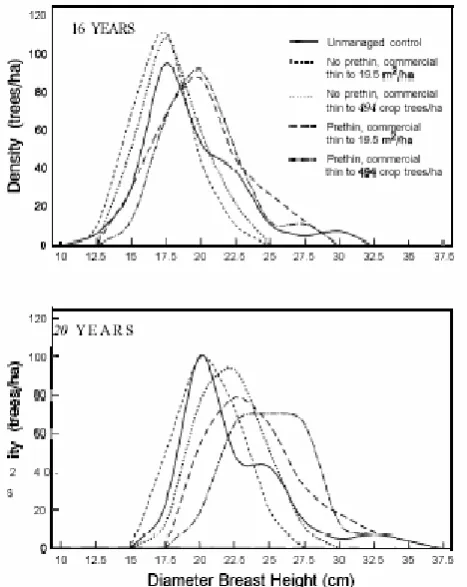
• Diameter distributions for the largest 247 crop pines ha-1 are illustrated in Fig. 1 by
thinning treatments at stand ages 16 and 20 years. At 16 years, the normal distributions peaked at 20.3 cm dbh on precommercially thinned plots, compared with 17.8 cm dbh on plots without that treatment. By age 20, dbh growth gains from precommercial thinning were still apparent, and the majority of these pines were approaching sawlog size (> 24 cm dbh) on prethinned plots.
Fig. 1. Number of trees by 2.5-cm dbh classes for the 247 largest crop pines per hectare at ages 16 and 20 years.
• Although differences in tree diameters were developing between treatments, the effects of commercial thinning on diameter distributions at age 20 were not as obvious as the effects from precommercial thinning.
• Precommercial thinning also tended to improve height growth of crop pines through 20 years. Height gains from precommercial thinning ranged from 2.0 m (P = 0.0002) to 2.2 m (P = 0.0001) for a residual stocking of 494 crop trees ha-1 or
19.5 m2 of basal area ha-1, respectively (Table 1).
• At 20 years, total height of crop pines on unmanaged control plots did not differ (P = 0.1829) from those on commercially thinned plots. Annual height growth from age 16 to 20 years averaged 11% better (P = 0.0302) when crop pines where thinned to 19.5 m2 ha-1 rather than to 494 crop trees ha-1 (Table 2).
years, there was an average gain of 24% (P = 0.0037) in per-tree volumes for crop pines on thinned plots compared with unmanaged control plots.
• There was an apparent improvement in mean annual volume growth of crop trees when commercially thinned to 494 crop trees ha-1 as opposed to 19.5 m2 ha-1
(Table 2), but the difference between thinning regime means was non-significant
(P = 0.0737) at 20 years. As would be expected, crop pines on thinned plots had substantially wider crowns (P = 0.0007) and larger live-crown ratios (P = 0.0001) compared with those on unmanaged controls (Table 1), and precommercial thinning increased live-crown ratios within commercial thinning treatments (P = 0.0001).
4.1.2. Stand density, basal area and volume production
• As a result of natural mortality, pine density on unmanaged control plots declined by an average of 24700 stems ha-1 between 1982 and 1993. Since survivors on
these control plots were principally dominant and codominant trees, 76% had attained merchantable size (>= 9.1 cm dbh) by age 20 (Table 3).
• With over 2000 trees ha-1, unmanaged control plots had 120% more (P < O.OOO1)
pines of merchantable size than plots that were commercially thinned after 16 years, and plots thinned to 19.5 m2 ha-1 had 92% more (P = 0.0005) pines than
plots thinned to 494 crop trees ha-1 . At 20 years, trends among thinning
treatments in pine basal area were similar to those for density (Table 3).
• Pine basal area averaged highest (P <0.0001) on unmanaged control plots (40.4 m2 ha-1) compared with all other treatments (24.5 m2 ha-1). Because of the
intensive site preparation that was used in 1971, hardwoods were never a major vegetative component on the study area. At stand age 20, hardwood basal area averaged less than 2 m2 ha-1 on unmanaged control plots. Plots that were thinned
to 19.5 m2 ha-1 after 16 growing seasons averaged 28.8 m2 ha-1 of pine basal area
at 20 years (Table 3).
• That stocking was significantly higher (P < 0.0001) when compared with plots thinned to 494 crop trees ha-1 (20.2 m2 ha-1).
• At stand age 20 years, total volume production differed by only 21 m3 ha-1 across
all thinning treatments (Table 3), and that difference was statistically non-significant (P = 0.7297).
• However, residual sawlog (> 24 cm dbh) volume at 20 years was substantially improved by precommercial thinning at 6 years (Fig. 2).
• Precommercial thinning resulted in a 625% increase (P = 0.03 10) in sawlog volume on plots cut to 19.5 m2 ha-1 and a 236% increase (P = 0.0077) on plots cut
to 494 crop pines ha-1. Within 4 years after commercial thinning, plots thinned to
494 crop pines ha-1 averaged 14 m3 ha-1 more (P = 0.0797) sawlog volume than
plots thinned to 19.5 m2 ha-1.
4.1.3. Prescribed burning effects
• Fuel and weather variables are presented at ages 17 and 19 years, when the most recent prescribed bums were conducted (Table 4, Appendix 3).
• Because of a greater tonnage of fine fuels from commercial thinning 8 months earlier, fireline intensities tended to average higher during the bum at stand age 17 as compared with the bum at stand age 19. Nevertheless, when the two bums were in progress, the highest mean fireline intensity (602 kW m-1) was recorded at
stand age 19 and occurred during a headfire because of a wind shift (Table 4, see Appendix 3).
• Across all thinning treatments, 46% of crop pines were crown scorched during the 17th-year bum and 29% were crown scorched during the 19th-year burn. For those pines with evidence of folk discoloration, crown scorch averaged 25% and 28%, respectively, following the bums at ages 17 and 19 years.
• As crown scorch increased on crop pines in all thinning treatments and regardless of the year of burning, there was a statistically significant (P < 0.05) reduction in dbh growth during the year after each bum (Figs. 3 and 4, see Appendix 4 and 5). Although these regression are indicative of trends within thinning treatments, low coefficients of determination (r2 values less than or equal to 0.26) suggest that
they are not very useful as precise estimates of dbh growth. After the bum at 17 years, the highest r2 in these regressions were associated with plots that were
precommercially thinned (Fig. 3, see Appendix 4). After the bum at 19 years, the higher r2 also tended to occur on plots that were precommercially thinned or
commercially thinned to 494 crop trees ha-1 (Fig. 4, see Appendix 5).
4.1.4. Vegetative ground cover
• As would be expected, hardwood ground coverage on unmanaged control plots at 20 years averaged 23% higher (P = 0.0279) than on commercially thinned plots (Table 5), where hardwoods were controlled by stem injection with herbicide 3 years earlier.
• At 20 years, shrubs-principally Rhus copallina and Vaccinium spp.-were most prevalent on precommercially thinned plots, where ground coverage averaged from 12% to 13% (Table 5).
• Within one growing season after the prescribed bum at stand age 19, grass coverage averaged 44% higher (P = 0.0003) on commercially thinned plots compared with unmanaged control plots (Table 5), where the pine canopy was closed and where no burning occurred.
• At 20 years, ground coverage from semi-woody plants-principally blackberry (Rubus spp.)-averaged highest (> 25% cover with P < 0.02) on plots that were precommercially thinned at stand age 6 (Table 5).
4.1.5. Economic returns
• The most intensive thinning regime, i.e. precommercial thinning at age 6 plus commercial thinning to 494 crop pines ha-1 after 16 years, resulted in the highest
PNV, regardless of the interest rate (Fig. 5).
• However, if the stumpage price of pine pulpwood had been higher in 1989, then the appreciated PNV of control plots would have been less while that of thinned plots would have been higher at age 20.
• PNVs for the other three thinning treatments ranked as follows: prethin after 6 years and commercial thin to 19.5 m2 ha-1 (after 16 years) no prethin but
commercial thin to 494 crop trees ha-1 (after 16 years) no prethin but commercial
thin to 19.5 m2 ha-1 after 16 years (Fig. 5).
4.2. Discussion
• Fourteen years after precommercial thinning, the beneficial effects of that treatment on pine diameter growth were still apparent. Although total volume production in m3 ha-1 averaged somewhat lower on precommercially thinned plots
compared with other thinning treatments, sawlog volumes at 20 years were significantly higher as a result of precommercial thinning at stand age 6.
• Through age 20, annual volume growth ranged from 9.4 to 10.5 m3 ha-1 across all
treatments, which is consistent with expected growth rates on these sites (Grano, 1969). The fact that volumes averaged highest on unmanaged control plots is also consistent with earlier research. For direct-seeded stands of loblolly pine in central Louisiana, Lohrey (1977) reported somewhat higher volumes for all surviving pines on unthinned control plots (254 m3 ha-1) at age 16 when compared with yields from
plots that were precommercially thinned (152-230 m3 ha-1) 13 years earlier.
• Crop pine crown scorch from prescribed burning varied by thinning treatments. Some of that variation was attributed to the type of fuels that were present. Precommercially thinned plots, for example, were the least disturbed by logging activity during commercial thinning and had an accumulation of tall grasses that were not present on other plots when burning was done at stand age 17.
• These grasses tended to be quite flammable during winter because they dry much sooner after winter rains than the ground layer of pine litter and logging slash. Similarly, at stand age 19, plots that were precommercially thinned or commercially thinned to 494 crop trees ha-1 had almost complete ground coverage
by herbaceous vegetation because of the open stand conditions.
• After a killing frost in winter, these plants contributed to the fine fuel component which in turn resulted in a higher percentage of crown scorch when burning occurred. In contrast, plots thinned to 19.5 m2 ha-1 without precommercial thinning
had almost complete canopy coverage from pines, which reduced the presence of shade-intolerant herbaceous vegetation and lowered the drying potential of surface litter, thereby resulting in minimal crown scorch on crop pines when burning was done during the winter of the 19th year.
• A preponderance of evidence from these earlier studies and the present investigation suggests that forest managers should try to minimize crown scorch by coordinating their prescribed bums and firing techniques to coincide with appropriate weather and fuel conditions as recommended by Wade and Lunsford (1989).
• Precommercial thinning contributed to a greater component of shrubs and semi-woody plants. The two most commonly recurring shrubs were huckleberries (Vuccinium spp.) and shinning sumac (Rhus copallina L.). Blackberry canes (Rubus spp.) were the most common semi-woody plants. All of these species have been identified as important to wildlife in southern forests (Oefinger and Halls, 1974). Precommercial thinning and biennial prescribed winter bums-between stand ages 9 and 16-were effective in maintaining a mosaic of low-level, horizontal plants that were not present on unthinned plots.
• Since prescribed burning may contribute to changes in air quality, all burning should be done in accordance with applicable smoke management guidelines and regulations (Wade and Lunsford, 1989). Landowners can increase their returns on investment by timing harvests to coincide with higher stumpage prices. For example, when the first commercial thinning was done after 16 years, the stumpage price for pine pulpwood in southern Arkansas was only $14 per 3.6 m3
($ per cord).
• Within 4 years, that price had increased to $21.30 per 3.6 m3 ($ per cord). Similar
fluctuations occur in sawlog prices. During the third quarter of 1993, the stumpage price for pine sawtimber in southern Arkansas ranged from $39 rn-3 to $45 m-3
(based on International 0.25-inch log rule).
• If landowners were to liquidate their timber assets on a 20-year rotation, then the unmanaged control plots in this study would have been a desirable economic alternative to the other treatments because there were no costs for precommercial thinning, prescribed burning, or hardwood control.
• In many cases, however, forest landowners have multiple resource objectives, such as enhancing wildlife habitat as well as increasing the economic value of their standing timber by managing for sawlog-size trees. To that end, thinning proved to be an important part of the management strategy in this investigation by producing significantly larger diameter trees by age 20. If present growth trends continue, higher projected stumpage prices for sawlog products will more than offset the costs associated with precommercial thinning or prescribed burning.
V. Conclusion
Based on the study, the authors concluded as follows:
• A commercial thinning during the 17th growing season left a residual stocking of either 19.5 m2 ha-1 or 494 crop trees ha-1 in merchantable-sized (> 9.0 cm dbh)
pines on plots that were precommercially thinned and on plots that were not. • Precommercial thinning enhanced pine growth in total height and in diameter at
breast height (dbh, taken at 1.37 m) through stand age 20 years. At age 20, present net value (PNV) averaged highest on plots that were precommercially thinned at age 6 then commercially thinned to 494 crop trees per hectare after 16 years because of increased production in sawtimber (trees over 24 cm dbh). • The second highest PNV at age 20 was on unmanaged control plots because no
costs were incurred for precommercial thinning, hardwood injection, prescribed burning, or timber sale administration.
VI. General Comments on the Paper
6.1. Strengths
• Generally, this paper is quite interesting as it presented the direct link between the silvicultural system (intermediate treatment), especially about thinning. The primary goal of thinning is to produce fewer large, healthy trees for logging rather than many small, weak trees. There are five basic objectives of a thinning program, namely:
(a) Increase the growth of the remaining trees, particularly the diameter of the tree rather than the height. This allows trees to reach a marketable size more quickly.
(b) Select the most favorable species for growth by removing the unwanted or low value trees.
(c) Reduce vulnerability to insects and diseases by improving the health of remaining trees.
(d) Select for the highest quality trees by removing broken, deformed or forked trees.
(e) Utilize or sell trees that are cut.
• Forest trees often grow too close together for the development of timber suitable for harvest. Crowded trees compete for light, moisture, and nutrients, resulting in slow growth and weakened condition. This paper explain to the reader, that thinning can avoid overcrowding and competition, a stand of trees should be thinned when young to increase the growing space available to each tree.
• The timing of the thinning should consider management objectives, operability, site quality, stand density, probability of subsequent thinning, and rotation length. This paper also explains about timing of thinning. Timing in thinning is also important consideration because of possible insect and disease damage that may occur if the thinning is conducted at the wrong time of year.
6.2. Weakness /Limitations
• This paper not explains about thinning intensity and thinning frequency. In fact the intensity and frequency thinning was the important matter was considered in thinning.
6.2. Suggestion
• I think that it would be better if the author also explain about thinning intensity and thinning frequency in this paper, considering the important factor in managing the forest (Biologically and economically).
land is under-utilized and you will not maximize your harvest. Wind damage and sun scald can also be issues in heavily thinned forests of certain species or on highly exposed sites. If conducted properly, thinning projects can have positive environmental and economic results.
Biological considerations in defining thinning intensity concern the tradeoffs between net volume production and average tree size. Stand volume growth is directly proportional to the residual basal area left after thinning, whereas diameter growth is the reverse. As thinning intensity increases, the method used becomes more important because of its effect upon the growing stock left).
Thinning frequency is influenced by management objectives, stand density, and site quality. The number of thinning is determined by stand density at the time of the first thinning. The interval of cutting is influenced by economic factors associated with operability, but the biological interval is frequently defined by the length of time required for trees to grow 10 feet in height. From the biological viewpoint, the interval between thinning will increase as site quality decreases and stand age at the first thinning increases.
• So, that is the reason, I suggested that thinning intensity and thinning frequency are important
REFERENCES
Chain, M.D. 1996. Growth Expectations from Alternative Thinning Regimes and Prescribed Burning in Naturally Regenerated Loblolly-Shortleaf Pine Stands through Age 20. Journal: Forest Ecology and Management 81 (1996) 227-241.
Daniel, T.W., J.A. Helms, F.S. Bakel. 1980. Principle of Silviculture. Mc. Graw-Hill Book Company. New York. Pp: 416-435.
Hawley, R.C. and D.M. Smith. 1960. The Practice of Silviculture. 6th edition. John Waley
and Sons, New York. Pp: 343-428
Ministry of Forests Forest Practices Branch, British Columbia. 1999. Guidelines for Commercial Thinning. www.for.gov.bc.ca/hfp/pubs.htm.