1
Understanding Creationism and Anti-creationism in the US: Shifting Strategies and the Dilemma of Sociology
Presentation at the Annual Conference of the British Sociological Association, London, 04/05/13 Tom Kaden, University of Leipzig
I would like to present to you my views on how to best analyse the so-called creation/evolution controversy that’s been going on in the United States in a professionalized manner since the 1960s. First, I’d like to sketch some of the things that have been going on in the US in the last few years that pose problems for professional anti-creationism as well as for sociology. Namely, it’s becoming increasingly harder for anti-creationists to set and defend criteria with which to exclude current versions of creationism from science education in public schools. The main categories that are employed in order to determine the situation are science and religion, or whether one form of creationism or materialism is scientific or religious. For sociology, this debate about the nature of science and religion makes it hard to apply these categories as means of analysis. After explaining those points a bit further, I’d like to suggest a way to resolve those issues with respect to sociological analysis. I’m going to propose a model that sidesteps the issue of science and religion while maintaining a sufficient analytical depth. Finally, I will briefly present an example of how to apply this model as an interpretive framework for creationist and anti-creationist action in the US.
I. Current Developments within American Creationism
Let me first sketch some developments within the contemporary creationist scene in the US upon which my argument is based. For my purposes, it is crucial to note that many of the dynamics of the creation/evolution controversy is based on the issue of defining creationism. The various actors involved in the controversy define creationism differently and attempt to enforce this definition in various social fields like the media and the judicial system. This process is especially virulent with regard to the latest and still most discussed version of creationism, Intelligent Design. The proponents of Intelligent Design don’t regard it as creationism, and hence not as religious, but contend that Intelligent Design is a legitimate scientific paradigm, whereas anti-creationists like the National Center for Science Education think otherwise.
Indeed, Intelligent Design arguments often manage to resemble at least the style of real scientific arguments pretty closely, and some of the Intelligent Design proponents tend to resemble real scientists much more than proponents of other forms of creationism. Some of them hold PhDs from prestigious universities, and publish in peer-reviewed journals, although typically the content of these papers has little or nothing to do with Intelligent Design in a narrow sense.
So doesn’t Intelligent Design as an idea as well as a social practice resemble science proper so much that it may count as science proper? Isn’t Intelligent Design merely a competing theory regarding the complexity of life so that it would be perfectly reasonable to have this scientific controversy taught in public schools? These arguments have been brought forth by proponents of Intelligent Design, and anti-creationists have made an effort to counter them.
2
science, methodological naturalism, that is, the rule to retrace natural causes only to natural effects.
When we step back and think about who may be right here, we immediately encounter a problem: depending on the scope of our perspective, both are right. Those who defend methodological naturalism are certainly right as regards contemporary science. On the other hand, the history of science tells us that this holds only within this rather small historical frame of, say, four hundred years. Apart from that, it is impossible to name elements of science as a thought concept that have always been (or will always be) connected to science as a social undertaking. For much of European history, the very notion of methodological materialism was not regarded a sine qua non of science. All this would be rather trivial, and there would be only minor consequences for sociological analysis, if this problem wouldn’t, in a classic Spencer Brownian manner, re-enter the very realm in which this distinction is negotiated. What I mean by that is simply what I have mentioned before: the actors who struggle to be included in the realm of science (like Intelligent Design proponents) and those who struggle to exclude other actors (like the National Center for Science Education) both employ reflections on the nature of science as means of defending their own position. And here I think we have reached the core of the problem as regards sociological analysis of creationism. In my view, sociology can never properly analyze the creation/evolution controversy using the notions of science and religion or anything similar, because these notions are inherently normative. Describing something, like evolutionary theory, as scientific is inevitably linked to ideas about what science should be like, and to characterize Intelligent Design as unscientific is a normative statement about what the social undertaking of science should not be like. Of course it is possible to limit the scope of these notions by defining science as the social practice that is being regarded as science at the moment. But at this point, as a sociologist, one comes dangerously close to representing the very value judgments one ought to be analyzing.
This situation leaves sociology in a dilemma: While it is clear that we are witnessing a social conflict in which science and religion play pivotal roles, we cannot use these very notions to explain what exactly it is we are witnessing. Let me now outline an alternative way of approaching the creation/evolution controversy at the level of professional organizations that avoids these problems.
II. Resolving the Science/Religion Dilemma
3
creationism, in their discussion of its religious aspects refer to Christian concepts, namely the concept of a personal God. As with nature, the notion of God cannot be suspended by any of the actors without ceasing to partake in the controversy itself. After all, if there is something like a creation, it is a result of God’s will. On the other hand, for many, autonomous natural processes require the absence of God as an intentional actor who intervenes on a whim.
If, for the sake of the argument, you agree with what I said thus far, you may also agree that it would be useful for any assessment of the creation/evolution controversy to map the different perspectives on God and nature that the actors advocate. Before I show you my map, I must first specify what it is exactly that the actors disagree on with respect to God and nature. I propose to you this central question as the structuring problem of the controversy:
What part has ‘God’ and what part has ‘nature’ in the emergence, development and conservation of the world?
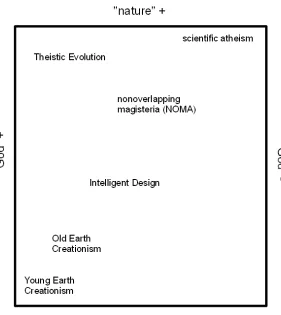
The different answers given to that question are from this analytical point of view identical with the different forms of creationism and anti-creationism. These answers may be located in a field of positions that looks like this:
4
On the bottom left part of the field there are situated all answers that attribute a minor role to nature in answering the question, and a major role to God. On the top right area are the opposite positions, like scientific atheism. Of course, both factors can be combined in thought concepts that identify the natural process with God’s intention, like theistic evolution proposes. We can now link the professional creationist and anti-creationist actors with their respective positions like this:
Fig. 2: Professional creationist and anti-creationist actors in the US (selection). CTNS = Center for Theology and the Natural Sciences (Berkeley); NA = New Atheism; NCSE = National Center for Science Education (Oakland); CSC = Center for Science and Culture (Seattle); RTB = Reasons to Believe (Glendora); AiG = Answers in Genesis (Petersburg); ICR = Institute for Creation Research (El Cajon).
5
Still, I think there are two things to be gained from this approach:
First, we can derive a non-substantialist definition of creationism from it, by which the sociologist avoids positioning herself within the controversy, and we can even make clear in what way definitions may differ from one another.
Creationism is every approach to resolve the Question that contains a relatively large
proportion of God-related arguments and also a relatively small proportion of nature-related arguments.
The advantage of defining creationism like this is that its inherent variability is already included in its definition, and it avoids references to the concepts of science and religion which are being used as means of enforcing various definitions of creationism within the field of conflict.
6
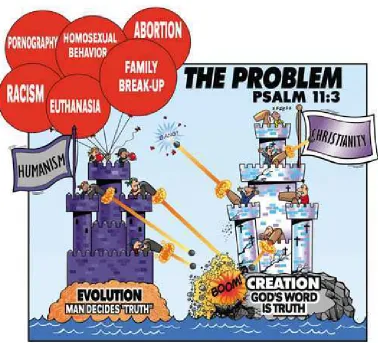
Fig. 3: “The Problem”: Graphic representation of the conflict by Answers in Genesis.
7
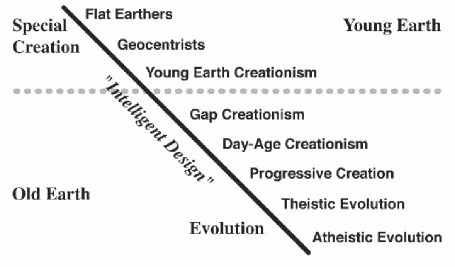
Fig. 4: “The Creation/Evolution Continuum”: Graphic representation of the conflict by the National Center for Science Education.
Since their position does not allow for a dualist reduction of the conflict, we cannot find it in this graphic. Rather, what we find is a differentiated continuum that allows for multiple ways of expressing opposition towards different positions. Interestingly enough, Intelligent Design isn’t even characterized as a distinct form of creationism, but rather as a way of transporting older variants like Day-Age creationism, which holds that the six days of creation represent vast ages of time. Much like Answers in Genesis, the NCSE’s position does not allow for a consideration of the fact that the Intelligent Design movement by now is very much autonomous, since its aim is to identify Intelligent Design as a form of creationism as clearly as possible.