Clinical symptoms and related factors of obstructive sleep apnea
among overweight and obese taxi drivers
Keywords: obstructive sleep apnea, occupational lung disease, taxi driver
pISSN: 0853-1773 • eISSN: 2252-8083 • http://dx.doi.org/10.13181/mji.v24i4.1279 • Med J Indones. 2015;24:206–14 • Received 01 Sep 2015 • Accepted 15 Dec 2015
Correspondence author: Agus D. Susanto, [email protected]
Copyright @ 2015 Authors. This is an open access article distributed under the terms of the Creative Commons Attribution-NonCommercial 4.0 International License (http://creativecommons.org/licenses/by-nc/4.0/), which permits unrestricted non-commercial use, distribution, and reproduction in any medium, provided the original author and source are properly cited.
Agus D. Susanto,1,3 Barmawi Hisyam,1,2 Lientje S. Maurits,1 Faisal Yunus3 1 Doctoral programme, Faculty of Medicine, Gadjah Mada University, Yogyakarta, Indonesia
2 Department of Internal Medicine, Faculty of Medicine, Gadjah Mada University, Sardjito Hospital, Yogyakarta, Indonesia 3 Department of Pulmonology and Respiratory Medicine, Faculty of Medicine, Universitas Indonesia, Persahabatan Hospital,
Jakarta, Indonesia
C l i n i c a l Re s e a rc h
ABSTRAK
Latar belakang:Obstructive sleep apnea (OSA) merupakan kondisi yang umum pada pengemudi kendaraan komersil dengan berat badan lebih dan obesitas, diketahui merupakan faktor risiko terpenting. Penelitian ini bertujuan untuk mengetahui gejala klinis serta faktor-faktor risiko OSA pada pengemudi taksi dengan berat badan lebih dan obesitas di Jakarta, Indonesia.
Metode: Penelitian potong-lintang ini dilakukan pada 103 pengemudi taksi di Jakarta sejak November 2011–September 2013, secara systematic random sampling di 10 pool taksi. Kriteria inklusi adalah pengemudi taksi dengan indeks massa tubuh (IMT) 23–29,9 dan terbukti OSA ringan atau
sedang. Diagnosis OSA dengan pemeriksaan polisomnografi
(PSG). Analisis bivariat menggunakan uji parametrik dan nonparametrik. Regresi logistik multivariabel untuk evaluasi faktor-faktor risiko.
Hasil: Sebanyak 54 (52,4%) dari 103 pengemudi terbukti
OSA dan 49 (47,6%) bukan OSA. Gejala OSA yang signifikan
(p<0,05) adalah mendengkur, bangun tidur tidak segar, tertidur saat mengendarai mobil dan sakit kepala atau mual saat bangun tidur. Faktor yang berhubungan dengan OSA adalah peningkatan IMT (OR=0,60, 95% CI=0,45–0,79, p=0,001), riwayat mendengkur dalam keluarga (OR = 4,92, 95% CI=1,82–13,31, p=0,002) dan lama tidur <7 jam dalam 24 jam (OR=5,14, 95% CI=1,37–19,23, p=0,015).
Kesimpulan: Gejala klinis OSA adalah mendengkur, bangun tidur tidak segar, tertidur saat mengendarai mobil dan sakit kepala atau mual saat bangun tidur. Faktor risiko OSA adalah peningkatan IMT, riwayat keluarga mendengkur, dan lama tidur <7 jam dalam 24 jam.
ABSTRACT
Background: Obstructive sleep apnea (OSA) is common condition in commercial drivers while overweight and obesity as the most important risk factors. This study aimed to know the clinical symptoms and risk factors of OSA in overweight and obese taxi drivers in Jakarta, Indonesia. Methods: A cross-sectional study was done in 103 taxi drivers in Jakarta from November 2011–September 2013, by systematic random sampling from 10 taxi stations. Inclusion criteria were taxi drivers with body mass index (BMI) which 23–29.9 and mild or moderate OSA. Portable polysomnography (PSG) test was used to diagnose OSA. Parametric and nonparametric test were used in bivariate
analysis. Logistic regression multivariable was used to final
evaluate risk factors of OSA.
Results: There were 54 (52.4%) of 103 drivers with OSA and 49 (47.6%) without OSA. Clinical symptoms found significantly (p<0.05) were snoring, unrefreshing sleep, occasional sleep while driving, and headache or nausea on waking up in the morning. Risk factors for OSA were increased BMI (OR=0.60, 95% CI=0.45–0.79, p=0.001), snoring history in the family (OR=4.92, 95% CI=1.82–13.31, p=0.002) and sleep duration <7 hours within 24 hours (OR=5.14, 95% CI=1.37–19.23, p=0.015).
Obstructive sleep apnea (OSA) is a disorder characterized by repeated collapse of the upper airway, either as part or total that occurs during a person’s sleep. Airway collapse is associated with a decrease or cessation of airflow even
though there is still some effort for breathing.1
Upper airway collapse that occurrs is connected with the occurrence of fragmented sleep episode and recurrent reduction of oxyhemoglobin
saturation.2 The common symptoms of OSA are
snoring, fatigue or excessive daytime sleepiness
(EDS).3 Gold standard to confirm the diagnosis
of OSA currently is using polysomnography
(PSG).4
There are several risk factors that may lead to OSA such as gender, age, genetics, overweight or obesity, large neck, smoking, alcohol consumption, nasal obstruction, craniofacial abnormalities. However, the main risk factor is
obesity.5 Individuals with 10% increase of body
weight are associated with six-fold increased risk
of moderate to severe OSA.6 Approximately two
thirds of patients with OSA have body weight 20% above normal weight. Obesity increases the average progression of OSA and weight loss will
decrease further progression.5,7
Sleep apnea clearly increases EDS. This causes a tendency to sleep, decreases alertness and vigilance, slow down reaction time and decreases
pshycomotor coordination.8 These conditions in
turn increase the risk of a vehicle crash accident.9
The risk is two to 10 times higher among drivers
with OSA compared with non-OSA.10
The prevalence of OSA in commercial vehicle drivers is quite high. Epidemiological data shows OSA incidence among commercial drivers varied
from 15.8% to 17.6%.11 Study of Howard, et al12 on
3,268 commercial truck drivers in Australia found that more than half (59.6%) of the drivers had sleep-disordered breathing (SDB) and as much as 15.8% are proven to have OSA. Approximately 24.0% of the truck drivers had excessive
sleepiness. Pack7 found that the prevalence of
SDB in a professional driver in Philadelphia is
28.2%. Study of Hui et al13 on 216 commercial bus
drivers in Hong Kong found that 37.0% of them had snoring and 7.9% of them had sleep apnea. While research on the 262 bus drivers in Brazil by
Viegas and de Oliviera14 found 36.0% of snoring,
32.0% snoring loudly, and 12.0% had apnea.
Obstructive sleep apnea research specifically on taxi drivers are still very limited and generally use
questionnaires. Gülbay et al15 reported that 5.9%
taxi drivers show symptoms of OSA and 23.7% show EDS. A total of 67.8% of taxi drivers have a history of accidents, and there is a significant relationship between traffic accidents that occurred with EDS and OSA symptoms. Firestone
et al16 estimated the prevalence of moderate
and severe OSA on taxi drivers in Wellington, New Zealand to be around 18.0%. Research in
Indonesia by Wiadnyana et al17 reported the
occurrence probability of OSA in ‘X’ taxi driver in Jakarta for about 25.0%. To date there are no research data of OSA on taxi drivers in Indonesia by using the gold standard examination of PSG.
This study aimed to know the clinical symptoms and related factors of mild and moderate OSA among overweight and obese taxi drivers in Jakarta, Indonesia.
METHODS
This study is part of another study examining the relationship of OSA with an accident and reaction time of taxi drivers using the cross-sectional design. Target population in this study was taxi drivers in Jakarta. While scope population of this study was taxi drivers of ‘X’ company in Jakarta. Inclusion criteria were active driver with less than one work year, age between 25–58 years, male,
body mass index (BMI) 23 to 29.9, the value of O2
saturation >90% before the PSG examination and they were willing to follow the study by filling out informed consent. The inclusion criteria from PSG result were mild and moderate OSA or non-OSA. The exclusion criteria were having a sleep disorder other than OSA, a history of heart disease, stroke, drugs and alcohol abuse, mental disorders, visual impairment, and hearing impairment.
This study was approved by Medical and Health Research Ethics Committee (MHREC) Faculty of Medicine Gadjah Mada University, Yogyakarta, Indonesia (No. KE/FK/386/EC). Subjects in this study were taken from 10 taxi pools of ‘X’ company in Jakarta. Sample size (total number of the taxi drivers) was calculated using systematic random sampling method. The research was conducted
from November 1st 2011 to September 31th 2013.
using questionnaires. Data were obtained from the interview, questionnaires, physical examination, and PSG done at driver’s residence. The questionnaire, which had been used, was a questionnaire assessing the identity, work history, habits, health conditions
and symptoms of OSA, the Berlin questionnaire18
and epworth sleepines scale (ESS)19 were used to
assess the likelihood of OSA. PSG examination was conducted at driver’s residence (portable home monitoring) when the driver was off from his work hour. PSG is done by using device that consist of electroencephalogram (EEG), electrooculogram (EOG), electromyogram (EMG), nasal airflow, thoraco-abominal movement, and oximetry.
Criteria for OSA is stated if it fulfills the criteria of the American Academy of Sleep Medicine
(AASM) 2005.20 The patient was diagnosed as
OSA when apnea-hypopnea index (AHI) ≥15 or
AHI ≥5 which is accompanied by one or more of the following symptoms: 1) unintentional sleep episodes during wakefullness, daytime sleepiness, unrefreshing sleep, fatigue, or insomnia; 2)
wakened from sleep by breath holding, gasping or choking, and 3) bed partner reported loud snore, breathing interruptions or both during the patient’s sleep. OSA severity is classified based on the frequency of AHI during sleep. The category called mild when the AHI five to <15 events/hour and moderate when AHI of 15 to 30 events/hour.
Data were analyzed using computer programme. Parametric and non-parametric test were used in bivariate analysis. Multivariate analysis using binary logistic regression test was used to do final evaluation of OSA related factors.
RESULTS
Polysomnography characteristics
A total of 103 taxi drivers who met the inclusion criteria participated in this study. Taxi drivers who proven to have OSA (mild and moderate) consist of 54 subjects (52.4%) and non-OSA were about 49 subjects (47.6%). Polysomnography examinations
Variables OSA Non-OSA
p* 95% CI
Mean SD Mean SD
Apnea hypopnea index 15.66 6.26 4.92 3.46 0.001 8.78–12.70
Total in bed 412.93 63.37 421.43 67.41 0.511 -34.07–17.06
Sleep periode time 374.68 63.42 363.31 65.29 0.372 -13.79–36.55
Total sleep time 338.45 66.41 332.26 64.98 0.634 -19.54–31.92
Sleep onset 32.05 23.12 37.46 26.43 0.273 -15.15–4.32
Rapid eye movement (REM) latency 74.65 93.21 89.53 94.26 0.423 -51.56–21.79
Sleep eff 0.82 0.11 0.79 0.12 0.235 -0.02–0.07
Arousal 16.50 5.85 18.38 7.57 0.159 -4.51–0.75
Apnea 3.11 3.56 0.47 0.49 0.001 1.65–3.61
Central apnea 0.47 0.47 0.14 0.24 0.001 0.18–0.47
Obstructive apnea 2.45 3.14 0.29 0.37 0.001 1.29–3.01
Hypopnea 12.56 4.77 4.53 3.20 0.001 6.45–9.61
Oxygen saturation (SpO2) mean 0.95 0.01 0.96 0.01 0.171 -0.007–0.001
SpO2 lowest 0.86 0.05 0.90 0.05 0.001 -0.06–-0.02
Desat index 11.27 6.85 4.43 6.85 0.001 4.50–9.19
Limb move 44.94 44.57 34.16 22.53 0.121 -2.89–24.44
Total desat 64.70 45.98 25.33 29.94 0.001 24.27–54.47
Heart rate 35.32 64.73 30.06 50.46 0.649 -17.59–28.11
Snoring 245.61 339.46 88.86 133.86 0.003 57.05–256.46
% Snoring 0.04 0.05 0.01 0.02 0.001 0.01–0.04
*unpaired T-test, OSA=Obstructive sleep apnea
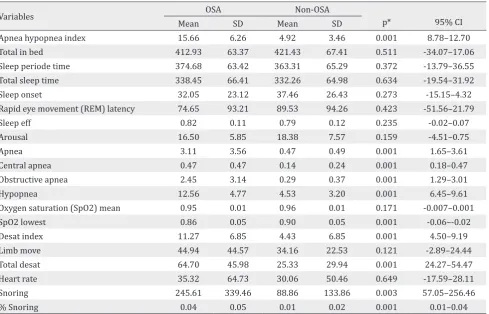
on 103 subjects show the results that are listed in table 1. There are significant differences in the mean AHI, apnea, obstructive apnea, hypopnea and snoring between subjects with OSA and non-OSA (p<0.05). There are significant differences in mean oxygen saturation, mean of the lowest oxygen saturation and total oxygen desaturation during apnea hypopnea period (p<0.05).
Clinical symptoms
Table 2 shows clinical symptoms of taxi drivers
Variables OSA non-OSA OR
(95% CI) p
n % n %
Snoring 3.77 (1.65–8.59) 0.003*
Yes 39 66.1 20 33.9
No 15 34.1 29 65.9
Choking during sleep 2.25 (0.65–7.84) 0.317**
Yes 9 69.2 4 30.8
No 45 50.0 45 50.0
Frequent awakening during sleep 1.25 (0.40–3.89) 0.927*
Yes 8 57.1 6 42.9
No 46 51.7 43 48.3
Not feel refresh when waking 5.12 (2.03–12.94) 0.001*
Yes 27 77.1 8 22.9
No 27 39.7 41 60.3
Stop breathing during sleep
Yes 1 100 0 0
No 53 52.0 49 48.0
Fatigue 2.56 (0.99–6.59) 0.079*
Yes 18 69.2 8 30.8
No 36 46.8 41 53.2
Falling a sleep while driving 3,52 (1.39–8.95) 0.009*
Yes 22 73.3 8 26.7
No 32 43.8 41 56.2
Sleepiness 2.40 (0.44–12.97) 0.441*
Yes 5 71.4 2 28.6
No 49 51.0 47 49.0
Impared concentration 1.92 (0.45–8.12) 0.493**
Yes 6 66.7 3 33.3
No 48 51.1 46 48.9
Headache or nausea when waking 5.34 (1.11–25.75) 0.048**
Yes 10 83.3 2 16.7
No 44 48.4 47 51.6
Insomnia 2.00 (0.88–4.54) 0.143*
Yes 24 63.2 14 36.8
No 30 46.2 35 53.8
Table 2. Clinical symptoms of taxi drivers with OSA and non-OSA
*Chi-square test; **Fisher test; OSA=Obstructive sleep apnea
Association between variables and OSA
Association between independent variables and OSA is shown in tables 3, 4, and 5. Physical examination showed that body weight, BMI, neck circumference and abdominal circumference were significantly different between subjects with OSA and non-OSA (Table 3). But there were no significant differences for parameters of tonsil size and high blood pressure (hypertension) in subjects with OSA and non-OSA. History of snoring in family variables had a significant relationship with OSA, with OR=3.46 (95% CI=1.51–7.94) and p=0.005 (Table 4).
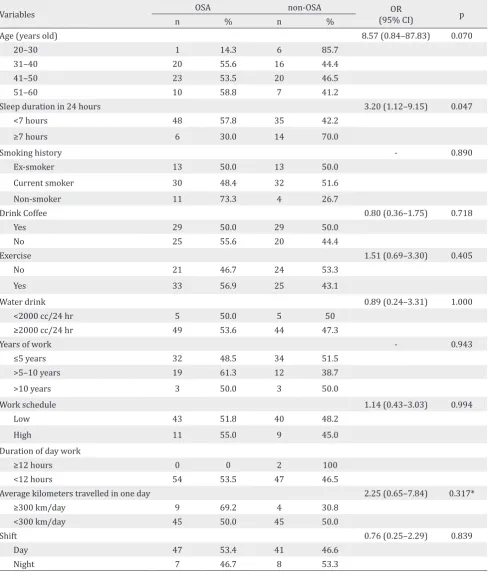
Age and the overall life habits of subjects in two groups were not significantly different, which consists of smoking, drink coffee, water drink, and exercise. OSA subjects were increased in the age range of 31–40 years and 41–50 years The only habit that had a meaningful relationship with OSA was the sleep duration in 24 hours with OR=3.2 (95% CI=1.12–9.15) and p=0.047. Job characteristics such as years of work, work schedules, duration of day work, shift work, and the average kilometers travelled in one day were not significantly different between subjects with OSA and non-OSA (Table 5).
Multivariate analysis for OSA
Multivariate analysis was performed on variables that have significant relationship with OSA, and these included BMI, body weight, neck circumference, abdominal circumference, family history of snoring and the number of sleep hours. Considering that BMI variable and body weight variable interplay each other and also neck circumference and abdominal
Variables OSA non-OSA p
Mean (SD) Mean (SD)
BMI 25.18 (2.17) 24.24 (1.32) 0.001 Body weight 71.44 (8.57) 65.82 (5.74) 0.001 Neck circumference 38.50 (2.56) 37.24 (2.05) 0.007 Abdominal
circumference
91.59 (7.99) 86.51 (5.52) 0.001 Table 3. Association between body mass index (BMI), body weight, neck circumference and abdominal circumference with OSA
*SD=Standard deviation; binary logistic regression test; OSA: Obstructive sleep apnea
Variables OSA non-OSA OR
(95% CI) p
n % n %
Tonsil size 0.89
(0.31–2.6) 1.000 Increase 8 50.0 8 50.0
Normal 46 52.9 41 47.1
Hypertension 0.89
(0.32–2.46) 1.000
Yes 9 50.0 9 50.0
No 40 47.5 45 52.5 History of
snoring in family
3.46 (1.51–7.94)
0.005 Yes 30 69.8 13 30.2
No 24 40.0 46 60.0
Table 4. Association between tonsil size, history of hyper-tension and history of snoring in family with OSA
*Chi-square test; OSA=Obstructive sleep apnea
circumference, variable interplay each other, these when put them into statistical test, will simultaneously cause the effect in the multivariate analysis (co-linearity effect). Finally the multivariate analysis was performed only on four variables: BMI, neck circumference, family history of snoring, and the sleep duration less than seven hours in 24 hours (Table 6). Multivariate analysis showed that BMI, family history of snoring and the number of sleep hour in 24 hours was significantly associated with OSA, while the neck circumference had no relationship with OSA.
DISCUSSION
Polysomnography result
The results of PSG become an objective tool of OSA diagnosis. Parameters on PSG examination, which are: apnea, obstructive apnea, hypopnea, AHI, snoring, oxygen saturation and desaturation, were significantly different between OSA and non-OSA subjects. This was expected since the presence of obstruction during sleep in OSA subjects, either totally or partially, is recorded by PSG examination and became the gold
standard for diagnosis of OSA.4 Other studies
show the PSG results of OSA subjects showed significant differences in the value of AHI, apneas, obstructive apnea, hypopnea, snoring and oxygen
Variables OSA non-OSA OR
(95% CI) p
n % n %
Age (years old) 8.57 (0.84–87.83) 0.070
20–30 1 14.3 6 85.7
31–40 20 55.6 16 44.4
41–50 23 53.5 20 46.5
51–60 10 58.8 7 41.2
Sleep duration in 24 hours 3.20 (1.12–9.15) 0.047
<7 hours 48 57.8 35 42.2
≥7 hours 6 30.0 14 70.0
Smoking history - 0.890
Ex-smoker 13 50.0 13 50.0
Current smoker 30 48.4 32 51.6
Non-smoker 11 73.3 4 26.7
Drink Coffee 0.80 (0.36–1.75) 0.718
Yes 29 50.0 29 50.0
No 25 55.6 20 44.4
Exercise 1.51 (0.69–3.30) 0.405
No 21 46.7 24 53.3
Yes 33 56.9 25 43.1
Water drink 0.89 (0.24–3.31) 1.000
<2000 cc/24 hr 5 50.0 5 50
≥2000 cc/24 hr 49 53.6 44 47.3
Years of work - 0.943
≤5 years 32 48.5 34 51.5
>5–10 years 19 61.3 12 38.7
>10 years 3 50.0 3 50.0
Work schedule 1.14 (0.43–3.03) 0.994
Low 43 51.8 40 48.2
High 11 55.0 9 45.0
Duration of day work
≥12 hours 0 0 2 100
<12 hours 54 53.5 47 46.5
Average kilometers travelled in one day 2.25 (0.65–7.84) 0.317*
≥300 km/day 9 69.2 4 30.8
<300 km/day 45 50.0 45 50.0
Shift 0.76 (0.25–2.29) 0.839
Day 47 53.4 41 46.6
Night 7 46.7 8 53.3
Table 5. Association between age, life habits and work with OSA
Chi-square test ; *Fisher test; OSA=Obstructive sleep apnea
Clinical symptoms of OSA
Snoring in subjects with OSA is significantly different than non-OSA subjects. This is consistent with the published literature which stated that
snoring is a major clinical symptom of OSA and reflects the typical basic pathophysiology of the
disease.3,22 Approximately 95% of subjects with OSA
Variables Adjusted OR 95% CI p
Lower Upper
BMI 0.60 0.45 0.79 0.001
Neck circumference 0.50 0.80 1.35 0.815
Family history of snoring 4.92 1.82 13.31 0.002
Sleep duration less than 7 hours in 24 hours 5.14 1.37 19.23 0.015 Table 6. Multivariate analysis of BMI, neck circumference, family history of snoring, and sleep duration less than seven hours in 24 hours with OSA
Binary logistic regression test
that were significantly associated in this study were
headache or nausea when waking up. McNicholas22
reported that other symptoms that can occur in OSA patients include fatigue, morning sickness and headaches. Subjects with OSA did not feel refresh when waking up and fall asleep easily while driving. These complaints are suitable with one of the clinical symptoms in the criteria of the AASM 2005, which are unintentional sleep episodes during alertness
and not refreshed after sleep.20
Sleep apnea is one of the symptoms commonly
reported from patient partner.22 In this study,
sleep apnea is not a significant symptom, probably because the interview in this study was conducted directly to the subjects who do not know whether this condition is happening to them or not. In addition, most of the subjects lived in a rented house or in the company’s inn alone, so that no one recognized whether apnea events occurred or not.
Drowsiness during the day (daytime sleepiness)
is also a major symptom of OSA.3 In this study,
daytime sleepiness which was assessed by ESS was not significantly different between OSA subjects (five people) and non-OSA (three people). Only 8.1% of subjects who have that complaint. The difference may be caused by posibility that subject is not entirely familiar with the questions from ESS. In addition, drowsiness may be obscured by the fatigue felt by the subject
since his profession is taxi driving. McNicholas22
stated that drowsiness should be distinguished from other symptoms, such as feeling tired which is often underestimated by patients.
Factors associated with OSA
The age range among OSA and non-OSA was not significantly different. OSA subjects were increased in the age range of 31–40 years and
41–50 years. This is consistent with the study from
Wiadnyana, et al17 which concluded that patients
who were >36 years old had two-fold risk of OSA compared to patients who were <36 years of age. OSA incidence increased progressively by increase
of age.23 Young et al24 mentioned that the incidence
of OSA increased especially in middle age. The mechanisms proposed for the age-related OSA are an increase deposition of fat in the parapharyngeal area, lenghthening of the soft palate and changes in
body structures surrounding the pharynx.23
Physical examination showed that body weight, BMI, neck circumference, and abdominal circumference were significantly different between subjects with OSA and non-OSA. Study
from Wiadnyana et al17 concluded that BMI >25
and neck circumference >40 cm had a significant relationship with suspected of OSA. The same results were reported by the sleep heart health study which stated that OSA was significantly associated with BMI, neck circumference and
abdominal circumference.23 Weight gain by
10% was known to be associated with a six-fold
increased risk of OSA.6 Weight gain can affect
airway during sleep through some mechanisms. The mechanisms are: 1) an increase in fat deposition on peripharynx cause upper airway constriction, 2) affects the neural compensatory mechanisms for maintaining the patency of airway, 3) instability of respiratory control system, and 4) reduction in the functional residual capacity due to the resultant decrease in the stability of the
upper airway caudal traction.23
Tonsil size was not significantly different between OSA and non-OSA subjects. Enlargement of tonsils as a risk factor for OSA in adults is debatable. As per one of the research, tonsil enlargement is
one of risk factors of OSA.7 Lee et al25 in reported
independent factor of the OSA. There are few studies that assess enlargement of tonsils as a
risk factor for OSA in adults.24 Some studies stated
that tonsil and adenoid hypertrophy are major
risk factors for OSA in children.5,26
Hypertension status in subjects with OSA and non-OSA had no significant difference. This result
was consistent with the study of Wiadnyana et al17
that concluded the absence of correlation between hypertension and suspected OSA. But, this result was in contrast with some of the previous studies which stated that hypertension was associated with OSA. There is a consistent association between
OSA and hypertension in various studies.22,27,28
Incidence of hypertension increases in subjects
suspected with OSA.22 Several studies reported that
OSA was a cause of hypertension or uncontrolled
hypertension.27,28 But only few studies have reported
that hypertension is a risk factor of OSA.
Our study indicate that snoring history in family has a significant relationship with OSA. These results are consistent with existing research data. Previous data suggest that research inquiries about family history can certainly aid in identifying those that have OSA. Familial susceptibility to OSA directly increases with the number of
affected relatives.23 Young et al29 reported that
snoring history or OSA in family increases the risk
of OSA. Wiadnyana et al17 reported that snoring
history in family was significantly associated with suspected OSA.
Smoking is estimated as one of the risk factors associated with OSA. Epidemiological studies have shown that smoking is associated with an increased prevalence of snoring and OSA. Airway inflammation and damage due to cigarette smoke can affect the mechanical support function and neural upper airway, also increase posibility of
airway collapse during sleep.23 Even so, Young
et al24 said that only a few studies have reported
association between smoking and OSA. Although there is a biological plausibility for a causal role of smoking, it is not yet firmly established as a risk factor. Results of this study showed no association between smoking and OSA. Smoking habits were not significantly different between OSA and non-OSA subjects. The same result was reported by
Wiadnyana et al17 that showed no difference in
smoking habits of taxi driver between those with and without suspected OSA. Differences in study
results are likely because taxi drivers usually smoke.
Chuang et al30 reported that 57.9% taxi drivers in
Taiwan had smoking habits. Smoking habits are also common in Jakarta, Indonesia. It was estimated that approximately one-third of Jakarta population are
smokers.31
Habits for drinking coffee, water in 24 hours and exercise habits did not differ between OSA and non-OSA subjects. Similar results were reported
by Wiadnyana et al17 which stated that daily habits
of taxi drivers are not associated with likelihood of OSA. Other habit that has a significant association with OSA is sleep duration less than seven hours in 24 hours. These results are in accordance with some recent studies regarding the association between sleep duration, obesity and OSA. Chin
et al32 in his study at Japan said that number of
sleep hours should be considered as an important factor in investigating the prevalence of severe
OSA and metabolic syndrome.32 Risso et al33
reported that sleep duration may be associated to the low mean oxygen saturation in OSA Patients.
Kim et al34 even proved that there is a significant
relationship between sleep duration, OSA and visceral obesity in adult patients.
Job characteristics such as work period, work schedules, duration of day work, shift work and the average distance travelled in one day were not significantly different between subjects with OSA and non-OSA. Similar results were reported by
Wiadnyana et al17 who reported that a taxi driver’s
job characteristics were not related to the suspected OSA. He reported that only work schedules variable is associated with suspected OSA.
In conclusion, significant symptoms of taxi drivers with mild and moderate OSA are snoring, unrefreshing sleep, headache or nausea while waking up in the morning and occasional sleep while a driving. Factors associated with OSA in taxi drivers with overweight and obesity are the increase of BMI, snoring history in family and sleep duration less than seven hours in 24 hours. Limitation of this study were small sample size, further studies are needed with larger sample size to validate these results.
Acknowledgment:
Conflict of interest:
The authors confirm there is no conflict of interest in this study.
REFERENCES
1. De Backer W. Obstructive sleep apnea/hypopnea
syndrome. Definitions and pathopysiology. In:
Randerath WJ, Sanner BM, Somers VK, editors. Sleep apnea. Current diagnosis and treatment. Prog Respir Res; 2006. p. 90–6.
2. White DP. Sleep apnea. Proc Am Thorac Soc. 2006;3:124–8. 3. Patil SP, Schneider H, Schwartz AR, Smith PL. Adult
obstructive sleep apnea: pathophysiology and diagnosis. Chest. 2007;132(1):325–7.
4. American Academy of Sleep Medicine. Sleep-related breathing disorders in adults: recommendations for
syndrome definition and measurement techniques in
clinical research. Sleep. 1999;22(5):667–89.
5. Young T, Skatrud J, Peppard PE. Risk factors for obstructive sleep apnea in adults. JAMA. 2004;291(16):2013–6. 6. Smith IE. Alternatif therapies for obstructive sleep apnea
syndrome: behavioral and pharmacological options. In: Randerath WJ, Sanner BM, Somers VK, editors. Sleep apnea. Current diagnosis and treatment. Prog Respir Res; 2006. p. 174–9.
7. Pack AI. Advances in sleep-disordered breathing. Am J Respir Crit Care Med. 2006;173(1):7–15.
8. Scott AJ. Sleepiness and fatigue risk for the transportation industry. Occupational and Environmental Med. 2003;3:81–108.
9. George CF. Sleep apnea, alertness, and motor vehicle crash. Am J Respir Crit Care. 2007;176(10):954–6. 10. Hartenbaum N, Collop N, Rosen IM, Philips B, George
CF, Rowley JA, et al. Sleep apnea and commercial motor vehicle operators: statement from the joint task force of the American College of Chest Physicians, American College of Occupational and Environmental Medicine, and the National Sleep Foundation. Chest. 2006;130(3):902–5.
11. George CF. Sleepiness, sleep apnea, and driving: still miles to go before we safely sleep. Am J Respir Crit Care Med. 2004;170(9):927–8.
12. Howard ME, Desai AV, Grunstein RR, Hukins C, Armstrong JG, Joffe D, et al. Sleepiness, sleep-disordered breathing, and accident risk factors in commercial vehicle drivers. Am J Respir Crit Care Med. 2004;170(9):1014–21. 13. Hui DS, Chan JK, Ko FW, Choy DK, Li TS, Chan AT, et al.
Prevalence of snoring and sleep-disordered breathing in a group of commercial bus drivers in Hong Kong. Intern Med J. 2002;32(4):149–57.
14. Viegas CA, de Oliviera HW. Prevalence of risk factors for obstructive sleep apnea syndrome in interstate bus drivers. J Bras Pneumol. 2006;32(2):144–9.
15. Gülbay BE, Acican T, Doğan R, Baççioğlu A, Güllü E, Karadağ
G. The evaluation of excessive daytime sleepiness in taxi drivers. Tuberk Toraks. 2003;51(4):385–9. Turkish. 16. Firestone RT, Mihaere K, Gander PH. Obstructive sleep
apnea among professional taxi drivers: a pilot study. Accid Anal Prev. 2009;41(3):552–6.
17. Wiadnyana IPGP, Susanto AD, Amri Z, Antariksa B. The Prevalence of suspected obstructive sleep apnea and related factors on “X” taxi drivers in Jakarta. J Respir Indo. 2010;30:32–8. Indonesian.
18. Chung F, Yegneswaran B, Liao P, Chung SA, Vairavanathan S, Islam S, et al. Validation of the Berlin questionnaire and American Society of Anesthesiologist checklist as screening tools for obstructive sleep apnea in surgical patients. Anesthesiology. 2008;108(5):822–30.
19. Johns MW. A new method for measuring daytime sleepiness: the Epworth sleepiness scale. Sleep. 1991;14(6):540–5.
20. Shiomi T, Sasanabe R. Advances in diagnosis and treatment of sleep apnea syndrome in Japan. JMAJ. 2009;52(4):224–30.
21. Widysanto A, Yunus F, Yusuf I, Sutrisna B, Suradi. Oxygen desaturation index as a risk factor for coronary artery disease in male subject with obstructive sleep apnea. J Respir Indo. 2012;3:161–6. Indonesian.
22. McNicholas WT. Diagnosis of obstructive sleep apnea in adults. Proc Am Thorax Soc. 2008;5(2):154–60.
23. Punjabi NM. The epidemiology of adult obstructive sleep apnea. Proc Am Thorac Soc. 2008:5(2);136–43. 24. Young T, Peppard PE, Gottlieb DJ. Epidemiology of
obstructive sleep apnea: a population health perspective. Am J Respir Crit Care Med. 2002;165(9):1217–39. 25. Lee YC, Eun YG, Shin SY, Kim SW. Prevalence of snoring
and high risk of obstructive sleep apnea syndrome in young male soldiers in Korea. J Korean Med Sci. 2013;28(9):1373–7.
26. Chang SJ, Chae KY. Obstructive sleep apnea syndrome in children: epidemiology, pathophysiology, diagnosis and sequelae. Korean J Pediatr. 2010;53(10):863–71. 27. Wolk R, Shamsuzzaman ASM, Somers VK. Obesity,
sleep apnea, and hypertension. Hypertension. 2013;42(6):1067–74.
28. Khan A, Patel NK, O’Hearn DJ, Khan S. Resistant hypertension and obstructive sleep apnea. Int J Hypertension. 2013:2013:1–6.
29. Young T, Palta M, Dempsey J, Skatrud J, Weber S, Badr S. The occurrence of sleep-disordered breathing among middle-aged adults. N Engl J Med. 1993;328(17):1230–5. 30. Chuang CY, Lee CC, Chang YK, Sung FC. Oxidative DNA
damage estimated by urinary 8-hydroxydeoxyguanosine:
influence of taxi driving, smoking and areca chewing.
Chemosphere. 2003:52(7):1163–71.
31. Authority of Health Research and Developed, Ministry of Health Republic of Indonesia. Basic Health Research (RISKESDAS) 2010. Ministry of Health Republic of Indonesia. 2010. p. 400–16. Indonesian.
32. Chin K, Oga T, Takahashi K, Takegami M, Nakayama-Ashida Y, Wakamura T, etal. Associations between obstructive sleep apnea, metabolic syndrome, and sleep duration, as measured with an actigraph, in an urban male working population in Japan. Sleep. 2010;33(1):89–95.
33. Risso TT, Poyares D, Rizzi CF, Pulz C, Guilleminault C,
Tufik S, et al. The impact of sleep duration in obstructive sleep apnea patients. Sleep Breath. 2013;17(2):837–43. 34. Kim NH, Lee SK, Eun CR, Seo JA, Kim SG, Choi KM, et al.