FISITA2010/FISITA2010-SC-P-36
SELF-REPORTED SEAT DISCOMFORT AMONG DUTCH
COMMERCIAL TRUCK DRIVERS
Tan, CheeFai
Designed Intelligence Group, Department of Industrial Design, Eindhoven University of Technology, the Netherlands
Universiti Teknikal Malaysia Melaka, Durian Tunggal, Melaka, Malaysia
Chen, Wei, Rauterberg, Matthias
Designed Intelligence Group, Department of Industrial Design, Eindhoven University of Technology, the Netherlands
KEYWORDS – seat, discomfort, truck driver, questionnaire
ABSTRACT – Comfort is an attribute that today’s consumers demand more and more. The seat has an important role to play in fulfilling these comfort expectations. Seating comfort is a major concern for drivers and other members of the work force who are exposed to extended periods of sitting and its associated side effects. In this paper, we described of the survey that examine the seat discomfort and travel time factors for Dutch commercial truck driver. For the survey, the self-administered questionnaires were completed by 217 truck drivers in the Netherlands. Statistical methods such as factor analysis and one way ANOVA were used to find the differences between body discomfort of truck drivers after one hour and five hours sitting while driving. The results showed that truck drivers experienced different level of body discomfort for one hour and five hours sitting while driving. Subsequently, the survey also found that there is significant discomfort at different body part. The outcomes from the analytical results were important and required more attention to reduce the body discomfort for long hour sitting.
INTRODUCTION
Comfort is an attribute that today’s drivers demand more and more. The driver comfort is depends on different features and environment during the driving. Seat comfort is a very subjective issue because it is the customer who makes the final determination and customer evaluations are based on their opinions having experienced the seat (1). One of the products often considered in truck industry is the driver’s seat. The truck driver’s seat has an important role to play in fulfilling driver comfort expectations. Seat is one of the important features of vehicle and there is the place where the truck driver spends most of their time. According to the ‘European Union Legislation for Drivers and Promote’ (2), the weekly driving time for truck drivers shall not exceed 56 hours. Commercial trucks are unique in that they are specifically designed to transport loads over long distances, in contrast to aircraft passenger seat that are designed for individual comfort. The truck driver’s seat, which is in contact with the drivers, plays an important role to position the driver to perform the task of driving, meet the safety requirements, and be acceptable to the driver’s comfort needs.
The concepts of comfort and discomfort in sitting are under debate. There is no widely accepted definition, although it is beyond dispute that comfort and discomfort are feelings or emotions that are subjective in nature (3). Seating discomfort has been examined from a number of different perspectives. The problem with evaluating comfort in regards to pressure
or any other factor is that, comfort is subjective and not easy to quantify. Seating discomfort varies from subject to subject and depends on the task at hand. Comfort, however, is a vague concept and subjective in nature. It is generally defined as lack of discomfort (4).
For example, truck drivers require sitting for long periods of time approximately eight hours. The extended period of sitting includes higher risk of back problems, numbness and
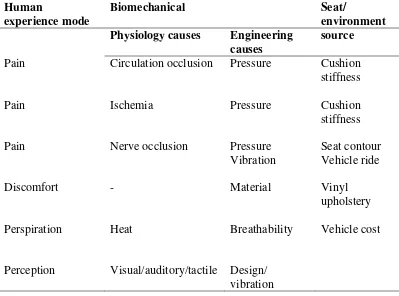
discomfort in the buttocks due to too high surface pressure under the thighs (5). The study by Adler et al. (6) shows that the driver posture is not static and changes over time. Posture changes and continuous motion are strategies of the driver to avoid mechanical load and ischemia of tissue, which has been identified as one main reason for discomfort. Discomfort feelings, as described by Helander and Zhang (7), is affected by biomechanical factors and fatigue. The sources of such discomfort are listed in Table 1.
Table 1:Causes of seating discomfort (7).
Human
Seat is one of the important elements for the aircraft passenger comfort. The aircraft
passenger’s comfort depends on different features and the environment during air travel. Seat discomfort is a subjective issue because it is the customer who makes the final determination and customer evaluations are based on their opinions having experienced the seat (8). The aircraft passenger seat has an important role to play in fulfilling the passenger comfort expectations. The seat is one of the important features of the vehicle and is the place where the passenger spends most of time during air travel. The aviation industry is highly
discomfort reduction. Further studies concerning how to best provide comfort to long haul economy class aircraft passenger are needed.
METHOD
Questionnaire Development
The questionnaire consisted of two sections: (1) question about their uncomfortable level of each part of their body backside after one hour and five hours travel; (2) question about demographic background. The questionnaire begins with a short, self-explanatory
introduction in which the purpose and background of the survey were explained; it was also emphasizes that data would be treated with confidentiality and analyzed in an anonymous manner.
The primary means of investigation is to identify the body back discomfort level with regards on time during truck driving. This was devised to identify the body back part discomfort, to indicate the discomfort level for each defined body back part for after 1 hour and after 5 hours of driving. In order to identify the body back part discomfort level, a body mapping method is used. In this method, the perception of discomfort is referred to a defined part of the body back. The subject is asked for the discomfort experiences during driving for each defined body back part and to assess the discomfort level using a five point Likert scale. The scales are graded from ‘extremely discomfort’ to ‘normal’. Figure 1 shows the body back map and scales for discomfort assessment.
Figure 1: Body back map.
Questionnaire Administration
The content of the questionnaire was examined by an organization, which is BGZ
1000 questionnaires were distributed through BGZ Wegvervoer. 217 questionnaires were returned by post. All data from truck seat discomfort questionnaire were analyzed using the SPSS statistical program.
RESULTS
Demographics
The truck driver seat group consisted of 215 individuals (4 female and 211 male). The average of the truck drivers was 45.6 years, the average weight was 92.6 kg and the average height was 1.81 m. The average BMI of the truck drivers was 28.32 kg/m2.
Body Back Part Discomfort Level
From the statistical analysis, there was no significant relationship between truck driver
genders with body back discomfort. Subsequently, there were significant relationship between age and right shoulder discomfort after 1 hour travel (Pearson’s r =.139 p <.05, two tailed). In
general, older truck driver felt right shoulder discomfort after 1 hour than younger truck driver. Height was correlated with head discomfort (Pearson’s r = -.161 p <.05, two tailed)
and neck discomfort (Pearson’s r = -.139 p <.05, two tailed) after 1 hour travel. The taller
truck driver felt less discomfort at head and neck after 1 hour travel than shorter truck driver.
For the differences between weight and body back discomfort, the correlation showed that there was significantly relationship between weight with neck discomfort (Pearson’s r = -.171 p <.05, two tailed) and shoulder discomfort (Pearson’s r = -.145 p <.05, two tailed) after 1
hour travel. Subsequently, it was discovered that BMI was correlated with right lower leg discomfort after 1 hour travel (Pearson’s r = -.138 p <.05, two tailed). It was indicated that
truck driver with higher BMI felt more discomfort at right lower leg after 1 hour travel.
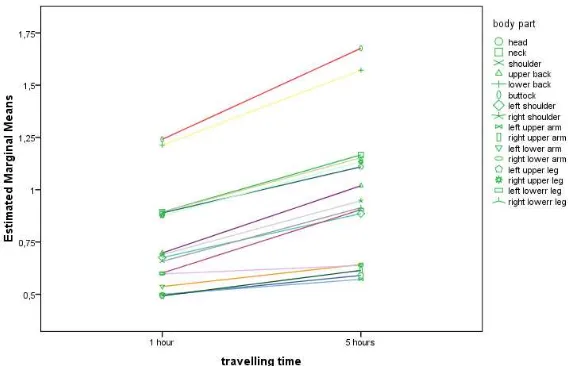
Univariate analysis of variance was conducted to find the differences of body back discomfort level for truck driver between after 1 hour and after 5 hours travel. Figure 2 showed the comparison of body discomfort level for different body back part after 1 hour and after 5 hours travel. Most of the respondents felt that buttock was the most discomfort body back part than others body back part after 1 hour travel (M = 1.24, SD = 1.34) as well as after 5 hours travel (M = 1.68, SD = 1.43). It was followed by lower back, neck, shoulder and right upper leg. From Figure 2, it was noticed that there were same top five body back part discomfort after 1 hour travel and after 5 hours travel. The results also showed the body back discomforts level after 5 hours travel was higher discomfort than body discomfort level after 1 hour travel.
Figure 2: graph body back discomfort of truck driver over 1 hour and 5 hours travel.
DISCUSSIONS
For after one hour driving, the most discomfort body part is buttock; it is followed by lower back, neck, shoulder, left upper leg and right upper leg. Subsequently, With respect to body back discomfort after 5 hours driving, the most discomfort body part is buttock; it is followed by lower back, neck, shoulder and right upper leg. The result showed the buttock is the most discomfort body part over time. It is followed by lower back, neck and shoulder. The truck driver requires sitting for long periods of time. The extended period of sitting includes higher risk of back problems, numbness and discomfort in the buttocks due to surface pressure under the thighs (5). Hulshof and van Zanten (12) reported that truck drivers is exposed to whole body vibration while driving for some periods of time and this has been causing low back pain. Poor posture in some types of truck have been linked with neck and trunk discomfort (13). In the study by Porter et al. (14), it was observed that buttock discomfort is increased over time. The prolonged sitting and uneven pressure distribution at buttock may cause the discomfort for truck driver. Chow and Odell (15) reported that a sitting person unconsciously adjusts his body position when he feels discomfort. There is an inverse relationship between the tolerable pressure levels and the time duration of the pressure. This time pressure
relationship depends on many factors such as general health of the patient, the diet, seat pan and backrest cushion type etc. If pressure is relieved intermittently, higher pressure can be tolerated for the same time period or a longer duration of a specific pressure. Thus, it will increases the incidence of pressure sores and lengthens the tolerable time period in a given body position.
CONCLUSIONS
In the present survey, we sought to gain more insights into body back discomfort level between after 1 hour flight and after 5 hours. There were 217 truck drivers filled up the questionnaire about body discomfort level after 1 hour and after 5 hours travel. In line with the survey hypothesis, findings confirmed that truck driver who after 5 hours driving are more discomfort than after 1 hour travel. The finding also showed that buttock, shoulder and neck were the same body part discomfort for truck driver over time. The truck seat comfort
seat comfort should be prioritized when devising a discomfort reduction strategy for truck drivers and improve the driving comfort for long hour.
ACKNOWLEDGMENTS
The survey was funded by Designed Intelligence Group, Department of Industrial Design, Technical University Eindhoven and Technical University of Malaysia Melaka. We thank Marinka de Groot from BGZ Wegvervoer, the Netherlands for information and distribution of truck driver questionnaires.
REFERENCES
(1) Gruber, G.J., “Relationship between Whole body Vibration and Morbidity Patterns among Interstate Truck Drivers”, Southwest Research Institute, San Antonio, Texas, Center for Disease Control Publication, 77-167, 1976.
(2) http://www.euractiv.com / en/ transport/ drivers- deplore-inconsistent-eu-working-time-laws/ article- 166879. Accessed on 10 November 2007.
(3) De Looze, M.P., Kuijt-Evers, L.F.M. and Dieen, J.V., “Sitting comfort and discomfort and the relationship with objective measures”, Ergonomics, vol. 46, no. 10, 985-997, 2003.
(4) Shen, W. and Vertiz, A.M., “FOCOPP- an approach for a human posture prediction model using internal/external forces and discomfort”, Society of Automotive Engineers. Inc., Technical Paper, no. 970597, 1997.
(5) Floyd, W.F. and Roberts, D.F., “Anatomical and physiological principles in chair and table design. Ergonomics”, vol. 2, no. 1-16, 1958.
(6) Adler, S., Friedrichs, A. and Blickhan, R., “Analysis of driver seated posture to objectively measure long-term discomfort”, 6th world congress on ergonomics. Maastricht, the Netherlands, 2006.
(7) Helander, M.G. and Zhang, L., “Field studies of comfort and discomfort in sitting”, Ergonomics, vol. 40, no. 9, 895-915, 1997.
(8) Runkle, V.A., “Benchmarking Seat Comfort”, SAE Technical Paper, no. 940217, 1994.
(9) Quigley, C., Southall, D., Freer, M., Moody, A. and Porter, M., “Anthropometric Study to Update Minimum Aircraft Seating Standards”, EC1270, ICE Ergonomics Ltd., 2001.
(10) Hinninghofen, H. and Enck, P., “Passenger Well-being in Airplanes”, Auton Neurosci, vol. 129, no. 1-2, 80-85, 2006.
(11) Hulshof, C. and van Zanten, B.V., “Whole-body Vibration and Low Back Pain- a Review of Epidemiological Studies”, International Archives of Occupational Health, vol. 59, 205-220, 1997.
(12) Massaccesi, M., Pagnotta, A., Soccetti, A., Masali, M., Masiero, C. and Greco, F., “Investigation of work-related disorders in truck drivers using RULA method”, Applied Ergonomics, vol. 34, 303-307, 2003.
(14) Mark Porter, J., Gyi, D.E. and Tait, H.A., “Interface Pressure Data and the Prediction of Driver Discomfort in Road Trials”, Applied Ergonomics, vol. 34, 207-214, 2003. (15) Chow, W.W. and Odell, E.I., “Deformations and Stresses in Soft Body Tissues of a