iv
from phonological change that he found during conducting the job training.
This research uses a qualitative descriptive method, since the data is presented in form of words and sentences instead of numbers.
v ABSTRAK
Laporan berjudul “Translating Medical books: The Types of Loan Words Presented in Nursing Care of Patients Living with HIV/AIDS” memperlihatkan jenis-jenis kata pinjaman yang digunakan di Indonesia yang mengalami perubahan fonologis dan yang tidak mengalami perubahan fonologis yang ditemukan penulis pada saat menjalankan kuliah kerja nyata.
Penelitian ini menggunakan metode penelitian deskriptif kualitatif karena data yang yang diteliti di presentasikan dalam bentuk kalimat, bukan nomor,
HARY PRATAMA 63708004
Bandung, November 2011 Approved by:
Advisor,
Asih Prihandini, S.S., M.Hum. NIP: 4127.20.03.010
Acknowledged by Head of English Department
1 CHAPTER I
INTRODUCTION
1.1Background
Medical field plays very important role to maintain and to restore people`s health. Today, with the improving condition of globalization, the health professionals all over the world are expected to work together to develop new medicines. In this case, Indonesian health professionals are expected to update their knowledge due the Indonesian medical science is still oriented to European.
Moreover, most of medical terms used by Indonesian health professionals are borrowed from English. Some of them are borrowed directly without phonological change, and some of them borrowed with some adjustment of phonological change.
The issue that the writer wants to discuss is the types of loan words from English to Indonesian in book titled comprehensive nursing care of Patients living with HIV/AIDS published by Family Health International.
1.3Objectives
The objectives of this Job Training report are as follow:
1. To share the information about English medical terms in Indonesia;
2. To share the knowledge to translate the text which contains medical terms; 3. To complete the 7th semester subject`s requirement.
.
1.4Significance to Knowledge
3
1.5The Framework of the Theory
David Crystal (2008) mentioned that Loan is a linguistic unit (usually a lexical item) which has come to be used in a language or dialect other than the one where it originated. Moreover, Crystal identifies several types of loan process. The first one is loan words (where both form and meaning are borrowed, or „assimilated‟, with some adaptation to the phonological system of the new language. To check whether the words that the writer found belong to English loan words or not, the writer used medical glossary and Kamus Kata-kata Separam Asing dalam Bahasa Indonesia.
1.6Research Method
1.7Place and Time of Job Training
In every program, the schedule is usually organized regarding to the stated role. It is intended to create the discipline of the order to sustain the activities. This job training was placed and timed as clarification bellow:
1.7.1 Place
This Job Training was held in COMPAC Female addressed at Eijkman Streets No. 38 Bandung West Java Indonesia.
1.7.2 Time
5
CHAPTER II
THE GENERAL DESCRIPTION OF COMPAC – FEMALE
2.1 General Description
COMPAC – Female (Community – based Prevention and Care for Most-at-Risk Females) is a collaboration program between TB working Group Health Research Unit and Padjadjaran University. This organization focuses on sexual reproductive health and life skills education related to HIV-AIDS for females. COMPAC - Female is funded by CORDAID to train nurse and midwife in order to improve their knowledge and skill in delivering health services to community, especially for females.
2.2 The Objectives of COMPAC – Female
With the goal to improve HIV-prevention and care for females in West Java, COMPAC – Female has several objectives as follow:
2.2.1 General Objective
To improve the capacity in prevention, treatment, and care of HIV/AIDS program among most-at-risk females in West Java.
2.2.2 Specific Objectives
1. To improve the education for adolescent and female in West Java through the implementation of Puskesmas outreach program including the participation of public health workers (nurse and midwife) as well as government and private sector.
2. To increase the knowledge and skills of nurses and midwives in nine selected districts/cities with most HIV cases and skill related to HIV-prevention.
7
4. To strengthen Home-based care service in community conducted by nurse and midwife
5. To contribute to the MDGs attainment for West Java in the form of strengthening first-line provider skills, referral system and home-based care system in the community.
2.3 Job Position and Coordination
In doing the Job Training, the writer has responsibility to translate medical books from English to Bahasa Indonesia and vice versa that will be used as the guideline for Master Trainer activity in the nine selected districts/cities in West Java Province.
2.3.1 Job Position
Coordination is organized by one Program manager, one Operational officer, and one Training Coordinator, as well as 11 supporting staffs, including the writer. The specification of responsibilities as follows:
1. Diba A. E. P. Basar, S.S. M.Si.
a. Job Position : Program Manager
b. Job Authorities : allowing the writer to conduct his Job Training, and giving the writer credits
b. Job Responsibilities : executing, and monitoring projects based on schedule
1. Dindin Komarudin, S.E.
a. Job Position : Operational officer of COMPAC-Female b. Job Authorities : allowing the writer to conduct his Job Training c. Job Responsibilities : monitoring the sustainability of the program
2. Thareq Barasabha, S.Ked. dr.
a. Job Position : Training Coordinator
b. Job Authorities : giving the writer guide and support, and giving grade to the writer
9
2.3.3. Responsibilities
During his Job Training, the writer has responsibility to contribute in achieving the objectives of the organization. Here are responsibilities of the writer:
1. Translating medical books into Bahasa as guideline for module development team
2. Translating the modules which are developed by Module Team Development into English as the reports for CORDAID.
10
Since Indonesian medical field is oriented to Europe in which the health professionals there communicate using English, many Indonesian health professionals also use English medical terms as well. It is because the loan word
“reflect historical contact between people and culture” (Lombard, 1990).
During his job training, the writer found some loan words which are used by health professionals in Indonesia. Most of them are medical terms from English. For instance, when the writer had to translate the term Profilaksis which is found in a module developed by the module development team into English. The writer referred to Kamus kata-kata serapan asing dalam bahasa to ensure whether this term is a loan word from other language that suffer from phonological change or not, and to check the origin of them.
After the writer collects loan words from book titled Nursing Care of Patients with HIV/AIDS, and other sources, the writer refers to Kamus kata-kata serapan asing
dalam bahasa Indonesia to check whether the terms are loan words or not. Moreover,
11
language phonology" (Lucia V. Aranda. Handbook of Spanish-English Translation, p.10). From the notion above, we can assume that medical terms borrowed from English are used in Indonesia with some adjustments of Indonesian pronunciations.
In addition, David Crystal (2008) mentioned that Loan word is a linguistic unit (usually a lexical item) which has come to be used in a language or dialect other than the one where it originated. Moreover, Crystal identifies several types of loan process. The first one is Loan words (where both form and meaning are borrowed,
or „Assimilated’, with some adaptation to the phonological system of the new
language). However, the writer focuses on identify the loan words that suffer from phonological change or assimilation.
3.2 The Types of Loan words
One of the types of loan words presented by David Crystal in his book titled Dictionary of Linguistics and Phonetics is assimilated word. Based on the notion
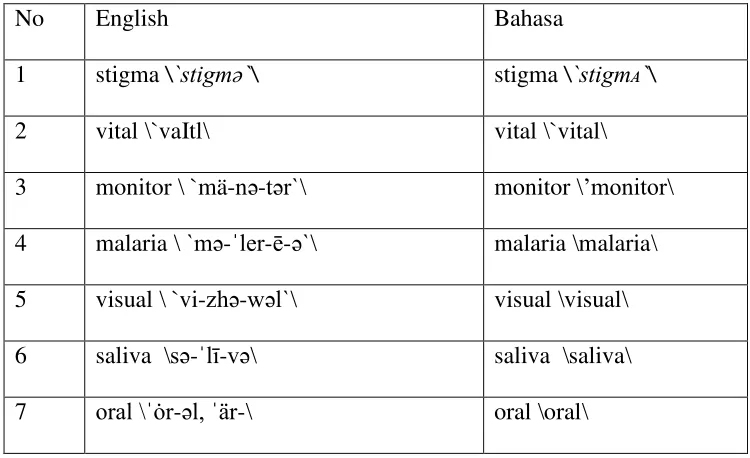
Loan word is a process of borrowing word where both form and meaning are borrowed without any change in its written. The majority of loan words that the writer found in documents contains medical terms are loan words which do not suffer from phonological changes. These loan words maintain their pronunciation and written. It is caused by the phoneme of these words has the same characteristic with Indonesian words. Therefore, Indonesian people do not find any difficulties to pronounce the word. The pronunciation and the writing of these words do not change because they have been used as general words in Indonesian. For further details, it will be described in the table below.
Table 1. List of Loan Words with no change in its form
No English Bahasa
1 stigma \`stigmǝ`\ stigma \`stigmᴀ`\
2 vital \`vaItl\ vital \`vital\
3 monitor \ `mä-nə-tər`\ monitor \‟monitor\ 4 malaria \ `mə-ˈler-ē-ə`\ malaria \malaria\ 5 visual \ `vi-zhə-wəl`\ visual \visual\ 6 saliva \sə-ˈlī-və\ saliva \saliva\
13
8 herpes \ˈhər-(ˌ)pēz\ herpes \hèrpes\
The words in the table above are medical terms from English that are used in Indonesia without any change neither in their pronunciation nor in their written.
3. 2.1 Assimilated/assimilation
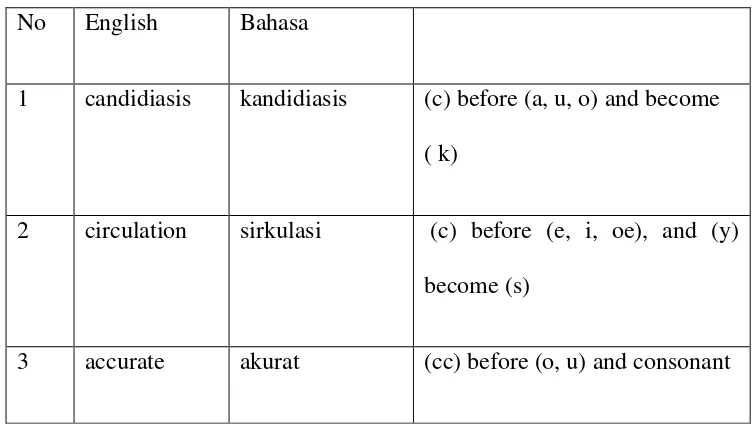
[image:16.612.141.518.468.681.2]According to Crystal in his book titled Dictionay of Linguistics and Phonetics, Assimilated word is a process of borrowing a terminology from source language with some adaptation to the phonological system and written of the source language. For more detail, it will be described on the table below.
Table 2. Lists of medical terms with some adaptation
No English Bahasa
1 candidiasis kandidiasis (c) before (a, u, o) and become ( k)
2 circulation sirkulasi (c) before (e, i, oe), and (y) become (s)
5 vaccine vaksin (cc) before (e) and (i) become (ks)
6 chromosome kromosom (cch) and (ch) before (a, o) and consonant become (k)
8 phase fase (ph) becomes (f)
9 frequency frekuensi (q) becomes (k)
10 schizophrenia skizofrenia (sch) before vocal become (sk)
11 patient pasien (t) before (i) become (s) if the pronunciation is (s)
15
Handbook of Spanish-English Translation, p.10). Based on the theory above, we can see that the adaptation of loan words is required to make readers in the target language easier to spell them.
3.3Problem Identification
Since medical translation is a new experience for the writer, he faces some problems in translating the documents with medical terms. First, he finds it difficult to translate certain medical terms, for example, the term candidiasis, if this term is translated by its literal meaning to Bahasa Indonesia it will be infeksi yang disebabkan oleh jamur. However, the health professionals in Indonesia are more
familiar with term kandidiasis..
3.4Solution of the Problem
16
CONCLUSION AND SUGGESTION
4. Conclusion and Suggestion
This chapter describes the conclusion of the problems that are discussed in this paper and suggestion. For the further details, it will be explained below.
4.1Conclusion
During conducting his job training, the writer was contracted by the organization to translate several medical books from English to Bahasa Indonesia and vice versa.
Translating medical terms require more understanding, so before a translator translated any text, the translator must first know who the reader is. Due to the target reader of the writer are health professional, the writer must know the terms that are familiar with Indonesian health professionals. In solving the problem, the writer asks a doctor that works with him to know the types of translation those Indonesian health professionals familiar with. Based that question, the writer knows that most of medical terms that are used in Indonesia are borrowed from Europe.
17
Indonesian health professional, it will be easier for them to use borrowed medical terms.
4.2 Suggestion
The suggestions from the writer are as follow: 4.2.1 Suggestion to The Faculty of Letters
The English Faculty of Letters should support the students to find the institution for their job training, through developing connection with many institutions. It will make The English Faculty of Letters become more widely known by publics, and help the student.
4.2.2 Suggestion to The English Department
The department should develop connections with institutions that will make the students easier to do their job training.
4.2.3 Suggestion to The Students
JOB TRAINING REPORT
Submitted to fulfill one of the course requirements
Hary Pratama 63708004
ENGLISH DEPARTMENT FACULTY OF LETTERS
INDONESIA UNIVERSITY OF COMPUTER BANDUNG
26
CURRICULUM VITAE
1. Student`s profile
a. Name : Hary Pratama
b. Address : Jl Sekeloa utara No33B, Bandung
c. Place and date of birth : Sukabumi, September 2nd 1990
d. Sex : Male
e. Religion : Islam
f. Phone :085759837653
g. Email
2. Educational background a. Formal education
No Year Institution
1 1996-2002 SDN Sukaraja 1 Sukabumi
2 2002-2005 SMPN 15 Sukabumi
b. Informal education
No Year Name of Education Certification
1 2008 Mentoring of English Conversation Club Certified
2 2008 Mentoring Agama Jurusan Sastra Inggris Certified
3 2009
English Leadership Internal Training of Education (ELITE)
Certified
4 2009
Seminar and Workshop Copywriting as a Creative Thinking
Certified
5 2010
Copy Writing and Consumer Behavior Seminar
Certified
6 2010 Workshop Translating & Interpreting Certified
7 2010 Seminar IT-Preneur Certified
8 2011 Seminar Feminist, Feminine and Text Certified
9 2011
Kuliah Umum “Strategi Politik Luar Negeri
28
c. Competency
Here are the competencies that the writer has: 1.Spoken English both oral and written
2.Translating documents from English to Bahasa Indonesia and vice versa
3.Basketball
4.Operating computer
d. Organizational and work experiences
1.June 2011 – December2011 work asConsultant translator at COMPAC-Female
Bandung, ____________________
18 REFERENCES
Aranda, L. V., 2007. Handbook of Spanish-English translation. WikiAnswer, retrieved on September 11, 2011 from
http://wiki.answers.com/Q/What_is_Phonological_translation.
Badudu, J.S, 2003, Kamus Kata-kata Separam Asing dalam Bahasa Indonesia, Penerbit Buku Kompas.
Crystal, D. (2008). A Dictionary of Linguistics and Phonetics. 6th edn, Oxford: Blackwell.
Crystal, D. (2003). English as a Global Language. 2nd edn Cambridge: CUP.
http://kateglo.bahtera.org/
Oxford, 2003, Oxford Learner`s pocket Dictionary new Edition, Oxford University press.