FRENCH MULTI-TRACK CULTURAL
DIPLOMACY TO INDONESIA THROUGH
PRIVATE SECTORS
(STUDY CASE: PRINTEMPS FRANCAIS IN INDONESIA 2012 - 2016) Abstract
France is one of the most modern countries in the world, with vast development and technology as well cultural heritage they possessed. The emergence of cultural diplomacy is taken account by many developed countries such as France. This research will try to elaborate concept of cultural diplomacy, multi-track diplomacy and national interest to answer question why French government maximize private sectors to support the multi-track diplomacy in Indonesia in case of Printemps Francais 2012 to 2016. Method that will use in this research is qualitative methods where the data use is primary and secondary data. Secondary data is collected from books, journal, literature, and information from Internet that related to the topic. Primary data obtained from in-purposive sampling through in-depth interview with related person in the field. The results show that French government needs support on the budget to implement Printemps Francais so it maximize the involvement of private sectors. Printemps Francais also become the medium to facilitate French product in Indonesia.
1 CHAPTER I
INTRODUCTION
This first chapter will begin with background of the problem by elaborating briefly France information and its bilateral relations with Indonesia. It follows with the French institution that manages relation in Indonesia, especially in culture and education program. This chapter will describe Printemps Francais as part of program runs by Institut Francais that regarded as tools of its cultural diplomacy. Later on, this chapter will mention research question that limits the range of the research that comes up based on the background explained before. Literature review that use to developed topic discussed in this research will be mentioned later, as well as theoretical framework, contribution of the research, range of the research, research methods and data collection, and last is the structure of the research.
A. Background
France is known for its diverse culture, good economy, as well as welfare of its citizen. According to focus-economics.com, in 2015 Growth Domestic Product (GDP) per capita of France is 33,990 Euros and its economic growth is increasing from 2012 where it was only 0.0 percent to 1.2 percent also in 2015.1 Paris, the capital city of France is well known for its fashion and architecture. One of its famous
1
2 landmarks is the Eiffel Tower that standing tall in the heart of Paris. Not only famous with its fashion industry, France also known for its architecture fines arts, as well as performing arts. There are many artists reside in France such as Monet, Renoir, Delacroix, and many others.2 France is a country rich in for all but there is an emergence of soft power taken a big role in creating world political condition.3 This shifted of world politics enforce the role of soft power diplomacy to be taken account, not again become the kick-side of hard power diplomacy like military and economic based diplomacy. Cultural diplomacy is set of actions which exercise the exchange of values, ideas, traditions and other parts of culture or identity, in order to strengthen relations, cooperation in socio-political aspects, promote and achieve national interest and many other purposes.4 Among countries within European Union, France is one of the countries that actively promote
2
Famous French Painters, taken from The Famous People: http://www.thefamouspeople.com/french-painters.php 3
Andrew F. Cooper, Jorge Heine, Ramesh Thakur, “The Oxford Handbook of Modern Diplomacy”, 2013, Oxford University Press
4
Cultural Diplomacy Definition, retrieved on June 10, 2016, taken from Institute of Cultural Diplomacy:
3 themselves through cultural exchange.5 Cultural activities use by French government to promote their ideas, values, and Indonesia relations already started since the colonization era, even though it was not significant like Netherlands and Portuguese. The relations during colonization was indirect relations where in early 19th century when Netherlands lost war in Napoleonic wars, its possession belong to France as well as in East Indies.6 France revolution and its government system inspired Indonesia legal system.7 In 2011, President Susilo Bambang Yudhoyono and President Nicholas Sarkozy agreed on strategic partnership after Indonesia’s President visited France in 2009.8 France and Indonesia relations in economic sector are visible in which many France companies operating in Indonesia such as Total, Carrefour, Michelin and Air France.
5
France & The Promotion of French Worldwide, Cultural and French Language Policy, retrieved August 17, 2016, taken from:
http://www.diplomatie.gouv.fr/en/IMG/pdf/FR_promotion_du_francais_version_ anglaise_cle4df411.pdf, retrieved August 17, 2016
6
Asvi Warman Adam, “The French and the British in Java1806-1815”, Britannica, taken from: https://www.britannica.com/place/Indonesia 7
Timothy Lindsey, “Indonesia, Law and Society”, 2008, Federation Press 8
Erwida Maulia, “RI, France agree on ‘unlimited’ strategic partnership”, 2009, Jakarta Post, taken from Press Reader:
4 Bilateral relations between France and Indonesia also occur in other sectors like culture.
France has many successful histories in keeping or creating good relations with once enemy now partner countries through cultural diplomacy, one of them was German. German and France were known as ferocious enemy, involved in many bloody wars and conflicts. The cultural understanding between both countries was starting by the signing of Elysee Treaties in 1960.9 The importance of language exchange between two countries become the beginning of better relations between them; they started to create an effort to increase number of school children to learn about each other languages.10 From this example, France is seen to understand the importance of cultural exchange in creating, developing, and maintaining its relations to others. Moreover, it gives better chance for France to achieve its national interest.
The role of cultural diplomacy is not only seen as good steps for successful relations between France and other countries, but it is also realized by many countries around the world such as United States of America, South Korea with its spread of k-pop, and more. For example is the United States diplomacy in education which now known as Fulbright scholarship. This scholarship is at the beginning proposed by
9
The Franco-German Treaty of Friendship, taken from:
http://www.cvce.eu/en/recherche/unit-content/-/unit/02bb76df-d066-4c08-a58a-d4686a3e68ff/e186f474-22ac-4360-bc1d-d923d8ecadc4
5 Senator J. William Fulbright in 1945. The bill included the use of profit from war property to create and promote international goodwill in the exchange of students in education, science, and cultures.11 He saw the benefits of creating good images of the States. This program has been implemented from the beginning of 1950s until today.
Another advance cultural diplomacy implementation is done by South Korea. South Korea is one of the new emerging countries in Asia and the world with its culture dispersion as well as economic development in technological industry. South Korean culture is spread through addicted Korean drama or shortens as K-drama and do not forget the musical influences it brings to the rest of the world.12 The benefits of music industry to South Korea economy is, for example, the income of famous k-pop idol agency is around 630 million dollar in year, not only adding the national income it also become the effective tools to promote South Korean culture.13
From some of cases mentioned earlier, France is advanced in cultural diplomacy area as good as United States or South Korea. France has sets of strategy and also agencies that
11
History of Fulbright, taken from Fulbright: http://us.fulbrightonline.org/about/history 12
Anais Faure, “K-Culture Diplomacy: From Sao Paulo to Tehran”, May 2016, taken from The Diplomat: http://thediplomat.com/2016/05/k-culture-diplomacy-from-sao-paulo-to-tehran/
13
Zack O’Malley Greenburg, “Big Bang Theory: How K-Pop’s Top Act Earned $44 Million In a Year”, July 2016, taken from Forbes:
6 involved in its cultural diplomacy. Institut Francais d’Indonesie is institution that manage cooperation network in Indonesia on culture and linguistic sectors. Institut Francais d’Indonesie (IFI) is located is several cities in Indonesia, Jakarta, Bandung, Yogyakarta, Surabaya, as well as Bali. IFI is a consolidation of Service for Cooperation and Culture (Le Service de Cooperation et d’Action Culturelle (SCAC)) of French Embassy with French Cultural Centers (Centre de Culturelle Francais (CCF)).14 In short, IFI is a French agency that manages the cooperation between France and its host country. IFI Indonesia is a cooperation agency that conducts cooperation in education and culture between France and Indonesia.15
Printemps Francais is annual program held by France government within the framework of Institut Francais programs. This festival that celebrate and held every year is not only in Indonesia, but also in other countries where Institut Francais located such as Srilanka, Laos, and Hongkong. Printemps Francais celebration is including performing arts from various French artists that having performance in several cities in Indonesia, French and Indonesian artists collaboration, workshop, and discussion. In 2016, Printemps Francais already held in Indonesia for 12 times. The opening ceremony of
Printemps Francais 2016 held in Jogjakarta on 28th April 2016 with the performance by French leading puppet theatre group
14
About IFI, taken from IFI: http://www.ifi-id.com/presentasi 15
7
Les Remouleurs which collaborate with Indonesian artist.16
Printemps Francais that held every year from 2004 to the recent festival in 2016 must have certain results to the bilateral relations between France and Indonesia. There must be reason why this spring festival is still ongoing since 12 years ago and with many French companies supporting the budget of the festival. Printemps Francais is self-sufficient festival where the budget is mainly came from partnership. Even though it was governmental organization, IFI, that organized the Printemps Francais need to cooperate with private sectors in order to create a better cultural exchange during the festival. Printemps
Francais is a cultural diplomacy implement by French
government under Institut Francais, which the exercise of the festival is requiring a broad support and work of various level of parties. Private sectors have a great role in term of supporting the Printemps Francais in Indonesia.
B. Purpose of Research
The writer has several purposes by conducting this research on French Cultural Diplomacy to Indonesia through
Printemps Francais:
1) The research aim to understand how France government construct the cultural diplomacy in brief, and the festival of
Printemps Francais as their diplomacy instrument not only
16
Indonesia Francais Institute Launch Printemps Francais 2016 Festival, retrieved August 10, 2016, taken from Jakarta Globe:
8 to Indonesia but also to other countries to maintain and develop their relationship.
2) To understand the importance of the cultural diplomacy through the festival in gaining France national interests in Indonesia.
3) To analyze the reasons in maximizing private sectors to support the Printemps Francais as one of its multi-track cultural diplomacy instrument in Indonesia.
C. Contribution of Research
This research aims to contribute on several aspects:
1) This research will be contributing on the evaluation for French government towards the importance of the cultural exchange within the Spring Festival.
2) To contribute as lessons for Indonesian government in managing its cultural diplomacy towards other countries. 3) This research contributes as well in broadening the ideas of
multi-track cultural diplomacy as one of effective tools in creating a better relationship among countries.
D. Research Question
Based on the background of the research explained in the previous section of this chapter, the research question is “Why French government maximize private sectors to support the
9 E. Literature Review
There are some literature and academic paperwork, which discussed the topic of cultural diplomacy and specifically France cultural diplomacy. These literatures are helping the writer to create and develop idea or topic of this research.
1) Review on French Science and Cultural Diplomacy by Phillipe Lane
10 2) Undergraduate Research of Fitria Afriyanti
Undergraduate thesis with titled Diplomasi Kebudayaan Perancis di Indonesia Melalui Institut Francais D’Indonesie
(IFI) Tahun 2012-2013 (French Cultural Diplomacy in
Indonesia through Institut Francais D’Indonesie (IFI) in 2012 – 2013) talked about the role of IFI in promoting the french cultural diplomacy within several programs held by this institute. Cultural diplomacy of France has two priority, education and influences. Based on the research done by the Afriyanti, French government exercise its cultural diplomacy under Counselor of Cooperation and Culture of French Embassy in Indonesia through Institut Francais D’Indonesie.
11 student to study in France. This program is believed to be one of the effective ways to spread French language and culture through mobility of students, teachers, and lecturer from and to Indonesia. The last program is science cooperation. Under IFI, there are some programs that established to connect to education facilities. French Corner and Joint Research Programs are programs for science and reserach related topic.
Based on Afriyanti’s research there are quite problems and barriers regarding the imlementation of programs manage by IFI. Despite, all the odds face by IFI in establishing french cultural dilplomacy, there are succeed stories of all the effort done by IFI, one of them is there are increasing number of audience to the program held by IFI as well as the number of student and researcher that cooperate with France university and also student and researcher that applied French as their additional languages.
12 3) Undergraduate Research of Dian Rachmawati
Undergraduate paper of Dian Rachmawati entitled
Festival Film Cannes 2006 sebagai Diplomasi Kebudayaan
Perancis (Cannes Film Festival 2006 as French Cultural Diplomacy) written on 2007 discussed about diplomacy done by France through film festival, which is the most known film festival, Cannes. The writer of this research created hypothesis on the topic of France Cannes Film Festival, which are the implementation of French cultural diplomacy through Cannes Film Festival is categorized as exhibition form of cultural diplomacy. Based on this research the purpose of French cultural diplomacy is to increase or improve its France economic welfare by tourism.
13 contribute in this prestigious film festival. This type of cultural diplomacy is not only beneficial for France but also for Indonesia, through this festival Indonesia young artist could participate and at the same times creating an images of Indonesia film industry development. Prenjak, short movie, which produced by Indonesian filmmaker, recently won an award in Cannes Film Festival 2016 on Leica Cine Discovery Prize, this example, is showing the impact of French cultural diplomacy through Film Festival.17
4) The First Resort of Kings: American Cultural Diplomacy in the Twentieth Century by Richard T. Arndt
The book written by Richard T. Arndt discussed about United States cultural diplomacy from the early times where first World War to the recent years. Richard T. Arndt, the writer of the book is pursued his career in United States Information Agency (USIA) for almost quarter of century. On this book, Andt could describe and explains well about United States cultural diplomacy or public diplomacy because he is been in the office before. This book explains phenomenon, which related to American cultural diplomacy such as the birth of USIA, President’s period, as well as Fulbright which one of American cultural diplomacy tools. From the book by Andt, the writer could get wider images on how cultural diplomacy may take place in different
17
Agnes Anya, “Indonesian short movie Prenjak wins award at Cannes”, May 16, 2016, taken from The Jakarta Post:
14 situation of a state. Scheme of cultural diplomacy might differ from one state to another state as the definition of cultural diplomacy might be different as well based on how the state also defines its national interests. This book is giving a new perspective on perceiving the role of states in shaping the cultural diplomacy by explaining president’s period and how the cultural diplomacy is implemented.
5) Research Paper on La Diplomatie Culturelle Francaise: La culture face à de nouveaux enjeux? by Gerbault Loïc
Research paper by Gerbault Loïc entitled “La Diplomatie Culturelle Francaise: La culture face à de
nouveaux enjeux?” or in English is “French Cultural
15 also highlight the emergence of new economic of China. This paper gives perspective based on French point of view.
6) Article The Neglected Aspects of Cultural Diplomacy by John Brown
Article written by John Brown that entitled The Neglected Aspects of Cultural Diplomacy published on Routledge Handbook of Public Diplomacy edited by Nancy Show and Phillip M. Taylor in 2009 is talked about one of aspects that have been ignored by United States government on their public diplomacy. This article argues that United States neglect the aspects of cultural diplomacy which is art (arts here included music, literature and painting) in its diplomacy. Brown compared United States with other countries such as France, German, and Japan whom actively use arts as part of their cultural diplomacy. This article could give other perspective on the use of arts in diplomacy as Brown mentioned that there are three reasons why arts is importance to U.S. diplomacy; 1) Arts is a response to the desires of overseas public, 2) it provides context on American cultures, and 3) arts diplomacy will give public unique and memorable experience.
7) Notions of popular culture in cultural policy: a comparative history of France and Britain by David Looseley
16 intercultural aspects rather than Britain. Even though France and Britain most likely has quite the same condition towards their historical background, but Looseley closed his remarks by saying that Britain might learn from a nation across the Channel.18
8) North Korea: The Potential Application of Multi-track Diplomacy to Conflict Resolution and Peace Building
The paper by Randall Cuthbert talked about the multi-track diplomacy in general and applied the nine-multi-track of diplomacy to the peace building and conflict resolution in North Korea.19 The paper talked about the conflict of North Korea and South Korea and applied the nine-tracks to the possible situation of the conflict. It gives a great view on how the tracks use to explain and demonstrate two states relations. In this research, the tracks will explain the cultural diplomacy done by French, and it will focus on some of the tracks of multi-track diplomacy.
From all the literature explained above, those researches are relate and compare to French Multi-track Cultural Diplomacy to Indonesia through Private Sectors, the study
18
David Looseley, “Notions of Popular Culture in Cultural Policy: A Comparative History of France and Britain”, 2011, International Journal of Cultural Policy, 17:4, pp.365-379, DOI: 10.1080/10286632.2010.541907 19
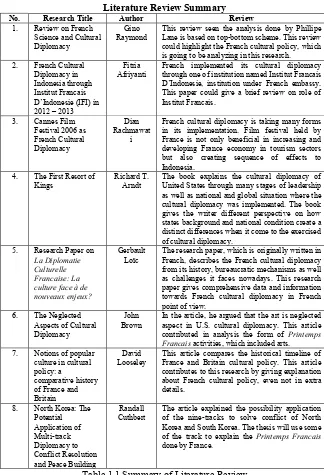
17 case of Printemps Francais in Indonesia 2012 - 2016, it will concluded on the table below.
Literature Review Summary No. Research Title Author Review
1. Review on French Lane is based on top-bottom scheme. This review could highlight the French cultural policy, which is going to be analyzing in this research.
2. French Cultural
French implemented its cultural diplomacy through one of institution named Institut Francais D’Indonesie, institution under French embassy. This paper could give a brief review on role of developing France economy in tourism sectors but also creating sequence of effects to as well as national and global situation where the cultural diplomacy was implemented. The book gives the writer different perspective on how states background and national condition create a distinct differences when it come to the exercised of cultural diplomacy.
The research paper, which is originally written in French, describes the French cultural diplomacy from its history, bureaucratic mechanisms as well as challenges it faces nowadays. This research paper gives comprehensive data and information towards French cultural diplomacy in French point of view.
This article compares the historical timeline of France and Britain cultural policy. This article contributes to this research by giving explanation about French cultural policy, even not in extra
The article explained the possibility application of the nine-tracks to solve conflict of North Korea and South Korea. The thesis will use some of the track to explain the Printemps Francais done by France.
18 diplomacy, firstly the writer will explain briefly about diplomacy and culture itself. Diplomacy is set of communication systems between countries in international system which purpose is to create agreement through negotiation or tacit understanding.20 The words diplomacy itself derived from Greek words “diploma” which is union of “diploun” which means fold and “ma” which means an object.21 The main function of diplomacy is to protect and expand national interest.22 According to Harold Nicholson, Diplomacy is international relations management through negotiation, where the relations adjusted and managed by ambassadors.23 While according to Hans J. Morgenthau, diplomacy is promoting national interests of a state in peaceful ways.24
20
G.R Berridge, “Diplomacy: Theory and Practice”, 2010, Palgrave Macmillan 21
Sally Marks, Chas .W. Freeman, “Diplomacy”, 2016, taken from Britannica: https://www.britannica.com/topic/diplomacy
22
S.L. Roy, “Diplomacy”, 1984, New Delhi: Sterling, 23
Sir Harold Nicholson, “Diplomacy”, 1988, Study of Ersity 24
19 It can be conclude that, diplomacy is set of mechanism, which within it includes the creation of agreement, negotiation between actors that carried out in order to exercise foreign policy of a country. At the beginning of nation-state, diplomacy is done by state officials that appointed by head of government. As the technology develop where national border of states become blurred by the increasing use of World Wide Web, the emergence of non-formal actors that carried out diplomacy is increasing. Diplomacy is not only carried out by formal diplomatic agents chose by government, other official and private people also conduct it.
After getting the brief explanation of the definition of diplomacy, in this research the need to understand culture itself is necessary. According to Lederach, culture is knowledge and scheme shared by group of people in situation where people perceive, interpret, express, and responds to the social situation or condition around them.25 Culture is exceedingly broad term to be define in one definition, this characteristic also influence the definition of cultural diplomacy itself. Culture includes literature, arts, customs, traditions, history, music, and also social relationship.26 In this research, the culture that discussed will
25
John Paul Lederach, “Preparing for Peace: Conflict Transformation across Cultures”, 1995, Syracause, NY: Syracause University Press. p.9
26
20 includes in form of culture that portrayed in Printemps Francais which considered as cultural exchange festival where French and Indonesian culture round up. It can be seen that with several cultural adjustment could increase the possibility of effective persuasion.27 Printemps Francais
uses some cultural adjustment within its framework; such as considerate the cultural background of the host country, in this matter is Indonesia.
In the book written by Richard T. Arndt entitled The First Resort of Kings: American Cultural Diplomacy in Twentieth Century, he argues that the cultural diplomacy is absorb little funds, as he compared to the U.S. aircraft.28 His argument before stated that the cultural diplomacy is giving advantage in creating image with quite minimum budget rather than military policy that cost billions. In the Concise Review on the basic of cultural diplomacy, it can be concluded that cultural diplomacy is:
2008, The Interdisciplinary Center Herzliya, Lauder School of Government, Diplomacy Strategy, Argov fellows Program in Leadership and Diplomacy. 27
Kelton Rhoads, “The Culture Variable in the Influence Equation” on Routledge Handbook of Public Diplomacy, 2009, New York: Routledge, pp. 166
28
21 Cultural diplomacy is a domain of
diplomacy concerned with establishing, developing, and sustaining relations with foreign states by way of culture, art, and education. It is also a proactive process of external projection in which nation’s institutions, value system, and
unique cultural personality are
promoted at a bilateral and multilateral level.29
Joseph Nye in his article The Changing Nature of World Power, made distinction between hard and soft power. He explained that soft power is the ability to persuade through, culture, values and ideas.30 He explained further that power; especially soft power comes from attraction. Attraction use by politicians, groups, and states in form of intangible assets such as culture as mentioned before.31 Moreover as Nye soft power since the use of culture as one of power’s sources in influencing other. Soft power use by France in order to persuade others through attractive attribute she possess, in
29
Concise review of the basics of cultural diplomacy, taken from
http://textus.diplomacy.edu/textusBin/BViewers/oview/culturaldiplomacy/oview. asp
30
Joseph Nye, “The Changing Nature of World Power”, Political Science Quarterly, Vol. 105, pp. 177-192, The Academy of Political Science 31
ibid 32
22 this topic is culture. The use of culture as manifestation of its soft power can be seen in the cultural diplomacy done by France. Culture is one of sources of soft power which it has its own attraction. Cultural diplomacy is indeed using culture as its material in establishing diplomatic relations with aimed states. Giving situation, when someone is adoring culture, they will follow even spread culture they have been looking up to.
There are two important things in cultural diplomacy as explained in Diplomasi Kebudayaan book by Tulus Warsito and Wahyuni Kartikasari, which is micro and macro diplomacy. Micro diplomacy is connected to the culture exploitation to support the implementation of foreign policy. While, macro diplomacy is where cultural diplomacy should involving power and political prestige, economy and military that are possessed by developed countries that create unbalance condition between states that create condition where cultural diplomacy could be implemented in.33 In the implementation of French cultural diplomacy in form of Printemps Francais includes on the definition of micro diplomacy as explained in Warsito and Kartikasari books. Printemps Francais use and exploit cultures in form of performing arts, and other type of arts in purpose to support France’s foreign policy.
33
23 Cultural diplomacy concerns three aspects of national interests, which are cultural identity, political aspects in form of soft power, and creative economy.34 France cultural identity is transferring into its cultural diplomacy through Spring Festival, which organized, by Institut Francais D’Indonesie.
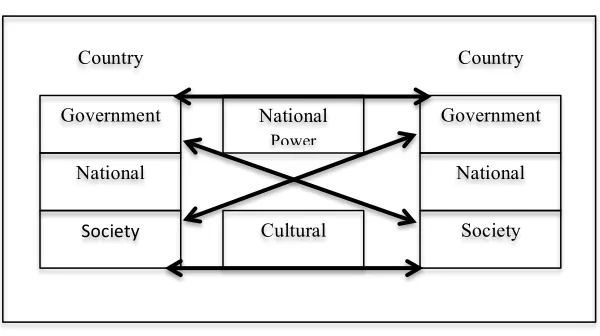
Scheme of Actors and Target of Cultural Diplomacy
Figure 1.1 Scheme of Actors and Targets of Cultural Diplomacy35
As seen on the figure above, cultural diplomacy through
Printemps Francais will be explained as the action of both government and society in order to achieve its national interests. Government is supporting institution and society in set of bureaucracy and regulation in exercising the
34
Hyungseok Kang, “Reframing Cultural Diplomacy: International Cultural Politics of Soft Power and Cretaive Economy”, 2013, taken from:
http://www.culturaldiplomacy.org/academy/content/pdf/participant-papers/2011- 08-loam/Reframing-Cultural-Diplomacy-International-Cultural-Politics-of-Soft-Power-and-the-Creative-Economy-Hyungseok-Kang.pdf
35
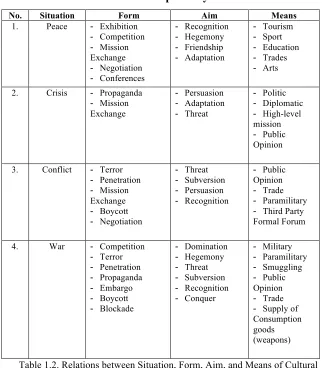
25 Relations Between Situation, Form, Aims, and Means of
Cultural Diplomacy
Table 1.2. Relations between Situation, Form, Aim, and Means of Cultural
Diplomacy36
As the figure above describe the forms of cultural diplomacy in many situations from peace, crisis, conflict and war. The cultural diplomacy of France will be categorized on the form exhibition. Unlike the cultural diplomacy done
36
26 by United States during Cold War which might categorize into condition of war where the form of its cultural diplomacy might fall into propaganda group. Table above gives a highlight on type of cultural diplomacy done by France government to Indonesia through Printemps Francais. Moreover, on article written by Clarke, he argues there are four categories of actors that he considered making value with cultural products, which he later described as cultural producers and consumer.37 The four actors will be described on the table below:
Actors which giving meaning to Cultural Products
No. Name Functions
1. Policy-makers Funding priorities, set policy goals
2. ‘Agents’ 4. Individual Engaging to the cultural products
Table 1.3. Actors which giving meaning with cultural products38
In the explanation of private sectors involvement in the multi-track cultural diplomacy effort done by French during Printemps Francais held in Indonesia, the table above would help to explain the position of private sectors in the cultural diplomacy done by France.
37
David Clarke, “Theorizing the role of cultural products in cultural diplomacy from a Cultural Studies perspective”, International Journal of Cultural Policy, 2016, 22:2,147-163, DOI: 10.1080/10286632.2014.958481
27 Additionally, to understand further about French multi-track cultural diplomacy, the explanation of multi-multi-track cultural diplomacy is needed. Multi-track diplomacy is another form of diplomacy that develops in 1980s. 39 Joseph V. Montville, like any other conflict resolution researcher and practitioner, he worried about Track One diplomacy failures. Later, he mentioned the term of Track Two diplomacy. 40 Track One diplomacy is an official or governmental diplomacy, where the communication and interaction are between the government officials such as President, Ministry of Commerce, or Ministry of Foreign Affairs.41 So, Track Two diplomacy is the unofficial diplomacy done by non-governmental parties. Track One diplomacy, during 1990s, believed incapable to solve the intra-state conflict or protect the international cooperation. Joseph V. Montville argued that the interpersonal approach is essential to support the government effort.42 In the Mapendere article, he explained Track Two diplomacy have strength compared to Track One diplomacy such as; 1) the parties do not constrain by the political or constitutional
39
Jeffrey Mapendere, Track One and a Half Diplomacy and the Complementary of Tracks, Culture of Peace Online Journal 2, pp. 66 – 81. Taken from:
http://peacemaker.un.org/sites/peacemaker.un.org/files/TrackOneandaHalfDiplo macy_Mapendere.pdf
40
Jeffrey Mapendere, Track One and a Half Diplomacy and the Complementary of Tracks, Culture of Peace Online Journal 2, pp. 66 – 81. Taken from:
http://peacemaker.un.org/sites/peacemaker.un.org/files/TrackOneandaHalfDiplo macy_Mapendere.pdf
41
What is Multi-Track Diplomacy, taken from Institute for Multi-Track Diplomacy: http://imtd.org/multi-track-diplomacy
28 power, so that they could express their stand point, 2) they do not fear of losing their constituencies because they are the constituent, 3) it gives platform for people to understand what peace means for them in their society and environment, 4) Track Two diplomacy identified as an effective instrument pre-violent condition as well as post-violent, 5) it operate in grass-root and middle level of leadership that exist within the direct contact of conflict, and the last is 6) do not affected by electoral cycles.43
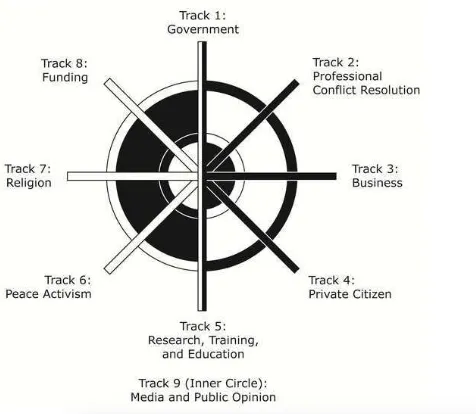
Multi-Track Diplomacy Diagram
Figure 1.2 Multi-track diplomacy diagrams44
43
Jeffrey Mapendere, Track One and a Half Diplomacy and the Complementary of Tracks, Culture of Peace Online Journal 2, pp. 66 – 81. Taken from:
http://peacemaker.un.org/sites/peacemaker.un.org/files/TrackOneandaHalfDiplo macy_Mapendere.pdf
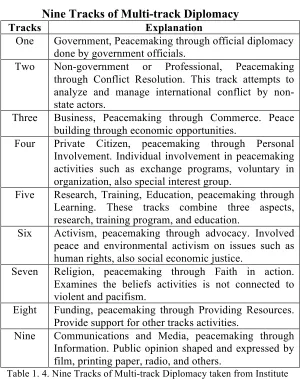
29 In the development of Track Two diplomacy, Dr. Louise Diamond, observed that Track Two diplomacy was not sufficient enough to cover all the complexity under the unofficial diplomacy.45 United States Ambassador, John W. McDonald expanded the Track Two diplomacy into four separated parts; conflict resolution officials, business, private citizen, and media.46 In 1991, Track Two diplomacy expanded more into nine different tracks by added four other tracks. Dr. Diamond and Ambassador McDonald differentiate the tracks into religion, activism, research, training, education, and philanthropy, as can be seen on the figure above. Each of the nine tracks in diagram above is not the only entity that operates by itself but rather interconnected system where each of the tracks are influencing and supporting the diplomacy effort.
45
What is Multi-Track Diplomacy, taken from Institute for Multi-Track Diplomacy: http://imtd.org/multi-track-diplomacy
30 All the nine tracks will be explain below:
Nine Tracks of Multi-track Diplomacy
Tracks Explanation
One Government, Peacemaking through official diplomacy done by government officials.
Two Non-government or Professional, Peacemaking through Conflict Resolution. This track attempts to analyze and manage international conflict by non-state actors.
Three Business, Peacemaking through Commerce. Peace building through economic opportunities.
Four Private Citizen, peacemaking through Personal Involvement. Individual involvement in peacemaking activities such as exchange programs, voluntary in organization, also special interest group.
Five Research, Training, Education, peacemaking through Learning. These tracks combine three aspects, research, training program, and education.
Six Activism, peacemaking through advocacy. Involved peace and environmental activism on issues such as human rights, also social economic justice.
Seven Religion, peacemaking through Faith in action. Examines the beliefs activities is not connected to violent and pacifism.
Eight Funding, peacemaking through Providing Resources. Provide support for other tracks activities.
Nine Communications and Media, peacemaking through Information. Public opinion shaped and expressed by film, printing paper, radio, and others.
Table 1. 4. Nine Tracks of Multi-track Diplomacy taken from Institute
for Multi-Track Diplomacy.47
The involvement of Private Sectors in the cultural diplomacy by France that reflects in the program of Institut
Francais D’Indonesie, Printemps Francais, will be
demonstrate by multi-track diplomacy concept defined above. Private sectors and other actors that involved in the
47
31 implementation of Printemps Francais will be illustrate using the model above and how each of the aspects inter-related to one another. To summarize, multi-track cultural diplomacy is category of multi-track diplomacy that focus on the cultural exchange which will be use to explain several tracks that responsible or associate to the implementation of
Institut Francais’s program, Printemps Francais.
2) National Interests
In order to understand the foreign policy of France by doing cultural diplomacy in forms of cultural festival called
Printemps Francais, the writer decided to elaborate the reasons behind this action. To elaborate France cultural diplomacy, the writer also use national interests concept to analysis more deeply on this topic. Using the national interest concept, there is a need to understand the meaning of interest beforehand.
32 Indonesia. The concept of national interest has two factors, first is the necessity or its existence is demanded rationally, and second is the national interest is changeable and decided based on the situation where it is formulate.48
Miroslav Nincic introduced three categories of basic assumptions that need to be understood regarding the National Interest concept49:
a) The Interest should be vital in its nature, so that its achievement become main priorities for society and government.
b) Those interests should be related to international environment in which the attempt to achieve national interest influenced by international situation
c) National interests should cover beyond individual, group, or governmental institution’s interests. So it becomes concern of the society as a whole
G. Hypothesis
Based on the literature review on the topic discussed in this research as well as theoretical framework that use to explain and analyze the topic, there are several hypotheses can be drawn the reasons why French maximizing the private sector
48
China National Interest-ch1.pdf 49
33 to support multi-track cultural diplomacy in form of Printemps Francais:
- France maximizes private sectors involvement in the
implementation of Printemps Francais because the needs
of funding support.
- France government maximizes private sectors so that it
could facilitate French industrial products as well as
cultural creation of its people.
- Through Printemps Francais within the multi-track cultural diplomacy scheme, it could attract visitors to
France, which could increase number of foreigner, who
come to France whether as tourist or student.
H. Research Method
34 which gives further explanation on the topics. The research is using library research, in which the secondary data mentioned before use to understand fact about the topics.
I. Range of Research
French cultural diplomacy is still general topic to discuss about. In this research, range of research will be specifically analyzing the multi-track cultural diplomacy through private sectors. By creating limit to the research it will focus the research analysis. To even more limit the research, this research only observe the Printemps Francais that held in Indonesia from 2012 to 2016 as the study case. This research is also limit the research only in cultural diplomacy concept multi-track cultural diplomacy and national interest as theory basis in analyzing the phenomenon of French cultural diplomacy to Indonesia.
J. Systematic Writing
Systematic writing of this research will be divided into five chapters, as follows:
35 Chapter II, France and Its Bilateral Relations with Indonesia, this chapter will discuss briefly about France general information started with social and political dimension, economy, involvement in international organization and the main focus of this research is culture. This chapter will also discuss the France and its relation with Indonesia since colonization until this day issues between both countries.
Chapter III, Printemps Francais: French Cultural Diplomacy, this chapter will analyze cultural exchange and diplomacy done by French government. Also, will explain
Institut Francais D’Indonesie and its role in French cultural diplomacy. Moreover, this chapter discusses the Printemps Francais as tools of French cultural diplomacy to Indonesia. Last is the private sectors that involved in the implementation of Printemps Francais would be explain in this chapter.
Chapter IV, Printemps Francais: Sweet Attempts on Multi-track cultural diplomacy, this chapter will analyze the impact of this cultural diplomacy method to bilateral relations between France and Indonesia, it also analysis more about the role of private sectors in supporting French multi-track cultural diplomacy.
CHAPTER II
FRANCE AND ITS BILATERAL RELATIONS WITH INDONESIA
In this chapter the writer will discuss and explain briefly
about the history of France and Indonesia relations from the
beginning of Indonesia’s independence to the recent time. The
explanation will be focus on several big topics between both
countries. It is not only covered the bilateral relations between two
countries but also it will give basic knowledge about France in
general. The France overview will highlighted country profile,
economy in general, as well as the cultural resources owned by
France that become the main focus of this research.
A. France: Country’s General Information
France is one of modern countries in the world and it is
located in Western Europe alongside with Netherlands,
Germany, and Spain. France formal name is La Republique
Francaise or The Republic of France. France revolution on
1780s marked as the shifting of France’s system from absolute
monarchy to republic which purpose to uphold sovereignty
and human rights.1 This one of the earliest countries entitled
with republic system of government that upholds the slogan of
1 French Revolution, taken from History:
liberte, egalite, and fraternite, which means consecutively
liberty or freedom, equality, and fraternity.2
France capital city is Paris, the city of lights. Paris is the
largest city of France; it covers around 100 km2 of land with
population reached 2.2 million people.3 It has become the
most populous urban area in European Union.4 The official
language is French language that also spoke by almost 200
million people all around the world whether as their first or
second language.5 It makes French language is ranked 14th as
language spoken internationally.6
2 French National Motto, taken from Reference.com:
https://www.reference.com/geography/france-s-national-motto-4a3797fc79240b69, retrieved September 25th 2016.
3 Paris, taken from Encyclopedia:
http://www.encyclopedia.com/places/britain-ireland-france-and-low-countries/french-political-geography/paris Retrieved September, 25th 2016.
4 Major Metropolitan Areas in Europe, taken from New Geography:
http://www.newgeography.com/content/003879-major-metropolitan-areas-europe , retrieved October 10th 2016
5
How many people speak French and countries that speak French, taken from France This Way: http://www.francethisway.com/info/french-language-speakers.php, retrieved August 16, 2016
6 The 50 most widely spoken language (2016), taken from:
France Map in European Continent
Figure 2.1 Maps of France7
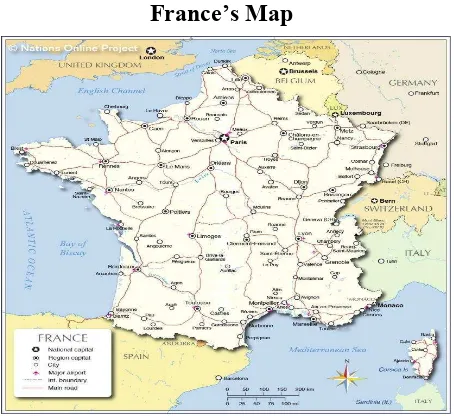
France’s Map
Figure 2.2 France maps8
The area of France is covered around 650, 000 km2 and
positioned as the largest country in European Union and rank
7
How has History Affected People Western Europe, taken from Jrank: http://www.jrank.org/history/pages/8350/How-Has-History-Affected-People-Western-Europe.html, retrieved July 10, 2016
8 France Maps, taken from Nations Online:
43th in the world.9 France is bordering with Atlantic Ocean in
West, Germany, Italy and Switzerland in East, Mediterranean
Sea, Monaco, Spain and Andorra in South.10 Besides, what
have been mentioned about its border, France has coast with
Mediterranean Sea to the South and English Channel in the
North. France geographically consisted by large range of
terrain and has varied of climate. One of the main mountain
ranges is Pyrenees in the Southwest and Alps in the East.
Those mountain ranges created a natural border with its
bordering countries. France central rivers are Seine, Loire,
Garonne, and Rhône.
Area of France noticed above is only covered the France
Metropolitan, excluding France territory outside European
continent. France territory is not only limited to its territory
within Europe, but also other areas such as Guadeloupe,
Martinique, Guyane, La Reunion, Wallis and Futuna,
Polynesie Francaise, Saint-Pierre and Miquelon, Mayotte,
Nouvelle Caledonie, and Terres Australes and Antarticques
Francaise as seen on the figure above. That is all the general
information about France. Moreover, this part of the chapter
will also explain briefly about France socio-political
dimension, its economy, involvement in international
organizations, and last but not least is French culture.
9
50 Largest Countries in the World, taken from Geohive: http://www.geohive.com/earth/area_top50.aspx
10 Political Map of France, taken from Nations Online:
1. Socio-Political Dimension of France
France is a quite diverse country. It is combination
of many ethnicity and race, consists of its French origin,
as well as migrant from Africa and Middle East. It is
quite hard to define demographic of France ethnicity,
because there is prohibition for French Republic to
create distinction between citizens based on their
ethnicity, racial, and religious background according to a
law from 1872.11 Even though it is hard to determine the
spread of ethnicity and race in France through
government data, private polling has conduct many
survey on this diversity.
According to World Population Review, in 2004, it
was estimated that the population of France
Metropolitan is 85% European origin, 10% North
Africa, 3,5% Black, and 1,5% Asian.12 Marketing
company named Solis conducted survey on minority in
2009, resulted on 5.23% Maghrebis, 2.94% Sub-Saharan
Africa, and 0.71% Turkish. Like any other European
countries, France also attract immigration, even in 2008
the number of born immigrants who have been living
and reside in France was 19 % of total population in that
year.
11 ibid
12 France Population 2016, taken from World Population Review:
France Population since 1990 - 2016
Year Population %
Male %
Female
Density
(Km2)
Density
Rank
Growth
Rate
World
Rank
2016 64,668,129 48.7% 51.3% 118 71 0.42 % 22
2015 64,395,345 48.7% 51.3% 117 71 0.42 % 22
2010 62,961,136 48.7% 51.3% 114 70 0.49 % 21
2005 61,241,700 48.8% 51.2% 111 68 0.6 % 20
2000 59,387,183 48.9% 51.1% 108 67 0.55 % 20
1995 58,224,051 49% 51% 106 65 0.38 % 19
1990 56,943,299 49.1% 50.9% 103 65 0.5 % 17
Table 2.1 France Populations13
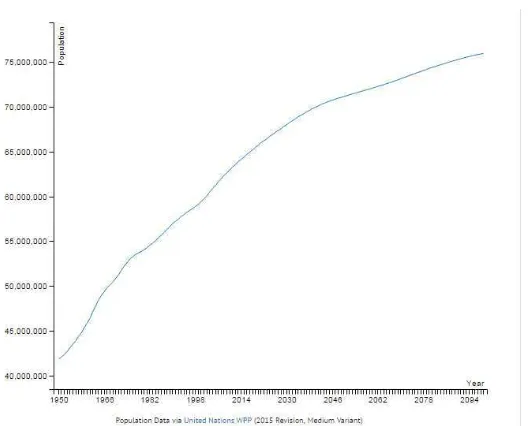
France’s Population Growth
Figure 2.3 France Population Growths14
France population growth is 0.45 percent’s and
there are approximately 62,814,233 of France’s
13 ibid
14
population by July 2014.15 As seen on the figure above,
there is increasing number of population gradually from
1950 to 2014. However, in the end of 1990s, France
population was approximately 58 millions people, it was
considered low compared to other Western Europe
countries.16 At that period, children allowance is given to
the family in order to increase the number of people.
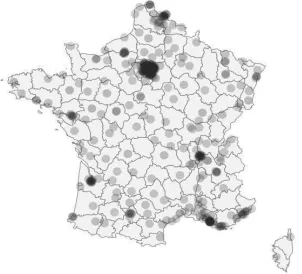
France population density concentrated on the capital
city, Paris as seen on the picture below. The rest of the
dense population is on South France, and the rest is quite
the same.
France’s Population Density
Figure 2.4 France Population Densities17
Even though France famous as secular countries
with no religion attributes on their politics, 64 percent of
15 France Demographic Profile 2014, taken from Index Mundi:
http://www.indexmundi.com/france/demographics_profile.html
16
France, taken from Countries and Their Culture: http://www.everyculture.com/Cr-Ga/France.html
17 Figure of France Population Density, taken from World Population review:
population identified themselves as catholic. Muslim
counted 7.5 percent of population, followed by Jewish,
Buddhist, and Hindus.18 There are also million of people
of practiced folk religion, other religions or unaffiliated
with any of the religion.
Describing about population will leads to political
dimension of France. France today is constituted on the
Fifth Republic, which established in 1958.19 France is
presidential and constitutional or semi-presidential type
of government. France has President as well as Prime
Minister. France recent president, Francois Hollande, is
the 24th President of France from Socialist Party.
France’s Prime Minister is Manuel Valls. Both President
and Prime Minister lead the executive branch. The
system of government administration is divided into
several levels; nation, region, department,
arrondissement, canton, and commune.20 France in
general is highly centralized governmental system, but
since the decentralization act in 1982, more power
distribute to the region and commune.21 France is consist
of twenty-two regions and headed by prefect.
18 Religion in France Fast Facts, taken from Religion Facts:
http://www.religionfacts.com/france
19
France, taken from Countries and Their Culture: http://www.everyculture.com/Cr-Ga/France.html
20 ibid 21
The election is universal suffrage, where people
choose the President as their head of states and later the
President will choose the Prime Minister. France’s
general election divided into two parts, first is
Presidential election and second is parliament election.
Presidential election consists of two stages of voting,
firsts round is where all parties involved to promote their
candidates, candidate that secure their position will
continue to second stage of run-off election where the
most voted will be the President.22 President election
held every five years.
In the parliament, French has two chambers, The
Senate and The National Assembly.23 National assembly
and The Senate or the parliament is elected every
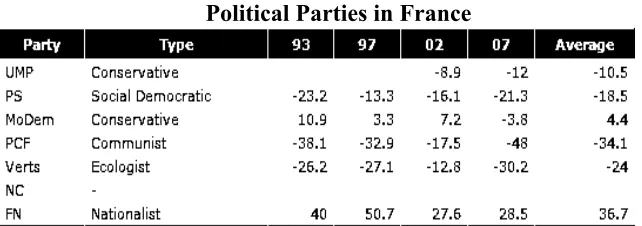
five-year term. France is implementing multi parties system,
there are approximately 14 political parties in France, on
the last election on 2012; Socialist Party (PS) won 29,
4% of seat on the parliament, followed by Les
Republicains (LR), Front Nationalism (FN), Front de
22 Manuel Alvarez-Rivera, “Presidential and Legislative Elections in France”,
taken from Election Resources: http://www.electionresources.org/fr/
23
French-American Foundation, “Your Guide to French Government”, taken from Frenchamerican.org:
Gauche (FG), Europe Ecology The Greens (EELV), and
Nouveau Centre (NC).24
Political Parties in France
Table 2.2 Shows score from left (-100) to right (+100) given in the Comparative
Manifesto Project.25
2. Economic Sectors
France is developed economy with
well-established private and state sector. As one of leading
countries in European Union, France is positioned 6th in
world economy ranks according to projection by
International Monetary Fund (IMF) on 2015.26 France
has experienced the “Thirty Glorious Years” of
expansion and the impact to its industry was significant,
between 1960 and 1973, the growth of France’s GDP
was about 6% each year.27 Unfortunately, the oil crises
24 French Political Parties, taken from
http://www.parties-and-elections.eu/france.html
25 France – Political Parties, taken from Norsk Senter for Forskningsdata:
http://www.nsd.uib.no/european_election_database/country/france/parties.html, retrieved November 2, 2016
26
Projected GDP Ranking (2015-2020), taken from:
http://statisticstimes.com/economy/projected-world-gdp-ranking.php, retrieved October 14, 2016
27 France: Economy, taken from Britannica:
created an unpredictable effect to France’s economy at
that time.28. France applied mix economy system, where
it mixed of capitalism and socialist economic systems.29
France has resources of coal, iron, bauxite, gypsum,
timber, and also fish. Approximately 30% of France’s
land is suitable for agriculture.30
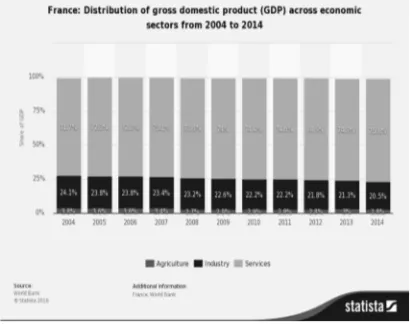
France economic sector spreads into three big
sectors, which are agriculture, industry and services.
From the figure below, the distribution of each sectors
contribution to the French economic, the highest
contributor to France’s economy is service sectors.
Services sectors contributed never less than 70% of
Gross Domestic Products (GDP) of France since 2004
until 2014. While, on the second place is Industrial
sector around 19 percent, and the least is agricultural
sector around 2.1 percent from GDP. The highest
agricultural product produce by France is Wheat.31
Based on its history, the industrial area concentrated in
28 France, taken from Countries and Their Culture:
http://www.everyculture.com/Cr-Ga/France.html
29 French economic system, taken Reference:
https://www.reference.com/business-finance/kind-economic-system-france-6690d302214d227b#
30
France – Agriculture, taken from Nations Encyclopedia: http://www.nationsencyclopedia.com/economies/Europe/France-AGRICULTURE.html
31 France, taken from Countries and Their Culture:
Paris, Lille, and Lyon where located in the Northeast and
Eastern part of the country.32
Distribution of France’s Gross Domestic Product (GDP)
Figure 2. 5 Distribution of gross domestic product (GDP) across economic sectors
from 2004-201433
France’s industrial products are machinery and
chemicals, automobiles and aircraft, electronics, textiles,
food, and energy production.34 One of France economy
sources is tourism destination. Around 79 million
tourists visit France each year.35 This sector of economy
contributes around 200 million of Euro average each
32 ibid
33
France: Distribution of gross domestic product (GDP) across economic sectors from 2004 to 2014, taken from Statista:
https://www.statista.com/statistics/270352/distribution-of-gross-domestic-product-gdp-across-economic-sectors-in-france/
34
France: structure of Economy, taken from Economy Watch: http://www.economywatch.com/world_economy/france/structure-of-economy.html
35 France country overview, taken from EU Business:
year as seen on the Figure 2.7 below. The rapid grow of
tourism sector in France started approximately in
1960s.36 At first there was significant different between
French people who go abroad for holiday with foreign
tourist that came to France, especially in Paris and
Mediterranean coast. 37
Tourism Economic Sectors Divisions
Figure 2.6 Tourism economic sector divisions38
36
France: Civil Service, taken from Britannica: https://www.britannica.com/place/France/Civil-service
37 ibid
38 Tourism economic sectors division, taken from:
France GDP Report
Figure 2.7 France GDP Report from Trading Economics39
Economic sectors played as one of influencing
aspect in one country. The implementation and practice
of many activities within France is depending on its
economic. This sector is closely related to
socio-political and moreover the cultural aspects that become
the highlighted theme in this thesis. French economy is
well developed with many multi-national corporation
operated abroad not to mention its industrial revolution
also influence the world economic settings. The
example of French company is Total that operates the
petroleum-based business, automotive company such as
Renault and Peugeot. Many famous fashion brands are
from France, take for example Louis Vuitton, Dior, and
Givenchy. The hotel chains from France also covered
39 France GDP Growth Rate, taken from Trading Economics:
many places in the world such as, Meridien, and
Sheraton Hotel chains. ERAMET also one of French big
mining group, one of the projects is called Weda bay
Nickel that operates in Indonesia.40
3. France involvement in European Union and other International Organization
France plays its global role in many international
organizations such as permanent member United Nations
Security Council, NATO, the G-8, G-20, European
Union, and other multilateral organizations. As one of
the developed countries, France has a big role in shaping
the world politics as today.
France is all along strong supporter of the union of
Europe. The founding fathers of European Union (EU))
are French men named Aristide Briand, Jean Monnet,
and Robert Schuman.41 European Parliament is located
in Strasbourg, a capital of France’s Alsace region.
Another France’s influence in the EU is that French
language is use as one of the official languages in its
assembly and boards.42 France position in the EU is most
of the time played a central role despite all the problems
40 Key Date in ERAMET’s History, taken from ERAMET:
http://www.eramet.com/en/about/our-group/our-history
41 Maxime Lefebvre, “France and Europe: An Ambivalent Relationship”, taken
from Brookings: https://www.brookings.edu/articles/france-and-europe-an-ambivalent-relationship/
42 The French language in European Institutions, taken from France Diplomatie:
she faces.43 Many French politicians still devoted to the
EU
France involvement in the European Economic
Community and Common Market has shifted the
once-protectionist economy where France not played major
role in the world economy.44 Its involvement moreover
created and molded French economy today.
4. French Cultural Legacy
French is a country that possesses an extraordinary
cultural heritage. In France, there are around 40, 000
preserved monument, 38 cultural sites listed by
UNESCO World Heritage, and around 8,000
museums.45 French government is giving quite a big deal
towards it support to artists, to the restoration of
historical buildings and to museum. These supports are
carried out by The French Ministry of Culture. French
cultural history and aspect will be emphasizing in this
part, since it will become the basic analysis on culture as
French sources in executing its foreign policy. France
culture is shaped by its contacts with its neighbor’s
countries, the variety of its land, and also its colonies.
43 France’s European Global Role: Can she lead? taken from The Ditchley
Foundation: http://www.ditchley.co.uk/conferences/past-programme/2010-2019/2014/frances-role
44 France, taken from Countries and Their Culture:
http://www.everyculture.com/Cr-Ga/France.html
45
French history can be traced back decades and even
centuries ago.
When it comes to France and culture, most people
often associating it Paris, the capital of France. Paris is
the center of Fashion, cuisine, arts, and architecture. But,
the region outside the city of lights offers varies of
culture. France is not only known for its taste of arts, and
according to Cristina de Rossi, anthropologist from
Southgate College of London, stated that the world
culture itself derived from the same French term, which
also derives from Latin word “colere”, which means
cultivation and nurture.46
Historically, way before the rise of Renaissance,
Celtic and Gallo-Roman, as well as Franks influenced
French culture. The French territory called the Western
part of Germany called Rhineland, which later known as
Gaul within the Iron Age and Roman Era. The term
“France” used to refer people in lower Rhineland. The
name “Francia” itself used to determine units are during
Middle Ages. Within the Renaissance era, Francois I, the
King of that time, welcome and invited many Italian
artist to France. It was the beginning of the spread of
Renaissance ideas to the French people.47 All these
46
French culture, taken from Live Science: http://www.livescience.com/39149-french-culture.html
47 French Historical Timeline, taken from: ref
combination and influenced has shaped French culture
that we knew today.
For language, the French language is the majority
language use and speaks in France by almost 88 percent
of its population, German speaks by 3 % of its
population, while the rest of other language speak are
Flemish, Italian, Basque, Catalan, Breton and also
Arabic.48 Language is one of cultural products that could
differentiate one nation other nations. French language is
complicated especially for someone who learns it for the
first time. Written and spoken French is different. Oral
and folktales was dominating pre modern France, and it
was the beginning of development of French written
literature.49 French literature recognized as one of the
greatest tradition in the world, there are many writers
that delivered well-known writings. For example,
Chansons de Geste – the first work of literature -,
enlightenment writers such as Voltaire, Montesquieu,
Jean Jacque Rousseau, post war writer such as Albert
Camus, Simone de Beauvoir and many other
distinguished writers born and lived in France.50 France
culture is basically influence by the development of arts
and science. France has produced many influential
48
French Culture, taken from Live Science: ref http://www.livescience.com/39149-french-culture.html
49 Countries and their Culture, taken from Every Culture:
http://www.everyculture.com/Cr-Ga/France.html
50
thinkers of centuries such as Descartes and Pascal in 17th
century, Jean Jacques Rousseau in 18th century, to Sartre
and Camus in twentieth century. Not only it is home of
many scholars, a lot artist born, reside, and die in France.
There is famous cemetery where many great artists
buried it named Père Lachaise cemetery. There are
famous named such as Félix Faure (President of France
in 1895), Moliére (acclaimed playwright writers),
Chopin, and even reputable English writer, Oscar Wilde,
buried in this cemetery.51 France visual arts include
paintings, sculpture, and architecture. Before the modern
arts that spread and develop in France, the cave paintings
also have important role in French visual arts. Matisse,
Renoir, Morisette are few of many French painting artist.
For sculpture, Auguste Rodin is French most prominent
sculptor. 52
France, particularly Paris is home for many
high-end fashion brands such as Louis Vuitton, Hermes, Dior,
and Chanel. In France, French people often dress in a
sophisticated and fashionable style. It can be seen in
many places, from Paris to other cities all around France.
France relations to culture and arts are really fond. The
term Haute couture which familiar all over the world is
even protected under the law, which defined, by Paris
51
Top 10 Fascinating Graves in Père Lachaise, 2011, taken from ListVerse: http://listverse.com/2011/10/27/top-10-fascinating-graves-in-pre-lachaise/
52 Countries and their Culture, taken from Every Culture: