Inluence of the abilities in controlling violence behavior to the length of stay
of schizophrenic clients in Bogor mental hospital, Indonesia
Budi Anna Keliat1, Azrul Azwar2, Adang Bachtiar3, Achir Yani S. Hamid4
1 Faculty of Nursing University of Indonesia, Jakarta
2 Head of Health Science Institute Binawan, Formal Director General of Community Health in Ministry of Health Republic of Indonesia,
Jakarta
3 Head of Department of Administration and Policies in Faculty of Public Health, University of Indonesia; Lecture in Faculty of Public
Health University of Indonesia, Jakarta
4 Head of Department of Mental Health Nursing in Faculty of Nursing, The president of nurses association Indonesia,
Abstrak
Tujuan Klien yang dirawat di rumah sakit jiwa di Indonesia mempunyai rerata lama hari rawat yang tinggi yatu 54 hari, dan yang paling lama dirawat adalah klien dengan diagnosa skizofrenia. Data rumah sakit jiwa pusat Bogor 2001, menunjukkan rerata lama hari rawat adalah 115 hari dan untuk klien perilaku kekerasan 42 hari. Penelitian ini bertujuan mengurangi lama hari rawat klien skizofrenia dengan perilaku kekerasan dengan meningkatkan kemampuan klien mencegah perilaku kekerasan.
Metoda Metoda penelitian yang digunakan adalah kuasi eksperimen dengan disain multipel seri ganda. Penelitian dilakukan di RSJP Bogor, dengan 152 responden (75 orang kelompok intervensi dan 77 orang kelompok non intervensi). Pendidikan diberikan kepada kelompok intervensi tentang cara mencegah perilaku kekerasan.
Hasil Dari hasil penelitian ditemukan bahwa rerata lama hari rawat klien kelompok intervensi adalah 23 hari dan kelompok non intervensi 40 hari. Klien kelompok intervensi yang mempunyai kemampuan mandiri 86,6% dan kemampuan dengan bantuan 13,4% dalam mencegah perilaku kekerasan. Klien kelompok non intervensi semuanya tidak mempunyai kemampuan mengendalikan perilaku kekerasan. Klien dengan kemampuan mandiri dalam mencegah perilaku kekerasan mempunyai lama hari rawat yang lebih pendek secara bermakna dibandingkan dengan klien yang tidak mempunyai kemampuan (p-value 0.025).
Kesimpulan Disimpulkan, pendidikan kesehatan tentang cara mencegah perilaku kekerasan dapat meningkatkan kemampuan klien dan selanjutnya memperpendek lama hari rawat secara bermakna. (Med J Indones 2009; 18: 31-5)
Abstract
Aim In average, the length of hospital stay in mental hospitals in Indonesia is 54 days, the longest of which occur on schizophrenic clients. In Bogor Mental Hospital, the average length of stay is 115 days. Those with schizophrenic and violence behavior have 42 days length of stay. The purpose of this study was to reduce length of stay for schizophrenic clients by enhancing their abilities to control violence behavior.
Methods This is a quasi experimental study with multiple series design. Study was conducted in Bogor Mental Hospital with 152 respondents (75 intervention and 77 non intervention). Training was given to the intervention group about the ways how to control violence behavior.
Results The results of this study showed that the average length of stay in the hospital for the clients in intervention group was 23 days and non intervention group was 40 days. There were 86.6% of clients in intervention group that independently (without assistance) could control their behavior, whereas 13.4 % still need assistant. All clients in non intervention group had no abilities to control their violence behavior. Clients who were independent in controlling
violence behavior had signiicantly shorter length of stay compared to non independent clients (p < 0.05).
Conclusion Hence, the training control violence behavior can increase the abilities of the clients in controlling their violence behavior and resulting in shorter length of stay in hospital. (Med J Indones 2009; 18: 31-5)
Keywords: violence behavior, schizophrenia, training, length of stay.
Schizophrenia represents most common mental health problems and until recently remain unsolved in the world. The client and family have double burden which
disorganize behaviors (violence behavior), catatonic,
and negative symptoms such as lack of functions, lat/
dull affect, withdrawal, and no initiative.1,2,3,4 Research related to violence behavior found that medical diagnosis of clients with violence behavior consist of: 49 % substance abuser, 45 % schizophrenia, and 34 % severe depression.5
Clients with mental disorders are often excommunicated and restricted because the society assumes that they are dangerous. Study conducted by The Canadian Mental Health Association3 found that 88 % respondents told that the clients were dangerous, 40% said they were retarded and 32 % told they could not functioning However, 20-30 % of the clients could earn normal live, 20-30 % showed symptoms and 40-60 % showed bad condition. Curing the clients with schizophrenia is possible, and maximal effort is needed.
Violence behavior consisted of violence to others, at self, to the environment, and verbally.11 Stuart and Laraia16 elaborated three strategies of nursing interventions for the clients with violence behaviors; which consist of: controlling, anticipation, and restraint. Strategy that was tested in this study was controlling strategy by providing training to the clients about how to control violence behavior. Four ways of controlling were taught, consisting of physical, verbal, spiritual and medication obedience.
Angry feeling can be sublimated through constructive physical activities by using power and energy.13,14,18 A physical relaxation activity such as deep breathing training is an alternative choice.4 In this study two physical ways was selected that more possible to be conducted; consisting of deep breath training, and beating pillow or mattress.
The most successful method in controlling violence behavior is by training how to speak assertively.16,17 Emotion atmosphere such as dislike, sulky, and anger are the conditions which can result in violence behavior.13 Expressing the feeling verbally and willing
conidentially without threaten represent assertive
ways.4,14 Direct communication training to others about deduction illogical request, telling complaints to others’ attitudes, and giving praise to others can also control violence behavior.16 In this study we selected three ways to control violence behavior by verbal way, those were request assertively, refuse assertively, and express feeling assertively.
Clients desire to dominate and force others are considered as an immoral behaviors.14 For this case,
clients was assisted to respect their spiritual values and beliefs concerning anger behaviour. Clients were helped to transform their willing to dominate others trough religious activities and invoking to control others and themselves. This maneuver was aimed to help the clients to do two religious activities that formerly conducted.
Antipsychotic medications given to the schizophrenia clients with violence behavior are effective to reduce violence behavior that is a positive symptom of schizophrenia.16 Combination of antipsychotic therapy
and self-management are the nursing interventions for
the clients and their families.6,8 In this research, clients were taught about medication management namely
ive right ways of taking medication: right name,
right medicines, right doses, right frequency, and right
routes. It was also explained the beneits of medication
and effects of withdrawing from taking medication.
The main aim of this study was to know the relationship between client’s abilities in controlling violence behavior and the length of stay in Bogor mental hospital.
METHODS
This study is a quasi experimental research with multiple series design, conducted in Bogor mental hospital, Indonesia.
Respondents were the clients with violence behavior who were diagnosed as schizophrenia, and hospitalized in Bogor Mental Hospital. Respondents were randomly grouped into intervention and non intervention. Total respondents were 152 clients consisted of 75 patients in intervention group and 77 in non intervention group.
Clients in intervention group were trained in four ways to control violence behavior.
After training, the daily activities were scheduled and practiced continuously until they were considered independent. The ability was measured daily and
classiied into three categories: “independent” if the
clients are able to control violence behavior without reminding and help by others; “assistance” if clients are able to control violence behavior according to the schedule but need to be reminded; “dependent
Research Ethic committee of Faculty of Medicine University of Indonesia has given Ethical Clearance for this study. Clients and their family have been provided information about the study and signed the informed consent form. Respondent’s right were protected and
all documents were kept conidential and cannot be
accessed by others except the researchers.
Characteristic of clients, abilities to control violence behavior and length of stay in hospital were analyzed with univariate method using frequency distribution. Relationship between clients characteristic and hospitalization length were analyzed with bivariate using paired t-test and ANOVA. The length of stay according to the ability to control violence behavior and was tested by using ANOVA.
RESULTS
Characteristics of intervention groups and non inter-vention groups can be seen in Table 1. Both groups were equal except in level of education, where the intervention
group has signiicantly higher education level (p < 0.05)
than non intervention group. Background education was
not signiicant related with the length of stay.
Table 1. Characteristics of respondents with violence behaviors
Characteristics of
Ability in controlling violence behaviors
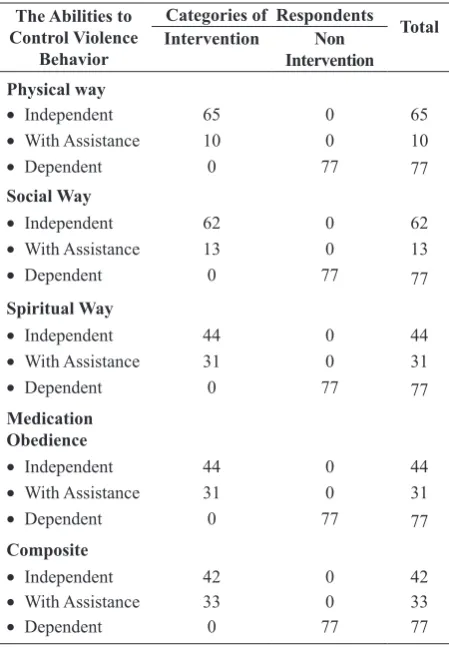
It was found that 86.6 % of intervention group had independent abilities in controlling violence behavior, while all non interventions group was dependent or unable to control their violence behavior (Table 2).
Table 2. The ability of clients in controlling violence behaviors in intervention and non intervention groups
The Abilities to Control Violence
Behavior
Categories of Respondents Total Intervention Non
Length of stay in the hospital
The average length of stay in the hospital in intervention group was 23 days and in non intervention group was
40 days and the difference was signiicant (p < 0.05).
Table 3. Distribution of the clients with violence behaviors based on the length of stay in hospital
Categories of
Respondents Length of StayAverage p-value
Relationship Between Client’s Characteristics and the Length of Stay in Hospital
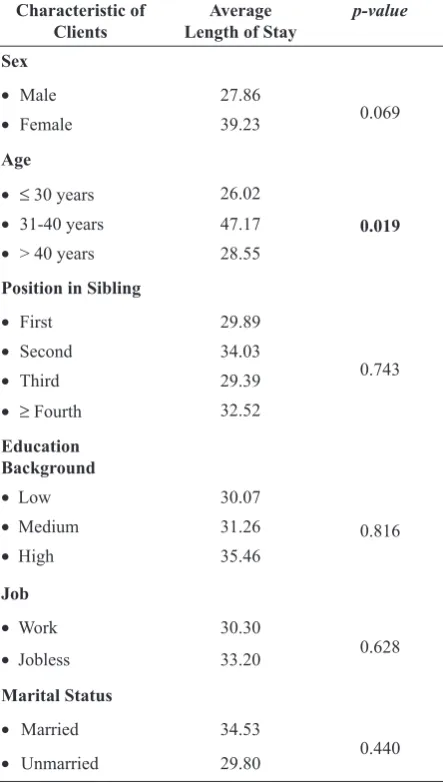
Characteristic of age has relationship with the length
of hospitalization signiicantly (p <0.05) (Table 3). It
means that the older the clients had the longer of their hospitalization.
Table 3. Relationship between characteristics of clients with violence behavior and the length of stay
Characteristic of
Clients Length of StayAverage p-value Sex
The relationship between abilities to control violence behavior and the length of hospitalization
The results of this study showed that clients who were
independent had signiicantly shorter length of stay compared to those who are dependent or unable (p <
0.05) (Table 4).
Table 4. The relationship between ability to control violence behavior and the length of stay in the hospital
Abilities to
Control Length of StayAverage p-value Physical way physical, social or interaction, spiritual and medication. Nursing staff must motivate a patient and make him or her continue learning to verbalize his or her feeling,17 this was one of the way have been thought to the client to control violence.
The average length of hospital stay in clients receiving training to control violence behavior was 23 days and who were not trained was 40 days. This result gives an advantage for clients and their families because the expense of hospitalization can decrease by 17 days and the quality of life become better due to increase in residing at home compared to staying in the hospital. Length of stay was shorter than the average length of stay clients at mental hospitals in Indonesia, i.e 54 days1. In Bogor Mental Hospital as a whole the average
length of stay is 115 days and speciic for clients
with violence behavior, it is 42 days.2 The decreased length of hospital stay and the improved psychosocial functioning in client resulted in a marked overall cost saving.19
Although have been better than the length of hospitalization in Indonesia, it is not yet equal to that in other countries as reported by Morrison,3 where the length of stay in clients who were independent in controlling violence behavior were 86.6%. This proves that clients with mental disorders still have self-care abilities, and there
is still hope to improve their function. This inding
could change public opinion that schizophrenic clients cannot function anymore.
The clients who were hospitalized for seven weeks or longer were 49 per cent less likely to be readmitted within a month compared to those who stayed only a week.20 Control and intervention group had length of hospital stays between 23 days – 40 days (3 weeks to 5.5 weeks), those had possibility for readmission within 30 days. There were many way to manage schizophrenia with violence, which could reduce more the length of hospital stays.21
It is concluded that clients who were independent
in controlling violence behavior had a signiicant
shorter length of hospitalization than clients who were dependent in controlling violence behavior. Males had
shorter length of hospital stay signiicantly than females.
Moreover, in the frequency of admission, the clients
who were hospitalized once or twice have signiicantly
shorter length of hospital stay than the clients who were hospitalized in third times or more.
REFERENCES
Johnson BS. Psychiatric-mental health nursing: adaptation 1.
and growth. (4th ed). Philadelphia : JB Lippincott Company, 1997.p.764-91.
Boyd MA, Nikart MA. Psychiatric nursing contemporary 2.
practice. Philadelphia: Lippincott, 1998.p.360-402. Boyd MA. Psychiatric nursing: contemporary practice. 3.
Philadelphia, Lippincott & Wilkins, 2005.p.230-62. Kaplan HI, Sadock BJ, Grebb J. A. Synopsis of psychiatry: 4.
behavioral sciences clinical psychiatry. ( 10th ed.). Baltimore: Williams & Wilkins, 2007.p.1329-558.
Morison EF. The evolution of a concet: aggression and 5.
violence in psychiatric settings. Archieves of Psychiatric Nursing, Vol. III, No. 4 (August): p.245-53.
Stuart GW, Laraia MT. Principles practice psychiatric 6.
nursing (7th ed). St.Louis: Mosby, 2005.p.639-52. Puckett A. Community mental health. Sydney: WB 7.
Saunders, 1993.p.223-50.
Rawlins RP, Williams SR, Beck CK. Mental health- 8.
psychiatric nursing: a holistic life-cycle approach. St. Louis: Mosby Year Book, 1993.p.207-23.
Videbeck SL. Psychiatric mental health nursing. 9.
Philadelphia: Lippincott, 2001.p.214-27.
Davis M, Eshelman ER, Mc. Kay M. Panduan relaksasi & 10.
reduksi stress. Alih bahasa: Hamid AYS. and Keliat BA. Jakarta: ECG, 1995.
Townsend MC. Essentials of psychiatric mental health 11.
nursing (3rd ed). Philadelphia: FA Davis Company, 2005. Drake RE, Mueser KT, Torrey WC, Miller AL, Lehman AF, 12.
Bond GR, Goldman HH, Leff HS. Evidence-based treatment of skizophrenia. Curr Psychiatry Rep. 2000; 2(5):393-7. Gibson DM. Reduced rehospitalizations and reintegration 13.
of persons with mental illness into community living: a holistic approach. Journal Psychosocial Nursing Mental Health Service, 1999; 37(11): 20-5.
Duxbury J. An evaluation of staff and patient views of 14.
and strategies employed to manage inpatient aggression and violence on one mental health unit: a pluralistic design. Journal of Psychiatric and Mental Health Nursing. 2002;9:325-37.
Toshiko M. Nursing care of schizophrenic patient who 15.
impulsively repeats violence: the case in which violence decreased by verbalizing feelings. Nippon Seijinkai Suda Hospital. 2005; 48(1):194-5.
Understanding mental illness and violence. Available at: 16.
www.mifsa.org.au Accessed August 19th 2008.
Depkes RI, Dirjen Yanmed. Informasi rumah sakit. Jakarta: 17.
Depkes RI. 2000.
Rumah Sakit Jiwa Pusat Bogor. Laporan akuntabilitas 18.
kinerja RSJP Bogor years Anggaran 2001. Bogor: Not publish, 2001.
Hirayasu Y, Korn ML. Management of patient with acute 19.
psychosis. CME. Available at: www.medscape.com/
viewarticle/420241. Accessed December 4th 2008. Hospital length of stay and readmission for individuals 20.
diagnosed with schizophrenia: Are they related. Available at: www.cihi.ca. Accessed January 8th, 2009
Thomson LDG. Management of schizophrenia in condition 21.