STUDY ON OPEN DEFECATION FREE IN
KELURAHAN KELAYAN TENGAH
BANJARMASIN CITY
Gusti Ihda Mazaya, Hendrawati Noya, Eddy Setiady Soedjono
Institut Technology Sepuluh Nopember, Faculty of Engineering,
Sukolilo 60111, Surabaya
[email protected]
Abstract
Endeavors toward Universal Target of 2019 dealing with water and sanitation are not merely
the responsibility of central and local government, since community is both the subject and
object of the target achievement. One of the main obstacles in accomplishing this target is the
practice of open defection in a number of areas in Indonesia. This study was aimed to assess
Open Defecation Free (ODF) in the environment applying the off-site sanitation system. The
study was conducted in Kelayan Tengah village, Banjarmasin, consisting of 232 households
in which 117 of them are still practicing open defecation (OD). The study was commenced by
reviewing relevant literatures, conducting field survey (questionnaire and interview), and
analyzing the data by using Analytical Hierarchy Process (AHP). The analysis included the
assessment of technical aspect, social cultural aspect, and institution aspect. Questionnaire
was fulfilled by 75 respondents, while AHP involved 5 respondents. Action Plans of open
defecation free in Kelayan Tengah village encompassed the establishment of Waste Water
Treatment Plan (WWTP) in Elementary school of Kelayan Tengah village to design 117
house connections out of 232 house, the organization of community and public discussion
with theme of proper sanitation, and the improvement of coordination of sanitation working
group. Action Plans to achieve Open Defecation Free in Kelayan Tengah village, Banjarmasin
encompassed the possibility of using Kelayan Tengah 2 Elementary School as the site to
establish waste water treatment plant (WWTP) to provide the toilet access for 117 houses
which cannot afford the appropriate ones; the effort to disseminate the importance of toilet
and to organize public discussion with theme of proper sanitation; the improvement of
coordination among sanitation working groups to maintain open defecation free and agencies
that play a role in this issue, as well the promotion to conduct fund collaboration between
public and government for the purpose of ODT.
Keywords: Sanitation, ODF, Kelayan Tengah village, Banjarmasin.
Presenting Author’s biography
1.
Introduction
Indonesian government attempted to increase sanitation access to achieve the Universall Access of 2019, one of the targets is 100 % sanitation access. Government policies in the National Medium Term Development Plan (RPJMN) 2015-2019 is also as parallel as target of universal access to realize decent sanitation conditions from 60.5 % at 2014 towards target 100 % at 2019 [3].
Banjarmasin is one of the participants in the Settlement Sanitation Development Acceleration since 2009, Target of Strategy Sanitation Banjarmasin city 2014 to 2019 is that the practice of Open Defecation Free reduced to 0 % at 2019 [8]. Numbers of local community in Banjamasin settled on the riverbanks, which is identical with slum neighborhoods with inappropriate sanitary condition. Related to this concern, Banjarmasin Local Government has made an inquiry for this neighborhoods and one of them is Kelayan Tengah village [8]. The total population in Kelayan Tengah village is 6567 people, the number of households is 1864 households [1], there are 1312 houses where 249 of them cannot afford appropriate toilet [2], particularly in the Neighborhood Association (Rukun Tetangga/RT) 14, 15, 20, and 21, where there are 117 houses from 232 houses cannot afford it.
Dealing with the issue above, this study aimed to carry out an analysis on open defecation free in Kelayan Tengah village by identifying the technical aspects, social cultural aspects, and institutional aspects regarding with the action plans in promoting ODT in this village.
2.
Methods
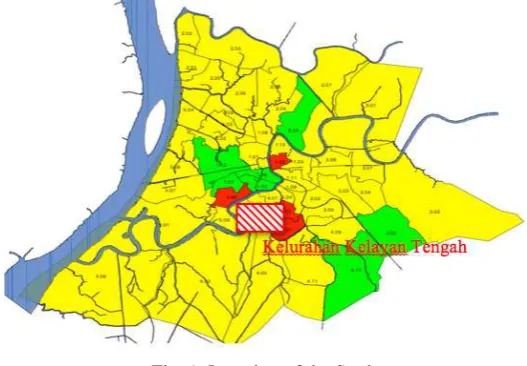
The study was conducted in Kelayan Tengah village. Administratively, it consists of 2 Community Associations (Rukun Warga/RW) and 21 Neighborhood Associations (Rukun Tetangga/RT)[1]. The map of the study site is provided in Fig. 1.
Fig. 1. Location of the Study
Data was recapitulated and classified to obtain the percentage. Analysis performed in this study included analysis in terms of technical, social-cultural, and institutional aspects.
The technical aspects assessed were the prevailing condition of sanitation infrastructure, technology, land availability, soil type, and tidal condition in Kelayan Tengah village. Social aspects were in terms of community’s consciousness and behavior dealing with sanitation, willingness to change habits, as well as willingness and capability to build latrines. Institutional aspects were in terms of the institutions’ involvement in sanitation, coordination among agencies in program’s planning, monitoring and evaluation mechanism. The determination of the action plan of open defecation free by AHP analysis was scrutinized with a comparative scale of 1-9, which was 1 (equally important), 3 (less important), 5 (more important), 7 (very important), 9 (extremely important), 2,4,6,8 (average) [4].
3.
Result and Discussions
Technical Aspects
Waste water management is stipulated in Government Regulation No. 16/2005 on the development of the drinking water system. Referring to the various references, waste water management systems can be grouped which is the local system, waste water (black and gray water) directly in the local though, centralized system, in which the waste water flows through the piping to the wastewater treatment plant, and hybrid, is a modification of the two systems [5].
Based on Minimum Service Standards (Kimpraswil Ministerial Decree No. 534/KPTS/M/ 2001), the selection of a local system or a centralized system based on the type of city, population density, and high groundwater level [6]:
1. The local system is more geared to being a small town with an average density of < = 200 inhabitants/ha, with a level of ground water level > 2 m , and the potential for cost recovery that has not been conducive to the piping system .
2. The centralized system is more geared to the major metro cities with an average density of > = 200 inhabitants/ha , the level of the groundwater < 2 m , and the potential for cost recovery has not been support for piping systems.
Some of the factors that influence the selection of technologies for sanitation, namely the population density associated, source of water, topography ground, the ability to build up associated, and the socio-economic condition of society.
Based on geological maps and technical test data of Lithology in the planning area, and it is known that most of the rock formations and soil in the region of South Banjarmasin is Alluvium (Qa) formed by gravel, sand, silt, clay and mud. Level of the groundwater was 0.5 m.
Fig. 2 Map of house connection to WWTP design.
Social and Cultural Aspects
a. Characteristics of Respondents
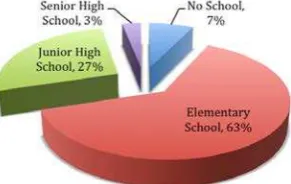
Respondents’ characteristics were identified from their background of education, occupation, home ownership, and income. Based on the results of the survey, education level of respondents varied from non-formal education to senior high school. Level of education was dominated by elementary school graduates by 64%, the percentage of educational background shows that the majority of respondents’ education level is low since the standard of 9-years obligatory education is not implemented (Fig. 3). The respondents’ occupations were grouped into merchant, workers, private, housewife, and the self-employed. The survey showed the majority of the respondents were labor by 51 %, consisting of market and construction labor. The highest percentage of house ownership was tenant by 63% of respondents, with income between Rp500,000.00— Rp1,000,000.00 by 51%.
Fig. 3. The Education Level of Respondents.
b. Community Knowladge on Sanitation
Fig. 4. Community Knowledge about Sanitation
c. The behavior of people towards sanitation
The analysis indicated 69% of respondents practiced open defecation at the river, while pit latrines also became another choice as shown in Fig. 5.
Fig. 5. Location of open defecation.
d. The Willingness of community to change habits
Despite the practice of open defecation, 100% of respondents have an eagerness to change the habit. As for the target to abandon the habit, the majority of the respondents could not answer the precisely, only 7% of respondents stated the willingness to abandon it in < 4-years. They consider government’s support to accelerate public awareness on this open defecation habit was necessary. The percentage is illustrated in Fig. 6.
Fig. 6. The Willingness of community to change habits of Open Defecation Free
e. The willingness and ability of community to built a latrine.
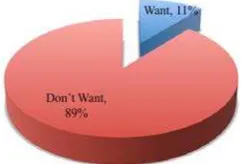
Based on the analysis, the entire respondents wanted to have private latrine. However, most of them had no intention to build latrine with their own expense, only 11% of respondents considered that latrine is their own responsibility. An amount of 61% respondents also wanted the government to promote public discussion on the importance of proper sanitation. The percentage of willingness to build toilet with private expense is depicted in Fig. 7.
Institutional Aspects
Banjarmasin established a working group sanitation to addressing the problems of sanitation in Banjarmasin. In domestic wastewater sector, one of goals to be achieved of open defecation free in Banjarmasin in 2019, open defecation 20% in riverside [8].
Working group sanitation divided by each sector, namely Local Development Planning Agency has sectors sanitation program in coordination and integration with city policy, Environment Agency Banjarmasin served to recommend the concept and technology of wastewater treatment system that will be implemented, monitoring and evaluation of environmental sanitation activities/urban. But the environmental agency is still not performing their duties in a domestic waste water, Department of Human Settlements and Housing Banjarmasin served in a technical sector that is mapping the location, area measurements and prepare drawings of physical development plans of network systems and wastewater treatment plants is based on concepts from the Environment Agency [8]
Increased coordination between the working group of sanitation, especially for the environmental agency that has not accomplished the task in monitoring and evaluation of domestic waste, and doing
streamlining agencies that play a role in achievement of open defecation free.
AHP Analysis
The aspects quality of AHP analysis is based on the opinion of experts who involved directly or indirectly in the achievement of open defecation targets in Kelayan Tengah village, Banjarmasin. The priority order of indicators from the highest-lowest in achievement of open defecation targets show in Tab. 1.
Tab. 1. Value Indicator of Aspects
No Indicator Value Indicator
1 The willingness to change habits 0.142
2 The availability of land 0.141
3 The willingness to built a toilet 0.118
4 Coordination among related agencies in the preparation of the program 0.117
5 The behavior of people towards sanitation 0.108
6 The ability to build a toilet 0.075
7 Community culture 0.054
8 Mechanism of monitoring and evaluation 0.048
9 Tidal conditions 0.045
10 Community knowledge 0.038
11 Soil conditions 0.034
12 The availability and requirements of human resources 0.028
13 Technology conditions which used of society 0.025
14 Institutions that play a role in sanitation 0.024
the preparation of the program, the behavior of people towards sanitation, and the ability to build a latrines.
4.
Conclusions
Action Plans to achieve Open Defecation Free in Kelayan Tengah village, Banjarmasin is an on-going process which require cooperation between central and local government as well as the local community. Analysis on technical aspects included discussion of the possibility of using Kelayan Tengah 2 Elementary School as the site to establish waste water treatment plant (WWTP) to provide the toilet access for 117 houses which cannot afford the appropriate ones. Social and cultural aspect included an effort to disseminate the importance of toilet and to organize public discussion with theme of proper sanitation. Institutional aspect included the improvement of coordination among sanitation working groups to maintain open defecation free and agencies that play a role in this issue, as well the promotion to conduct fund collaboration between public and government for the purpose of ODT.
Reference
[1] Central Agency of Statistics. South Banjarmasin in Figures. Banjarmasin. 2014.
[2] Headship of Puskesmas Kelayan Timur. Activity Report Basic Data mapping. Puskesmas Kelayan Timur. 2015.
[3] Republic of Indonesia. National Medium Term Development Plan 2015-2019, The Ministry of National Development Planning. Jakarta. 2014.
[4] Saaty , T.L. Decision For Leaders Analytical Hierarchy Process for Decision Making in Complex Situations. Reader Binama Pressindo. 1993.
[5] E.S. Soedjono, T. Wibowo, S.S. Saraswati, and C. Keerelaat,. Reference books Sanitation Systems
and Technology Options. Sanitation Development Technical Team. Jakarta. 2010.
[6] Water and Sanitation Program East Asia and the Pacific (WSP-EAP). Option Sanitation Affordable For Specific Regions . World Bank Office. Jakarta. 2011 .
[7] Working Group Sanitation. Report of Environmental Health Risk Assessment Study (EHRA). Health Department. Banjarmasin. 2013.