ISBN 978-983-2641-93-3
Entrepreneurship Students Person-Environment Fit: A Study Of Two Public Higher Learning
Institution In Malaysia
Ahmad Rozelan Yunus, Amir Aris, Syed Najmuddin Syed Hassan
Universiti Teknikal Malaysia MelakaABSTRACT
This study was conducted to determine the congruency between the type of student
personality and the type of environment area of specialization based on Holland’s
Individual-Environmental Congruence Theory among engineering students of two universities in Malaysia. The subjects of this study were 276 students who were selected using the purposive random sampling of entrepreneurship program students.
The instrument used in this study was the Holland’s Self-Directed Search (SDS). The finding of this study showed that there was no significant congruence between the type of student personality and their area of specialization. The finding of this study also showed that there was a significant difference in personality between male and female student of entrepreneurship program in one of the university, but there was no significant difference in personality between male and female student of entrepreneurship program in the other university. Generally the finding of the study showed that the entrepreneurship students had chosen the area of specialization that is not congruent to their personality. In view of the findings, several implications and recommendation were put forward.
Keywords: Person-Environment Fit, Congruency, Entrepreneurship, Self-Directed Search
PAPER NO:
P046
PRESENTER(s):
Ahmad Rozelan Yunus
Introduction
The main issue that arises from the data itself is why is this happening in government funded higher-learning institutions? The main factors that are believed contributing to this phenomenon is the lack of congruency
between student’s personality and the studying environment. This deficiency has resulted low satisfaction in their
study thus resulting their low academic achievement.
Fritzsche, McIntire and Yost Fritzsche (2002) have analyzed the R, I, A, S, E, C environment traits and found
that personality is a strong determinant on academic achievements. Therefore, university’s goal in producing
excellent graduates depends greatly on the level of student’s interactions with their environment. High congruency
between the two will produce high satisfaction for students and thus, provides a positive impact on student’s
academic achievements.
Holland’s Career Typology Theory
Holland’s Career Typology Theory (1973; 1985) suggested that the principle of human behavior is the
interaction between human’s personality function and its environment. More than 100 studies that have been conducted to study this theory and its construct has proven and supported the existence of personality types and environment models (Walsh, 1973). This has popularized the use of the theory as a base in studies on individuals and their environment and its relationship with satisfaction, stability, and achievements in career and education.
This theory was created and shaped to explain career’s behavior and suggested few practical ideas related
to person-environment fit. The congruency between these two variables which is the individual’s personality characteristics and their environment’s characteristics will assist the individual to achieve satisfaction in his job. In addition, this theory also hypothesized that satisfaction towards its education environment is linked to the congruency between personality and the individuals’ learning environment.
In this particular aspect, Holland’s Career Typology Theory (1973) emphasized that students who are
functioning in their area of specialization’s environment that matched their own personality are healthy students,
compare to those interacting in an environment that is incongruent with the person. Holland (1973; 1985) characterized humans according to their similarity to one of the six types of personalities: Realistic (R), Investigative (I), Artistic (A), Social (S), Enterprising (E) and Conventional (C). The closer the similarity between the person and a certain type of personality, the more obvious he will portray the traits.
Parallel to human’s personalities, occupations’ environment are also categorized into 6 types of personalities (R, I, A, S, E, C). The congruency between individuals and their working or studying environment will enable them to understand and predict the suitability of their career choosing, career achievements and education achievements (Holland, 1973; 1985). He hypothesized that individuals will choose career field that similar to their personalities.
The system currently practiced by Centre for Universities Unit (UPU) in Malaysia to handle pre-university
students’ entries to public higher learning institutions are only based on their academic results in public examinations such as SPM/STPM/Diploma/Matriculation. There are no other mechanisms used through out the choosing process. It shows that the qualifications in to the public universities are based only on the academic qualifications without considering the congruency and suitability between the students and their majors.
For that reason, question arises whether the courses given to the students are congruent with their personality and interest. This aspect is important for enabling students to participate and appreciate all academic activities to achieve a high level of satisfaction in studying and subsequently raising their interest and motivation in studying, and thus, improve their academic achievements.
Objectives
This study aims to view and identify the personality profile for engineering students who were attending business and entrepreneurial courses as elective in UTeM and Universiti Tun Hussein Onn Malaysia (UTHM). Specifically, the main objectives of this study are to determine whether there is congruency between personality
will determine whether there are differences of personality between male and female students according to their area of specialization.
Methodology
The design of this study is ex-post facto correlation. This study has been conducted in UTeM and UTHM. The decision of choosing these two institutions is based on the objectives of the study which is to explore current scenario in local tertiary education. Furthermore, the environment for both institutions can represent the six
category of education’s environment as suggested by Holland. The subject of this study consists of engineering final year students who were following business or entrepreneurial courses as elective courses in two universities. The numbers of subjects from UTeM are 156 students and from UTHM are 120 students.
The questionnaire used in this study consists of two parts. Part A consists of demographic items while Part B is a standard questionnaire of Self Directed Search-Form E (SDS-E) that was used to measure the evaluation of personality and environment. SDS-E is an interest inventory that was developed by John L. Holland and has been translated to Malay language by Sidek (1998) using back translation method. This instrument consists of 192 items that was divided in to 3 categories: Activities, Competencies, and List of Occupations. All the items can be classified to the six personality categories as suggested by Holland (1973; 1985). The Cronbach Alpha coefficients for this instrument are considerably high ranging from .68 to .80 (Chong Yoke Lee, 1991). Amla Mohd Salleh (1992) also found that the validity of SDS instrument to be considerably high.
Collected data were analyzed using descriptive and inferential methods. Descriptive statistic used in this
study are mean and ranking while the inferential statistics used are the Kendall’s Coefficient of Concordance (W)
and t-test for two independent samples with a significant level of p < .05. Collected data are processed using Statistical Package for the Social Sciences (SPSS Version 13.0) for Windows (Norusis & SPSS Inc., 2004).
Findings
Student’s Personality Profile
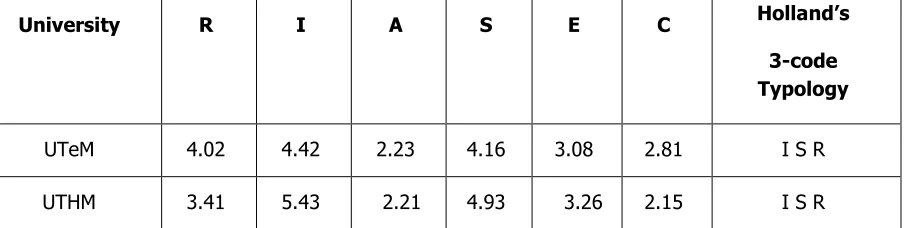
The mean score for every personality type based on area of specialization are obtained by using descriptive methods. By using the three highest mean scores, Holland’s 3-code typology for engineering specific programs
from the two institutions has been determine. Holland’s 3-code typology was also determined based on gender for each program. These codes presented the personality profiles of the students for their major programs. Results are shown in Table 1 and 2.
Based on Table 1, the 3 types of personality with the highest mean scores for UTeM students are I (4.42), S (4.16) and followed by R (4.02). This means the Holland’s 3-code typology for engineering major students who were taking elective business courses in UTeM is ISR. For UTHM, the 3 highest mean score personality are I (5.43), followed by S (4.93) and R (3.41). Therefore, it can be concluded that both groups in UTeM and UTHM
have the same Holland’s 3-code typology, which is ISR.
University R I A S E C Holland’s
3-code Typology
UTeM 4.02 4.42 2.23 4.16 3.08 2.81 I S R
UTHM 3.41 5.43 2.21 4.93 3.26 2.15 I S R
Table 2 shows the students’ personality profile according to gender for both universities. The 3 personality
types that have highest mean score for male students in UTeM are I (4.23), R (4.21) and S (4.13). Hence, the Holland 3-code typology for the male students is IRS. Meanwhile, the highest mean scores for female students are I (4.78), S (4.10) and R (3.32). This means the female students have a Holland 3-code typology of ISR. This result showed that there are differences in terms of personality profile between both genders in UTeM.
University Gender R I A S E C Holland’s
3-code Typology
UTeM
M 4.21 4.23 1.92 4.13 3.12 2.33 I R S
F 3.32 4.78 2.89 4.10 3.26 2.91 I S R
UTHM
M 2.19 5.23 2.15 4.56 3.21 2.89 I S E
F 1.61 5.38 2.67 5.13 3.27 3.28 I S C
Table 2 - Male and Female Student’s Personality Profile according to Universities
On the other hand, the Holland 3-code typology for UTHM male engineering students is ISE with the mean score for the 3 personality types are 5.23, 4.56 and 3.21 respectively. The 3 highest mean scores for the female
students’ personality profile are I (5.38), S (5.13) followed by C (3.28). Therefore the Holland 3-code typology for the female engineering students in UTHM is ISC. Results showed that there is a slight difference in terms of personality profile between male and female engineering students in UTHM.
Congruency between Personality Types and Area of Specialization
As stated earlier, one of the purposes of this study is to determine whether there is a significant congruency
between student’s personality types and their environment or area of specialization. To meet this objective, the
ranking scores for personality obtained from SDS is analyzed using Kendall’s Coefficient of Concordance (W) statistical method. This method is used to determine whether a significant congruency exists between rankings. The value of W will be converted to the value of X2. The Congruency Index (CI) (Wiggins & Moody, 1981) will also be determined. The Wiggins’s congruency index is a 9-point index where the lowest value of CI = 0 and the CI = 8 being the highest index, with a mean of CI = 4. The significant value of W together with CI value greater than 4 will show that there is a significant congruency between student’s personality and their area of specialization.
Test results using Kendall’s Coefficient of Concordance (W) method are shown in Table 3. The results for
engineering students in UTeM are (W=.25, X2 (5) = 55.46, p<.05) while the results for UTHM’s engineering students are (W=.59, X2 (5) = 82.07, p<.05). These results showed that the existence of significant ranking congruency for engineering program in both universities.
Universities N W X2 dk P
UTeM 78 .25 55.46 5 .000*
UTHM 60 .59 82.07 5 .000*
* p < .05.
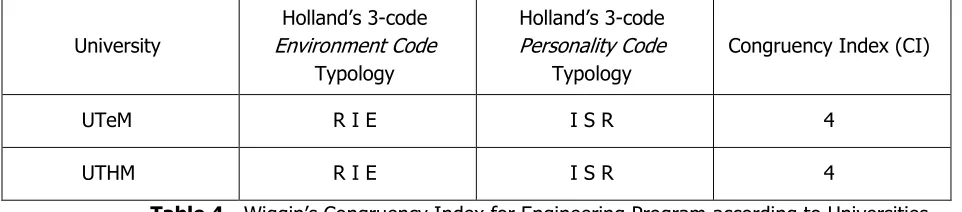
Next, the value of congruency index is ascertained by comparing the Holland’s 3-code typology from this study with the Holland 3-code typology in The Occupation Finder [10] based on Wiggin’s congruency index (Wiggins & Moody, 1981). Table 4 shows the results for the comparison and congruency index derived from the study. It has been found that the congruency index for engineering programs both in UTeM and UTHM is (CI = 4).
University
Table 4 - Wiggin’s Congruency Index for Engineering Program according to Universities
From the value of congruency index (CI) and Kendall’s Coefficient of Concordance (W), it can be concluded
that there is no significant congruency between personality types and its environment for engineering programs in both UTeM and UTHM.
Personality Difference between Males and Females
One of the objectives for this study is to determine whether there is difference in personality between male and female engineering students in both universities. To measure this difference, the mean value of congruency
index for male and female students’ personality has been compared using t-test for two independent samples. The results of t-test are displayed in Table 5.
Table 5 - T-test Analysis on Personality Difference between Male and Female Students
As shown in Table 5, the mean of congruency index for male engineering students in UTeM is 4.06 while the mean score for female students is 2.65, with a difference of 1.41 between the two groups. The t-test analysis showed the results as {t (34) = 2.43, p <.05}. These results indicated that there is a significant difference in personality types between males and females engineering students in UTeM. Meanwhile, for the engineering program in UTHM, the mean scores of congruency index are 5.46 and 4.83 for male and female students respectively, with a total difference of 0.63. The result for t-test analysis showed the results of {t (26) = .776, p<.05} which indicated no significant differences in personality between male and female engineering program students in UTHM.
Discussion
Results from the study have shown that the personality of engineering students in both universities is not congruent with its environment personality profile. From the aspect of gender, there seems to be a significant difference in personality between male and female engineering students in UTeM. However, this study has failed to detect any significant difference between male and female engineering students in UTHM.
The instrument, SDS has given the Holland’s 3-code typology for the engineering students in both
universities. It has been found that the Holland’s 3-code typology for engineering programs in both universities is the same, which is ISR. These results are different from previous study by Sabariah Siron (1995) on engineering
undergraduates in UPM whom produced Holland’s 3-code typology of RSI. Although there’s a difference between
our study and the previous study, the findings are still considered consistent conceptually as stated in Holland’s
theory as the difference are only on the arrangement of the codes. One of the reasons the differences occur is (1994), Miller (1997), Rebecca Fatima (1993), Haslee Shahril Lim (1992) and Abd. Aziz Mohd Yatim (1991).
More importantly, findings from this study, it has proven that the personalities of engineering students and their environment in these two public universities are incongruent. This finding is consistent with findings from previous study by Ahmad Rozelan Yunus (2004), Brand and Noordwyk (1994), Miller (1997), Rebecca Fatima (1993) and Haslee Shahril Lim (1992).
The implications of the study
From a theoretical view, the findings of this study have clearly supported and consistent with the Holland’s
Theory of Career Choice (Holland, 1973; 1985). The theory has suggested the existence of 6 personality types of individual as well as personality profile for its environment which are Realistic, Investigative, Artistic, Social, Enterprising and Conventional.
According to Holland, engineering programs should carry the 3-code typology of R, I and E. This study however has found that the engineering programs in both universities only matched two out of the three codes which are R and I respectively. The other code that has been match to the program is the Social code (S). This social code is depicted to have characteristics such as friendly, enjoys social outings, extrovert, enjoys interpersonal interactions and have a high interest in doing social work. This situation can be seen as a good sign
as it can be used as an added value to these engineering students’ character.
Nevertheless, it was surprising to find that the Enterprising (E) characteristic as suggested by Holland is not found in the Holland 3-code typology among the subjects from both universities. According to Holland, this E character should be seen in these individuals because these subjects are taking business and entrepreneurial courses as an elective. This phenomenon has raised a certain curiosity to researchers. There is a probability that this scenario happened because of the effectiveness of the teaching and learning process which might have resulted from the content of these business and entrepreneurial elective courses itself.
Recommendations
their enrolment application into public universities. With the results of these personality tests, students will then be channeled into academic courses that are congruent with their personality characteristics and career interests.
Another solution that can be executed by the universities is to open up opportunities for students to change their academic courses that are congruent to their interest and personality characteristics. Counselors or Student Relation Officers are recommended to provide career guidance for student before their formal enrolment into the accepting academic programs.
3-Phase Career Guidance Model
Congruency between the personality and its environment is a major predictor of good academic performance. In order to achieve a high academic performance rate among students, universities have the obligations to provide comprehensive and thorough career guidance to ensure that their students are fit into the right choice of majors and will subsequently achieve the desirable academic performance. Therefore, we would like to propose a simple career guidance model that can be used during the orientation week for university students before they start their formal study in respected fields.
Phase 1: Self-Exploration
The first step in this career guidance model is the self-exploration phase. It is essential for the students to understand their own strength, weaknesses and their interests before exploring their future career options. Awareness on choosing career based on your interest rather than following the trend must be created among the students. They need to be educated that going for professions that are trendy and popular does not promised a good and satisfying career ahead. While one-to-one counseling may be more effective in deciphering a person’s personality, it is impossible to conduct individual career counseling for a large group of students during orientation. Therefore a simple career aptitude test is suggested to be used to assist these students in this stage.
Since the introduction of person-environment fit theory, there has been many career aptitude tests created to be use in career counseling. However, we suggested the use of Self-Directed Search (SDS) by Holland (1973; 1985) for its high reliability and validity constructs. The six personality traits (R, I, A S, E, C) is a good reflection of
one’s personality and their career interest. SDS will serve as a tool for self-exploration by the students. The completion of the inventory will allow students to have an insight on their true personality, interests and jobs that they like. Counselors will guide them to complete the inventory and later discuss the characteristics of each personality traits.
Phase 2: Career Exploration
After the self-exploration phase, students are encouraged to explore all the career alternatives. At this stage, students will be given the chance to explore their future career, and finally decide on their choice of majors. Two activities are suggested to achieve the objective of career exploration.
i) Career Talk
A career talk will provide a good chance for students to understand the nature of their future career. Particularly for UTeM which consists of engineering students, guest speakers from the professional engineering field will be invited to give an insight of the industry. Sharing experiences from successful engineers in various fields is very valuable and beneficial not only to the new students, but also for the sophomores and the seniors.
students to excel in their studies and thus gaining more interest in to their respected field. This is due to the realistic nature testimonials from the professionals themselves.
ii) Career Research
In this stage too, students can be encouraged to research on their future career options. Example, for students who are accepted to pursue a Bachelor Degree in Mechanical Engineering will be asked to research not only on the career of mechanical engineers, but also careers that he/she found interesting. The students will be required to look up for details such as job environment, skills requirements and the pay. This will enable the students to create an understanding in depth about the career itself before deciding on what they want to study for their majors. The results from their research are then compiled and discuss in groups according to their accepting courses. These in-depth discussions about the careers that they researched will offer more understanding to the students about their true personality and career interests.
Phase 3: Career Assistance
After the first 2 phases, students at this stage will be able to decide whether they are on the right track of finding their true career. Students who are sure of what they want will need motivation to pursue their dreams. Therefore, a motivational talk and perhaps a study plan for the next 4 years will be handy to help these students out.
However, not every student is fortunate to experience majors-interest congruency in the first 2 phases. Some students might be indecisive and some might finally discovered that they are accepted into courses that are incongruent with their interest. These students are expected to face a higher stress level than students who have decided to continue in pursuing their engineering studies. Hence, this students need to be given a more thorough and in-depth assistance through individual counseling. The university has to play its part in providing chances for students to change their courses rather than forcing them to accept the courses offered to them.
Career assistance for students is a continuous process and should be available throughout the years of study in the universities. For this reason, we would like to propose to universities to set up a career resource centre for the benefits of the students. This centre should be fully equipped with self-help facility such as computers with internet connection, updated books and magazines that can provide the latest information about their respected fields.
Conclusion
Congruency between the personality and its environment is a major predictor of good academic performance. At the same time, good academic performance reflects the quality of students which are directly connected to their true ability and skills to perform in their professional work. As what have been found in the study, the personality of engineering students is proven to be incongruent with its environment personality profile. Apparently, this incongruence can be associated with the low academic performance rate not only among
engineering students but the whole students’ population in public universities. In order to achieve a high academic performance rate among students, universities must undertake appropriate measures to overcome the decline in quality of university graduates. These higher learning universities have the obligations to provide comprehensive and thorough career guidance to ensure that their students are fit into the right choice of majors, and subsequently achieve the desirable academic performance.
References
Abdillah Sulaiman. (1997). Relationship between personality congruence and job satisfactions among secondary school counselor in Pahang. Unpublished Master Thesis. Faculty of Education Studies, Universiti Putra Malaysia, Serdang.
Ahmad Rozelan Yunus. (2004). Personality congruence and compliance: A study among Students of a Higher Learning Institution in Sabah. Unpublished Fundamental Research Report. Universiti Malaysia Sabah, Kota Kinabalu.
Amla Mohd Salleh. (1992). An investigation of the the validity of Holland’s Self-Directed Search for utilization by Malaysian population. Jurnal Perkama, 3 & 4, pp. 165-173.
Brand, H. J. & Van Noordwyk, J. S. J. (1994). Die toepassing van die self directed search op ‘n groep swat
adolessence. South African Journal of Psychology, 24(2).
Chong Yoke Lee. (1991). Personalty and its relation with job behavior among workers. Unpublished Academic Paper. Universiti Kebangsaan Malaysia, Bangi, Selangor.
Fritzsche, B. A., McIntire, S. A. & Yost, A. P. (2002). Holland type as a moderator of personality-performance predictions. Journal of Vocational Behavior, 60, pp. 422-436.
Haslee Shahril Lim. (1992). The compatibility of trade student’s personality and their respective trade training enviroment: An application of Holland’s Theory in Negeri Sembilan vocational schools. Unpublished Master Thesis. Serdang: Universiti Pertanian Malaysia.
Holland, J. L. (1989). The occupations finder. Florida: Psychological Assessment Resoaurces Inc.
Holland, J. L. (1985). Making Vocational Choices (2nd ed.). Englewood Cliffs, New Jersey: Prentice Hall.
Holland, J. L. (1973). A theory of vocational personality and work enviroment. Englewood Cliffs, New Jersey: Prentice Hall.
Levinson, E. M. & Rafoth. B. A. (1994). A criterion-related validity study of the OASIS-2 Interest Schedule. Journal of Employment Counselling, 31, pp. 29-37.
Miller, M. J. (1997). Error rates on two forms of the Self-Directed Search and satisfaction with the results. Journal of Employment Counseling, 34, pp. 98-103.
Mohd Som Abd Hamid. (1996). Personality congruence and it’s relationship with academic satisfactions among
Technical Secondary School. Unpublished Master Thesis. Faculty of Education Studies, Universiti Putra Malaysia, Serdang
Norusis, M. J., & SPPS Ins. (2004). SPSS for windows: Case system user’s guide. Chicago: SPSS Ins.
Ohler, D. L. & Levinson, E. M. (1996). The relationship between career maturity and congruence, consistency and defferentiation among individuals with and without learning disabilities. The Career Development
Quarterly, 33, pp. 50-60.
Sabariah Siron. (1995). Holland’s Personality Congruence and it’s relationship with academic satisfaction and
academic achievement among university students. Unpublished Master Thesis. Faculty of Education Studies. University Putra Malaysia, Serdang.
Sidek Mohd Noah. (1998). Testing in Psychology and Counseling. Serdang: Perkhidmatan Percetakan Fakulti Pengajian Pendidikan.
Walsh, W.B. (1973). Theories of Person-environment Interactions: Implication for the College Student. Iowa City: American College Testing Program.