182 Basuki Med J Indones
Risk of
ectopic pregnancy
associated
with
gynecological
history, past
con-traceptive
use,
and smoking
habit
Bastaman
Basuki
Abstrak
Makalah ini merupakan salah satu bagian analisis penelitian kasus-kontrol populasi
isiko
kehamilan ektopik terganggu (KET) yang berkaitan dengan pemakaian kontrasepsi di masa lalu, riwayat obstetrik-ginekologilç dan merokok di I I kota di Indonesia pada tahun 1989/1990. Kasus adalah KETyang d.ikonfirmasikanberdasarkanpemeriksaanhistopatologik, danseorangkontolwanita hamil untuksetiap kasus KETyang dipadankan menurut daerah kerja penelitian serta intemal umur limatahunanwanitayang masihmenikah. Wawancara dilakukan untuk memperoleh data mengenai metode konffasepsidi
masalalu,
riwayat obstetik-ginekologik, serta karakteristik demografik. Kasus KET dan kontrol yang pada saat perkiraan konsepsi lerjadi masih menggunakan kontrasepsi, tidak diikutsertakan dalam analisis itti, sehingga diperoleh456 KET dan 596 kontrol. Faktor risiko obstetrik-ginekologikyang mempertinggirkiko KET ialah KET terdahulu (risiko relatif [RR] suaian
=
16,84; 95Vo interval kepercayaan[CI]:
2,14-132,50), inflamasi pelvis (PID), riwayat indul<si haid, dan abortus spontan. Kontrasepsi masa lalu (alat kontrasepsi dalnm rahim [AKDR], suntikan, metode alamiah) mencegah KET, yaitu RR suaian metode alamiah = 0,18; 95Vo CI: 0,05-0,54, metode suntikan RR suaian=
0.51; 95% CI: 0,37-0,72 relatif terhadap merelayang tidakpernahmemalai kontrasepsiyangberkenaan. Rekttif terhadapyang tidakpemahmemakai AKDR, AKDR di masa lalu selama 13-36 bulan menurunkan rtsiko KET (RR suaian 0,47; 95Vo CI 0,24-0,93), dan 36-202 bulan (RR suaian0,58:95Vo Cl0,36-0,94). Relatif terhadapyang tidakpernahmerokok,perokokcenderungberisiko tinggi KET(tes kecenderungan suaian p < 0,001). Risiko KET mencolok di antara merekayang merokok selama 36-360 bulan (RR suaian = 3,20; 95Vo CI: 1,30-7,83). Dapat disimpulkan bahwa abortus spontan, induksi haid,PID,
dan merokok mempertinggi risiko KET. Sedangkan pemakaian kontrasepsi dimasa lalu memperkecil risiko KET.Abstract
This analysis is a part of a popularton-based case-contol study in I I cities in Indonesia in1989/1990 to assess risk of ectuPic pregnancy (EP) associated with past contraceprtve
use,
obstetrical-gynecological history, and smokinghabit.
Cases were EP histopathologically confirmed and one pregnant controlfor
each case was matched by catchment area and. five-year age intervalof
marriedwomen. Personal interviews were conductedin collecting information regarding past contraceptive use, obstetical-gynecologi-cal history, and demographic characteistics. Cases and pregnant controls that at the estimated date of conception were still using any contraceptive methods were excludedfrom this analysis, 456 cases and 506 pregnant controls were included. The obstetical-gynecologi-cal riskfactors which increased the risk of EP were previous EP (adjusted RR = 16.84; 95Vo CI: 2.14- 132.50), PID (pelvic inflammatory disease), history ofinduced abortion and spontaneous abortion. Past contraceptive use (IUD, injectable, natural method) prevented EP, i.e. past natural method, natural method (adjusted RR
=
0.18; 957o CI: 0.05-0.54), past injectable method (adjusted RR = 0.51; 95Vo CI: 0.37-0.72) relative to never used of respective contraceptives, and relative to never used IUD, past IUD usefor
13-36 months (adjusted RR 0.47: 95Vo CI 0.24-0.93), and 36-202 months (adjusted RÀ 0.58; 95Vo CI 0.36-0.94). Relative to non smokers, longer duration of smoking tends to increase risk of EP (adjusted testfor trend p < 0.001). The rtskwas most pronounced in smokersfor
36-360 months (adjusted RR = 3.20; 957o CI: 1.30-7.83). In conclusion, PID, miscatiage, induced abortion, and smoking habit increase risk of EP, however past contraceptive use prevented EP,Keyworils : ectopic pre gnancy, contraception, gynecolo gical, smoking habit
Results
of previous
studiesindicate that,
amongfertile
women, gynecological
infection, history
of obstetrical
operation,
andcontraceptive
usemay
increaserisk
of
ectopic
pregnancy
(EP).'''
Association
of
past
IUD
Department of Community Medicine, University of Indonesia Faculty of Medicine, Jakarta, Indonesia
Vol 8, No 3, July - September 1999
EP.l Contraception
with
anIUD
isnow
recommendedprimarily
tomarried women in mutually
monogamousrelationship,
as thesewomen
arein
generalthought
to bein lower risk of sexually transmitted
disease.oPast
hormonal and other interval
contraceptive
methods seem to belowering
theriskof EP,l''
undlut".
studies
reports indicated that smoking habits
increaserisk
of
EP.l-3'7'8In
addition,
in lndonesia there are more
than20
mil-lion women
who
arecontraceptive users,
which
wereusing fUDs, pills, injectables, implants,
and condoms.They were at risk
of
EP related to the contraceptive
methods.Since EP is
life
threatening
andno population-based
study
has beenconducted in Indonesia, therefore
it
isbeneficial
to conduct
anepidemiological
study. This
analysis are based on data onmulti-center case-control
study
of
married, gravid women
(while
still
sexually
active)
in
Indonesia
in
order to
assessthe risk of
EPamong women who
arenot currently
using any
con-traception
at theestimated
dateof conception
Methods
As
part
of
the population-based
case-control study
which
wasconducted in
11cities in
Indonesia,namely
in
Medan, Padang, Palembang, Jakarta,
Bandung,
Semarang, Yogyakarta,
Surabaya, Denpasar,
Ujung-pandang
and Manado, that have teaching
hospitalsprimarily serving defined catchment
areas,during
theperiod
of
1
April
1989
to
3l August
1990 which
referred to 2,222,000 eligible
couples.Cases
were EP that were
histologically confirmed by
histopathologist
by
the presenceof
trophoblast, fetal,
or chorionic villus
tissuein
a sample taken at surgery.The women also
hadto
bemarried,
15to 44
yearsof
ageat diagnosis, and to reside within one of defined
catchment
areasof
thehospitals.
Cases wereidentified
by
treating physicians and referred
to
a
specially
trained nurse-midwife
for
interview. Interview
wasconducted in hospital
within
thethird or fburth
dayof
hospitalization. During
the period, 560 eligible
caseswere
identified
andall completed
theinterviews.
The control group consisted
of
married women who
lived within
thecatchment
areathat
was servedby
theparticipating hospitals.
Thecontrol
group wasclinical-Risk of ectopic
pregnancJ
183ly
pregnantwomen of
less than 2O-weekof
pregnancy.The controls were
matchedto
the casesby catchment
area and
five-year
age
interval.
Each cases
was matchedby
one pregnantcontrol.
Controls were randomly
selectedfrom the catchment
areas
of participating hospitals
in the following
man-ner. For
each area,subdistrict consisting
of
40 to
60neighborhood
were
identified,
and
neighborhoods
wererandomly
selectedfrom this
list. Each
neighbor-hood included
from
20
to 40 eligible
women.
Eligibility
was determined
at
four-month
intervals
through
adoor-to-door
census.Potential controls
wereordered
by
age group
of
five-year intervals
(15-19,
20-24, 25-29, 30-34, 35-39, and 40-44 years)
andcatchment
area.One pregnant
control
was randomly
matched
to
each
case.If
a selected control was
not
available
for
interview after two return visits
to
her
home, analternative control
was selected.A
nurse-midwife interviewed control
women
in
their
homes.Although
theinterviewers
of cases andcontrols
differed,
the
interviewers
were similarly
trained
specifically
for this
study.
A
total
of
560
pregnant
controls
wereinterviewed.
For
cases and pregnantcontrols,
information
collected
pertained to
exposures andcharacteristics
prior to
theestimated
dateof conception of
EP. Eachwomen
wasasked
to report her current method that
is, method
atconception for
case and pregnantcontrol, of birth
con-trol,
length
of
time
shehad been continuously using
that last method, the longest duration
of
using
that method, and thetotal duration of
use.Similar
informa-tion
was collected regarding
useof
every other
birth
control method that had previously been
used.
An
additional
information from women who ever
used anIUD,
the
following
information was asked:
the last
type
of IUD
used; the duration
of
the last
IUD
use;whether or not symptoms of pelvic inflammatory
dis-ease had occurred
while
using
anIUD;
and the reasonsfor discontinuation
of
thelast IUD used,
andwhether
at the estimated date
of conception
werestill using
anycontraceptive
methods.Current users
of
any contraceptive methods
at
theestimated
dateof conception
weredefined
asfollows.
IUD, pill, minipill,
condom, vaginal
jelly,
or natural
methodcurrent
users were thosewho for
one monthor
less
before
theestimated
dateof conception were still
using contraceptive method; Injectable
and
implant
methods were those
who
for
three months
oi
less184 Basuki
Cases and
pregnant controls that
at the estimated dateof
conception
were
still
using any
contraceptive
methods
lower
therisk of
having pregnancy,vtherefore
104
casesand 54
pregnant
controls were
excluded.After
exclusion,
caseswhich
met thecriteria
were 456, and 506of pregnant controls.
A number
of risk
factors were examined
aspotential
confounders
and/or
effect
modifiers, including:
cigarette smoking habit
(never,former, current); study
center,
education (high
=
seniorhigh
school or
above,middle
=
primary
school
or
junior
high
school,
lower=none or
read
only);
age(15-19, 20-24,25-29,
30-34,35-39,
40-44 years);
history
of
PID
(never or
ever);
history of
spontaneousabortion
(never orever);
history of
induced abortion (never or ever);
history
of
EP
(never orever); parity
(2 ormore,
1, none);history
of
aprior
episodeof IUD
use (never or ever).PID
wasdefined
as ahistory of
treatment
for PID
or
symptomsof lower
abdominal pain
andfever.
Logistic regression analysislo was
used
in
order
to
control
for
the
confounding
effects
of risk
factors
on therelationship
between therisk factors
and EP.A
risk
factor
was considered
to
be
apotential
confounder
if
upon completing
of
theunivariate
test has
a p-value
<0.25 which
will
beconsidered
as a candidatefor
themultivariate model alons
with
all risk
factors ofknown
biological
importance.
Ir
Characteristics that
fulfilled
this
definition as
con-founders are included
by
the method
of
maximum
likelihood. Ninety-five percent confidence
intervals
were
based on
the
standard
error
of
coefficient
es-timates.
Calculation using unconditional
logistic
methods, and based
on
candidateof
potential
risk
fac-tors,
for
thesimplicity,
thefinal
model wasconstructed
by
stepwisemethod using Egret
software.'-Since
the
casesand
controls were most
likely
to
berepresentative sample
for
the catchment
areas,there-fore
the
relative risk (RR) is closely
appropriated by
the
oddsratio,l I
the term
relative risk (RR)
was used insteadof
oddsratio (OR)
throughout
thetext.
This
study
was approvedby
theEthical
Committee
of
the
National
Family
Planning
Coordinating Board of
Indonesia.
Results
Cases and pregnant
controls were
similarly
distributed
with
respectto
study center (p=0.995)
and agegroup
Med J Indones
(p=0.882).
In
term
of
education levels, a
moderatedifference was
found
between
cases
and controls
(p=0.089). Pregnant controls more
likely to
havehigher education level
comparedto
cases(Table
l).
Table
l.
Some characteristics of subjectsEctopic
(N=4s6) Pregnant control(N=506)
Center
Medan
Padang
Palembang Jakarta Bandung Semarang Yogyakarta Surabaya Denpasar Ujungpandang Manado
Age group l5-19 years
2O-24yeats
25-29 years 30-34 years
35-39 years
40-44 years
Education
53
11.625
5.529
6.4r07
23.553
l 1.624
5.330
6.641
9.041
9.031
6.822
4.8t2
2.686
l8.9180
39.5t20
26.352
I l-46
1.30.995 I 1.5
5.3 4.7 22.5
13.0
4.9 6.5 8.9
9;l
7.5 5.3
0.882 2.6
17.8
38.5
27.1 12.6 1.4
0.089 32.8
5 1.6
r -5.6
58
27 24
l14
66
25 33 45
49
38 27
166 26r
79
l3
90
195
r37 64
7
High school or
above 128
28.1Primary or junior high
235
5l .5school
llliterate or read
only 93
20.4Results
from
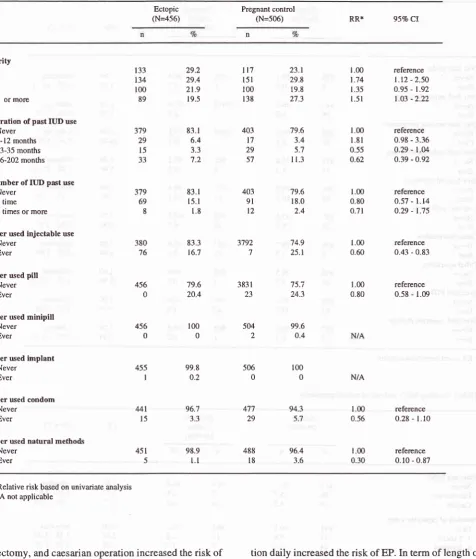
univariate analysis (Table
2)
showsthat
those
who
had moreparity
had an increasedrisk
of EP
compared to those
who
never hadlivebirth. In
general,it
seemed that pastcontraceptive
uselower
therisk
of
EP. Those
who
ever usedIUDs in
aperiod longer
than12
months
seemedto
be more protected
against
EPcompared
to
those
who never
usedIUD. Nurnber
of
pastIUD
use episodes alsolower
therisk of
EP.
His-tory
of past use ofinjectable,
pills,
and natural methods seemed to belowering
therisk of
EP.The
risk
of
implant and
minipill
users
can
not
beevaluated
becausethere was
no
such subjects
in
the study. [image:3.595.345.577.159.516.2]appen-VoI 8, No 3, July - September 1999
Table 2. Parity, past contraceptive uses aÉd risk of ectopic pregnancy
Risk of ectopic pregnancy 185
Ectopic
(N=456) Pregnant (N=s06)control RR* 95%Cl
Parity 0
I
)
3 or more
Duration of past IUD use Never
l-12 months
l3-35 months 36-202 months
Number of IUD pâst use Never
I time
2 times or more
Ever used injectable use Never
Ever
Ever used pill
Never Ever
Ever used minipill Never
Ever
Ever used implant Never
Ever
Ever used condom Never
Ever
Ever used natural methods
Never
Ever
379 29 l5 JJ t33 134 100 89
379 69 8
380 16
456 0
455 l
29.2 29.4 21.9 19.5
83.1 6.4 3.3
1)
83.1 15. I
1.8
83.3 16.7
79.6 20.4
100 0
t17
l5l
100 r3823.t
29.8 19.8 27.3
79.6 3.4 5.7 I 1.3
79.6 18.0 2.4
'74.9 25.1
75.i 24.3
99.6 0.4
100 0
96.4 3.6
L00
1.74 1.35
l.5l
1.00
l.8l
0.55 0.62L00
0.60
1.00 0.80
N/A
1.00 0.56
r.00
0.30 1.00 0.80
0.7t
403 t7 29 57
403
9l
t2
reference
l.t2
- 2.50 0.95 - 1.92 l.o3 -2.22reference 0.98 - 3.36
0.29
-l.u
o.39 - O.92
reference 0.57 - l.14 0.29 - 1.75
reference 0.43 - 0-83
reference 0.58 - 1.09
reference 0.28 -
l.l0
reference 0.10 - 0.87 456
0
3792 7
383 I 23
504 2
506 0 99.8
0.2
MI
l596.7 3.3
98.9
l.l
477 29
488 l8
94.3 5.7
451 5
* Relative risk based on univariate analysis
N/A not applicable
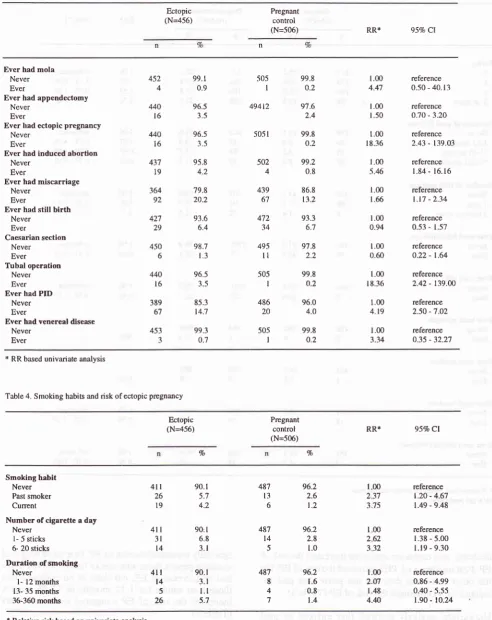
dectomy,
and caesarianoperation
increased therisk
of
EP. Past incidence
of
PID
increasedtherisk
of EP. Onthe other hand, the
data
did not prove that
past
in-cidence
of VD
increase therisk
of EP (Table
3).Univariate
analysis showed that
current
or
past
cigarette
smoking,
more number of cigaretteconsump-tion
daily
increased therisk
of
EP.In term
of
length of
[image:4.595.92.569.108.668.2]r86 Basuki
Table 3. Obstetrical and gynecological and risk ofectopic pregnancy
Med J Indones
Ectopic (N=4s6)
Pregnant
control
(N=506) RR* 95Vo Cl
Ever had mola
Never Ever
Ever had appendectomy Never
Ever
Ever had ectopic pregnancy Never
Ever
Ever had induced âbortion
Never Ever
Ever had miscarriage
Never Ever
Ever had still birth Never
Ever
Caesarian section Never
Ever
Tubal operation Never Ever
Ever had PID
Never Ever
Ever had venereal disease Never Ever 452 4 440 l6 440 l6 43't t9 364 ot 427 29 450 6 440 l6 389 67 451 99.1 0.9 96.5 3.5 96.5 3.5 95.8 4.2 79.8 20.2 93.6 6.4 98.7 1.3 96.5 3.5 85.3 14.7 99.3 0.7 -505 I 494t2
505
l
502 4 439 67 472 14 495
ll
505 I 486 20 50-5 I 99.8 o.2 9'1.6 2.4 99.8 o.2 99.2 0.8 86.8 13.2 9?.3 6.7 97.8 a1 99.8 o.2 96.0 4.O 99.8 0.2 1.00 4.47 l.00 1.50 1.00 18.36 t.00 5.46 1.00 1.66l
00 0.941.00
0.60
1.00 t 8.36
1.00
4.19
1.00
3.34
reference 0.50 - 40. l3
reference o.70 - 3.20
reference 2.43 - t39.O3
reference
1.84- 16.16
reference
t.r7 - 2.34 reference 0.53 - 1.57
reference 0.22 - t.64
reference 2.42 - t39.00
reference 2.50 - 7.02
reference
o35 - 32.27
* RR based univariate analysis
Table 4. Smoking habits and risk ofectopic prcgnancy
Ectopic (N--4s6)
Pregnant control
(N=506) RR*
95Vo Cl Vo
Vo
Srnoking habit
Never
Past smoker Current
Number of cigarette a day Never
l- 5 sticks 6- 20 sticks
Duration of smoking
Never
l-
12 months13- 35 months 36-360 months
4rl
3l l4 90.1 5.7 4.290: I
6.8 3-l 90.1 3.1
l.l
5.7 96.2 2.6 1.2 96.2 t.6 0.8 t.44ll
26 t94tt
t4 5 26 487 t3 6 487 t4 5 96.2 2.8 1.0 100 237 375 t00 262 332 reference t.20 - 4.671.49 - 9.48
reference t.38 - 5.00
l.19 - 9.30 reference 0.86 - 4.99 0.40 - 5.55 t.90 - 10.24
487
I
4 7 1.00 2.O7 1.48 4.N [image:5.595.79.572.102.722.2]Vol 8, No 3, July - September 1999
The
final
model
as
shown on Table
5
revealed
thatthere were
relationships
betweenhistory
of
contracep-tive
methods (past
IUD
use,
andpast
injectable
use, pastnatural), obstetrical history (previous
EP,induced
abortion,
andmiscarriage), PID,
andduration of
smok-ing
habits.The most
potential
obstetrical-gynecological
risk
fac-tor which
increased
the risk
of
EP
was previous
EP (adjustedRR
=
16.84; 95VoCI:2.14-2126). History of
induced abortion,
PID,
and
history
of
spontaneousabortion
followed.
History of
past contraceptive methods
(pastIUD
use,past
injectable
use, pastnatural
method)
lowered
therisk
of EP. The
most potential past
contraceptive
method which protected
therisk
of
EP are pastnatural
method
(adjusted
RR
=
0.18;
95Vo Cl:0.05-
0.54),
followed
by
past
injectable method
(adjusted
RR
=
0.51;95Vo
CI:
0.37-
0.72).Risk of ectopic
pregnancy
187Relative
to
non
IUD
users,
past
IUD
use
for
l-12
months moderately
increasedthe
risk of
EP
(adjustedRR
=
1.65;
957oCI:0.84-3.22; p = 0.145),
however
longer duration
of IUD in
thepast protected
againstEP.
Thosewho
ever
used IUDfor
13-36 months
had53Volower risk of
EP (RR =0.47;
95VoCI:0.24-0.93),
and among
who
usedIUD for
36-202months
had42Volower
risk
of EP
(RR
=
0.58;
95VoCI:
0.36-0.94)
relative to
non IUD
subjects.In
general,longer
dura-tion
of
pastIUD
use protected therisk
of
EP(adjusted
testfor
trendp = 0.015)
In
term
of
duration
of cigarette
smoking habits,
thereis
a trend that longer duration
of
smoking
cigarette
trend
to increase therisk
ofEP
(adjusted testfor
trendp <
0.001). Relative
to non
smokers,
smokin,e habitsfor
l-12
months
increases
the
risk
of
EP 2.7
times
(adjusted
RR
=
2.76;
95VoCI:
1.09-6.97),
smoking
habits
for 36-360
months
for
3.2times (adjusted RR
-
3.20;957o
CI:
1.30-7.83).
However, our
data
doesnot prove increased
risk
of EPfor
thosewho
smokefor
13-35 months.Table 5. Relationship between past contraceptive use, history obstetrical-gynecological, and smoking habits and risk ofectopic pregnancy
Ectopic (N=456)
Pregnant
control
(N=506)
RR*
95VoClPast IUD use
Never
l-12 months
l3-35 months
36-202 months
Ever used injectable
Never
Ever
Ever used natural method
Never Ever
Ever had ectopic pregnancy
Never
Ever
Ever had induced abortion
Never
Ever
Ever had miscarriage
Never Ever
Ever had pelvic inflammatory disease Never
Ever
Duration of smoking habit
Never
I - 12 months
13 - 35 months 36 - 360 months
379 29
l5
-t -t
380
93
403
t'l
2957
379
127
488
l8
505
I
502 4
439
67
486 20
487
8
4
7
440
l6
437
t9
364
o,
389
6'1
4lL t4
5
26
45t
5
83. I
6.4
3.3
7.2
83.3 16.7
98.9
l.l
96.5 3.5
95.8
4.2
79.8 20.2
85.3
t4.7
90. I 3.1
t.l
5.7
'19.6
3.4
5.7
I1.3
74.9
25.1
96.4 3.6
99.8
0.2
99.2 0.8
86.8 13.2
96.0 4.0
96.2
1.6
0.9
t.4
L00 r.65
o.47 0.58
1.00 0.51
1.00 0. l8
r.00 t6.84
l
00 6.70t.00
1.63
1.00
4.47
1.00
2;t6
0.81
3.20
reference 0.84 - 1.22 0.24 - 0.93 0.36 - 0.94
reference 0.37 - 0.72
reference 0.05 - 0.54
reference
2.t4 - 132.50
reference
2.lt
-21.26reference 1.29 -2.35
reference 2.57 -'t.76
reference
t.æ -6.9'r
0.17 - 3.91 1.30 - 7.83
[image:6.595.83.572.374.722.2]188 Basuki
DISCUSSION
There are several limitations, which must be
con-sidered
in
the interpretation
of
the findings. Firstly,
case ascertainment, although based
on a
defined
population,
may
beincomplete,
as somewomen may
have received
medical
care
for
their EP at
a private
hospital
which
was
not
participating
in
our
study.However,
although there
areprivate hospitals
operat-ing within the study
areas,the large
majority of
EPsare treated
at the
teaching hospitals
from which
our
caseswere
identified.
In
addition, we
have
no
dataregarding
theproportion
of
selectedcontrols
that werenot interviewed.
Different individuals interviewed
cases andcontrols.
However, all
interviewers
have beensimilarly
trained
in
the useof
the datacollection
instrument.
We
have
no
dataon the
aspectof IUD
and theother
contraceptive
methods use thatmight
haveallowed
usto
more
specifically
examine
risk factors
associatedwith
the last
timing
of these contraceptive
methodsused.
In
spiteof
theselimitations,
therestriction
of ourstudy
population
tomarried, gravid women
made our resultsmore directly applicable than
those
of
prior
studies.Although
we do have some evidence thatcontrols
wererepresentative
of
the
generalpopulation,
as 22.l%oof
the total controls interviewed (including those
who
were
excluded from
these analysis) reported current
use
of
anIUD, in which similar to overall proportion
of
IUD
use(22.2Vo) among Indonesia women
in
thearea
in
which this
study was conducted (personalcom-munication, Indonesian National
Family
Coordinating
Board).
In
addition,
pregnant
controls were
selectedrandomly
from
random
subsetof neighborhood
within
the same
catchment
area asthat
of
cases.The final model
suggestedthat
past
[UD,
injectable,
and
natural contraceptive
use mayprovide
a degreeof
protection
against EPrelative
to neverhaving
usecl anycontraceptive method.
After
the discontinuation
of
these
contraceptive methods would be
expected to
reduce therisk of
EP.The
final
model shows that natural
methods (coitus
interruptus
and othertraditional
methods such astradi-tional
herbs) are
the most protecting
contraceptive
methods against EP.
Coitus
interruptus
is
the method
most
likely to
prevent EP
due
to
less
probability
of
having
an infection along
with
ejaculated
sperm.Therefore, natural contraceptive methods
arepromis-Med J Indones
ing
methods
to
prevent EP. However,
only
a
small
number
of our
subjectspracticed
traditional
methods.Among
casesonly l.lEo
(51456),
and 3.6Vo(18/506)
among
pregnant controls.
Those
who
ever
used
IUD for
l-12
months
has 58%moderate
in
increaserisk
of
EP
relative to
never
hadan
IUD
(p=0. 145),while for
longer period of
pastIUD
use reduce
the
risk
of
developing EP
relative
to
those who never had anyIUD.
A longer duration of
pastIUD
use
protecting women
of
developing EP. Those who
ever
usedIIID
for 13-35
months
had
52Vo decrease,and
for
past
IUD
users
for
36-202 months
42Vodecrease
of
risk
to
develop
EP relative to
never
hadpast
IUD
use.This finding is similar with
the
resultsof
multinational WHO (World Health
Organization)
study
in
1978-1980that
pastIUD
useprevented EP.'
Women who ever reported
PID
wassubsequently
4.5fold
increaserisk
of EPrelative
to thosewho
never hadPID.
Others13'14huu"
noted
thatrisk
of
symptomatic,
diagnosed
PID
in IUD
users
is
greatest
shortly
after
insertion
of IUD. This condition might
bethe
reason,which
increaserisk of
EP among
thosewho
hadIUD
for
a shortperiod. Our
data,which
showpelvic
inflam-matory
diseaseincrease
the risk
of
EP,
is
similar
toothers'l'2'13'14
The
final
model
also shows thatprevious
EP is themost
prominent
risk
factor (RR =16.84).
This finding
isconsistent
with
previous population-based
studies."'''
These
findings
arenot
surprising
becauseone
would
expect a
woman
with
a damagedtubal structure
which
caused a
previous
EP to
be more prone
to
develop
asubsequent
EP either
in
the
contra lateral
tube
or,
if
conservative surgery were performed,
in
the repaired
tube.Some studies in developed countries
found
that
p_re-vious
induced abortion
hadlittle
relation to
EP.l'fs'16
Other
studiesfound
thatprevious abortion did
increaserisk
of FJP.2'|1 In
Indonésia,
acountry
where induced
abortion
isillegal,
therefore induced abortion
wasper-formed
illegally
and
might
be
by non-professional
medical personnel
with
low
quality
of
care. This
elevated
risk of
EP
among
the
subjects
of
2.4Vo(231962)
who
ever hadprevious abortion.
In
addition, our
dataon smoking habit
is similar with
previous studies that indicated elevated
risk
of
EPâssociated
with
cigarette smoking.l'5'18
Eu"n
though
those
who
smoked
for
13-35 months
did not
non-Vol 8, No 3, July - September 1999
smokers,
but
the
final
model indicates
thatin
Seneralsmoking
increasesrisk
of
EP (adjusted testfor
trend p =0.003). Cigarette smoking has
been shown to reducehumoral
andcellular immunity,
andthis impaired
im-munity may
predispose smokers to
pelyic-
infection,
thus
indireitly incréasing
therisk of
ËP.8'leIn
conclusion, the
final
model revealed that
pastcon-traception (IUD,
injectable, natural) use
protected
women against EP.
Longer
duration
of
IUD
use also decreasedthe risk
of
EP. As previous
studies
noted,our
data shows
that PID,
previous
EP,
andprevious
induced abortion
aswell
as spontaneousabortion
andsmoking habit
increasedrisk
of EP.It
is recommendedto
have a betterquality
andlegal medical program
for
those
who
needmedical
services toovercome
miscar-riage and induced abortion problem, and
finally
acom-munity
program
is
needed
on PID,
as
well as
onsmoking prevention
among women.Acknowledgment
The
author thanks
Dr. Olav
Meirik
(Special Program
of
Research,Development and
ResearchTraining in
Human Reproduction,
World
Health
Organization)
and
Dr. Sujana Jatiputera
(School
of
Public
Health
University
of Indonesia)
for
technical
assistancein
thepreparation on the study. Special thanks are
extendedto Dr. Mary Anne
Rossing (Fred Hutchinson
CancerResearch Center, Seattle
USA)
for data
verification
and transformation
of
the
study. Special thanks
to
colleagues
in
1I
centers
in
Indonesia
for
their
high
dedication
in participating
the study.And lastly
toDr.
Abdul Bari Saifuddin to review earlier drafts
of
this
manuscript
thatimproved
thefinal
product.
REFERENCES
1.
World
Health Organization. Task forceon intrauterine
devicesfor
fertility
regulation.Clin Reprod
Fertil
1986;3:l3l-43.
2. Marchbank PA, Annegers JF, Coulam CB, Strathy JH, Kur-land LT. Risk factors for ectopic pregnancy. A
population-based study. JAMA 1988;259: 1823-7.
Risk of ectopic pregnancy
3. Rossing
MA, Daling JR,
Voigt LF, Stergachis AS, WangS-P, Grayston JT. Past use of an intrauterine device and risk of tubal pregnancy. Epidemiology 1993:4:245-51.
4. Thorbum JO, Philipson M, Lindblom B. Backgroungd fac-tors of ectopic pregnancy
II:
Risk estimation by meanof
logistic model. EurI Obstet; 1986:333-40.
5. Daling JR, Weiss NS,
Voigt
LF,
McKnightB.
The in-trauterine device and primary tubal infertility. N Engl J Med 1992;326:203-4.6. Anon. Diagnostic and therapeutic technology assessment.
Intrauteri ne devices. JAM A 1 9 89 ; 261 :2127 -30.
7. Hersey P, Prendergast
D, Edwards A.
Effectof
cigarette smoking on the immunity system: follow-up studies innor-mal subjects
after cessation
of
smoking.Med
J
Aust 1983;2:425-9.8. Kalandidi
A,
DoulgerakisM,
TzonouA,
et al. Induced
abortions, contraceptive practices, and tobacco smoking asrisk factors for ectopic pregnancy
in Athens, Greece'
Br JObstet Gynecol 199 | :98:207 -13.
9. Weiss NS, Daling JR, Chow
WH.
Control definition tn case-control studiesof
ectopic pregnancy.AJPH
1985; 75:6'1-8.10. Breslow NE, Day NE. Statistical Methods
in
Cancer Re-search Vol I. The analysis ofcase-control studies (IARC Sci.Publ No.32). Lyon, France: Intemational Agency
for
Re-search on Cancer, 1980. p 93-l 15.I
l.
Hosmer DW, Lemeshow S. Applied logistic regression. New York. John Willey&
Sons. 1989. p 82-9112. Statistics and epidemiology research Corporation. Egret:
Reference manual. Seattle. 1990; p 134-61.
13. Farley TMM, Rosenberg MJ, Rowe PJ, Chen J-H, Meirik O.
Intrauterine devices and pelvic inflammatory disease: an intemational perspective. Lancet 1992; 339: 785-8. 14. Lee NC, Rubin GL, Ory HW, Burkman RT. Type
of
in-trauterine device and the risk of pelvic inflammatory disease. Obstet Gynecol 1983; 62:l-6.
15. Nordenskkjold F, Ahlgren M. Risk factor in ectopic
preg-nancy. Acta Obstet Gynecol Scan 1991; 575-9.
16. Daling JR, Chow
WH, Weiss
NS, Match BSR. Ectopic pregnancy in relation to previous induced abortion, JAMA1985;253:1005-8.
17. Panayotou PP, Kaskarelis DB, Mietinen OS et al. Induced
abortion and ectopic pregnancy.
Am
J
Obstet Gynecol 1972:114:507-10.18. Levin AA, Schoenbaum SC, Stubblefield PG, et al. Ectopic pregnancy and prior induced abortion. Am J Public Health
1982;72:253-6.
19. Niles JH, Clark JFJ. Pathogenesis of tubal pregnancy. Am J