Manual for
Module 1
The Australian
production system for
live cattle exports
Module 1
The Australian
production system for
live cattle exports
The harsh and monsoonal climates of northern Australia, allied to
poor soils, mean that most grasslands are suitable for breeding
cattle but not for fattening them.
South-East Asia has a large population demanding more meat in
their diet. From demand has risen the export of live cattle from
Australia to be fattened in feedlots in South-East Asia.
This module describes the systems for producing well-adapted
and healthy cattle in northern Australia, and how these cattle are
prepared for export.
Contents
Introduction 2
The northern Australian beef industry 2
The environment 3
Properties and herd size 3
Breeding and exporting 4
Herd management 4
Labour 4
Australian livestock disease status 5
National Livestock Identiication System (NLIS) 5
2 Module 1. The Australian production system for live export cattle
Introduction
The livestock export trade to South-East Asia is critically important to northern Australian producers. Australia’s northern cattle industry has grown and developed due to the strong demand for beef from South-East Asia. For its ever-increasing population and a middle class that can afford to purchase good quality beef, importing and fattening live cattle provides a source of fresh beef for the local population. It also removes pressure to slaughter local female cattle thus supporting a more secure local beef industry.
“Australian cattle are well known for being of high quality, healthy and disease-free. They are well suited to the South-East Asian climate and the livestock industries in our key markets are investing in animal welfare programs and infrastructure to support this trade.”
Animal requirements for SE Asian markets
The northern Australian beef
industry
The environment
The climate across the top half of Australia varies from the tropical zones in the north with a wet season from October to April to the arid environments of central Australia. Annual rainfall ranges from as high as 2000mm in the north to 200mm in the arid centre and west.
The monsoonal climate of northern Australia and relatively poor soils mean that the grasslands of much of the region are suitable for breeding beef cattle but not for inishing them. As a result of the Australian conditions and SE Asian demand, growing cattle are exported to the region to be fattened in local feedlots. Soil types are equally variable: from the fertile marine plains of the north coast and the black clays of the Barkly Tableland to the lighter soils of the semi-arid centre of the continent.
Water supplies for cattle include limited natural water in the wetter northern areas and the more common bore water supplies on the majority of properties across northern and western Australia.
Country Human
population Domestic herd slaughtered Imported cattle slaughtered Consumption (kg per head of
population)
Indonesia 250,000,000 1,700,000 750,000 2.4
Malaysia 25,000,000 4.7
Philippines 80,000,000 5.1
Brunei 370,000 8.4
Table 1 South-East Asian beef cattle status
Cattle suitable for live export are sourced from across the top of the Australian continent and down the west coast of Western Australia. Most live cattle are exported from Darwin in the Northern Territory (NT) because of its proximity to SE Asia. The second largest source of live cattle is Queensland from where animals are exported from the ports of Townsville,
Karumba and Mourilyan. Those from Queensland can come from areas north of about Emerald up into the Gulf of Carpentaria. Queensland exports tend to be more opportunistic and are often shipped during the wet monsoonal months when transport in the NT can be unreliable because of wide-spread looding.
Cattle in these northern areas have been selected and bred for tropical and subtropical conditions and are well suited to the hot and humid environment found in SE Asian feedlots.
Property and herd size
Property sizes are similar across the north and west of Australia despite the large variation in carrying capacity. The overall size of cattle properties in the Northern Territory (NT), North Queensland (NQ) and Western Australia (WA) averages just over 3000 square kilometres.
The total cattle herd in the area from which cattle are sourced for live export comprises about 5 million head in North Queensland, 1.7 million head in the Northern Territory and 500,000 head in Western Australia. Individual herd size varies greatly because of the very different carrying capacities of the various environments across the regions. Herd sizes in the NT range from 80,000 head on a single property to fewer than 1000 head in some far northern areas. The most common breeder herd across the north is 2000–5000 head. Large property sizes and small labour forces mean that cattle are handled only infrequently.
Big properties, open spaces. Brahman and cross-bred cattle.
4 Module 1. The Australian production system for live export cattle
Breeding and exporting
The main cattle breeds across the northern half of Australia are Bos indicus, being pure Brahman and Brahman cross. These animals are ideally suited to this harsh environment and equally suited to the environment found in SE Asia.
The main production system in all these areas is breeding, with a small proportion of properties able to fatten cattle. The animals most commonly sold are 18–24-month-old feeder steers,
followed by cull cows and heifers; all these are generally turned off in the dry season between April and September. Most are sent to live export, the rest to abattoirs or for fattening in other parts of Australia.
In the wet season, stock often come from Queensland where they can be transported over the more reliable all-weather road system. However, in high rainfall years, fewer cattle may be available from there as producers have ample grass for more proitable fattening of their steers.
Herd management
Most producers undertake two rounds of mustering each year during the dry season using helicopters, horses, motorbikes and trap yards. Most northern beef herds do not restrict mating and so calve year-round, with young stock weaned from their mothers at each round of mustering.
Breeders in Queensland tend to be mated seasonally with mustering and weaning from April to June.
Most animal receive some nutritional supplement—phosphorus in the wet season and nitrogen (as urea) in the dry season. The main animal health concern is botulism; virtually all herds on very phosphorus-deicient country are vaccinated against botulism if there is any history of it in the region.
Labour
It is often dificult to source labour to work in these remote areas. The average property across the regions has about ive permanent staff but employs an additional seven seasonal workers for the mustering season. Thus very large numbers of cattle spread over vast areas are managed by very small work forces. As a result, cattle in these areas do not have a great deal of contact with humans.
Well-adapted Brahman-cross cattle.
Mustering cattle on extensive properties with helicopters means that many northern cattle have little contact with humans.
Mustered cattle being drafted in the yards.
Australia’s livestock disease status
Australia’s unique disease status is a result of the history of early settlement by Europeans. The irst domesticated livestock brought to Australia in the late 1790s and early 1800s travelled from England on sailing ships on a voyage that took about 9 months. During this enforced quarantine, a wide range of diseases were either eliminated naturally or died out with the animals. Thus, the more serious diseases of livestock did not come onto Australian soil, creating an extremely disease-free base herd. Once the early settlers understood this process and its value to the future of livestock production, they introduced strict quarantine measures for all future introductions, resulting in one of the most disease-free animal populations in the world. Travellers to Australia will have encountered the very strict quarantine arrangements at all points of entry.Australia is free from Foot and Mouth Disease (FMD), rabies, rinderpest and Haemorrhagic Septicaemia. Pleuropneumonia was eradicated from the national cattle herd in the 1960s, and bovine brucellosis and tuberculosis between the early 1970s and 2000. The strict quarantine measures and early ban on feeding meat meal to livestock has ensured that BSE (Mad Cow Disease) is also absent from our national herds.
National Livestock Identiication System
(NLIS)
The disease-free status of the Australian cattle herd needs to be carefully monitored to ensure our access to foreign markets. NLIS is Australia’s system of livestock identiication and traceability for disease, food safety, product integrity and market access purposes. It is a permanent whole-of-life system that allows individual animals to be identiied electronically and tracked from the property of birth to slaughter or live export. NLIS uses machine-readable Radio Frequency Identiication (RFID) devices as either ear tags or rumen boluses to identify cattle. Each animal has a unique number which is recorded when the animal is irst tagged and then recorded again if the animal leaves the property, and this information is downloaded to a national database. NLIS has created a centrally-stored electronic history of all recorded individuals which enables rapid and accurate traceability.
Livestock Production Assurance (LPA)
LPA is an on-farm food safety program that ensures thatlivestock producers can support their claims that the meat from their animals is it for human consumption. Producers complete a statutory declaration called the National Vendor Declaration (NVD) Waybill when animals are dispatched from their properties. The NVD describes the stock and any treatments or procedures that they have experienced to demonstrate that the meat from
the animals is safe for human consumption. Hand-held NLIS tag reader.
6 Module 1. The Australian production system for live export cattle
Australian Standards for the Export of
Livestock (ASEL)
The general public in Australia takes great interest in animal health and welfare. The Australian Government recognises this concern and the country’s international obligations to animal health and welfare. Accordingly, the Government has developed a set of standards to help the export industry ensure that the outcomes of the live export process meet the expectations of the Australian and international communities. The export trade will depend on the industry continuing to meet these expectations.
The standard developed by the Australian government and industry provides:
• an Australian government statement of guiding principles and minimum recommended animal health and welfare outcomes for animals in the livestock export industry • an approach consistent with that taken by international
bodies such as the World Organisation for Animal Health (OIE)
These standards are under constant review.
Australian Quarantine Inspection Service
(AQIS)
The livestock export industry is regulated by the Australian Commonwealth Government through the Australian Quarantine and Inspection Service (AQIS). Only livestock exporters licensed by AQIS can export livestock from Australia.
The standards take a whole-of-chain approach to minimise the chance of an adverse animal health and welfare outcome. They aim to identify critical risks and to develop and implement risk management measures. The key elements in the chain are:
• planning the consignment
• sourcing and on-farm preparation of livestock • land transport
• pre-embarkation assembly at AQIS registered premises • vessel preparation and loading
• sea voyage • discharge
• post-embarkation
A licensed livestock exporter must apply to AQIS for each export consignment, and provide information on all aspects listed above to satisfy AQIS that the ASEL are complied with and the risks of the consignment are minimised.
Trucking cattle to port quarantine yards.
Quarantine yards at port.
Australian guide to itness of animals for export.
The export supply chain
The licensed exporter negotiates a commercial transaction with a SE Asian importer. The importer provides the exporter with an import permit and health protocol.
The exporter presents these documents to AQIS along with a Notice of Intent to Export (NOI) and a Consignment Risk Management Plan (CRMP). If all documentation is in order and the export process will meet the ASEL, the exporter is given approval to proceed. This includes speciic requirements for the shipment.
Producers are contacted and suitable livestock are selected and purchased.
Issues that are considered in the selection process include: • Breed factors – most low-land SE Asian feedlots must use
only Brahman and Brahman-cross cattle for the hot and humid local conditions. Feedlots at elevated locations may be fatten cattle with a higher British or European breed content.
• Importing feedlot requirements – the type of animal that the feedlot requires, the period of feeding, the most suitable weight range, sex and class.
• Seasonal factors – the dificulties of sourcing stock during the monsoon season in northern Australia, and associated higher prices.
South-East Asian health protocols require properties of origin to be free from certain diseases, and cattle can be sourced only from properties that meet the protocol requirements.
Some importers send a selector to personally choose
appropriate stock; others rely on the experience of the exporter. Livestock agents are frequently used to source stock for
exporters.
Road transport companies are contracted to deliver the selected stock to registered assembly depots for preparation of the consignment. These transport companies are required to comply with ASEL.
Feed manufacturers are contacted to source fodder for both the time spent in the registered premises and the voyage. This fodder is generally pellets or cubes of compressed hay and must be of a minimum standard as per the ASEL.
Assembly depots for processing of export livestock must be accredited by AQIS to ensure that they meet the ASEL.
Only veterinarians accredited by AQIS are permitted to complete the tests, treatments and inspections required for export. They have to provide appropriate documentation to AQIS as proof of completion of treatments and inspections.
Any female feeder cattle must be certiied to be either spayed
Export cattle being fed a pelletted maintenance ration.
8 Module 1. The Australian production system for live export cattle
At all stages of the export process, animals are constantly
inspected for health and welfare, and any ill, injured or unsuitable animals are rejected from the consignment.
Stevedoring companies are engaged to facilitate the loading of the vessel. The livestock export industry provides training for stevedores to ensure that they are able to load the cattle onto ships in a manner that maintains the health and welfare of the cattle and minimises stress.
Accredited stockmen must accompany every voyage. These stockmen are trained and accredited by LiveCorp to ensure they are familiar with the management of livestock onboard vessels at sea.
ASEL requires the master of the vessel and the stockmen to report on the outcomes of each live export voyage. In the event of mortalities—or other unfavourable events such as vessel problems or delays to discharge—AQIS will investigate the incident so as to minimise the chances of a repeat of this event. Accredited stockmen (and veterinarians when they are required to travel with the shipment) have to remain with the vessel until all cattle are unloaded.
Australian livestock producers and exporters, through levies on every exported animal, have invested in projects in South-East Asia to promote the health and welfare of the livestock after arrival and to assist with the sustainable development of local feedlot industries.
Under supervision on board.
Finishing unloading cattle in Indonesian port. Cruising ‘cattle class’ on an ocean liner.
10 Module 1. The Australian production system for live export cattle
Module 2
Module 2
Feedlot design
Good design will result in a feedlot that ensures good animal welfare,
eficient weight gains and effective feeding and waste management
with minimal management concerns. Poor design can hinder the
operation and management of a feedlot for its entire life.
This module provides design information on the components of a
feedlot, and also looks at poor designs that should be avoided.
Contents
Introduction 2
Feedlot pens 3
Housing systems 5
Flooring and bedding 8
Feed delivery systems 10
Water troughs and water supply 13
Cattle lanes and fencing 16
Bio-security and quarantine 18
Cattle handling facilities 19
Solids management systems 22
Efluent management systems. 25
Introduction
The operating conditions of a feedlot are based on the local climate, the environmental sensitivity of the area, the type of cattle being fed, the nature and availability of commodities and the social structure of local communities.
The climate in South-East Asia is probably the single most important factor inluencing feedlot design. It is characterised by:
• frequent, high-volume and high-intensity rainfall • high temperatures
• high humidity.
These aspects inluence feedlot design, particularly from the perspectives of animal welfare and waste management. For example, large quantities of rainfall run-off could contaminate areas of high environmental value.
Most cattle in SE Asian feedlots are Bos indicus—generally large-framed animals with high tolerances to heat and humidity. Although local feedlots often have access to large workforces, some mechanisation may improve the eficiency of their operations.
Module 2. Feedlot design 3
1. Feedlot pens
Function
Feedlot pens hold cattle; provide access to feed and water; provide conditions which allow cattle to maximise their weight gain; allow easy removal of manure; and provide free drainage.
Design features
Pen size
The dimensions of a feedlot pen depend on pen capacity, the stocking density and the amount of feed trough required. Figure 1 shows how stocking density (SD), trough length (TL) and pen capacity relate to the dimensions of a typical feedlot pen. Where shed structures require columns within the pen area, pen dimensions may also be determined by the spacing of the shed frames to ensure that fences are aligned with columns.
Pen capacity
Pen capacity is best matched with the expected numbers of cattle entering or leaving the feedlot in each consignment—for example, a standard truck load.
Stocking density
The stocking density describes how much area is allowed for each animal, and is based on the size of animals with larger heavier cattle needing more space than smaller lighter one. It is also based on the type of housing intended. Fully covered pens can be stocked more densely (2.5–4 m2 per head) than partially covered pens (5–9 m2 per head).
Feed and water
Cattle must always have free access to both feed and water. The feed trough should run along the full length of the front of the pen, while the water trough should be located towards the rear of the pen (see Figure 2). Each animal must have at least 200 mm of feed trough space. See Sections 4 and 5 for further detail on feed and water troughs.
Cattle movement
Cattle must be able to be easily moved into and out of the pens. The gate should be located in one of the back corners of the pen, and should swing across the cattle lane.
Sample plans
Figure 2 – Dimensions of a single pen
W (m)
L (m)
Figure 1 – Typical layout of a feedlot pen
Stocking Density (m2/head): SD = (L x W) / No. of head
Trough Length (mm/head): TL = (W x 1000) / No. of head
Feed tr
Module 2. Feedlot design 5
2. Housing systems
Function
Housing provides a suitable environment for cattle through shade and protects feed from rain without causing waste management problems.
Design features
Coniguration
Feed troughs (bunks) must be covered under South-east Asian climatic conditions. Pens can be fully or partially covered (over the feed trough only). Fully covered pens cost more but reduce efluent control requirements as there is no pen run-off. Partially covered pens cost less, but require more complex systems for efluent control.
Orientation
Open-sided feedlot sheds should be orientated east–west to reduce direct sunlight penetrating underneath the roof during the day. However, north–south orientation can allow early morning and late afternoon sunlight into the pens to promote drying of bedding material.
Shed design
Sheds should have high eaves, open sides and open ridge caps to promote natural ventilation. Ridge caps must allow suficient overhang to prevent wind-driven rain passing through the gap. Sheds must allow easy access for machinery to deliver feed and clean pens.
Support columns
Clear-span structures are preferred. No columns should be placed inside pens other than in line with fences or on the alley side of feed troughs. Steel columns should be encased in concrete to prevent corrosion around their bases.
Rooing
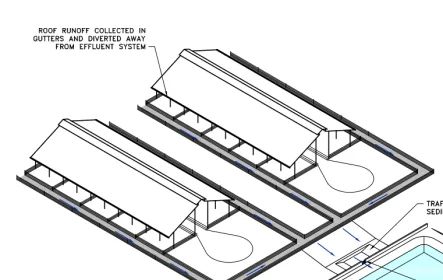
Roof pitches should be steep enough (between 1:2 and 1:3 slope) to promote good natural ventilation. All roof run-off should be collected in gutters and diverted away from any efluent management systems.
Shed spacing
Sheds should be spaced apart a distance of 3–5 times the eave height to promote natural ventilation.
Sample plans
Module 2. Feedlot design 7
Practical examples
Good features
Poor features
High eaves, good roof pitch and raised open ridge vent.
Sheds too close, and no ridge vents; poor natural ventilation.
Clear-span structure, with good pen slope. Insuficient cover for both cattle and feed.
Suficient cover for cattle and feed, and concrete encased columns.
Insuficient cover to prevent rain entering shed and spoiling feed.
3. Flooring and bedding
Function
Cattle must have a safe and comfortable surface to move and rest on. The surface must allow good drainage and easy pen cleaning.
Design features
Base surface
Concrete surfaces are best for all feedlot pens, but these should be stamped with a grooved pattern to prevent cattle slipping.
Slope
The surface should slope from the feed trough end of the pen to drain any moisture. Slopes should be 0.5–1.5% for covered pens and 1–2% for uncovered pens.
Pen cleaning
Pens need to be cleaned regularly. Spent bedding material, manure and other solid wastes must be able to be removed by hand or mechanically from covered pens. Uncovered pens will generally be washed clean by rainfall—with hosing when necessary.
Bedding material
Module 2. Feedlot design 9
Practical examples
Dry compost and sawdust being laid as fresh bedding.
Straw used as bedding material.
Stockpile of fresh bedding material. Fresh bedding being spread in a pen.
Stamped concrete to prevent cattle slipping in uncovered pen.
Pen overdue for cleaning and fresh bedding.
4. Feed delivery systems
Function
Cattle must have easy and comfortable access to fresh feed, which can be delivered by hand or by machine.
Design features
Construction materials
Concrete or rendered brickwork is the most durable material for feed troughs, and can be formed to desired shapes. Feed delivery roads can be made with compacted gravel provided they are well maintained and kept free of potholes.
Trough length
Each animal should have 200–300mm length of accessible feed trough. For the most eficient delivery of feed, troughs should be continuous along each row of pens (see Figure 2).
Weather protection
Feed troughs must be protected from rain to prevent feed being spoiled by excess moisture. See Section 3 for further detail.
Cattle access
Cattle should be able to access all of the feed in the trough with comfort. A single overhead cable or rail will prevent cattle climbing into the trough and escaping.
Feed delivery access
Delivery of feed and roughages to the troughs should not be obstructed by overhead cables or rails. Feed delivery roads should be wide enough for two feed delivery vehicles.
Shape
The coniguration of the trough and cables/rails should allow cattle to reach all of the feed. The pen side of the trough should be rounded and lower to allow better access to feed while the road side of the trough should be higher to minimise the spilling of feed during delivery. Both external faces of the trough should be vertical to prevent build-up of spilt feed and manure, and to help pen cleaning. Pens must slope away from the feed trough.
Cleaning
Module 2. Feedlot design 11
Sample plan
Figure 4 – Typical feed trough
Practical examples
Good features
Poor features
Feed delivered with minimal spillage. Too low restraint cable restricts cattle access.
Good width—cattle can reach right across trough to feed.
Feed trough is too wide; cattle stretching to reach feed.
Wide feed alley gives clear access to troughs for feed delivery vehicles.
Narrow feed alley prevents delivery of feed by vehicle.
Module 2. Feedlot design 13
Function
Cattle need a constant supply of good-quality, clean and cool drinking water.
Design features
Construction materials
Concrete is strongest and most durable. Steel can rust and plastic can be damaged by cattle and machinery.
Trough length
Provide 50cm of accessible trough length per animal.
Water supply pipes
Reticulation systems should be able to deliver 5–6 litres/head/ hour with pipes shielded from direct sunlight to keep water cool. Pipes should be protected from damage by cattle and machinery, particularly if vulnerable materials such as PVC are used.
Water level control in troughs
Troughs should have some form of water level control to minimise water waste through overlow. Float valves are recommended but must be protected from damage by cattle and machinery.
Location in pen and cattle access
Troughs should be in-line with the side fences (positions A or C in Figure 6). Troughs on the back fence (D) can block drainage and cause manure to build up. A trough positioned within the pen (B) will allow access from both sides, provided it does not hinder cleaning of the pen. All troughs should be easy to clean around and should not have any areas where manure can collect. A neck rail above the centre will prevent cattle climbing into the water.
Cleaning
Water troughs need to be cleaned regularly with any dirty water discharged from the pens. Troughs should have a lushing outlet with a plug that can be removed to drain the water rapidly. Access should be allowed for brush cleaning.
External shape
Troughs should been enclosed underneath with vertical sides to prevent manure building up underneath.
Emergency supply
Cattle must have constant access to water. An on-site gravity-fed emergency supply (usually a large elevated tank) should be provided in case a pump or pipeline breaks down.
5. Water troughs and water supply
Sample plans
Module 2. Feedlot design 15
Practical examples
Good features
Poor features
A well-protected loat valve.
An exposed loat valve can be easily damaged.
Water trough located in dividing fence allows manure to be washed from pens.
A water trough across the bottom fence holds manure in the pen.
Good loat protection, enclosed sides, overlow pipe and brush for cleaning.
Manure can accumulate under an open water trough support.
6. Cattle lanes and fencing
Function
Fenced lanes allow cattle to be moved safely around the feedlot in all weather conditions, and with minimal disruption to other feedlot operations.
Design features
Location
Cattle lanes should run along the bottom end of feedlot pens. These lanes allow cattle to be moved into pens through gates which open into the laneway. Cattle lanes should not cross any roads since moving cattle could disrupt feeding and cleaning operations. If the spacing of the sheds allows, cattle lanes can be shared by a row of pens on either side (Figure 7).
Width
Lanes should be 4–5m wide to allow free movement of cattle herds and machinery.
Surface
Concreting the lanes allows cattle to be moved around the feedlot in any weather conditions. A grooved pattern on the surface will prevent cattle slipping.
Slope
Cattle lanes should have a slope of 0.5–1% to help drainage.
Intersections and corners
Changes of direction should be as open and smooth as possible to help cattle low but cattle should move in straight lines as much as possible.
Fencing
Fences should include a large-diameter steel top rail and a steel belly rail with pipe or steel cable for intermediate horizontal restraints. The overall height of fences should have a determined by the types of cattle being fed. Fences should have a minimum overall height of 1.5m high while 1.8m for large Bos indicus breeds.
Posts
Posts can be made from wood or steel tube set into concrete at least 900mm below ground level and spaced no more than 2.5 m apart. The tops of steel posts should sealed to prevent rain water entering while the bottoms should be encased in concrete to prevent corrosion.
Module 2. Feedlot design 17
Sample plans
Figure 7 – Typical plan view of feedlot pen.
Figure 8 – Typical fencing for feedlot pens and cattle lanes
Practical examples
Good features
Poor features
Sturdy fencing, concrete protection for post bases and concreted cattle lane (which could be grooved to reduce slipping).
Flimsy, poorly maintained fencing, and bogging due to poor lane drainage. Cattle would baulk at using this.
Function
The risk of cattle in the feedlot contracting or transmitting disease or sickness must be minimised.
Design features
Isolation
Animal receival and dispatch facilities, feed receival areas and hospital pens should be separated from the main feedlot complex to prevent any potential infections spreading through the larger herd. Sick cattle should be isolated from the main feeding complex as much as practically possible.
Public access restrictions
Only feedlot vehicles and staff should be allowed in the feedlot. External trafic and people should be restricted to ofice facilities, feed receival areas and cattle dispatch and receival facilities.
Feedlot hygiene
Good hygiene is important to preventing disease spreading around a feedlot. Machinery should be kept clean and free of dust, mud and manure. Feeding equipment must be kept separate from that used to handle waste products. Drainage around the feedlot must be carefully maintained to prevent water lying in puddles for extended periods and causing bogging.
Quarantine/hospital pens
Speciic pens should be provided near the cattle receival and dispatch facilities to temporarily quarantine cattle before introduction to the feedlot. These pens can also be used as hospital pens to separate sick animals from the main herd in the feedlot. The pens must be at least partially covered to provide protection for cattle from rain and sun, and feed and water troughs should be larger than in normal feedlot pens to reduce stress on animals.
Practical examples
7. Bio-security and quarantine
Module 2. Feedlot design 19
8. Cattle handling facilities
Function
Handling facilities provide a safe, hygienic and low-stress way of inducting cattle into the feedlot, performing treatments on the cattle, and dispatching inished cattle from the feedlot.
Design features
Location
Cattle handling facilities should be separated by a short distance from the main feedlot complex for bio-security reasons (see Section 7). There must be adequate room for trucks to turn and to access the unloading/loading ramp.
Pens
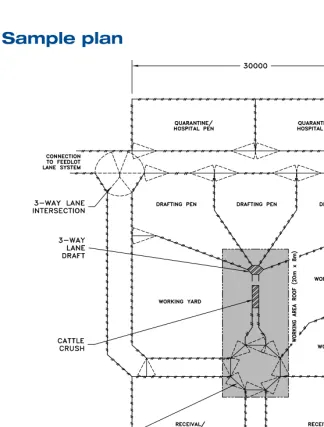
Holding pens allow cattle to be held after receival and before being inducted, and also allow inished cattle to be held before dispatch. Drafting and working pens allow cattle to be grouped, re-grouped and held before further treatment or transfer to the feedlot pens. Quarantine or hospital pens allow sick cattle to be isolated from the main herd to prevent spread of sickness and provide conditions that will help them to recover.
Crush
A sturdy steel cattle crush is essential to for safe handling of cattle. It must be able to restrain animals at the head while a squeeze mechanism will help immobilise the animal for handling and treatment. Crushes should allow veterinarian access to the rear of the animal. Weighing scales can be installed onto the crush or in a dedicated weighing box.
Unloading/loading ramp
Loading ramps should have a level section at least 1.5m long at the top for cattle to step onto and off trucks. The ramp should be approximately 760mm wide and be no steeper than 3h:1v (<20%); the loor can be made from concrete or hardwood, but concrete loors must be grooved to prevent cattle slipping. Sides of the ramp should be fully enclosed. Trucks must be able to pull up to the ramp in a way that leaves minimal gaps between the truck and ramp on the loor and sides. No part of the animal may be allowed to it through any gaps.
Drafting
The ability to separate and divide cattle is essential to good management of a herd. Drafting from a lane generally causes less stress on animals than drafting from a conined round yard. A draft should be able to be directed into one of at least three pens.
Cattle low
Cattle naturally low better around curves than around sharp angles or tight corners; thus races and lanes should be curved wherever possible. As cattle will baulk if they see handlers ahead of them, sheeting on lane fences will assist cattle low. Lanes or races must not appear to come to a dead end, and should have as few shadows as possible crossing them.
Rooing and looring
The crush and main working area must be covered to protect equipment and handlers from rain and sun. The whole handling facility, and at least the main working area, may be covered by rooing and on a concrete loor. Paved surfaces in working pens can help to reduce bogging under heavy rainfall.
[image:33.694.175.500.278.706.2]Module 2. Feedlot design 21
Practical examples
Covered working area protecting weighing box, crush and drafting gates.
Sturdy fences in working pens but poor drainage in uncovered areas causing bogging.
Clear access for trucks to loading/unloading ramp. Working area fully covered.
Grooved pattern on concrete ramp loor prevents cattle from slipping.
Function
Solid wastes from the feedlot (manure, spent bedding material, spoiled feed and carcasses) must be contained and then allowed to dry to become beneicial, with minimal harm or nuisance to the environment and surrounding residences.
Design features
Storage capacity
Solids are cleaned out of pens and sedimentation structures (see Section 10) and transferred to storage areas. Solid waste management systems must have enough capacity to store solids produced from the feedlot as they dry and are processed for reuse. Reuse or sale of stockpiled solid wastes will reduce the required capacity of storage systems.
Storage design
Stockpiles must be contained in some form to minimise
exposure to rainfall or surface water. Simple bunk-style storage areas can offer adequate protection and containment for minimal cost.
Cover
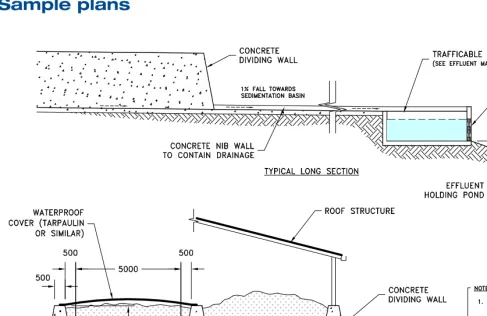
All solid waste storage areas must be covered to stop rainfall wetting the stockpiled solids which must be kept as dry as possible to stop it smelling excessively. Cover can be provided by a roof or by a tarpaulin sheet spread over the top of the stockpile (see Figure 10). Any covers must be well maintained to ensure that they are water-tight.
Drainage
All storage areas must provide adequate drainage to allow stockpiled solids to drain and dry. Drainage from the storage area must be directed into the efluent management system (see Section 10).
Handling
Solid wastes are most easily handled when they are dry. Skid-steer loaders are suitable for cleaning pens or sedimentation structures, and can load solids into the back of trucks for transporting and dumping into storage areas. Solids cleaned from pens can be moved to draining pads to allow them to partially dry before being transferred to stockpile areas.
Reuse
Solid wastes from feedlots can make highly effective fertilisers. Further value can be added by composting solids, which may be offered for sale (often in bags) as soil additives or fertiliser products.
Module 2. Feedlot design 23
Composting
Composting is a natural process involving the breakdown of organic matter by microorganisms into a humus-like material with a relatively inoffensive odour. Composting material must be kept moist and aerated, so piles should be turned every one to two weeks. Front-end loaders are suitable for turning compost piles, although specialist equipment is available.
[image:36.694.66.554.220.536.2]Sample plans
Figure 10 –Example solid waste storage area.
Practical examples
Good Features
Poor Features
Fully covered bunk stockpile provides good protection from moisture.
Uncovered stockpile causes bogging and creates contaminated runoff.
Bagged compost waiting for sale. Sedimentation structure overdue for solids removal and stockpiling.
Solids cleaned from pens being loaded into a truck for transfer to stockpiles.
No cover and poor drainage create surface water contamination risk.
Module 2. Feedlot design 25
Function
To contain, treat and dispose of contaminated water from the feedlot pens and manure storage area to prevent pollution of surrounding water resources.
Design features
System Capacity
Efluent systems must be designed to have suficient capacity such that efluent does not overlow from any structures more frequently than once in every 20 years on average, and they should also be able to contain large rainfall events without overlowing. System capacity should be determined by run-off modelling using long-term daily rainfall records. Efluent management systems consist of drainage networks, sedimentation structures and efluent storage ponds.
Catchments
Run-off from contaminated areas must be directed to the efluent
management system. Contaminated areas include all open feedlot pens, cattle lanes, manure stockpile areas and cattle handling yards. Clean run-off (from roofs and grassed areas) should be excluded from the efluent management systems to minimise the required system capacity.
Drainage
Drainage structures should direct all contaminated run-off to a sedimentation structure, and should exclude any clean run-off. A properly designed drainage system should also reduce bogging around the feedlot complex.
Sedimentation
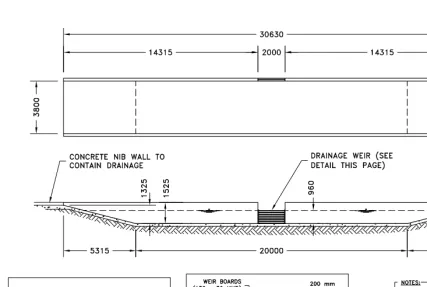
Contaminated water should enter a sedimentation structure to remove solids from the efluent stream. Sedimentation structures must be traficable so that solids can be cleaned out easily by machinery. They must be able to drain completely to ensure that solids can dry suficiently. Drainage from the sedimentation structure should be controlled by a board-type weir.
Storage
Efluent should be captured in a holding pond to prevent contamination of surrounding water resources. The pond must be constructed so that efluent cannot seep through the walls or base and contaminate surrounding water resources.
System Maintenance
Efluent drains, sedimentation structures and holding ponds must be kept as clean as possible. Blockages to any lows must be removed immediately. Solid wastes should be removed frequently.
Disposal or reuse of efluent
Efluent can be disposed of by evaporation or may be reused for other purposes. Possible uses can include the irrigation of fodder crops for cattle feed, wetting of compost, or cleaning of the feedlot complex. If efluent is irrigated onto surrounding crop land, drainage structures must be provided to prevent run-off entering local waterways.
10. Efluent management systems
Sample plans
Module 2. Feedlot design 27
Figure 12 – Typical sedimentation structure
Practical examples
Good features
Poor features
Raised edges on drains exclude clean water runoff from efluent system.
Poor sedimentation performance overloads pond with solids.
Well-maintained traficable sedimentation structure effectively removes solids.
Unlined efluent storage ponds can cause pollution of groundwater.
Efluent used to irrigate forage crops to supplement feed supplies.
Poorly maintained sedimentation structures and choked overlows prevent good drainage.
Module 3
Transport and
induction at the
feedlot
Module 3
Transport and induction
at the feedlot
Contents
Before loading onto the ship 2
On the ship 2
2 Module 3. Transport and induction
Before loading onto the ship
All importing country protocols are determined by negotiations between the Australian Quarantine Inspection Service (AQIS) and the importing country’s government authorities. Before leaving Australia, all animals are inspected by AQIS and, if the protocols have been met, they are passed it for loading. They are then moved to the port and start being loaded onto the ship (see Module 1. The Australian Production System).
On the ship
On the ship, cattle are penned at the density speciied for their weight, age and condition. They are fed a pelleted total-mix ration—generally of compressed feed products including hay, grain, legume and mineral components—which is typically formulated for maintenance. Waterers must be frequently monitored for contamination given the stocking density on board. This shipping period helps the cattle to become accustomed to noise and movement and helps them adjust to the feedlot when they arrive.
Arrival at port of disembarkation
Customs and quarantine clearanceOnce the ship is alongside the wharf, authorities from local customs, immigration and quarantine board the ship to check all documentation relating to the vessel, its cargo and the health of the livestock. Cattle cannot be unloaded until all these aspects are accepted.
Unloading from the ship
Once the unloading platforms and gateways are secured,
unloading can start. The importer of the cattle has to ensure that there are suitable trucks to deliver the animals from the wharf to the feedlot. Trucks must have a suitable rear gate system for safe loading and to hold the cattle; truck loors must be checked for holes and for suitable bedding so that cattle do not injure themselves if they fall during the road journey.
The speed of unloading depends on the number of cattle, the skill of the handlers, the quality of the unloading equipment and the number of trucks available. Cattle are counted off the ship by the crew and onto trucks by a representative of the importer. Trucks should be weighed at the wharf and when they arrive at the feedlot.
At the feedlot, cattle are unloaded into receiving yards and all documentation should be checked again to match the truck information with number and type of cattle delivered.
Unloading from ship into local trucks at night in an Indonesian port.
Loading at Australian port.
Cattle are fed a pelleted maintenance ration before and during shipment.
Induction at the feedlot
Quarantine
Depending on requirements of the importing country, quarantine regulations may apply to cattle arriving at the feedlot. Most quarantine regulations require that the cattle are kept separate from other cattle at the feedlot for a minimum of two weeks during which they are inspected by quarantine veterinarians.
For the irst three days, new arrivals should be given complete rest in pens with soft bedding and plenty of room to allow them to lie down, and should be fed and watered as described in the nutrition section (see page 5). Cattle should remain in their original groups, based on age and sex, during quarantine (and preferably for their whole time in the feedlot).
After the three days of rest and rehydration, normal induction activities such as vaccinations, ear-tagging and blood testing are performed. In Indonesia, cattle are vaccinated for Haemorrhagic Septicaemia and blood-tested for Brucellosis.
If animals are in good health at the end of the quarantine period, the quarantine veterinarians permit their release to the commercial feedlot.
Animal management and observation
As cattle will usually have travelled for at least four hours in a truck from the ship to the feedlot, they should be unloaded to the quarantine pens as calmly as possible to reduce further stress. Any sick or injured animals should be placed in a hospital pen and decisions made about their treatment or salvage for slaughter (see below).
Recognising sick animals
It is unlikely that all sick animals will be identiied when they are being unloaded from trucks at the feedlot. Newly-arrived cattle must be observed carefully in their quarantine pens to identify any serious health problems. Sick or injured cattle are removed to the hospital pen using experienced staff so as to minimise disturbance to both the main group of cattle and the sick animal.
Feedlot staff must be well trained to recognise injured or sick animals at induction and during the irst week at the feedlot.
Check for signs of injury— Can all cattle rise and walk? Sick cattle often:
• are depressed and hold their heads lower than normal • have a ‘distant’ or disinterested attitude
• tend to hide behind other cattle or stand alone
• have a dry, dull hair coat
• have soft, repetitive coughing and an increased breathing rate
• have watery, dull eyes and a clear nasal discharge
Unloading from trucks at feedlot. Slippery truck loors should be covered with bedding.
4 Module 3. Transport and induction
Common problems seen at induction
Do cattle come to the feed trough more slowly than normal? Do they eat when at the trough?
Are they generally resting comfortably and ruminating (chewing cud)?
Sick cattle with infectious disease have a rectal temperature at or over 39-40˚C.
General signs to look for each day include: appetite; depression; lameness; stiff movements; nasal and eye discharge; coughing; increased breathing rate; panting; mouth breathing; crusted muzzles; sunken eyes; rough hair coat; loose or extra irm faeces; poor abdominal ill; straining to defaecate or urinate; swollen legs.
When sick animals are put in the hospital pen, the pens they came from should be checked extra carefully.
The main problems and their treatment
When new animals arrive and are inducted into the feedlot, 1–2% often require attention. The main problems and their treatment are summarised in Table 1.
Table 1 Treatments for common problems encountered at induction.
Symptom Treatment
Non-eater Sulphadiazine and Trimethoprim,
Dexamethasone and multi-vitamin injections. Give daily for at least 3 days
Diarrhoea As for non-eater
Fever Long-acting Oxytetracycline, Tolidine and vitamin injection.
Repeat every 3 days if necessary
Transit tetany Calcigol Plus and Dexamethasone
Lameness Long-acting Penicillin and Tolidine. Repeat every 3 days as necessary
Abscess / swelling Long-acting Penicillin, pain relief if required and ly control
Dead tails Amputate tail, long-acting Penicillin, Tolidine and ly control
Prolapse Replace prolapse, long-acting Oxytetracycline and Tolidine
Nervous signs Calcigol Plus, Dexamethasone and vitamin B
Downers Calcigol Plus and Dexapent. Reassess after 24 hours and salvage if not substantially recovered
Dead tails and other photos
Loner animal off its feed.
Injured tail, often seen on animals that want to stay lying down.
Injuries to legs.
Starting on higher-energy concentrate ration during induction.
Treat or salvage sick cattle?
The economics of treating sick animals vary between feedlots, types of cattle and the problem encountered.
The most critical decision is whether to treat the problem or sell for salvage, and this should be made by an experienced staff member or veterinarian. If the animal is to be kept, the treatment must have a good chance of success, and should start immediately to allow a rapid recovery.
However, treatment may continue the suffering of the animal, with the cost impacting of proitability, especially if it does not recover.
If the decision is to sell the animal for salvage, it should be sold without delay.
Sick or injured animals should be placed in a clean, dry hospital pen with access to clean water and food. Treatment protocols should be followed and with no short cuts in the use of veterinary drugs. Never leave a sick animal by itself; if there are no other animals in the hospital pen, introduce a few healthy animals for company.
Nutrition
When cattle are starting onto a feedlot ration, their diet must be changed slowly. The cattle arriving from Australia will have been fed on a pelleted maintenance ration while in the assembly depot and on board the ship. They should start on roughage and water to allow rehydration, and then go on a starter diet for a minimum of ten days.
Once they have adjusted, their ration can be changed to the inisher diet gradually over the next week or so.
Watch for cattle that are not eating, have runny dung, look ‘hollow’ or are suffering from ill thrift. If any of these symptoms are seen, the animals must be pulled out and put in a separate pen for closer management.
Transition to production pens
After the quarantine period has inished and rumen function has stabilised on the medium-energy starter rations, cattle can progress to high-energy rations under a normal production feeding system (refer to Module 6 Ruminant Nutrition). By this time, rumen microbial composition has transformed and there will be minimal disruption to the digestive system.
Formal induction programs vary depending on the individual feedlot operation, but cattle are typically:
• ear-tagged with new identiication and the Australian NLIS tag recorded
• individually weighed
• vaccinated and treated for ly control
• allocated to new pens for the inishing stage
6 Module 3. Transport and induction
8 Module 3. Transport and induction
Module 4
Good handling of livestock will result in higher productivity and
good animal welfare. This module highlights the importance of
understanding and communicating effectively with animals.
The principles can be applied by all those working on board ships,
unloading and loading, truck drivers, feedlot workers and workers in
slaughter houses.
Module 4
Animal handling
Contents
OIE Animal Welfare Standards 2 Commercial beneits of improved animal welfare 3
Flight-zones of cattle 4
Herd instinct 5
Animal senses 6
Communicating with cattle 7
Four principles of livestock communication 8
– Position 8
– Pressure 9
– Movement 10
– Communication 12
Do’s and dont’s at ship unloading 15
Loading your truck 17
Summary 19
OIE Animal Welfare
Standards
International standards for working with animals have been set by the World Organisation for Animal Health (OIE). Some key issues of the OIE Animal Welfare Standards are described throughout this guide.
Under the standards, an animal handler needs to understand the following key points:
• Domestic livestock live in herds and follow a leader by instinct.
• Animals have natural light-zones.
• The animal’s senses (mainly sight and sound) and how these affect direction by the handler.
• Animals need to be handled in a balanced way to avoid harm, distress or injury.
• Aids such as the ‘cattle talker’ that can be used to encourage movement and direction of animals.
• Unacceptable practices include creating noise that will agitate the animals, using implements that may cause pain or stress, hitting animals, walking animals over the top of other animals.
Module 4. Animal handling 3
Commercial beneits of better animal
welfare
Understanding cattle and how they react to each other and also to a handler increases eficiency and production. It makes the handler’s job easier and saves time, tempers and money.
As the handler – Knowledge of animals and their environment will reduce stress to the animal. The commercial beneits of this include:
• reduced weight loss during handling • fewer deaths
• faster completion of the job — quicker vessel discharge
• better resistance to disease — high stress levels lower the animal’s immune system
As the employer, your understanding of animal welfare can also save time and money by:
• Reducing time and thus cost of unloading from the ship and loading trucks at the port.
• Fewer injuries or deaths mean more animals for the importer.
• Good animal welfare standards reduce criticism from animal rights groups — keep the live export industry (and your business) open.
improved animal welfare
Happy animals
[image:54.694.55.408.460.673.2]Happy people!
Figure 1. Happy animals and happy people.
The light-zone of livestock
Cattle like to keep their distance from humans and will try to escape if humans get too close to them too quickly. This critical distance is called the FLIGHT-ZONE.
The light-zone varies among species and individuals of the same species, but greatly depends upon previous contact with humans.
Animals reared near humans and regularly handled have a small light-zone, and can often be touched without moving away. Animals reared under extensive grazing systems generally have larger light-zones and move away as they are approached.
Australian cattle reared in extensive systems usually have larger light-zones than cattle raised in SE Asia.
Humans exert pressure on cattle just by being there. Animal handlers should avoid suddenly penetrating the light-zone as this may cause a panic reaction which could lead to aggression or escape.
The distance between the handler and the animal (the light-zone) and where he is in respect to this will determine the animal’s response — ‘Flight or ight’.
Herd behaviour
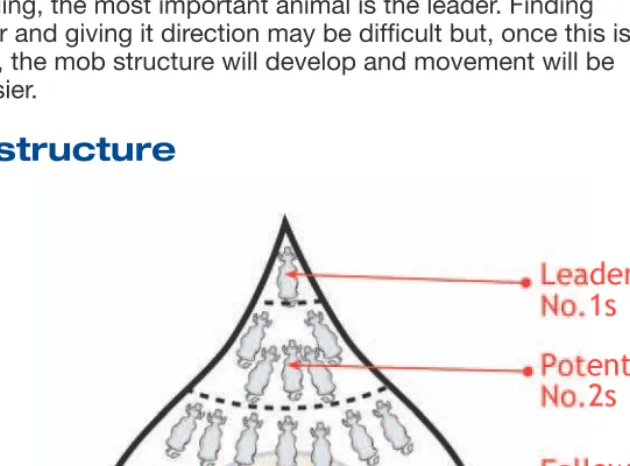
Livestock are herding animals that like to be with, and follow, similar animals. They naturally group together in a mob* in which there are leaders and followers (Figure 2).
Module 4. Animal handling 5
Herd instinct
Cattle from pre-historic times have grazed on open grass plains. In the food chain of the animal world, livestock are regarded as prey animals hunted by the big cats (lions, tigers), wild dogs— and humans.
Cattle are relatively defenceless to predators; to survive, they react naturally by moving away.
It is important to understand the predator–prey relationship as it causes the ‘light or ight’ response. Even though cattle have been domesticated, they may still see humans as a ‘predator’.
Herd or mob structure
In each mob, there is a structure which is always maintained. It may not always be the same animal, but the mob is classiied into:
• Leader – the leader is out in front, giving direction and setting the pace. They are called No.1s.
• Potential leaders – these are just behind the leaders in the mob. They are called No. 2s.
• Most insecure – these animals are in the centre of the mob and have a very large light-zone.
• Followers – most of the animals in the mob. They look to the leaders for stability and direction.
For handling, the most important animal is the leader. Finding the leader and giving it direction may be dificult but, once this is achieved, the mob structure will develop and movement will be much easier.
[image:56.694.117.432.493.726.2]Mob structure
Figure 2. The structure of a mob.
Animal senses
Cattle use many of their senses to communicate, but sight is the most important.
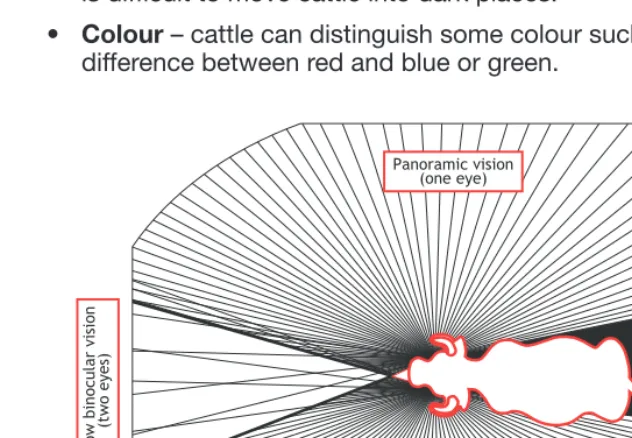
Cattle have panoramic vision as shown in Figure 3 below, but they cannot see behind—the blind spot.
The handler should never position himself in the blind spot directly behind the animal. It wants to see the handler and to follow other animals.
Features of sight
• Depth perception – some animals ind it dificult to determine distance from a stationary object. To overcome this, create slight movement.
• Illumination – stock like to move from dark to light areas. It is dificult to move cattle into dark places.
• Colour – cattle can distinguish some colour such as the difference between red and blue or green.
Animals have panoramic vision as shown in the diagram below.
Panoramic vision (one eye) to ps dni lB noi si v r al uc oni b wo rr a N )s ey e o wt( Panoramic vision (one eye)
Other senses that need to be considered when working with animals are:
• Sound – noise causes stress and so is better avoided. Animals can be moved without noise.
[image:57.694.243.559.343.562.2]• Smell – for example, cattle become upset by strange smells or the smell of blood.
Module 4. Animal handling 7
Animals have panoramic vision as shown in the diagram below.
Panoramic vision (one eye) to ps dni lB noi si v r al uc oni b wo rr a N )s ey e o wt( Panoramic vision (one eye)
Communicating with cattle
The most important aspects of communicating with cattle are related to light-zones, mob structure and understanding their reaction to the handler’s position and movement.
Cattle want to:
• move quietly without being abused
• follow other cattle
• be part of a mob — and not to be isolated • see what (or who) is pressuring them
Cattle in a mob are always looking for a leader — which may be another animal or a person.
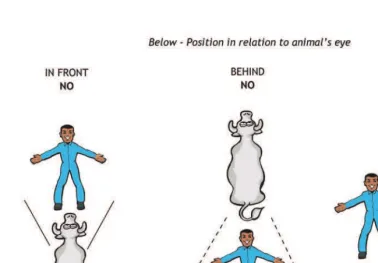
The way the handler positions his body in relation to the animal’s eye will inluence how it moves.
Vision is the most important animal sense when communicating with livestock.
Four principles of cattle
communication
The four top principles of livestock communication are:
1.
Position –
where are you in relation to the animal’s eye?
2.
Pressure –
apply pressure to get the animals to move
but then release it.
3.
Movement –
move your body position so that the animal
sees you.
4.
Communicating –
let the animal communicate with
other members of the mob while you communicate with
your fellow workers.
What do you want? Can I see you?
Four principles of cattle
communication
1. Position
Cattle use sight as the main way they communicate.
Where are you in relation to the animal’s eye?
In front – this is very confrontational and can be very dangerous with some cattle.
Behind the animal – they like to see what is pressuring them. If they cannot see you, they will become nervous and turn around to watch you.
[image:59.694.155.533.343.606.2]The side – you can only inluence an animal and create eficient movement and direction when you are at the side of the animal.
Module 4. Animal handling 9
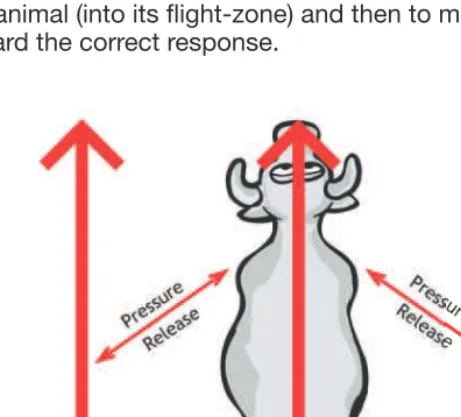
2. Pressure
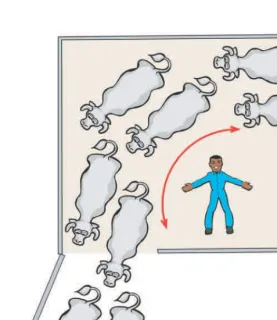
Pressure is whatever is forcing the animal to move away.
Too many people or too much activity can cause too much pressure.
Whatever pressure is applied, it must not be constant. Once it has caused the animal to move, it should then be released.
For example:
• If using a ‘cattle talker’ or goad with a lap, stop waving the lapper after the animal responds.
• If you created movement by positioning your body, release this pressure by moving back.
The most effective way to create pressure is to move towards the animal (into its light-zone) and then to move back away to reward the correct response.
• There is no point applying consistent pressure when animals are already moving in the correct direction.
[image:60.694.88.319.337.546.2]• Do not penetrate the animal’s light-zone and apply pressure when the animal has nowhere to go.
Figure 5. Pressure and release
3. Movement
Moving your body is an effective way to create pressure and inluence the direction of an animal.
Tools that can be used to create movement are:
• Human body – move your body by either walking towards an animal (in a zig-zag position) or jumping up and down (without noise) in the same position.
• Goads –the ‘cattle talker’ is a stick with a lapper on the end. Goads are an extension of your body—they are not a tool to hit animals.
Once the cattle are moving, discontinue the action. To move cattle in a race forward:
• move your body over the top of the race
• put the ‘cattle talker’ in the race and move back in the opposite direction of the cattle
Some basic rules to move cattle:
• You cannot make an animal move if it has nowhere to go. • Never hit an animal that is already moving in the right
direction.
• Never hit or pressure an animal that has nowhere to go.
• To make an animal go where it does not want to go, apply pressure to increase movement in the desired direction.
Module 4. Animal handling 11 • Livestock always move in a curve when going in and out of
gateways and pens.
[image:62.694.146.424.169.490.2]• Position yourself so the animal curves around you, rather than blocking them.
Figure 7. Using body position to move animals from a yard.
4. Communication with the animal and your
fellow workers
Make sure that what you are asking livestock to do is made very clear to them.
Are you sending the animals the right message?
It is dificult to communicate with an animal that is frightened of you.
Do not penetrate the light-zone too deeply or too quickly when trying to create movement with frightened animals.
Do your fellow workers understand what you are trying to achieve? Working together as a team will create more effective movement and livestock handling.
Never hit an animal that is already moving in the right direction.
[image:63.694.65.551.348.659.2]Never hit or pressure an animal that has nowhere to go. Do not stand behind the animal. It cannot see you.
Module 4. Animal handling 13
Figure 9. Do not stand behind the animal as it cannot see you.
Do not isolate an animal from the mob. Cattle on their own are generally dangerous. They become frightened and can get aggressive.
[image:65.694.147.565.226.733.2]Module 4. Animal handling 15
Figure 11. Stand back and make less noise!
These igures are schematic.We know that cattle cannot be regimented to stand in lines and that generally they align across the truck.
Do’s and don’ts of
ship unloading
Figure 12. Don’t stand in front of the cattle banging the race alley with sticks!
Module 4. Animal handling 17
Correct loading for Colt Diesel
9-10 head of 300-350 kg cattle
or 8 head of 450-500 kg cattle
Correct loading for Tronton truck
16 head of 300-350 kg cattle
or 13 head of 450-500 kg cattle
Don’t load so many cattle so that they cannot move at all
[image:68.694.64.541.114.652.2]or so few so that they have no support when the truck moves.
Figure 13. Correct loading for Colt Diesel and Tronton trucks.
Work on the side of the animal to move it.
Do not stand directly behind an animal. It cannot see you.
[image:69.694.54.514.92.719.2]Use movement and position to move an animal forward. Never hit an animal.
Module 4. Animal handling 19
Summary
• Be aware of your obligations under the OIE Animal Welfare Standards.
• Improving animal welfare will have commercial beneits for both employer and employee.
• Animals like their distance from us = their light-zone.
• Avoid entering their light-zone and creating agressive reactions.
• Cattle are instinctively herding ‘prey’ animals and avoid ‘hunters’ such as humans and dogs.
• The most important member of the mob or group is the leader. The leader creates movement and gives direction. • Never apply so much pressure that the animal is isolated.
It may become dangerous and dificult to control.
• Position – always work on the side of an animal so that it can see you.
• Whatever pressure is applied, must always be released.
• You cannot make