OSHA 3071 2002 (Revised)
U.S. Department of Labor
Occupational Safety and Health Administration OSHA 3071
2002 (Revised)
Contents
Who needs to read this booklet? ... 1
What is a hazard? ... 1
What is a job hazard analysis? ... 1
Why is job hazard analysis important? ... 2
What is the value of a job hazard analysis? ... 2
What jobs are appropriate for a job hazard analysis? ... 3
Where do I begin? ... 4
How do I identify workplace hazards? ... 6
How do I correct or prevent any hazards? ... 12
What else do I need to know before starting a job hazard analysis? ... 12
Why should I review my job hazard analysis? ... 13
When is it appropriate to hire a professional to conduct a job hazard analysis? ... 14
OSHA Assistance, Services, and Programs ... 15
How can OSHA help me? ... 15
How does safety and health program management assistance help employers and employees? ... 15
What are state plans? ... 16
How can consultation assistance help employers? ... 16
Who can get consultation assistance and what does it cost? ... 17
Can an employer be cited for violations
after receiving consultation assistance? ... 18
Does OSHA provide any incentives for seeking consultation assistance? ... 18
What are the Voluntary Protection Programs? ... 18
How does VPP work? ... 19
How does VPP help employers and employees? ... 19
How does OSHA monitor VPP sites? ... 20
Can OSHA inspect an employer who is participating in the VPP? ... 20
How can a partnership with OSHA improve worker safety and health? ... 21
What is OSHA’s Strategic Partnership Program (OSPP)? ... 21
What do OSPPs do? ... 21
What are the different kinds of OSPPs? ... 22
What are the benefits of participation in the OSPP? ... 22
Does OSHA have occupational safety and health training for employers and employees? ... 23
Does OSHA give money to organizations for training and education? ... 24
Does OSHA have other assistance materials available? ... 25
OSHA Regional and Area Office Directory ... 27 OSHA-Approved Safety and Health Plans ... 32 OSHA Consultation Projects ... 36 Appendix 1 —
Hazard Control Measures ... 41 Appendix 2 —
Common Hazards and Hazard Descriptions ... 43 Appendix 3 —
Who needs to read this booklet?
This booklet is for employers, foremen, and supervisors, but we encourage employees to use the information as well to analyze their own jobs and recognize workplace hazards so they can report them to you. It explains what a job hazard analysis is and offers guidelines to help you conduct your own step-by-step analysis.
What is a hazard?
A hazard is the potential for harm. In practical terms, a hazard often is associated with a condition or activity that, if left uncontrolled, can result in an injury or illness. See Appendix 2 for a list of common hazards and descriptions. Identifying hazards and eliminating or controlling them as early as possible will help prevent injuries and illnesses.
What is a job hazard analysis?
Why is job hazard analysis important?
Many workers are injured and killed at the workplace every day in the United States. Safety and health can add value to your business, your job, and your life. You can help prevent workplace injuries and illnesses by looking at your workplace operations, establishing proper job procedures, and ensuring that all employees are trained properly.
One of the best ways to determine and establish proper work procedures is to conduct a job hazard analysis. A job hazard analysis is one component of the larger commitment of a safety and health management system. (See page 15 for more information on safety and health management systems.)
What is the value of a job hazard analysis?
Supervisors can use the findings of a job hazard analysis to eliminate and prevent hazards in their workplaces. This is likely to result in fewer worker injuries and illnesses; safer, more effective work methods; reduced workers’ compensation costs; and increased worker productivity. The analysis also can be a valuable tool for training new employees in the steps required to perform their jobs safely.
For a job hazard analysis to be effective, management must demonstrate its commitment to safety and health and follow through to correct any uncontrolled hazards identified. Otherwise, management will lose credibility and employees may hesitate to go to management when dangerous
What jobs are appropriate
for a job hazard analysis?
A job hazard analysis can be conducted on many jobs in your workplace. Priority should go to the following types of jobs:
• Jobs with the highest injury or illness rates;
• Jobs with the potential to cause severe or disabling injuries or illness, even if there is no history of previous accidents;
• Jobs in which one simple human error could lead to a severe accident or injury;
• Jobs that are new to your operation or have undergone changes in processes and procedures; and
Where do I begin?
1. Involve your employees. It is very important to involve your employees in the hazard analysis process. They have a unique understanding of the job, and this knowledge is invaluable for finding hazards. Involving employees will help minimize oversights, ensure a quality analysis, and get workers to “buy in” to the solutions because they will share ownership in their safety and health program.
2. Review your accident history. Review with your employees your worksite’s history of accidents and occupational illnesses that needed treatment, losses that required repair or replacement, and any “near misses” — events in which an accident or loss did not occur,
but could have. These events are indicators that the existing hazard controls (if any) may not be adequate and deserve more scrutiny.
3. Conduct a preliminary job review. Discuss with your employees the hazards they know exist in their current work and surroundings. Brainstorm with them for ideas to eliminate or control those hazards.
4. List, rank, and set priorities for hazardous jobs.
List jobs with hazards that present unacceptable risks, based on those most likely to occur and with the most severe consequences. These jobs should be your first priority for analysis.
5. Outline the steps or tasks. Nearly every job can be broken down into job tasks or steps. When beginning a job hazard analysis, watch the employee perform the job and list each step as the worker takes it. Be sure to record enough information to describe each job action without getting overly detailed. Avoid making the breakdown of steps so detailed that it becomes unnecessarily long or so broad that it does not include basic steps. You may find it valuable to get input from other workers who have performed the same job. Later, review the job steps with the employee to make sure you have not omitted something. Point out that you are evaluating the job itself, not the employee’s job performance. Include the employee in all phases of the analysis— from reviewing the job steps and procedures to discussing uncontrolled hazards and recommended solutions.
How do I identify workplace hazards?
A job hazard analysis is an exercise in detective work. Your goal is to discover the following:
• What can go wrong?
• What are the consequences?
• How could it arise?
• What are other contributing factors?
• How likely is it that the hazard will occur?
To make your job hazard analysis useful, document the answers to these questions in a consistent manner. Describing a hazard in this way helps to ensure that your efforts to eliminate the hazard and implement hazard controls help target the most important contributors to the hazard.
Good hazard scenarios describe:
• Where it is happening (environment),
• Who or what it is happening to (exposure),
• What precipitates the hazard (trigger),
• The outcome that would occur should it happen (consequence), and
• Any other contributing factors.
A sample form found in Appendix 3 helps you organize your information to provide these details.
contributing factors tend to line up in a certain way to create the hazard. Here is an example of a hazard scenario:
In the metal shop (environment), while clearing a snag (trigger), a worker’s hand (exposure) comes into contact with a rotating pulley. It pulls his hand into the machine and severs his fingers (consequences) quickly.
To perform a job hazard analysis, you would ask:
• What can go wrong? The worker’s hand could come into contact with a rotating object that “catches” it and pulls it into the machine.
• What are the consequences? The worker could receive a severe injury and lose fingers and hands.
• How could it happen? The accident could happen as a result of the worker trying to clear a snag during operations or as part of a maintenance activity while the pulley is operating. Obviously, this hazard scenario could not occur
if the pulley is not rotating.
• How likely is it that the hazard will occur? This determination requires some judgment. If there have been “near-misses” or actual cases, then the likelihood of a recurrence would be considered high. If the pulley is exposed and easily accessible, that also is a consideration. In the example, the likelihood that the hazard will occur is high because there is no guard preventing contact, and the operation is performed while the machine is running. By following the steps in this example, you can organize your hazard analysis activities.
The examples that follow show how a job hazard analysis can be used to identify the existing or potential hazards for each basic step involved in grinding iron castings.
Grinding Iron Castings: Job Steps
Step 1. Reach into metal box to right of machine, grasp casting, and carry to wheel.
Step 2. Push casting against wheel to grind off burr.
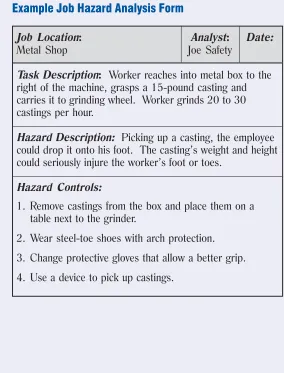
Example Job Hazard Analysis Form
Job Location: Analyst: Date:
Metal Shop Joe Safety
Task Description: Worker reaches into metal box to the right of the machine, grasps a 15-pound casting and carries it to grinding wheel. Worker grinds 20 to 30 castings per hour.
Hazard Description: Picking up a casting, the employee could drop it onto his foot. The casting’s weight and height could seriously injure the worker’s foot or toes.
Hazard Controls:
[image:15.396.78.362.88.461.2]1. Remove castings from the box and place them on a table next to the grinder.
Job Location: Analyst: Date:
Metal Shop Joe Safety
Task Description: Worker reaches into metal box to the right of the machine, grasps a 15-pound casting and carries it to grinding wheel. Worker grinds 20 to 30 castings per hour.
Hazard Description: Castings have sharp burrs and edges that can cause severe lacerations.
Hazard Controls:
1. Use a device such as a clamp to pick up castings. 2. Wear cut-resistant gloves that allow a good grip and fit
Job Location: Analyst: Date:
Metal Shop Joe Safety
Task Description: Worker reaches into metal box to the right of the machine, grasps a 15-pound casting and carries it to grinding wheel. Worker grinds 20 to 30 castings per hour.
Hazard Description: Reaching, twisting, and lifting 15-pound castings from the floor could result in a muscle strain to the lower back.
Hazard Controls:
1. Move castings from the ground and place them closer to the work zone to minimize lifting. Ideally, place them at waist height or on an adjustable platform or pallet. 2. Train workers not to twist while lifting and reconfigure
work stations to minimize twisting during lifts.
How do I correct or prevent hazards?
After reviewing your list of hazards with the employee, consider what control methods will eliminate or reduce them. For more information on hazard control measures, see Appen-dix 1. The most effective controls are engineering controls that physically change a machine or work environment to prevent employee exposure to the hazard. The more reliable or less likely a hazard control can be circumvented, the better. If this is not feasible, administrative controls may be appropriate. This may involve changing how employees do their jobs.
Discuss your recommendations with all employees who perform the job and consider their responses carefully. If you plan to introduce new or modified job procedures, be sure they understand what they are required to do and the reasons for the changes.
What else do I need to know before
starting a job hazard analysis?
Twenty-four states and two territories operate their own OSHA-approved safety and health programs and may have standards that differ slightly from federal requirements. Employers in those states should check with the appropriate state agency for more information. A list of applicable states and territories and contact information is provided on page 32.
Why should I review my job hazard analysis?
Periodically reviewing your job hazard analysis ensures that it remains current and continues to help reduce workplace accidents and injuries. Even if the job has not changed, it is possible that during the review process you will identify hazards that were not identified in the initial analysis.
When is it appropriate to hire a professional
to conduct a job hazard analysis?
If your employees are involved in many different or complex processes, you need professional help conducting your job hazard analyses. Sources of help include your insurance company, the local fire department, and private consultants with safety and health expertise. In addition, OSHA offers assistance through its regional and area offices and consultation services. Contact numbers are listed at the back of this publication.
OSHA Assistance, Services, and Programs
How can OSHA help me?
OSHA can provide extensive help through a variety of programs, including assistance about safety and health programs, state plans, workplace consultations, Voluntary Protection Programs, strategic partnerships, training and education, and more.
How does safety and health program
management assistance help employers
and employees?
Effective management of worker safety and health protection is a decisive factor in reducing the extent and severity of work-related injuries and illnesses and their related costs. In fact, an effective safety and health program forms the basis of good worker protection and can save time and money —about $4 for every dollar spent — and increase productivity.
To assist employers and employees in developing effective safety and health systems, OSHA published recommended Safety and Health Program Management Guidelines, (Federal Register 54(18):3908–3916, January 26, 1989). These voluntary guidelines can be applied to all worksites covered by OSHA.
The guidelines identify four general elements that are critical to the development of a successful safety and health management program:
The guidelines recommend specific actions under each of these general elements to achieve an effective safety and health program. The Federal Register notice is available online at www.osha.gov.
What are state plans?
State plans are OSHA-approved job safety and health programs operated by individual states or territories instead of Federal OSHA. The Occupational Safety and Health Act of 1970 (OSH Act) encourages states to develop and operate their own job safety and health plans and permits state enforcement of OSHA standards if the state has an approved plan. Once OSHA approves a state plan, it funds 50 percent of the program’s operating costs. State plans must provide standards and enforcement programs, as well as voluntary compliance activities, that are at least as effective as those of Federal OSHA.
There are 26 state plans: 23 cover both private and public (state and local government) employment, and 3 (Connecticut, New Jersey, and New York) cover only the public sector. For more information on state plans, see the listing at the end of this publication, or visit OSHA’s website at www.osha.gov.
How can consultation
assistance help employers?
Comprehensive consultation assistance provided by OSHA includes a hazard survey of the worksite and an appraisal of all aspects of the employer’s existing safety and health management system. In addition, the service offers assistance to employers in developing and implementing an effective safety and health management system. Employers also may receive training and education services, as well as limited assistance away from the worksite.
Who can get consultation
assistance and what does it cost?
Consultation assistance is available to small employers (with fewer than 250 employees at a fixed site and no more than 500 corporatewide) who want help in establishing and maintaining a safe and healthful workplace.
Funded largely by OSHA, the service is provided at no cost to the employer. Primarily developed for smaller employers with more hazardous operations, the consultation service is delivered by state governments employing
professional safety and health consultants. No penalties are proposed or citations issued for hazards identified by the consultant. The employer’s only obligation is to correct all identified serious hazards within the agreed-upon correction time frame.
Can OSHA assure privacy to an employer
who asks for consultation assistance?
Can an employer be cited for violations
after receiving consultation assistance?
If an employer fails to eliminate or control a serious hazard within the agreed-upon time frame, the Consultation Project Manager must refer the situation to the OSHA enforcement office for appropriate action. This is a rare occurrence, however, since employers request the service for the expressed purpose of identifying and fixing hazards in their workplaces.
Does OSHA provide any incentives
for seeking consultation assistance?
Yes. Under the consultation program, certain exemplary employers may request participation in OSHA’s Safety and Health Achievement Recognition Program (SHARP). Eligibility for participation in SHARP includes, but is not limited to, receiving a full-service, comprehensive consultation visit, correcting all identified hazards, and developing an effective safety and health management system.
Employers accepted into SHARP may receive an exemption from programmed inspections (not complaint or accident investigation inspections) for a period of 1 year initially, or 2 years upon renewal.
For more information concerning consultation assistance, see the list of consultation offices beginning on page 36, contact your regional or area OSHA office, or visit OSHA’s website at www.osha.gov.
What are the Voluntary Protection Programs?
and OSHA’s Strategic Partnership Program (OSPP) — represents a cooperative approach which, when coupled with an effective enforcement program, expands worker protection to help meet the goals of the OSH Act.
How does VPP work?
There are three levels of VPP recognition: Star, Merit, and Demonstration. All are designed to do the following:
• Recognize employers who have successfully developed and implemented effective and comprehensive safety and health management systems;
• Encourage these employers to continuously improve their safety and health management systems;
• Motivate other employers to achieve excellent safety and health results in the same outstanding way; and
• Establish a relationship between employers, employees, and OSHA that is based on cooperation.
How does VPP help employers and employees?
VPP participation can mean the following:
• Reduced numbers of worker fatalities, injuries, and illnesses;
• Lost-workday case rates generally 50 percent below industry averages;
• Lower workers’ compensation and other injury- and illness-related costs;
• Further improvement and revitalization of already-good safety and health programs; and a
• Positive relationship with OSHA.
How does OSHA monitor VPP sites?
OSHA reviews an employer’s VPP application and conducts a VPP Onsite Evaluation to verify that the safety and health management systems described are operating effectively at the site. OSHA conducts Onsite Evaluations on a regular basis, annually for participants at the
Demonstration level, every 18 months for Merit, and every 3 to 5 years for Star. Each February, all participants must send a copy of their most recent Annual Evaluation to their OSHA regional office. This evaluation must include the worksite’s record of injuries and illnesses for the past year.
Can OSHA inspect an employer
who is participating in the VPP?
Sites participating in VPP are not scheduled for regular, programmed inspections. OSHA handles any employee complaints, serious accidents, or significant chemical releases that may occur at VPP sites according to routine enforcement procedures.
How can a partnership with OSHA
improve worker safety and health?
OSHA has learned firsthand that voluntary, cooperative partnerships with employers, employees, and unions can be a useful alternative to traditional enforcement and an effective way to reduce worker deaths, injuries, and illnesses. This is especially true when a partnership leads to the development and implementation of a comprehensive workplace safety and health management system.
What is OSHA’s Strategic
Partnership Program (OSPP)?
OSHA Strategic Partnerships are alliances among labor, management, and government to foster improvements in workplace safety and health. These partnerships are voluntary, cooperative relationships between OSHA, employers, employee representatives, and others such as trade unions, trade and professional associations,
universities, and other government agencies. OSPPs are the newest member of OSHA’s family of cooperative programs.
What do OSPPs do?
What are the different kinds of OSPPs?
There are two major types:
• Comprehensive, which focuses on establishing comprehensive safety and health management systems at partnering worksites; and
• Limited, which helps identify and eliminate hazards associated with worker deaths, injuries, and illnesses, or have goals other than establishing comprehensive worksite safety and health programs.
OSHA is interested in creating new OSPPs at the national, regional, and local levels. OSHA also has found limited partnerships to be valuable. Limited partnerships might address the elimination or control of a specific industry hazard.
What are the benefits of
participation in the OSPP?
Like VPP, OSPP can mean the following:
• Fewer worker fatalities, injuries, and illnesses;
• Lower workers’ compensation and other injury- and illness-related costs;
• Positive community recognition and interaction;
• Development of or improvement in safety and health management systems; and
• Positive interaction with OSHA.
For more information about this program, contact your nearest OSHA office or go to the agency website at www.osha.gov.
Does OSHA have occupational safety and
health training for employers and employees?
Yes. The OSHA Training Institute in Des Plaines, IL, provides basic and advanced training and education in safety and health for federal and state compliance officers, state consultants, other federal agency personnel, and private-sector employers, employees, and their representatives.
Institute courses cover diverse safety and health topics including electrical hazards, machine guarding, personal protective equipment, ventilation, and ergonomics. The facility includes classrooms, laboratories, a library, and an audiovisual unit. The laboratories contain various demonstrations and equipment, such as power presses, woodworking and welding shops, a complete industrial ventilation unit, and a sound demonstration laboratory. More than 57 courses dealing with subjects such as safety and health in the construction industry and methods of compliance with OSHA standards are available for personnel in the private sector.
Does OSHA give money to organizations
for training and education?
OSHA awards grants through its Susan Harwood Training Grant Program to nonprofit organizations to provide safety and health training and education to employers and workers in the workplace. The grants focus on programs that will educate workers and employers in small business (fewer than 250 employees), train workers and employers about new OSHA standards or high-risk activities or hazards. Grants are awarded for 1 year and may be renewed for an additional 12 months depending on whether the grantee has performed satisfactorily.
OSHA expects each organization awarded a grant to develop a training and/or education program that addresses a safety and health topic named by OSHA, recruit workers and employers for the training, and conduct the training. Grantees are also expected to follow-up with people who have been trained to find out what changes were made to reduce the hazards in their workplaces as a result of the training.
Does OSHA have other
assistance materials available?
Yes. OSHA has a variety of materials and tools available on its website at www.osha.gov. These include eTools, Expert Advisors, Electronic Compliance Assistance Tools (e-CATs), Technical Links, regulations, directives, publications, videos, and other information for employers and employees. OSHA’s software programs and compliance assistance tools walk you through challenging safety and health issues and common problems to find the best solutions for your workplace. OSHA’s comprehensive publications program includes more than 100 titles to help you understand OSHA requirements and programs.
OSHA’s CD-ROM includes standards, interpretations, directives, and more and can be purchased on CD-ROM from the U.S. Government Printing Office. To order, write to the Superintendent of Documents, U.S. Government Printing Office, Washington, DC 20402, or phone (202) 512–1800. Specify OSHA Regulations, Documents and Technical Information on CD-ROM (ORDT), GPO Order No. S/N 729-013-00000-5.
What other publications does OSHA offer?
What do I do in case of an emergency
or if I need to file a complaint?
To report an emergency, file a complaint, or seek OSHA advice, assistance, or products, call (800) 321–OSHA or contact your nearest OSHA regional or area office listed beginning on page 27. The teletypewriter (TTY) number is (877) 889–5627.
You can also file a complaint online and obtain more information on OSHA federal and state programs by visiting OSHA’s website at www.osha.gov.
OSHA Regional and Area Offices
Region VI
(AR, LA, NM,* OK, TX) 525 Griffin Street, Room 602 Dallas, TX 75202
(214) 767–4731 or 4736 x224
Region VII
(IA,* KS, MO, NE) City Center Square
1100 Main Street, Suite 800 Kansas City, MO 64105 (816) 426–5861
Region VIII
(CO, MT, ND, SD, UT,* WY*) 1999 Broadway, Suite 1690 Denver, CO 80202-5716 (303) 844–1600
Region IX
(American Samoa, AZ,* CA,* HI, NV,* Northern Mariana Islands)
71 Stevenson Street, Room 420 San Francisco, CA 94105 (415) 975–4310
Region X
(AK,* ID, OR,* WA*) 1111 Third Avenue, Suite 715 Seattle, WA 98101-3212 (206) 553–5930
OSHA Regional Offices
Region I
(CT,* ME, MA, NH, RI, VT*) JFK Federal Building, Room E340 Boston, MA 02203
(617) 565–9860
Region II
(NJ,* NY,* PR,* VI*) 201 Varick Street, Room 670 New York, NY 10014 (212) 337–2378
Region III
(DE, DC, MD,* PA,* VA,* WV) The Curtis Center
170 S. Independence Mall West Suite 740 West
Philadelphia, PA 19106-3309 (215) 861–4900
Region IV
(AL, FL, GA, KY,* MS, NC,* SC,* TN*)
Atlanta Federal Center
61 Forsyth Street, SW, Room 6T50 Atlanta, GA 30303
(404) 562–2300
Region V
(IL, IN,* MI,* MN,* OH, WI) 230 South Dearborn Street Room 3244
OSHA Area Offices
Birmingham, AL (205) 731–1534 Mobile, AL (251) 441–6131 Anchorage, AK (907) 271–5152 Little Rock, AR(501) 324–6291(5818) Phoenix, AZ
(602) 640–2348 San Diego, CA (619) 557–5909 Sacramento, CA (916) 566–7471 Denver, CO (303) 844–5285 Greenwood Village, CO (303) 843–4500 Bridgeport, CT (203) 579–5581 Hartford, CT (860) 240–3152 Wilmington, DE (302) 573–6518 Fort Lauderdale, FL
Jacksonville, FL (904) 232–2895 Tampa, FL (813) 626–1177 Savannah, GA (912) 652–4393 Smyrna, GA (770) 984–8700 Tucker, GA (770) 493–6644/6742/8419 Des Moines, IA
Wichita, KS (316) 269–6644 Frankfort, KY (502) 227–7024 Baton Rouge, LA (225) 389–0474 (0431) Braintree, MA (617) 565–6924 Methuen, MA (617) 565–8110 Springfield, MA (413) 785–0123 Linthicum, MD (410) 865–2055/2056 Bangor, ME (207) 941–8177 Portland, ME (207) 780–3178 August, ME (207) 622–8417 Lansing, MI (517) 327–0904 Minneapolis, MN (612) 664–5460 Kansas City, MO
New York, NY (212) 337–2636 North Syracuse, NY (315) 451–0808 Tarrytown, NY (914) 524–7510 Westbury, NY (516) 334–3344 Cincinnati, OH (513) 841–4132 Cleveland, OH (216) 522–3818 Columbus, OH (614) 469–5582 Toledo, OH (419) 259–7542 Oklahoma City, OK (405) 278–9560 Portland, OR (503) 326–2251 Allentown, PA (610) 776–0592 Erie, PA (814) 833–5758 Harrisburg, PA (717) 782–3902 Philadelphia, PA (215) 597–4955 Pittsburgh, PA (412) 395–4903 Wilkes–Barre, PA (570) 826–6538 Guaynabo, PR (787) 277–1560 Providence, RI (401) 528–4669 Columbia, SC (803) 765–5904 Nashville, TN (615) 781–5423 Austin, TX
(512) 916–5783 (5788) Corpus Christi, TX (361) 888–3420 Dallas, TX
(214) 320–2400 (2558) El Paso, TX
(915) 534–6251 Fort Worth, TX
(817) 428–2470 (485–7647) Houston, TX
(281) 591–2438 (2787) Houston, TX
(281) 286–0583/0584 (5922) Lubbock, TX
Salt Lake City, UT (801) 530–6901 Norfolk, VA (757) 441–3820 Bellevue, WA (206) 553–7520 Appleton, WI (920) 734–4521
OSHA-Approved
Safety and Health Plans
Alaska
Alaska Department of Labor and Workforce Development Commissioner
(907) 465–2700 FAX: (907) 465–2784 Program Director (907) 269–4904 FAX: (907) 269–4915
Arizona
Industrial Commission of Arizona
Director, ICA (602) 542–4411 FAX: (602) 542–1614 Program Director (602) 542–5795 FAX: (602) 542–1614
California
California Department of Industrial Relations Director
(415) 703–5050 FAX: (415) 703–5114 Chief
(415) 703–5100 FAX: (415) 703–5114 Manager, Cal/OSHA Program Office (415) 703–5177 Connecticut Connecticut Department of Labor Commissioner (860) 566–5123 FAX: (860) 566–1520 Conn-OSHA Director (860) 566–4550 FAX: (860) 566–6916
Hawaii
Hawaii Department of Labor and Industrial Relations Director
(808) 586–8844 FAX: (808) 586–9099 Administrator
(808) 586–9116 FAX: (808) 586–9104
Indiana
Indiana Department of Labor Commissioner
Iowa
Iowa Division of Labor Commissioner (515) 281–6432 FAX: (515) 281–4698 Administrator
(515) 281–3469 FAX: (515) 281–7995
Kentucky
Kentucky Labor Cabinet Secretary (502) 564–3070 FAX: (502) 564–5387 Federal\State Coordinator (502) 564–3070 ext.240 FAX: (502) 564–1682
Maryland
Maryland Division of Labor and Industry
Commissioner (410) 767–2999 FAX: (410) 767–2300 Deputy Commissioner (410) 767–2992 FAX: (410) 767–2003 Assistant Commissioner, MOSH (410) 767–2215
FAX: (410) 767–2003
Michigan
Michigan Department of Consumer and Industry Services
Minnesota
Minnesota Department of Labor and Industry Commissioner (651) 296–2342 FAX: (651) 282–5405 Assistant Commissioner (651) 296–6529 FAX: (651) 282–5293 Administrative Director, OSHA Management Team (651) 282–5772 FAX: (651) 297–2527
Nevada
Nevada Division of Industrial Relations Administrator (775) 687–3032 FAX: (775) 687–6305 Chief Administrative Officer (702) 486–9044
FAX: (702) 990–0358 [Las Vegas (702) 687–5240]
New Jersey
New Jersey Department of Labor Commissioner
New Mexico
New Mexico Environment Department
Secretary (505) 827–2850 FAX: (505) 827–2836 Chief
(505) 827–4230 FAX: (505) 827–4422
New York
New York Department of Labor Acting Commissioner
(518) 457–2741 FAX: (518) 457–6908 Division Director (518) 457–3518 FAX: (518) 457–6908
North Carolina
North Carolina Department of Labor
Commissioner (919) 807–2900 FAX: (919) 807–2855 Deputy Commissioner, OSH Director (919) 807–2861 FAX: (919) 807–2855 OSH Assistant Director (919) 807–2863 FAX: (919) 807–2856
Oregon
Oregon Occupational Safety and Health Division
Administrator (503) 378–3272 FAX: (503) 947–7461 Deputy Administrator for Policy (503) 378–3272
FAX: (503) 947–7461 Deputy Administrator for Operations (503) 378–3272 FAX: (503) 947–7461
Puerto Rico
Puerto Rico Department of Labor and Human Resources Secretary
(787) 754–2119 FAX: (787) 753–9550 Assistant Secretary for
Occupational Safety and Health (787) 756–1100,
1106 / 754–2171 FAX: (787) 767–6051 Deputy Director for
Occupational Safety and Health (787) 756–1100/1106, 754–2188
FAX: (787) 767–6051
South Carolina
South Carolina Department of Labor, Licensing, and
Regulation Director
Tennessee
Tennessee Department of Labor Commissioner
(615) 741–2582 FAX: (615) 741–5078 Acting Program Director (615) 741–2793 FAX: (615) 741–3325
Utah
Utah Labor Commission Commissioner
(801) 530–6901 FAX: (801) 530–7906 Administrator
(801) 530–6898 FAX: (801) 530–6390
Vermont
Vermont Department of Labor and Industry Commissioner (802) 828–2288 FAX: (802) 828–2748 Project Manager (802) 828–2765 FAX: (802) 828–2195
Virgin Islands
Virgin Islands Department of Labor
Acting Commissioner (340) 773–1990
Virginia
Virginia Department of Labor and Industry
Commissioner (804) 786–2377 FAX: (804) 371–6524
Director, Office of Legal Support (804) 786–9873
FAX: (804) 786–8418
Washington
Washington Department of Labor and Industries Director
(360) 902–4200 FAX: (360) 902–4202 Assistant Director (360) 902–5495 FAX: (360) 902–5529 Program Manager, Federal–State Operations (360) 902–5430 FAX: (360) 902–5529
Wyoming
Wyoming Department of Employment
OSHA Consultation Projects
Raleigh, NC (919) 807–2905 Bismarck, ND (701) 328–5188 Lincoln, NE (402) 471–4717 Concord, NH (603) 271–2024 Trenton, NJ (609) 292–3923 Santa Fe, NM (505) 827–4230 Albany, NY (518) 457–2238 Henderson, NV (702) 486–9140 Columbus, OH (614) 644–2631 Oklahoma City, OK (405) 528–1500 Salem, OR (503) 378–3272 Indiana, PA (724) 357–2396 Hato Rey, PR
Columbia, SC (803) 734–9614 Brookings, SD (605) 688–4101 Nashville, TN (615) 741–7036 Austin, TX (512) 804–4640 Salt Lake City, UT (801) 530–6901 Montpelier, VT (802) 828–2765 Richmond, VA (804) 786–6359
Appendix 1
Hazard Control Measures
Information obtained from a job hazard analysis is useless unless hazard control measures recommended in the analysis are incorporated into the tasks. Managers should recognize that not all hazard controls are equal. Some are more effective than others at reducing the risk.
The order of precedence and effectiveness of hazard control is the following:
1. Engineering controls.
2. Administrative controls.
3. Personal protective equipment.
Engineering controls include the following:
• Elimination/minimization of the hazard — Designing the facility, equipment, or process to remove the hazard, or substituting processes, equipment, materials, or other factors to lessen the hazard;
• Enclosure of the hazard using enclosed cabs, enclosures for noisy equipment, or other means;
• Isolation of the hazard with interlocks, machine guards, blast shields, welding curtains, or other means; and
Administrative controls include the following:
• Written operating procedures, work permits, and safe work practices;
• Exposure time limitations (used most commonly to control temperature extremes and ergonomic hazards);
• Monitoring the use of highly hazardous materials;
• Alarms, signs, and warnings;
• Buddy system; and
• Training.
Personal Protective Equipment — such as respirators, hearing protection, protective clothing, safety glasses, and hardhats— is acceptable as a control method in the following circumstances:
• When engineering controls are not feasible or do not totally eliminate the hazard;
• While engineering controls are being developed;
• When safe work practices do not provide sufficient additional protection; and
• During emergencies when engineering controls may not be feasible.
Appendix 2
Common Hazards and Descriptions
Hazards Hazard Descriptions
Chemical A chemical that exposes a person by absorption (Toxic) through the skin, inhalation, or through the blood
stream that causes illness, disease, or death. The amount of chemical exposure is critical in determining hazardous effects. Check Material Safety Data Sheets (MSDS), and/or OSHA 1910.1000 for chemical hazard information. Chemical A chemical that, when exposed to a heat ignition (Flammable) source, results in combustion. Typically, the lower a
chemical’s flash point and boiling point, the more flammable the chemical. Check MSDS for flammability information.
Chemical A chemical that, when it comes into contact with (Corrosive) skin, metal, or other materials, damages the
materials. Acids and bases are examples of corrosives.
Explosion Self explanatory. (Chemical
Reaction)
Explosion Sudden and violent release of a large amount of (Over gas /energy due to a significant pressure difference Pressurization) such as rupture in a boiler or compressed gas
cylinder.
Hazards Hazard Descriptions
Electrical Use of electrical power that results in electrical (Fire) overheating or arcing to the point of combustion or ignition of flammables, or electrical component damage.
Electrical The moving or rubbing of wool, nylon, other (Static/ESD) synthetic fibers, and even flowing liquids can
generate static electricity. This creates an excess or deficiency of electrons on the surface of material that discharges (spark) to the ground resulting in the ignition of flammables or damage to electronics or the body’s nervous system. Electrical Safety-critical equipment failure as a result of (Loss of Power) loss of power.
Ergonomics Damage of tissue due to overexertion (Strain) (strains and sprains) or repetitive motion. Ergonomics A system design, procedure, or equipment (Human Error) that is error-provocative. (A switch goes up to
turn something off).
Excavation Soil collapse in a trench or excavation as a result (Collapse) of improper or inadequate shoring. Soil type is
critical in determining the hazard likelihood. Fall Conditions that result in falls (impacts) from (Slip, Trip) height or traditional walking surfaces (such as
slippery floors, poor housekeeping, uneven walking surfaces, exposed ledges, etc.) Fire/Heat Temperatures that can cause burns to the skin
or damage to other organs. Fires require a heat source, fuel, and oxygen.
Hazards Hazard Descriptions
Mechanical Self explanatory; typically occurs when devices Failure exceed designed capacity or are inadequately
maintained.
Mechanical Skin, muscle, or body part exposed to crushing, caught-between, cutting, tearing, shearing items or equipment.
Noise Noise levels (>85 dBA 8 hr TWA) that result in hearing damage or inability to communicate safety-critical information.
Radiation Alpha, Beta, Gamma, neutral particles, and (Ionizing) X-rays that cause injury (tissue damage) by
ionization of cellular components.
Radiation Ultraviolet, visible light, infrared, and microwaves (Non-Ionizing) that cause injury to tissue by thermal or
photochemical means.
Struck By Accelerated mass that strikes the body causing (Mass injury or death. (Examples are falling objects and Acceleration) projectiles.)
Struck Against Injury to a body part as a result of coming into contact of a surface in which action was initiated by the person. (An example is when a screwdriver slips.) Temperature Temperatures that result in heat stress,
Extreme exhaustion, or metabolic slow down such as (Heat/Cold) hypothermia.
Appendix 3
Sample Job Hazard Analysis Form
Job Title: Job Location: Analyst Date
Task # Task Description:
Hazard Type: Hazard Description:
Consequence: Hazard Controls: