
Suman Malik et al.
* Corresponding author.
Email address : [email protected]
FIRST-ROW TRANSITION METAL COMPLEXES OF OMEPRAZOLE
AS ANTI-ULCERATIVE DRUGS
Suman Malik1, Supriya Das1,*, and Bharti Jain2
1
Department of Chemistry, Sadhu Vaswani College Bairagarh, Bhopal
2
Department of Chemistry, Sarojni Naidu Govt. Girls College, Bhopal
Received April 26, 2010; Accepted August 28, 2010
ABSTRACT
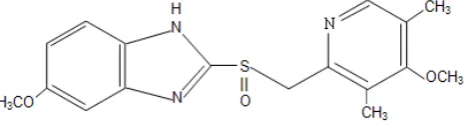
Omeprazole (OME) is a proton pump inhibitor (PPI). PPIs have enabled to improve the treatment of various acid-peptic disorders. OME is a weak base and it can form several complexes with transition and non-transition metal ions. In the present paper, we are describing series of transition metal complexes of omeprazole i.e., 5-methoxy-2[(4methoxy-3, 5dimethyl-2-pyridinyl) methylsulfinyl]–1H–benzimidazole with CuII, MnII, CoII, NiII, FeII, ZnII and HgII. These complexes were characterized by elemental analysis, molar conductivity, IR, NMR, magnetic susceptibility, UV-visible spectral studies, ESR, SEM and X-ray diffraction. Based on the above studies, the ligand behaves as bidentate O, N donor and forms coordinate bonds through C=N and S=O groups. The complexes were found to non-electrolytic in nature on the basis of low values of molar conductivity. Analytical data and stoichiometry analysis suggest ligand to metal ratio of 2:1 for all the complexes. Electronic spectra and magnetic susceptibility measurements reveal octahedral geometry for Mn(II),Co(II), Ni(II),Fe(II) and Cu(II) complexes and tetrahedral for Hg(II) and Zn(II) complexes. Ligands and their metal complexes have been screened for their antibacterial and antifungal activities against bacteria Pseudomonas, Staphylococcus aureus and fungi Aspergillus niger and A. flavous.
Keywords: Complex, Omeprazole, Antibacterial, Ligand, Stoichiometry
INTRODUCTION
A peptic ulcer, also known as PUD or peptic ulcer disease is an ulcer of an area of the gastrointestinal tract that is usually acidic and thus extremely painful. Ulcer results from a complex interplay of acid and chronic inflammation induced by Helicobacter pylori infection [1-2]. Most of the times, ulcers are associated with Helicobacter pylori, a spiral-shaped bacterium that lives in the acidic environment of the stomach. Reflux of acid and stomach contents can cause irritation or damage of the lining of lower esophagus. If this damage is continuous, it can cause gastro-esophageal disease (GERD) [3-5]. Ulcers can also be caused or worsened by drugs such as aspirin and anti-inflammatory drugs. A class of drugs, called, proton pump inhibitors (PPIs) [6-8], blocks the production of acid by the stomach. PPIs are substituted benzimidazoles and are lipophilic weak bases that cross the parietal cell membrane and enter the acidic parietal cell canaliculus. In this acidic environment, the PPIs become protonated producing the activated sulphonamide from the drug that binds covalently with the H+, K+ -ATPase enzyme resulting in irreversible inhibition of acid secretion by the proton pump. The drugs in the same class include omeprazole, lansaprazole, rarbeprazole, and pantoprazole [9] and are used for the treatment in acid induced inflammation
conditions and ulcers of the stomach and duodenum, gasteo-oesophageal reflux disease, all caused by stomach acid. The therapeutic activity of coordination compounds has been evaluated extensively [10-11]. Some important examples of inorganic based drugs are metallocene tumor complexes [12], gold anti-arthritic compounds [13] and lithium antidepressants [14]. In all these cases, work is largely focused on elucidating the action mechanism of these complexes. Biological science literature reveals that the complexes of metallic salts are more potent and less toxic in many cases as compared to the parent drug [15]. Considering the importance of drugs and their complexes, it has been desired to synthesize and study the metal complexes of Omeprazole with metals. The present paper reports the synthesis, characterization and antimicrobial activity of a very common PPI, omeprazole, with first row transition metals like CuII, MnII, CoII, NiII, FeII, ZnII andHgII.
Suman Malik et al.
EXPERIMENTAL SECTION
Materials and methods
All chemicals used were of Analytical Grade. Pure sample of omeprazole (molecular formula C17H19N3O3S) with molecular weight 345.42 was obtained from Aristro Pharmaceutical Ltd. Mandideep, Bhopal. All Metal salts CuCl2.2H2O, NiCl2.4H2O, CoCl2.6H2O, FeSO4.7H2O, MnCl2.7H2O, ZnCl2 and HgCl2 were of Merck Chemicals. The solvents used were distilled water and methanol. Metal-ligand ratio was calculated using Systronics digital conductivity meter, IR spectra were obtained from CDRI Lucknow (Instrument used: Perkin Elmer FTIR Spectrophotometer in the range of 4000-400 cm1). Magnetic susceptibility measurements were received from CAT Indore (Instrument used-Vibrating Sample Magnetometer). Nitrogen was determined by the Dumas method and sulphur was estimated by the Messenger’s method. The elemental microanalyses of C, H, and N for ligand were carried out with Thomas and Coleman Analyzer Carlo Erba 7106.
Ligand – metal ratio
To confirm the ligand-metal ratio, conductometric titrations using mono-variation method were carried out at 21 °C. Solution of 0.01 M omeprazole drug was prepared in [70:30] mixture of methanol and water. Similarly, 0.02M solutions of metal saltswere prepared in the same solvent .The ligand was titrated against metal salt solutions using mono-variation method. Conductance was recorded after each addition. From
the equivalence point in the graph, it has been concluded that the complex formation has taken place in the ratio of 2:1 (L:M). Stability constants and free energy changes were also calculated by using Job’s method [16] of continuous variation modified by Turner and Anderson [17].
Synthesis of complexes
The complexes were synthesized by mixing the solutions (70% methanol) of metal salt with that of ligand in 1:2 molar ratios respectively. The thick precipitates of different colors for different metal salts were observed. By adjusting the pH with the addition of dilute NaOH solution and refluxing the mixtures for three and a half hours colored crystalline complexes were obtained. The complexes were filtered, washed with (70:30) mixture of methanol water and dried. Carbon, hydrogen, nitrogen, metal and water were estimated microanalytically at CDRI, Lucknow.
RESULT AND DISCUSSION
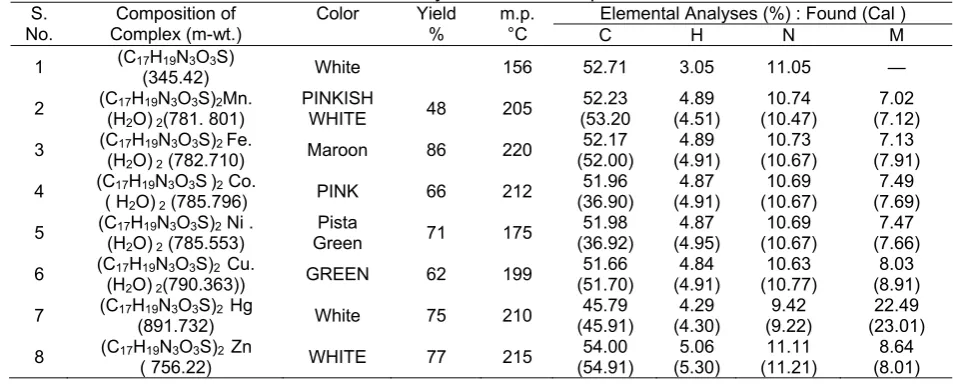
The synthesized complexes are stable solids. They are soluble in DMF and DMSO and insoluble in all other organic solvents. Analytical data and conductometric studies suggest 2:1 [L:M] ratio. Measured conductance values of these complexes are too low to account for their electrolytic behavior. The magnetic studies indicate the Mn(II), Co(II), Ni(II), Fe(II) and Cu(II) complexes to be paramagnetic while Zn(II) and Hg(II) complexes to be diamagnetic.
Table 1. Analytical data of complexes
S.
Elemental Analyses (%) : Found (Cal )
Suman Malik et al.
Table 2. Stability constant, Free energy change, Molar conductance and Magnetic- moment data of complexes
S. No.
Composition of Complex (m-wt.)
Stability constant logK(L/mole)
Free Energy change -∆F (Kcal/mole)
Molar conductance (ohm-1m2mol-1)
Magnetic Moment (B.M.)
1. (C17H19N3O3S)2 Zn 10.7471 15.9751 14.6 _
2. (C17H19N3O3S) 2hG 10.5231 14.9751 10.34 _
3. (C17H19N3O3S)2 Fe. (H2O) 2 11.1692 15.9466 10.6 5.20
4. (C17H19N3O3S)2Mn.(H2O) 2 12.088 17.03 12.01 5.62
5. (C17H19N3O3S)2Cu.(H2O) 2 11.1704 15.5905 13.0 1.75
6. (C17H19N3O3S)2 Ni. (H2O) 2 11.4204 16.1746 12.13 3.06
7. (C17H19N3O3S)2Co.(H2O) 2 11.4208 16.039 14.08 4.65
Fig 2. IR spectra of Omeprazole and its [Co(OME)2.(H2O) 2] Complex
I.R. Spectra
The vibrational spectra [18-21] for the free ligand omeprazole when compared to those of its complexes provided meaningful information regarding the bonding sites of the ligand (Table 3). The IR spectra of the complexes indicate that the ligand behaves as bidentate and co-ordinate the metal via C=N and sulphonic acid group. The shift of the νC = N and νS = O by 10-25 cm-1 in the complexes indicates that these groups are involved in the complexation. In the IR spectra of omeprazole, strong band at 3456 cm-1 is assigned to the secondary NH stretching vibrations. This band remains unaltered or shifted to the higher wave number in the complexes suggesting non-involvement of secondary
Table 3. IR Absorption data of the complexes Ligand and complex νN-H
cm-1
Electronic spectra and magnetic susceptibility data
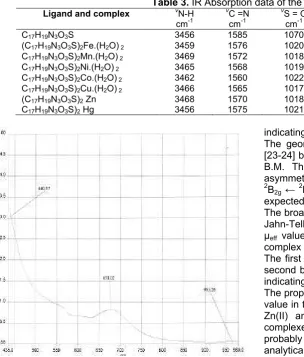
The electronic spectra of the Ni(II), Co(II), Mn(II), Fe(II) and Cu(II) complexes were taken in DMSO(10-3M) solution. The Co(II) complex exhibit three bands at 981 nm, 539 nm and 385 nm respectively, assignable to 4
T1g(F) (ν3) transitions which indicate octahedral [22] geometry of the complex. The proposed geometry is further confirmed by high μeff value in the range 4.89-5.24 B.M [23-24]. The Ni(II)complex exhibits three bands at 955nm, 540nm and 440nm which are octahedral [22] geometry of the complex. The geometry of Ni (II) complex is further confirmed [23-24] by the high
μeff value in the range 3.09-3.20 B.M. The electronic spectra of the paramagnetic Mn(II) complex displays three absorption bands at 408 nm, 441 nm and at 600 nmwhich can be assigned to 4Eg(G) ←
A1g transitions respectively
indicating octahedral [22] geometry of the complex. The geometry of Mn(II) complex is further confirmed [23-24] by the high μeff value in the range of 5.85-5.98 B.M. The Cu(II) complex exhibits a single broad, asymmetric band in region 780 nm may be assigned to 2
B1g transitions are in analogy with expected tetragonally distorted octahedral geometry. The broadnessof the band may be due to dynamic and Jahn-Teller distortion. It is further supported by the high
μeff value in the range of 1.89-1.92 B.M. The Fe(II) complex exhibits two bands at 397 nm and 695 nm. The first band is assigned to charge transfer while the second band may be due to the transitions 5Eg ←
5 T2g indicating octahedral [22] geometry of the complex. The proposed geometry is further confirmed by high μeff value in the range [23-24] 5.92-5.24 B.M. As expected, Zn(II) and Hg(II) complexes are diamagnetic. The complexes are suggested to be tetra-coordinated probably having tetrahedral geometry based on analytical, electronic spectra and conductance data.
NMR Spectra
The 1H NMR [25-26]spectra of the ligand has the expected characteristic signals. The CH3 proton shows singlet at δ 2.2 and O-CH2CH3 proton at δ 3.5 ppm .The doublet peak observed at δ 4.36 and 4.66 ppm is attributed to CH2 protons. In addition, a multiplet peak at δ 6.9-8.3 ppm may be due to aromatic protons and peak at δ13.2 may be due to NH proton of benzimidazole ring. Signals observed in the complexes at region of δ 8.18-8.23 ppm due to the azomethine proton either remained unaffected or shifted slightly downfield with reference to those of the parent ligand and the position of signal due to NH proton remains unaffected in the complexes. The aromatic protons show downfield shifts in the complexes. These observations support the assigned structure to the complex.
Scanning Electron Micrographs [S.E.M.]
SEM of metal complexes indicates the presence of well defined crystals free from any shadow of the
Suman Malik et al.
metal ion on their external surface. The representative micrographs of a) Ligand; [C17H19N3O3S] b) [FeL2(H2O)2], c) CuL2(H2O)2], d) CoL2(H2O)2], e) NiL2(H2O)2], f) ZnL2(H2O)2] are shown in Fig. 5.
ESR Spectra
ESR spectra of powdered samples of [Cu (OME) 2(H2O)2] complex was recorded at room temperature. When the monomeric species change into dimeric species having axial symmetry and identical sites, the ‘g’ values also change due to the change in symmetry [27]. The spectra have asymmetric bands with two ‘g’ values g║ and g┴. The trend g║>g┴>g (2.002), indicates that unpaired electron lies predominantly in the dx2-y2 orbital of copper (II) ion. The values of the σ bonding parameter, α2, show appreciable covalence character in the metal-ligand bond. Based on these observations copper (II) complex may have octahedral geometry.
X-ray diffraction
The crystallinity of the material was analyzed with XRD with K-alpha radiation The X-ray diffraction of Cu(II) complex of L1 is studied as a representative system. The observed 2θ values with relative intensity more than 10% are indexed and have been used for evaluation. The X-ray diffraction pattern of the complex with respect to their prominent peaks has been indexed by using
computer software [28]. The above index method also yielded miller indices (h, k, l) values, unit cell parameters, volume of unit cell and space group.
The observed values fit well with orthorhombic system to give a unit cell dimensions a = 6.3314 Å, b = 8.5059 Å and c =15.405Å.
Fig 4. NMR spectra of Omeprazole and its [Zn(OME)2]
Complex
Suman Malik et al.
Fig 6. ESR spectra of Omeprazole-Cu Complex
Fig 7. XRD Graph for [Cu(OME)2.(H2O) 2] Complex
Thermal analysis
The thermal decompositions of the Ni(II)complex was studied using the TG and DSC technique. The thermo gravimetric studies of the complex was carried out in the temperature range 30-800 °C with a sample heating rate 10 °C/min in air atmosphere. The weight-loss step between 175-200 °C may correspond the elimination of coordinated water molecules. The weight-loss step between 250-450 °C may be attributed to the loss of organic moiety of the complex molecule. The final decomposition continuous up to 800 °C and on further increasing the temperature no weight loss is observed which may be attributed to formation of stable metal oxide.
Antimicrobial activity
The antimicrobial activity of the ligand and the complexes was determined by the disc diffusion
technique [29]. The compounds were screened in vitro against Pseudomonas, Staphylococcus aureus and two strain of fungi, Aspergillus niger and A. flavous. A solution of 1 mg/mL in DMF was used. The standard used was gentamicin sulphate 1 mg/mL and solvent control was used to know the activity of the solvent. The bacterium was maintained on nutrient agar and the agar media were incubated for different microorganism culture tests. After 24 h of incubation at 37 °C for bacteria and 72 h of incubation at 25 °C for fungi, the diameter of zone of inhibition (mm) thus formed around each disc containing the test compound was measured accurately. All complexes show significant activity against bacteria Pseudomonas and Staphylococcus aureus as compared to ligand. The Co(II) complex is shown to be less active than the ligand in fungi
Aspergillus niger and Mn(II)complex in fungi A.flavous.
Fig 8. TGA/DTA and DSC Curve of [Ni (OME) 2.(H2O) 2] complex
as compared to the ligand can be explained by chelation theory. The theory explains that decrease in polarizability of the metal could enhance the liphophilicity of the complexes which leads to the breakdown of permeability of the cells resulting in interference with normal cell process.
CONCLUSION
In view of the foregoing discussions, the high melting points and insolubility in common organic solvents, we have assigned following probable structure of the complexes of omeprazole.
ACKNOWLEDGEMENT
The authors are thankful to Principal, Sadhu Vaswani College Bairagarh for providing necessary facilities for research work, DST for granting FIST program to the college and UGC for sanctioning UGC Research award to Dr. Suman Malik, one of the co-author.
REFERENCES
1. Biasco, G., Miglioli, M., Barbara, L., and Corinaldesi, R., 1998, Am. J. Med.,129, 547–550.
2. Soll, A.H., 1996, Abstr. J. Am. Med. Assoc., 275, 8, 622–629.
3. DeVault, K.R., and Castell, D.O., 2005, Am. J. Gastroenterol., 100, 190–200.
4. Spechler, J.S., 2000, Mt. Sinai J. Med., 67, 106– 111.
5. Brown, M., and Yang, R.D., 2001, Suppl. Manage CareMag., 10, 10, 7–10.
6. Vanderhoff, B.T., and Tahboub, R.M., 2002, Am. Fam. Physician, 66, 2, 273–281.
7. Mui, A.C.W., and Fan, T.C.Y., 2007, Hong Kong. Med. J., 13, 430–435.
8. Devlin, J.W., 2005, Am. J. Health-Syst. Pharm., 62, 10, S24–S29.
9. Vidaillac, C., Guillon, J., Arpin, C., Forfar-Bares, I., Ba, B.B., Grellet, J., Moreau, S., Caignard, D-H., Jarry, C., and Quentin, C., 2007, Antimicrob. Agents Chemother., 51, 3, 831–838.
10. Reedijk, J, 1987, J. Pure Appl. Chem., 59, 181– 192
11. Lochrer, P.J., and Einhorn, L.H., 1984, Ann. Intern. Med., 100, 704–713.
12. Toney, J.H., Brock, C.P., and Marks, T.J., 1986, J. Am. Chem. Soc., 108, 7265.
13. Forestier, J., 1935, J. Lab. Clin. Med., 20, 827–40. 14. Bansal, A., and Singh, R.V., 2001, Synth. React.
Inorg. Met.-Org. Chem., 31, 381.
15. Singh, A., and Singh, P., 2000, Indian J. Chem.,
39A, 874–879.
16. Job, P., 1928, Ann. Chim., 11, 113–203.
17. Turner, S.E., and Anderson, R.C., 1949, J. Am. Chem. Soc., 71, 912–914.
18. Nakamoto, K., 1976, Infrared Spectra of Inorganic and Co-ordination Compounds, John Wiley, New York.
19. Vogel, I., 1954, Quantitative Inorganic Analysis Longman, Green and Co., London, 455.
20. Bellamy, L.J., 1956, Chemical Application of Spectroscopy, Interscience Publishers, New York. 21. Weiss Berge, A., 1956, Chemical Application of
Spectroscopy, Interscience Publishers, New York. 22. Krishna, C.H., Mahapatra, C.M., and Dash, K.A.,
1977, J. Inorg. Nucl. Chem., 39, 1253.
Suman Malik et al.
23. Carlin, R.L., and Vandryneveledt, A.J., 1997,
Magnetic Properties of Transition Metal Compounds, Springer- Verlag, New York.
24. Figgis, B.N., 1976, Introduction to Ligand Fields, Wiley Eastern Ltd., NewDelhi , 279.
25. Silverstein, R.M., and Bassler, G.C., 1967,
Spectrometric Identification of Organic Compounds, 2nd ed., Wiley, New York.
26. Pople, J.A., Schneider, W.G., and Berstein, H.J., 1959, High Reduction Nuclear Magnetic Resonance,
McGraw Hill Company, New York.
27. Dutta, R.L., and Syanal, A., 1992, Electron spin resonance responses, In Elements of Magneto chemistry, 2nd ed., East-West Press, New Delhi, 206–250.
28. Cheng Dong, Computer Software ‘Powder X’,
Institute of Physics, Chinese Academy of Science, Beijing 1000080.
![Fig 2. IR spectra of Omeprazole and its [Co(OME)2.(H2O) 2] Complex](https://thumb-ap.123doks.com/thumbv2/123dok/871862.820780/3.595.65.543.123.558/fig-ir-spectra-omeprazole-ome-h-o-complex.webp)
![Fig 4. NMR spectra of Omeprazole and its [Zn(OME)2] Complex](https://thumb-ap.123doks.com/thumbv2/123dok/871862.820780/5.595.93.519.461.725/fig-nmr-spectra-omeprazole-zn-ome-complex.webp)
![Fig 7. XRD Graph for [Cu(OME)2.(H2O) 2] Complex](https://thumb-ap.123doks.com/thumbv2/123dok/871862.820780/6.595.133.458.112.314/fig-xrd-graph-for-ome-h-o-complex.webp)
![Fig 8. TGA/DTA and DSC Curve of [Ni (OME) 2.(H2O) 2] complex](https://thumb-ap.123doks.com/thumbv2/123dok/871862.820780/7.595.119.500.114.316/fig-tga-dta-dsc-curve-ni-ome-complex.webp)
