COMMUNITY- BASED APPROACH TO REDUCE EARTHQUAKE
VULNERABILITY IN KATHMANDU VALLEY
Punya Sagar Marahatta
[email protected] or [email protected]
Department of architecture and Urban Planning, Tribhuvan University
A B S T R A C T
Nepal is a vulnerable country in terms of multiple disasters and one of them is earthquakes. Disaster risk management experts believe that one of the ways to reduce the vulnerabilities is by adopting a community-based disaster risk management approach. Unfortunately, Nepal has limited resources; the culture of insurance against disasters does not currently exist. This paper describes the findings of research conducted in traditional settlements of Kathmandu Valley multiple case studies, household surveys, and community-based participatory research have identified that the culture of participation in local development activities and fundraising at the local level could contribute to disaster risk management in traditional settlements of Kathmandu Valley. This paper thus suggests developing resilience governance at the community level through consumer cooperatives in order to reduce vulnerability to earthquakes and capitalize on already existing financial, human, and social capital and resources.
Key words: Disaster management, earthquakes, vulnerabilities, Kathmandu - Nepal
ABSTRAK
Nepal adalah negara yang rentan terhadap berbagai masalah bencana alam dan salah satunya adalah gempa bumi. Ahli manajemen risiko bencana percaya bahwa salah satu cara untuk mengurangi kerentanan adalah dengan penanganan bencana berbasis masyarakat. Sayangnya, Nepal memiliki sumber daya yang terbatas, budaya asuransi terhadap bencana saat ini tidak ada. Makalah ini menjelaskan temuan dari penelitian yang dilakukan di pemukiman tradisional Lembah Kathmandu. Beberapa studi kasus, survei rumah tangga, dan masyarakat berbasis penelitian partisipatif telah menunjukan bahwa budaya partisipasi dalam kegiatan pembangunan daerah dan penggalangan dana di tingkat lokal dapat berkontribusi untuk manajemen risiko bencana di permukiman tradisional Lembah Kathmandu. Makalah ini menyarankan pengembangan tata kelola ketahanan di tingkat masyarakat untuk mengurangi kerentanan terhadap gempa bumi dan memanfaatkan yang sudah ada keuangan, modal manusia, dan sosial dan sumber daya yang sudah ada.
Kata Kunci: Manajemen bencana, gempa bumi, kerentanan, Kathmandu - Nepal IJG Vol. 44, No.2, December 2012 (161 - 172)
INTRODUCTION
Nepal has been experiencing increasingly larger earthquakes at regular intervals. The first ever recorded earthquake in Nepalese history goes back to the early-13th century [Pant, 2002]. The latest of the large earthquakes occurred in 1934 and claimed a huge loss in lives and infrastructure [Rana, 1934]. There have been additional moderate earthquakes since 1934. The 1988 earthquake in eastern Nepal claimed 721 lives and caused severe damage to infrastructure [Pujari and Marahatta, 2010].
It is believed that there is a probability of a devastating earthquake occurring in Nepal every 75 years. It is predicted that if an earthquake of 5.7 on the Richter scale hits Kathmandu, approximately 40,000 people will die, another 90,000 people will suffer injuries, and 60% of the existing buildings will collapse (IRIN, 2008). The earthquake will also have a severe impact on the national Gross Domestic Product. Records show that 8% of the total GDP was spent on rehabilitation works after the 1988 earthquake in Nepal. Similarly, figures show that 17% of the GDP was used for the post-Tsunami period in 2004 in Maldives [Pokharel, 2008]. Due to the huge concentrations of population, industries, and commercial activities in Kathmandu Valley, a large earthquake will have a huge economic impact on the country as a whole. The history of Nepal revolves around Kathmandu Valley, which has evolved as a centre of excellence from physical, social, and cultural dimensions of human development. The valley itself contains seven out of eight of the
UNESCO (Cultural) world heritage sites in
Nepal. The valley is rich in built and living heritage and is under a constant threat of earthquake.
Historically, the valley managed to recover, restore, and reconstruct the devastated built heritage through active participation of local communities. No
foreign support was involved in the reconstruction and rehabilitation aftermath of the 1934 earthquake. All available local resources were mobilized, including the collection of Pashupatinath and Macchendranath [Rana, 1934]; this approach focused on post-disaster response and recovery.
The research considers that earthquake vulnerability in traditional settlements of Kathmandu Valley is directly linked with financial resources; this consideration is based on the quick emergence and disappearance of several community-based disaster management committees in the valley due to lack of operational capital or financial sustainability. Therefore, the research investigated the financial sustainability for a disaster vulnerability reduction approach at the community level. In this regard, this paper discusses the research conducted in traditional settlements of Kathmandu Valley to determine: how can earthquake vulnerability of communities living in the traditional settlements of Kathmandu Valley are reduced through a community-based approach? It also highlights the findings of the research.
THE METHODS
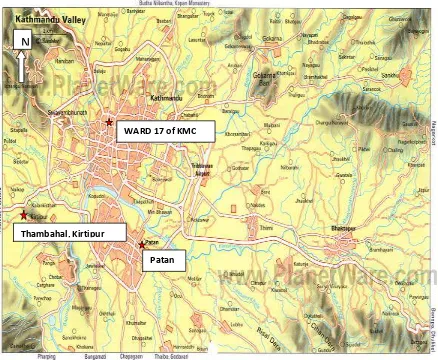
The research is considered exploratory; it is intended to explore the vulnerabilities of selected communities related to earthquake disasters. For that purpose, the research carried out multiple case studies in the valley. There were six community-based organizations located in a single tolei (a community in traditional settlements in the valley) and a consumer cooperative from
Patan, a historic city in Kathmandu
Valley, utilized for case studies. Likewise, to have a better understanding of community participation on community development and disaster risk management, two other cases from traditional settlements in Kathmandu Valley (one from Kirtipur and one from
(see Figure 1.) The agenda of using those cases was to identify the appropriate community-based earthquake vulnerability
reduction approach to be adapted to other similar cases.
Figure 1. Figure showing different case areas of Kathmandu Valley
The research attempted a method of working with local people in one of the major case areas, which is closer to the community-based participatory method used in the United States. In this method, community people were not mere informants, but active participants, in the research. The researcher developed community-driven research questions with local participation by selecting local youths as community partners whose roles were clearly identified. Their roles were to contribute in designing the questionnaires and instruments, implementation of fieldwork, dissemination of study findings, and facilitation in researcher-community interaction. The research method also involved the local youths to identify and mobilize the local resources.
The research adopted a mixed research method with a majority of qualitative components. It was carried out using different tools such as a household questionnaire survey, observer participation, structured and semi-structured interviews, etc. The unit of research is the tole, which is a conglomeration of several households. The research uses a case study method, taking several toles in three different traditional settlements of Kathmandu Valley. The case study conducted in Patan contained a household questionnaire survey along with several participatory activities. The case study in Kirtipur was conducted through multiple visits and an interview with the leader of a community-based development program. Finally, the case study of Ward no. 17 Disaster Management Committee Thambahal, Kirtipur
Patan WARD 17 of KMC
adopted a method of investigation through structured and semi-structured interviews and data collection through questionnaires. Analysis of the household data was carried out using Statistical Package for Social Sciences (SPSS) and MS Excel. It assessed the total vulnerability of households and impact on corresponding toles. In order to assess the total resilience of a household the research used the Rapid Vulnerability Assessment Tool (RVA) developed by Nepali structural engineers to assess physical vulnerability [Poudel et.al, 2009]. Similarly, a social and cultural vulnerability assessment was carried out by assessing the adaptive capacity of the household. The addition of physical, social, and cultural vulnerability gave the overall vulnerability of the household and the total of all the household results as the vulnerability of the tole. The analysis of household data also assessed the participatory trend and household interests in community-based disaster risk management activities.
Analysis of socio-cultural institutions, community-based organizations, and consumer cooperatives was based on organizational structure, participation, resources, turn-over, and their involvement in infrastructure and community development.
Analysis also includes a brief study on existing by-laws, educational patterns, and interviews with respective professionals/stakeholders.
Theory
The research, as stated earlier, aimed to find an appropriate community-based approach to earthquake vulnerability reduction. Therefore, it carried out studies to understand earthquake vulnerability in the selected case context. It was established that earthquake vulnerability, as with all other vulnerabilities, has a societal dimension. The primary focus of present day Nepali disaster management experts is on protecting the physical infrastructure in order to reduce the
earthquake vulnerability. Protecting the physical infrastructure is an incomplete spectrum as the focus needs to be shifted to protect people (Morrow, 1999,
Kasperson, 2010, Fekete, 2011).
Understanding vulnerability from social and cultural perspectives is less accepted in Nepal. If vulnerabilities are assessed and analyzed through social and cultural perspectives, a more comprehensive picture may appear [Bankoff, 2001]; this is important because vulnerabilities are directly linked to livelihood of the people [Morrow, 1999]. The direct link of vulnerability to any community lies with their physical, social, and cultural status [Basukala, 2009].
The impacts of earthquakes with the same magnitude differ depending on context, based on vulnerabilities and exposure of specific communities to any given particular hazard. Vulnerabilities are context specific. In the Nepalese context, the earthquake vulnerability assessment is dominated by a physical vulnerability assessment [Basukala, 2009] and different software is used to assess the vulnerability. Such assessments, however, do not provide a complete picture of vulnerability [Jimmy, 2006]. It has been observed that the vulnerability assessment in Nepal
doesn’t go lower than ward level (in Nepal a ward is the lowest unit of local government), which contradicts the concept held by the contemporary academia to advocate for household assessment. The lowest unit of socially agreed upon and traditionally accepted system is a tole [Joshi et.al. 2010]. A ward can be a conglomeration of different toles. In some cases, a single tole is divided into two or more wards because of its geographic and demographic size.
because of how they conceptualize the scale of the problem [Stephen and
Doening, 2001]. In most emergency
contexts, targeting vulnerable households is either inappropriate or not feasible. At the same time, it must be recognized that in some situations it is necessary to target vulnerable individuals or households because resources may be insufficient to feed everyone within the emergency-affected population [Jaspars and Shoham, 1999]. In this context, the researcher adopted methodology that attempts to assess the vulnerability of households in the selected communities.
According to the literature, reducing earthquake vulnerability is possible by increasing the resilience; the Hyogo Frame of Actions (2005-2015) highlights the importance of resilience [Manyena, 2006]. David Alexander writes in his blog that the term resilience, or resiliency, began to be applied in the 2000s in the field of disaster risk reduction. A resilient society is one that is simultaneously able to resist the impact of disasters (i.e. avoid a certain amount of harm and damage) and absorb it by adapting to the hazard [Berkes 2007]. Theories suggest that the establishment of resilience governance is important to reduce disaster vulnerability. In order to develop resilience governance, increasing adaptive capacity of the vulnerable communities is of utmost importance. Community participation is a tool to increase the capacity of society to resist the impact of disaster and absorb it by adapting to the hazard. Likewise, increasing adaptive capacity is also possible through linking disaster and development. The earlier practices of disaster management focused on response and recovery; however, modern day principles suggest disaster management should also focus on disaster preparedness. Hence, while conducting development intervention in the disaster-prone communities, disaster risk should remain central [Blaike et.al, 1994, Cline-Cole, 1997].
Nepal is an underdeveloped country with a long tradition of participatory development
[Devkota, 1999]. Historically, Nepal’s
development model was based on the cooperative model/ approach [Nepal, 2011], which is participatory. The Participatory development approach advocates the importance of communities and their direct role in decision-making; it is considered to be a rights-based approach [Meenai, 2008]. In Nepal the majority of people living with the threat of natural disasters are financially vulnerable. Paulo Frieire states that poor and marginalized people are capable of analyzing their own realities and bringing about change in their own situation [Meenai, 2008].
There is a problem in participatory disaster risk reduction approaches in Nepal. Quite often, it is expert driven [Marahatta, 2011] and community participation for disaster risk reduction is also advocated by external experts and donors. The participation classifies local people in four broad classes according to their roles: (i) subject, (ii) voter, (iii) consumer, and (iv) co-producer [Dool, 2005]. According to the classification, present day disaster risk reduction approaches, while seeking community participation, often fail to consider the local people as co-producers, which is one of the causes for participation lethargy. Therefore, on the basis of capabilities and resources, there is a need to consider the local people as co-producers. One of the reasons for failure of local people to become co-producers is the lack of financial and human resources in disaster risk reduction measures and a need of a sustainable resource pool in Nepal.
researcher examined the acts, policies, and practices in Nepal. These policies have dealt with the complexities of disaster risk management and proposed systematic approaches to deal with natural disasters. They have highlighted the importance of community-based disaster risk management practices; however, they failed to address the issue of resources to keep such activities ongoing. Likewise, the sole existence of a legal framework cannot solve the problem of disaster vulnerabilities. There are institutions to address disaster issues; however, such institutions are over-dependent on a reactive approach confined to response and recovery activities. The laws and regulations are insufficient in terms of financial and human resources. Similarly, the institutional arrangements are found to be inadequate regarding economic efficiency, equity, and public accountability [Chan, 1997]. Therefore, the legal framework must adhere with the above-mentioned issues, and contribute to the proper functioning of the disaster
management institution at community level.
After going through the theoretical studies, the research was confined to answer the research question with the support of the following key issues:
Understand the vulnerabilities and assess them in a local context Develop resilience governance Link development interventions with disaster risk management Increase participation of beneficiaries
Understand the dynamics of Community-Based Disaster Management (CBDM).
RESULTS AND DISCUSSION
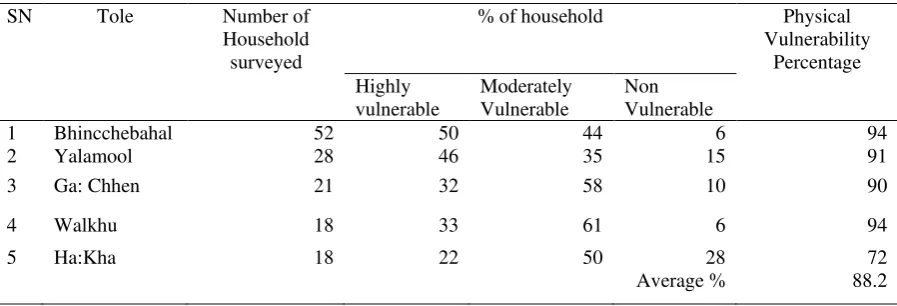
The vulnerability assessment of different toles was carried out assessing the physical vulnerability of selected buildings in toles using the Rapid Vulnerability Assessment
tool. (See Table 1)
Table 1. Physical Vulnerability of Various toles
SN Tole Number of toles was carried out by assessing adaptive capacity, which considers socio-economic status, social capital, and knowledge as relevant. Socio-economic status includes income, land ownership, and vehicle access as parameters for the assessment. In terms of social capital, interviewees were asked about familiarity with neighbors, current level of support (help) from their neighbors, participation in community
activities, available organizations in the community, respondents’ connection to earthquake disaster prevention, availability of emergency evacuation sites, and ability to identify those sites. Researchers developed a scoring system for the responses, which were scored and summarized according to three themes:
those with a score of 7-11 were categorized as MAC (moderate adaptive capacity),
And those with a score of 12-19 were labeled as HAC (high
adaptive capacity).
Here, LAC refers to an adaptive capacity
with less knowledge of earthquakes, weak social-economic status, and lack of adequate social capital. As it is found that
the level of adaptive capacity contributes to reduction of vulnerability and vice versa, households, communities, or even the ward with a lower scored LAC are to
be considered as more vulnerable. The following table illustrates the adaptive capacity of selected households in the toles surveyed. Table 2 shows the Adaptive
Capacity of Different Toles.
Table 2 .
Adaptive Capacity of Different Toles
SN Name of tole Number of Household surveyed
% of household Percentage of
Lower Adaptive Capacity LAC (Low Adaptive
Capacity)
MAC (Moderate
Adaptive Capacity)
HAC (High Adaptive Capacity)
1 Bhinchhebahal 52 38 59 3 97
2 Yalamool 28 22 77 1 99
3 Ga:Chhen 21 30 63 7 93
4 Walkhu 18 19 78 3 97
5 Ha:kha 18 27 61 12 88
Average % 94.8
The research also assessed participation trends in different toles and interests in establishing the community basket. In order to analyze the participation trend in communities the respondents’ age group, gender, occupation of the household, household income, involvement in community organizations, Involvement in community activities, and involvement in earthquake preparedness activities were assessed.
The age group of respondents is considered important because the trend of youth participation in community activities is diminishing. Senior citizens are often participating in activities but there is less
Table 3. Scoring basis of Participatory Trend Analysis
Indicator Score
Age group 15-29=3 30-60=2 60 &+=1
Gender Male=1 Female=2
Occupation Farming=3 Business=2 Services=1
Involved organizations Youth=1 Mothers=1 Tole=1 Guthi=1 Others=1
Involvement in CBO Yes=1 No=0
Involvement in Earthquake preparedness activities
Yes=1 No=0
According to the scores assigned, a scale was designed where household scoring (0-6) as low, (7-12) as medium and (13-19) as
high participatory households. The analysis of the responses to the questions is presented in Figure 2.
Figure 2. Participatory Trend chart
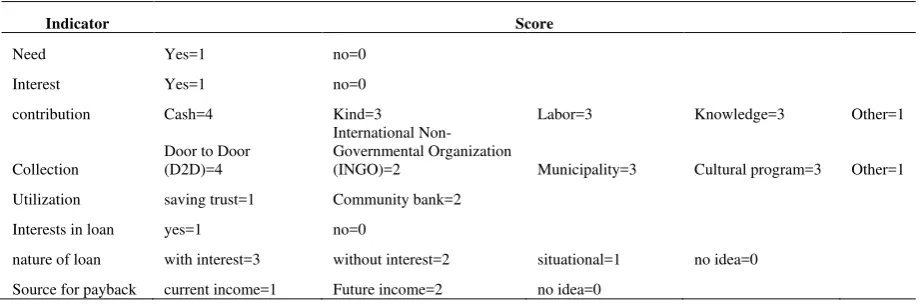
While assessing the feasibility of the community basket, the following indicators were used in the questionnaire survey, which collected information on people’s interest in the community basket with their contribution, their interest in its utilization through borrowing, method of paying back, and potential use of what was
borrowed. The following scoring system was developed to check if the concept of the community basket works. Table 4. Reveals the scoring basis for assessment of feasibility of community basket, and Table 5. Reveals scaling criteria for feasibility of community basket.
Table 4. Scoring Basis for Assessment of Feasibility of Community Basket
Indicator Score
Need Yes=1 no=0
Interest Yes=1 no=0
contribution Cash=4 Kind=3 Labor=3 Knowledge=3 Other=1
Collection
Door to Door (D2D)=4
International Non-Governmental Organization
(INGO)=2 Municipality=3 Cultural program=3 Other=1 Utilization saving trust=1 Community bank=2
Interests in loan yes=1 no=0
nature of loan with interest=3 without interest=2 situational=1 no idea=0
Table 5. Scaling Criteria for feasibility of Community Basket
Scale Score
Highly productive 33 to 42
Productive 23 to 32
Feasible 12 to 22
not feasible 0 to 11
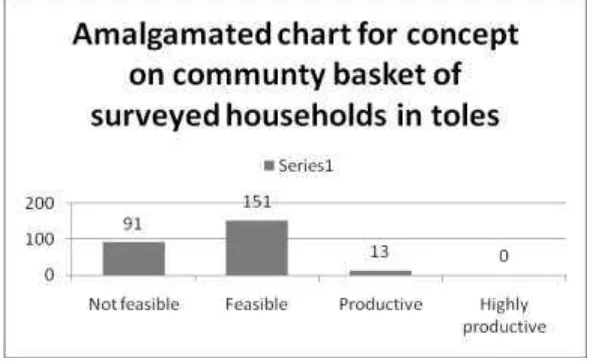
The following amalgamated chart (Figure 3) is the result of the assessment on the basis of scoring parameters and scales provided.
Figure 3. Amalgamated chart for concept of community basket
The research establishes that 88.2% of the research population is physically vulnerable and 94.8% of the population
doesn’t have a high adaptive capacity in case of earthquake disaster; this means that almost the entire population is living under the threat of earthquake disaster. The assessment also highlights the possibility of reduction of such threat by adopting a community-based approach because the participatory trend in the toles is on the higher side at 97.6%. Results show the feasibility of developing and mobilizing a participatory community basket and local resources is about 60%. The numbers of consumer cooperatives in the case study area also indicate opportunities.
CONCLUSION AND RECOMMENDATION
The case study areas have tremendous potential for financial resources through tourism. All toles and communities in the
case study areas have consumer cooperatives, which could be a good resource pool for that purpose. Likewise, such consumer cooperatives could add and attract external support through I/NGO
funding, government funding, citizen donations, agencies, or companies. The financial resources could be utilized for disaster risk reduction approaches and for earthquake vulnerability reduction at the community level for structural strengthening on public structures, increasing the physical resilience of the built infrastructure, and increasing the adaptive capacity of locals living in the traditional communities.
The existing Community-Based Organizations (CBOs) such as youth
training could be linked with livelihood options, thus providing tangible benefits to the participants, such as life-skill development, employment opportunities, and decreases to participation lethargy. These historic and present day community organizations have already been working in the area of local development; therefore less effort is needed to tie their activities to disaster risk management. Linking disaster risk management with local development interventions is possible through community-based organizations.
The community-based organizations in the selected communities should be credited for their efforts in infrastructure and community development, but they are not working directly in the area of disaster management. Government must provide legitimacy for these organizations to work in disaster management. Rigorous intervention at the government level is needed in earthquake vulnerability reduction to address structural and building issues as well as social and cultural issues. Local governments need to develop their by-laws accordingly. Such disaster management activities should be linked to the livelihood of the local people, which not only creates employment opportunities at their toles but also helps to reduce earthquake vulnerability.
Community-based disaster management requires reliable financial resources available at the community level. As observed through the case studies, communities have developed their own consumer cooperatives. They are funding several local development projects at the grassroots level. Consumer cooperatives could contribute to resilience governance as well; however, there must be a favorable environment for it in terms of structure, legitimacy, and financial accountability. Similarly, the vulnerability assessment of the community could also be carried out by members of the cooperatives.
Nepal s current educational system is not focused on developing life-skills and hands-on training. The consumer cooperatives that are active in the local communities, while training their participants, could provide a soft loan to enhance skills. Trained participants would pay back the loan and also contribute a specified amount of their earning to disaster management projects and/or to the cooperative. Similarly, the entire community can run a business borrowing from the cooperative and pay interest, as well as contribute a specified amount for disaster management projects.
In Nepal a natural disaster-free situation is impossible. The presence of hazard is the contributing factor for risks. The risk from hazards could cause disasters. Four major factors accompany disasters: risks, vulnerabilities, coping capacity, and resilience. Resilience governance is the solution to reduce risks and vulnerabilities, which is possible through a socio-technical approach. Increasing resilience in the communities reduces the vulnerability. Communities living in traditional settlements could develop or use the existing consumer cooperatives to assess the vulnerability, develop resilience governance, and to link their local development initiatives to disaster risk.
REFERENCES
Bankoff, G. (2001), Rendering the World Unsafe: 'Vulnerability' as Western Discourse.Disasters,25,19-25.
Basukala, R. K. (2009), Seismic Vulnerability Assessment of Urban Settlements: A Case of Bhaktapur City. Department of Architecture and Urban Planning, Pulchowk
Campus. Kathmandu, Tribhuvan
University.
-20'. " 0! :" !0%. ; International
Journal of Disaster Risk Science,<,
*E-<T;
Natural Hazard Studies. 6.:# % %,
"# % (%"# %0$'. -" %0 '"/ '$
Journal of Disaster Risk Science,*,
U-+;
Himalayan Times.W '"#1 ' !;
4%% '/, ]. (<==F), Participatory
Byabahar (Cooperatives: Theory and Practice), W '"# 1 ' ! D '/0'7/
Nepali National Daily.
^ _`abc d ef gf huibajd k f lm a h nobstnld gf
pqrrstd glu ja v jsulc h bjswjx
vuc m brl ijc jty zssbsswbmt { __c |_o
}ltnwlm a` vlccbyf ~
J , Engineers
Associationf
^ulrjd hf lm a lrl nlttl d ^f hf pqr rtd
gbtnjm jm tnb jabm jty _| rilm
u bm hulxbsf Spaces Magazine,
Vol 6, Issue 5.
glmld f hf ps td Nepalko
Mahabhukampa (1990),
}ltnwlm a`d Nbu lcd rl nwl
h n`wsnbr glmlf
htbu nbmd f lm a _m j md {f f pqrr td
bttjm tnb hxlc b gjn z
_wulrjs_m _|z mlcytjxlc btn_a
| _o vucm brl ijcjty zssbsswbm lm a
_` bn_c acbvbc {lrbtjmf