ARTICLE HISTORY
The Abuse of Sympathetic Power to Counter Hegemony
S. Andika Cahya Ari Wibowo
SMK Negeri 1 Jepon
ABSTRACT
Sympathy may be generally defined as a support given to other who is believed that he/she is undeservedly suffering or misfortune. Identical to the positive notion of ‘support’, the practice of sympathy in the society portrays deviates purpose. Powerless can effectively appeal to the sympathy of their counterparts for their own strategic gain, and more specifically, that these powerless individuals can leverage their weaknesses through the strategic use of sympathy in order to mitigate the disadvantages of lacking power. This powerless strategy may even be used to maintain their relation with the power. It calls sympathy as means of resistance. The phenomena will be noted as the abuse of sympathetic power. This article is intended to explore the practice of sympathetic power to counter hegemony. It attempts to portray the sympathetic
power’s potency as means of resistance to counter hegemony. The area of inquiry constricted into the specified context of Minah’s Cocoa Beans
Stealing Case in 2009. The study was conducted by combining Fairclough’s CDA model with Systemic Functional Linguistics (SFL), particularly by considering interpersonal metafunction proposed by Halliday.Based on the analysis, Minah appeals sympathy by exposing her innocence and all the characteristics that she naturally possessed. She was able to influence court decision to set her free even all the evidence proves her for intentionally or, at least, incline him to act intentionally. (‘Emotion’ and ‘motive’ both derive from the Latin movere, to move.)
Accepting support from others, one may notice and feel, whether the support is based on sympathy or just fulfilling the sense of responsibility, by their facial expression, posture or movement. As it is possible for others provide support to our suffering or misfortune based on the sense of responsibility.
VOL.7, NO.1, 45-56
http://dx.doi.org/10.21580/vjv7i12736
Believing that one provides support to our suffering based on the sense of responsibility, we may have no bond of emotional feeling to him. Even we may still accept the support or later do the same thing to him which is possibly done on the same basis.
Speaking to this bond, Hochschild (1983: 18) quoted by Clark (2011: 291) emphasizes that group members create sympathy "accounts," or "margins," for each other. Sympathy is a type of "feeling currency" that people hold "on account," ready to give to each other in the future.
At this point, it seems that it is common for people to remember and then believe that on which one gives sympathy to him, he will think and believe that it is necessary to provide sympathy whenever he needs it.
Sverdlik also stresses that the practice of sympathy may provide reason, he refers to it as motives, why people behave in such a way. Thus, sympathy has potency to influence people decision which is manifested into their attitude.
Moreover, sympathy psychologically motivates the prosocial behavior (Hume, 1739/1888:52 in Decety& Chaminade, 2003:128). Prosocial behavior refers to voluntary actions that are intended to help or benefit another individual or group of individuals. It refers to a pattern of social activities including sharing, comforting, rescuing, helping and donating (Dovidio, Piliavin, Schroeder & Penner, 2012: 5-6). To this behavior, our minds are mirror to one another: they reflect one another’s passions, sentiments, and opinions. We may feel what others feel and imagine if such situation happens to us.
Research reveals how sympathy has potency to trigger altruistic desires. Altruistic desires is the motivation to help others out of pure regard for their needs rather than how the action will benefit oneself (Buss, 2015: 81). It happens as overt motivation for prosocial behavior. It is triggered when the self covertly (and automatically) resonates with the other (Decety& Chaminade, 2003:128).
As one believes that someone is undeservedly suffering from something or misfortune he is then motivated intrinsically to release his burden/ suffering for the sake of him. His action possibly influences others and makes them believe and then willing to do the same action. This certainly will be a massive action of prosocial behavior.
Hume, Decety and Chaminade further illuminate that through operating the sympathy a person possibly influences others emotion which then may be reflected in their point of view, moral judgment as well as action upon certain social phenomenon.
sympathy, one may think to benefit himself through the practice of sympathy that he issued. Thus, the sympathizee does action to release one’s suffering or burden (even just expressing it), not merely for the sake of the sympathizer, rather he does it because he serves the other purpose for his own benefit. It often happens in the administration relations involving state and citizen. Referring to Conover research (1988), Piston (2014: 79) concludes that sympathy for low-status social groups can be a politically consequential phenomenon, motivating individuals to support policies intended to aid such groups. On the other hand, sympathizer, the one who is believed to be supported/ helped, which is powerless can effectively appeal to the sympathy of their counterparts for their own strategic gain, and more specifically, that these powerless individuals can leverage their weaknesses through the strategic use of sympathy in order to mitigate the disadvantages of lacking power (Shirako, 2011: 44). This powerless strategy may even be used to maintain their relation with the powerful. It calls sympathy as means of resistance. These phenomena will be noted as the abuse of sympathetic power.
This article is intended to explore the practice of sympathetic power to counter hegemony. It attempts to portray the sympathetic power’s potency as means of resistance to counter hegemony.
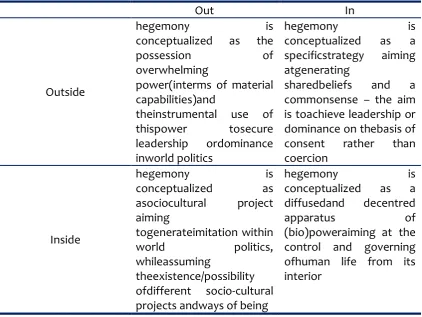
For the sake of the study, hegemony will be interpreted as the movement of power. This view considers the nature of the relationship between power and those who exercise it, objected to it or make it possible. It perceives power as external/ outside to its subject or whether it is internal/ inside to it (Antoniades, 2008: 8).
Following Foucault, power is perceived as something which is not just essentially possessed by institution and used oppressively against individual or group. It is more like something that acts andoperates in a certain way, it's more a strategy than a possession. He sees it as coextensivewith resistance; as a productive factor (Balan, 2010: 56).
In this sense no subordinate group is totally powerless. This group may have strategy to resist the powerful domination.
that culturally both dominant and dominated groups are caught in the circularity of power in which certain cultural forms predominate over others (Hall 1986 in Klein, 2014: 11). Thus, no party possess complete control over others. It opens a chance for the subordinate groups to challenge and exercise its power toward the ruling class. These ideas provide a base for countering hegemony.
Minah’s Cocoa Beans Stealing Case
Attempt to reveal the potency of sympathetic power to counter the hegemony will be conducted within the inquiry area of Indonesian society. This area of inquiry constricted into the specified context of Minah’s Cocoa Beans Stealing Case in 2009.
This case is about a grandmother of seven who was charged with stealing three pieces of cocoa fruit and subjected to 18 days of house arrest before being dragged to court to receive a suspended sentence. It refers to the case of Minah, 55, an illiterate grandmother from a small village near Banyumas in Central Java. Minah was confused that, after having returned the cocoa fruit to the plantation, owned by PT Rumput Sari Antan, and having apologized profusely, they still reported her to the police.
Hegemony as Movement of Power
This view is proposed by Antoniades (2008:10). It necessitates the examination of nature of the relationship between power and those who exercise it, objected to it or make it possible. Power may possibly move from one party to another. Two issues are of specific importance here:
(a) Is power an external characteristic (e.g.weaponry) or something that defines the internal composition of its subject (e.g. identity)?In the first case, it can be said that power is something that is external/outside to itssubject, whereas in the second case it is internal/inside to it.
Table 1.Hegemony as a Movement of Power interpersonal metafunction realized through appraisal devices following a model proposed by Martin and Rose (2003).
Critical Discourse Analysis is a three-dimensional framework, which includes the analysis of the text, the discursive practice and the socio-cultural practice (Fairclough as quoted by Titscher et al, 2000: 150).
Data and Source of Data
The data used in the study is the written expressions related to the practice of sympathy of Minah’s case which was taken from mass media.
Data Analysis
refers to Fairclough (1992). Thus, referring to Warsono (2007), several steps were taken in analyzing the data. The steps of analysis are exemplified as follows: a) Reading the text to have comprehensive understanding of their content. This
comprehensive understanding of the text content forms the basis for further analysis.
b)Grouping the text into sympathy appeal, sympathetic statement/ action and subsequence of sympathy.
c) Translating the text into target language (English) and numbering the lines for ease of references.
d)Following Martin and Rose (2003), then the text will be broken down into chunks or clauses for further analysis.
e)The next step will be analyzing the smallest units – words of appraisal devices expressed in the transcript based on the appraisal system network offered by Martin and Rose (2003), which concerns with the system of attitude, the system of amplification, and the source of attitude.
The procedure of data analysis is summed up in the diagram below:
Diagram 1. Procedure of Data Analysis
The data analysis in this study results in three forms of analysis: first, the analysis of text; second, the analysis of the discursive practice which refers to the process of text production, and text consumption; third, the analysis of the socio-cultural practice.
Data
(writen expression of sympathy taken from mass media)
Sympathy Appeal Sympathetic Statement/ Action
Subsequence of Sympathy
Appraisal Devices Anaysis
Discursive Practice Analysis:
Text Production -Text Ideology
Text Consumption
Discussion
How sympathetic power is constructed.
How sympathetic power counters hegemony.
Socio-Cultural Practice Analysis: Social Level:
Analyzing the Text
In analyzing the text, the study employed appraisal devices suggested by Martin and Rose (2003), which concern the system of attitude, the system of amplification, and the source of attitude (engagement). Attitude involves affect, judgment/appreciation. Amplification comprises grading, including force and focus. Source covers source of evaluations, whether monogloss or heterogloss.
Analyzing the Discursive Practice
Discursive practice is the link between text and social practice. Based on Titscher et al (2000: 150), there is a connection between the socio-cognitive aspects of text production and interpretation. Thus, this level is closely related to the textual level. Further, the analysis of discursive practice includes not only a precise explanation of how the participants in an interaction interpret and produce text, but also the relationships of discursive events to orders of discourse, that is a matter of interdiscursivity.
The analysis of discursive practice focuses on the production and consumption of a text. Text is produced through discursive practice. Text involves complicated and complex discursive practice. This practice determines how the text is formed. Fairclough as quoted by Eriyanto (2001: 317) in Oktavianti, there are two sides of the discursive practice. They are the text production and the consumption. The text production closely relates to the intentionally designed pattern of a certain text while the text consumption firmly relates to the interpretation of the speech target audience toward the text.
Analyzing the Socio-Cultural Practice
Fairclough suggests that a fully rounded Critical Discourse Analysis should involve an analysis of the text’s “socio-cultural practice”, or “the social and cultural goings-on which the communicative event is part of” (Fairclough, 1995a: 57). This level of analysis “may be at different levels of abstraction from the particular event: it may involve its more immediate situational context, the wider context of institutional practices the event is embedded within, or the yet wider frame of the society and the culture” (Fairclough, 1995a: 62).
Discussion
statement/ action is analyzed to reveal whether the sympathizer strategy already meets his target; in this case getting sympathy from sympathizee. The subsequence of sympathy is analyzed to review whether the appeal is genuine or a mere strategy. It is also intended to measure the effectivity of sympathy as strategy to counter hegemony.
The Sympathy Appeal Analysis
Appraisal Device Analysis
The appeals for sympathy are made by Minah, her family and local social activist. Based on the appraisal device analysis they appreciate the action of taking those three cocoas positively. It is indicated by ten positive appreciation in the appealing text. On the other hand they appreciate negatively the action taken by Rumpun Sari Antan ltd. which brings this case to trial. It is indicated by seven negative appreciation in the text. In the analysis it is also revealed that Minah also shows her confidence to face her case. It is indicated by the use of monogloss source of attitude (pronoun I, my). She also tries to portray herself as a persistent personality. It is indicated by positive affect (“I am not giving up”).
She also impicitly tries to exploit her sadness and poverty. It is indicated by four negative implicit affect (“I was accused to take three cocoas”, “Somebody reported me to the police”, “I managed by myself. No one gave me money”,
andshowing emotional expression when mentioning the cost to trial). Her son also evaluates the judge who will lead the trial morally positive. It is indicated by the positive moral judgement toward the judge (“We just hope that the judge may give his sense of justice to our parents”).
Socio - Cultural Analysis
Sympathetic Statement/ Action Analysis
Appraisal Device Analysis
The sympathetic statements are made by Muslih Bambang Luqmono, SH. The trial judge, IrmanGusman, The head of Council of Regional Representatives (DPD), and Patrialis Akbar, Minister of Law and Human Rights. Based on the apraisal device anaysis, the trial judge surprisingly appreciate what has been done by Minah positively. It is indicated by five positive appreciation in his verdict. He also judgeMinah personality positively (“Her spirit should be
appreciated. She attends the trial on time even tired and distressed”).
Moreover,dealing with the case those three people Muslih Bambang Luqmono, SH., IrmanGusman, and Patrialis Akbar are regretting; why the case should be trialed. They provide nine negative appreciation. Patrialis Akbar even implicitly shows his pitty to Minah. It is indicated by two negative implicit affect (“She is just an old woman. The judge even cried seeing her on trial”).
Socio - Cultural Analysis
Sympathetic Action also shown by the jugde by directing the trial question to a social phenomenon which easily drag the people emotion which is “poverty”. He suddenly asks about the cost to go to trial. As if he wants to persuade the public and make the legitimation that what he will do later (set Minah free) is a moral obligation. Thus, it should haven’t bring controversy.
Based on the appraisal device and socio cultural analysis we may note that those people feel sympathy to Minah. They also refer to ‘poverty’ and ‘the state of being old’ as reasons to give sympathy to Minah which turns out correspond to minah effort presenting her own image to appeal for sympathy.
Subsequence of Sympathy Analysis
Subsequence of sympathy analysis is conducted to review whether the appeal is genuine or a mere strategy. It is also intended to measure the effectiveness of sympathy as strategy to counter hegemony. The subsequence of sympathy analysis inlvolves the statements of sympathizer (subordinate party), and superordinate party. It involves Minah and Sumarno (the head of PT Rumpun Sari Antan).
Minah shows her happines; free from being sentenced to jail. Surprisngly, she gives negative appreciation toward what she had done (“I will not do it again,
taking the cocoa in the plantation”). This inconsistencymay reveal that her appeal
Further, we may notice that in her appeals for sympathy she polishes herself positively and emphasizes negative toward RSA ltd. This correspond to Van Dijk (1995) theory of Ideology. He states that the one who tries to instil her ideology to others tends to emphasizes positives things about him and emphasizes negative things about his opponent. In the essence, ideology is interpreted as the idea which is expressed through communication. This ideology controls the circulation of messages in society (Fairclough, quoted by Jorgensen and Phillips (2007: 139) in Oktavianti). In this case through her ideology Minah wants to control the public opinion that she is innocent. This confirms that her appeal for sympathy is a mere strategy.
AnalyzingSumarno (the head of PT Rumpun Sari Antan) statement, it is revealed that the company accepts the judge’s verdict. It is indicated by his positive appreciation toward the judge’s verdicts (“We are also already willing
with the judge’s verdict”).
This indicates that there is a movement of power from the RSA ltd (superordinate party) to Minah (subordinate party). Thus, it may be concluded that through manipulating the sympathy, Minah may counter the hegemony of RSA ltd. In this case, hegemony is interpreted as the movement of power. This view considers the nature of the relationship between power and and those who exercise it, objected to it or make it possible. It perceives power as external/ outside to its subject or whether it is internal/ inside to it (Antoniades, 2008: 8).
References
Antoniades, Andreas. (2008). From ‘Theories of Hegemony’ to ‘Hegemony
Analysis’ In International Relations. http://sro.sussex.ac.uk.Downloaded on
10th February 2018.
Balan, Sergiu. (1999). M. Foucault’s View on Power Relations. http://cogito.ucdc.ro. Downloaded on 15th January 2017
Buss, Arnold. (2015). Social Behavior and Personality. New York: Psychology Press. Clark, Candace. (2011). Sympathy Biography and Sympathy Margin. https://
campus.fsu.edu. Downloaded on 15th January 2017
Decety, Jean & Thierry Chaminade. (2003). Neural correlates of feeling sympathy. http://thirdworld.nl/neural-correlates-of-feeling-sympathy. Downloaded on 15th January 2017
Dijk, T.A. van. (1995a). Discourse Analysis as Ideology Analysis, in C. Schäffner and A.L. Wenden (eds.) Language and Peace, pp. 17–33. Aldershot: Dartmouth. Dijk, T.A. van. (1995b). Discourse semantics and ideology, Discourse and Society
Dovidio, John F., Jane A. Piliavin, David A. Schroeder & Louis A. Penner. 2012. The Social Psychology of Prosocial Behavior. New York: Psychology Press. Fairclough, N. (1992). Discourse and Social Change. Cambridge: Polity Press. Fairclough, N. (1995a). Media Discourse. London: Edward Arnold.
Ives, Peter. (2004). Language and Hegemony in Gramsci. http://www. mercaba.org. Downloaded on 10th December 2016.
Klein, Reisa. (2014). Beauty Marks: Counter-hegemonic Power of the Body? A thesis submitted to the Faculty of Graduate and Postdoctoral Affairs of Carleton University Ottawa, Ontario. https://curve.carleton.ca/.../klein-beautymarkscounterhegemonic power ofthebody.pdf. Downloaded on 10th December 2016.
Martin, J.R. and D. Rose. (2003). Working with Discourse; Meaning beyond the Clause. Sydney: Copyright JR Martin and David Rose.
Oktavianti, Ikmi Nur. (2008).A Comparative Study of Language, Power and Ideology InInsert Investigasi AndSiletInfotainment Programs A Study of Critical Discourse Analysis. Thesis. Brawijaya University. http://www.scribd.com/doc/70556586 /24890829 -Thesis-on-Critical-Discourse-Analysis. Retrieved on 8th April 2013.
Piston, Spencer C. (2014). Sympathy for the Poor, Resentment of the Rich, and their Political Consequences. A dissertation. University of Michigan. https://deepblue.lib.umich.edu/handle/2027.42/109000. Downloaded on 10th February 2018.
Shirako, Aiwa. (2011). Power to the Powerless: Interpersonal Influence through Sympathy Appeals. A dissertation. University of California, Berkeley. http://digitalassets.lib.berkeley.edu. Downloaded on 10th February 2018. Sverdlik, Steven. (2008). "Compassion and Sympathy as Moral
Motivation".Occasional Papers.
3.http://scholar.smu.edu/centers_maguireethics_occasional/3. Downloaded on 10th February 2018.
Titscher, Stefan; Michael Meyer; Ruth Wodak; & Vetter Eva. (2000). Methods of Text and Discourse Analysis. London [u.a.]: SAGE Publications, 2000. [Standort: Staats- und Universitätsbibliothek, Signatur: A 2000/11023]. Retrieved on 25th March 2013.
Warsono.(2007). A Critical Discourse Analysis To Unmask The Ideological
StanceBehind “Al-Qaeda In The Asia Pacific: Origin, Capability, And Threat”.