jmm.unram.ac.id 70
U N I V E R S I T A S M A T A R A M
REVIEW OF PUBLIC HOSPITAL BALANCE SCORECARD
AND ITS APPLICABILITY TO INDONESIAN PUBLIC
HOSPITALS
Saipul Arni Muhsyaf
1and Masaaki Aoki
21Graduate School of Economics and Management, Tohoku University, Japan.
Email : [email protected], [email protected]
2Graduate School of Economics and Management, Tohoku University, Japan
ARTICLE INFO ABSTRACT
Muhsyaf, Saipul Arni and Aoki,
Masaaki (2018). Review Of Public Hospital Balance Scorecard And Its Applicability To Indonesian Public Hospitals.
JMM UNRAM, 7(4), 70 - 87
DOI:
10.29303/jmm.v7i4.347
Indonesia is currently adopting the Balanced Scorecard (BSC) concept for its national health development plan. This indicates that Indonesian health institutions, including hospitals, were encouraged to apply BSC as their strategic management tool. This study is aimed to fill the literature gap by reviewing the existing international experiences regarding the Balanced Scorecard implementation in hospitals and assess its applicability in Indonesian public hospitals. By using a research method called "systematic review", we study in more detail the diversity of proposed BSC for healthcare organizations described from major online-based research databases, e.g. Pubmed, EBSCOhost, Scopus, Emerald, Wiley, ScienceDirect, JSTOR, SpringerLink, and Inderscience.Most of studies on BSC adoption and implementation highlight benefits such as managerial focus improvement, capturing a balanced view of financial and non-financial performance indicators, helpful in goals congruence, useful as cultural and motivational tool, and also for catalyzing changes needed by hospitals. However, time-consuming and a need for intensive exercises were reported as major challenges in its adoption and implementation process. A gradual approach would be an appropriate for Indonesian context, with an institutional assessment of cultural readiness as an additional approach, then followed by the designing, piloting, and gradual scaling-up.
Rencana pembangunan di bidang kesehatansaat ini di Indonesia mengadopsi konsep Balanced Scorecard (BSC). Hal ini mengindikasikan bahwasanya institusi-institusi kesehatan, termasuk rumah sakit, juga diharapkan untuk menerapkan konsep BSC tersebut. Studi ini bertujuan untuk mereviu penerapan BSC di rumah sakit di berbagai Negara dan menilai kelayakan penerapannya untuk rumah sakit–
jmm.unram.ac.id 71 rumah sakit di Indonesia. Studi ini menggunakan metode systematic review, yaitu dengan mempelajari artikel-artikel penelitian terkait BSC Rumah Sakit yang dipublikasikan secara online di Pubmed, EBSCO, Emerald, Wiley, Science Direct, JSTOR, Springer Link, dan Inderscience. Studi ini menemukan bahwa manfaat dari penerapan BSC di rumah sakit antara lain meningkatkan focus dalam proses pengelolan institusi, menyeimbangkan capaian kinerja keuangan dan non-keuangan, membantu menyelaraskan tujuan, mendorong budaya kerja yang positif dan meningkatkan motivasi kerja, serta mendorong perubahan lingkungan kerja seseuai kebutuhan rumah sakit. Studi ini juga menemukan bahwasanya tantangan utama dalam penerapan BSC di rumah sakit adalah lamanya waktu yang dibutuhkan untuk proses adopsi dan penerapannya, dan membutuhkan proses percobaan (piloting) yang intensif. Bagi rumah sakit di Indonesia, BSC sebaiknya diadopsi dan diterapkan secara bertahap. Rumah sakit juga perlu melakukan penilaian kesiapan secara kelembagaan (readiness assessment) sebelum dilakukan desain, piloting, dan penerapannya secara bertahap untuk skala yang lebih luas.
Copyright © 2018 JMM UNRAM. All rights reserved.
1. INTRODUCTION
The emergence of BSC as one of new modern Performance Measurement (PM) systems can be seen as an alternative solution to the use of traditional business PM systems which focus only on financial performance and give little attention to the non-financial measures, and putting management attention into short-term performance. This may mislead companies business continues improvement and innovation purposes which are two important
aspects in today's constantly changing business environment (Magdy et al., 2011). The
powerful financial-based measures were incapable in gauging value in today's business environment where intangible assets and execution of strategy are everything (Niven, 2008, p. 14). BSC offers a complementary measures to financial measures, which are required by enterprises with the drivers of future financial success represented by such disparate but critical elements as innovation, customer satisfaction, and employee involvement.
As the most important management innovation of the 20th century, the Balance Scorecard (BSC) has been adopted in a broad range of industries from manufacturing to healthcare
and has received considerable attention from both academic and industry press(Zelman et
al., 2003). BSC adoption in the healthcare industry is considered to have similar issues to the
other kind of industries such as manufacturing industry. However, Zelman et al. (2003)
reported that healthcare industries faced some unique challenges such as the complexity of measuring, interpreting and comparing the medical staff relations and quality of care. Research focusing on performance management within the healthcare setting is still relevant for several reasons. Gurd and Gao (2007) argued that increase of demand from aging populations, better treatments wanted by many people, shortage of professional workers, and reducing governments financial subsidiaries were still relevant to the theme. Considerable strategic challenges and strong pressure to be more responsive to costumers'
demands by improving quality and efficiency were also being reported(Chow et al., 1998;
jmm.unram.ac.id 72 hospitals’ pressures into three groups; (1) demand-side changes (changes in demography, fertility, ageing, migration, changing patterns of disease, changing risk factors, and hospital-acquired infections), (2) supply-side changes (changes in technology, clinical knowledge, and workforce), and (3) political and societal changes (financial pressures, internationalization of health system, and global changes in the market for medical research and development). While traditional performance measurement and management control systems lack abilities to meet strategic objectives of healthcare organization (Gurd& Gao,
2007; Lorden et al., 2008), BSC adoption was considered as a solution (Baker & Pink, 1995;
Gumbus & Wilson, 2004; Naranjo-Gil et al., 2016; Zelman et al., 2003).
Indonesia is currently promoting BSC concept for its national health development plan. This indicates that Indonesian health institutions, including hospitals, have been encouraged to apply BSC as their strategic management tool (Indonesian Ministry of Health, 2016). Unfortunately, reports regarding the progress of BSC implementation in Indonesia are not available. Some articles, indeed, used BSC framework to assess particular Indonesian hospital performance, however, none of those studies explained BSC as an official tool for hospital quality improvement.
This research is aimed to review the existing internationally experiences of BSC implementation and to assess the feasibility of its application in the Indonesian public hospitals. This paper will explore in more detail the diversity of proposed BSC for healthcare organizations described in recent publications.
The rest sections of this paper isstructured as follows: the next section provides brief literature on development of BSC followed by method used and results. The fifth section discusses presents a thorough discussion of the findings and then concludes the paper by presenting useful policy implications and directions for future research.
2. THE EVOLUTION OF BALANCED SCORECARD
Kaplan and Norton (1996, p. 25) defined BSC as a framework that helps organizations translates strategy into operational objectives that drive both behavior and performance. The measures and objectives are viewed across four dimensions of performance: financial, customer, internal business process, and learning and growth. The word balanced in the term 'Balanced Scorecard' is an indication of the balanced consideration given to long and short-term objectives, financial and non-financial measures, leading and lagging indicators,
and external and internal performance perspectives (Hendricks et al., 2004; Kaplan &
Norton, 1996, p. 222).The 1stgeneration of BSC in the 1990s is well-known for the 4-box
model and aimed to solve the measurement problem of balancing the accuracy and integrity of financial metrics with the drivers for future financial success (Figure 1) (Niven,
2005, p. 6). The 2nd generation shows the evolvement of BSC from measurement system to
core management system by suggesting the creation of a "strategy map" to link the
causality between measures perspective (Lawrie & Cobbold, 2004). The 3rdgeneration
introduced a “cascading strategy” to reach all organization levels and suggested organization to incorporate destination statements by linking ‘the activity perspective’ derived from financial and customer perspectives to the ‘outcome perspective‘ derived from the learning and growth and internal business process perspectives (Lawrie&
Cobbold, 2004). The 3rdgeneration put greater focus on strategic linkage model (Perkins et
al., 2014).
jmm.unram.ac.id 73 into operational terms as the second principle, and then doing alignment - how to use strategy maps and scorecards to align organizational units, both line business units and corporate staff ones, to a comprehensive corporate strategy - of the organization into the strategies as the third principle. The fourth principle is redesigning of some key human resource systems (goal-setting and incentives) and then followed by final principle by redesigning of various planning, budgeting, and control systems. Based on this five sequence principles, Kaplan and Norton (2008, pp. 8 - 17)introduced Closed-Loop Management System in six stages to help companies to (1) develop the strategy, (2) plan the strategy, (3) align organizational units and employees with the strategy, (4) plan operations by setting priorities for process management and allocating resources that will deliver the strategy, (5) monitor and learn from operations and strategy, and (6) test and adapt the
strategy (Kaplan & Norton, 2008, pp. 8 - 17).
3. METHODS
Under systematic review methods (Fink, 2014; Tsafnat et al., 2014), we identified any
previous academic publications using keywords of "Balanced Scorecard," "hospital," "health care,""health care organization,""hospital performance management," and "hospital performance measurement" from major Internet-based research databases, e.g. Pubmed, EBSCO host, Scopus, Emerald, Wiley, Science Direct, JSTOR, Springer Link, and Inder science.
We applied the search string to titles, abstracts and keywords of academic publications within the databases. Emphasizing the use of BSC within healthcare organizations particularly in the hospital setting was our first criteria for inclusion and exclusion. Other criteria applied were (1) the articles included BSC, (2) accessibility of the full text of the publications, (3) the report was published in English, and (4) only articles from journals ranked Q1 to Q4 proposed by Scimago Journal & Country Rank (SJR) in year 2016 were selected. All the selected articles were reviewed for their aims, types, materials and methods, results and the outcomes, and also for the benefits and challenges.
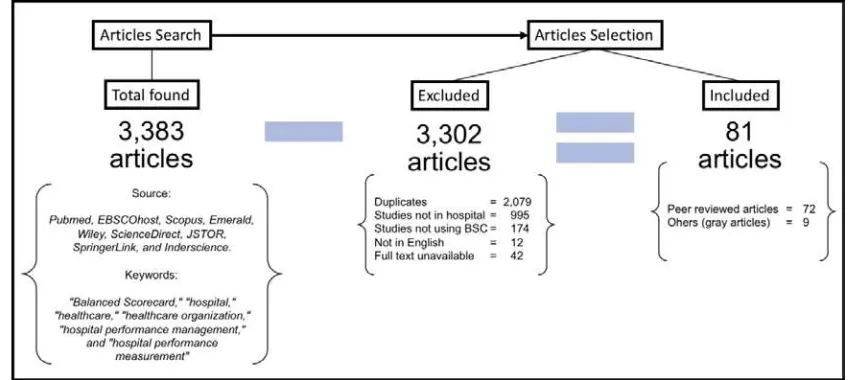
Figure 1. Steps of articles selection
jmm.unram.ac.id 74 1,223 articles for some reasons, i.e. studies were not conducted in hospital’s environment, studies were not using BSC in their analysis, articles were no published in English, and the full-text version were not available. We included 81 articles for further analysis consisting of 72 peer-reviewed articles and nine grey-articles.
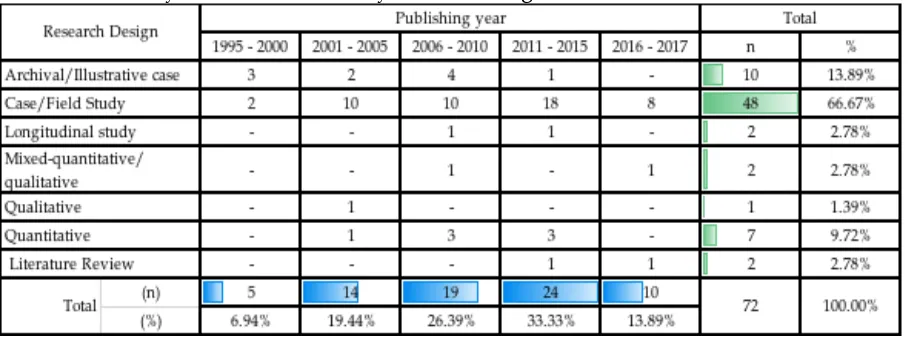
Table 1. Summary of selected articles by research design
Table 1.summarizes the ranges of publishing from 1995 to 2017 with case study as the most method applied by researchers. This is understandable since BSC is a management tool and mostly proposed as a strategic management tool. Case studies are generally used by researchers to interpret strategies, or to develop sets of "best practices"(Klonoski, 2013). Looking at the economy country setting and geographical distribution of the authors’ affiliation (Table 2.), it appeals that BSC is driven mostly by HICs’ research institutions. This is not surprising since HICs, particularly in North America and Europe, faced the change in funding environment in 1990s stipulated by the federal and provincialgovernments, greater demand on accountability from the healthcareoperators, and the raise of healthcare costs (Chan & Ho, 1999). Most global health centers also were located in HICs, indicating that interest in global health stems from HICs’ public health institutions which were not a feature of non-HICs (Beaglehole & Bonita, 2010).
Table 2. Summary of selected articles by countries economy setting and continents
4. DISCUSSION
BSC Adoption by hospitals: Benefits, Functions, and Challenges
Baker and Pink (1995)were the first authors discussing the adoption of BSC concept by
jmm.unram.ac.id 75
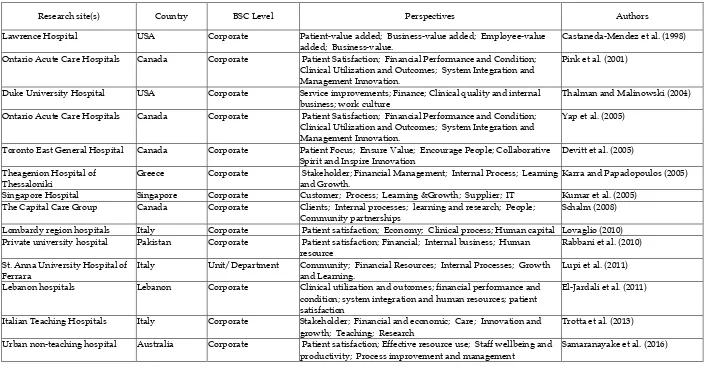
Castaneda-Mendez et al. (1998), Gordon et al. (1998), Wachtel et al. (1999), and Curtright et
al. (2000). While Baker and Pink (1995), Chow et al. (1998) and Curtright et al. (2000)used the
same perspectives as original Balanced Scorecard perspectives, i.e. financial, customer, internal business (process), and innovation and learning perspectives, Castaneda-Mendez
et al. (1998), Gordon et al. (1998)and Wachtel et al. (1999) modified the perspectives.
Castaneda-Mendez et al. (1998)modified the perspectives by using the term of "value
added" to modify the original perspectives (patient-value added, employee-value added,
business-value added (learning perspective, business-value added). Gordon et al.
(1998)used five perspectives in his framework by using customer satisfaction, internal
excellence, innovation and learning, financial viability, and population types. Curtright et
al. (2000) developed seven perspectives for Mayo Clinic consisting of customer satisfaction,
clinical productivity and efficiency, financial, internal operations, mutual respect and diversity social commitment, external environmental assessment and patient characteristics.
jmm.unram.ac.id 76 Table 3. Variations of BSC perspectives used (corporate level)
Research site(s) Country BSC Level Perspectives Authors
Lawrence Hospital USA Corporate Patient-value added; Business-value added; Employee-value
added; Business-value.
Castaneda-Mendez et al. (1998)
Ontario Acute Care Hospitals Canada Corporate Patient Satisfaction; Financial Performance and Condition;
Clinical Utilization and Outcomes; System Integration and Management Innovation.
Pink et al. (2001)
Duke University Hospital USA Corporate Service improvements; Finance; Clinical quality and internal
business; work culture
Thalman and Malinowski (2004)
Ontario Acute Care Hospitals Canada Corporate Patient Satisfaction; Financial Performance and Condition;
Clinical Utilization and Outcomes; System Integration and Management Innovation.
Yap et al. (2005)
Toronto East General Hospital Canada Corporate Patient Focus; Ensure Value; Encourage People; Collaborative
Spirit and Inspire Innovation
Devitt et al. (2005)
Theagenion Hospital of Thessaloniki
Greece Corporate Stakeholder; Financial Management; Internal Process; Learning
and Growth.
Karra and Papadopoulos (2005)
Singapore Hospital Singapore Corporate Customer; Process; Learning &Growth; Supplier; IT Kumar et al. (2005)
The Capital Care Group Canada Corporate Clients; Internal processes; learning and research; People;
Community partnerships
Schalm (2008)
Lombardy region hospitals Italy Corporate Patient satisfaction; Economy; Clinical process; Human capital Lovaglio (2010)
Private university hospital Pakistan Corporate Patient satisfaction; Financial; Internal business; Human
resource
Rabbani et al. (2010)
St. Anna University Hospital of Ferrara
Italy Unit/Department Community; Financial Resources; Internal Processes; Growth
and Learning.
Lupi et al. (2011)
Lebanon hospitals Lebanon Corporate Clinical utilization and outcomes; financial performance and
condition; system integration and human resources; patient satisfaction
El-Jardali et al. (2011)
Italian Teaching Hospitals Italy Corporate Stakeholder; Financial and economic; Care; Innovation and
growth; Teaching; Research
Trotta et al. (2013)
Urban non-teaching hospital Australia Corporate Patient satisfaction; Effective resource use; Staff wellbeing and
productivity; Process improvement and management
jmm.unram.ac.id 77 Kaplan and Norton (1996, p. 2) initially developed BSC for for-profit (private) sector and as an instrument for managers to navigate their company’s competitiveness by emphasizing not only on achieving financial objectives, but also on the performance drivers of these financial objectives. For the nonprofit organizations, Kaplan (2001) found that BSC, when adopted by the nonprofit sector, enabled all organizational resources—the senior leadership team, technology resources, initiatives, change programs, financial resources, and human resources—become aligned to accomplishing organizational objectives. BSC has been increasingly applied in hospitals and healthcare in high-income countries, and recently extended to low- and middle-income countries (McPake, 2016).
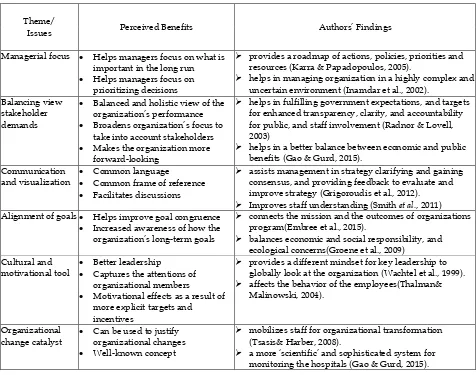
Following perceived benefits theme proposed by Madsen and Stenheim (2014) (Table 4), the implementation of BSC within hospitals helps managers focus on what is important in the long run, prioritize and making decisions. Karra and Papadopoulos (2005)reported that BSC framework provides a roadmap of actions, policies, priorities and resources to achieve mission and strategic goals. BSC also being reported for its usefulness in decision making in highly complex and uncertain environment, and effectively underlying existing problems
and identifying opportunities for improvements on time (Inamdar et al., 2002; Koumpouros,
2013; Pink et al., 2001).
BSC can be used to balance the demands of internal and external stakeholders. Radnor and Lovell (2003) pointed out that BSC is not necessarily used only to focus on external stakeholders. It also targeted for enhanced transparency, clarity, and accountability for public/patients, and involvement/support for staff. BSC provides a balanced view of the organization’s performance, and broadens a manager’s focus to take into account other issues than just financial aspects. Several authors pointed that the more balanced view has helped in reducing the over-emphasis on financial measures and assisted in shifting the focus towards a more ‘holistic’ and balanced view of the organization’s performance (Gao &
Gurd, 2015; Jones et al., 2002; Rabbani et al., 2010).
The concept of BSC can be useful in communicating and visualizing the strategy in the
organization. Grigoroudis et al. (2012), as well as Thalman and Malinowski (2004), argued
that the concept of BSC often makes it easier to communicate the strategy to the organization. Other authors also argued that BSC provides a ‘common language’ and frame
of reference, and can be a facilitator of useful discussions in the organization (Nippak et al.,
2016; Rabbani et al., 2010; Samaranayake et al., 2016; Smith et al., 2011). In addition, Thalman
and Malinowski (2004) also highlighted that the concept can facilitate useful discussions about strategies.
For the goal alignment, BSC framework ensured everyone in the organization works toward
the same goals, i.e. what is referred to as goal congruence (Embree et al., 2015; Gordon et al.,
1998). This is similar to the findings of Groene et al. (2009) and Jones et al. (2002) who
pointed out that BSC gives organizational members greater awareness of long-term goals, for example, balances economic considerations and social responsibility, and ecological concerns, and improves understanding of how their activities affect the organization’s long-term goals.
BSC can be a ‘cultural tools’ that changes how the organization operates and focus on the
things that lead to better performance in the long run (Wachtel et al., 1999) and also as a
‘motivational tool’ that captures the attention of organizational members, which can be useful in goal-setting and for motivating employees (Gao& Gurd, 2015; Thalman & Malinowski, 2004). For example, the BSC can be used to set more explicit targets than before, and various types of incentives to encourage the right kind of behavior. Finally, for organizational change catalyst issues, BSC was highlighted that it can be used as a catalyst
jmm.unram.ac.id 78 2015) and useful in mobilizing staff for organizational transformation(Aidemark, 2010; Tsasis & Harber, 2008).The popularity of BSC framework as one of ‘scientific’ and sophisticated business strategic management, also helps in anticipating resistance from organization members, make it easier when monitoring the hospitals’ operations to achieve certain changes needed by hospital (Gao & Gurd, 2015).
Table 4. Perceived benefits
Theme/
Issues Perceived Benefits Authors’ Findings
Managerial focus • Helps managers focus on what is
important in the long run
• Helps managers focus on
prioritizing decisions
provides a roadmap of actions, policies, priorities and resources (Karra & Papadopoulos, 2005).
helps in managing organization in a highly complex and
uncertain environment (Inamdar et al., 2002). Balancing view
stakeholder demands
• Balanced and holistic view of the organization’s performance
• Broadens organization’s focus to
take into account stakeholders
• Makes the organization more
forward-looking
helps in fulfilling government expectations, and targets for enhanced transparency, clarity, and accountability for public, and staff involvement (Radnor & Lovell, 2003)
helps in a better balance between economic and public
benefits (Gao & Gurd, 2015). Communication
and visualization
• Common language
• Common frame of reference
• Facilitates discussions
assists management in strategy clarifying and gaining consensus, and providing feedback to evaluate and improve strategy (Grigoroudis et al., 2012).
Improves staff understanding (Smith et al., 2011)
Alignment of goals • Helps improve goal congruence
• Increased awareness of how the
organization’s long-term goals
connects the mission and the outcomes of organizations
program(Embree et al., 2015).
balances economic and social responsibility, and ecological concerns(Groene et al., 2009)
Cultural and motivational tool
• Better leadership
• Captures the attentions of organizational members
• Motivational effects as a result of more explicit targets and incentives
provides a different mindset for key leadership to globally look at the organization (Wachtel et al., 1999).
affects the behavior of the employees(Thalman& Malinowski, 2004).
mobilizes staff for organizational transformation (Tsasis& Harber, 2008).
a more ‘scientific’ and sophisticated system for monitoring the hospitals (Gao & Gurd, 2015).
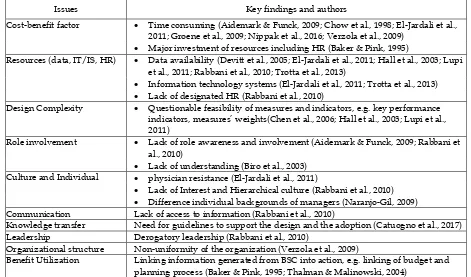
Time-consuming was the biggest issue found by authors in adopting and implementation of
BSC within hospitals as shown in Table 5 (Aidemark & Funck, 2009; Chow et al., 1998;
Groene et al., 2009; Nippak et al., 2016; Verzola et al., 2009). In addition, Baker and Pink
(1995) stated that implementation of BSC needs a major investment of resources and continues investment in human resources. Availability of data for developing baseline data
performance indicators and for benchmarking purposes were the next challenges (Devitt et
al., 2005; Hall et al., 2003; Lupi et al., 2011; Thalman & Malinowski, 2004; Trotta et al., 2013). Several authors such as Chen et al. (2006), Hall et al. (2003), Lorden et al. (2008), Lupi et al.
(2011) emphasized that difficulties and complexities in designing BSC were also challenges in adopting BSC. Facts founded by authors such as failure in choosing effective key performance indicators, questions regarding the reliability of measures and indicators, measures of satisfaction for both employees and customers, and choosing appropriate indicators and indicators/measures' weights.
jmm.unram.ac.id 79 challenge on the lack of involvement from medical professionals in development and implementation in Sweden, a high-income country in Europe, similar to the findings within
lower-middle income setting as reported by Rabbani et al. (2010). Lack of understanding of
actors involved (Biro et al., 2003) and lack of access to information (Rabbani et al., 2010) were
also challenges. Therefore, a standardized guideline to support the design and the adoption
of BSC is needed (Catuogno et al., 2017). Rabbani et al. (2010) and El-Jardali et al. (2011)
ended their report with the same conclusion regarding cultures, such as hierarchical culture and physician resistance, as one of the constraints in adoption BSC in Pakistan and Lebanon.
Rabbani et al. (2010) also added committed leadership as one of the pre-requisites in
adopting BSC in Pakistan.
Table 5. Challenges in BSC adoption
Issues Key findings and authors
Cost-benefit factor • Time consuming (Aidemark & Funck, 2009; Chow et al., 1998; El-Jardali et al.,
2011; Groene et al., 2009; Nippak et al., 2016; Verzola et al., 2009)
• Major investment of resources including HR (Baker & Pink, 1995)
Resources (data, IT/IS, HR) • Data availability (Devitt et al., 2005; El-Jardali et al., 2011; Hall et al., 2003; Lupi et al., 2011; Rabbani et al., 2010; Trotta et al., 2013)
• Information technology systems (El-Jardali et al., 2011; Trotta et al., 2013)
• Lack of designated HR (Rabbani et al., 2010)
Design Complexity • Questionable feasibility of measures and indicators, e.g. key performance
indicators, measures’ weights(Chen et al., 2006; Hall et al., 2003; Lupi et al., 2011)
Role involvement • Lack of role awareness and involvement (Aidemark & Funck, 2009; Rabbani et
al., 2010)
• Lack of understanding (Biro et al., 2003)
Culture and Individual • physician resistance (El-Jardali et al., 2011)
• Lack of Interest and Hierarchical culture (Rabbani et al., 2010)
• Difference individual backgrounds of managers (Naranjo-Gil, 2009)
Communication Lack of access to information (Rabbani et al., 2010)
Knowledge transfer Need for guidelines to support the design and the adoption (Catuogno et al., 2017)
Leadership Derogatory leadership (Rabbani et al., 2010)
Organizational structure Non-uniformity of the organization (Verzola et al., 2009)
Benefit Utilization Linking information generated from BSC into action, e.g. linking of budget and
planning process (Baker & Pink, 1995; Thalman & Malinowski, 2004)
Making BSC applicable for Indonesian Local Public Hospitals
The reform of public hospitals in Indonesia began in 1991 under decentralization policies in the health sector (Lieberman & Alkatiri, 2003) and were driven mainly by the fiscal crises of the late 1980s and early 1990s (Preker& Harding, 2003, p. 16). The policy, however, were also inspired by the successful of the same policy run by developed countries around the world. For example, Government of Finland launched the health care decentralization since the late 1980sto simplify the planning processes of health care systems, to give more decision making power to local authorities, and to provide more effective health care production through better coordination of the functions between primary and secondary care (Vartiainen, 2010).
jmm.unram.ac.id 80 government, i.e. by giving public hospitals at provincial and district levels more authority to manage personnel, finance and procurement (Heywood & Harahap, 2009; Lieberman & Alkatiri, 2003; Maharani & Tampubolon, 2014). However, Maharani and Tampubolon
(2017), by extending research conducted by Suwandono et al. (2001), reported that
autonomization and devolution efforts on public hospitals do not necessarily improve either their financial performance or their utilization as measured by bed occupancy rates and number of procedures.
Following trends in many countries that have improved their public hospitals’ performance through corporatization type of decentralization (Preker& Harding, 2003, p. 10), Government of Indonesia launched the Government Law No. 23 Year 2005 concerning Financial Management of Public Service Agencies that increased the autonomy of public hospitals in managing their resources were also expected to improve the quality services and, in the other hand, to reduce dependencies on government subsidies. Corporatized hospitals, by transforming local public hospitals as local public service agencies, or ‘Badan
Layanan Umum Daerah (BLUD)’, have broader decision space on finance and other
resources than autonomized hospitals have and also from ordinary subordinates of local government entities, or ‘Satuan Kerja Perangkat Daerah (SKPD)’, which are run under Government Law No. 58 Year 2005 concerning Management of Local Government Finance Governance. They have greater control on budget, revenue utilization, investment, partnership with private sector services and investors, procuring debt and accounts receivable, and personnel management. Corporatized hospitals were expected to lower the dependency on central government subsidies, to increase the competitiveness of public hospitals within other public and private hospitals, and to better serve the community (Maharani & Tampubolon, 2017).
Maharani and Tampubolon (2017) reported that corporatization, indeed, has improved
revenue and expenditure of the Indonesian public hospitals but not efficiency and equity.
They highlight that corporatization hospitals were poor in design since Indonesia began the
policy without a pilot model - a strategy that worked in Malaysia (Hussein et al., 2003),
Vietnam (London, 2013), Pakistan (Bossert & Mitchell, 2011), and Singapore (Phua, 2003) -
that led to a lack of preliminary data needed to re-fine the reform design. They also
suggested to improve the capacity and the capability of hospital managers, and maintain regular monitoring (Maharani & Tampubolon, 2017). In a case study of five district public
hospitals in Java island of Indonesia, Andayani et al. (2015) found that a new business
standards of financial reporting has led hospitals to wider flexibility in the use of public resources and also to the expansion of hospitals' responsibilities. However, successful implementation depends on the operational management system of the hospital to support the accountability. They recommended that the hospital managers were encouraged to improve their political communication skills for the effectiveness of hospital advocacy process to the politicians, and should monitor performance from various perspectives, including clinical, managerial and financial. All of these findings, i.e. lack in preliminary data for good design reforms, lack of capacity and capability of hospital managers, and the need for regular monitoring system from various perspectives, would be considerable reasons behind the adoption of BSC by Indonesian public hospitals.
As discussed earlier, the outcomes that have been promoted by BSC within high-income countries, such as integration and facilitation of clinical, operational, and financial indicators with greater employee motivation and patient satisfaction, would be the first impression for
its adoption. In addition, Rohsiswatmo et al. (2014) revealed BSC approach as a mechanism
for driving quality improvement of patient perspective, i.e. improving prevention and
jmm.unram.ac.id 81 suggested that in addition to assessing its feasibility, objectivity, cost-effectiveness, and sustainability, the adoption must track political and leadership priorities, resource constraints, local culture, levels of education, and quality of information systems. El-Jardali
et al. (2011) explained that willingness to accept and participate in adopting BSC by hospitals
depends on constant efforts in clarifying the non-punitive nature of the initiatives.
As a quality improvement that required for continuous rather than a discrete process and
for its objective to integrate performance measurement and strategic analysis, El-Jardali et al.
(2011) and Rabbani et al. (2010), recommended that, depending on the fulfillment of
necessary pre-requisites, BSC adoption should be in gradual approach. We would recommend the two studies as the most relevant to Indonesia setting for at least three
reasons, first, country setting, second, similar findings to Andayani et al. (2015) and Maharani
and Tampubolon (2016, 2017) regarding problems and challenges faced by the public hospitals - e.g. lack of preliminary data and inadequate capacity of human resources, and
finally, critical need for pilot model reference in the adoption process of BSC. Furthermore,
El-Jardali et al. (2011) and Rabbani et al. (2010) proposed four perspectives adopted from the
Ontario Acute Care BSC framework to be applied by hospitals in their countries, namely: clinical utilization and outcomes, financial performance and condition, system integration and human resources, and patient satisfaction, proved that the hospitals from non-HICs could adopt the BSC framework implemented by those hospitals from HICs.
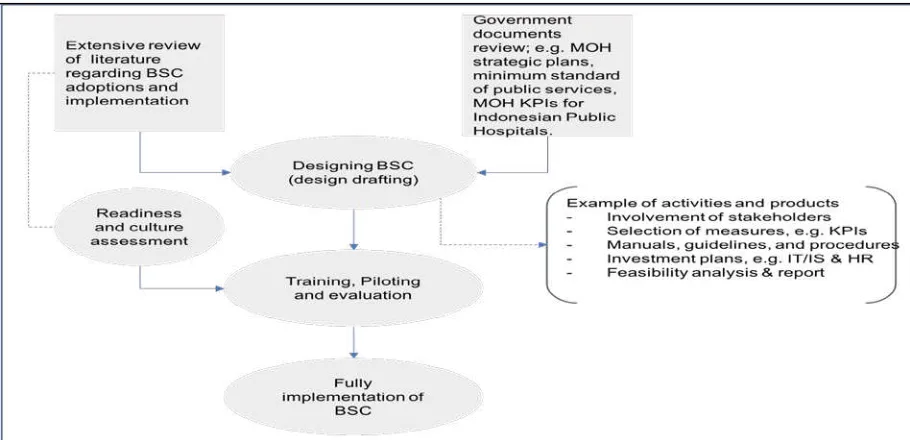
Figure 2. An example framework of BSC adoption phases for Indonesian local public hospitals
jmm.unram.ac.id 82 5. CONCLUSION
Successful in initial adoption of BSC within public hospital depends on how serious that the hospitals' management put their attention in investments of technologies, human capital, and time. Thus, ensuring the availability of resources those having skills in formulating strategic hypotheses, data analysis, and data management would be necessary. Next is building active involvement of the executives and stakeholders. Involvement of government and external parties such as consultants or/and university experts would be valuable in the
development phase. For non-high-income countries, Rabbani et al. (2010) suggested that
committed leadership, cultural readiness, quality information systems, viable strategic plans, and optimum resources, would be pre-requisites in adopting and implementing BSC within hospitals.
Caution should also be addressed regarding BSC as a strategic management rather than measurement system. Thus continues review and revision of the scorecards are encouraged to ensure BSC is valuable for decision-making process. The adoption of BSC is aimed to help hospitals in seeking for balance and harmony between long-term and short-term, financial and non-financial, individual and organizational, internal and external factors, cause-and-effects, and efficiency and fairness. However, since lives are difficult to balance and most countries are struggling to contain health costs (Gurd & Gao, 2007), it would be necessary to
consider for putting patient needs at the top among the perspectives (Catuogno et al., 2017;
Devitt et al., 2005; Gao & Gurd, 2015).
A major limitation of this study is the scarcity of BSC studies from Indonesia site (only one study found in Indonesian setting). Other limitations were the exclusion of non-English articles and ignoring studies that conducted in the other types of not-for-profit entities such as from government organization or non-government organizations (NGOs). However, important study findings from similar theme, i.e. performance of public hospitals,
highlighted that Indonesian public hospitals were in the need for; first, high communication
skill managers for advocacy process to the politicians; second, tool for monitoring
performance from various perspectives, including clinical, managerial and financial; third,
adequate and reliable data for good design reforms; and (4) managers with high managerial
skill to capture hospitals’ goals (Andayani et al., 2015; Maharani & Tampubolon, 2016, 2017).
Despite the facts that BSC is time-consuming and also required for intensive exercises (Hoque, 2012), adoption of BSC could be an alternative solution since most studies on its adoption and implementation reveal with benefits such as managerial focus improvement, capturing a balanced view of financial and non-financial performance indicators, helpful in goals congruence, useful as cultural and motivational tool, and catalyzing changes needed by hospitals, considerable reasons behind the adoption of BSC by Indonesian public
hospitals. A gradual approach suggested by El-Jardali et al. (2011) and Rabbani et al. (2010)
would be an appropriate reference for Indonesian context, with an institutional assessment of cultural readiness as an additional approach, then followed by the designing, training and piloting, and finally, scaling-up in gradual.
REFERENCES
Aidemark, L.-G., & Funck, E. K. (2009). Measurement and Health Care Management.
Financial Accountability & Management, 25(2), 253-276.
jmm.unram.ac.id 83 Aidemark, L. G. (2010). Cooperation and competition: balanced scorecard and hospital
privatization. Int J Health Care Qual Assur, 23(8), 730-748.
doi:10.1108/09526861011081868
Andayani, N. L. P. E. P., Marthias, T., Putri, L. P., & Armiatin. (2015). Public hospital
governance in Indonesia. In D. Huntington & K. Hort (Eds.), World Health
Organization. Regional Office for the Western, Pacific: Public hospital governance in Asia
and the Pacific (pp. 26 - 63). Manila: WHO Regional Office for the Western Pacific.
Baker, G. R., & Pink, G. H. (1995). A balanced scorecard for Canadian hospitals. Healthc
Manage Forum, 8(4), 7-21. doi:10.1016/S0840-4704(10)60926-X
Beaglehole, R., & Bonita, R. (2010). What is global health? Global Health Action, 3,
10.3402/gha.v3403i3400.5142. doi:10.3402/gha.v3i0.5142
Biro, L. A., Moreland, M. E., & Cowgill, D. E. (2003). Achieving Excellence in Veterans
Healthcare—A Balanced Scorecard Approach. Journal For Healthcare Quality, 25(3),
33-39. doi:10.1111/j.1945-1474.2003.tb01057.x
Bossert, T. J., & Mitchell, A. D. (2011). Health sector decentralization and local
decision-making: Decision space, institutional capacities and accountability in Pakistan. Social
Science & Medicine, 72(1), 39-48. doi:10.1016/j.socscimed.2010.10.019
Castaneda-Mendez, K., Mangan, K., & Lavery, A. M. (1998). The role and application of the
balanced scorecard in healthcare quality management. J Healthc Qual, 20(1), 10-13.
doi:10.1111/j.1945-1474.1998.tb00243.x
Catuogno, S., Arena, C., Saggese, S., & Sarto, F. (2017). Balanced performance measurement
in research hospitals: the participative case study of a haematology department. BMC
Health Serv Res, 17(1), 522. doi:10.1186/s12913-017-2479-6
Chan, L., & Ho, S.-J. (1999). The Use of Balanced Scorecard in Canadian Hospitals.
Chen, X. y., Yamauchi, K., Kato, K., Nishimura, A., & Ito, K. (2006). Using the balanced
scorecard to measure Chinese and Japanese hospital performance. International
Journal of Health Care Quality Assurance, 19(4), 339-350.
doi:10.1108/09526860610671391
Chow, C. W., Ganulin, D., Teknika, O., Haddad, K., & Williamson, J. (1998). The balanced scorecard: a potent tool for energizing and focusing healthcare organization
management. J Healthc Manag, 43(3), 263-280. doi:10.1097/00115514-199805000-00010
Curtright, J. W., Stolp-Smith, S. C., & Edell, E. S. (2000). Strategic Performance Management:
Development of a Performance Measurement System at the Mayo Clinic. Journal of
Healthcare Management, 45(1), 58-68. doi:10.1097/00115514-200001000-00014
Devitt, R., Klassen, W., & Martalog, J. (2005). Strategic management system in a healthcare
setting--moving from strategy to results. Healthc Q, 8(4), 58-65.
doi:10.12927/hcq.2013.17693
El-Jardali, F., Saleh, S., Ataya, N., & Jamal, D. (2011). Design, implementation and scaling up of the balanced scorecard for hospitals in Lebanon: policy coherence and application
lessons for low and middle income countries. Health Policy, 103(2-3), 305-314.
doi:10.1016/j.healthpol.2011.05.006
Embree, J. L., Swenty, C. F., & Schaar, G. (2015). A Balanced Scorecard With Strategy Map:
Measuring the Value of a Nursing Sabbatical. J Nurs Care Qual, 30(4), 352-358.
doi:10.1097/NCQ.0000000000000121
Fink, A. (2014). Conducting research literature reviews : from the internet to paper (Fourth edition.
ed.). Thousand Oaks, California: SAGE.
Gao, T., & Gurd, B. (2015). Meeting the challenge in performance management: the diffusion
and implementation of the balanced scorecard in Chinese hospitals. Health Policy
jmm.unram.ac.id 84 Gordon, D., Carter, M., Kunov, H., Dolan, A., & Chapman, F. (1998). A strategic information
system to facilitate the use of performance indicators in hospitals. Health Serv Manage
Res, 11(2), 80-91. doi:10.1177/095148489801100202
Grigoroudis, E., Orfanoudaki, E., & Zopounidis, C. (2012). Strategic performance measurement in a healthcare organisation: A multiple criteria approach based on
balanced scorecard. Omega, 40(1), 104-119. doi:10.1016/j.omega.2011.04.001
Groene, O., Brandt, E., Schmidt, W., & Moeller, J. (2009). The Balanced Scorecard of acute settings: development process, definition of 20 strategic objectives and
implementation. Int J Qual Health Care, 21(4), 259-271. doi:10.1093/intqhc/mzp024
Gumbus, A., & Wilson, T. (2004). Designing and implementing a balanced scorecard: lessons
learned in nonprofit implementation. Clin Leadersh Manag Rev, 18(4), 226-232.
Gurd, B., & Gao, T. (2007). Lives in the balance: an analysis of the balanced scorecard (BSC)
in healthcare organizations. International Journal of Productivity and Performance
Management, 57(1), 6-21. doi:10.1108/17410400810841209
Hall, L. M., Doran, D., Laschinger, H. S., Mallette, C., Pedersen, C., & O'Brien-Pallas, L. L. (2003). A balanced scorecard approach for nursing report card development.
Outcomes Manag, 7(1), 17-22.
Healy, J., McKee, M., Edwards, N., & Harrison, A. (2002). Pressures for change. In M. McKee
& J. Healy (Eds.), Hospitals in a changing Europe (pp. xviii, 314 p.). Buckingham ;
Philadelphia: Open University Press.
Hendricks, K. B., Wiedman, C. I., Menor, L., & I., W. C. (2004). The Balanced Scorecard: To
Adopt or Not to Adopt? Ivey Business Journal(November / December 2004).
Heywood, P., & Harahap, N. P. (2009). Public funding of health at the district level in
Indonesia after decentralization-sources, flows and contradictions. Health Res Policy
Syst, 7, 5. doi:10.1186/1478-4505-7-5
Hoque, Z. (2012). Measuring Performance in Government and Non-Profit Organisations:
The Role of the Balanced Scorecard. Best Practices in Management Accounting, 211-219.
Hussein, R. H. T., Al-Junid, S., Nyunt-U, S., Baba, Y., & Geyndt, W. D. (2003). Corporatization of a Single Facility: Reforming the Malaysian National Heart
Institute. In A. S. Preker & A. Harding (Eds.), Innovations in Health Service Delivery:
The Corporatization of Public Hospitals, The World Bank, Washington DC (pp. 425 - 450).
Inamdar, N., Kaplan, R. S., & Bower, M. (2002). Applying the balanced scorecard in
healthcare provider organizations. J Healthc Manag, 47(3), 179-195; discussion
195-176. doi:10.1097/00115514-200205000-00008
Peraturan Pemerintah Nomor 23 Tahun 2005 tentang Pengelolaan Keuangan Badan Layanan Umum) (Government Regulation Number 23 Year 2005 concerning Financial Management of Public Service Agencies), 23 C.F.R. (2005a), Indonesian Ministry of Finance. Retrieved from http://www.djpk.kemenkeu.go.id/?p=470 Peraturan Pemerintah Nomor 58 Tahun. 2005 tentang Pengelolaan Keuangan Daerah
(Government Law No. 58/2005 concerning Financial Management of Indonesian Local Governments), 58 C.F.R. (2005b), Indonesian Ministry of Finance. Retrieved from http://www.jdih.kemenkeu.go.id/fullText/2005/58Tahun2005PP.HTM
Indonesian Ministry of Health. (2016). Laporan Kinerja Kementrian Kesehatan Indonesia Tahun
2015 (Performance Report of Indonesian Ministry of Health Year 2015). Indonesian
Ministry of Health Retrieved from
jmm.unram.ac.id 85 Jones, M. L., Filip, S. J., Smith, H., & Remsburg-Bell, E. (2002). Strategy management system
in perinatal services: the role of a patient resource manager. Lippincotts Case Manag,
7(1), 27-42.
Kaplan, R. S. (2001). Strategic Performance Measurement and Management in Nonprofit
Organizations. Nonprofit Management and Leadership, 11(3), 353-370.
doi:10.1002/nml.11308
Kaplan, R. S., & Norton, D. P. (1996). The balanced scorecard : translating strategy into action.
Boston, Mass.: Harvard Business School Press.
Kaplan, R. S., & Norton, D. P. (2001). The strategy-focused organization : how balanced scorecard
companies thrive in the new business environment. Boston, Mass.: Harvard Business
School Press.
Kaplan, R. S., & Norton, D. P. (2008). The execution premium : linking strategy to operations for
competitive advantage. Boston, Mass.: Harvard Business Press.
Karra, E. D., & Papadopoulos, D. L. (2005). Measuring performance of Theagenion Hospital
of Thessaloniki, Greece through a Balanced Scorecard. Operational Research, 5(2),
289-304. doi:10.1007/bf02944314
Klonoski, R. (2013). The Case For Case Studies: Deriving Theory From Evidence (Vol. 9).
Kocakulah, M. C., & Austill, A. D. (2007). Balanced scorecard application in the health care
industry: a case study. J Health Care Finance, 34(1), 72-99.
Koumpouros, Y. (2013). Balanced scorecard: application in the General Panarcadian
Hospital of Tripolis, Greece. Int J Health Care Qual Assur, 26(4), 286-307.
doi:10.1108/09526861311319546
Lawrie, G., & Cobbold, I. (2004). Third‐generation balanced scorecard: evolution of an
effective strategic control tool. International Journal of Productivity and Performance
Management, 53(7), 611-623. doi:10.1108/17410400410561231
Lieberman, S. S., & Alkatiri, A. (2003). Autonomization in Indonesia: the wrong path to
reduce hospital expenditures. In A. S. Preker & A. Harding (Eds.), Innovations in
Health Service Delivery: The Corporatization of Public Hospitals, The World Bank,
Washington DC (pp. 511 - 532).
London, J. D. (2013). The promises and perils of hospital autonomy: Reform by decree in
Viet Nam. Social Science & Medicine, 96, 232-240. doi:10.1016/j.socscimed.2013.07.009
Lorden, A., Coustasse, A., & Singh, K. P. (2008). The balanced scorecard framework-a case study of patient and employee satisfaction: what happens when it does not work as
planned? Health Care Manage Rev, 33(2), 145-155.
doi:10.1097/01.HMR.0000304503.27803.aa
Lupi, S., Verzola, A., Carandina, G., Salani, M., Antonioli, P., & Gregorio, P. (2011). Multidimensional evaluation of performance with experimental application of
balanced scorecard: a two year experience. Cost Eff Resour Alloc, 9(1), 7.
doi:10.1186/1478-7547-9-7
Madsen, D. Ø., & Stenheim, T. (2014). Perceived benefits of balanced scorecard
implementation: Some preliminary evidence. Problems and Perspectives in
Management, 12(3), 81-90.
Magdy, A.-K., Souad, M., & K., L. E. (2011). Balanced Scorecard Development: A Review of
Literature and Directions for Future Research. In M. G. Abdel-Kader (Ed.), Review of
Management Accounting Research (pp. 214-239). London: Palgrave Macmillan UK.
Maharani, A., & Tampubolon, G. (2014). Has decentralisation affected child immunisation
jmm.unram.ac.id 86 Maharani, A., & Tampubolon, G. (2016). Does corporatisation improve organisational
commitment? Evidence from public hospitals in Indonesia. The International Journal of
Human Resource Management, 29(13), 1999-2026. doi:10.1080/09585192.2016.1239121
Maharani, A., & Tampubolon, G. (2017). The double-edged sword of corporatisation in the
hospital sector: evidence from Indonesia. Health Econ Policy Law, 12(1), 61-80.
doi:10.1017/S174413311600027X
McPake, B. (2016). Hospital Quality and Performance Around the Globe. In World Scientific
Handbook of Global Health Economics and Public Policy (pp. 1-53): WORLD SCIENTIFIC.
Naranjo-Gil, D. (2009). Strategic performance in hospitals: the use of the balanced scorecard
by nurse managers. Health Care Manage Rev, 34(2), 161-170.
doi:10.1097/HMR.0b013e31819e8fd0
Naranjo-Gil, D., Sanchez-Exposito, M. J., & Gomez-Ruiz, L. (2016). Traditional vs. Contemporary Management Control Practices for Developing Public Health Policies.
Int J Environ Res Public Health, 13(7). doi:10.3390/ijerph13070713
Nippak, P. M., Veracion, J. I., Muia, M., Ikeda-Douglas, C. J., & Isaac, W. W. (2016). Designing and evaluating a balanced scorecard for a health information management
department in a Canadian urban non-teaching hospital. Health Informatics J, 22(2),
120-139. doi:10.1177/1460458214537005
Niven, P. R. (2005). Balanced scorecard diagnostics : maintaining maximum performance.
Hoboken, N.J.: Wiley.
Niven, P. R. (2008). Balanced scorecard step-by-step for government and nonprofit agencies (2nd
ed.). Hoboken, N.J.: J. Wiley & Sons, Inc.
Perkins, M., Grey, A., & Remmers, H. (2014). What do we really mean by “Balanced
Scorecard”? International Journal of Productivity and Performance Management, 63(2),
148-169. doi:10.1108/ijppm-11-2012-0127
Phua, K. H. (2003). Attacking Hospital Performance on Two Fronts: Network Corporatization and Financing Reforms in Singapore. In A. S. Preker & A. Harding
(Eds.), Innovations in Health Service Delivery: The Corporatization of Public Hospitals, The
World Bank, Washington DC (pp. 451 - 484).
Pink, G., McKillop, I., Schraa, E., Preyra, C., Montgomery, C., & Baker, G. (2001). Creating a
balanced scorecard for a hospital system (Vol. 27).
Preker, A. S., & Harding, A. (2003). Innovations in health service delivery: the corporatization of
public hospitals: The World Bank.
Rabbani, F., Jafri, S. M., Abbas, F., Shah, M., Azam, S. I., Shaikh, B. T., Brommels, M., & Tomson, G. (2010). Designing a balanced scorecard for a tertiary care hospital in
Pakistan: a modified Delphi group exercise. Int J Health Plann Manage, 25(1), 74-90.
doi:10.1002/hpm.1004
Radnor, Z., & Lovell, B. (2003). Success factors for implementation of the balanced scorecard
in a NHS multi-agency setting. Int J Health Care Qual Assur Inc Leadersh Health Serv,
16(2-3), 99-108. doi:10.1108/09536860310465618
Rohsiswatmo, R., Rafika, S., & Marsubrin, P. M. (2014). Prevention and control of blood
stream infection using the balanced scorecard approach. Acta Med Indones, 46,
209-216.
Samaranayake, P., Dadich, A., Fitzgerald, A., & Zeitz, K. (2016). Developing an evaluation
framework for clinical redesign programs: lessons learnt. J Health Organ Manag, 30(6),
950-970. doi:10.1108/JHOM-07-2015-0109
Smith, A., Mainland, J., & Blais, I. (2011). Managing strategy to enhance care for children.
jmm.unram.ac.id 87 Suwandono, A., Gani, A., Purwani, S., Blas, E., & Brugha, R. (2001). Cost recovery beds in
public hospitals in Indonesia. Health Policy Plan, 16 Suppl 2, 10-18.
Thalman, J. J., & Malinowski, T. P. (2004). Balanced scorecard for methodology for total
performance improvement. Respir Care Clin N Am, 10(2), 253-268.
doi:10.1016/j.rcc.2004.01.007
Trotta, A., Cardamone, E., Cavallaro, G., & Mauro, M. (2013). Applying the Balanced Scorecard approach in teaching hospitals: a literature review and conceptual
framework. Int J Health Plann Manage, 28(2), 181-201. doi:10.1002/hpm.2132
Tsafnat, G., Glasziou, P., Choong, M., Dunn, A., Galgani, F., & Coiera, E. (2014). Systematic
review automation technologies. In Syst Rev (Vol. 3, pp. 74).
Tsasis, P., & Harber, B. (2008). Using the balanced scorecard to mobilize human resources in
organizational transformation. Health Serv Manage Res, 21(2), 71-80.
doi:10.1258/hsmr.2007.007008
Vartiainen, P. (2010). Changes and challenges in Finnish health care management. Society
and Economy, 32(1), 123-136. doi:10.1556/SocEc.32.2010.1.9
Verzola, A., Bentivegna, R., Carandina, G., Trevisani, L., Gregorio, P., & Mandini, A. (2009). Multidimensional evaluation of performance: experimental application of the
balanced scorecard in Ferrara university hospital. Cost Eff Resour Alloc, 7, 15.
doi:10.1186/1478-7547-7-15
Wachtel, T. L., Hartford, C. E., & Hughes, J. A. (1999). Building a balanced scorecard for a
burn center. Burns, 25(5), 431-437. doi:10.1016/S0305-4179(99)00024-8