Strategies and Steps to
e-Business Success
Chou-Hong Chen, Ph.D. Professor of MIS
School of Business Administration Gonzaga University
Spokane, WA 99258, USA
Outline of the Topics
Introduction of Information Systems
and e-Business
INFORMATION SYSTEMS
ORGANIZATIONS TECHNOLOGY
MANAGEMENT
INFORMATIO N
Roles of Information Systems
Roles of Information Systems
Automates Automates
Innovates/ Transforms
Innovates/ Transforms Informates
IT problems and solutions
Research and Evaluation
Information overload
Proliferation of new technologies Need for rapid adoption
Purchasing and Delivery
Need for demos prior to purchase Complexity of electronic delivery of
business class applications
Complexity of corporate purchasing
Training
Technology changes too quickly to
assess and eliminate employees skill gaps
Updates and Maintenance
Shortened release cycles, multiple
updates
Decentralized workforces with
rapidly changing technology needs
Knowledge
Comprehensive info on new technologies Objective, centralized content
Decision, support tools
e-Commerce
Demos and evaluations
E-Channel Engine (order, inventory,
asset management)
Flexible design for corporate purchasing
and global delivery
e-Learning
Web-based and computer-based training
coupled with research and evaluation tools
e-Services
Comprehensive online update service Centralized and streamlined
enterprise-wide deployment of software and data
Internet Society
–
Each Media Reach to 50 Million
Radio 38 years,
Television 13 years, Cable TV 10 years,
Internet users only took
Why New Models?
We need some new models
for how we go about exploring IT for
competitive advantage,
for IT infrastructure how we create it and
manage it
for how we acquire, manage and deploy
eBusiness Key Concepts
eBusiness
the strategy of how to automate old business models with the aid of technology to maximize customer
value
eCommerce
the process of buying and selling over digital media (e.g., Internet)
eCRM (eCustomer Relationship Management)
E-Channel
Knowledge Management/Business Intelligence
eBusiness Processes
WHY Customer Relationship
Redesign Business
Processes (Outside-In)
Applying Technology
WHAT
Why e-Business?
Revolution, Revolution ...
The e-Business revolution is impossible to ignore.
It is transforming businesses in virtually every industry and reshaping the global economy.
The e-Business revolution is as
fundamental a change to current society as the industrial revolution was to its
e-Business ...
The heart of e-business is
interconnectivity and interaction.
The ability to reach more people while
sharing information of increasing
richness creates new opportunities for value creation in areas such as
e-Business
(continued) In this new world, status quo is not an
option. Companies have to reinvent themselves to survive.
Given the fast pace of e-business
change, actions that once took years to accomplish must now be done in
How is e-Business Changing
Traditional Business?
Globalization of markets
One-to-one marketing
Customization of site and product
Integration of systems with clients
New forms of E-Service
UPS setting up new computers
Commoditization of products
How is e-Business Changing
Business Processes?
Increased pre-and post- sale care of
customers
Increased use of databases and user
interfaces
Flatter organizational structures
Development and use of customer profiles
Increased reliance on cooperation software
Faster product-to-market strategies
Increased reliance on third parties
Facilitating Services:
Delivery, Escrow, Price Comparisons The World Wide Web
Business Model:
E-Catalog, Auctions, Name your price
Three key success factors for
e-Businesses
C
B
C
B
Traditional versus e-Business
Models?
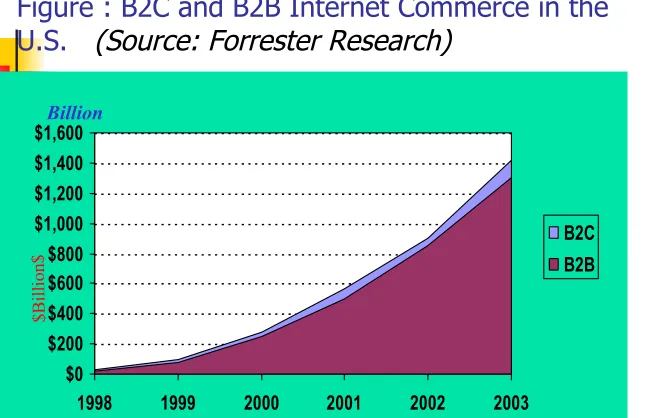
Figure : B2C and B2B Internet Commerce in the
U.S. (Source: Forrester Research)
Billion
1998 1999 2000 2001 2002 2003
Benefits of B2B
B2B solutions create competitive dynamics
through:
cost savings
the composition of cost (product versus process costs)
the number of intermediaries in the supply chain.
new financial (revenue) opportunities
the rate of industry-wide B2B adoption
Why Now?
B2B catalysts are now arising to stimulate
adoption (mentioned earlier).
Interactive networks have recently become
ubiquitous and inexpensive, accelerating the use of B2B applications.
A viral effect will spur copycat behavior
What Makes a B2B e-market
Company Succeed?
Five Critical Success Factors for
e-markets:
Business model,
market size,
industry expertise,
branding and distribution,
management execution hustle (not just the
Solutions for e-Enterprise
Organizations
(e-Power Corp.) Streamlines buying and
selling between trading partners
Maximizes trade efficiency
across the entire supply chain
Strategic e-commerce
capabilities in Internet time
Buyers
Sellers
Solutions for Internet
Market Makers
Turn your supply chain
into a revenue
generation opportunity
Leverage your industry
domain expertise into strategic e-commerce solutions
Brings e-commerce to
businesses of any size, across all industries
Strategies to
The Key to successful
business on the Internet ...
Strategy, strategy, strategy …
The key to successful business on the
Internet is understanding of the
Two Major Elements determines
Organization’s Success
Core Competency A Value-added
Business Model
Core Competencies
Detailed Customer Knowledge and Focus
We will seek to understand, anticipate, and be responsive to our customer’s needs.
Large-Scale System Integration
We will continuously develop, advance and protect the technical excellence that allows us to integrate effectively the systems we design and produce.
Learn, Efficient Design and Production Systems
Why e-Commerce Model is
beneficial to your Business?
The e-Commerce model is a basic
model of competitive strategy, based on the principles of low costs, high
volumes, and comprehensive service, combined with a product range
Vision
Mission
Policies
Goals
Metrics Values Time Horizon
Objectives
PORTER’S FIVE COMPETITIVE FORCES MODEL
Cost leadership
Differentiation
Focus
Expanded generic strategies
Strategic positioning (e.g., internal efficiency) Customer service
and my own view ...
Innovation
STRATEGIC ROLE OF INFORMATION SYSTEMS
STRATEGIC INFORMATION SYSTEM: CAN CHANGE GOALS, OPERATIONS
PRODUCTS, SERVICES ENVIRONMENT
Use of Porter’s Model
List players
Analyze business drivers Devise a strategy
Investigate supportive information
The Value Chain Model
The model views the firm
as a series or "chain" of basic activities that add a margin of value to a firm's products or services,
indicating where IS can
Activities of Value Chain
Administrative and Other Indirect Value Added
Administrative and Other Indirect Value Added
Primary Activities
The Value Chain
C om
pe titive
Adv anta
ge
Steps to
Seven-step Process ...
The following seven-step process can
help guide a company through its e-Business transformation.
Cover the gamut of e-business activities,
Seven-step Process
(continued) 1. Start High 2. Think Fresh
3. Know Your Market 4. Set Vision
5. Define Strategy 6. Create
Seven-step Process
(continued) 1. Start High
e-Business is more than developing a fancy Website
e-Business is a business rather than a technical endeavor radical change (BPR)
e-Business initiatives may also cut across corporate
boundaries, shifting organizational structures, redefining job descriptions, and upsetting established processes.
Only corporate executives can marshal the forces and
commitment to launch an e-Business program and respond the concerns of internal and external
Seven-step Process
(continued) 2. Think Fresh
The Internet revolution is radically changing the business
game.
Start with a fresh viewpoint and assume that everything
is open to question and change.
What your customers are really buying from you?
Is how you deliver your product more important than the product itself?
Porter’s model (commodities vs. differentiation from competitor, e.g., DELL)
Seven-step Process
(continued) 3. Know your market
assess your company’s current market
needs of your customers, partners, and suppliers
how you can meet or exceed their needs through e-Business capabilities.
expand upon this market awareness by identifying
possible new products, services, and business lines
encroaching competition from existing and unknown
sources
formulate your e-Business vision and strategy. Knowing your market means exploring your:
Seven-step Process
(continued) 4. Set Vision
a long-term vision to guide your company as it enters
the e-Business world
the vision defines
what a company wants to do, what it wants to be.
do not rush to strategies, actions, and results
Vision <--- Mission <--- Goals/objectives <--- Strategies <--- Tactics
Complete executive buy-in is essential; executives must
Seven-step Process
(continued) 5. Define Strategy
define, select, and prioritize the initiatives needed to
implement the company’s e-Business vision
the strategy defines
how the company is going to get there.
incremental actions are not enough
expect high potential returns and advantages
other factors to consider:
Seven-step Process
(continued) 6. Create
a company transforms itself through a set of coordinated
initiatives that implement that needed organization, technology, and process changes
the most difficult part of an e-Business transformation is
changing the underlying business model (but does not mean to undercut the importance of technology nor underestimate the complexity of the implementation)
when building e-business site, consider:
Seven-step Process
(continued) 7. Refresh Regularly
to be viable, a company must continually review, reexamine,
and revise its vision, strategies, and implementations.
Speed, innovation, and change are implicit parts of the
e-Business world
survey customers continually to learn if it is meeting their
needs and goals - making money, reaching prospects,
satisfying stakeholders - in order to know when and what
to change
keep company’s Website design and content fresh and
Seven-step Process
(continued) 7. Refresh Regularly (continued)
launch promotional campaigns
to drive traffic to its Website. Products, and services;
to maintain and enhance its brand identity; and
to garner a greater share of a market where switching costs are low or
nonexistent
e-Business promises lower prices and
better selection for consumers, and unlimited opportunities for new
Conclusion
The need for interdisciplinary thinking
has never been greater …
companies that can continually combine
innovative business thinking,
creative design and content, and
advanced technology