VALUING ENVIRONMENTAL SERVICES BY THE UPLAND POOR:
METHODS FOR FACILITATING ENVIRONMENTAL TRANSFERS
PENILAIAN JASA LINGKUNGAN YANG DIHASILKAN OLEH
PETANI MISKIN DI LAHAN KERING: METODE TRANSFER JASA
LINGKUNGAN
M. S. delos Angeles and S. Suyanto
International Center for Research in Agroforestry/ICRAF
ABSTRAK
Makalah ini memaparkan tentang program penelitian dalam mengembangkan mekanisme untuk menghargai petani miskin lahan kering bagi jasa lingkungan yang mereka hasilkan. Banyak komunitas lahan kering dan pegunungan di Asia mengelola lahan dan menghasilkan jasa lingkungan kepada komunitas luar lain yang menikmati. Jenis-jenis jasa lingkungan misalnya: penyedia air bersih dalam jumlah yang besar pada daerah aliran sungai, proteksi keanekaragaman hayati, dan penambatan karbon yang dapat mengurangi pemanasan global. Dari satu sisi seringkali komunitas memerlukan biaya oportunitas yang tinggi dalam menyediakan jasa lingkungan tersebut, sementara itu jasa lingkungan tersebut dinikmati masyarakat luas tanpa biaya. Program penelitian ini mengupayakan kesetaraan yang bertujuan untuk merumuskan pengalihan jasa lingkungan kepada komunitas masyarakat lahan kering sehingga dapat meningkatkan taraf hidup, mengurangi kemiskinan, dan melestarikan jasa lingkungan. Sebuah komponen yang menonjol dari program ini adalah pelaksanaan studi penilaian jasa lingkungan yang memberikan informasi dalam memfasilitasi perjanjian layanan lingkungan antara komunitas lahan kering yang mengupayakan dan masyarakat luar yang menikmati. Metode penilaian didiskusikan secara singkat pada makalah ini.
ABSTRACT
beneficiaries. The action research program seeks to address this asymmetry by formulating environmental transfers that reward the poor upland communities thereby enhancing their livelihood, reducing poverty, and sustaining environmental services. A salient component of the action research is the conduct of environmental valuation studies that would provide information for facilitating environmental service agreements among upland providers and off-site beneficiaries. These valuation methods are briefly discussed in this paper.
BACKGROUND1
Among the vast multitude of the poor in Asia, the populations that have been most affected by the process of marginalisation are those living in the uplands, namely in the hills and mountainous areas which cover almost half the total area of the region2. Nearly one quarter of Asia’s absolute poor (some 250 million people) out a meagre existence in these areas.
The benefits of national and local investments in economic development have tended to bypass most of these poor upland people as the composition of development initiatives and/or their products are often irrelevant or inaccessible to the upland communities. Being far away and disconnected from administrative and economic power centres means that the political, social, economic, and ecological niches occupied by them are not central to national development concerns or priorities. Hence, their development needs and aspirations are often not on the “map” of decision-makers and rank very low in the hierarchy of national priorities. Even where well-intentioned macro-policies are developed to try to improve the situation in the uplands, they are often too "macro" in their approach, relying on economic models and methods that give insufficient attention to differences between localities.
In addition, upland and mountain people often bear a disproportionate share of the negative externalities of the development process, whether it be the loss of production base to land acquisition for development projects or to migration from the lowlands, or the appropriation of natural resources (including forest and water) by national and non-local interests. The lack of security of tenure over livelihood resources has led, not only to disempowerment, but also to unsustainable natural resource management practices.
The steepness of slopes and the high risks of erosion, landslides and flooding in downstream villages, however, should make the uplands a priority target for development initiatives to reduce poverty. However, lack of local capital and security of tenure over land and tree resources have resulted in a low level of investment. It has
1
This section draws heavily from the IFAD/ICRAF Final Project Design Document, “Program for Developing Mechanisms to Reward the Upland Poor in Asia for the Environmental Services that They Provide (February 2001).
2
also led to practices that are environmentally unsustainable, such as slash-and-burn agriculture with insufficient fallow periods, farming on steep slopes with inadequate investments in soil and water conservation, or inappropriate exploitation of forest and other biological resources.
It is increasingly realised that the real plight of mountain and upland poor has been overlooked. The vulnerability of poor areas and poor people to different livelihood shocks and stresses was never seriously considered, resulting in inadequate measures to safeguard these people. Years of continuous neglect and the recent crises (financial, El Nino, La Nina, political insurgency) have created a sense of helplessness in the uplands. The first major challenge is to help restore the lost self-confidence of these people in their own abilities to come out successfully from the current situation. There is an urgent need to support a process of self-empowerment so that poor upland people can take the necessary decisions to build a sustainable future based on their resources, improved technology and centuries of accumulated wisdom.
Many upland and mountain communities in Asia manage landscapes that
provide environmental services to outside beneficiaries, but without sharing in the benefits from such services. The services include clean and abundant water supplies from watersheds, biodiversity protection, and stocks of carbon that may alleviate global warming. Rewarding the poor upland providers would enhance their livelihoods, reduce poverty, and contribute to securing these environmental services. While clear opportunities have emerged for environmental transfer payments the current successes (re: Malaysia, Costa Rica, Colombia, Venezuela, Chile) have generally benefited large landowners and concessionaires. There is actually a danger that some types of transfer payment mechanisms, that are currently evolving, inadvertently worsen conditions for the upland poor. They may actually exacerbate the displacement of poor people from the uplands, and increase their poverty - this is potentially true for carbon sequestration. There are also risks that the concerns of national and global societies about biodiversity protection, and about the hydrological services of watersheds, may negatively affect the welfare and land rights of poor upland communities.
The programme for rewarding the upland poor in Asia for environmental services they provide (RUPES)
The overall goal of the project is enhanced livelihood and resource security for poor upland communities in Asia. Improved livelihoods in this context refer to: improved food security, income and welfare of poor households and communities in upland areas; improved nutritional status; greater access to and control over the use of resources. The project objective (purpose) is proven institutional mechanisms for recognizing and rewarding poor farmers for the environmental services they provide.
To achieve this objective, the project will develop an international consortium to create the knowledge to deploy rewards to upland communities. Appropriate methods for transfer payments to upland communities will be tested and monitored through action research. These methods will ensure that the transaction costs for these activities are competitive, and that there is full community involvement in the decision-making process. The project would also explore the most appropriate means of institutionalising a sustainable process of transfer payments to the poor.
There are a number of significant questions that must be answered as environmental transfer payment mechanisms are put into place to reach the upland poor.
1. What kind of institutional arrangements are needed to facilitate transfer payments to the poor?
2. How can contractual agreements with upland communities be created and enforced?
3. How can the agreements be monitored and verified in a cost-effective way?
4. How can transfer payments be disbursed efficiently and equitably to large numbers of households?
5. How can an enabling policy environment be put in place to underpin these initiatives?
These questions require serious investigation across a range of environmental services, and across a wide range of ecological, social, political and economic conditions in the Asian context. Answers are needed to guide action to establish environmental service payment mechanisms to benefit the poorest upland communities, or they will likely be left out or even disadvantaged by these evolving processes. A co-ordinated international effort is required to investigate the issues, derive successful methods, and test and refine them through an array of pilot action research projects.
institutional arrangements and financial mechanisms may be applied to foster local development, while simultaneously preserving and restoring the environment. The emphasis will be on conceptually coherent, analytically sound, and financially and institutionally sustainable approaches. There will be a particular focus on the development and strengthening of local institutions associated with transfer payments. Ways to increase flows through the implementation of new arrangements and mechanisms will be identified. In addition, practical, cost-effective methods of how to monitor and verify adherence to agreed protocols between the parties will be examined and tested. Networking at global, regional, and national levels will obviously be a key function.
Key programme activities of RUPES programme
(i) Identification of environmental service functions across a range of settings, and assessment of where and how the benefits of these services currently are distributed.
1. Develop a typology that elucidates how environmental services depend upon the land use practices of upland communities.
2. Identify the characteristics of the environmental services, including the degree to which these services can be achieved by alternate solutions, and the degree to which they can be served simultaneously by specific land use practices.
3. Identify the needs of the upland communities providing the services, and elucidate the constraints to the maintenance or enhancement of these environmental service functions.
4. Identify the beneficiaries of the environmental service functions who have a stake in these services.
5. Quantify the benefits currently received by the various stakeholders.
(ii) An array of mechanisms is developed and tested in at least 10 sites across a range of settings, that will reward the poor for the environmental services they provide.
1. Review the existing practices for benefit sharing and identification of new opportunities in a range of settings.
2. Identify and engage key partners to achieve the outputs.
4. Test new environmental service transfer payments methods in an action research mode in the pilot areas (including methods for aggregating benefits and streamlining payments).
5. Develop replicable models for benefit sharing, and identify the factors that contribute to success and risk in the pilot studies.
(iii) A transparent enabling institutional environment at local, subnational, and national levels has been supported, so as to deliver rewards that are effective, equitable, and sensitive to marginalized groups (including ethnic groups and women).
1. Identify the enabling environment (institutional, political, legal, financial and social) necessary to enable environmental transfer payments.
2. Identify the existing supportive institutional environments and frameworks.
3. Select promising pilots in support of these frameworks.
4. Build the capacity of stakeholders to support and engage in environmental transfer payments activities (including negotiation skills and processes).
5. Assist collaborators to put in place a conducive policy framework for environmental service payments to poor communities undertaken.
(iv) Awareness of the potential for rewards to enhance environmental services has been raised among government officials, and the producers and consumers of these services.
1. Establish a platform for the exchange of views, initially in the targeted pilot areas, and later expanded to broader domains.
2. Develop and deploy tools to educate and increase the awareness of various audiences about the issues and opportunities surrounding environmental service payments systems for the upland poor, through such media as radio, video, print, and the internet.
(v) Effective partnerships have been developed and managed to accomplish the project purpose.
1. The specific needs for partnerships to accomplish the various outputs will be determined.
2. Specific partnerships to achieve each of the outputs are identified and developed.
(vi) An appropriate and sustainable institutional approach to foster transfer payments to the poor identified.
1. An analysis of the strengths, weaknesses, opportunities, and threats for existing institutional mechanisms related to environmental services is completed.
2. A business plan for a sustainable approach to institutional transfer payments completed, including an exit strategy, and mobilization of appropriate resources.
3. Identify a group of champions to oversee evolution of institutional options.
The need for environmental valuation
The long-term generation of environmental services through appropriate upland management technologies depends on an effective mechanism for linking ‘supply’ and ‘demand’ for these services such as through the formulation of environmental transfers. The proposed Environmental Valuation Component of RUPES thus seeks to address the following conditions arising from the disconnect between suppliers and users of environmental services:
1. The providers of environmental services receive low financial returns from marketed products of upland, resource conservation.
2. Un-marketed, environmental services are under-appreciated, and are not compensated by the beneficiaries.
3. Constituency for resource conservation by various levels of decision-making, and by other sectors of society is low.
To close the gap between the upland, poor, producers of environmental services and the off-site beneficiaries at various levels of the landscape, we propose to enhance environmental values through various methods as enumerated below.
Method for valuation of services3
The first step in valuing of services is to understand what is environment value? In general environment values are classified as below:
1. Use value:
a. Direct use: example food, biomass.
b. Indirect use: ecological function include air pollution reduction, watershed protection, and carbon storage.
2. Non use value
a. Option value: future direct and indirect value, example biodiversity or conserved habitat.
b. Bequest value. c. Existence value.
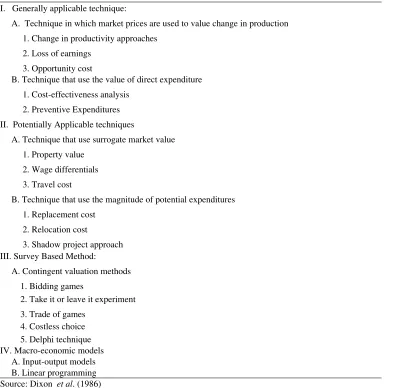
Dixon et al. (1986) listed the valuation techniques into some categories (See Table 1). “The generally applicable technique is standard and straightforward valuing technique that mostly relies on change in physical production or on direct cash expenditures”. There are two types of general applicable technique: technique in which market price are used to value change in production and technique that use the value of direct expenditure.
Table 1. Economic valuation techniques
I. Generally applicable technique:
A. Technique in which market prices are used to value change in production 1. Change in productivity approaches
2. Loss of earnings 3. Opportunity cost
B. Technique that use the value of direct expenditure 1. Cost-effectiveness analysis
2. Preventive Expenditures II. Potentially Applicable techniques
A. Technique that use surrogate market value 1. Property value
2. Wage differentials 3. Travel cost
B. Technique that use the magnitude of potential expenditures 1. Replacement cost
2. Relocation cost
3. Shadow project approach III. Survey Based Method:
A. Contingent valuation methods 1. Bidding games
2. Take it or leave it experiment 3. Trade of games
There are three techniques that use market prices to value the impact of environment changes. The first deals with change in productivity and the associated value of output. This approach measures the physical changes in production and values using market prices for inputs and outputs. The second technique is loss of earnings or also known as the human capital or forgone earnings approach. The value of the change in the quality of environment is estimated by the value of lost earnings and medical costs. The third technique is opportunity cost, in the case that the cost of using resources is un-priced or un-marketed. For example the value of the reserved park can be estimated by valuing the timber harvesting.
There are two techniques that use value of direct expenditures. The first technique is cost-effectiveness analysis. This approach is very powerful for decision makers for making choices on the technology or policy that can achieve the certain objective with cost effectiveness. The second technique relates to preventive expenditures. For example, the value of improving water quality can be estimated by the cost of households to have a good quality of water such as the cost of filtration.
Potentially applicable techniques are the techniques that need greater care, demand more data and require strong assumptions. There are two broad categorizes of the potentially applicable techniques: technique that use surrogate market value and technique that use the magnitude of potential expenditures.
Three subsets of techniques are listed under the technique that uses surrogate market values. The first technique is property value. The price of house is assumed to be influence also by the quality of environment. Second technique is wage differential. The basic theory is that the worker needs higher wages to induce workers to work in polluted areas or risky areas. However, in the developing country probably this technique is difficult to implement because it requires competitiveness in the labour market, unhindered flow of information and labour mobility. The third approach is travel cost, in which commonly used to value recreational goods and services.
In the absence of the market price and surrounded-market prices, the survey-based method or contingent valuation methods (CVM) is applied. This method is also known as the stated preference method that is based on data from people’s responses to hypothetical questions. The varieties of contingent valuation model include bidding games, take it or leave it experiments, trade-off games, costless choice and Delphi technique.
One major limitation of using contingent valuation is not representing the actual behaviour and subject to bias that may influence to reliability of the results. Freeman (1993) identified two sources of problem of using hypothetical method: “the incentive for respondent to behave strategically-that is to provide biased responses in order to influence public policy and the absence of incentive for respondents to provide accurate responses when asked about purely hypothetical situation”.
Lastly macroeconomic models, such as the generalized input-output (I-O) models and linear programming, may also be used to generate environmental values. The I-O model that was developed by Leontief, is based on the interrelationships of production activities. Input-output analysis consists of tables that describe, for a number of sectors within the economic system, the inputs to the processes of production and the output realized as a results. Environmental variables can be added into this input-output table. Linear programming model is a method of using mathematical programming for optimisation of environmental quality. The basic model is to maximize the economic benefit of production while at the same time preserving or promoting environmental quality.
Examples of valuing environmental services
This section describes two examples of valuing environmental services: (1). Valuing carbon sequestration on different land use system in Northern Philippines, and (2). Valuing the impacts of pesticide use on farmer’s health.
Table 2. Land use option in Northern Philippines
Social NPV with Value of C Sequestration (P/ha) at r = 10%
Land Use
System NPV w/o C
NPV
Biomass C NPV Soil C
NPV w/ Biomass C
NPV w/ Biomass and Soil C
Imperrata 498 0 264,782 498 265,280
Food Crops 30,913 0 243,113 30,913 274,026 Timber AF 149,459 10,866 261,138 160,325 421,464 Source: Predo, (2002)
Second example is a study by Huang et al. (2001) on estimating the impacts of pesticide use on farmers’ health. Using household survey of 100 respondents, the authors estimated the health costs of pesticide use in rice production. The health impacts include of eye effects, headaches, skin problems, liver problem, and neurological effects. They found that pesticide use significantly affected farmer’s health (see Table 3). The authors pointed out that the uses of pesticides are “a double-edge sword in the battle against pests”. The use of pesticide could increase the yield of rice. However, in developing countries, misuse and overuse of pesticide are often reported and farmers often ignored the negative impacts of pesticide on health. This study also reveals that the optimum level of pesticide use is less than half of current levels in Zheijing Province.
Table 3. Appropriate pesticide use given productivity and health effects in Zheijing Province, China
Pesticide use/ Farm Health cost
Yuan
Less than 9 kg 9
Between 9 – 15 kg 24
Over 15 kg 33
Source: Huang, et al. (2001)
CONCLUDING REMARKS
Valuation of environmental services is an important step in integrating economic concerns into environmental management and explicitly addressing environmental concerns in decision-makers by various stakeholders. The process of facilitating environmental transfers is likely to be enhanced with knowledge of environmental values experienced by various actors, including the suppliers of the environmental service, the beneficiaries, the intermediaries, and the policy makers.
REFERENCE
Barbier, E. 1996. The Economic of Soil Erosion: Theory, Methodology, and Example. EEPSEA Special paper.
Dixon, J.A., R.A. Carpenter, L.A. Fallon, P.B. Sherman, and S. Manopimoke. 1986. Economic Analysis of the Environmental Impacts of Development Projects. Earth scan Publications Limited London in association with The Asian Development Bank. Manila.
Freeman III. A.M. 1993. The Measurement of Environmental and Resource Values: Theory and Method. Resource for the Future. Washington DC.
Huang, J., F. Qiao, L. Zhang, and S. Rozelle. 2001. Farm Pesticides, Rice Production, and the Environment. EEPSEA Research Report 2001-RR3.
International Centre for Research in Agroforestry. 2001. Program for Developing Mechanisms to Reward the Upland Poor in Asia for the Environmental Services that They Provide. Final Project Design Document. IFAD/ICRAF (Unpublished)