http://cre.sagepub.com/
Clinical Rehabilitation
http://cre.sagepub.com/content/22/2/125
The online version of this article can be found at:
DOI: 10.1177/0269215507081580
2008 22: 125
Clin Rehabil
Olive Lennon, Aisling Carey, Niamh Gaffney, Julia Stephenson and Catherine Blake
paradigm for the non-acute ischaemic stroke population
A pilot randomized controlled trial to evaluate the benefit of the cardiac rehabilitation
Published by:
http://www.sagepublications.com
can be found at:
Clinical Rehabilitation
Additional services and information for
http://cre.sagepub.com/cgi/alerts
Email Alerts:
http://cre.sagepub.com/subscriptions
Subscriptions:
http://www.sagepub.com/journalsReprints.nav
Reprints:
http://www.sagepub.com/journalsPermissions.nav
Permissions:
http://cre.sagepub.com/content/22/2/125.refs.html
Citations:
What is This?
- Jan 22, 2008
Version of Record
>>
at University College Dublin on September 24, 2013
cre.sagepub.com
A pilot randomized controlled trial to evaluate the benefit
of the cardiac rehabilitation paradigm for the non-acute
ischaemic stroke population
Olive Lennon,Aisling Carey,Niamh Gaffney,Julia StephensonStroke Rehabilitation Unit, Baggot Street Community Hospital andCatherine Blake School of Physiotherapy and Performance Science, University College Dublin, Ireland Received 22nd December 2006; returned for revisions 25th February 2007; revised manuscript accepted 18th April 2007.
Objective: To evaluate risk factor reduction and health-related quality of life following a 10-week cardiac rehabilitation programme in non-acute ischaemic stroke subjects.
Design: Single-blinded randomized control trial.
Setting: Outpatient rehabilitation.
Subjects: Forty-eight community-dwelling ischaemic stroke patients (38 indepen-dently mobile, 9 requiring assistance, 1 non-ambulatory) were randomly assigned to intervention or control groups by concealed allocation.
Intervention: The trial consisted of a 10-week schedule with measures taken at weeks 1 and 10. Both groups continued usual care (excluding aerobic exercise); intervention subjects attended 16 cycle ergometry sessions of aerobic-training intensity and two stress-management classes.
Main outcome measures: Cardiac risk score (CRS);VO2(mL O2/kg per minute) and
Borg Rate of Perceived Exertion (RPE) assessed during a standardized ergometry test; Hospital Anxiety and Depression Scale (HADS); Frenchay Activity Index; Fasting Lipid Profiles and Resting Blood Pressure.
Results: Group comparison with independentt-tests showed significantly greater improvement at follow-up by intervention subjects than controls inVO2(intervention 10.61.6 to 12.02.2, control 11.11.8 to 11.11.9t¼4.734,P50.001) and CRS
(intervention 13.410.1 to 12.410.5, control 9.46.7 to 15.06.1t¼ 2.537, P50.05). RPE rating decreased in intervention subjects (13.412.2 to 12.42.0) and
increased in controls (13.81.8 to 14.41.6); Mann–WhitneyU(U¼173.5,P50.05).
Within-group comparison showed significant decrease in the HADS depression subscale in the intervention group alone (5.13.4 to 3.02.8) (Wilcoxon signed ranks testZ¼ 3.278,P50.001).
Conclusion: Preliminary findings suggest non-acute ischaemic stroke patients can improve their cardiovascular fitness and reduce their CRS with a cardiac rehabilitation programme. The intervention was associated with improvement in self-reported depression.
Address for correspondence: Olive Lennon, Stroke Rehabilitation Unit, Baggot Street Community Hospital, 18 Upper Baggot Street, Dublin 4, Ireland.
e-mail: [email protected]
ßSAGE Publications 2008
Introduction
Cardiovascular disease and ischaemic stroke are both vascular diseases sharing many predisposing, potentially modifiable risk factors (hypertension, abnormal blood lipids and lipopro-teins, cigarette smoking, physical inactivity, obesity and diabetes mellitus).1,2Their association is not benign, with the risk of death in the stroke population, in part due to cardiac disease, at least twice that of age-matched controls.3Modification of multiple risk factors through lifestyle interven-tions and pharmacological therapy is recognized as the cornerstone of prevention of recurrent events.3–5
Regular physical activity and cardiac rehabilita-tion have proven benefits in the general population and post cardiac event,6–9 however, adoption of the cardiac rehabilitation paradigm to the ischaemic stroke population has remained untested. Stroke patients are known to have low endurance to exercise and decreased activity levels10and few can avail themselves of cardiovas-cular training through exercise counselling alone due to acquired disability.11 A Cochrane review and the American Stroke Association have highlighted as a priority the need for research into the efficacy and feasibility of aerobic exercises post stroke.2,12
As adapted cycle ergometers allow aerobic fitness training post stroke10,13,14 this pilot study aims to establish the feasibility of a 10-week cardiac rehabilitation programme including 16 cycle ergometry sessions. Of interest is whether the programme improves:
Cardiovascular fitness using estimatedVO2and
Borg’s Rate of Perceived Exertion15(RPE), at a given workload and resting heart rate (HR).
Multivariate cardiac risk score16 (CRS)
measured by a coronary disease prediction algorithm.
Cardiovascular–metabolic risk factor profile
using fasting lipid profiles and resting blood pressure.
Health-related function and quality of life as
measured by the Frenchay Activity Index17 and the Hospital Anxiety and Depression Scale.18
Methods
Study design
A randomized, controlled, single-blind trial was conducted, approved by University College Dublin Human Research Ethics Committee. Measurements were made by an independent assessor blinded to allocation.
Patients
Subjects were recruited from the Stroke Rehabilitation Database, Baggot Street Community Hospital, Dublin. Information leaflets were posted and volunteers contacted the research team for initial telephone screening, including the PAR-Q Questionnaire.19
Informed consent was obtained. Participants’ general practitioners were asked to notify contraindications to exercise or medication changes. All participants received a medical screening by a physician in the stroke unit prior to participation.
Sample size calculations with 80% power and
P50.05 were conducted on the following outcome measures:
Borg’s RPE15 scale to detect a 2-point change
between groups indicated that a minimum of 16 subjects would be required per group (mean 17 (SD 2)).20
Hospital Anxiety and Depression Scale (HADS)
depression subscale to detect a 2.5-point change between groups indicated a minimum of 24 per group (mean 6.2 (SD 3.1)).21
Systolic blood pressure reduction of 5 mmHg
indicated a minimum of 170 subjects in each group22 which was not feasible for this pilot study. Data for CRS in stroke patients was not available for sample size calculation.
Inclusion criteria:41 year post ischaemic stroke (confirmed by CT or MRI scan) and over 18 years of age. Patients were included irrespective of their ability to ambulate independently.
Exclusion criteria: O2 dependence, angina,
blocker medication (RPE, a primary outcome measure, was shown to be unreliable in subjects taking beta blocker medication).22,23
Random allocation
Participants were assigned an ID number, stratified by age and sex into four blocks of six and randomly assigned using a sequence generator (SPSS version 12.0), to either intervention or control groups, by an independent party. Following initial testing, participants were handed an opaque envelope which contained details of their group assignment, by clerical staff unrelated to the trial.
Programme
Both control and intervention subjects who were in receipt of physiotherapy and occupa-tional therapy services continued with usual care. Occupational and physiotherapy received focused on functional activities, balance and gait. No therapy contained an aerobic exercise component.
Control subjects had a baseline assessment on week 1 and re-assessment on week 10 with no additional intervention in the interim.
The Cardiac Rehabilitation Programme consisted of a 10-week schedule with baseline measures in week 1 and reassessment in week 10. Intervention subjects attended twice weekly for 30-minute cycle ergometry exercise (Motomed Viva 2) using either the upper or lower limbs. They exercised through biofeedback alarms set at 50–60% of their maximal heart rate, calcula-ted sessionally (Karvonen formula THR¼ (HRmaxHRrest)(50–60%)þHRrest). Resistance and speed were adjusted daily to ensure tailored progression. As participants did not exceed 60% max HR, the programme posed very low risk of adverse events.2 Participants attended two life skills classes addressing stress management, relaxation and life balance.
Two participants exercised concurrently in a controlled environment and all sessions were supervised by a physiotherapist. Staff had cardiac resuscitation and defibrillation certification. Indications to stop exercise included: chest pain,
dizziness, malaise, heart rate in excess of 60% maximal heart rate, oxygen saturation levels lower than 90% or participant request to stop in accordance with American Heart Association (AHA) guidelines.24
Measurements
Baseline descriptives including Oxfordshire Stroke Subtype Classification,25medical history including stroke, previous cardiac events and Functional Ambulation Category26were noted from each participant’s medical chart.
Fitness testing19was conducted with a standar-dized 3-minute submaximal exercise test using a cycle ergometer (Reck, Motomed Viva 2) at resistance setting 8 (5.6 Nm). Participants were fasting overnight for 12 hours at the time of testing, they were instructed to wear loose, comfortable clothing and room temperature was maintained at 20
C. The machine passively moved for 1 minute at 50 rpm, allowing a warm-up and assuring no joint discomfort. Participants took over pedalling for 3 minutes at a steady state of 50 rpm with a workload of 5.6 Nm. A metronome was present to assist with pacing.
VO2 (mL O2/kg/min) was calculated (10.8WM1
) þ7, using average wattage output during the test.
RPE was rated at the end of the test, in accordance with the recommended guidelines.15 Peak wattage was recorded at the end of the
3-minute exercise test.
Cardiac risk score16 (CRS) was calculated for each participant. This is an algorithmic score based on age, resting blood pressure, smoking status, diabetic status, total cholesterol and high-density lipoprotein (HDL) scores.
Resting heart rate and SaO2 were measured following a 5-minute seated rest period (Nanox 2 oximeter, Medlab).
Resting brachial artery blood pressure (unaf-fected limb) was measured with a calibrated mercury sphygmomanometer in accordance with the Joint National Committee VI.27 Body mass index (BMI) was calculated using a
Fasting lipids were measured from blood samples obtained by venipuncture following overnight fasting by the subjects. Serum was analysed for total cholesterol and triglycerides. HDL cholesterol was determined from plasma. Low-density lipoprotein (LDL) cholesterol calculated using the Friedewald equation.28 Frenchay Activity Index17 and HADS18 forms
were filled in by all participants.
Spirometry testing was performed with the participant in upright sitting using the Microlab 3300 (Micro Medical Limited). Routine use of respiratory medications including inhalers was permitted.
Data analysis
Data were entered onto the Statistical Package for the Social Sciences (SPSS) version 12. Analysis performed was on an intention to treat basis and
as such final scores are included on patients who failed to complete the intervention.29 Change scores were compared between groups using independent t-tests where data were interval or
ratio level and conformed to the assumptions of normality. Mann–Whitney non-parametric tests were otherwise used. Ancillary analysis included single-group analysis using paired t-tests and
Wilcoxon signed ranks test.
Results
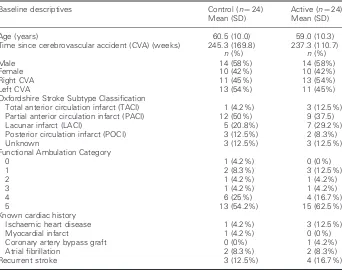
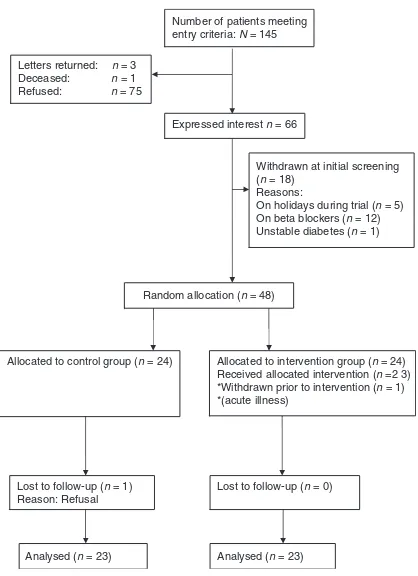
Demographic and clinical characteristics of the intervention and control groups are presented in Table 1. Forty-eight subjects entered the trial with participant flow represented in Figure 1.
No change in cholesterol lowering medication was reported in either group. Three control sub-jects had blood pressure medication changes during the trial: subject 4, from hypertension
Table 1 Baseline and clinical descriptives
Baseline descriptives Control (n¼24) Active (n¼24) Mean (SD) Mean (SD)
Age (years) 60.5 (10.0) 59.0 (10.3)
Time since cerebrovascular accident (CVA) (weeks) 245.3 (169.8) 237.3 (110.7)
n(%) n(%)
Male 14 (58%) 14 (58%)
Female 10 (42%) 10 (42%)
Right CVA 11 (45%) 13 (54%)
Left CVA 13 (54%) 11 (45%)
Oxfordshire Stroke Subtype Classification
Total anterior circulation infarct (TACI) 1 (4.2%) 3 (12.5%) Partial anterior circulation infarct (PACI) 12 (50%) 9 (37.5)
Lacunar infarct (LACI) 5 (20.8%) 7 (29.2%)
Posterior circulation infarct (POCI) 3 (12.5%) 2 (8.3%)
Unknown 3 (12.5%) 3 (12.5%)
Functional Ambulation Category
0 1 (4.2%) 0 (0%)
1 2 (8.3%) 3 (12.5%)
2 1 (4.2%) 1 (4.2%)
3 1 (4.2%) 1 (4.2%)
4 6 (25%) 4 (16.7%)
5 13 (54.2%) 15 (62.5%)
Known cardiac history
Ischaemic heart disease 1 (4.2%) 3 (12.5%)
Myocardial infarct 1 (4.2%) 0 (0%)
Coronary artery bypass graft 0 (0%) 1 (4.2%)
Atrial fibrillation 2 (8.3%) 2 (8.3%)
Recurrent stroke 3 (12.5%) 4 (16.7%)
monotherapy to angiotensin II antagonist/ thiazide, subject 12 was prescribed a diuretic tablet the day before retesting and subject 34 had hypertension medication increased. Of the intervention group no change to hypertension agents was noted. Seven of the 48 subjects recruited to the study (3 control, 4 intervention) continued usual therapy as described in the programme outline.
Table 2 illustrates control and intervention group scores demonstrated at baseline and follow-up. Baseline scores were compared between groups with no significant differences noted, despite outliers in BMI and time since stroke in the intervention and control groups, respectively. Outliers were included in analysis. Between-sex differences were noted in baseline data with males scoring significantly higher on forced expiratory volume in 1 second (FEV1) (P¼0.005), peak wat-tage (P50.001) and total cholesterol (P¼0.02).
When change scores were compared between groups, the intervention arm demonstrated significantly greater improvements after treatment in several primary variables when compared with the control. Overall cardiovascular fitness improved in the intervention group with greater increase in VO2(t 4.734, P50.001) and decrease
in RPE (U 173.5, P¼0.04) by comparison with the controls. Cardiac risk score reduced in the intervention group but increased in the controls (t2.537, P¼0.015). No significant change occurred in cardiovascular–metabolic risk factor profiles of total cholesterol, LDL, HDL, triglycer-ides, systolic and diastolic blood pressures. Similarly, no significant difference was found in the Frenchay Activity Index or HADS change scores.
Secondary outcome analysis demonstrated no significant difference in change scores between groups in spirometry results of forced vital capacity (FVC), peak expiratory flow (PEF), FEV1 and FEV1/FVC (%). Peak wattage output
reflecting peak power generated by the limbs during testing increased in the intervention group compared to the control (t4.035,P50.001).
When within-group analysis was performed using paired t-tests and Wilcoxon signed ranks test where appropriate, only the intervention group had a significant change in VO2
(P50.001) and cardiac risk score (P¼0.005). It is interesting to note that the HADS depression score also improved significantly in the interven-tion group (Z 3.278, P50.001), but not in the control. BMI increased in both control (P¼0.008) and intervention (P¼0.012) groups.
Between-sex comparison of change scores in the intervention arm indicates both males and females benefited equally from the intervention (no significant differences noted).
Discussion
This pilot randomized controlled trial study tested the feasibility of a 10-week cardiac rehabilitation programme, demonstrating its efficacy with significant increases in fitness parameters ofVO2
and RPE and cardiac risk score reduction in the intervention group.
Number of patients meeting entry criteria: N = 145
Expressed interest n = 66 Letters returned: n = 3
Deceased: n = 1 Refused: n = 75
Withdrawn at initial screening (n = 18)
Reasons:
On holidays during trial (n = 5) On beta blockers (n = 12) Unstable diabetes (n = 1)
Random allocation (n = 48)
Allocated to control group (n = 24) Allocated to intervention group (n = 24) Received allocated intervention (n =2 3) *Withdrawn prior to intervention (n = 1) *(acute illness)
Analysed (n = 23) Analysed (n = 23) Lost to follow-up (n = 1)
Reason: Refusal
Lost to follow-up (n = 0)
Table 2 Pre- and post-treatment scores for control and active groups
Control (n¼23) Active (n¼23) Analysis of between-group change
Pre Post Change Pre Post Change P-value 95% CI Effect size
Cardiac risk
Waist girth (mm102) 96.5
10.8 97.511.0 1.0 103.012.4 103.015.7 0.1 0.602 5.2, 3.0
Total cholesterol (mmol/L) 4.61.2 4.71.1 0.1 4.61.1 4.51.0 0.1 0.192 0.4, 0.1
Cardiac risk score 9.46.8 10.46.1 1.0 12.010.3 10.410.5 1.5* 0.015 4.4,0.5 0.8
Resting systolic BP (mmHg) 135.217.5 133.516.7 1.7 137.115.7 136.013.3 1.1 0.903 8.7, 9.8
Resting diastolic BP (mmHg) 81.811.6 82.09.0 0.2 79.77.6 81.48.4 1.7 0.545 3.7, 6.9
Fitness and function
Body mass index (kg/m2) 25.7
3.7 26.23.7 0.5* 28.15.6 28.75.5 0.6* 0.604 0.4, 0.7
Resting HR (bpm) 70.110.2 70.911.3 0.8 72.310.2 72.910.9 0.6 0.948 7.2, 6.7
FEV1(L) 1.90.8 1.90.7 0.0 2.30.8 2.20.8 0.1 0.778 0.2, 0.2
VO2(mL O2/kg/min) 11.11.8 11.11.9 0.0 10.61.6 12.02.2 1.4* 50.001 0.8, 2.1 1.3
Peak wattage (Nm) 57.429.1 56.330.2 1.1 56.631.8 75.339.2 18.7* 50.001 9.9, 30.0 1.4
Rate of perceived exertion, median (range)
14.0 (9–16) 15.0 (11–17) 1.0 (25) 13.0 (9–17) 13.0 (7–17) 1 (74) 0.043
Self-reported function and HRQoL
HADS
Anxiety, median (range) 7.0 (1–13) 6.0 (0–18) 1.0 (85) 5.0 (0–11) 4.0 (0–16) 1.0 (513) 0.938
Depression, median (range) 6.0 (0–20) 4.0 (1–20) 1.0 (63) 4.0 (0–13) 2.0 (0–11) 1.0 (112)y 0.222
Frenchay Activity Index, median (range)
26.0 (7–42) 27.0 (3–40) 1.0 (711) 26.0 (3–42) 27.0 (8–42) 1.0 (711) 0.724
*Pairedt-test for within-group differences.
yWilcoxon sign rank test for within-group differences:
Active group: Cardiac risk score (P¼0.005); BMI (P¼0.012);VO2(P50.001); peak wattage (P¼0.001); HADS depression subscale (P¼0.001).
Control group: BMI (P¼0.008).
CI, confidence interval; BP, blood pressure; HR, heart rate; FEV1, forced expiratory volume in 1 second; HRQoL, health-related quality of life; HADS, Hospital
Anxiety and Depression Scale.
130
O
Lennon
et
No significant improvements were noted in health-related quality of life (HRQoL) indices or cardiovascular–metabolic profiles. Decreased HADS depression scores on final testing in the active group does however suggest an associated increase in well-being. As a pilot study with relatively small numbers, limited power to demonstrate health status and functional bene-fits exists.
Another limitation of the methodology employed in this study is that the control group did not receive comparable non-exercise related attention to the intervention group. Thus there may be a potential Hawthorn effect.
The Cochrane Review on Physical Fitness Training in Stroke Patients12 details only two studies including measures of aerobic fitness (VO2) and maximal work rate (Watts)10,30 and
two meeting the American College of Sports Medicine (ACSM) guidelines for developing cardiorespiratory fitness.10,31 This study complies with cardiovascular training requirements by the rigour of the training programme described and similar improvements in fitness parameters VO2
and RPE were observed in this study. As no aerobic training component was included in usual therapy, common to both groups, these changes may be attributed to the intervention. It has been demonstrated in the literature that stroke patients can improve their fitness levels to the same degree as their age-matched counter-parts.10 This study, through deployment of the CRS outcome measure, demonstrates the benefit of such interventions on vascular risk reduction.
Previous studies noted that improvement in RPE andVO2cannot distinguish between central
and peripheral adaptation.10,32 This was also observed in this study with a significant increase in peak wattage in the intervention group compared to the control, indicating that a lower limb muscle training effect must be considered as well as central cardiac adaptation to the exercise programme.
Comparison with cardiac rehabilitation programmes for the coronary heart disease populations is limited as primary outcome measures of mortality and non-fatal cardiac events were not feasible in the short time-frame and limited subject numbers in this pilot study. However, meta-analysis of exercise-based
rehabilitation in coronary heart disease8 has demonstrated a net reduction in total cholesterol and LDL in comprehensive cardiac rehabilitation groups but not in exercise-only interventions. As both groups in this study demonstrated no significant change in lipoprotein profiles and increases in BMI over the trial period, it suggests future interventions should involve dietary education.
Two coronary heart disease trials33,34 noted favourable decreases in both systolic and diastolic blood pressure in comprehensive cardiac programmes. However, systematic review noted an increase in blood pressure over trial periods in both groups in a number of studies.8 As increases were more marked in the control groups, the net changes were considered negative. This study demonstrated a drop in systolic blood pressure in both groups and an increase in diastolic blood pressure in both groups. A number of subjects in the control group had a change in hypertension medications over the course of the trial but no change in medication noted in the intervention group, suggesting a possible trend toward blood pressure reduction in the intervention group.
Higher cardiac risk scores in the intervention group occurred because, despite randomization, the intervention arm contained three more people with diabetes than the control. This status does not change from initial to final testing. Similarly both groups contained six smokers and 17 non-smokers, with smoking status remaining unchanged on final testing. Therefore the cardiac risk reduction scores were as a result of alteration of resting blood pressure and fasting cholesterol measurements. While no significant change was seen in either variable in isolation, when considered in the context of a weighted algorith-mic score, cardiac risk scores were reduced in the intervention group. Given the absence of change in cholesterol lowering medications in both groups and pharmacological management of hypertension in the intervention group, this may be attributed to the programme.
scores with these subjects’ data removed however, continues to demonstrate significantly greater cardiac risk reduction in the intervention group (t2.512,P¼0.016).
Modification of all major cardiovascular risk factors, including physical inactivity, is reported to be cost-effective but needs to be better targeted for potential health gain.35
No study to date has looked at reducing vascular risk profiles in ischaemic stroke through adoption of the cardiac rehabilitation paradigm. These findings show promise for such programmes as preventative interventions for further stroke and cardiac events. Using baseline data from this study, sample size estimation (n42K2/2 (K¼7.8)) suggests a minimum of 120 subjects
in each group would be required to show expected change in all primary outcome measures in a definitive study, to be conducted by this research group.
Acknowledgements and funding
Heart Health Research Bursary, Health Service Executive, Ireland 2004. Ethical approval was granted by University College Dublin, Human Research Ethics Sub-Committee, University College Dublin, Belfield, Dublin 4, Ireland.
All authors state no conflict of interest exists in this body of research.
References
1 Heart Health Task Force.Ireland’s Changing Heart. Department of Health and Children, 2003. 2 Gordon NF, Gulanick M, Costa Fet al. Physical activity and exercise recommendations for stroke survivors.Circulation2004;109: 2031–41. 3 Adams RJ, Chimowitz MI, Alpert JSet al. AHA/
ASA Scientific Statement. Coronary risk evaula-tion in patients with transient ischemic attack and ischemic stroke.Circulation2003;108: 1278–90. 4 Chalmers J, Chapman N. Challenges for the
prevention of primary and secondary stroke: the importance of lowering blood pressure and total cardiovascular risk.Blood Press2001;10: 344–51. 5 Wolf PA, Clagett GP, Easton JDet al. Preventing
ischemic stroke in patients with prior stroke and transient ischemic attack: a statement for health-care professionals from the Stroke Council of the AHA.Stroke1999;30: 1991–94.
6 Pearson TA, Blair SN, Daniels SRet al. AHA guidelines for primary prevention of cardiovascular disease and stroke.Circulation2002;106: 388–91. 7 Fletcher FG, Blair SN, Blumenthal Jet al.
Statement on exercises, benefits, and recommen-dation for physical activity programs for all Americans: a statement for health professionals by the committee on exercise and cardiac
rehabilitation of the council on clinical cardiology, American heart association.Circulation1992;86: 340–44.
8 Jolliffe JA, Rees K, Taylor RS, Thompson D, Oldridge N, Ebrahim S. Exercise-based rehabilita-tion for coronary heart disease.Cochrane Database Syst Rev2001, Issue 1. Article no: CD001800. DOI: 10.1002/14651858.CD001800.
9 Taylor RS, Brown A, Ebrahim Set al. Exercise-based rehabilitation for patients with coronary heart disease:systematic review and meta-analysis of randomized controlled trials.Am J Med2004;
116: 682–92.
10 Potempa K, Lopez M, Braun 1, Szidon P, Fogg L, Tincknell T. Physiological outcomes of aerobic training in hemiparetic stroke patients.Stroke
1995;26: 101–105.
11 Hill K, Ellis P, Bernhardt J, Maggs P, Hull S. Balance and mobility outcomes for stroke patients: a comprehensive audit.Aust J Physiother1997;43: 173–80.
12 Saunders DH, Greig CA, Young A, Mead GE. Physical fitness training for stroke patients.
Cochrane Database Syst Rev2004, Issue 1. Article no: CD003316.pub2. DOI: 10.1002/
14651858.CD003316.pub2
Clinical messages
Ischaemic stroke patients have high risk
of coronary heart disease and recurrent stroke.
Stroke patients are known to have low
exer-cise endurance.
Submaximal aerobic training is both safe
and feasible in chronic stroke using adapted cycle ergometry.
The cardiac rehabilitation paradigm adapted
to stroke reduces cardiac risk and increases aerobic fitness in chronic ischaemic stroke patients.
13 Carr J, Shepherd R.Stroke rehabilitation: guide-lines for exercise and training to optimize motor skill. Butterworth Heinemann, 2003.
14 Brinkmann JR, Hoskins TA. Physical conditioning and altered self-concept in rehabilitated hemiplegic patients.Phys Ther1979;7: 859–65.
15 Borg G.Borg’s perceived exertion and pain scales. Human Kinetics, 1998.
16 Wilson PW, D’Agostino RB, Levy D, Belanger AM, Silbershatz H, Kannel WB. Prediction of coronary heart disease using risk factor categories.Circulation1998;97: 1837–47. 17 Holbrook M, Skilbeck CE. An activities index for
use with stroke patients.Age Ageing1983;12:
166–70.
18 Zigmond AS, Smith RP. The hospital anxiety and depression scale.Acta Psychiatry Scand1983;67:
361–370.
19 American College of Sports Medicine.ACSM’s guidelines for exercise testing and prescription. sixth edition. Lippincott Williams and Wilkins, 2000: 165–93.
20 Fletcher BJ, Dunbar SB, Felner JMet al. Exercise testing and training in physically disabled men with clinical evidence of coronary artery disease.Am J Cardiol1994;73: 170–74.
21 Wade DT, Collen FM, Robb GF, Warlow CP. Physiotherapy intervention late after stroke and mobility.BMJ1992;304: 609–13.
22 Eng JJ, Chu KS, Dawson AS, Kim CM,
Hepburn KE. Functional walk tests in individuals with stroke. Relationship to perceived exertion and myocardial exertion.Stroke2002;33: 756–61.
23 Derman EW, Sims R, Noakes TD. The effects of anti-hypertensive medications on the physiological response to maximal exercise testing.J Cardiovasc Pharmacol Ther1992;19: 122–26.
24 Gibbons RJ, Balady GJ, Beasley JWet al. A report of the American college of cardiology/American Heart association task force on practice guidelines (Committee on Exercise Testing).J Am Coll Cardiol1997;30: 260–311.
25 Dewey H, Macdonell R, Donnan G, Freeman E, Thrift A, Sharples. Inter-rater reliability of stroke sub-type classification by neurologists and nurses
within a community-based stroke incidence study.
J Clin Neurosci2001;8: 14–17.
26 Holden MK, Gill KM, Magliozzi MR, Nathan J, Piehl-Baker L. Gait assessment for the neurologi-cally impaired: reliability and meaningfulness.Phys Ther1984;64: 35–40.
27 Joint Committee on Prevention, Detection, Evaluation and Treatment of High Blood Pressure (JNCVI), Public Health Service, National Institute of Health, NIH Publication No. 98-4080,
November 1997.
28 Friedewald WT, Levy RT, Frederickson DS. Estimation of VLDL- and LDL-cholesterol.Clin Chem1972;18: 499–502.
29 Hollis S, Campbell F. What is meant by intention to treat analysis? Survey of published randomised controlled trials.BMJ1999;319: 670–74.
30 da Cunha IT, Lim PA, Qureshy H, Henson H, Monga T, Protas EJ. Gait outcomes after acute stroke rehabilitation with supported treadmill training. A randomised controlled pilot study.Arch Phys Med Rehabil2002;83: 1258–65.
31 Teixeira-Samela LF, Nadeau S, McBride I, Olney SJ. Muscle strengthening and physical conditioning to reduce impairment and disability in chronic stroke survivors.Arch Phys Med Rehabil
1999;80: 1211–18.
32 Landin S, Hagenfedlt L, Saltin B, Wahren J. Muscle metabolism during exercise in hemiparetic patients.Clin Med Sci Mol Med1997;53: 257–69.
33 WHO Helsinki: Kallio V, Hamalainen H, Hakkila J, Luurila OJ. Reduction in sudden deaths by a multifactorial intervention programme after acute myocardial infarction.Lancet1979;2(8152): 1091–94.
34 Haskell WL, Aldermamn EL, Fair JMet al. Effects of intensive multiple risk factor reduction on cor-onary atherosclerosis and clinical cardiac events in men and women with coronary artery disease: The Stanford Coronary Risk Intervention Project (SCRIP).Circulation1994;89: 975–90.
35 Ebrahim S. Systematic review of cost-effectiveness research of stroke evaluation and treatment.Stroke