EVALUATING THE
EFFECTIVENESS OF DUAL
MONETARY POLICY
IN PROMOTING PRICE
STABILITY IN INDONESIA
Arif Widodo
Centre for Development of Islamic Economics and Finance, Universitas Muhammadiyah Yogyakarta
Abstract
Since the enactment of the dual banking system in 1998, Bank Indonesia has a new mandate for regulating both conventional and Islamic banking in Indonesia by enforcing dual monetary policy to attain and maintain the primary objective of Bank Indonesia: price stability. By reconstructing a conceptual model based mainly on Ascarya (2011), this study was designed to empirically examine whether the implementation of dual monetary is effective in ensuring the stability in price level as
represented in low inlation as well as stable exchange
rate. The method applied in this research was Vector Auto-regression (VAR) Model to capture the response
of inlation to the shocks arising from both monetary
instruments. The results of this study indicate that Volume 10 Nomor 2 2017
conventional monetary policy in general—when compared to the Islamic counterpart—may certainly
trigger instability of the price level since
lawed-cum-vulnerable money system (iat-based money) has fully
been implemented, thereby inducing inlation. In
addition, the debt system, interbank money market and the fractional reserve banking which are relied heavily on interest system have indeed contributed to the price volatility in Indonesia. In contrast, Islamic monetary policy shocks have proven to be capable of promoting price stability since they could hamper a highly volatile
inlation.
Keywords: Price stability, dual monetary system,
proit and loss sharing, fractional reserve banking
JEL Classiication: E31, E51, E52
Abstrak
kertas selama ini yang sangat rentan terhadap krisis, sebagai konsekuensinya akan meningkatkan tingkat harga. lebih lanjut, sistem hutang, pasar uang antar bank dan fractional reserve banking yang semuanya sangat bergantung pada sistem bunga telah menyebabkan gejolak pada tingkat harga di Indonesia. Sebaliknya, gunjangan dari kebijakan moneter Islam terbukti mampu menodorong kestabilan harga karena semua instumen tersebut mampu menekan gejolak yang terjadi pada inlasi.
Kata Kunci: Stabilitas harga, sistem moneter ganda,
I. Introduction
Bank Indonesia has a single objective to maintain the stability of the rupiah as relected in low inlation rate and stable the exchange rate. In achieving stability in the rupiah, Bank Indonesia has three pillars, one of which is formulating and implementing monetary policy. Under the Act No. 3 of 2004, which is an amendment to the Act No. 23 of 1999 a constitutional mandate of Bank Indonesia to maintain the price stability is enshrined and extended. Since then, it has been possible for Bank Indonesia, as stated clearly in the Act, to ensure the stable price level by employing several monetary instruments that entail the instruments based on Sharia principle.
The development of Islamic banking industry in Indonesia has started in the early 1990s, given the oficial establishment of Bank Muamalat in 1992. The legal protection of Islamic Bank to provide inancial services was irst under the Act No. 10 of 1998 that has eventually been repealed by the Act No. 21 of 2008. Bank Indonesia in accordance with such legislation became dual monetary outhority, implementing dual instruments to fulill its primary objective.
As the new Law has provided the clear legal framework both for monetary authority and the inanacial institutions, there has been a gradually growing Islamic inancial institution (IFI) functioned under such a dual inancial environenment. Adopting dual banking system in which conventional and Islamic banking can function side by side, Indonesia has imposed a dual regulation to govern the banking and inancial system owing to a fundamentally different concept between conventional and Islamic monetary instruments. While the main purpose of those instruments is to promote price stability, it is crucial to evaluate how both instruments that have distinct instruments contribute greatly to accomplish a single prupose of Bank Indonesia.
Beside the aforementioned reasons, it is
into account. In the aftermath of 2008 global inancial crisis, January to May 2009 saw sharp decrease in inlation, so it was able to adjust the inlation target. Of monthly inlation, price movements were relatively stable from 2009 until June 2015, except in June 2013 when inlation (yoy) reached 9.0% well above the target. Rapid luctuations in the inlation rate may bring about the question that pertains to the effectiveness of monetary policy within the dual monetary system.
The inancial crisis that occurs repeatedly in many countries in the world both developed and developing countries always starts with depression, high inlation, asset prices bubbles and then leads to a great depression (Ascarya, 2009a). High inlation is an economic phenomenon that still lingers so that has always been a topic of research. Moreover, in the aftermath of the 2008 global inancial crisis, many economists began to focus on the problems of credit that has widely belived as a main source of subprime mortgage crisis in the US, therefore in order to develop model proposed by Ascarya (2011), it is necessary irst to include conventional credit and Islamic inancing in the proposed model this paper seeks to reconstruct. As
emphasized recently by Chapra (2017), the primary cause of 2008 inancial meltdown was an excessive and imprudent credit extended easily by bank. In fact, such an argument has repeteadly been articulated by several prominent economists such as Mises (1953, 1998 and 2006), Kindleberger (2005), Minsky (1970, 2016), Cesa-Bianchi and Sokol (2017) and Drehmann et al. (2017).
Moreover, this study also attempts to develop the variables responsible for a high inlation. Although the previous study has found some important indings, given the increasingly complex and the development of banking infrastructure and policies, it needs to be further analyzed. Since the study by Ascarya (2011) has not explained yet fractional reserve banking as other factors that play a substantial role in contributing to the price volatility.
II. Literature Review
In a dual monetary system as Implemented In
and empIrIcal lIterature InvestIgatIng the performance of the dual monetary system adopted In several countrIes.
ascraya (2007) analyzed and compared, both theoretIcally and empIrIcally, the three Instruments of the monetary system of conventIonal and
IslamIc, that Interestrate vs. a profIt-and-loss sharIng (pls), fIat money vs. full bodIed/ backup money, and fractIonal vs 100 percent reserve-bankIng system.
theoretIcally, all conventIonal monetary Instruments have a great potentIaltoIncreasevolatIlIty In prIces, resultIng In hIgh InflatIon compared to IslamIc monetary Instrument. fIrst, throughfIatmoneythatprInted by the monetary authorIty of a partIcular country, wIll produce many benefIts of seIgnIorage. thIs occurs because the IntrInsIc value of paper money Is not equalto Its facevalue; theIntrInsIcvalueIs muchsmallerthanthenomInal value stated In money. unlIke themoneyIn IslamrequIresthat moneyhasIntrInsIcvalueequal to Its nomInal value, such as goldand sIlver, so that wIthIn theframeworkof IslamIcmoney there Is no authorIty whIch earns huge profIts by prIntIng money.
Not to mention the fractional reserve banking
system, which the banking system is able to create money-demand deposits, for example. In this context, money is created by banks when issuing bank loan, the more loan issued through this system the more money will automatically be created. Hence, such a system can threaten severely the price stability. In contrast, in the Islamic system is through 100 percent reserve banking, banks can not create money.
Lastly, the interest rate instrument and PLS, Ascraya (2007) describe theoretically and empirically. Interest rate well, theoretically and
empirically, negatively associated with investments,
meaning that when interest rates rise and investment will fall, it will also have a negative impact on economic growth. Investment and economic growth are positively related to each other: a signiicant increase in investment will encourage economic growth. Unfortunately, the economic growth will be disturbed by the presence of a negative
relationship between investment and the interest
Ascarya (2009b) formulate ideal synergy between conventional and Islamic monetary policy that will achieve the stability of price level and economic growth. The conventional system, according to its instruments characteristics, such as interest rates, iat money, and fractional reserve banking system allowing speculation to get the maximum beneit. Worse, the beneits were only enjoyed by a minority group. So the money that should be spinning for real sector instead accumulates in the monetary sector. Thus, economic bubbles become unavoidable. While in the Islamic system through PLS, Zakah system and a ban on speculation in Islam will improve the investment climate is healthy and based on sector willingly so will minimize bubbles and economic growth can be realized.
In a dual monetary system, both systems explained above with their respective characteristics must work together. Ascarya stressed that in order to create the desired synergy, both systems must work side by side in accordance with their respective paradigm do not mix and merge with each other. An instrument that can unite these two systems is that the proit-and-loss sharing (PLS). In terms of monetary
policy, the monetary authorities need to leave the monetary policy of passive (creating/ adding money to the economy) with an active monetary policy that emphasizes to accelerate V (velocity of money in the economy) by issuing sukuk based on the PLS system.
In the context of Indonesia that has implemented a dual monetary system, Ascarya (2010) suggests that conventional economics contains the root causes of the
systemic problems of the crisis. Several root causes of high inlation are riba, which is not limited in the form of interest rate but on the creation of a system of money and banking system which is rested greatly on fractional reserve banking.
Ascarya (2011) attempted to examine the
inlation (increasing inlation) permanently, compared with PLS whose inluence is much smaller. The same result is also shown from the negative effects of multiple currency systems and permanent outweigh GOLD single currency against inlation. Moreover, Saharuddin and Rama (2016) found that gold has stiil triggered the inlation if implemented. While the biggest contributor to inlation in the dual monetary system of Indonesia is interest rate with 54.7% share. This study has not been able to prove empirically that credit creation of fractional reserve banking system is one of the main causes of inlation.
Study conducted by by Herianingrum and
Syapriatama (2016) has entailed both conventional and Islamic loan in the model, yet the fractional reserve banking as stated by previous studies has yet to be addressed. In contrast, Yuliadi et al. (2017) seemed to ill that gaps by incorporating fractional reserve system into their model, however the main important cause of crisis which is credit was not included.
III. Methodology and Data
3.1 Data
In order to fully grasp the condition of monetary system within dual system,
this study applies the empirical methodology to examine the dynamic relationship between instruments, namely Vector Auto Regression (VAR). Therefore, the montly basis data of inancial variables from both conventional and Islamic are required by such a quantitative method. The data of this study were obtained from various resources, encompassing every institution from Bank Indonesia (SEKI-BI), Financial Services Authority (SBI and SPS) to Biro Pusat Statistik (BPS) and covered the period from January 2009 to June 2015. The period of 2009 was chosen to be the starting point of this paper since it was the period after the Act No. 10 2008 about Islamic Banking in Indonesia being enacted.
3.2 Vector Auto Regressive (VAR) Model
in Vector Error Correction Model. Hence, VECM is also called as VAR that is designed for non stationary series or stationary at irst difference level which has long-term cointegration (Ascarya, 2009b). Otherwise, if there is no lon term cointegration between variabeles, this study employs the irst difference of VAR model. The general model of VECM can be written as as endogenous, lexible according to the model; εk is disturbance or error term with zero means and constant variance-covariance.
The model used in this study followed Ascarya (2011), where variables will be divided into conventional monetary policy and Islamic monetary policy; then will be tested how both monetary policies can induce or reduce price level volatility. Moreover, price stability can be deined according to the stability of inlation by assessing the response of costumer price index from both monetary policy shocks. Therefore, the research models under dual
monetary policy system are as follows:
Conventional monetary policy model:
xk = [Inlation, lnFM, lnFRB, INT, lnEXC, rPUAB, lnLOAN]
(3.2)
Islamic monetary policy model:
xk = [Inlation, GOLD, PLS, lnIM, rPUAS, lnFINC]
(3.3)
Where R is matrix
polynomial parameter estimator which consists of 7x7
in the conventional and 6x6 in Islamic model respectively; L is the lag length operator; Δ is the difference operator; denotes the level of adjustment from short-term to long-term equilibrium if the VAR model is co-inetgrated.
Where:
• INF: the monthly CPI
dan Inlasi Bulanan Indonesia”, BPS.
• INT: the rate of one-month conventional time deposits, obtained from table I.28 “Suku bunga simpanan berjangka rupiah menurut kelompok bank”: Bank Umum 1/3/6/12/24 bulan, SEKI-BI.
• PLS: the rate of one-month Islamic time deposits (deposito iB), obtained from table 36 “Ekuivalen Tingkat Imbalan bagi hasil/fee/ bonus – Bank Umum Syariah dan Unit Usaha Syariah”: Time Deposits – 1 month, SPS-BI.
• FM: money creation
originally issued by the central bank or money in circulation (M2), obtained from table I.2 “Neraca analitis otoritas moneter”: Uang Kartal yang diedarkan, SEKI-BI.
• FRB: credit creation or fractional reserve banking, is the difference between broad money M2 and M0 monthly. Broad money M2, obtained from table I.1 “Uang Beredar dan Faktor-Faktor yang Mempengaruhinya”: M2, SEKI-BI.
• IM: Just money supply
or money needed in the economy in Islamic perspective, which is an equilibrium intrinsic M0 proximate by the monthly
M1 and GDP data obtained from SEKI-BI and BPS.
• LOAN: the outstanding
amount (total loan) of conventional banks gained from Indonesian Banking Statistics (SPI)-BI.
• FINC: the outstanding
amount (total inancing) of Islamic banks acquired from Islamic Banking Statistics (SPS)-BI.
• EXC: Multiple currency
systems or exchange rate is the exchange rate of Rupiah against the US Dollar gained from SEKI-BI.
• GOLD: Single global
currency or gold price, is international gold price index obtained from “Indeks Harga Energi”, SEKI-BI.
IV. Result and Analysis 4.1 Preliminary Test
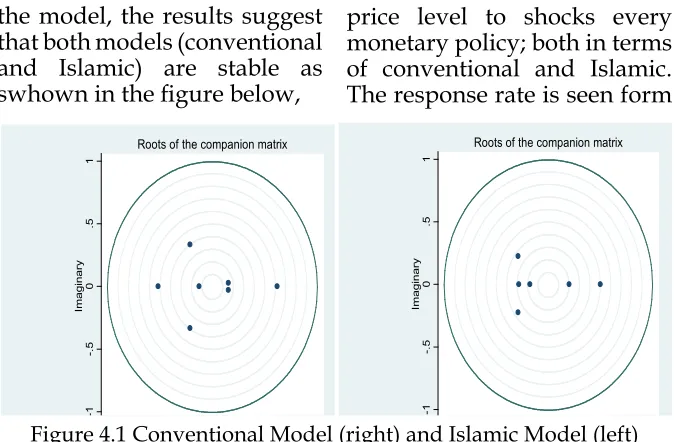
the model, the results suggest that both models (conventional and Islamic) are stable as swhown in the igure below,
Third, optimum lag test for both conventional and Islamic model are 1 (one) as the results of selection order criteria demonstrate the lag 1 (one) (see Appendix b and d). Fourth, to assess the co-integration, this study employs Johansen Cointegration test. The result demonstrates that there is no cointegration in both models since the trace statistics exceeds the critical value (see Appendix c and e). From the cointegration result, it can be concluded that this paper applies VAR model instead of VECM.
4.2 VAR of Conventional Monetary Model
In this section will explain the response of the
price level to shocks every monetary policy; both in terms of conventional and Islamic. The response rate is seen form
the Impulse Response; when the response rises (upward and positive), then the price level in this case has increased, meaning that any changes or shocks that occur in monetary policy resulted in price volatility rises. Conversely, when the response rate of price decreases (toward negative) it means a change in the monetary policy side is able to reduce the price level. Furthermore, in this section it will also be shown how to price stability occurs, when there is a mix between those two policies to maintain price levels, so it can be illustrated by how comprehensively price stability has been maintained in the dual monetary system in Indonesia.
In addition, the
-1
Roots of the companion matrix
-1
Roots of the companion matrix
contribution of each monetary policy-will either raise or lower the price level-will be explained also by the results of the variance decomposition, so it would seem any policies that contribute the most dominant to stabilize the price level in the dual monetary system.
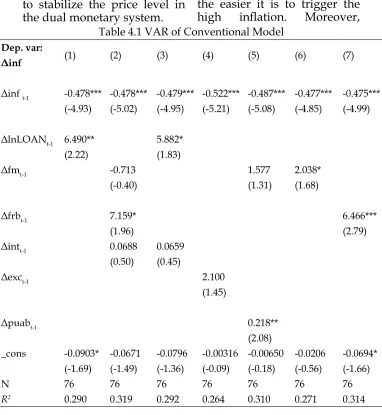
From the model (1) and (3), it is apparent that the credit (Loan) of conventional has a signifantly positive impact on the inlation, this means that the more the credit is extended to the borrowers the easier it is to trigger the high inlation. Moreover,
Table 4.1 VAR of Conventional Model
Dep. var:
(1) (2) (3) (4) (5) (6) (7)
Δinf
Δinf t-1 -0.478*** -0.478*** -0.479*** -0.522*** -0.487*** -0.477*** -0.475***
(-4.93) (-5.02) (-4.95) (-5.21) (-5.08) (-4.85) (-4.99)
ΔlnLOANt-1 6.490** 5.882*
(2.22) (1.83)
Δfmt-1 -0.713 1.577 2.038*
(-0.40) (1.31) (1.68)
Δfrbt-1 7.159* 6.466***
(1.96) (2.79)
Δintt-1 0.0688 0.0659
(0.50) (0.45)
Δexct-1 2.100
(1.45)
Δpuabt-1 0.218**
(2.08)
_cons -0.0903* -0.0671 -0.0796 -0.00316 -0.00650 -0.0206 -0.0694*
(-1.69) (-1.49) (-1.36) (-0.09) (-0.18) (-0.56) (-1.66)
N 76 76 76 76 76 76 76
R2 0.290 0.319 0.292 0.264 0.310 0.271 0.314
the iat money along (model 6) with fractional reserve banking system (model 2 and 7) has a positive relationship with the price level: if FM and FRB increase 1 per cent, due to a positive coeficient, both will bring about the rise in inlation rate 2.03 and 6.46, respectively. It can be argued that iat money and fractional reserve system has been detrimental for price stability. The other three variables, namely interest rate, puab rate and exchang rate have a positive relation to inlation, however only puab rate that can signiicantly contribute to the price volatility.
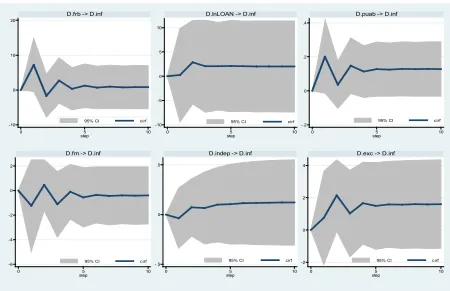
The previous results are in line with the Impulse Response Function (IRF) results of Inlation for conventional policy model as can be seen in igure 4.2. IRF results show that all conventional variables induce inlation especially: iat
money ‘FM’, followed by total credit outstanding ‘LOAN’, fractional reserve banking ‘FRB’, interest rate ‘INT’, interbank money market rate ‘rPUAB’ and the last is exchange rate ‘EXC’.
To see how much the contribution of both the policy in maintaining price stability, FEVD is applied. Forecast Error Variance Decomposition (FEVD) results for conventional policy (see igure 4.3) show that fractional reserve banking ‘FRB’ with 7.5% is the main contributor of high volatility in price level, followed by interbank call money market rate ‘rPUAB’ with 3.8%, total loan ‘LOAN’ with 3% share, exchange rate ‘EXC’ with 1% share, interest rate ‘INT’ (0.03%), and the last is iat money ‘FM’ which gives the highest share (0.01%) to induce inlation.
Shocks that occur in conventional monetary instruments, especially in a system based on iat
money and fractional reserve banking, make the price level to rise long term. It can not be avoided because the system of paper money is inlationary, so do not be surprised if iat money ‘FM’ as a means of transaction has the greatest role in raising signiicantly the level of the price. In any creation, banknotes These indings conirm the historical volatility after the collapse of the Bretton Woods Agreements in 1972; characterized by high frequency inlation and a series of crises which are becoming more frequent. One thing that can not be avoided, that the seigniorage proits are always obtained through printing iat money, this is what makes the money supply in the economy increases and rising inlation becomes unavoidable.
The total outstanding credit, which in conventional systems, can be created through the mechanism of fractional reserve banking system. Debt or leveraging originally a sign of economic expansion, but when the debt has been accumulated will lead to asset price bubbles. In this case, Meera (2002) explains that the support system of fractional reserve banking ‘FRB’ are applied in banking is the interest rate; where the interest rate ‘INT’ was instrumental in the formation and additional money through debt (new loans) in the banking system calculation. The banking system that is run by fractional reserve banking able to create money and add new loans but unable to ensure well-being.
Total loans issued by banks in the long term have very large impact on the rise of inlation, it is in line with the system used to create a
0
D.lnLOAN -> D.inf D.puab -> D.inf D.fm -> D.inf
D.frb -> D.inf D.int -> D.inf D.exc -> D.inf
whole debt, that fractional reserve banking. Although in the short term, the loan does not affect the stability of prices but in the long term, the accumulated loan capable of being a threat to price stability. These empirical results prove explanation Shirakawa (2015) states that the accumulated debt that could be the root of asset price bubbles, because the debt could be an indicator of macroeconomic stability.
Interbank call money market rate (rPUAB) which is the benchmark lending rate between conventional banks also causes price volatility. Exchange rate (EXC) in the early period were able to lower the price level, because as a means of monetary transmission to dampen inlation, exchange rate is effective in the short term, but after a period of ive shocks that occur in the exchange rate responded negatively by the price level, in other words improving instability in CPI.
Furthermore, Ascarya (2007; 2009; and 2010) stressed that the monetary system based on iat money is likely to be instability and even crises. With iat money system, it would be very easy to get the beneits of seigniorage for the cost of printing money is lower than the value of paper money itself so high and unstable
inlation becomes inevitable. And not surprisingly, the FRB also give the same effect, because According to Meera (2002) that the interest rate is actually an important factor in the creation of money through fractional reserve banking system, and the money created through the FRB would be circulated into new debt ‘LOAN’.
The banking system that implements fractional reserve banking system is able to automatically create money through issuing new debt, so that in the long term was ‘FRB’ pose a threat to price stability. These results successfully demonstrated empirically that the FRB are the main factors that cause inlation, and these results also complement the indings by Ascarya (2011).
4.3 VAR of Islamic Monetary Model
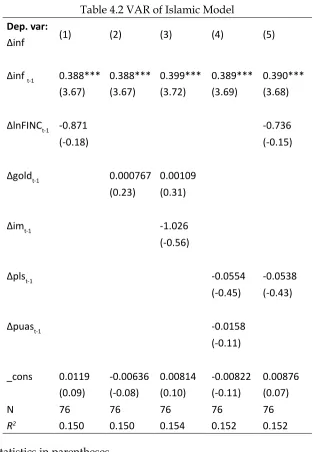
Islamic inancing which is based on real sector activity (model 1 and 5) can negatively affect the inlation but not signiicant and hence when the volume of Islamic inancing
is distributed the volatility of inlation can effectively be dampened. It can be argued that such a condition may occur because of the share of Islamic banking which is
Table 4.2 VAR of Islamic Model
Dep. var:
(1) (2) (3) (4) (5)
Δinf
Δinf t-1 0.388*** 0.388*** 0.399*** 0.389*** 0.390***
(3.67) (3.67) (3.72) (3.69) (3.68)
ΔlnFINCt-1 -0.871 -0.736
(-0.18) (-0.15)
Δgoldt-1 0.000767 0.00109
(0.23) (0.31)
Δimt-1 -1.026
(-0.56)
Δplst-1 -0.0554 -0.0538
(-0.45) (-0.43)
Δpuast-1 -0.0158
(-0.11)
_cons 0.0119 -0.00636 0.00814 -0.00822 0.00876
(0.09) (-0.08) (0.10) (-0.11) (0.07)
N 76 76 76 76 76
R2
0.150 0.150 0.154 0.152 0.152
relatively small compared to conventional counterpart, so that it can not signiicantly impact the inlation. Islamic money along with proit and loss sharing has also a negative effect on inlation while the impact is not signiicant.
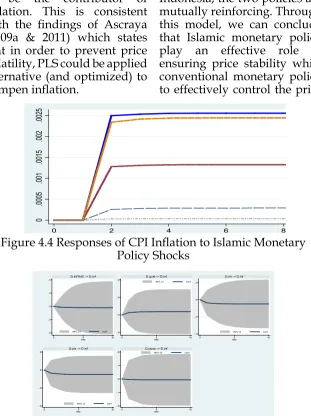
Almost all Islamic monetary instruments (see igure 4.4) such as proit and loss sharing ‘PLS’, Islamic interbank call money market ‘rPUAS’, Total inancing ‘FINC’, base money ‘IM’ can reduce inlation or stabilize price level however gold ‘GOLD’ which is believed to be the main factor of promoting the price stability induce inlation.
The Impulse Response Function (IRF) supports the estimation results. Shocks that occur from Islamic variables are responded positively by inlation thereby they are able to stabilize the price level. In this case, IRF indicates that Islamic money (IM) gives the most effect on price volatility reduction because in Islamic monetary policy, inancing should be based on the real sector which is able to increase investment and boost the economy. Proit-and-loss sharing ‘PLS’ has an impact on reducing the price volatility, because the PLS system is a growth-oriented real sector, unlike the conventional
interest rate. Chapra (2017) proposed the risk-sharing principle to be adopted in the mainstream system since it can safeguard the whole inancial system, promoting a prudent debt. In addition, Ascarya (2009b) stressed that proit-and-loss sharing which should be the principle also in Islamic inancing is perfectly fair system wherein both investors and entrepreneurs can share the proit gained from the business activities as well as the loss incurred in the future. As a result, the exploited party can initially be avoided.
In addition, policy sharia interbank money market rate (rPUAS) also plays a role in dampening inlation, the same as former variable, since rPUAS is based on proit sharing rate in Islamic banking. Furthermore, the single currency ‘GOLD’ seems to be resulting in instability of the price level. This inding is in aggrement with study by Ascraya (2011) which showed that gold still has the potential to increase the inlation rate even though its contribution is smaller than the application of the multiple currencies ‘EXC’.
sharing ‘PLS’ with the share (0.024%) to reduce inlation, total inancing ‘FINC’ with (0.04%) share, and interbank syariah call money market (rPUAS) with 0.01% share, while GOLD (0.14%) appears to be the contributor of inlation. This is consistent with the indings of Ascraya (2009a & 2011) which states that in order to prevent price volatility, PLS could be applied alternative (and optimized) to dampen inlation.
Islamic policies in the short term have a fairly effective role in bringing about stability in prices. This suggests that to achieve stability in the price level or inlation in accordance with the target of Bank Indonesia, the two policies are mutually reinforcing. Through this model, we can conclude that Islamic monetary policy play an effective role in ensuring price stability while conventional monetary policy to effectively control the price
0
Figure 4.4 Responses of CPI Inlation to Islamic Monetary Policy Shocks
level in the initial period only; in the long run it causes price volatility.
With the results as described above, in the context of the application of the dual monetary system in Indonesia, not all conventional monetary policy is able to ensure and maintain price stability, as one of the objectives of the central bank. However, Islamic monetary policy also has a good performance in order to realize these objectives. Although the market share of Shariah banking is relatively lagging behind from conventional banking, but the results already provide empirical evidence for the contribution of the Islamic policy.
V. Conclusion
From the results of VAR for conventional monetary model, it is apparent that all variables are inducing the inlation in Indonesia in particular credit. As the previous studies seem to exclude credit in the model, this study is able to grasp the information about the detrimental effect of credit on increasing the likelihood of high inlation that may certainly lead to a great crisis. Moreover, since this paper seeks to include fractional reserve banking in the model,
it can be concluded that it is capable of illing the gap of the study undertaken by Ascarya (2011), and other previous researches done by Herianingrum and Syapriatama (2016) and Yuliadi et al. (2016). The result indicates that such a fractional reserve system tends to be the key contributor of price volatility in dual banking system adopted by Indonesia. While the interest rate does not impact the inlation, the interbank money market rate (rPUAB) which is rested on interest system appers to be a major threat to price stability.
In contrast, Islamic monetary instruments are proven to be effective in curbing inlation as shown in the estimation results as well as IRF. It is clearly seen that all Islamic instruments has a negative impact on inlation, hence the full implementation of this policy will result in a stable price level. Yet, gold which is widely believed to stable becomes the only Islamic instrument that can possibly trigger the inlation.
References
Achsani, Noer Azam, Oliver Holtemoller, and Hizir Sofyan. (2005). “Econometric and Fuzzy Modeling of Indonesian Money Demand.” In Statistical Tools for Finance and Insurance. Pavel Cizek, Wolfgang Hardle, and Rafal Weron (eds.). Berlin Heidelberg, Germany: Springer-Verlag. pp. 249-270.
Agung, Juda, Solikin M Juhro, Harmanta and Tarsidin. (2016). Managing Monetary and Financial Stability in a Dynamic Global Environment: Bank Indonesia’s Policy Perspectives. BIS Papers No 88 (October).
Alamsyah, Halim, J. Adamanti, Diana Yumanita, and R. I. Astuti. (2014). Siklus Keuangan Indonesia. Bank Indonesia Working Paper (No. WP/8/2014), December.
Ascarya. (2007). Optimum Monetary Policy under Dual Financial/Banking System. Paper presented at 2nd Islamic
Conference (iECONS2007). Faculty of Economics and Mu’amalat, Islamic Science University of Malaysia.
Ascarya. (2009a). Lessons Learned from Repeated Financial Crisis: An Islamic Perspective. Bulletin of Monetary Economics and Banking 12(1): 27 – 69.
Ascarya. (2009b). Toward Optimum Synergy of Monetary Policy in Dual Financial/Banking System. Journal of Indonesian Economiy and Business 24(1): 33 – 48.
Ascarya. (2010). The Future of Dual Monetary Policy in the Light of Global Financial Crises: The Case of Indonesia. Paper selected 3rd KLIFF Essay Competition on Islamic Finance 2010.
Kuala Lumpur, Malaysia, August 3-4.
Ascarya. (2011). How to Eradicate Inlation under Dual Monetary System: The Case of Indonesia. Paper presented at 8th
Ascarya. (2013). Developing Monetary Policy under Dual Financial System in Indonesia. Presentation delivered in Public Lecture on Islamic Financial System. Universitas Muhammadiyah Yogyakarta, Yogyakarta, September 21, 2013.
Cesa-Bianchi, Ambrogio and Sokol, Andrej. (2017). Financial Shocks, Credit Spreads and International Credit Channel. Staff Working Paper No. 693. Bank of England (November).
Chapra, M. Umer. (2017). The Looming International Financial Crisis: Can the Introduction of Risk Sharing in the Financial System as Required by Islamic Finance Play a Positive Role in Reducing its Severity?. Islamic Economic Studies 25(2): 1-13.
De-Ramon, Sebastian and Straughan, M. (2017). The Economic Cost od Capital: a VECM Approach for estimating and Testing the Banking Sector’s Response to changes in Capital Ratios. Staff Working Paper No. 663. Bank of England. (June).
Drehmann, Mathias, Juselius, M and Korinek, A. (2017). Accounting for Debt Service: the Painful Legacy of Credit Booms. BIS Working Paper No. 645. Bank for International Settlements.
Enders, Walter. (2010). Applied Econometric Time Series. Third Edition. Hoboken: John Wiley & Sons, Inc.
Hayek. F. A. (1976). Denationalisation of Money. Westminster, London: The Institute of Economic Affairs.
Hayek. F. A. (2008). Prices and Production and other Works: F.A. Hayek on Money, The Business Cycle, and Gold Standard. Edited by Joseph T. Salerno. Auburn, Alabama: Ludwig von Mises Institute.
Kindleberger, Charles P. and R. Z. Aliber. (2005). Manias, Panics, and Crashes: A History of Financial Crises. Fifth Edition. New Jersey: John Wiley & Sons, Inc.
Meera. A. K. Mydin. (2002). The Islamic Gold Dinar. Selangor, Malaysia: Pelanduk Publications (M) Sdn Bhd.
Meera. A. K. Mydin. (2004). The Theft of Nations: Returning to Gold. Selangor, Malaysia: Pelanduk Publications (M) Sdn Bhd.
Minsky, Hyman. P. (1970). Financial Instability Revisited: The Economics of Disaster. Paper prepared for the Steering Committee for the Fundamental Discount Mechanism Appointed by the Board of Governors of the Federal Reserve System. 1-64.
Minsky, Hyman. P. (2016). Can “It” Happen Again?: Essays
on Instability and Finance. With a new foreword by Jan Toporowski. London and New York: Routledge Classics. Mises. Ludwig Von. (1953). The Theory of Money and Credit. New
Haven: Yale University Press.
Mises. Ludwig Von. (1998). Interventionalism: An Economic Analysis. Edited by Bettina Bien Greaves. New York: The Foundation for Economic Education, Inc.
Mises. Ludwig Von. (2006). The Causes of The Economic Crisis and other Essays Before and After the Great Depression. Auburn, Alabama: Ludwig von Mises Institute.
Saharuddin, D. and Rama, Ali. (2017). Currency System and Its Impact on Economic Stability. Al-Iqthishad: Journal of Islamic Economics 9(2): 289-310.
Shrestha, Min B. dan Khorshed Chowdhury. (2005). ARDL Modelling Approach to Testing the Financial Liberalisation Hypothesis. Working Paper 05-15. Department of Economics, University of Wollongong.
through Exchange Rate Channel. Jurnal Ekonomi dan Studi Pembangunan 14(2): 91-100.
Yuliadi, I., Wiranatakusuma, D. B and Syahputra, A. S. (2016). Dynamics of Inlation Determinants under Dual Monetary Systems: Empirical Evidences from Indonesia and Malaysia. Jurnal Ekonomi dan Bisnis Islam 2(2): 149-166.
Appendix a. Unit Root test
Variable ADF Value MacKinnon Criical Value (5%)
Level 1st Diference Level 1st Diference
CPI Inf -3.091589 -5.967617 -2.900137 -2.900670
IM -2.139282 -7.189076 -2.901217 -2.901217
GOLD -0.413825 -7.995538 -2.899619 -2.900137
PLS -2.805238 -11.76616 -2.899619 -2.900137
INT -2.089824 -3.662435 -2.900670 -2.900670
FM -0.819366 -8.400545 -2.899619 -2.900670
LOAN -0.627279 -4.201535 -2.899619 -3.480463
FINC -2.136680 -3.614344 -2.900670 -3.470851
FRB -0.287591 -8.874091 -2.900670 -2.900670
EXCH 0.319318 -7.524795 -2.899619 -2.900137
PUAB -3.081866 -8.237052 -2.899619 -2.900137
PUAS -3.598283 -11.36603 -2.899619 -2.900137
b. Selelction-order Criteria (for Conventional model)
Exogenous: _cons
Endogenous: lnIHK lnLOAN puab fm frb indep exc
c. Johansen Cointegration Test (for Conventional model)
d. Selelction-order Criteria (for Islamic model)