INTRODUCTION
The issue of character values of the nation is now a demand of various aspects of life. Character education is a moral education plus, which involves aspects of knowledge (cognitive), feeling (feeling), and action (action). Education that is less emphasized on the aspect of character planting raises various problems among students, whether social, economic, and morality. Various problems continue to emerge as a result of the declining quality of character values in students, especially student academic cheating and are considered as common, especially towards national examinations by making efforts such as academic trans-actions or preparing ways to cheat. The re-sults of this academic fraud behavior can
potentially damage the image and expecta-tions of society to the morality of graduates as the future leaders of the nation.
Anderman and Murdock (2007) define a cheater as someone who can accept or perform activities to copy or copy (trace) someone else's work during a test or use notes that are not allowed or help someone cheat when the test or while the exam takes place. Bower (in Kushartanti, 2009) states cheating is an act that uses illegitimate means for a legitimate or honorable pur-pose of obtaining academic success to avoid academic failure. Abbas and Naemi (2011) found that students with high grade (GPA) achievement indices tend to engage in academic fraud, even clever students can easily engage in academic fraud by utiliz-ing all available opportunities. David (2015) states that students with high
self-E. AndayaniA.T. Balkema & G. Westers (tanpa spasi) self-E. Andayani
Kanjuruhan University of Malang, S. Supriadi 49 Street, Malang City, 65148, IndonesiaA.A. Balkema Publishers, Rotterdam, Netherlands (lebih kecil dan miring) afiliasi
New Institute, Gouda, Netherlands
Character Values: Fraud Academic Prevention
Huruf besar Pada kata Pertama, kecuali Windows, model huruf besarSPACE KOSONG
BIARKAN
ABSTRACT: The purpose of this study is to analyze the contribution of added value in academic cheating. A sample of 95 students, used descriptive analysis with percentage done in depth. The findings found for academic achievement is important for students, but the way that most students do academic cheating and is considered as something reasonable. Factors affecting academic cheating are dominated by religious factors, situations, and self-efficacy. Teachers give rewards to students who are honest and have a hard effort. The punishment is done by tearing up the fraudulent student exam sheets, making special notes, repeating the exam in front of the teacher. The im-plications of the research need further study on the culture of anti-cheating through the growth of manners in school.
Keywords:Character Values, fraud academic
esteem and high sense of mastery tend not to cheat. While the pattern of plagiarism, getting answers from friends, helping oth-ers to cheat, and get help will be more ac-ceptable and the most commonly used way of cheating.
The previous studies has been done by Lambert, Hogan and Barton (2003), Thomas Lickona (2011:35), Supraptin-ingrum and Agustini (2015), and Naufal Ilma (2015). Lambert, Hogan and Barton (2003) stated that Academic Fraud or Aca-demic Dishonesty is very difficult to clearly define. While Thomas Lickona (2011) sta-ted that there are 10 signs of times to watch out for, that are (1) increased violence among adolescents, (2) the use of language and worsening words, (3) strong peer-gro-up influence in acts of violence, (4) increa-sed self-destructive behavior such as drug use, alcohol and free sex, (5) The blurring of good and bad moral guidelines, (6) dec-lining work ethic, (7) the lower the respect for parents and teachers, (8) the low res-ponsibility of individuals and citizens, (9) cultivate dishonesty, (10) the presence of suspicion and hatred among others. On the other hand, Supraptiningrum and Agustini (2015) found that character building thro-ugh the school culture can be built by per-forming routine habits such as: (1) routine activities that students do continuously and consistently every time; (2) spontaneous activity by the students spontaneously on the spot; (3) model is behavior, attitude of teacher, educator, and student in giving example through good actions so that expected become role model for other stu-dent; and (4) conditioning by way of the creation of conditions that support the cha-racter of chacha-racter education. And the last, Naufla Ilma (2015) stated that education is very important factor to create character to face globalization challange.
Recognizing the seriousness of the is-sue of academic cheating in the increas-ingly widespread education field, the high academic cheating in the students'
environ-ment, the high level of academic fraud trig-gering factors, the implementation of char-acter values has not been done integrally by the entire academic community. For that we need to find solutions to various prob-lems of academic cheating by implement-ing the values of character in schools that are integrated in the learning process.
RESEARCH METHODS
This research is a qualitative descriptive re-search using scientific way based on ratio-nality, empirical and systematic where sourced from observed behavior researcher to certain object either in the form of ac-tion, word or writing. Researchers partici-pated during field data retrieval, careful notes on what happened, conducted reflec-tive analysis of the various documents found in the field, and made detailed re-search reports.
mem-ber check. In qualitative research, data col-lection is done on natural condition, pri-mary data source, and data collection tech-nique using questionnaire, interview, ob-servation, and documentation.
RESULT AND DISCUSSION RESULT
The results of data analysis indicate that the need for good academic achievement on students of Vocational High School of NU Sunan Ampel Poncokusumo, known 98.9% of respondents stated that it is sho-uld be avoided. Based on data collected re-search is known that 73.7% of students al-ways try, to get good academic achieve-ment because they have the desire to make parents happy, go to university, continue to higher level, and ease in getting a job. While students who do not always try to get academic achievement on all their lessons have the assumption: the lessons that do not take the national exam need not be studied in earnest, not all subjects are favored by the students and are not sure of their ability to get good academic achieve-ment. Most students consider national and vocational exams an important lesson to master, which holds the key whether the student can graduate from the vocational school or not, thus making the student strive to understand and master only on the lessons tested in the exam. 91.6% students do the self study, 5.3% do the group learn-ing activities, and 3.2% student join the extra class.
The result of the research found that the constraints to get the academic achieve-ment there are 55.8% of students stated in-ternal factor, 28.4% of students stated come from external factors, and 15.8% stu-dents stated from internal and external
fac-tors of students. Students' responses to aca-demic fraud were 92.6% of students said not important. From the results, it can be concluded that most students understand that cheating is an act that should not be done, this is because the students reasoned: honesty is the most important thing, good results if obtained from the cheating results do not give pride to students, friends who will Cheated is not necessarily the right an-swer, will damage the morale and character of students, the knowledge we get becomes useless, and do the cheating to make stu-dents not smart. Stustu-dents who commit aca-demic fraud are reasoned: want to get good grades, not be able to do, and afraid of be-ing scolded by parents. Activities that stu-dents usually do in academic fraud include: copying the tasks assigned by the teacher from the work of friends, asking for help friends to complete the tasks given teach-ers, helping friends to complete the tasks given teachers, cheating on the exam / test, make notes Small to be copied at the exam, give cheat compressions during exams / tests, and exchange answers to friends.
Factors that cause students to do academic fraud conducted by students in Vocational High School of NU Sunan Am-pel in this study consist of: 1) individual or personal by 16.4%, 2) personality of 2.4%, 3) peers of 2.4%, 4) Situation of 19.9%, self-efficacy of 16.9%, (bad) moral devel-opment by 14%, and (low on) religion by 27.9%. Based on these results we can know that the factors that cause students to do academic cheating among the seven factors is the greatest religious factor that is equal to 27.9%.
DISCUSSION
the results of research most of the students stated that obtaining good academic achievement is important, because it can make parents happy, upgrade, ease in con-tinuing to higher level and can ease in looking for work, so students should al-ways try hard to learn well Independent, study group or by following the guidance of learning outside school, in addition stu-dents must resist the sense of lazy in learn-ing.
Based on the results of the study known students of Vocational High School of NU Sunan Ampel in trying to get aca-demic achievement there are doing well and also there are doing in a way that is not good, as for a good way is to do: learn in-dependently, study groups, and follow the guidance Learning, while the bad way is to do: copy the tasks assigned to the teacher from the work of friends, ask for help friends to complete the task given by the teacher, cheating on a friend during the exam / test, make small notes to be cheated on the exam, And exchange answers to friends.
Obstacles in obtaining good aca-demic achievement, for a learner is a chal-lenge that must be fought, based on the re-sults of research barriers to get good achievements experienced by students of Vocational High School of NU Sunan Am-pel include: internal factors: lazy in learn-ing, dislikes lessons, habit of cheatlearn-ing, Dif-ficult to understand lessons, less serious in learning, unable to manage study time, of-ten forget from what is learned, external factors: friend, less conducive learning en-vironment, games, social media, girlfriend, family that is not support, no time Learn-ing, teachers, learning facilities.
Vocational High School of NU Sunan Ampel every new student accep-tance, always make introduction of school environment, in which there are training and character education from train student discipline, order, honesty, responsibility,
and mental coaching through istighosah (pray) activity. Over time, a problem is found in the existence of a relatively high level of academic fraud, is certainly a prob-lem that needs to be addressed by the school, because if it is not immediately ad-dressed it will have a negative impact on the character of students. In overcoming these problems, teachers at the time of im-plementation of teaching and learning ac-tivities in every theme and basic compe-tence always instill the values of akhlakul karimah characters to the students in order not to engage in academic cheating activi-ties, both inside and outside the classroom.
Prevention of academic fraud is also done by the teacher at the time the stu-dent will do repetition or exams by way of advice in order to do the students do with full responsibility and not doing academic cheating, in addition the teacher also pro-vide information related to the reward that will be obtained by students if students’ Academic cheating and will provide pun-ishment if the student does academic fraud. In giving reward, the teacher usually do: give praise for honesty and hard work in doing the task, giving spirit to remain hon-est and responsible, giving added value in subjects that I teach from behavior aspect. While on the punishment side the teacher usually performs the following actions: 1) tearing out the Test Answer Sheet (LJK) during the exam and replacing it with the new LJK, 2) making special notes for the assessment process in the report card, re-peating the tests or tests already done, Exam in front of the teacher. This is impor-tant and supported by research from Krist-jan, K. (2013) which states that there should be an idea that should be applied in schools as a first step to instill the value of character and virtue in moral education at school.
for students, because there are still many students who still keep doing academic fraud activity even though it has received sanctions that have been given by the teacher, this is possible because there Some teachers are less consistent in preventing the occurrence of academic cheating by al-lowing students to cheat on the exam, the school can only provide rules through the rules and then handed over directly to the guardian of the classroom and teacher sub-jects related to cheating students and there has been no discussion on the issue of abuses Students further, in addition to the existence of school policies that still raise students who often commit violations.
CONCLUSION
Based on the results of research and discussion, it can be concluded that obtain-ing academic achievement is very impor-tant for the career of advanced students. Patterns that students do to get academic achievement, some are doing with a good way and there is also a cheating so as to give the impact of the growth of disgrace-ful character in the students. Students' re-sponses to academic fraud are common, es-pecially in forced circumstances, even if they know that the activity is a violation and will get sanction from the teacher if caught. Therefore, the method of obtaining academic value should be based on noble values of education which become the ba-sis for human resource development. Char-acter values implemented in preventing the occurrence of academic cheating, done by the way teachers to instill honesty, disci-pline, and responsibility in every teaching and learning activities both in the class-room and outside the classclass-room, in addi-tion to prevenaddi-tion in order to avoid aca-demic cheating by students by giving re-wards and punishment consistently.
BIBLIOGRAPHY
Anderman E. M. dan Murdock T. B. 2007. Psychology of Academic Cheating. London : Academic Press, Inc.
Davidson, M., Khmelkov, V., Baker, K., & Lickona, T. (2011). Values education: The Power2Achieve approach for building sustainability and enduring impact. International Journal of Ed-ucational Research, 50(3), 190-197.
Davis, S. F. Drinan, P. F. Gallant, T. B. 2009. Cheating in School : What We Know and What We Can Do. Chices-ter : Wiley Blackwell.
Doni Kesuma A. (2009). Pendidikan Karakter di Zaman Keblinger. Jakarta: Grasindo.
Kushartanti, A. 2009. Perilaku Mencontek Ditinjau Dari Kepercayaan Diri. In-digenous Jurnal Ilmiah Berkala Psikologi Vol. 11, No. 2, November 2009 : 38-46.
Kristjan, K. 2013. Ten Myths About Char-acter, Virtue and Virtue Education – Plus Three Well-Founded Misgiv-ings. British Journal of Educational Studies, 61:3, Routledge. ISSN: 0007-1005 (Print) 1467-8527 (On-line) Journal homepage: http://www.-tandfonline.com/loi/rbje
done, how often they done it, who does it, and why did
Laura, T.D. 2015. Academic cheating in college students: relations among personal values, self-esteem and mastery. Procedia - Social and Be-havioral Sciences 187 ( 2015 ) 88 – 92.
Masnur Muslich.2011. Pendidikan Karak-ter Menjawab Tantangan Krisis Mul-tidimensional. Jakarta: Sinar Grafika Offset.
Moleong, Lexy, J. 2010. Metodologi Penelitian Kualitatif. Bandung: PT Remaja Rosdakarya
Naufal Ilma, 2015. Peran Pendidikan Se-bagai Modal Utama Membangun Karakter Bangsa. Tadbir Jurnal Manaj. Pendidikan Islam. ISSN 2338-6673 E ISSN 2442-8280. Vol. 3 No. 1 Feb. 2015 Hal. 82-87.
Http://Journal.Iaingoronta-lo.Ac.Id/Index.Php/Tjmpi. IAIN Sultan Amai Gorontalo.
Salahudin, Anas dan Irwanto Alkrienciehie. 2013. Pendidikan Karakter Pen-didikan Berbasis Agama dan Bu-daya Bangsa. Bandung: Pustaka Setia.
Sukmadinata, Nana Syaodih. 2005. Lan-dasan Psikologi Proses Pendidikan. Bandung: PT Rosda Karya.
Saeeda B. & Anam, A. Zahra, N. 2011. Cheating Behavior among Undergrad-uate Students. International Journal of Business and Social Science Vol. 2 No. 3 (Special Issue - January 2011).
GENERAL INSTRUCTIONS Type area
The text should fit exactly into the type area of 187 272 mm (7.36" 10.71"). For correct settings of mar-gins in the Page Setup dialog box (File menu) see Table 1.
Typefont, typesize and spacing
Use Times New Roman 12 point size and 13 point line spacing (Normal;text tag). Use roman type except for the headings (Heading tags), parameters in mathematics (not for log, sin, cos, ln, max., d (in dx), etc), Latin names of species and genera in botany and zool-ogy and the titles of journals and books which should all be in italics. Never use bold, except to denote vec-tors in mathematics. Never underline any text. Use the small font (10 points on 11 points) for tables (Table tags), figure captions (Figure caption tag) and the references (Reference text tag).
Never use letterspacing and never use more than one space after each other.
Jangan mengunderline teks meskipun pent-ing
Getting started
Preparing the new file with the correct tem-plate
be found by selecting the Tools menu, Options and then by tabbing the File Locations. When the Word programme has been started open the File menu and choose New. Now select the tem-plate B2ProcA4.dot or B2ProcLe.dot (see above). Start by renaming the document by clicking Save As in the menu Files. Name your file as follows: First three letters of the file name should be the first three letters of the last name of the first author, the sec-ond three letters should be the first let-ter of the first three words of the title of the paper (e.g. this paper: balpat.-doc). Now you can type your paper, or copy the old version of your paper onto this new formated file.
Copying old text onto new file
Open your old file and the new file. Switch between these two with the Window menu. Select all text of the old file (ex-cluding title, authors, affiliations and abstract) and paste onto bottom of new file, after having deleted the word IN-TRODUCTION (see also section 2.5). Check the margin setting (Page Setup dialog box in File menu) and column settings (see Table 1 for correct set-tings). After this copy the texts which have to be placed in the frames (see sections 2.3 and 2.4 ). In order to avoid disruption of the text
Table 1. Margin settings for A4 size paper and letter size paper. (di sisi sebelah kiri, lebih kecil font)
__________________________________ ____________
Setting A4 size paper Letter size paper
____________ _____________
cm inches cm inches
__________________________________ ____________
Top 1.2 0.47" 0.32 0.13"
Bottom 1.3 0.51" 0.42 0.17"
Left 1.15 0.45" 1.45 0.57"
Right 1.15 0.45" 1.45 0.57"
All other 0.0 0.0" 0.0 0.0"
Column width* 9.0 3.54" 9.0 3.54"
Column spacing* 0.7 0.28" 0.7 0.28"
__________________________________ ___________
* Column dialog box in Format menu. and frames, copy these texts paragraph by
paragraph without including the first word (which includes the old tag). It is best to first retype the first words manually and then to paste the correct text behind. When the new file contains all the text, the old tags in the text should be replaced by the new Balkema tags (see section 3). Before doing this apply automatic formatting (AutoFormat in Format menu).
Title, author and affiliation frame (tdk boleh lebih dari 75 karakter pada judul)
delete the paragraph end). Place the cursor on the A of A.B.Author(s) and type the name of the first author (first the initials and then the last name). If any of the co-authors have the same affiliation as the first author, add his name after an & (or a comma if more names follow). Delete the words A.B. Author etc. and place the cursor on the A of Affiliation. Type the correct affili-ation (Name of the institute, City, State/Province, Country). Now delete the word Affiliation. If there are au-thors linked to other institutes, place the cursor at the end of the affiliation line just typed and give a return. Now type the name(s) of the author(s) and after a return the affiliation. Repeat this procedure until all affiliations have been typed.
All these texts fit in a frame which should not be changed (Width: Exactly 187 mm (7.36"); Height: Exactly 73 mm (2.87") from top margin; Lock an-chor).
Abstract frame (maksimal 150 kata)
If there are no further authors place the cursor one space behind the word AB-STRACT: and type your abstract of not more than 150 words. The top of the first line of the abstract will be 73 mm (2.87") from the top of the type area. The complete abstract will fall in the abstract frame, the settings of which should also not be changed (Width: Exactly 187 mm (7.36"); Height: Automatic; Vertical 73 mm (2.87") from margin; Lock anchor). First line of text or heading
If your text starts with a heading, place the cursor on the I of INTRODUCTION and type the correct text for the head-ing. Now delete the word INTRODUC-TION and start with the text after a re-turn. This text should have the tag First paragraph.
If your text starts without a heading you should place the cursor on the I of IN-TRODUCTION, change the tag to First paragraph and type your text after deleting the word INTRODUCTION. Layout of text
Text and indenting
Text is set in two columns of 9 cm (3.54") width each with 7 mm (0.28") spacing between the columns. All text should be typed in Times New Roman, 12 pt on 13 pt line spacing except for the pa-per title (18 pt on 20 pt), author(s) (14 pt on 16 pt), and the small text in ta-bles, captions and references (10 pt on 11 pt). All line spacing is exact. Never add any space between lines or para-graphs. When a column has blank lines at the bottom of the page, add space above and below headings (see oppo-site column).
First lines of paragraphs are indented 5 mm (0.2") except for paragraphs after a heading or a blank line (First para-graph tag). Paragraf pertama tidak menjorok, paragraf ke2 menjorok Headings
this has to be done manually as fol-lows: Place the cursor on the primary heading, select Paragraph in the For-mat menu, and change the setting for spacing after, from 13 pt to 0 pt. In the same way the setting in the secondary heading for spacing before should be changed from 20 pt to 7 pt.
Listing and numbering
When listing facts use either the style tag List signs or the style tag List num-bers.
Equations
Use the equation editor of the selected word processing programme. Equa-tions are not indented (Formula tag). Number equations consecutively and place the number with the tab key at the end of the line, between paranthe-ses. Refer to equations by these num-bers. See for example Equation 1 be-low:
From the above we note that sin = (x + y)z or:
Kt=
(
1−
R
2t
c
a+
ν
tan
d
)
4 k1
(1)
where ca = interface adhesion; = friction angle at interface; and k1 = shear stiff-ness number.
For simple equations in the text always use superscript and subscript (select Font in the Format menu). Do not use the equation editor between text on same line.
The inline equations (equations within a sentence) in the text will automatically be converted to the AMS notation standard.
(huruf persamaan jgn kabur)
Tables
Locate tables close to the first reference to them in the text and number them con-secutively. Avoid abbreviations in col-umn headings. Indicate units in the line immediately below the heading. Explanations should be given at the foot of the table, not within the table itself. Use only horizontal rules: One above and one below the column head-ings and one at the foot of the table (Table rule tag: Use the Shift-minus key to actually type the rule exactly where you want it). For simple tables use the tab key and not the table op-tion. Type all text in tables in small type: 10 on 11 points (Table text tag). Align all headings to the left of their column and start these headings with an initial capital. Type the caption above the table to the same width as the table (Table caption tag). See for example Table 1. Tabel, huruf pertama besar
Figure captions
Always use the Figure caption style tag (10 points size on 11 points line space). Place the caption underneath the figure (see Section 5). Type as follows: ‘Fig-ure 1. Caption.’ Leave about two lines of space between the figure caption and the text of the paper.
References
Larch, A.A. 1996a. Development ... Larch, A.A. 1996b. Facilities ... Larch, A.A. 1997. Computer ...
Larch, A.A. & Jensen, M.C. 1996. Effects of ...
Larch, A.A. & Smith, B.P. 1993. Alpine ... Typography for references
Last name, First name or Initials (ed.) year. Book title. City: Publisher.
Last name, First name or Initials year. Title of article. Title of Journal (series num-ber if necessary) volume numnum-ber (is-sue number if necessary): page num-bers.
Examples
Grove, A.T. 1980. Geomorphic evolution of the Sahara and the Nile. In M.A.J. Williams & H. Faure (eds), The Sahara and the Nile: 21-35. Rotterdam: Balkema.
Jappelli, R. & Marconi, N. 1997. Recom-mendations and prejudices in the realm of foundation engineering in Italy: A historical review. In Carlo Viggiani (ed.), Geotechnical engineering for the preservation of monuments and histor-ical sites; Proc. intern. symp., Napoli, 3-4 October 1996. Rotterdam: Balkema. 2 author
Johnson, H.L. 1965. Artistic development in autistic children. Child Develop-ment 65(1): 13-16.
Polhill, R.M. 1982. Crotalaria in Africa and Madagascar. Rotterdam: Balkema. Endnote
We would appreciate it if you make use of the enclosed Endnotes stylefile (Har-vard.ens).
Notes
These should be avoided. Insert the infor-mation in the text. In tables the follow-ing reference marks should be used: *, **, etc. and the actual footnotes set di-rectly underneath the table.
Conclusions
Conclusions should state concisely the most important propositions of the pa-per as well as the author’s views of the practical implications of the results. Photographs and figures
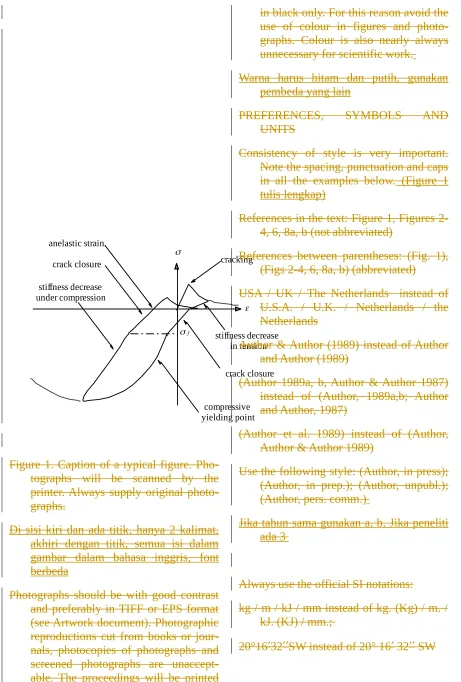
Number figures consecutively in the order in which reference is made to them in the text, making no distinction be-tween diagrams and photographs. Fig-ures should fit within the column width of 90 mm (3.54") or within the type area width of 187 mm (7.36"). Figures, photographs, etc. can be in
f
cracking
stiffness decrease in tension
crack closure
compressive yielding point stiffness decrease
under compression crack closure anelastic strain
Figure 1. Caption of a typical figure. Pho-tographs will be scanned by the printer. Always supply original photo-graphs.
Di sisi kiri dan ada titik, hanya 2 kalimat, akhiri dengan titik, semua isi dalam gambar dalam bahasa inggris, font berbeda
Photographs should be with good contrast and preferably in TIFF or EPS format (see Artwork document). Photographic reproductions cut from books or jour-nals, photocopies of photographs and screened photographs are unaccept-able. The proceedings will be printed
in black only. For this reason avoid the use of colour in figures and photo-graphs. Colour is also nearly always unnecessary for scientific work. Warna harus hitam dan putih, gunakan
pembeda yang lain
PREFERENCES, SYMBOLS AND UNITS
Consistency of style is very important. Note the spacing, punctuation and caps in all the examples below. (Figure 1 tulis lengkap)
References in the text: Figure 1, Figures 2-4, 6, 8a, b (not abbreviated)
References between parentheses: (Fig. 1), (Figs 2-4, 6, 8a, b) (abbreviated) USA / UK / The Netherlands instead of
U.S.A. / U.K. / Netherlands / the Netherlands
Author & Author (1989) instead of Author and Author (1989)
(Author 1989a, b, Author & Author 1987) instead of (Author, 1989a,b; Author and Author, 1987)
(Author et al. 1989) instead of (Author, Author & Author 1989)
Use the following style: (Author, in press); (Author, in prep.); (Author, unpubl.); (Author, pers. comm.)
Jika tahun sama gunakan a, b. Jika peneliti ada 3
Always use the official SI notations:
kg / m / kJ / mm instead of kg. (Kg) / m. / kJ. (KJ) / mm.;
0.50 instead of 0,50 (used in French text); 9000 instead of 9,000 but if more than 10,000: 10,000 instead of 10000 14C instead of C14 / C-14 and BP / BC /
AD instead of B.P. / B.C. / A.D.
× 20 instead of 20 / X20 / x 20; 4 + 5 > 7 instead of 4+5>7 but –8 / +8 instead of – 8 / + 8
e.g. / i.e. instead of e.g., / i.e., Submission of material to the editor
The camera-ready copy PDF file of the complete paper should be created with the enclosed CPI_AR_PDF1.7.jobop-tions file and sent to the editor. To-gether with the MsWord or LaTeX file. All figures should be included as high resolution file in the PDF and word file (see artwork document). Check whether the paper looks the same as this sample: Title at top of first page in 18 points, authors in 14 points and all other text in 12 points on 13 points line space, except for the small text (10 point on 11 point line space) used in tables, captions and references. Also check if the type width is 187 mm (7.36"), the column width 90 mm (3.54"), the page length is 272 mm (10.71") and that the space above the Abstact is exactly as in the sample. Write your name and the shortened ti-tle of the paper in pencil in the bottom margin of each page and number the pages correctly.
Deadline
The above material should be with the edi-tor before the deadline for submission. Any material received too late will not be published.