The Relationship Between Psychological Empowerment And Organizational Commitment: A
Study Among Employees In Construction Sector In Kota Kinabalu, Sabah, Malaysia
Sylvia @ Nabila Azwa binti Ambad1 Arsiah Bahron2
1
(Masters of Business Administration, Universiti Malaysia Sabah, Kota Kinabalu, Sabah, Malaysia) Faculty of Business Management
Universiti Teknologi MARA 40450 Shah Alam Selangor, Malaysia [email protected]
2
(Associate Professor; Doctor of Business Administration, Universiti Kebangsaan Malaysia, Bangi, Selangor, Malaysia)
School of Business and Economics Universiti Malaysia Sabah
Locked Bag 2073 88999 Kota Kinabalu
Sabah, Malaysia +6088-320000 (tel) [email protected]
Abstract
This research aims to investigate the relationship between psychological empowerment and organizational commitment among employees in the construction sector in Kota Kinabalu area. Psychological empowerment dimensions namely meaning, competence, self-determination and impact are the independent variables. The dependent variable is the organizational commitment. Moderating variables consist of education level and length of service. Each of these dimensions was tested to see its relationship with the organizational commitment. The objectives of this study are, firstly, to measure the level of psychological empowerment and organizational commitment among the respondents; secondly, to examine the relationship between independent variables and dependent variable; and thirdly, to investigate whether the education level and length of service moderate the relationship between psychological empowerment and organizational commitment. Questionnaires were distributed to 171 employees from various backgrounds and positions working in the construction sector in Kota Kinabalu. The questionnaire for psychological empowerment was adapted from Spreitzer (1995) and for organizational commitment the questionnaire developed by Mowday, Steers and Porter (1979) had been used. Twelve hypotheses were developed and tested using regression analysis assisted by Statistical Package for Social Science (SPSS) Version 15.0. The findings indicate that when the construction employees feel empowered by giving them autonomy, freedom and opportunity in determining how they do their job, they will be more committed to their organization and put the best effort to ensure the sustainability of the organization. In addition, if the employees are directly involved in outcomes that affect the organization and the more the individuals are involved in decision making, the more committed they would be to their organization. The research findings show that education level and length of service did not significantly moderate the relationship between psychological empowerment and organizational commitment. The implications of each variables and further suggestions for future research are identified and proposed.
Introduction
The major sources of competitive advantage will lie not only in new technology but in the dedication, the quality of the commitment and competence of the workforce. The results of the human capital energy and creativity are the company’s most important resource. Empowerment is the new fuel for the growing and booming workplace (Scott & Jaffe, 1993). Moreover, according to Lawler, Mohrman and Benson, (2001, cited in Spreitzer, 2007) today, more than 70 percent of organizations have adopted some kind of empowerment initiative for at least part of their workforce. Other than that, to be successful in today’s business environment, companies need the knowledge, ideas, energy, and creativity of every employee, from front line workers to the top level managers in the executive suite. Even though empowerment is a good management practices but not everyone opt for it. Firstly, on the manager’s side, they fear of losing the power, control, and authority over their employees. Trust is another issue because most of the time they are not trust the employee because may be sharing information means leaking ideas, plans, and knowledge to competitors. Secondly, on employee’s side, they are reluctant to make responsible decision as they don’t want to be blame for any mistakes arise from the decision.
Hence, this study is trying to answer these questions: “Is there any relationship between each component of the four dimensions in psychological empowerment (PE) and organizational commitment (OC)?” and “To what extent do the employee’s demographic characteristic such as education level and length of service moderate the relationship between PE and OC?”. Accordingly, the objectives of the study are: i) to measure the level of psychological empowerment and organizational commitment among employees in the construction sector in Kota Kinabalu area; ii) to examine the relationship between psychological empowerment (meaning, competence, self-determination and impact) and organizational commitment among employees in the construction sector in Kota Kinabalu; and iii) to investigate whether education level and length of service moderate the relationship between PE and OC.
Literature Review
Psychological Empowerment - As mentions earlier on, this study will focus on the psychological empowerment perspective. Psychological empowerment refers to a set of psychological states that are necessary for individuals to feel a sense of control in relation to their work. Rather than focusing on managerial practices that share power with employees at all levels, the psychological perspective is focused on how employees experience their work. This perspective refers to empowerment as the personal beliefs that employees have about their role in relation to the organization (Spreitzer, 2007). According to Spreitzer the four dimensions of psychological empowerment are as follows: Meaning involves a fit between the needs of one's work role and one's beliefs, values and behaviors (Hackman & Oldham, 1980). Competence refers to self-efficacy specific to one's work, or a belief in one's capability to perform work activities with skill (Gist, 1987; Bandura, 1989, cited in Spreitzer, 2007). Self-determination is a sense of choice in initiating and regulating one's actions (Deci, Connell and Ryan, 1989). It reflects a sense of autonomy or choice over the initiation and continuation of work behavior and processes (e.g., making decisions about work methods, pace, and effort; Bell and Staw, 1989, cited in Spreitzer, 2007). Impactis the degree to which one can influence strategic, administrative, or operating outcomes at work (Ashforth, 1989, cited in Spreitzer, 2007).
Arsiah (2006) discusses a variety of meanings, concepts and structure of psychological empowerment that have been explored and derived from previous scholars and practitioner’s researches such as from Bandura (1986) who articulated empowerment as construct in terms of self-efficacy; Conger and Kanungo (1988) who refers empowerment to a process whereby an individual’s belief in their self-efficacy is enhanced; Konczak et.al (2000) who sought empowerment through the leader’s behavior; Thomas and Velthouse (1990) defined empowerment as increased intrinsic motivation while Spreitzer (1995) has extended it at the workplace; Corsen and Enz (1999) examined the impact of psychological empowerment of service workers in terms of support-based relationships; and Menon (2001) defined empowerment as a psychological state manifested in perceived control, competence and goal; just to name a few.
(Dewettinck et al., 2003) which is an important precondition of job satisfaction that the individual finds work personally meaningful. In contrast, according to Thomas and Velthouse (1990) low level of meaning have been linked to apathy at work and hence lower level of job satisfaction.
Second variable that attracted more researchers is job commitment such as research conducted by Cunningham and Hyman (1996), McDermott, Lashinger, and Shamian (1996), Wu and Short (1996), Kraimer, Seibert and Liden (1999), Liden et al. (2001), Laschinger et al. (2001), Dee et al. (2003) and Dewettinck (2003). All these study show that not all psychological empowerment dimensions have positive relationship to particular variables. For example, Kraimer et al. (1999) found that only self-determination and impact dimension have positive relationship with organizational commitment. On the other hand, influence of type of work (management and non-management) in relationship between psychological empowerment and organizational commitment has been conducted by Cunningham and Hyman (1996). They pointed out that, psychological empowerment among the management staff increased their commitment. However, for non-management staffs, psychological empowerment creates problem to them such as decrease of commitment, low morale and increasing of job stress because inadequate of training, refuse to empowerment and less authority awareness. Moreover, the intention to leave has significant relationship with psychological empowerment (Koberg et al., 1999). Feelings of empowerment were associated with decreased propensity to leave the organization. Koberg et al. (1999) used questionnaire and distribute to technical, professional, and managerial staffs working in private general hospital in a major western metropolitan area.
Organizational Commitment -Generally, organizational commitment is recognized as an individual‘s recognition with a particular organization, the internalization of the values and goals of that organization, and the willingness to exert considerable effort on behalf of the organization (Angle & Perry, 1981; Bateman & Strasser, 1984; Mowday, Steers & Porter, 1979; Porter, 1979; Porter, Steers, Mowday & Boulian, 1974, cited in Griffin and Hepburn, 2005). Commitment to an organization represents loyalty to the organization and desire for involvement in an organization (Lambert, 2004).
Definition of organizational commitment has been further refined and developed over the years (Chen & Francesco, 2001). It has been extensively studied because of its status as a core job attitude governing how employees attitudinally and behaviorally approach their works career (Allen & Meyer, 1990; Mowday, Steers & Porter, 1979; O’Reilly & Chatman, 1986).
Studies indicate that high level of organizational commitment are associated with lower levels of absenteeism and turnover (Cohen, 1993, Mowday et al. 1979) and may serve as a basis for committed action (Reichers, 1985). Therefore, organizational commitment should be an important concern for organizational leadership. Most of the previous studies attempted to identify the linking between organizational commitment with work behavior including turnover (Porter et al., 1974; William and Hazer, 1986), absenteeism (Blau, 1964; Pierce & Dunham, 1987), job performance (DeCotiis & Summers, 1987; Steers, 1977; Chen & Francesco, 2003) and intention to leave (Williams & Hazer, 1986; Shore & Martin, 1989; Iverson & Buttigieg, 1999; Bozeman & Perrewe, 2001; Gautam, Van Dick & Wagner, 2001., 2001; Snape & Redman, 2003). The research by Porter, Steers, Mowday and Boulian (1974) reported that organizational commitment have significant link with psychiatry technician turnover. Organizational commitment level shows how long they tend to stay in organizational. Lower commitment level among employee shows that they will leave the organization soon. The commitment level among employee can be seen as a predictor whether the employee will stay longer or leave the organization.
Research Methodology
Moderating Variable
Figure 1 : Theoretical Framework
Thus, the study tested the following hypotheses.
Hypothesis 1: There is a significant relationship between PE and OC.
Hypothesis 1(a): There is a significant relationship between meaning and OC. Hypothesis 1(b): There is a significant relationship between competence and OC. Hypothesis 1(c): There is a significant relationship between self-determination and OC. Hypothesis 1(d): There is a significant relationship between impact and OC.
Hypothesis 2: Education level significantly moderates the relationship between PE and OC.
Hypothesis 2(a): Education level significantly moderates the relationship between self-determination and OC. Hypothesis 2(b): Education level significantly moderates the relationship between impact and OC.
Hypothesis 3: Length of service significantly moderates the relationship between PE and OC.
Hypothesis 3(a): Length of service significantly moderates the relationship between self-determination and OC. Hypothesis 3(b): Length of service significantly moderates the relationship between impact and OC.
To measure PE, the authors used Spreitzer (1992, 1995a) based on the definition given by Thomas and Velthouse (1990) and the instrument modified by Fulford and Enz (1995). The instrument has 12 items (3 items for each of the four dimensions). The Cronbach alphas are : meaning = 0.836 , competence = 0.823 , self-determination = 0.764 and impact = 0.903. For OC, the instrument by Mowday et al. (1979) was adopted. It has 15 items and a Cronbach alpha score of 0.841 (Appendix A). All the items are measured using a 7-point Likert scale from 1 = strongly disagree to 7 = strongly agree.
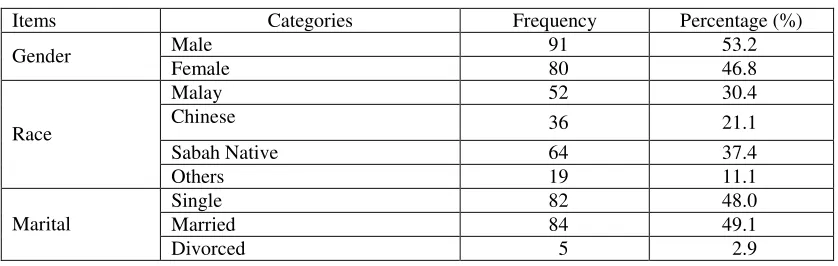
The sampling method used was the convenience sampling method. This is the most widely used of all sampling techniques, and it is the least justifiable (Vogt, 2007). A total of 230 questionnaires were distributed to 20 construction companies in Kota Kinabalu, Sabah where 10 employees of each company were chosen randomly by the management as respondents. The respondents profile is shown in Table 1.
Table 1 : Respondents’ Profile
Items Categories Frequency Percentage (%)
Male 91 53.2
Gender
Female 80 46.8
Malay 52 30.4
Chinese 36 21.1
Sabah Native 64 37.4
Race
Others 19 11.1
Single 82 48.0
Married 84 49.1
Marital
Divorced 5 2.9
PSYCHOLOGICAL EMPOWERMENT Meaning (believe in work value) Competence (believe in capability) Self-determination (sense of having choice)
Impact (degree of influencing)
ORGANIZATIONAL COMMITMENT
Secondary School 44 25.7
Certificate 25 14.6
Diploma 47 27.5
Bachelor Degree 53 31.0
Education
Masters 2 1.2
RM 500 – RM 1500 67 39.2
RM 1600 - RM 2500 55 32.2
RM 2600 - RM 3500 31 18.1
Salary
RM 3600 and above 18 10.5
Administrator 61 35.7
Supervisor 41 24.0
Engineer/QS/Surveyor 38 22.2
Manager 27 15.8
Designation
Others 4 2.3
Fresh (Less than 1 Year) 32 18.7
Junior (1-5 Years) 75 43.9
Tenure
Senior (6 years and above) 64 37.4
n = 171
Data management and analysis was performed using Statistical Package for Social Science (SPSS). The data from questionnaires were coded and analyzed. Methods of analysis used are descriptive statistic, linear regression and hierarchical linear regression.
Research Findings
Table 2 shows the descriptive statistics for the variables. For overall PE, the mean is 5.3621, while for individual dimension, meaning scores the highest with a mean of 6.0234 followed by competence (6.1014), self-determination (5.3255) and impact (4.8168). The level of OC is moderate with a mean of 4.8265.
Table 2: Descriptive Statistic of Independent Variables and Dependent Variables
Variables Minimum Maximum Mean Standard
Deviation Psychological Empowerment 1.92 6.50 5.3621 .77577
Meaning 1.00 7.00 6.0234 1.10707
Competence 1.33 7.00 6.1014 .95322
Self-Determination 1.33 7.00 5.3255 1.29451
Impact 1.00 7.00 4.8168 1.54588
Organizational Commitment 1.67 6.60 4.8265 1.00069
The regression test was used to test Hypotheses 1 namely 1a, b, c and d. Table 3 shows that overall, PE explains 29% of variance in OC. PE significantly affects the employees’ OC.
Table 3 : Model Summary of Linear Regression Analysis
Model R R Square Adjusted R
Square
F Sig. (F)
1 .538(a) .290 .273 16.934 .000
a Predictors: (Constant), MeanImpact, MeanMeaning, MeanSelf-determination, MeanCompetence
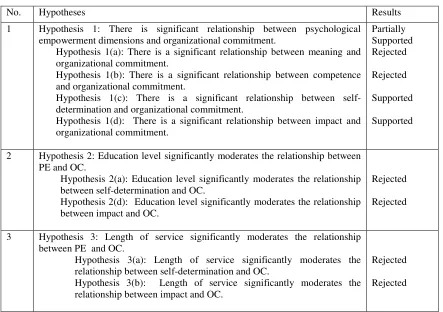
But if the four dimensions are considered separately (as shown in Table 4), only self-determination and impact significantly affect OC. Meaning and competence do not influence OC significantly. Consequently, the results show a partial support for Hypotheses 1.
Table 4 : The Results of Multiple Regressions
Model
Unstandardized Coefficients
Standardized
Coefficients t Sig. Collinearity Statistics
B
Std.
Error Beta Tolerance VIF
1 (Constant) 2.627 .443 5.930 .000
Meaning .156 .082 .173 1.902 .059 .519 1.925
Competence .066 .097 .062 .677 .499 .503 1.988
Self-determination -.158 .067 -.204 -2.349 .020 .566 1.768
Impact .353 .053 .545 6.688 .000 .644 1.554
Dependent Variable: MeanOrganizationalCommitment
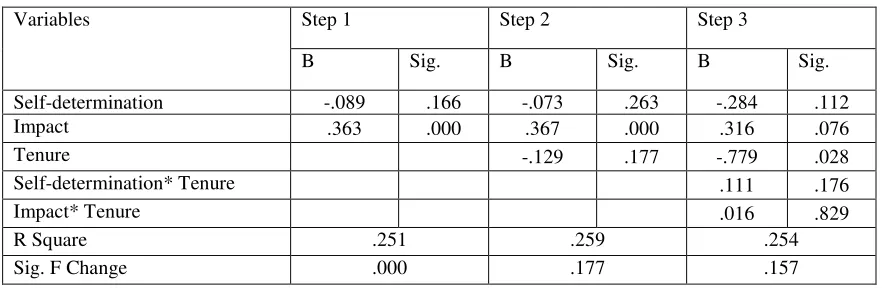
For the moderating effect of education level and length of service, the hierarchical regression analysis show that there is no significant moderating effect of both demographic factors on the relationship between PE and OC (refer to Table 5 and 6). Therefore, Hypotheses 2 and 3 are both rejected.
Table 5 : Moderating Effect Of Education Level
Step 1 Step 2 Step 3
Variables
B Sig. B Sig. B Sig.
Self-determination -.089 .166 -.068 .300 -.255 .087
Impact .363 .000 .355 .000 .139 .340
Education - - -.093 .102 -.951 .000
Self-determination* Education - - - - .095 .089
Impact* Education - - - - .072 .131
R Square .251 .263 .314
Sig. F Change .000 .102 .003
a Dependent Variable: MeanOrganizationalCommitment
Table 6 : Moderating Effect Of Length Of Service
Step 1 Step 2 Step 3
Variables
B Sig. B Sig. B Sig.
Self-determination -.089 .166 -.073 .263 -.284 .112
Impact .363 .000 .367 .000 .316 .076
Tenure -.129 .177 -.779 .028
Self-determination* Tenure .111 .176
Impact* Tenure .016 .829
R Square .251 .259 .254
Sig. F Change .000 .177 .157
The summary of hypotheses testing is shown in Table 7.
Table 7 : Summary Of Findings
No. Hypotheses Results
1 Hypothesis 1: There is significant relationship between psychological empowerment dimensions and organizational commitment.
Hypothesis 1(a): There is a significant relationship between meaning and organizational commitment.
Hypothesis 1(b): There is a significant relationship between competence and organizational commitment.
Hypothesis 1(c): There is a significant relationship between self-determination and organizational commitment.
Hypothesis 1(d): There is a significant relationship between impact and organizational commitment.
2 Hypothesis 2: Education level significantly moderates the relationship between PE and OC.
Hypothesis 2(a): Education level significantly moderates the relationship between self-determination and OC.
Hypothesis 2(d): Education level significantly moderates the relationship between impact and OC.
Rejected
Rejected
3 Hypothesis 3: Length of service significantly moderates the relationship between PE and OC.
Hypothesis 3(a): Length of service significantly moderates the relationship between self-determination and OC.
Hypothesis 3(b): Length of service significantly moderates the relationship between impact and OC.
Rejected
Rejected
Discussion
Level of PE and OC among respondents
The findings showed that construction employees do experience empowerment in the workplace and committed to their organization. The mean of the psychological empowerment is 5.3621 (7-point scale) which is well above average. The organizational commitment of the respondents is also above average which is 4.8265 (7-point scale). The results found that most of them are committed and tends to be dedicated to their organization.
The experience of empowerment is manifested in all four dimensions – if any one dimension is missing, then the experience of empowerment will be limited. For example, if people have discretion to make decisions (i.e., self-determination) but they don’t care about the kinds of decisions they can make (i.e., they lack a sense of meaning), they will not feel empowered. Alternatively, if people believe they can make an impact but don’t feel like they have the skills and abilities to do their job well (i.e., they lack a sense of competence), they will not feel empowered as well (Spreitzer, 2007). It is suggested by Thomas and Velthouse (1990) that empowered employee should perform better than those who are relatively less empowered. Spreitzer (1995a) argues that empowered employees are likely to be seen as effective because they proactively execute their responsibility. This is because they see themselves as competent and able to influence their jobs and work environments in meaningful ways (Dewettinck et al., 2003).
Relationship between PE and OC
Although the respondents value and organization value is similar, it’s still not enough for them to be loyal to the organization. It is the same with competence, even though the respondents are confident with their ability perform a particular task, it does not guarantee their commitment towards their organization.
The results are consistent with other previous study that is not all psychological empowerment dimensions have positive relationship to any particular variables. For example, Kraimer et al. (1999) found that only self-determination and impact dimension have positive relationship with organizational commitment. On the other hand, influence of type of work (management and non-management) in relationship between psychological empowerment and organizational commitment has been conducted by Cunningham and Hyman (1996). Their findings points out that, psychological empowerment among the management staff has increased their commitment. However, for non-management staffs psychological empowerment creates problem to them such as a decrease of commitment, low morale and increasing of job stress due to inadequate of training, refuse to empowerment and less authority awareness. So for this study, it can be concluded that employees of the construction companies have identical value with their organization. However, they still tend to leave the organization if there is better offer elsewhere.
The moderating effect of education level and tenure on the relationship
The results showed that education level and length of service do not significantly moderate the relationship between psychological empowerment and organizational commitment. This is due to the same opinion of the respondents regardless their qualification and their tenure with the current organization. This findings was consistent with Sagie's work (1998) (cited in Tatus, 2000) that discusses employee absenteeism, organizational commitment and job satisfaction; it did not explore the relationship between length of service and job satisfaction. It found that intention to quit, which is of some relevance to length of service, was not significantly related with either voluntary or involuntary absenteeism.
A number of earlier studies suggested that the length of service in a job could be used to estimate the levels of job satisfaction of workers. The assumption is that the less satisfied workers tend to resign while the more satisfied ones tend to remain in a job. Consistent with this thinking, a negative relationship between job satisfaction and turnover has been reported by several researchers (Atchinson & Lefferts, 1975; Karp et al., 1973; Locke, 1976; Mobley et al., 1979, cited in Titus, 2000).
Conclusion
The main objective of this research is to see the relationship between psychological empowerment and organizational commitment among employees in the construction sector in Kota Kinabalu. The research also interested to see the influence of educational level and length of service as moderating factors. Based on the data collected and analyzed using statistical analysis, it can be concluded that was a significant relationship between the variables. However, for the psychological empowerment dimensions, the findings showed that it is partially supported namely meaning and competence that do not influence the organizational commitment, whereas self-determination and impact do influenced their commitment to the organization. Employers should also treat their employees better in order to retain good and talented people in their organization.
Since the R square is only 29.90%, this indicates that, there are other important variables besides psychological empowerment that influence the organizational commitment. For example, most of the previous studies attempted to identify the linking between organizational commitment with work behavior including turnover (Porter et al., 1974; William & Hazer, 1986), absenteeism (Blau, 1986; Pierce & Dunham, 1987), job performance (DeCotiis & Summers, 1987; Steers, 1977; Chen & Francesco, 2003) and intention to leave (Williams & Hazer, 1986; Shore & Martin, 1989; Iverson & Buttigieg, 1999; Bozeman & Perrewe, 2001; Gautam et al., 2001; Snape & Redman, 2003). The data do not represent the whole employees in the construction sector but the findings present a clear trend on the relationship between psychological empowerment and organizational commitment. However the objectives of this research have successfully been achieved. Lastly, hopefully this research will contribute a great deal towards a better and ideal way of overall organizational management and human capital management in particular.
Bibliography
Avolio, B.J., Zhu, W., Koh, W., and Bhatia, P. 2004. Transformational leadership and organizational commitment: Mediating role of psychological empowerment and moderating role of structural distance. Journal of Organizational Behavior, 25: 951-968.
Arsiah Bahron, 2006. Kesan Empowermen Psikologi Ke Atas Kepuasaan Kerja, Komitmen Organisasi Dan Kelakuan Kewargaan Organisasi., Dissertation, Universiti Kebangsaan Malaysia.( Unpublished)
Azize Ergeneli, Guler Saglam Ari & Selin Metin 2006. Psychological Empowerment and Its Relationship to Trust In Immediate Managers,Journal of Business Research,60: 41-49
Brief, A.P. & Nord, W.R. 1990. Meaningof Occupational Work. Lexington, MA: Lexington Books.
Cohen A. 2007. Commitment Before and After: An Evaluation and Reconceptualization of Organizational Commitment, Human Resource Management Review.17:336-354
Conger, J. A. & Kanungo R.N. 1988. The Empowerment Process:Integrating Theory and Practice. Academy of Management Review13(3):(471-482).
Cunningham, I. and Hyman, J. 1996. Empowerment: The Right Medicine for Improving Employee Commitment and Moral in The NHS?Health Manpower Management,22(6):14-224.
Dainty R.J., Bryman A. and Price D.F. 2002. Empowerment Within The UK Construction Sector,Leadership and Organizational Development Journal23(6): 333-342.
Deci, E.L., Cornnell, J.P. and Ryan, R.M. 1989. Self-determination in a work organization. Journal of Applied Psychology74(4):580-590.
Dee,J.R., Henkin A. B., Duemer, L. 2003. Structural Antecedents and Psychological Correlates of Teacher Empowerment.Journal of Educational Administration41(3): 0957-8234.
Dewettink, K., Jagdip Singh, Buyens, D. 2003. Psychological Empowerment in The Workplace:
Reviewing the Empowerment Effects on Critical Work Outcomes.
Working Paper
Eylon, D. and Bamberger, P. 2000. Empowerment cognitions and empowerment acts: Recognizing the
importance of gender.
Group and Organization Management
,
25
: 354-372.
Erdheim ,J.,Mo. Wong, Zicker M.J. 2006. Linking The Big Five Personality Constructs To Organizational Commitment,Personality and Individual Differences41:959-970
Fuller, J.B., Morrison, R., Jones, L., Bridger, D., and Brown, V. 1999. The Effects Of Psychological Empowerment On Transformational Leadership And Job Satisfaction.The Journal of Social Psychology, 139(3): 389-391.
Holt, G.D, Peter E. D. and L. Jawahar Nesan, 2000. Employee Empowerment in Construction: An Implementation Model for Process Improvement, Team Performance Management: An International Journal,6(314) : 47-51.
Griffin M.L and Hepburn J.R, 2005. Side-bets and Reciprocity as Determinants of Organizational Commitment Among Correctional Officers,Journal of Criminal Justice,33: 611-625
Green, N.D and Macandrew, J. 1999. Re-empowering The Empowered – The Ultimate Challenge?, Personnel Review,3 :258-278
Hackman, J.R. and Oldham, G.R. 1980.Work Redesign.Massachusetss: Addison Wesley.
Hancer,M. and George, R.T. 2003. Psychological Empowerment of Non-Supervisory Employees Working In Full-Service Restaurants,Hospitality Management,22: 3-16
Heller, F. 1998. Influence at Work: A 25-year Program of Research. .Human Relations, 51(12), 1425-1456.
Herzberg. F. 1968. “One More Time: How do You Motivate Employees?” Harvard Business Review,Vol. 46 No. 1.pp. 53-62.
Henkin A.B and Marchiori, D.C. 2003. Empowerment and Organizational Commitment of Chiropractic Faculty, Journal Of Manipulative and Psychological Therapeutics
Hochwalder J and Brucefors A.B. 2005. Psychological Empowerment at The Workplace As Predictor of Ill Health, Personality and Individual Differences,39:1237-1248
The Gateway To Lucrative Markets In Greater Eaga-East Asia Growth Areas.
Jason, A.2007. Organizing Informal Workers In The Urban Economy: The Case of Construction Industry in Dar Es Salaam, Tanzania,Habitat International,10
Konczack L.J., Stelly, D.J. and Trusty, M.L. 2000. Defining and Measuring Empowering Leader Behaviors: Development of An Upward Feedback Instrument. Educational and Psychological Measurement 60 (2): 301 – 313
Koberg, C. S., Boss, W., Senjem, J. C., and Goodman, E. A. 1999. Antecedents And Outcomes Of Empowerment: Empirical Evidence From The Health Care Industry.Group and Organization Management, 34(1): 71-91.
Kraimer, M.L., Seibert, S.E. and Liden, R.C. 1999. Psychological Empowerment as a Multidimensional Construct: A Test of Construct Validity.Educational and Pyschological Measurement,59(1): 127-142.
Lambert, S.J. 2000, Added Benefits: The Link Between Work-Life Benefits and Organizational Citizenship Behavior.Academy of Management Journal43(5):801-815.
Lawler, E.E. 1994. From Job-based to competency-based organizations.Journal of Organizational Behavior15(1): 3 -15.
Laschinger, H.K..S., Finegan, J.E., Shamian, J. and Wilk, P. 2004. A longitudinal analysis of the impact
of workplace empowerment on work satisfaction.
Journal of Organizational Behaviors
, 24:
527-545.
Liden, R.C., and Arad, 1996. A power perspective of empowerment and work groups: Implication for HRM research. In G.R. Ferris (Ed.),Research in personnel and HRM, 14: 205-252. Greenwich, CT: JAI Press.
Liden, R. C, Wayne, S.J and Stilwell, D. 1993. A Longitudinal Study On The Early Development of Leader-member Exchanges, Journal of Applied Psychology,78(4): 662-675.
Liden, R.C., Wayne, S.J. and Sparrowe, R.T. 2000. An Examination of The Mediating Role of Psychological Empowerment on The Relations Between the Job, Interpersonal relationship and Work Outcomes.Journal of Applied Psychology,85(3),407-16
Locke, E.A. 1976. The Nature and Causes of Job Satisfication. In: M.Dunette (Ed.), The Handbook Of Industrial and Organizational Pyscohology: Chicago:Rand McNally.
Menon, S.T. 1999. Psychological empowerment: definition, measurement, and Validation, Canadian Journal of Behavioral Sciences,31(3): 161-164.
Menon, S.T. 2001. Employee Empowerment: An Integrative Psychological Approach. Apply Psychology: An International Review50(1):153-180.
Mowday, R.T, Steers R.M and Porter L.W. 1979. The Measurement of Organizational Commitment, Journal of Vocational Behavior,14: 224-247.
Nesan, L.J. and Holt, G.D. 1999. Empowerment in Construction: The Way Forward for Performance Improvement, Research Studies Press, Baldock.
Niehoff, B.P., Enz, C.A., and Grover, R.A. 1990. The impact of top management actions on employee attitudes and perception, Group and Organization Studies.
O'Reilly, C., Chatman, J. 1986. "Organizational Commitment and Psychological Attachment: The Effects Of Compliance, Identification, and Internalization On Pro-Social Behavior",Journal Of Applied Psychology, Vol. 71 No.3, Pp.492-9.
Oshagbemi, T. 2000. "Is length of service related to the level of job satisfaction?"International Journal of Social Economics, MCB University27(3):0306-8293
Quinn, R.E. and Spreitzer, G.M. 1997. The road to empowerment: Seven Questions every leader should consider. Organizational Dynamics, Autumn:37-49
Rothstein, L.R. 1995. The Empowerment Effort That Came Undone.Harvard Business Review,73(1):20-31
S. Arzu Wasti 2005. Commitment Profile: Combinations of Organizational Commitment Froms and Job Outcomes, Journal of Vocational Behavior,67:290-308
Scott, C.D and Jaffe, D. T. 1993. "Empowerment: Building a Committed Workforce." Kogan Page Ltd, 120 Pentonville Road, London.
Shah Jalal Sarker, Crossman A, and Chinmeteepituck P. 2003. The Relationships Of Age And Length Of Service With Job Satisfaction: An Examination Of Hotel Employees In Thailand, Journal of Managerial Psychology,Vol. 18(7): 745-758
Spreitzer, G.M. 1995a. Psychological Empowerment In The Workplace: Dimensions, Measurement, And Validation.Academy Of Management Journal, 38(5),1442-65.
Spreitzer, G.M. 1995b. An Empirical Test of A Comprhensive Model of Intrapersonal Empowerment In The Workplace: AmericanJournal of Community Pschology, 23:601-629.
Spreitzer, G.M. 1996. Social Structural Characteristics Of Psychological Empowerment.Academy Of Management Journal, 39(2), 483-504.
Spreitzer, G.M., Kizilos, M.A. and Nason, S.W. 1997. A Dimensional Analysis Of The Relationship Between Psychological Empowerment And Effectiveness, Satisfaction, And Strain. Journal Of Management, 23(5), 679-704.
Spreitzer, G.M. 2007.Taking Stock: A review of more than twenty years of research on empowerment at work. In The Handbook of Organizational Behavior, C. Cooper and J. Barling eds. Sage Publications.
Siegall, M. and Gardner, S. 2000. Contextual Factors of Psychological Empowerment,Personnel Review
Titus Oshagbemi, 2000. Is Length of Service related to the level of Job Satisfaction?. International Journal of Social Economics,27(3) : 213-226.
Thomas, K. W. ,Velthouse., B.A. 1990. Cognitive Elements of Empowerment: An "intepretive" Model of Intrinsic Task Motivation.Academy of Management Review15(4):(666-681).