INCIDENCE AND SPREAD OF HUANGLONGBING (HLB) OR CITRUS GREENING DISEASE IN RELATION TO THE DISTRIBUTION AND FLUCTUATION OF Diaphorina citri Kuwayama (HEMIPTERA: PSYLLIDAE)
POPULATION IN A CITRUS ORCHARD IN SARAWAK, MALAYSIA
Sui Sien Leong*1, Stephen Chan Teck Leong1 & G. Andrew C. Beattie2
1 Faculty of Agricultural Science and Forestry,
Universiti Putra Malaysia Campus Bintulu Sarawak, Nyabau Road, 97008 Bintulu, Sarawak, Malaysia.
2 Centre for Plant and Food Science,
University of Western Sydney,
Locked Bag 1797, Penrith, New South Wales 2751, Australia.
*Corresponding: [email protected]
ABSTRACT
Diaphorina citri Kuwayama is a very prolific and most efficient vector for the fast huanglonbing (HLB) transmission which has destroyed nearly all citrus orchards with the economic deficit of RM 6.5 million or USD 1.6 million in Malaysia. D. citri coupled with HLB is therefore the greatest obstacle to the financial development of a sustainable and viable citrus industry in Malaysia. The study was aimed to evaluate the spread of HLB disease vectored by
D. citri in relation to its spatial distribution and flight activity in response to flush cycles in a healthy orchard. Four types of yellow traps used to monitor for flight activity of this disease vector were evaluated monthly between June 2011 and December 2012. Both vector populations and HLB disease symptoms were monitored regularly between 2011 and 2014. A molecular diagnostic technique, Polymerase chain reaction (PCR) procedures was used to confirm the presence of the bacterium in diseased trees. D. citri adult populations expanded exponentially amid durations of cyclic production of new flush growths. The highest number of adult D. citri was captured by Rebel brown-yellow traps followed by Bamboo pole and yellow sticky traps with significant differences during the rainy months with monthly rainfall between 581-919 mm from October 2011 to March 2012 while higher catches were obtained by Bamboo pole traps during the dry months with monthly rainfall from 374-458 mm between May – September 2012. Yellow traps provided an indication of adult abundance and flight activity. It took about 21 months for D. citri population to spread all over the entire citrus garden. Rates of HLB transmission were related to high vector populations and spread was related to dispersing adults. Levels of HLB infected trees as determined by PCR increased progressively from 2.4% to 19.3% and 42.2% within four years after planting. The activity of infective D. citri is the key to HLB disease spread in a citrus orchard.
ISSN 1394-5130 25
ABSTRAK
Diaphorina citri Kuwayama adalah vektor yang sangat aktif dan cekap dalam penyebaran penyakit huanglonbing (HLB) yang telah memusnahkan hampir semua kebun sitrus dengan menyebabkan defisit ekonomi di Malaysia berjumlah RM 6.5 juta atau USD 1.6 juta. Oleh itu,
D. citri bersama HLB telah manjadi penghalang terbesar bagi pembangunan industri sitrus yang lestari dan maju di Malaysia. Kajian ini bertujuan untuk menilai penyebaran penyakit HLB yang dilancarkan oleh D. citri berkaitan dengan taburan spatial dan aktiviti penerbangan induk sebagai tindak balas terhadap sitrus di kebun. Empat jenis perangkap kuning telah digunakan untuk memantau aktiviti penerbangan vektor penyakit ini. Kajian ini dinilai stiap bulan di antara bulan Jun 2011 hingga Disember 2012. Kedua-dua populasi vektor dan gejala penyakit HLB dipantau secara berkala antara tahun 2011 dan 2014. Teknik diagnostik Tindakbalas Berantai Polimerase (PCR) digunakan untuk mengesahkan kehadiran bakteria pada pokok yang berpenyakit. Populasi serangga psyllid dewasa mengalami peningkatan secara eksponensial dengan kadar tumbesaran daun muda. Ini jelas menunjukkan penghijrahan serta taburan serangga dewasa adalah berkaitan dengan kitaran fenologi pokok perumah. Sebilangan besar induk dewasa D. citri disampel menggunakan Rebell perangkap coklat-kuning, diikuti oleh tiang buluh dan perangkap melekit kuning menunjukkan perbezaan yang ketara pada musim hujan dengan hujan bulanan 581-919 mm yangbermula dari bulan Oktober 2011 hingga Mac 2012 manakala tangkapan yang lebih tinggi diperolehi oleh perangkap tiang buluh pada bulan-bulan musim kering yang bermula dari bulan Mei hingga September 2012. Perangkap kuning memberikan petunjuk yang menunjukkan kelimpahan dewasa dan aktiviti penerbangan mereka. Penyebaran D. citri yang semakin meningkat, dari pokok ke pokok dan memerlukan waktu sekitar 21 bulan untuk menyebarkan ke seluruh taman sitrus. Kadar transmisi HLB adalah berkaitan dengan populasi vektor yang tinggi dan kejadian penyakit adalah berkaitan dengan sebaran serangga dewasa. Tahap pokok yang dijangkiti HLB seperti yang ditentukan oleh PCR meningkat secara progresif dari 2.4% kepada 19.3% dan 42.2% dalam empat tahun setelah penanaman. Kegiatan infeksi D. citri adalah kunci penyebaran penyakit HLB di kebun sitrus.
Kata kunci: Sitrus, Diaphorina citri, Huanglongbing, kerosakkan, penyebaran, Malaysia.
INTRODUCTION
The Asian citrus psyllid (ACP),Diaphorina citri Kuwayama, (Hemiptera: Psyllidae), being a very prolific and most efficient vector of one of the two known huanglongbing (HLB) disease, formerly known as citrus greening (Aubert 1987; Halbert & Manjunath 2004; Leong et al. 2019; Weinert et al. 2004). Citrus greening is a debilitating and one of the world's most severe citrus diseases caused by a phloem-limited Gram-negative bacterium, non-culturable causal agent ‘Candidatus Liberibacter asiaticus’ (α -Proteobacteria) (Bové 2006) in Asia. HLB is a devastating and fastidious citrus disease, attacking mandarin and orange varieties (Da Graca & Korsten 2004). It is the leading cause of loss in the blossoming of citrus in Asia (Aubert 1990), USA and South Africa (Tiwari et al. 2011), and currently no successful effective treatment for affected trees. According to Beattie & Holford (2008), HLB disease detected in the year after 1970 posed a destructive threat to the Malaysian citrus corporation. HLB together with its vectors indeed offer extensive intimidation to the profitability or even sustainability of the Malaysian citrus and nursery businesses, particularly in citrus restoration as one of the important agricultural industry in Malaysia. It transmits expeditiously and gained national importance due to the drastic transmission of HLB in Malaysia at intervals of 1989 and 1992, which destroyed nearly all orchards in the Malay Peninsular and Eastern Malaysia, along with
ISSN 1394-5130 26 Sarawak (Lim et al. 1990; Teo et al. 2000). The once-flourishing citrus industry in Sarawak, Malaysia was destroyed fully by this HLB in 1992 (Teo et al. 2000). By the year of 1991, the disease had ruined a total orchard area involving 1,143 ha. The projected yield loss of 310,000 trees reaches 6,500 metric tons of fruit and the economic deficit of RM 6.5 million or USD 1.6 million (Teo et al. 2000). Despite large increases in areas harvested in Malaysia, there were noticeable periods of decline due to HLB. The presence of pest D. citri in previously considered HLB-free citrus orchards is considered as potential threat in Malaysia because D. citri can cause the most ultimate serious citrus diseases that could harm the viability, productivity and sustainability of the Malaysian citrus industry. HLB disease is therefore the greatest obstacle to the financial development of sustainable citrus industry in Malaysia and seriously affects the earnings of national economies and farmers.
Control of D. citri with pesticides and bio-control agents rely on studies of relationships between population density and spatial distribution pattern of the vector in major citrus growing countries, and dispersion indices calculated for eggs, nymphs and adults in D. citri populations underlie reliable sampling plan for pest management. The use of selective insecticides and bio-control agents such as Tamarixia radiata (Waterston) (Hymenoptera: Eupholidae) and
Diaphorencyrtus aligarhensis (Shafee, Alam and Argarwal) (Hymenoptera: Encyrtidae) are recommended for the integrated pest management (IPM) program of D. citri. Nonetheless, the efficiency of these parasites is narrowing by the presence of hyperparasitic wasps. These specialist parasitoids are at present being evaluated for possible use in suppressing the psyllid population in citrus (Hoy & Nguyen 2000; Leong et al. 2011). Michaud (2002) reported that several ladybeetle species are found to prey on D. citri.
HLB disease shows signs of distinctive symptoms such as leaf becomes yellowish, mottling, and even blotching by visual inspection. These are often the first symptoms to appear. Later, the leaves are narrow, straight and with chloratic patterns similar to those caused by deficiencies in zinc and iron with sectorial dieback, the uneven coloration of the fruits and lopsided fruit with aborted seeds (Aubert et al. 1985; Zhao 1981). HLB is best controlled by the integrated management of diseases using healthy and Polymerase Chain Reaction (PCR) certified HLB-free planting materials, removal of diseased branches or trees and integrated vector control programs (Zhao 2017). Control of the disease is therefore, aside from propagation of disease-free trees, aimed at preventing spread by infective D. citri. It is very important for farmers to prevent the occurrence of high vector population densities especially on young flush growth on which eggs are laid (Catling 1970). Monitoring of HLB spread and the citrus psyllid incidence is imperative. Common methods for monitoring adult citrus psylla include use of yellow sticky traps (Regmi & Lama 1988), mouth aspirators (Aubert & Quilici 1984), vacuum aspirators, and careful visual inspections of young flushes/leaves and twigs to identify the occurrence of eggs and nymphs (Catling 1970).
Although examination of young flushes or leaves and twigs for the presence of psyllid egg, nymph and adult may be an appropriate sampling method for D. citri, it is tedious and time-consuming. To the best knowledge of the authors, very little information to date, is available on the flying behaviour of D. citri, although such knowledge is of great significance for citrus growers. However, coloured traps can provide a simple method of measuring fluctuations in psyllid populations and for obtaining information on the flying behaviour of adult psylla. Use of yellow sticky traps has been evaluated for monitoring D. citri at various sites ranging from 20 m to 1400m above sea level in Peninsular Malaysia (Shamsudin & Quilici 1991) and Saturn yellow sticky traps have proved effective for monitoring adult psyllid populations and assessing outbreaks (Aubert 1987; Aubert & Quilici 1988). However, Nurhadi et al. (1989)
ISSN 1394-5130 27 suggested that the use of Samways traps, as used for monitoring Trioza erytreae (Del Guercio) (Hemiptera: Triozidae) populations in South Africa, could be improved for monitoring D. citri, and that Rebell traps and improved cylindrical traps could be more effective. The study aimed to evaluate the incidence and spread of HLB disease vectored by D. citri in relation to its spatial distribution and flight activity in response to flush cycles in a healthy orchard.
MATERIALS AND METHODS Insect Sampling
Field studies conducted from 18 March 2011 to December 2014 in a 1- ha citrus orchard that housed 200 grafted non-bearing, PCR-certified disease-free honey tangerine (Citrus aurantium
Linnaeus) of similar size at Jemukan (1◦33’N, 110◦ 41’E), Samarahan Division, Southwest Sarawak in Malaysia. Disease-free trees were used to establish the citrus orchard in which the study was based.
The experiment was structured in a randomized full block format of four replicates. An experimental plot had 12 trees and, in each replicate, assessments were based on six core trees. A total of 100 flushes were selected on each sampling date. Visual counts were taken on the number of psyllids (eggs, nymphs, and adults) on the five twigs (each 10 to 20 cm long) per tree. All young shoot samples were about 6 to10 cm long and had five immature leaves within the size range 2 to 4 cm long. Insect count and number of trees infested by psyllids were recorded weekly throughout citrus growing season. Calculation of psyllid eggs, nymphs and adults were based on careful inspection of five haphazardly selected flushes per tree from each sample tree and examining them through 10x hand lens. Samples were collected weekly on 79 occasions and both HLB disease symptoms and vector populations were monitored regularly.
Incidence, dispersal and flight activity of D. citri populations were measured with four types of traps namely yellow sticky traps, Rebell brown-yellow traps, bamboo-pole traps and yellow pan traps from June 2011 to December 2012. Traps were placed in a 4-year-olds orchard and the trees were 2 to 3 m tall with relatively open canopies; Yellow sticky traps: four, 15 × 25 cm sticky yellow traps hung on the branches of citrus trees (Figure 1A) within the orchards, Rebell brown-yellow traps: Four 2.5 m high traps erected vertically in open space within the orchard (Figure 1B), with each trap comprising two panels with alternating paired, polybutene smeared, yellow and brown-yellow plates set 50 cm apart; bamboo-pole traps: three, 3m high, 10 cm diameter, bamboo poles placed vertically in open space within the orchard (Figure 1C), with polybutene-smeared yellow and brown-yellow bands positioned at 0.5, 1, 2, 2.5 and 3 m above ground height; yellow pan traps: four circular yellow water traps, each filled to a depth of 4 cm, were used and placed in citrus orchard, each 30 cm above the ground on a box (Figure 1D).
ISSN 1394-5130 28 Figure 1. Traps used in trapping of Diaphorina citri adults in the citrus orchard such as (A) yellow sticky trap, (B) rebell brown-yellow trap, (C) bamboo pole trap, (D) yellow pan trap
All traps were cleared weekly and numbers of the adults recorded daily in situ. Since the seasonal peaks of D. citri populations appear in August-September, daily counts of adults from 08:00 h to 18:00 h were carried out for the Rebell and bamboo pole traps during August and September 2013. Every two hours D. citri adults caught on each trap were counted and removed.
Disease Assessments
Incidence of HLB was monitored by visual inspection for signs of characteristic symptoms such as yellowing shoots, leaf mottling, and blotching. These are often the first symptoms to appear. Later, the leaves are narrow, straight and with chlorotic patterns similar to those caused by deficiencies in zinc and iron with sectorial dieback, the uneven coloration of the fruits and lopsided fruit with aborted seeds (Aubert et al. 1985; Zhao 1981). The number of suspected
ISSN 1394-5130 29 HLB trees in the orchard was determined on the basis of the visual symptoms. The frequency of the disease was determined as the number of trees exhibiting symptoms divided by the orchard's total number of trees. On suspected infected trees, specimens of leaf mid veins were obtained and field indication was afterwards ratified on the diseased trees. The number of HLB suspected trees in the orchard based on the visual symptoms was calculated monthly between 2011 and 2014. Disease incidence was calculated as the number of trees expressing symptoms divided by the total number of trees in the orchard. Monthly samples of leaf mid veins were collected on presumably infected trees, and field diagnosis was subsequently confirmed on the diseased trees. A molecular diagnostic technique, PCR procedures that amplify rDNAs fragments using HLB-specific primer 16SrDNA was used to confirm the presence of the bacterium in diseased trees.
Statistical Analysis
Data was subjected to one-way analysis of variance (ANOVA) using Statistical Analysis System (SAS) version 9.2. For significant F values, the differences between the means were separated using the Fisher’s least significant difference test at P ≤ 0.05.
RESULTS AND DISCUSSION Dissemination Frequency of D. citri Adults within Citrus Orchard
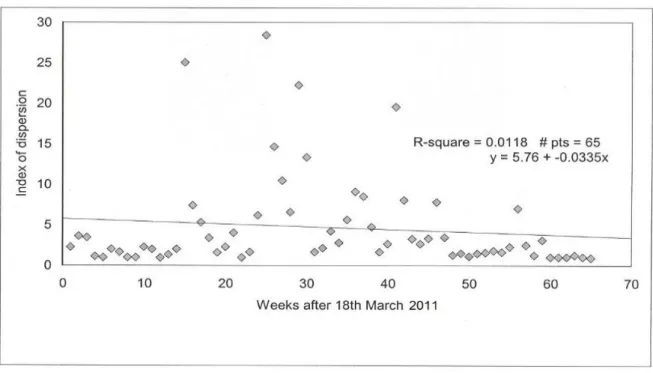
When the D. citri adults’ number per tree was plotted as frequency distribution and the variance was divided by the mean, the values ranged from 28 (contagious) to <1.0 (almost random). Figure 2 shows that the increase in the variance/mean ratio was exponential relative to time (y = 3.48e (0.006)x, r = 0.0153). Spatial distribution of D. citri changed with time in the citrus orchard. The dispersion index in Figure 3A indicated that adult dispersion went steadily from an early contagious distribution to a random distribution at an accelerating rate, then back to a contagious distribution.
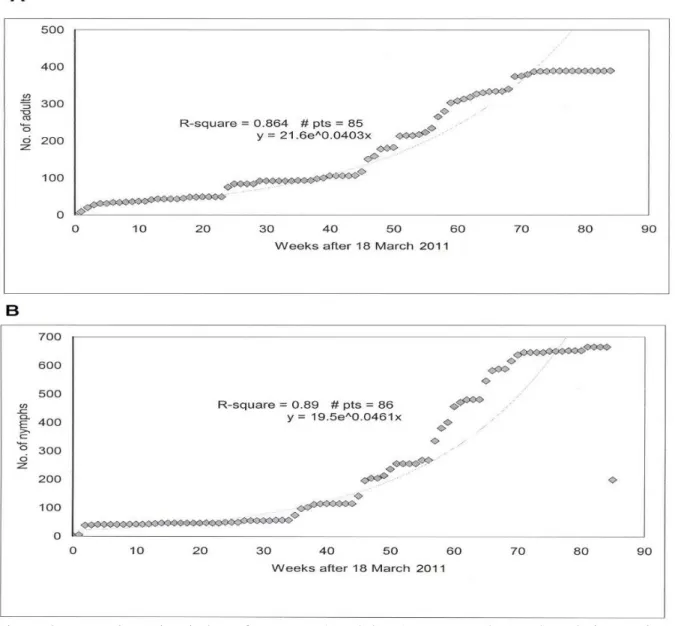
ISSN 1394-5130 30 Figure 3A & 3B showed an exponential increase in the number of adults and nymphs. Adults remained mostly within an infested tree, dispersing from flushes to flushes, then from leaf to leaf within a flush before moving locally to areas where there was a new suitable young flush. This indicated that female adults lay eggs contagiously on the flushes. By the time when almost all the trees were infested, adults D. citri moved from the area of high numbers to areas where there were suitable young flushes. Females may avoid infested flushes for oviposition, and when population densities increased to a critical point this selective behaviour resulted in a change from an aggregated distribution to an almost random distribution. The eggs and nymphs followed a contagious distribution on the flushes within the tree, and the increasing numbers of adults and nymphs were exponential relative to time as shown in Figure 3A (y = 21.6e(0.0403)x, r2 = 0.864) and Figure 3B (y = 19.5e(0.0461)x r2 = 0.89). The results show that the increase in nymph numbers was greater than the adult numbers as time progressed from the 60 weeks (May 2012) onwards. Because the population of eggs and nymphs depended entirely on the availability and abundance of cyclic production of new flush growths, and a short period of peak activity of the adult psyllid coincided with periods of new growth on trees linked to flush cycles in February, June and September-October. The distribution of nymphs on flushes change with fluctuating population density and nymphs could not disperse from flush to flush and the change in their distribution must be related to the movement of adults over time. However, the gradual rising daily ambient temperatures and prolific flushing during seasonally warm dry months, generally from April till August- September was favoured for a rapid increase in populations of D. citri nymph than adult. Leong et al. (2011) reported that the most favourable condition for increasing incidence of eggs and adults was the gradual rise in daily ambient temperatures that led to nymph peaks during hot and dry season from May to August and this also show that maximum temperatures have greater influence on nymph population. This means that a higher number of nymphs will become adults, resulting in a high population of adults. Abiotic factors include rainfall, ambient temperature, and saturation deficits (relative humidity) affect the survival of D. citri (Aubert 1987, 1990; Yang et al. 2006). The estimate of
D. citri infestation was not calculated over the trees in this study, however, a study by Samways & Manicom (1983) on Trioza erytreae (Del Guercio) (Hemiptera: Psylloidea) infesting the orchard and its populations increased exponentially, the rate of infection of new trees increased by 4% per day in the un-sprinkled orchard.
ISSN 1394-5130 31 Figure 3. Dispersion index of D. citri (A) adults, (B) eggs and nymphs relative to time
(weeks)
The importance of flush growth to D. citri has been demonstrated in previous research studies such as Catling (1969), Chavan & Summanwar (1993) and Wang et al. (1996). According to Catling (1970), D. citri adults have high fecundity and short life cycle and are therefore able to multiply very rapidly to exploit their citrus host plants. There is evidence that a fairly high number of vector populations are needed before significant transmission of the disease could occur (Catling 1970). The strong and sustained flow of young citrus trees made them very appealing to the vector. This would largely explain the rapid build-up of D. citri
populations. Catling (1969) reported that the rapid spread of disease in replanted groves was related to prolong flushing of young trees.
Flight Activeness of Adults D. citri on Citrus Canopy
Figure 4 parades that adults were trapped throughout the year, but extremely high catches were recorded using the Bamboo pole, Rebell and yellow sticky traps during September - October in 2011 and 2012, followed by progressively moderate catches in February-March 2011. Of the four types of traps used, the lowest average number of psyllid adults was recorded in the
ISSN 1394-5130 32 yellow pan traps, and largest in the Rebell traps and Bamboo Pole traps. It was noted that the adult psyllid catches by Rebell traps were higher than the Bamboo pole and yellow sticky traps during the rainy months with monthly rainfall between 581 and 919 mm from October 2011to March 2012 while higher catches were obtained by using Bamboo pole traps during the dry months from 374-458 mm between May and September 2012. Numbers caught on yellow sticky traps were greatest in March 2012, and moderate numbers were recorded during September - October 2012. Numbers caught on the Rebell traps were greatest during October 2012, and those on the bamboo pole traps were greatest in September those on the bamboo pole traps were greatest in September 2012. All except the yellow pan traps proved satisfactory for monitoring adult populations.
Figure 4. Seasonal variation in the abundance of D. citri adults from June 2011 to December 2012
In this study, the main peak catches in the yellow sticky traps, occurred in March, and moderate numbers were recorded during August-September. This is in agreement with the finding by Shamsudin & Quilici (1991). They reported that main peaks of catches in yellow sticky traps occurred in March-April and July in their studies on D. citri in Peninsular Malaysia. They recorded moderate peaks in September and November. The trapping results showed that highest catches of adults D. citri were in February-March, and September – October (Figure 4), indicating that in the vicinity of this citrus orchard, the most egg-laying activities by adults
D. citri occurs in February- March, and September-October during flushing periods. This finding is supported by field studies by Aubert & Quilici (1988) and Ke (1991). They found that D. citri catches were particularly high at the end of the dry season during August - September.
The mean number of D. citric aught at different heights are presented in Table 1. A significantly (p≤0.05) higher mean catches were obtained at 1.0 m and 1.5 m for Rebell and
ISSN 1394-5130 33 Bamboo pole traps respectively and most of the psyllid adults (65.2%) were captured on traps at a height between 1.0 m and 1.5 m high, with progressively fewer on the higher traps (Table 1). Since some citrus psylla were captured on the highest trap (3.0 m), some might have flown at even greater heights. Vertical flight activity between 0.6 and 1.6 m above ground level as indicated by numbers of adults caught in the bamboo pole and Rebell traps can be interpreted as the result of jumping-landing activity that is a behavioral characteristic of D. citri adults as they are not fast flyers, and when disturbed, they can jump short distances (Aurambout et al. 2009). They fly between 3 to 5m from one tree to the other (Hall & Hentz 2011). Vector activity is the key to HLB spread. Without dispersal by flight or jumping, the HLB cannot move from an infected citrus host plant. Flying, landing, probing and feeding are major components that should be considered when conducting epidemiological studies. Seasonal migratory flights occur when adults fly up to approximately 7m above ground level in mild winds that can carry them up to 4 km as reported by Aubert (1990). This was high enough for subsequent medium distance transport by wind over 0.5 to 1 km, rely upon wind motion and extent of sustained flight. Additional studies reported by Aubert & Xia (1990) indicated that seasonal migratory flights above. Murraya paniculate (L.) (Jack) (Plantae: Rutaceae) canopies were related to stresses caused by over-crowding of psyllid populations when populations reached their highest levels in the dry or rainy seasons. Other factors such as temperature, photoperiod, light intensity, wind speed also influence the movement or dispersal of D. citri (Aubert 1987, 1990; Aubert & Xia 1990).
Table 1. A total number (abundance) of mean numbers of D. citri adults caught on bamboo pole and Rebell brown- yellow traps at a range of heights above ground level from August 2012 to August 2013
Height (m) Bamboo pole Rebell Mean no. Adults/trap
0.5 8.8 5.0 6.9 b 1.0 18.3 41.2 29.8 a 1.5 12.0 25.0 18.5 a 2.0 1.3 18.8 10.0 b 2.5 0.8 4.5 2.6 b 3.0 0.3 1.5 0.9 b
ab Means in a column not followed by the same letter are significantly different at p≤0.05 by
Least Significant Difference Test.
Sampling of flying insects with traps can give quantitative information about the numbers in the air and the time of flight. Adhesive yellow traps have been successfully and widely used for trapping of winged D. citri populations. (Aubert 1987; Aubert & Quilici 1988; Aubert & Xia 1990; Mercado et al.1991; Nurhadi et al. 1989). The value of the traps lies in their ability to track population variability. It has been noted by some researchers that trapping techniques, different colour of traps, environmental factors and other factors can influence trapping efficiency (Aubert & Xia 1990; Aubert & Quilici 1988; Mercado et al. 1991; Nurhadi et al. 1989; Quilici & Trahais 1990; Samways 1984, 1987, 1990; Weerawut, 1990). Therefore, adult psyllid trapping by different methods was conducted for comparing their trapping efficiencies under Sarawak condition. Of the four traps evaluated, only the yellow pan trap was not sufficiently sensitive for monitoring psyllid abundance. The Rebell and Bamboo pole traps bamboo pole provided a relatively higher catches than the yellow sticky traps during the rainy season from April to February. Moderate catches have been obtained throughout the citrus growing season by the yellow sticky traps (Figure 4), as sticky traps depend in part on color
ISSN 1394-5130 34 attraction and in part on wind effect (Heathcote et al. 1968). However, the relative efficiency of each trap varied and its different pattern of responsiveness depends on the weather condition (Aubert & Quilici 1988). The area of yellow/brown on the Rebell and Bamboo pole traps are multidirectional and provide a layer surface exposure while the yellow sticky trap is unidirectional with a limited area of surface exposure. The yellow/brown Rebell trap has a strong selectivity for D. citri, thus giving "Cleaner" traps with minimum catches of other non-target insects and easy to monitor. However, the yellow sticky trap technique is a cheap, easy and convenient method for recording HLB vector outbreaks. All trapping methods except the yellow pan trap are accessible to use and can supply valuable information in adults D. citri
abundance and flight activity for immediate use.
The trapping can reflect a seasonal flight activity and provide a good assessment of the migration capacity of psyllids that commences beginning and damaging disruptions. Therefore, regular monitoring of vector population is essential for IPM. D. citri is strongly attracted by yellow colour (Aubert & Quilici 1988; Samways 1987) and weekly trappings are able to detect the main outbreak on a spatial and temporal basis (Aubert & Quilici 1988). Within an orchard, most adult psyllids were captured at a height between 1.0 m and 1.5 m and trap catches decreased with increasing height above 2.0 meters, with progressively fewer on the higher traps which confirms the preliminary work of Ke (1991); Gavarra et al. (1990) and Aubert and Xia (1990) that D. citri was mostly caught not more than 1.5metre above the ground. The dispersal of the insect on long distances is generally the result of strong wind and wind speeds increases with height (Aubert 1987). For this reason, the higher the psyllids fly, the better their chances to disperse over long distances. Other members of the Psylloidea such as T.erytreae and Psylla pyricola (Foerster) (Hemiptera: Psyllidae) are reported to disperse at different heights and most flights within orchards were below 2 m (van den Berg & Deacon 1989; Hodgson & Mustafa 1984) which are agreed mostly with that found for D. citri.
The mean numbers of adult psyllids collected hourly at 08:00 am daily in August - September 2012 are given in Table 2. A significantly (p≤0.05) higher mean numbers of psyllid adults were caught daily between 0800h to 1000h. Majority of the adult psyllids (49%) were captured early in the morning between 08:00 am to 10:00 am, and the catches decreased in the later of the day and progressively fewer before sunset. This indicates that D. citri flies from dawn to dusk. A large peak of activity was observed in the morning and a small peak shortly before sunset (Table 2). This may be due to the rapid increase in light intensity at sunrise may have stimulated the citrus psyllid flight. Activities may only have started to increase at a higher temperature a few hours later. The insect remained active before sunset this may be influenced by the decline on light intensity. Activities may only have started to increase at a higher temperature a few hours later. Although D. citri still active just before sunset, the flight activities continue at night. This was not the case as Lewis and Taylor (1967) state that Hemipteran are predominantly day-fliers. The results confirm the work of Ke (1991) in China that D. citri adults were most active from 14:00 to 16:00 hours.
ISSN 1394-5130 35 Table 2. Mean numbers of D. citri adults caught daily in bamboo pole and Rebell Traps
from August to September 2012
Hours Yellow Bamboo Pole Mean nos. Adults/trap
0800 - 1000 2.5 4.75 3.62 a
1000 - 1400 1.0 1.75 1.37 b
1400 - 1800 2.5 2.25 2.37 b
Total 7.36
ab Means in a column not followed by the same letter are significantly different at p ≤ 0.05 by
Least Significant Difference Test
Immigration and Dispersal Patterns of D. citri In Relation To Disease Transmission and Spread of Huanglongbing
Figure 5 shows the increase in numbers of adults over the study period from 18th March 2011 to 27th December 2013. It indicates a greater percentage of trees infested with a higher number
of grown-up psyllids. Psyllids were noticed to have begun conquering the citrus trees on 18th March 2011 when 1.5% of the trees were infested, and on 20th April 2011, only 12.2% of the trees were infested. This value had increased to 46.0% on 18th March 2012 with less than one adult per plant, one year after the principal invasion was identified and five to six months later on 6th August 2012, this value had jumped to 90% of trees infested with less than 1.5 adults per plant. It took around one year and nine months to spread everywhere throughout the plantation. As a result, there was a linear increase in the number of trees infested relative to time (r2=0.98; r2=0.983, p<0.001) and migration / dispersal of the psyllid population primarily associated with key flush cycles as shown in Figure 6A and 6B. D. citri propagation from tree to tree has resulted in a rising number of trees being infested with a citrus orchard throughout the growing seasons. The accelerated build-up in D. citri population was the result of exponential population growth and migration or dispersal of the psyllid population was primarily associated with major flush cycles. This clearly shows the build-up in D. citri
population was heavily influenced by the cyclical production of new flush growths and the rise in nymph and egg populations was lower than the adults in the citrus trees.
Figure 5. Incidence and spread of D. citri in a citrus orchard from 18th March 2011 to 27th December 2012
ISSN 1394-5130 36 Figure 6. Relationship between the number of trees supporting (A) adults, (B) nymphs or
eggs D. citri overtime
Disease Incidence and Spread of HBL in Relation to Psyllid Population
Migration and dispersal of adults D. citri and their spread from trees to trees around the citrus orchard was mostly highest during the flushing periods. Table 3 shows the percentage of plants showed typical symptoms of the disease with yellowing of leaf and blotchy mottling increased progressively from 10% on 7th April 2012 to 38.7% on 6th August 2012, only 2.4% of these plants gave positive PCR results. By 10th April 2013, 19.3% out of the 56.2% of plants with symptoms of mild mottling and small leaves point upright gave positive PCR results. By 8th October 2014, 42.2% out of the 80.2 of trees expressing symptoms of heavy mottling and vein corking together with some dieback of branches gave positive PCR tests. Field observation on the extent of the typical visual symptoms for the infected trees can sometimes be misleading. These symptoms could attribute to the nutrient deficiency or other physiological disorders. Therefore, PCR is useful for confirming the visual symptoms of the HLB infected trees. In
ISSN 1394-5130 37 China, citrus HLB often spread quickly in young citrus orchard, 50-70% of the citrus trees were infected before fruit production (Xu et al. 1987).
Table 3. Percentage incidence and spread of HLB in a citrus orchard
Date % of HLB infected and diseased plants
IP DP 7 April 2012 10.00 2.41 6 August 2012 38.70 7.89 10 April 2013 56.20 19.19 20 March 2014 62.30 28.20 8 October 2014 80.15 42.20
Note: IP = infected plant; DP = Diseased plants
CONCLUSION
Increase in the abundance of the vector is mainly related to the flushing cycles of host plants, including citrus. Heavy and extended flushing of young citrus plants between March and October in this study made the trees very attractive to the vector. This combined with its bright yellow and brown-yellow attractiveness; makes it a relatively easy for insect monitoring using yellow and brown-yellow traps. The vector is widely distributed and well adapted in the profusion of small citrus plantings and backyard trees that characterized most citrus areas in the Orient. It is also believed that D. citri adults colonizing the flush cycles which have previously fed for long periods on mature leaves containing a high concentration of HLB organism are particularly infective. Preventing the build-up of high population, particularly during the flushing periods, may therefore be intensely crucial in checking disease spread.
Results of this study indicated that the adults D. citri can be trapped throughout the year and a higher number of adult psyllids were dispersing from the contaminated citrus plants to nearby healthy plants in the citrus orchard especially during the major flushing periods in August and September. The main population build- up of the adults also commenced from August – September. Thus, the natural spread of HLB in a citrus orchard is probably greatest during August through October when new flush is accessible and psyllid grown populations are the topmost. This indicates that the most egg-laying activities may take place in February-March, May and preferably in August - September to coincide with the main flushing period before the onset of the rainy season. D. citri is a very prolific and effective vector for HLB transmission and the key to HLB spread is its activity. Without vector dispersal by flight or jumping, HLB could not move from an infected citrus host plant to a healthy plant. Flying, landing, probing, feeding are major components that should be considered when assessing an epidemiological study. Migration or dispersal and spread from tree to tree of adults around the citrus orchard mostly occurred during the flushing periods. The general results can be used as pointers to D. citri management. It was clear that this species is highly attracted to a vigorous flush. Also, it readily invades the whole of an orchard within days. It is highly mobile within the orchard, presumably looking for suitable feeding and oviposition sites.
Visual counting of young flushes should be supplemented with a trapping technique for obtaining more accurate information on D. citri population dynamics. The traps can detect economically important population increases and provide an early warning system to indicate
ISSN 1394-5130 38 the necessity for insecticidal treatments. Therefore, trapping of adult D. citri can be very helpful for monitoring and predicting the risk of psyllid outbreak.
ACKNOWLEDGEMENTS
Authors are thankful to the citrus orchard owner for providing land and other resources during the experiment and his kind cooperation. This research work was partially funded by The Australian Centre for Internal Agricultural Research (ACIAR).
ISSN 1394-5130 39
REFERENCES
Aubert, B. 1987. Epidermiological aspects of the greening (Huanglungbing) disease in Asia.
Proceedings of FAO Regional Workshop on citrus greening Huanglungbing disease. Fuzhou, China, pp. 28.
Aubert, B. 1990. Integrated activities for the control of huanglongbing-greening and its vector
Diaphorina citri Kuwayama in Asia. In Aubert, B., Tontyaporn, S. & Buangsuwon, D. (eds.). Proceedings of the Fourth International Asia-Pacific Conference on Citrus Rehabilitation, pp. 133-144. Chiang Mai, Thailand: NDP-FAO press.
Aubert, B. & Quilici, S. 1988. Monitoring adult psyllas on yellow traps in Réunion Island. In Timmer, L. W., Garnsey, S. M. & Navarror, L. (eds.). Proceedings of the Tenth Conference of the International Organization of Citrus Virologists, pp. 239-254. Riverside, California: International Organization of Citrus Virologists.
Aubert, B. & Quilici, S. 1984. Biological control of the African and Asian citrus psyllids (Homoptera: Psylloidea), through eulophid and encyrtid parasites (Hymenoptera: Chalcidoidea) in Reunion Island. In Garnsey, S. M., Timmer, L. W. & Dodds, J. A. (eds.). Proceedings of the Ninth Conference of the International Organization of Citrus Virologists, pp. 100-108. USA: University of California Press.
Aubert, B. & Xia, Y. H. 1990. Monitoring flight activity of Diaphorinacitri on citrus and
Murraya canopies. In Aubert, B., Tontyaporn, S. & Buangsuwon, D. (eds.).
Proceedings of the Fourth International Asia-Pacific Conference on Citrus Rehabilitation, pp. 181-187. Chiang Mai, Thailand: NDP-FAO press.
Aubert, B., Garnier, M., Guillaumin, D., Herbagyandono, Setiobudi, L. et al. 1985. Greening, a serious threat for the citrus production of the Indonesia archipelago. Future prospects of integrated control. Fruits 40(9): 549-563.
Aurambout, J. P., Finlay, K. J., Luck, J. & Beattie, G. A. C. 2009. A concept model to estimate the potential distribution of the Asiatic citrus psyllid (DiaphorinacitriKuwayama) in Australia under climate change-A means for assessing biosecurity risk. Ecological Modelling 220(19): 2512-2524.
Beattie, G. A. C. & Holford, P. 2008. Current HLB situation and industry perspective in Asia.
Proceedings of International research conference on huanglongbing, pp. 94.
Bové, J. M. 2006. Huanglongbing: A destructive, newly-emerging, century-old disease of citrus. Journal of Plant Pathology 88(1): 7-37.
Catling, H. D. 1970. Distribution of the psyllid vectors of citrus greening disease with notes on the biology and bionomics of D. citri Kuw. FAO, Plant Protection Bulletin 18: 8-15. Catling, H. D. 1969. The bionomics of the South African citrus psylla, Trioza erytreae (Del
Guercio) (Homoptera: Psyllidae). South Africa Citrus Journal 426: 9, 11, 13, 15, 16. Chavan, V. M. & Summanwar, A. S. 1993. Population dynamics and aspects of the biology of
ISSN 1394-5130 40
of 12th Int. IOCV Conference, pp. 286-290. Riverside, California, USA: University of California Press.
Da Graca, J. V. & Korsten, L. 2004. Citrus Huanglongbing: Review, present status and future strategies. In Naqvi, S. A. M. H. (ed.). Diseases of Fruits and Vegetables I, pp. 229 - 245. Netherlands: Springer.
Gavarra, M. R., Mercado, B. G. & Gonzales, C. I. 1990. Progress report: D. citri trapping, identification of parasite and possible field establishment of the imported parasite, Tamarixia radiata in the Philippines. In Aubert, B., Tontyaporn, S. & Buangsuwon, D. (eds.). Proceedings of the Fourth International Asia Pacific Conference on Citrus Rehabilitation, pp. 246-250. Chiang Mai, Thailand: FAO UNDP.
Halbert, S. E. & Manjunath, K. L. 2004. Asian citrus psyllids (Sternorrhyncha: Psyllidae) and greening disease of citrus: A literature review and assessment of risk in Florida. Florida Entomologist 87(3): 330-353.
Hall, D. G. & Hentz, M. G. 2011. Seasonal flight activity by the Asian citrus psyllid in east central Florida. Entomologia Experimentalis et Applicata 139(1): 75-85.
Heathcote, G. D., Palmer, J. M. P. & Taylor, L. R. 1969. Sampling for aphids by traps and by crop inspection. Annals of Applied Biology 63(1): 155-166.
Hodgson, C. J. & Mustafa, T. M. 1984. The dispersal and flight activity of Psylla pyricola Forster in southern England. Bulletin SROP 7(5): 97-124.
Hoy, M. A. & Nguyen, R. 2000. Classical biological control of Asian citrus psylla. Citrus Industry 81(12): 48-50.
Ke, C. 1991. The present status of Citrus Huanglungbing and its control in China. In Ke, C. & Shamsudin, M.O. (eds.). 6th Asia Pacific UNDP-FAO Conference on Integrated Citrus Health Management, pp. 65-76. Kuala Lumpur, Malaysia: FAO-UNDP-MARDI. Leong, S. C. T., Abang, F., Beattie, G. A. C., Kueh, J. H. & Wong, S. K. 2011. Seasonal
population dynamics of the Asian citrus psyllid, Diaphorina citri Kuwayama in Sarawak. American Journal of Agricultural and Biological Sciences 6(4): 536-543. Leong, S. S., Leong, S. C. T & Beattie, G. A. C. 2019. Dispersion pattern and sampling plan
for Asian citrus psyllid, Diaphorina citri Kuwayama (Hemiptera: Psyllidae) in a citrus orchard. Serangga 24(2): 25-40.
Lewis, T. & Taylor, L. R. 1967. Introduction to Experimental Ecology. London: Academic Press.
Lim, W. H., Mohd Shamsudin, O. & Ko, W. 1990. Citrus greening disease in Malaysia: Status report. In Aubert, B., Tontyaporn, S. & Buangsuwon, D. (eds.). Proceedings of 4th International Asia Pacific Conference on Citrus Rehabilitation, pp. 100-105. Chiang Mai, Thailand: FAO press.
ISSN 1394-5130 41 Mercado, B. G., Pableo, F., Gavarra, M. R. & Gonzales, C. I. 1991. Population studies and biological control of Diaphorina citri Kuwayama, the insect vector of citrus greening disease in the Philippines. In Ke, C. & Shamsudin, M. O. (eds.). Proceedings of 6th International Asia Pacific Workshop on Integrated citrus health management, pp. 105-117.USA: UNDP-FAO.
Michaud, J. P. 2000. The Asian citrus psylla, Diaphorina citri, and its natural enemies. Citrus Industry 81(81): 42-44.
Nurhadi, F., Hermanto, C. & Suhariyono. 1989. Attempts to improve a monitoring tool for assessing Diaphorina citri flying activity. Proceedings of Asian citrus Rehabilitation Conference. Matang, Indonesia. 4-14 July.
Quilici, S. & Trahais, B. 1990. Experiments on color attracting for the adult of Diaphorina citri
Kuwayama. In Aubert, B., Tontyaporn, S. & Buangsawon, D. (eds.). Proceedings of Asia-Pacific International Conference on Citri culture, pp. 54. Chiang Mai, Thailand: FAO press.
Regmi, C. & Lama, T. K. 1988. Greening incidence and greening vector population dynamics in Pokhara. In Proceedings of 10th IOCV Conference, pp. 238-242.
Samways, M. J. 1984. Prediction of upsurges in populations of the insect vector (Trioza erytreae, Hemiptera: Triozidae) of Citrus Greening Disease using low-cost trapping.
Journal of Applied Ecology 24(3): 881-891.
Samways, M. J. 1987. Weather and monitoring the abundance of the adult citrus psylla, Trioza erytreae (Del Guercio) (Hom., Triozidae). Journal of Applied Entomology 103(1-5): 502-508.
Samways, M. J. 1990. Biogeography and monitoring outbreaks of the African citrus psylla,
Trioza erytreae (Del Guercio). In Aubert, B., Tontyaporn, S. & Buangsawon, D. (eds.).
Proceedings of Asia Pacific International Conference on Citri Culture, pp. 188-197. Chiang Mai, Thailand: FAO press.
Samways, M. J. & Manicom, B. Q. 1983. Immigration, frequency distributions and dispersion patterns of the Psyllid Trioza erytreae (Del Guercio) in a citrus orchard. The Journal of Applied Ecology 20(2): 463-472.
SAS Institute Inc. 2002. SAS/STAT 9.2 Users Guide. Cary, NC: SAS Institute Inc.
Shamsudin, M. O. & Quilici, S. 1991. Trapping studies of citrus greening vector, Diaphorina citri Kuway., natural enemies and alternate hosts in Malaysia. In Proceedings of 6th International Asia Pacific Workshop on Integrated Citrus Health Management, pp. 118-127.
Teo, C. H., Voon, B. H. & Leong, C. T. 2000. Integrated management of citrus greening disease (Huanglongbing) in Sarawak. Proceedings of the Plant Resource Management Conference, Kuching, Malaysia, pp. 29-31.
ISSN 1394-5130 42 Tiwari, S., Mann, R. S., Rogers, M. E. & Stelinski, L. L. 2011. Insecticide resistance in field populations of Asian citrus psyllid in Florida. Pest Management Science 67(10): 1258-1268.
Van den Berg, M. A. & Deacon V. E.1989. Flight activities of the citrus psylla Trioza erytreae
(Hemiptera: Triozidae). Phytophylactica 21: 391-395.
Wang, L. Y., Hung, S. C., Hung, T. H. & Su, H. J. 1996. Population fluctuation of Diaphorina citri Kuwayama and incidence of citrus likubin in citrus orchards in Chiayi area. lant Protection Bulletin 38: 355-365.
Weerawut, P. 1990. Monitoring population of Diaphorina citri Kuwayama and thrips in Thailand. In Aubert, B., Tontyaporn, S. &Buangsuwon, D. (eds.). Proceedings of 4th International Asia Pacific Conference on Citrus Rehabilitation, pp. 203 – 206. Chiang Mai, Thailand: FAO press.
Weinert, M. P., Jacobson, S. C., Grimshaw, J. F., Bellis, G. A., Stephens, P. M. et al. 2004. Detection of Huanglongbing (Citrus Greening Disease) in Timor-Leste (East Timor) and in Papua New Guinea. Australasian Plant Pathology 33(1): 135-36.
Xu, C. F., Xia, Y. H., Li, K. B. & Ke, C. 1987. Further study of the transmission of citrus huanglongbin by psyllid, Diaphorina citri Kuwayama. Proceedings of FAO-UNDP Regional Workshop on Citrus greening Huanglongbin disease. Fuzhou, China: Agriculture Press.
Yang, Y., Huang, M., Beattie, G. A., Xia, Y., Ouyang, G. et al. 2006. Distribution, biology, ecology and control of the psyllid Diaphorina citri Kuwayama, a major pest of citrus: A status report for China. International Journal of Pest Management 52(4): 343-352. Zhao, X. Y. 1981. Citrus yellow shoot disease (Huanglongbin) - A review. International
Society of Citri culture 1: 466-469.
Zhao, X. Y. 2017. A Review of the Prevention and Control of Citrus Huanglongbing. Beijing, China: Agriculture Press.