MARKETING PLAN:
CINESA LA SALERA
Author: Adrián García Játiva
Tutor: Marta Estrada Guillén
DEGREE IN BUSINESS ADMINISTRATION
AE1049 - FINAL DEGREE PROJECT
INDEX
A. TABLE INDEX ...3 B. GRAPHIC INDEX ...3 C. FIGURE INDEX ...3 1. PROJECT JUSTIFICATION ...5 2. EXECUTIVE SUMMARY ...5 3. SITUATION ANALYSIS ...6 3.1. Internal analysis ...6 3.1.1. Company presentation ...6 3.1.2. Company resources ...7 3.1.2.1. Human resources ...7 3.1.2.2. Financial resources ...8 3.1.2.3. Marketing resources ...8 3.2. External analysis ...19 3.2.1. Political factors ...19 3.2.2. Economic factors ...20 3.2.3. Social factors...22 3.2.4. Technological factors ...26 3.2.5. Ecological factors ...27 3.2.6. Legal factors ...28 4. COMPETITORS ANALYSIS ...30 5. SWOT ANALYSIS ...38 5.1. Strengths ...39 5.2. Weaknesses ...39 5.3. Opportunities ...40 5.4. Threats ...40 6. MARKET DEFINITION...42 6.1. Market Definition ... 42 6.2. Target Market ...43 6.3. Segmentation ...43 6.4. Positioning ...45 7. OBJECTIVES ...478. STRATEGIES ...48
8.1. Competitive advantage strategy ...48
8.2. Competitive strategy ...48 8.3. Growth strategy...48 9. ACTION PROGRAMS ...50 9.1. Product decisions ...51 9.2. Price decisions ...53 9.3. Place decisions ...54 9.4. Promotion decisions ...55 10. TIMELINE ...58 11. BUDGET ...59 12. CONTROL ...60 13. BIBLIOGRAPHY...61
A. TABLE INDEX
Table 1. Financial profile between 2012 and 2014 ...8
Table 2. CINESA supplements and prices ...13
Table 3. Competiton from customer point of view ...30
Table 4. Competition summary ...37
Table 5. Product market ...43
Table 6. Objectives, strategies and action programs relatinoship ...50
Table 7. Timeline ...58
Table 8. Control ...60
B. GRAPHIC INDEX Graphic 1. Takings and spectators between 2000 and 2014 ... 20
Graphic 2. Average price by spectator between 2000 and 2014 ...21
Graphic 3. Unemployment rate evolution ...22
Graphic 4. Spanish pyramid population in 2014 ...23
Graphic 5. Cinema attendance rate per ages ...24
Graphic 6. Expenditure groups in 2014 ...25
Graphic 7. Expenditure groups evolution between 2009 and 2014 ...26
C. FIGURE INDEX Figure 1. Organization chart ...7
Figure 2. Film products ...10
Figure 3. Bar products ... 11
Figure 4. Bar products prices ...14
Figure 5. La Salera Shopping Center ...15
Figure 6. La Salera Shopping Center location ...15
Figure 7. Promotions ...18
Figure 8. PESTEL effect summary ...29
Figure 9. Competition map ...31
Figure 10. SWOT analysis ...38
Figure 11. Reference and relevant markets... 42
Figure 13. Psychographic segmentation ...45
Figure 14. Positioning map ...46
Figure 15. Ansoff’s matrix ...49
Figure 16. CINESA V.O. ...51
Figure 17. Morning price...53
Figure 18. Midnight price ...53
1. PROJECT JUSTIFICATION
I have chosen the company CINESA Salera for my final degree project because I believed desirable for a project of this magnitude, which I have to face alone, it was necessary to be about something that was interesting for me to investigate. Personally I consider myself a cinephile, I enjoy films and the stories they tell us, especially when they manage to be experiences where we are emotionally involved. So I decided to join this project and my moviegoing carrying out a marketing plan of the cinema that I am more regular.
2. EXECUTIVE SUMMARY
CINESA is a national company dedicated to the film screening, both films and special events like documentaries, opera or concerts, which currently has 46 cinemas and 534 theaters distributed throughout Spain. Concretly this marketing plan will consist about the cinema located in La Salera Shopping Center, Castellón.
Nowadays Spain lives an uncertainty situation because the politics, there is no government and this calls into question what is going to happen with the economic politics, being the most important one for CINESA’s sector the future of the cultural VAT. Because the current VAT and the economic crisis, the society has changed their lifestyles and this has affected the sector.
In this marketing plan, an internal analysis has been carried out to know the resources of CINESA, as an external one to study the current situation of the environment and the closest competitors. All this helped me to make a SWOT analysis to know the positive and the negative aspects that affect the most the company, and to establish objectives which are based in the increase of customers and its satisfaction.
Finally, to achieve these objectives I have been proposed 13 actions to which have been assigned a budget and a schedule, and have been established control guidelines in order to make sure that the objectives of the marketing plan are achieved.
3. SITUATION ANALYSIS
3.1. Internal Analysis
3.1.1. Company presentation
Being an acronym of Compañia de Iniciativas y Espectaculos SA, its origin dates back to 1944 when the producer Alfredo Matas met the businessman José Arquer and formed the first cinema in the Windsor complex which was being built by the former in Barcelona. From the seventies CINESA experienced a great expansion, getting to have 37 theaters located in Barcelona, Madrid, Cadiz, Granada and Murcia, thanks to the restructuring of existing theaters in more smaller ones. But this expansion was paralyzed because of the crisis in the sector in the eighties. In view of this situation, CINESA established the known Spectator Day on Wednesdays, halving the price of tickets to attract more public, like they were doing with the Red Ticket, and in later years it would be established discounts for Young Card and Large Family.
In addition to these commercial innovations, in recent years CINESA has also renewed itself technologically through a modernization plan to provide the highest visual and auditory quality to customers, and to offer greater comfort to these in terms of seats and services variety. CINESA was pioneer in establishing innovative services such as computerized box office, besides the purchase by phone and banking terminals, as well as a 24 hours customer information service for any consultation about the programming. But CINESA is not limited in the national level. When the creation of CINESA, there was a significant contribution of William Forman, which was the owner of the chain of cinemas Pacific American Theaters and the Cinerama operating license. Forman was gradually getting more and more shares in the company to become the majority shareholder, and his son, years later, with the 80% of the shares, reached an agreement with United Cinemas International in order to this to obtain CINESA 100%. Continuing with its international expansion, in 2005 and 2006, it acquired the cinema chain Warner Lusomundo Sogecable and four cinema complexes from AMC Cinemas. In total, CINESA/UCI manages 165.299 seats distributed among Spain, Portugal, Germany, Austria and Italy.
As I said before, I am going to center the marketing plan in the cinema located in the Shopping Centre La Salera, in Castellón de la Plana. But this cinema has not always been part of the CINESA chain, actually it was a cinema pertaining to Ábaco Cinebox, but the
company entered in a liquidity process, and in 2014 CINESA bought some of its cinemas, including the one situated in Castellón (El Periódico Mediterraneo, 2014).
● Mission
“Create unforgettable leisure experiences for each of our clients” (CINESA, 2016). ● Vision
“Create unforgettable experiences for each client, ranking leadership positions within the film exhibition sector by providing the most avant-garde technical performances for image and sound, the best commodities in their theaters, large products quantity and variety and the best personalized attention to the viewer” (CINESA, 2016).
3.1.2. Company Resources
3.1.2.1. Human Resources
According to late 2014 SABI data, CINESA has 1080 employees distributed in Spain, the maximum number of contracts in the history of the company and double the number of employees it had in 2013. The company is led by President Francisco Javier Fernandez Montoli and Vice President Manuel Falcon Alaix. Both are part of the Board of Directors of the company with the CEO Paul Michael Donovan and Secretary Miriam Fernandez Jerez. In cinemas people work in different jobs such as cleaning service, store and box office clerk, usher, maintenance staff and cabin crew; and each one is managed by at least one manager.
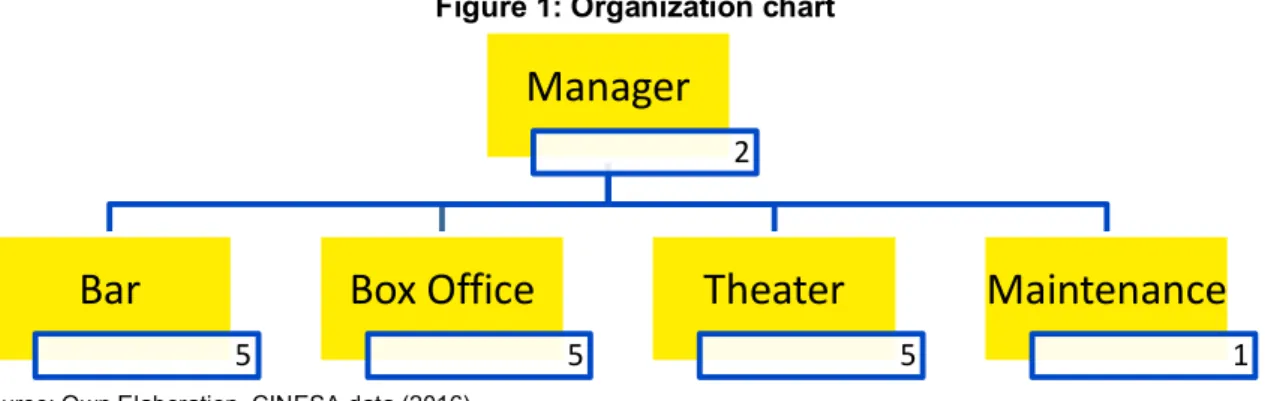
Specifically in CINESA Salera are working 18 employees and the horizontal and vertical structure of the jobs and its employees’ number are distributed as follows:
Figure 1: Organization chart
Source: Own Elaboration. CINESA data (2016)
Manager
2Bar
5Box Office
5Theater
5Maintenance
13.1.2.2. Financial Resources
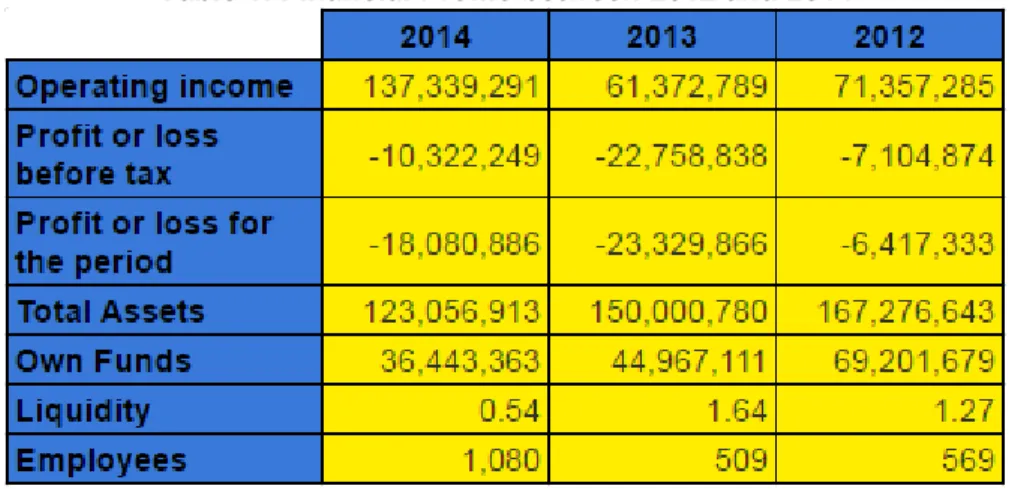
As reported by SABI (2015), CINESA has been generating losses continuously for several years, but if we keep in mind the years with most recent information, we can see that these data are not as bad. In 2013 the company had obtained four times the losses that it obtained in 2012, the operating income had been reduced by almost 1 million euros and both working capital and the value of its total assets had declined. But if we look at 2014 data we can see a big improvement. Although it still gets losses, CINESA had managed to reduce to almost -18 million euros, and nearly half of this value corresponds to taxes. This is thanks to achieve the highest revenues in its history, with more than double that obtained in 2013. Even so, working capital and assets value are also reduced between these two years.
Despite this CINESA faces liquidity problems because its current active is not big enough to meet their current liabilities, a problem that had been seemed to be solved by them in the previous three years.
Table 1: Financial Profile between 2012 and 2014
Source: Own Elaboration. SABI data (2015)
3.1.2.3. Marketing Resources
●
Product
The CINESA product portfolio consists of goods and services commonly available in cinemas, being the main the cinema exhibition, for which it has 14 theaters. This product is intangible, because it is not something that can be delivered in physical form to the customer, but rather is an experience, so the technological quality and comfort of the theaters are essential complements to the exhibition to be satisfactory for the customer,
because as poet Maya Angelou said: “people will never forget how you made them feel” (Kelly, 2003). Therefore the film exhibition is a nondurable service because it is something that is usually consumed few moments after its purchase, except presale occasions, and once consumed cannot be used again.
In addition to the exhibition, CINESA uses the technique of cross-selling to offer a complementary product to the film exhibition. These are soft drinks and snacks from the bar, which customers can purchase for more enjoyable viewing. So this product line is tangible, but like the film projection it would be nondurable products as they are usually consumed while viewing.
Therefore CINESA Salera would have only these two product lines, the cinema exhibition and bar service, which would result in a small amplitude portfolio, but within the film line are different offers:
● Family film: Those films for all audiences or over 7 years aimed at the youngest people and as a consequence also attract their responsible adults. Nonetheless these films also attract other audiences.
● Standard film: Other films aimed at those over 13 years. Within this product there are various genres that appeal to different types of audiences, such as science fiction, horror or comedy. Also herein we can find two sublines:
○ Classic projection films, i.e., the films are projected in 2D, the common format.
○ 3D projection films, which as the name says, it offers customers the chance to enjoy the film in a three-dimensional viewing. To see the film just in the way it is needed special glasses, which renting for the projection is usually provided to the customer at the entrance of the theater, but buying this product is not necessarily linked to the projection, since customers can bring their own glasses.
● Events: These are documentaries, broadcasts of plays, ballet or opera, screening of old films or series of films, concerts and competitions, whose price is set for all cinemas in the same value, but it varies depending on the type of event.
● Regala Cine: This offer consists of three products:
○ Pack Protagonista 30€: 2 tickets, 1 movie menu (2x75cl soft drink and 1 popcorn bucket) and 1 cup.
○ Pack Cine: 2 weekend tickets. Its price is the integer value of the weekend tickets without reduction.
○ Tarjeta Regalo 20€: Both tickets and bar products are included, if the 20€ limit is not exceeded.
● Birthday Pack: It is a product aimed at children between 7 and 12 years. A number of seats are reserved for a group of at least 10 children and 1 adult for the chosen film (under the responsibility of the person making the reserve), and also it is accompanied by a bar menu.
Figure 2: Film products
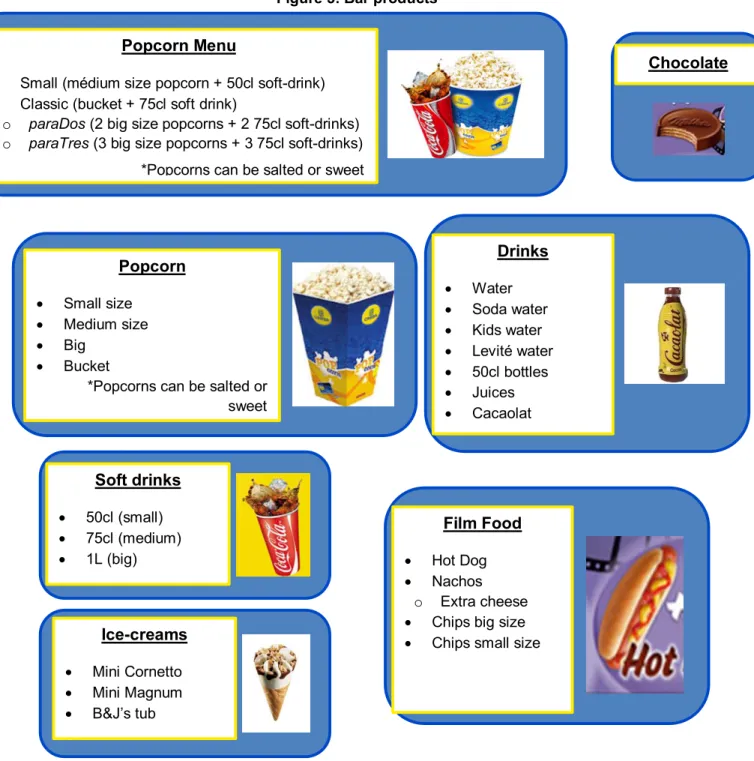
As for the bar product line, figure 3 represents the 6 sublines that CINESA has into this line, and its products.
Figure 3: Bar products
Source: Own Elaboration. CINESA data (2016)
Therefore the product portfolio’s depth, i.e., the number of products within a line, and its length, the total sum of the products, is big because it offers some exhibition diversity and in the viewing of films, as well as in the bar products. In addition, we can consider that
Popcorn Menu
Small (médium size popcorn + 50cl soft-drink) Classic (bucket + 75cl soft drink)
o paraDos (2 big size popcorns + 2 75cl soft-drinks)
o paraTres (3 big size popcorns + 3 75cl soft-drinks) *Popcorns can be salted or sweet
Popcorn Small size Medium size Big
Bucket
*Popcorns can be salted or sweet Drinks Water Soda water Kids water Levité water 50cl bottles Juices Cacaolat Chocolate Soft drinks 50cl (small) 75cl (medium) 1L (big) Film Food Hot Dog Nachos o Extra cheese Chips big size Chips small size
Ice-creams Mini Cornetto Mini Magnum B&J’s tub
there is a good consistency between its products, since both projection and bar offers are homogeneous within its product lines and also complement each other to give the best audiovisual experience to clients.
●
Price
Ticket price changes depending on three factors: place, day and time. Each of the cinemas that the company has spread throughout Spain has a different price, and this price may also vary depending on whether it is a workday, a holiday or a weekend, and some of them have different prices depending on the schedule session.
Tickets price in CINESA Salera is €8.00 all the week, so it is below of the two average prices of all the cinemas that the company has, which are €8.60 for workdays and €8.81 for weekends and holidays, and vary between €5 and €10 depending on the locality of the cinema in both cases.
This price is set having in mind the percentage that remains for film distributors, copyright entities and VAT, plus the price level of the sector in the geographical area. According to newspaper ABC (2013) these percentages would be 41.8%, 3% and 21% respectively, so that to CINESA belongs the 38.2% of revenue. Therefore CINESA Salera would keep only €3.06 of the revenue from normal tickets.
CINESA has three special schedules with different prices in some cinemas:
Morning session: This schedule is only available on weekends and is usually a schedule between 11:00 am and 1:00 pm, often it is a price for all audiences, but cinemas located in The Machinist and Heron City Barcelona for example limit it to those under 12 years. In addition, this schedule is only available in 22 of the 46 cinemas of CINESA. The prices range between €4.50 and €7.90, with an average of €6.60.
Session before 5:00 pm: This special price is even stranger than the last, only located in 9 cinemas, and as the name suggests is for those sessions prior to 5:00pm, particularly at the first session of the previous film at that time. This schedule is only available on workdays, and in some cinemas on Fridays is not included. Prices for this schedule are between €4.70 and €7.10 with an average of €5.90.
Midnight session: This is the last schedule of the day, located in the wee hours of Friday and Saturday. This schedule is present in all theaters of CINESA, but only 8 of them have established special prices, which range from €4.50 to €7.80. The average of these special rates is €6.09, although the actual average of this schedule if all the cinemas are counted would be €8.20.
Although CINESA Salera has midnight session and the one before 5:00pm, it does not change the price of tickets for them. However, these prices also will be determined in part by the conditions of the distributors, as for instance Warner films have the same price regardless of the schedule, just being indicative the cinema and when the ticket is purchased.
In addition to these prices, there are also products with periodic discounts, i.e., there are films whose prices after several weeks of exhibition are reduced to attract public, being tickets offered at €4.20 in CINESA Salera. Also the opposite happens, there are films that because of their greater ability to attract public are given a price of prestige which is an increase of €1.00 to their base price during the first ten days of release, renamed as premium movies.
We can also consider second market price, those prices are for a portion of population, because their several unique features, which have difficulty paying the usual price of tickets. In the case of CINESA Salera, this offers a price of €6.50 for those public over 65 years, under 26 years that have youth card, those who possess university card and the ones that belong to large families. Although this price is only available from Monday to Friday, provided these days are not holidays.
Apart from all this, CINESA has supplements in some of its cinemas to improve the satisfaction of film viewing for the customer, including the subline of 3D projections. These supplements carry an extra payment which would be added to the base price of each film. Supplements and its surcharges would be the indicated in Table 2.
Table 2: CINESA supplements and prices
VIP Seat 3D Projections 3D Glasses IMAX iSens DOLBY
€1.201 €1.00 €1.50 €2.00 €1.20 €2.00
Source: Own Elaboration. CINESA Data (2016)
These supplements, if the film lets it, are complementary. For example a customer who goes to watch a film in IMAX can also view it in 3D, so if he does not have 3D glasses he would pay a €4.50 surcharge. In the case of CINESA Salera are only available 3D projections and 3D glasses.
Regarding the price of the bar products, in figure 4 it is summarized.
Figure 4: Bar products prices
Source: Own Elaboration. CINESA data (2016)
Sweet Plus +€0.70
Small size €3.20 Big size €4.50
Medium size €4.10 Bucket €4.80
POPCORN
Sweet Plus +€0.70
50cl bottles €2.80 Water €1.20 Kids water €2.00
Soda water €2.30 Levité water €2.10
DRINKS
Juices €2.50 Cacaolat €2.00
SOFT DRINKS
50cl (small) €2.90 75cl (médium) €3.90 1L (big) €4.30
CHOCOLATES
€2
.00
ICE-CREAMS
Mini Cornetto €1.00 Mini Magnum €1.00 B&J’s tub €3.00
Hot Dog €2.50 Chips big size €2.70
Nachos €3.50 Extra Cheese +€0.75 Chips small size €1.50
FILM FOOD
Small €5.90 paraDOS €11.40
Classic €7.80 paraTRES €16.60
POPCORN MENU
Bigger soft drink (75cl) +€0.50 Bigger soft drink (1L) +€0.50
Chocolate +€1 Hot Dog +€2 Nachos +€3 Complete Your Menu
Place
As mentioned before, CINESA has 46 cinemas and 534 theaters distributed throughout Spain, all of to retail to customers. CINESA Salera is specifically located in the shopping center La Salera of Castellón de la Plana.
This location allows it to benefit from the influx of people going to the mall to shop or eat, or the opposite, it helps people who want to watch a film to have available restaurants and shops to spend the day. Not only that, the shopping center has large
free parking areas which ease access and parking for visitors to the mall, besides being located in an industrial estate in the peripheral area of Castellón, with easy access and surrounded by category killers such as Media Markt, Leroy Merlin and Decathlon, which also attract large masses of people who may be attracted by the offers of La Salera thanks to its closeness.
Figure 6: La Salera Shopping Center location
CINESA’s distribution is within a long channel since their products are provided by film and beverage suppliers and it makes them available to customers. According to Ricardo Gil (2007), former marketing director of CINESA, the wholesale distribution of films is divided into three main product groups: category A, category B and category C. Distributors with these products accomplish the block booking practice, with which they force CINESA to acquire their products by packs, that is, with this practice the distributors what they do is that for the exhibition company can get a category A film, the most requested by the public, it must also acquire category B and C films.
Promotion
Despite its presence throughout Spain CINESA is not a company that tends to advertise itself on TV ads, usually rather benefit from films publicity that is carried out by film trailers on television or the word of mouth that can generate a movie, especially the latter, because as Philip Kotler (2003) said: “the best advertising is done by satisfied customers”. This is, CINESA benefits from the satisfaction that generates a film itself, because customers will recommend it. But CINESA has to generate at the same time greater satisfaction with their products and services to create a different and unique experience compared to its competitors, so that the client not only recommends the film, but also recommends CINESA as a place to go to watch it.
Also to take advantage of this effect, CINESA before each film passes several film trailers that have a similar style like the film to be projected, to try to attract the public again when these films will premiere, or is also often to pass trailers of the same distributor, so films of the same company can benefit from the attractiveness of the film to be shown.
In addition to the trailers, CINESA sandwiches between these, advertisements of other companies, as well as promotions that they offer, so it not only draws attention with film trailers that the public may be interested in, but also increase their interest showing them offers that they can use when they want to watch these new films too.
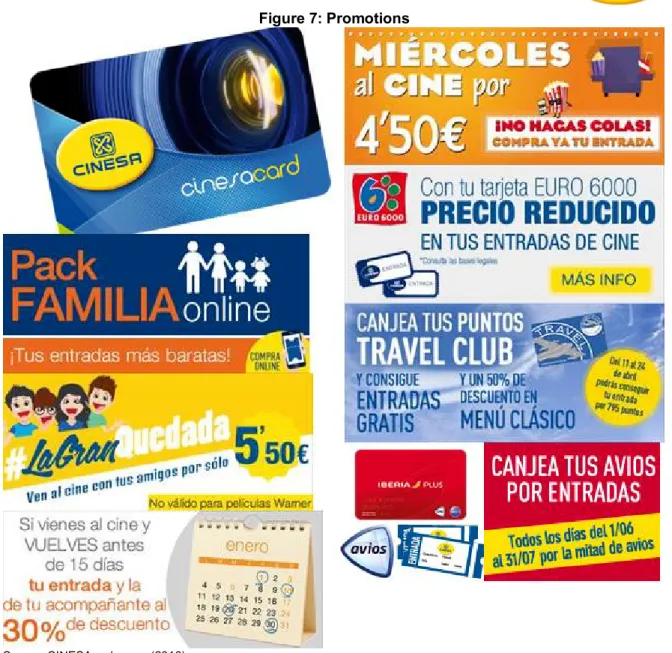
Respect to sales promotion, CINESA focuses on conducting consumer promotions to encourage purchase through discounts. CINESA’s promotions available in La Salera are as follows:
Spectator day: Like Miercoles al cine promotion the price is reduced, but in this case CINESA Salera drops it to €6.50. This cinema has kept this day as it is held on Thursday of each week except holidays.
Family Pack: Any day of the week to these sessions prior to 9:00 pm sessions, 2 adults and up to 4 children under 13 can enjoy discounts on their tickets, which will also change depending on the location of the cinema. These discounts in CINESA Salera are of €6.90 for adults and €4.50 for children.
La Gran Quedada: With this promotion customers can buy for €5.50 among 4 and 8 tickets, this price is for each one. They can do it via online, or creating a coupon on facebook and presenting it at the box office and then buy them there. There is too the Gran Quedada Menu, which consists in at least four menus that contains 1 medium size popcorns and a 40cl soft-drink for each one.
Vuelve al cine: Clients receive a coupon with a 15 days lifespan that provides them a 30% discount on tickets for the client and its companion.
Euro6000 Promo: With this promotion all customers with a Euro600 card can buy in non-holiday Monday to Friday through four tickets at the box office with a reduced price, which is €6.50. Clients will get a 50% discount on the classic menu too, which contains 1 popcorn bucket and 1 75cl soft drink, whenever the client downloads the coupon on the website and in this case any day of the week.
Travel Club and Iberia Plus: Both are very similar promotions, through the swap of points and avios, respectively, the customer can get free tickets. And with the swap of Travel Club points it is possible obtain the same discount on the classic menu that the client has with Euro6000 Promo.
CINESACARD: With this card customers are offered different offers and promotions. They obtain points with the tickets purchase (20 points per ticket) and can swap them once accumulated by bar products or tickets both standard theaters and supplementary theaters, all depending on the amount of points that the client can accumulate in a year, which is its shelf life.
Fiesta del cine: This promotion does not come from CINESA, but an event created by the Audiovisual Producers Confederation, the Spanish Cinemas Federation and the Cinematography and Audiovisual Arts Institute. It is a sporadic event, always three days, from Tuesday to Thursday, during which prices of all tickets of any film are reduced to €2.90, without taking into account the supplements.
Figure 7: Promotions
Source: CINESA web page (2016)
In addition to ticket sales at the box office, CINESA also has website, mobile app and social networks in which it carries out online marketing practices. On that website customers can find film trailers, all schedules and prices, events and the currently available promotions. In this way customers can also access, without surcharge, to the purchase of tickets and thus not having to queue to buy at the box office. With the mobile application customers can also access to see the billboard and schedules, and request the CINESACARD, but can not buy tickets directly from the app, as it redirects to the website, so in this case the application is a mere link.
By using social networks like facebook and twitter, the company also promotes the films and their offers, while carrying out public relationship activities such as contests and raffles
in which customers can win prizes as film merchandise or tickets. One of the best known examples of direct marketing activities of the company as MarketingNews.es collected was made in 2010 when they announced via facebook that for click like to its page the client would receive the 2x1 offer. In this way they achieved a 3000% increase of fans in seven days, plus saving on production costs by using facebook as a platform to launch this offer.
3.2. External Analysis
3.2.1. Political factors
Currently Spain is in a great political uncertainty, for the first time in the history of Spanish democracy has been no agreement among political parties to form a government after the result without an absolute majority in the elections of 12/20, so these elections have to be repeated. Furthermore, this instability is given by ideological differences between the most voted parties, on the one hand Partido Popular, the most voted list, has a right-wing ideology, while PSOE and Podemos are left-wing representatives, the first so more moderate than the second, and this along the differences in their political programs have been the main causes of the impossible agreements between them. These political differences also cause insecurity among the population and the economy, due to the difficult prediction of the next ruling party.
The current government, as gathered El País in 2012, along with the rise of the different rates of VAT (general increased from 18% to 21% and reduced from 8% to 10%, the super reduced 4% remained the same), it decided to increase the category of cultural VAT from the reduced one to the general, so that not only had to increase the difference between the two types, but also increased further due to new taxes, which was a blow to the film industry. This increase in VAT accounted for increased tickets price, making them harder for some people to attend to the cinema more assiduously and therefore a reduction in box office receipts of films in Spain, affecting especially the Spanish films because this country is their main, and sometimes unique, market.
This political uncertainty, with constant changes of ideas within parties, leads to ignore what really will happen with cultural VAT. But according to their political programs Podemos, PSOE and Ciudadanos seek that this VAT passes to be bound by the reduced rate and not by the general, just like was put in its moment by Partido Popular.
3.2.2. Economic factors
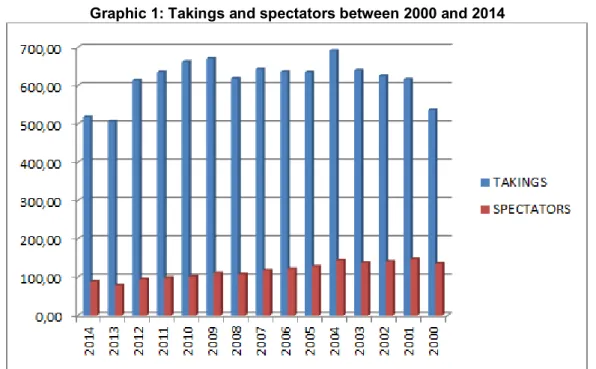
The film industry, according to data from National Statistics Institute (Instituto Nacional de Estadística, INE, 2015), has seen the takings of cinemas have been declining since 2009, when €671 million were earned, although in 2014 the decrease was stopped with €518.2 million. Even so this data is not particularly good, since it is the second lowest of the century, being only lower the amount gathered in 2013.
Graphic 1: Takings and spectators between 2000 and 2014
Source: Own Elaboration. INE Data (2015)
This fact was determined by two factors: The increase in tickets price and the economic crisis that began in 2007.
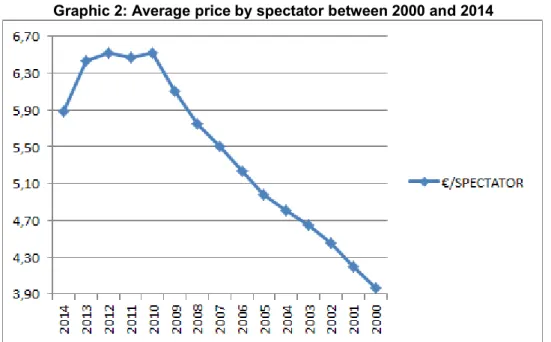
If we look at the relationship between the takings and the number of spectators from each year, we see a very clear trend: Every year since 2000 the tickets price was increasing gradually, which made revenues increase, but not the number of viewers. This caused the average price per viewer shot up during the first decade of the century, until stagnated in 2010, the last year of this upward trend. In the three years following the average price would remain virtually the same value of 2010. This was possible due to the increase in VAT commented on the political factors, because in this period the number of spectators began to decline significantly, to stand at less than 80 million in 2013, when until 2010 it had always been above 100 million. But in 2014 the average price suffered a sharp decline, although both the increase in annual takings and spectators was roughly the
same. This may be due to the popularity that won that year’s Fiesta del Cine, an event that according to El Pais (2014) managed to break records of spectators, gathering 1,904,728 viewers in three days in April and 2,196,101 in October. This great attraction of public by the reduced price made possible the increase of both annual spectators and takings, while the average price by viewer decreased.
Graphic 2: Average price by spectator between 2000 and 2014
Source: Own Elaboration. INE Data (2015)
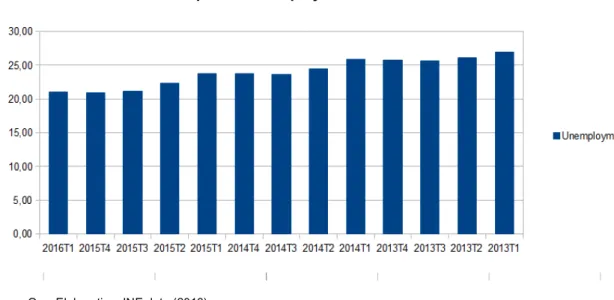
The economic crisis of 2007 was a major blow to the labor sector, generating a high level of unemployment since then. Although in recent years as stated in INE (2016) there has been a steady decline in the number of unemployed, from a rate of almost 27% to 21%, still it remains a high percentage, especially if we consider that part of this decline is also due to the decrease in the active population.
Graphic 3: Unemployment rate evolution
Source: Own Elaboration. INE data (2016)
Also we have to keep in mind the annual box office takings depend on films that are offered that year. In this case, years of big blockbusters will benefit the sector, as happened with domestic products as Spanish Affair in 2014 or The Impossible in 2012, or with a foreign product like Avatar in 2009.
According to El Mundo (2016), the International Monetary fund has improved gradually its economic outlook regarding Spanish GDP. It considered that GDP will obtain a 2% improvement in 2016 in its 2015 Spring Report, but recently in its Winter Report it raised this forecast to 2.7%. This view is shared by BBVA Research, according to El Economista (2016) the research service of BBVA considers that the Spanish economy will grow by the same percentage and not just in 2016 but also in 2017.
3.2.3. Social factors
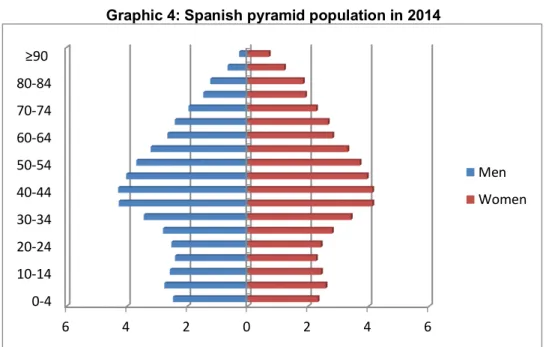
The Spanish society, according to data provided by the INE about the Spanish population in 2015, consists of a generally mature population, with highs between 35 and 59 years and lows since 70 years. Data of young people are not particularly good, no age group exceeds 3% of representation regarding the total population, but also never fall 2%. And not only this, it can be appreciated that in a few years there will be a predominance of older people, as this demographic sector has grown more than the others sectors. Improvements in health or nutrition and the falling birth rate have caused that the lifespan increases from 76.63 and 83.36 years, for men and women respectively that were in 2002,
to the estimated 80.89 and 86.92 years for 2030 (Estrada, 2013). So it is safe to say that the Spanish population is and will be the next few years an aging population.
Besides that, of the more than 46 million people, most are women, because thanks to their longer lifespan they are more representatives than men in the ages over 79 years, even to double their data, which results in the small majority of female population, since in the remaining age fringes the men and women data are almost equal.
Graphic 4: Spanish pyramid population in 2014
Source: Own Elaboration. INE data (2015)
The fact that the Spanish population is aging is a problem for the film industry. As shown in Graphic 5, population groups more moviegoers are those who are between 25 and 44 years, followed by the group between 45 and 54 years. So if the young population is decreasing and the senior population increases further, the sector is in danger of suffering a reduction in its incomes.
6 4 2 0 2 4 6 0-4 10-14 20-24 30-34 40-44 50-54 60-64 70-74 80-84 ≥90 Men Women
Graphic 5: Cinema attendance rate per ages
Source: Statista (2016)
Apart from that, regarding the lifestyle of the Spaniards, this is commonly related to outdoor fun and parties, and this is reflected in the graphic 6 with data from the INE (2015), in which it is possible see spending in hotels, cafes and restaurants of the Spanish population, only surpassed by spending on food and non-alcoholic beverages, transport and household and energy. Even so it can be seen that spending on leisure, entertainment and culture goes right after these expenses and the group called others, ahead of spending on alcoholic beverages, communications, clothing or health, among others.
Graphic 6: Expenditure groups in 2014
Source: Own Elaboration. INE data (2015)
And not only that, also as we can see in Graphic 7, provided by the INE (2015) too, where is analyzed the evolution about groups 1 (food and non-alcoholic beverages), 2 (alcoholic beverages), 4 (household and energy), 7 (transport), 9 (leisure, entertainment and culture) and 11 (hotels, cafes and restaurants), all these groups except number 4 were reduced their spending regarding the previous year. This downward trend was consistent for all groups, even for group 4 from the following year, except in 2011, where the group managed to increase its spending over 2010. The decreases in spending on leisure and hotels are much more pronounced than those that occurred in the first need’s expenses, denoting the decision of the population to prevail this expense over the ones related with their own enjoyment. Despite this the most highlight occurs in 2014, when groups of basic needs such as 1 and 4 continue to suffer declines in the amount of spending, but groups 7, 9 and 11 are increased.
0 2 4 6 8 10 12 14 16 18 20 Percentage
Graphic 7: Expenditure groups evolution between 2009 and 2014
Source: INE (2015)
Therefore, despite the economic crisis, the Spanish population is predisposed to spend not only on those basic necessities of life, but also in entertainment, and with this data we can say that is a society that not only enjoy the social entertainment, but also cultural and recreational one, but the fact that it will be an increasingly aging population may change this trend and in the future cause a decline in revenues.
3.2.4. Technological factors
Despite Spain being, according to the website of Marca España (2016), a leader country in the technological development of sectors such as the production of graphene, infrastructure management, and development of renewable energy, among others, it is at the same time one of European countries with the lowest percentage of GDP regarding R&D investment, particularly in 2015 stood at 16th position. This trend bears watching for
several years, suffering an 11% drop between 2012 and 2015 (Inversión Innovación, 2016).
CINESA is nourished mainly by technology development and innovation of the film world, such as special effects or photography. The industry of special effects has evolved over the years, becoming more realistic objects and sequences that really do not physically exists at the time of the filming, to the point where sometimes the viewer does not know what is real and what is not. This has enabled producers to create more spectacular and realistic action, fantasy or science fiction films, making them more attractive to the public.
In addition they have also improved filming methods, with advances such as 3D or IMAX, which allow a different and new experience and an improvement audiovisual, respectively, for greater enjoyment of the viewer.
It is also important to highlight the great progress that there has been in the technology related to online media. The progress of social networks have made it easier to carry out online marketing, as well as to bring companies closer to customers and their needs, being able to solve their problems quickly and direct, without the need to travel, to call or intermediaries. And not only it has been affected by social networks, thanks to these advances customers now have the ability to buy tickets online, choosing themselves their seats and the session they want, and thus the queues decline at the box office.
In addition, advances have made possible the existence of Customer Management Systems, which enables to manage customer information to provide better services to them and to satisfy their needs better and better.
3.2.5. Ecological factors
Spain is one of the countries with most pollution of the world, to the point of breaching the 1997 Kyoto Protocol agreement. However, according to ABC (2012) the UN gives its OK to the Spanish emissions inventory, as our country increase its margin buying allowances from other countries that accomplish the terms of the deal.
Despite this the Spanish legislation imposes to companies an environmental I regulation with the aim of companies which causes damages take care of repairing them, or prevent them in case that there have been no such damages and try to avoid them.
Furthermore according to CIS data (2010) the Spanish population is a conscientious society with environment, which has been concerned more and more over the years with modernization, but this concern is not expressed exactly as it should be. That is, the Spanish people have awareness and positive values regarding the environment support, but it does not translate mostly into attitudes and ecological practices. There are citizens who morally adhere to environmental awareness, others who perform voluntary cooperation in their private life styles, and others who are actively involved in environmental sustainability.
For this, companies that show respect and concern for the environment are viewed favorably by the public, and many try to make not only compliance with laws but also projects that help sustainability and help them to create a good image. CINESA for example has theaters sponsored by Gas Natural Fenosa, which as reported the energy company, in 2014 it decided to expand this agreement to carry out the Cinergia initiative together, a project of four shorts films related to energy efficiency, to raise awareness through the film industry to the population about it..
3.2.6. Legal factors
The film industry is a quite damaged sector due to the difficulty of its regulation, because it is very affected by piracy and the ease for anyone to use illegal means to watch a film. But in Spain there is the Law of Sustainable Economy in which the Final Rule 43 is, formerly known as the Final Disposition Second, and more popularly known as Ley Sinde. This law basically allows the existence of a commission under Ministry of Culture control with the ability to close, with the authorization of the Central Courts of Administrative Litigation, website which they consider are infringing intellectual property rights (Hipertextual, 200).
In addition to this, there is the Intellectual Property Law, toughened in its latest update, approved in October 2014. The law imposes penalties of up to €600,000 for the owners of those websites that infringe copyright, and not only intends to face these sites, but also to any intermediary that facilitates access to these pages (El País, 2015).
Despite this, according to ComputerHoy.com (2014), the websites can avoid these laws placing the domains of their websites abroad. The government has no power to close websites that are outside Spain.
Figure 8: PESTEL effect summary
4. COMPETITION ANALYSIS
CINESA Salera competition can be classified from the customer’s point of view in four levels:
Table 3: Competition from customer point of view
Product Form
Here would be whatever competitor which product provides the same service to the same segment than CINESA Salera, so any other cinema would be its product form competitor.
Product Category
This competition is whatever which product has similar attributes, but with different presence. Outdoor cinemas or drive-in cinemas, like Autocine Star, would be examples of product category competition.
Generic
Products that solve the same necessity will be in this level. Therefore the necessity to watch a film can be solved too by films DVD/Blu Ray, online distributor companies such as Netflix or Movistar+ and the piracy.
Budget
Products that solve the same necessity will be in this level. Therefore the necessity to watch a film can be solved too by films DVD/Blu Ray, online distributor companies such as Netflix or Movistar+ and the piracy. Source: Own Elaboration. Fundamentos de Marketing Estratégico (2013)
Figure 9: Competition map
Source: Own Elaboration
Therefore the CINESA Salera’s main competitors would be the cinemas from other companies that compete in the same product form, so it is necessary highlight those companies with cinemas near Castellón:
Neocine has cinemas located in the Azahar Seaport, located in the Grao de Castellón, a maritime district located 4 kilometers away from Castellón de la Plana, but it is part of the territory of the city. This cinema features evening and night sessions, but not every day because Mondays is closed.
This chain of cinemas has events like opera or ballet, or cycles of art, as well as VOSE films, but none of these products are projected in the theaters located in Azahar Seaport, so its only product are family and standard films. In addition it does not have 3D projection
theaters, so this films that include this possibility when they were produced only can be watched in 2D in this cinema.
Regarding the ticket price, it is €7.50 at the box office, and are subject to a surcharge of €0.90 if the customer buy it online. Even so this price is reduced to €6.50 for those customers who have youth card, student card, are over 65 years or belong to large families, any day of the week. Therefore, although its overall price is €0.50 lower than the CINESA Salera price, this advantage disappears when purchasing tickets via the website, as well as the second market, which price is the same in both companies, but with except that Neocine lets to reduce the price on weekends.
In addition to these prices, Neocine has two promotions, Miércoles al cine and Spectator Day, the latter held on Thursday, and as in CINESA Salera their prices are also €4.50 and €6.50 respectively. The company uses both its website and social media to promote their offers throughout Spain.
The location of this cinema is favorable, but not as much as CINESA. Azahar Seaport consists of three buildings where the client can find the Gran Casino de Castellón, shops, restaurants and pubs, which can generate a potential customers’ influx.
Multicines Sucre is a company that consists of two cinemas, one in Vic (Barcelona) and the one that concern us, at Vila-Real, 8 kilometers away from Castellón de la Plana. It is the closest cinema to CINESA Salera located outside the town Castellón.
Multicines Sucre’s offer is greater than Neocine’s one, here there are not only family and standard movies, but also movies in VOSE and 3D projections, having the latter a price increase of €1, and €1 more if the customer rents glasses in the cinema. This price will change depending on the day, being €4.99 on Monday, Tuesday and Thursday; €4.20 on Wednesday; €6.99 on Fridays; and €7.50 on Saturdays, Sundays and holidays. It can be seen therefore that Multicines Sucre offers more attractive prices than CINESA every day
of the week, with Wednesday the day that the difference is smaller, but they suffer an increase of €0.40 if the client buy tickets through the website.
As regards to the second market, Multicines Sucre offers different prices only on Friday, Saturday, Sunday and holidays to members of large families, people over 65 years or holders of student or youth card. This price is a reduction of €1 on the day standard price. In addition it also has the Gift Card, which can be loaded purchases of tickets and bar products (minimum €20) for use in anniversaries or parties, and the following promotions:
Vila-Real CF card: With which you can obtain tickets at the same price as stipulated for the second market.
Customer Card: With which as with the CINESACARD the customer may go accumulating points and then be exchanged for tickets and bar products. In addition with this card on Thursday its owners enjoy €1 discount on tickets.
Multicines Sucre not only has the website to promote films and to inform its customers, but unlike other cinemas, it has customized social networks for the cinema located in Vila-Real, which improve the communication and relationships with customers.
Unlike CINESA Salera and Neocine Azahar, Multicines Sucre Vila-Real is not located in a leisure area with great influxes of people, but it has restaurants, bars and fast food services nearby, so as the Carrefour hypermarket and parking large areas, so it can take advantage of the proximity of these places to attract public.
The last of the major cinemas in Castellon province is located in the Costa Azahar shopping center, in Benicarlo, located 71 kilometers at north of Castellon de la Plana. Despite being away from CINESA Salera, keep in mind that there is little offer of large cinemas in Castellon province, so it is a major competitor for those clients who are equally far from both cinemas.
Axion Benicarlo has 7 HD projection rooms, two of them equipped with 3D projection technology, where you can watch family and standard films, but only dub.
Common price is €7.50, being reduced to €6.50 on weekdays, the same price offered for the second market all the week, which in this case also includes children under 14 years. These prices apart, Axion also includes Miércoles al Cine, on its promotions, and like CINESA it costs €4.50. And offers Bono 10, with which the customer buys 10 tickets that can be swapped any day for any film, with a total cost of €49, so the customer would end up buying 10 tickets for €4.90 each one.
The company website only informs the customer of its offers and films and lets them buy tickets. They do not use social networks to promote themselves neither globally or only Benicarlo.
The Kinepolis cinema closest to CINESA Salera is located in Paterna (Valencia). Despite the geographical distance is a competitor to be reckoned with, as Kinepolis is an important brand in the exhibition industry in Spain, which could make people to travel a great distance just to see films in their theaters.
The offer of this cinema is quite wide, having 24 theaters where customers can see family films, standard films, dubbed or in VOSE, in 3D or 2D and events like opera, documentaries, concerts and monologues. This audiovisual offer and the quality of its theaters and screens are its main strengths to attract customers from differents parts of Valencian Community, including Castellon de la Plana and nearby cities.
This achievement is remarkable if it is considered that their prices are higher than the rest of the cinemas. Their normal price is €9.10 on Mondays, Tuesdays and Thursdays, and €9.50 on Friday, Saturday, Sundays and holidays. Like the other cinemas offer second market prices, €8.30 and €8.40 respectively. In both cases there is a €1.50 surcharge on the price for 3D films, which would increase another €1.20 if the client needs to acquire 3D projection glasses. The price of the events is variable and will depend on what event is going to be projected.
In addition Kinepolis Valencia also offers the possibility that the children celebrate their birthday for groups of at least 10 children for €11.50 per attendee, in which are included the ticket, popcorn, soft drink, sweets and a gift.
Like the rest of cinemas, in Kinépolis also exists Miércoles al cine, replacing Spectator Day, which price was €8.30, but now thanks to the change the price has dropped to €5.50. In Kinépolis they offer up to 6 types of cards, 3 aimed for films and the other 3 for events:
KINEFAMILY is aimed to families with a cost of €42, it lets to swap it for 5 tickets and get discounts on bar products.
KINECINCO and KINEDIEZ, which cost €42 and €74 respectively, can be swapped for five and ten tickets, but do not offer discounts on the bar. This product is aimed to the rest of clients.
Opera and Ballet pass 3, 6 and 10 tickets, for €47.90, €89.90 and €139.90 respectively, customers can get the indicated number of tickets to watch any opera and ballet event of the season.
In addition Kinepolis also carries out contests and raffles for customers to watch preview films or to get merchandising gifts from any of the films on billboard. All this is promoted through its website, mobile app and social networks, which like CINESA uses a global account for all its cinemas.
Kinepolis Valencia is located in Heron City shopping center, so that like the previous cinemas it takes advantage of the large influx of potential customers visiting shops and enjoying its restaurants and leisure facilities.
As Kinepolis Valencia, this cinema is located far away from CINESA Salera in Valencia, but also is part of an important cinemas chain, so it can also be an important competitor. Specifically, and like almost all mentioned cinemas, is located in a shopping center, Mercado de Campanar, so like the other two takes advantage of large influxes of people. Its offer is extensive too, offering movies for all audiences, in VOSE and in 3D. In addition Yelmo offers the possibility to make bookings for schools via their website.
Tickets price is common to all offers, dubbed and VOSE films, in 2D or in 3D, although the surcharge for 3D glasses amounts to €1.80. But instead, the price, except on Wednesdays, is divided into 4 segments of population: Children, Youth, Adults and Senior:
Children (under 13 years) and senior (over 65 years) prices are €5.90 every day, but for those sessions before at 18:00 pm the price is €4.50 on weekdays.
Youth price is divided into two fixed amounts, Youth MF and Youth SSd, the first is the price that this population has between Monday and Friday, being €5.90, and the second is for holidays, of €7.90.
Adult’s price as the youth is €5.90 on workdays and €7.90 on holidays, but unlike these, adults can enjoy discounts for sessions before at 18:00 pm.
Like the rest of cinemas, Wednesday price is reduced to €4.50 for all customers, that is why there is no differentiation between the four segments discussed before for that day. Yelmo also use its website to promote itself and sell tickets, as well as mobile app and social networks that represent all Yelmo cinemas.
Table 4: Competition summary
5. SWOT ANALYSIS
Figure 10: SWOT Analysis
Source: Own Elaboration
•Piracy •High bargaining power of suppliers •Economic crisis •Future shopping center •Aging population •Ley Sindeand
Intellectual Propierty Law
•Poor quality of piracy at short term
•Low bargaining power of clients •High entry barriers on
the sector
•There are few techonlogical innovations in theater's offer •Do not have total
control over its offer •High prices
•Company has liquidity problems •Bein part of a major
cinema chain •Good number of theaters •Favorable location •Variety of promotions
STRENGTHS
WEAKNESSES
THREATS
OPPORTUNITIES5.1. Strengths
Undoubtedly the main strength of CINESA Salera is to be part of a cinema chain so ingrained and important as CINESA. Being part of this allows it to access quickly to the best films, commercially speaking. An independent cinema or a smaller cinema chain might have difficulties when they negotiates with suppliers to have available the latest releases of those films that attract a large audience due the block booking.
This strength is also linked to the fact that CINESA Salera has up to 14 theaters, which allows a better distribution of the schedules of its films among them, to have a large and diverse billboard available and to maintain films successfully for long periods of time. In addition is located in La Salera Shopping Center, so it can take advantage of the large influx of customers who will go shopping or eat in restaurants, especially on weekends. Besides this, the company has a variety of promotions to do more attractive tickets’ purchase for customers, and not to be overwhelmed by their base price.
5.2. Weaknesses
Despite belonging to a group as important as CINESA, technological innovation in Salera cinema is limited to 3D projections. Other cinemas located in other cities have IMAX, iSens or Dolby theaters, which offer the viewer higher visual and audio quality allowing greater immersion in the film, in addition to better comfort regarding seats, speaking about the iSens and Dolby theaters.
An important feature of cinemas is the fact that they do not have full control of its offer, i.e., they cannot choose which films to issue and when do that, it depends on the films that have produced distributors. So CINESA will benefit from years in which suppliers produce blockbusters that attract large numbers of people, but there will be years or seasons that they do not have this kind of film, which can lead to financial problems if they fail to attract necessary customers.
Another weakness would be prices. Is a general complaint of viewers the fact that they consider high the ticket prices, but due to little bargaining power they can not do anything but accept them. And not only are complaints about ticket prices, but also about the ones of the products of the bar, although in this case because of the location of the cinema and its permissive policy, customers buy drinks, popcorn and other food in establishments that
are located too in the shopping center as Alcampo, and in this way they save the excessive price of the cinema. So this price at the end causes the customer directly do not buy these products in CINESA Salera.
In addition currently CINESA has been accumulating losses consecutively for several years, and in 2014 ended with an active current below its current liabilities, so CINESA is not able to cope with short-term payments that are pending, so it may need to liquidate some assets, make discounts to companies that have outstanding debts with CINESA or borrow a loan, something difficult considering the current economic and banking situation.
5.3. Opportunities
The laws imposed by the Spanish government are the main defense that has the film industry against piracy. Despite with these laws the sector is a bit protected, but they have failed to permanently stop illegal distribution of films.
Anyway, cinemas can benefit from the poor visual and sound quality of the illegal versions that arise soon after the premiere, as they are simple recordings made by someone in a theater. Therefore CINESA Salera can attract customers who want to watch a movie in satisfactory conditions and do not want to wait it to come out on DVD or Blu Ray, when the illegal version would have a decent quality of viewing.
As I mentioned earlier in the section of weaknesses, customers have low bargaining power, so the company can impose high tickets prices and decide how to manage its promotion policy, because the client does not have available many alternatives to avoid having to pay these prices. It is essential that such impositions go in line with the competition, since the customer can decide to go to another cinema if it considers that the opportunity cost of going to that other benefits him or her.
The good thing about this sector is that it is difficult to set in it, there are high entry barriers, since it involves very high costs to build a new cinema from scratch and succeed in creating good relations with suppliers, and to obtain more desired products in an effective way in the event of the company that starts the new cinema is new in the sector.
5.4. Threats
Piracy is the main threat to the film industry, as discussed above is true that when a film is released, its illegal version has very poor quality, but if customers do not see a priority the
fact of seeing the film in the cinema, and they are aware can see it in a few months simply downloading it in their homes, the company then do not receive the benefit that it can get from these people. And as has also been said, the Spanish laws are not overly efficient, as the main illegal content download pages only have to put their domain abroad.
Besides, high bargaining power of suppliers forces cinemas to accept their offers. If distributors want the company buy category C movies, they will succeed imposing their purchase with the creation of packs where there will be films of the three categories. Thus CINESA is forced to buy category C films because it is necessary to obtain category A films. The sector majors above all have this power, since by distributing globally, if a cinema of an only county refuses their conditions, all that they have to do is not selling the product to it because it would not be a serious cost to the major.
Another threat that concerns CINESA Salera, and any other company, is the economic crisis, although there is a possibility of a favorable evolution in the coming years, the current situation still causing that there are people who choose to limit their private spending to priority things, leaving aside the cinema because of high prices and the possibility to watch movies for free thanks to piracy.
CINESA Salera also has a future threat, the construction of a shopping center near La Salera, Estepark. Its opening according to comments reported by El Mundo (2015) is scheduled for early 2017. This new shopping center could have among its establishments a cinema, which would become a direct competitor for CINESA Salera. But although would not be built one, a new shopping center would remain a threat as there are people that just attends to the cinema after having gone to buy or eat at La Salera and it is on their way, but if the new shopping center takes away public, CINESA will lose potential customers. In addition, the aging population may cause, in long term, a decline in revenue both of CINESA and the sector in general.
6. MARKET DEFINITION
6.1. Market delimitation
When we are determinating the market we have to keep in mind the reference market, the product market, and the relevant market, which according Munuera and Rodriguez (2007) are:
Reference market: Substiute products that satisfy a specific need of all potential buyers (Kotler et al, 2011).
Product market: Is the base unit where one macrosegment, a need and a specific technology intersect (Kotler et al, 2011).
Relevant market: Products markets in which the Company decides to compete depending on their technological alternatives and that magrosegments that it goes (Kotler et al, 2011).
In the case of CINESA Salera, its reference market will be base don satisfy the need of leisure and entertainment of individuals, and should be considered what specialization strategy it has to use with regarding the relevant market.
Figure 11: Reference and relevant markets
Table 5: Product market
NEEDS
BUYERS
T
E
CH
NOL
OG
ICAL
AL
T
E
RN
AT
IV
E
S
ENTERTAINMENT INDIVIDUALS COMPANIESPUBLIC ADMINSITRATIONS PROJECTIONS AND REPRESENTATIONS SPORTS VIDEOGAMES Source: Own Elaboration
Therefore, as shown in figure 11 and table 5, CINESA Salera will use a strategy of focusing on a single product market, using only projections to meet the needs of individuals.
6.2. Target Market
Films are characterized by being a product that is aimed at all kinds of audiences, there are offers aimed at both the younger and the older population, and thanks to the wide variety of film's genres the population is attracted for one or another film, giving equal gender, social class or age.
6.3. Segmentation
Market segmentation consists to divide the population into groups of consumers according to their needs or characteristics. As I said earlier the cinema is a popular product in the population, people of all ages, social classes, gender, etc., use cinema as a leisure method for their own entertainment, but it is true that among the population there are certain sectors to analyze that may be more relevant to CINESA.
CINESA will segment population mainly according to their socio-demographic characteristics, as it is shown in figure 11.
Figure 12: Sociodemographic segmentation
Source: Own Elaboration
This group is suitable for CINESA because with children and for all audiences films, whose main audience is young children, really they do not only attract this public, but also their responsible adults. Therefore CINESA is promoting Pack Family, to attract the attention of this segment and achieve a greater benefit, since a children’s
film, which is directed specifically to a person of the household, actually attracts at least two of them, the child and one parent, and this pack what it does is attract both parents.
This audience is one of the most frequent to the cinema, for its greater Independence from having their own transport mean or do not have responsibilities as children, so these factors allow them to have more time for leisure. It is useful that CINESA uses social networks to promote itself and try to be noticed, because this sector gives great use to these means. Once past the age of childhood and still not being capable to enjoy the benefits of an adult, teenagers seek entertainment in mny different ways, and one of these is go to the cinema. This segment is important because it is very likely to be attracted by so-called blockbusters, which are those movies with big budgets and have a great capacity to generate box office revenue.
TEENAGERS
Cinema is one of the main options when planning a date, either for new couples or life partners. It is a public to consider because sometimes are offered films that will appeal to only one of the partners, but will attract both only because their union. This segment of the population it might be considered a subsegment of the previous three, as it can be a couple of teenagers, of young adults or even a couple with children who decides to go to the cinema without them.
YOUNG
ADULTS
FAMILIES
This kind of division appart, CINESA can also divide its audience according to their psychographic characteristics. In the film world there are two large groups of public according to their tastes, represented in figure 12.
Figure 13: Psychographic segmentation
Source: Own Elaboration
In addition to this, according to Bureau Veritas Business School (2012), CINESA also uses the individualized marketing to those customers who are holders of CINESACARD by sending emails which highlights the last releases related with the genres that interest to the customer and the available promotions, all thanks to the implementation of the Customer Relationship Management (CRM).
6.4. Positioning
Positioning is the imatge that a product occupies in the minds of customers (Kotler et al, 2000). So taking into account the attributes of the tickets price and quality of offers, which means the diveristy of them and the quality of the theaters, it can be made the positioning map of the sector about CINESA and its competidors, shown in the figure 13.
CINEPHI
LE
This kind of people are fans of the film world, they like not just watch a film for its plot or because they liked the trailer, but by the actors, the director or because it is an award winning film. Minor films, usually from independent studies, which hardly ever fill the theaters but receive praise from critics, and films in VOSE, will be the most attractive products for this sector.
FANATIC
S
Commonly known as geeks, they are fans of particular movies, usually sagas which adapt literary works or video games, or even sagas of original films that have attracted a large audience with their first installments. This sector, often young but has people of all ages, goes to watch the film the first days of the release, so that CINESA takes advantage of this with the prestigious price, as they will not mind paying it.