GAP ESTIMATING MODEL:
Future supply vs demand in Indonesia’s healthcare system
National Team for Accelerating Poverty Reduction
Ufara Zuwasti Curran, Prastuti Soewondo, Halimah, James P. Thompson
Hypertension: Diagnosed vs
Unmet Needs
Source: Riskesdas 2010 K al s e l Ja ti m S ul ba r S ul ba r S ul te n g B ab e l D I Y o g y ak a rta Ri a u NTB S um s e l M al u k u Su lt ra J am b i K al te n g Ba li S um b ar M al ut S ul s e l NTT K ep ri G o ro nt al o Ka lt im K al ba r S um u t A c eh J ab a r S ul ut B an ten DK I Ja ka rta P ap u a L am p un g L am p un g P ab a r 45.0 40.0 35.0 30.0 25.0 20.0 15.0 10.0 5.0 45.0 40.0 35.0 30.0 25.0 20.0 15.0 10.0 5.0 Sick Treated | 3•
Research question:
–
What is the gap between the medical needs of Indonesians and the health care
system capacity to fulfil those needs?
•
Aims:
–
To build structure that permits deeper analysis and understanding about gaps in
supply and demand
–
Examine future demand of healthcare services as healthcare insurance expands and
healthcare supply to serve it
–
Provide recommendations to improve supply adequacy
•
GEM study is a
system approach
. It accounts for dynamics of and relationship between
supply and demand from three perspectives:
–
Accessibility
–
Affordability
–
Availability
| 5
Methodology
•
Who is our
population
?
–
Population is dynamic
–
32 cohorts
= 2 gender groups *
4 age groups * 4 health
insurance status
•
Askes rates (by age and
gender) were extrapolated to
all venues and adjusted,
accounting for insured status
groups and accessibility.
•
Healthcare
capacities
(supply)
–
Doctors, nurses, midwives,
hospital facilities
•
How to estimate
medical
needs (demands)
of
population?
–
What is the
health status
of
population?
–
What is the agreed
standards
of care
received by
population?
•
Assumption used as
standards of care: Askes
insured population prior to
2014
•
Why not other utilization
•
“
Small models
” for
–
Population and insured status
–
For doctors, nurses, midwives, and
hospital beds
•
Parameters & initial values*
: birth,
mortality, migration rates, insured
status, current capacity for supply,
enrolment, graduation, attrition
rates, practice patters for HCW,
hospital capacity growth rates,
admission rates, ALOS, etc
•
Small models to larger model
that
simulates the whole country
(
national model
) 200+
parameters and initial values
•
Demand
is affected by
affordability, accessibility, and
availability – and is measured as
unconstrained demand,
desired/expected/real demand,
and
constrained demand
•
Gap
was calculated between
capacity and assumed standard of
care
•
The concept was carried to 34
provincial models
, with 200+
parameters and initial models for
each province
Methodology
(2)
*Data Sources : BPS 2010 population data; BPS 2010-2035 population projection; UNDESA 2010 – 2015; BPS birth, mortality, migration rates; MOH insured
status; Registered physicians – MOH; Practicing nurses and midwives – MOH; Hospital capacity and ALOS – MOH; Askes utilization rates – MOH; Susenas 2013; PODES 2011; etc.
Methodology
(3)
Gender Age Outpatient (primary) Inpatient (primary) Outpatient (hospital) Inpatient (hospital)
Askes Adjusted Askes Adjusted Askes Adjusted Askes Adjusted
Male 0-14 261.68 201.16 1.91 1.45 24.54 18.87 6.23 4.72 Female 0-14 378.50 290.96 2.42 1.84 28.00 21.52 6.97 5.28 Male 15-44 209.95 161.39 1.16 0.88 28.82 22.15 5.02 3.80 Female 15-44 243.10 186.88 2.50 1.89 32.90 25.29 5.62 4.26 Male 45-64 428.84 329.66 1.35 1.03 72.61 55.82 6.97 5.28 Female 45-64 558.69 429.48 1.90 1.44 82.34 63.30 7.74 5.87 Male 65+ 437.97 336.68 1.64 1.24 77.96 59.93 8.41 6.37 Female 65+ 635.84 488.79 2.53 1.92 87.90 67.57 9.30 7.04 Average 394.32 303.13 1.93 1.46 54.38 41.81 7.03 5.33
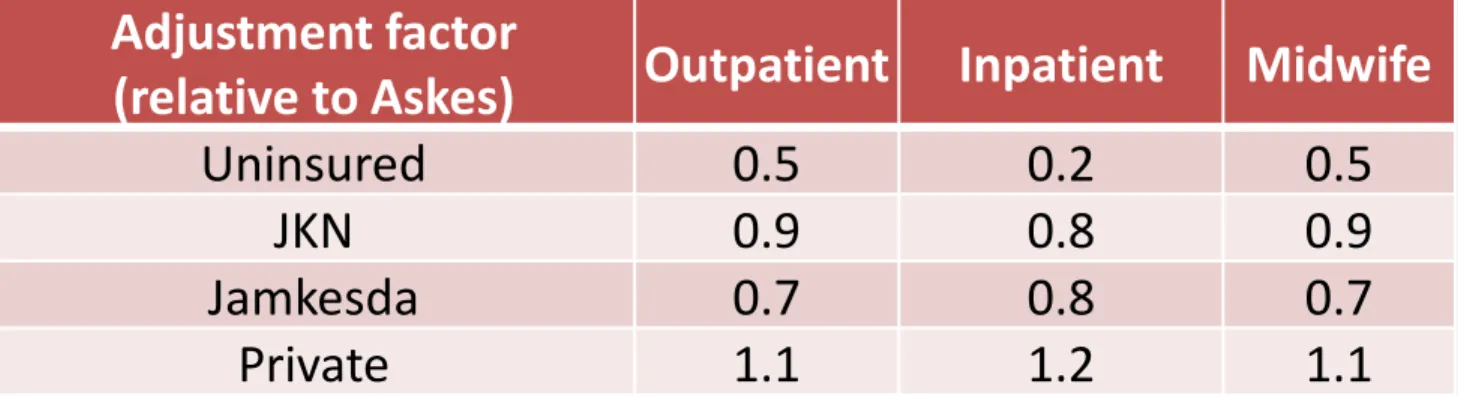
Adjustment factor
(relative to Askes)
Outpatient Inpatient
Midwife
Uninsured
0.5
0.2
0.5
JKN
0.9
0.8
0.9
Jamkesda
0.7
0.8
0.7
Private
1.1
1.2
1.1
Illustration for JKN insured group rates relative to Askes after adjusted using adjustment* and
accessibility** factors
Population Projection and Change in Insurance Status
Age 00 to 14 Indonesia 40 M 36 M 32 M 28 M 24 M 20 M 2010 2011 2012 2013 2014 2015 2016 2017 2018 2019 2020 peopl e Age 15 to 44 Indonesia 60 M 58 M 56 M 54 M 52 M 50 M 2010 2011 2012 2013 2014 2015 2016 2017 2018 2019 2020 peopl e Age 45 to 64 Indonesia 30 M 28 M 26 M 24 M 22 M 20 M 2010 2011 2012 2013 2014 2015 2016 2017 2018 2019 2020 peopl eAge 65 and over Indonesia
10 M 9 M 8 M 7 M 6 M 5 M 2010 2011 2012 2013 2014 2015 2016 2017 2018 2019 2020 peopl e
TOTAL NATIONAL POPULATION
300 M 280 M 260 M 240 M 220 M 200 M 2010 2011 2012 2013 2014 2015 2016 2017 2018 2019 2020 Date peopl e
total natl population : Indonesia
-50,000,000 100,000,000 150,000,000 200,000,000 250,000,000 Laki-laki Perempuan Jamkesda JKN Private Uninsured | | 1010
<(20,000) (10,001)-(20,000) (5,001)-(10,000) (2,001)-(5,000) (1)-(2,000) 0 1-2,000 2,001-5,000 5,001-10,000 10,001-20,000 >20,000 100,000 200,000 300,000 2014 2015 2016 2017 2018 2019 2020 Primary Care
Province Total Primary care Hospital
Jatim Jateng Jabar Jakarta Bali Banten Lampung NTB Sulsel Sumsel Sumbar Kalsel Sumut Jambi Aceh Kalbar Bengkulu NTT Sultra Sulteng Babel Gorontalo Kalteng Sulbar Maluku Riau Kaltara Kaltim Pabar Malut Sulut Kepri Jogja Papua Gap DOCTORS
Practicing doctors Desired demand Constrained demand
Supply and Demand for Doctors
Desired demand Practicing doctors 50,000 100,000 2014 2015 2016 2017 2018 2019 2020 Hospital | 11
50,000 100,000 150,000 200,000 250,000 2014 2015 2016 2017 2018 2019 2020 Hospital
Perawat di RS Permintaan perawat di RS 50,000 100,000 150,000 200,000 250,000 2014 2015 2016 2017 2018 2019 2020 Primary care
Perawat di Yankes Primer
Permintaan perawat di Yankes Primer
<(20,000) (10,001)-(20,000) (5,001)-(10,000) (2,001)-(5,000) (1)-(2,000) 0 1-2,000 2,001-5,000 5,001-10,000 10,001-20,000 >20,000 Gap
Province Total Primary care Hospital
Jatim Jabar Jateng Banten Bali Sulsel Lampung Sumsel Jakarta Sumut Sumbar NTB Jogja Kalsel Jambi Babel Gorontalo Sulbar Kepri Sulut Kaltara Bengkulu Sulteng Kalbar Malut Kaltim Pabar Sultra Riau NTT Kalteng Maluku Aceh Papua NURSES
Supply and Demand for Nurses
Practicing nurses Desired demand Constrained demand
<(20,000) (10,001)-(20,000) (5,001)-(10,000) (2,001)-(5,000) (1)-(2,000) 0 1-2,000 2,001-5,000 5,001-10,000 10,001-20,000 >20,000 Province Midwife Kaltara Sulbar Babel Gorontalo Jogja Pabar Kaltim Malut Kepri Maluku Jakarta Banten Kalteng Sulut Sultra Sulsel Papua Kalbar Sulteng Jambi Bali Kalsel Bengkulu Lampung Riau NTB NTT Sumsel Sumbar Jabar Aceh Sumut Jatim Jateng Surplus MIDWIVES
Supply and Demand for Midwives
Practicing doctors Desired demand
Gap
Supply and Demand for Hospital Beds
Capacity Desired demand Constrained demand
HOSPITAL BEDS
Province Hospital beds Jakarta Jateng Jabar Jatim Sulsel Sumsel Bali Jambi Lampung Banten Sumbar Sumut Riau Kalsel Sulteng NTB NTT Sulut Babel Aceh Kalteng Kalbar Sultra Bengkulu Malut Sulbar Gorontalo Maluku Kaltara Kepri Pabar Kaltim Papua Jogja | 13
Provincial Gap
Summary
Doctors33
1
Nurses Deficiency17
17
Worst:Jatim, Jateng, Jabar, Jakarta, Bali, Banten
Worst:
Sulsel, Lampung, DKI Jakarta, Jawa Tengah
Hospital beds
Deficiency
29
5
Worst:
Jakarta, Jateng, Jabar, Jatim
Deficiency
Surplus:
Papua Surplus:
Papua, Aceh, Maluku, Kalteng, NTT, Riau, Sultra, Pabar, Kaltim, Malut, Kalbar, Sulteng Bengkulu, Kaltara, Sulut, Kepri, Sulbar
Surplus:
Jogja, Papua, Kaltim, Pabar, Kepri
Midwives
No deficiency
34
• Availability of healthcare services is the greatest constraint on utilization
• Shortfalls in physicians, nurses, and hospital beds, and no deficiency in midwives
• In particular, the likely demand for physician and nurse services exceeds available capacities at all care levels
• For nurses, the gap will widen when numbers of physicians and hospital beds reach ideal figures • For midwives, however, local customs and need for
more midwives where the population is spread out indicate that the surplus is smaller than estimated • Insufficient capacity at the primary care level
increases the burden at the hospital level
• The generous governmental funding of healthcare costs makes shortfall in capacities even more
evident
• While remote areas will remain difficult to serve in future, it is possible and even likely that more
physicians and allied healthcare workers will be drawn to metropolitan areas, exacerbating access issues for Indonesians living in rural areas
• Quality and distribution of healthcare workers are still main problems, in addition to quantity
•
A 10 year strategic Master Plan
•
Focus infrastructure development in
rural/remote areas
•
Primary care strengthening to reduce secondary
care burden
•
Development of tax policies to encourage
investment by private sector
•
Engage development partners, ministries,
professional organizations, private sectors, NGO
•
Improve quality of medical, nursing, midwifery
trainings and provide continuous trainings
•
Increase quota and number of medical schools
•
Use of physician extenders – add qualifications
for nurses and midwives
•
A national service commitment which places
HCWs in rural and remote areas should be
considered for bonded in lieu compensations.
There may be needs to modify incentives
•
Consider placement of foreign doctors in
strategic areas
CONCLUSIONS RECOMMENDATIONS