SELECTING PROPER TOOLS FOR THE PROCESSING OF KOREAN, ARABIC AND
language spoken by almost 300 million people. However, this language does not have any writing system and prefers to employ romanized characters CITATION Gro97 \l 1033 .
Corpus processing tools that are equipped for the processing of English (and other romanized languages) are many. Can it be used to process corpora in which the data is written in non-romanized alphabet like Arabic or Korean? If not, what processing tools are present for languages with their own writing system like Arabic or Korean? This paper is an effort to answer these two questions. I, in the fourth section, will demonstrate the use of some corpus processing tools to process romanized and non-romanized languages. I believe that selecting the proper tool is a preliminary step before you go to more complex corpus processing tasks[ CITATION McE12 \l 1033 ] like statistical functions, automatic retrieval, data annotation, output generation etc.
2. Corpus Processing Tasks
Many corpus-processing tools, these days, are present on internet and can be downloaded for free. They can be used offline with the data that you customize yourself. Some corpora are made online, and also equipped with facilities to perform processing tasks. But for these online corpora, we usually cannot use our own texts or corpus. The corpus is kept on the server and cannot be modified.
The simplest task that corpus-processing tools can do is word count. It measures how many words are running in the text corpus. Another task is word rank. It may rank the word from the most to least frequent. These tasks can be done with raw corpus, as they are merely statistical. Some of these tasks can also be performed, even by non-corpus tools. Consider ‘word count’ and ‘find’ features in MS Word, a word processor program. This can be done as the tasks are purely character based. For more sophisticated task, the corpus needs to be annotated.
When the corpus is annotated, much more complex tasks beyond character match can be performed. For instance, you can search the corpus on the basis of part of speech (POS), semantic, or word relation, depending on the type of annotation present in the corpus.
Many researches focus on developing English corpus processing tools. This is because English is widely used around the world. The tool can also be used to process the corpus in different language, in condition that it employs romanized characters in the text. However, the function will be limited to only character-match based task (frequency count, word and character count).
3. Challenges For Non Romanized Languages
Most corpus processing tools are designed for corpus where the texts are written by using roman characters. However, some tasks that are considered simple like word count or word frequency might be quite challenging when it comes to the processing of languages with non-romanized characters, as usually the default language of computers is English. We can overcome this by selecting the proper encoding. But the problem is not all corpus processing tools have the same encoding system.
Character recognition for corpus with romanized characters like English and Indonesian is a simple processing task. However, it is a quite challenging issue for non-romanized language like Arabic or Korean. When you process corpus Korean or Arabic corpus with English/romanized characters based corpus-processing tool, then you might see strange symbols as in Figure 1:
The problem is because the two languages differ in terms of not only the characters but also the writing systems. English, which happen to be written in roman characters, is concatenative: each character is arranged horizontally by attaching one to another from left to right. Korean, on the other hand is written by using syllable block system. Each block is a syllable, where it is composed of at least 2 to maximum 4 characters. The characters are not arranged concatenatively.
Figure 2. Script Syllabification of <친구> [chin.gu] in Korean VS The Concatenation of Friend in English and teman in Indonesian
친구 [chin.gu] [chin] [gu]
ㅊ [ch] ㅣ[i] ㄱ [g]
ㄴ[n] ㅜ [u]
Each syllable in Korean script is composed uniquely. The token <친구> [chin.gu] is composed of two syllable. By referring to figure two, you are also aware that Korean script is composed both horizontally and vertically (the first syllable reads from left-right-up-down, while the second syllable reads up-down). Consider the difference with Indonesian and English. The Indonesian and English writing system is the same, using roman alphabets and concatenated from left to right.
What has been said about Arabic writing system? It reads from right to left rather than left to right. It also employs diacritics that are useful as vowel marker. In arabic orthography, words are composed of consonants skeleton, where the vowels are represented by diacritics. Even though diacritic is not always necessary as most arabic speakers are quite aware of the meaning just by the visual of the roots (the consonant skeleton). Consider figure three that shows the description of a consonantal skeleton [bis.mi]:
Figure 3. The Consonantal Skeleton in Arabic for [bismi]
[m] [s] [b]
[i] [i]
Speakers of arabic scripts (or at least people who have competence to read the script) are aware that the main character is actually the consonant and the vowels are reflected by diacritics. The consonant is obligatory while the vowels (marked by the diacritic) is optional. Often the diacritic (shown by broken line) is removed but speakers of arabic can still understand the meaning. In figure three, the consonant skeleton is [bsm] and inflected by two diacritics for vowel [i] attached on [b] and [m].
In this paper, I compare the processing of corpora. The can be categorized based on the the writing system (romanized VS non-romanized), and the language (Indonesian, Arabic, Korean). I will process these corpora by two kinds of tool. The first one is one-language platform (designed only for one one-language) and the second one is multi-one-languages tool (designed for more than one language).
4. Selecting The Proper Tool
One-Language Platform
Antconc [ CITATION Law06 \l 1033 ] is a tool written by Laurence Anthony for the purpose of English corpus processing. It is a very light, but very powerful in processing raw corpus. For new corpus users, it is recommended to work with this tool before proceeding further to more advanced tool. As a light tool, Antconc has many functionalities. Retrieval in Antconc can be performed by target word or regular expression CITATION Gro97 \l 1033 . It may retrieve single or multiword expression. The way Antconc presents the finding in the corpus is also interesting. It can display the result in standard concordance lines. Another way to display the result is by creating dispersion plot so that the users will understand the density of the target words with reference to the corpus texts. Antconc is also equipped with basic statistic collocation count.
Figure 4. Concordance Line with Target Word: Money
However, this tool can also be used to process languages with romanized characters, like Indonesian. The presence of this tool is actually useful for languages that do not have specific corpus processing tool yet. Corpus research for these languages can begin without having to wait for the creation of specific corpus processing tools.
Figure 5. Concordance Line with Target Word in Indonesian: uang ‘money’
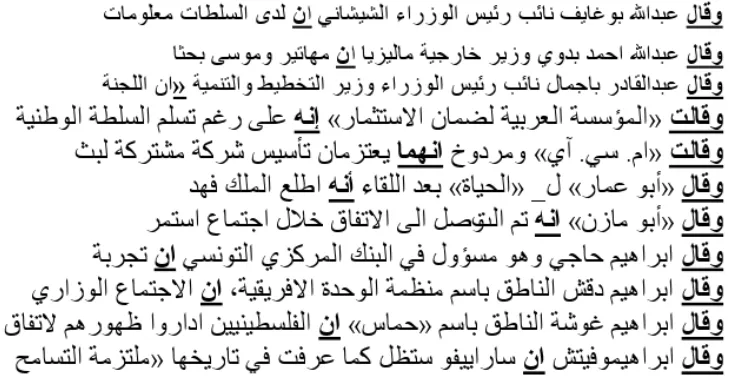
result on strange symbols as shown in figure 6, where the original text can be seen in figure 7:
Figure 6. Using English Module to Recognize Arabic Text
Figure 7. Original Arabic Text
The same thing will happen if this tool is forced to process Korean texts, as they are written in non-romanized characters. What users can do in this point is to seek a specific corpus processing tool for the language. Now, consider Geuljabi CITATION Gro97 \l 1033 , a corpus processing tool dedicated for the processing of Hangeul (Korean characters).
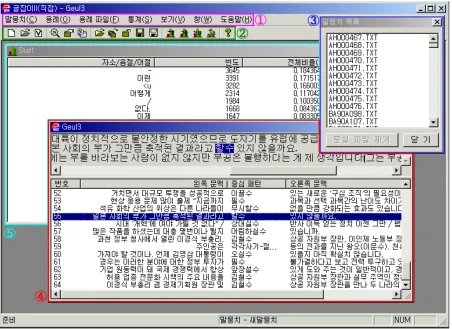
Figure 8. Geuljabi Display
CITATION Gro97 \l 1033 http://builder.hufs.ac.kr/user/boardList.action?
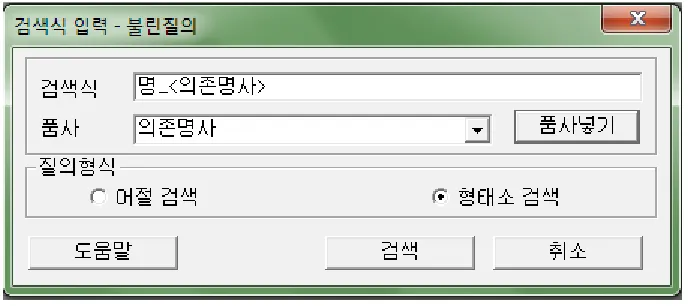
Geuljabi can process several texts at once. It also has basic functionalities as Antconc: basic concordance, text retrieval, statistical tasks and etc. The advantage of Geuljabi, besides its module can recognize Korean characters, is its ability to tag or annotate the text. The annotation is very useful as users may also search on the basis on linguistic information (not only character-based match):
The format of the search is as follow: target token_<word class>. If your search is just character based, this space can be left empty. Figure 10, shows the retrieval of target word명 as a dependent noun. The specification of word class is important as one token might be the representation of several word class in isolation, but in sentence context they fall only to one class. See the result in figure 10:
Figure 10. Concordance for the search of 명 as a Dependent Noun
The result of the retrieval shows that the target word is almost always accompanied by a number (digital numeric) in every line. The target word명in Korean is a numeral classifier. As it name suggests it has to co-occur with numeral, in either digital numeric or Arabic numeral. Although retrieval in this annotated corpus consume some more memory, but users have the benefit of performing linguistic information based retrieval. Can Geuljabi be used to process Indonesian corpus? The answer is yes, to some extent. However, it cannot perform annotation for Indonesian texts as the lexical resource is not designed for Indonesian lexicon. Basic corpus processing tasks, the character based match, however, can still be performed.
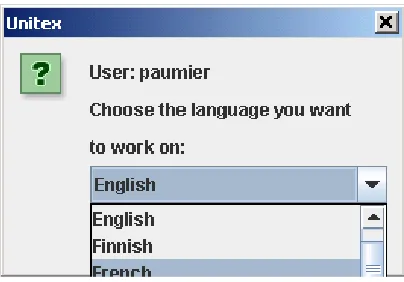
Tools with multi languages platform can process corpora in different language. Besides some basic processing tasks, it also has the ability to do advance processing tasks with annotated corpus. One of the examples is Unitex CITATION Gro97 \l 1033 [ CITATION Pau08 \l 1033 ]. Unitex is a multi-language platform corpus-processing tool. Before you use Unitex on your corpus, it requires you to select the language of your corpus. See figure 11:
Figure 11. Language Selection in Unitex
When you choose one language, Unitex will refer to the language resources (lexical resource, language characters, sentence separator, tokenizer and etc). The resources for each language are unique. For instance, the character recognition for Arabic is different from Korean. Using Korean module to recognize Arabic, or the other way around, will cause errors to happen. Now consider Arabic inflection module in figure 12. The mode is called Semitic mode:
Figure 12. A Toy Semitic Inflection Grammar
Lemma in Arabic is organized by consonantal skeleton, where the vowels are used to fill this skeleton [ CITATION Pau08 \l 1033 ]. The skeleton for inflection grammar in figure 12 is represented by number <123>. The lexical resource is as follow:
yakotobu,ktb.V:aP3ms
In this entry lines, the grammar code is <V:aP3ms>, where the root is <ktb> and the inflected form is <yakotobu>. The root might take different inflection that results on different word forms such as <kitab>, <kutiba> and etc. One research of Arabic by using Unitex was conducted by Traboulsi (2009). He managed to extract named entities (proper noun) in Arabic by using local grammar graphs (LGGs)1 in Unitex. Figure xxs shows the extraction of organization name in Arabic:
Figure 13. Extracting Arabic Organization Name
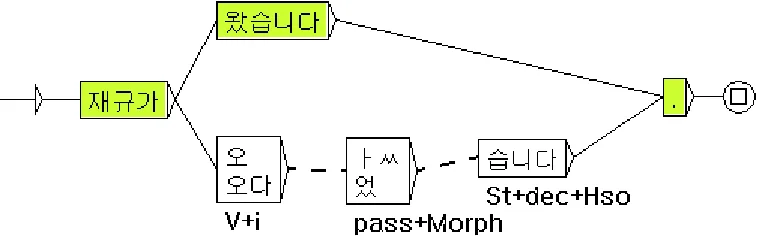
Unlike Arabic, Korean writing system obeys different logic. Korean is agglutinative language, where the characters are composed in syllabic block style. Unitex complies with this logic. Instead of recognizing characters concatenatively, it arranges the characters in syllable block style (see the upper part of figure 14). Beyond simple corpus processing task, Unitex can also perform morphological analysis on Korean text as shown by figure 15:
Figure 14. Syllable Block Writing as Opposed to Concatenative Writing
Figure 15. Sentence Automaton: Morphological Analysis of Korean
Figure 15 shows a sentence automation where the verb is morphologically analyzed[ CITATION Pau08 \l 1042 ]. The verb in green graph is the surface form, while the parallel three parts (see the dotted lines) is the basic forms by morphological analysis. The first part <V+i> is the main verb, where 오다 is the main verb. The second part 어 <pass+Morph> is the past tense morpheme, while the 습니다 <st+dec+hso> is the politeness marker.
One of the advantages of Unitex is that users can customize their own resources. One research by using self customized resource on Unitex was about the automatic conversion of archaic English to modern English (Prihantoro, 2011). See figure 16:
Figure 16. Input (archaic english) – Output (modern English) Concordance
be used to process Indonesian corpus. He designed a grammar to recognized morphophonemic variants of the derived forms. By using a grammar code in Unitex, the derivation of a lemma can be obtained. See the retrieval of derivations of lemma bor ‘to drill’:
Figure 17. Derivation of Lemma bor ‘to drill’
The grammar has managed to retrieve the derivational verbs dibor (passive),
mengebor (active) and noun bor. This research has shown that the prototype must be developed, and content of the Indonesian language resources (especially the lexical resource) in Unitex must be enrich to perform standard Indonesian corpus processing.
5. Conclusion
How to select the proper tool to process your corpus? First is to understand a tool that has the ability to process your corpus (depending on the language). Second is to find tools that suit your corpus processing purpose. If your processing tasks are considered basic like frequency count, character based retrieval and simple concordance. However, if you want some more advanced tasks that require the annotation of the corpus, then you will need to find tools with resources to perform annotation function. The third is to find tools that support your computing skills. Some tools do not require computing skills at all, but some tools do.
people with no prior computing skills might have difficulties in operating these tools. On my personal evaluation, the three software that I have briefly presented, AntConc, Geuljabi, and Unitex, are ‘quite’ friendly to the users. The ‘click’, ‘drag’, and ‘drop’ methods employed by the three tools are considered less complex than the syntax of coding or scripting, which just fits for linguists with no computational background.
REFERENCES
Anthony, L. (2006). Concordancing with AntConc: An introduction to tools and techniques in corpus linguistics. JACET Newsletter , 155-185.
Gross, M. (1997). The Construction of Local Grammars. In E. Roche, & Y. Schabes, Finite State Language Processing (pp. 329-354). Massachusetts: MIT Press.
Larasati, S.-D. (2012). IDENTIC CORPUS: Morphologically Enriched Indonesian-English Parallel Corpus. LREC , 902-906.
Lewis, M.-P., Simons, G.-F., & Fennig, C.-D. (2013). Ethnologue: Languages of the World, Seventeenth edition. Dallas, Texas: SIL International.
Mc Enery, T., & Hardie, A. (2012). Corpus Linguistics: Method, Theory and Practice. Cambridge: Cambridge University Press.
Paumier, S. (2008). Unitex Manual. Paris: Universite Paris Est Marne La Valee & LADL. Prihantoro. (2011b). Local Grammar Based Auto Prefixing Model for Automatic Extraction
in Indonesian Corpus (Focus on Prefix MeN-). Proceedings of International Congress of Indonesian Linguists Society (KIMLI) (pp. 32-38). Bandung: Universitas Pendidikan Indonesia Press.
Prihantoro. (2011). Transducer for Auto-Convert of Archaic to Present Day English: A Support for Computer Assisted Language Learning. Proceeding for The 16th English in Southeast Asia Conference. Yogyakarta: Sanata Dharma University Press.
Traboulsi, H. (2009). Arabic Named Entity Extraction: A Local Grammar Based Approach. Proceedings of the International Multiconference Science and Information Technology (pp. 139-143). Mragowo, Poland: Polish Information Processing Society.
![Figure 2. Script Syllabification of <친구> [chin.gu] in Korean VS The Concatenation of](https://thumb-ap.123doks.com/thumbv2/123dok/2906630.1347456/4.595.166.423.276.423/figure-script-syllabification-chin-korean-vs-concatenation.webp)