Selection Strategy of Drought Tolerance on Red Rice Mutant Lines
Eries D. Mustikarini 1*), Noer Rahmi Ardiarini 2), Nur Basuki 2) and Kuswanto 2) 1) Department of Agrotechnology, Bangka Belitung University
Kampus terpadu UBB Gedung BABEL IV Balunijuk Merawang Bangka, Bangka Belitung Indonesia 2) Department of Agricultural Science, Faculty of Agriculture, University of Brawijaya
Jl. Veteran Malang 65145, East Java Indonesia *) Corresponding author E-mail: [email protected]
Received: September 3, 2015/ Accepted: December 13, 2016
ABSTRACT
Most of Indonesian red rice is not grown in dry land. New varieties could be breeded through mutation breeding. This research objective was to evaluate the selection strategy of drought tolerant on red rice. The study was conducted on Ultisol soil in Bangka Belitung Province, Indonesia, in February 2012-February 2015. It consisted of three activities, selection M5, evaluation of selected M5 and evaluation of drought critical period on selected M6. Mutant of M5 was selected and evaluated with polyethylene glycol (PEG) -0.5 MPa and less of soil moisture. Selected M6 was evaluated to observe a critical period of drought stress. Eval-uation with PEG produces five superior mutants that more vigor than the elders. Selection on low humidity shows that M5-GR150-1-9 produces higher filled grain and weight filled grain than other mutants and elders. The selected red rice line M5 -GR150-1-9-13, has a better tolerance towards drought than its control. It could be obtained such mutant lines which have a high yield, early maturing and drought tolerant from the result of six generations gamma irradiation mutant selection. Keywords: drought; gamma; mutant; red rice;
selection
INTRODUCTION
The main obstacles in rice cultivation are drought stress and limited irrigated land. The limited amount of irrigated land is becoming an issue in the development of redrice varieties. Red rice varieties are currently classified as types of paddy as Aek Sibudong, Bahbutong (Aryana, 2009) and Inpari 24 (Utama, 2015). Red rice varieties of upland species released is only Inpago 7 (IAARD, 2012). Drought tolerance trait has to be owned by the red rice mutant to be cultivated on upland.
Drought tolerance of rice is controlled by many genes (polygenic) (Sudharmawan, 2010).
There were about 245 genes with direct impact and 413 genes with no direct impact have been identified as drought tolerance genes (Degenkolbe et al., 2009). The tendency of drought tolerant that is supported by drought resistance genes, had different and supportive roles (Sudharmawan, 2010). The selection strategy should be able to single out mutants which have resistant genes and are still expressed in drought stress conditions.
Pedigree selection is widely used in self-pollinated plants selection. The accuracy level of this selection is higher. The frequency of plants which have a recombinant was increasing (Bos & Caligari, 2008). The genes of superior lines were concentrated in a certain assembly point within the genes, and the pedigree was vividly learnt (Syukur, Sujiprihati, & Yunianti, 2010). Pedigree selection was used in 85 % of rice varieties in America (Guimarães, 2009). The modification of the selection method is performed to determine the differences in plants phenotype in order to accelerate the selection process.
Polyethylen Glykol (PEG) is used for the rice selection that have drought tolerance nature. Drought-tolerant red rice was selected by PEG-0.5MPa (Ballo, Nio, Mantiri, & Pandiangan, 2012). Drought tolerance in rice can be selected by observing less of soil moisture. The selection was carried out to, among other, aman rice genotypes at 40 % and 70 % degree of moisture (Zubaer, Chowdhury, Islam, Ahmed, & Hasan, 2007) and upland rice cultivars in moisture level of 10-90 % (Supriyanto, 2013). Asch, Dingkuhn, Sow, & Audebert (2005) proved that a decrease of 14% moisture reduces the biomass of upland rice. The varieties of upland rice that are more tolerant to drought stress were selected by using PEG and moisture content (Effendi, 2008).
Selection of drought-tolerant rice has been done by providing stress at critical periods of the plant. The critical period of rice paddy was experienced at the age of 16 days before blooming Cite this as: Mustikarini, E. D., Ardiarini, N. R., Basuki, N., & Kuswanto. (2017). Selection strategy of drought tolerance on red rice mutant lines. AGRIVITA Journal of Agricultural Science, 39(1), 91-99. http://doi.org/10.17503/agrivita.v39i1.648
Accredited: SK No. 81/DIKTI/Kep/2011
Eries D. Mustikarini et al.: Selection Strategy of Drought Tolerance………..
and 10 days after blooming (Kumar, 2011). The panicle length of the rice had decreased as a result of drought throughout the generative phase (Chutia & Borah, 2012), weight of 1,000 grains (Zain, Ismail, Mahmood, Puteh, & Ibrahim, 2014) and the production up to 94 % (Farooq, Wahid, Kobayashi, Fujita, & Basra, 2009). Drought stress at booting phase decreased the amount of fertile panicle, number of filled seeds (Pandey, Kumar, Pandey, & Thongbam, 2014), leaf area and dry weight of rice plants (Zubaer, Chowdhury, Islam, Ahmed, & Hasan, 2007). Drought stress on the grain filling phase lowered the crop production up to 60 % (Farooq, Wahid, Kobayashi, Fujita, & Basra, 2009; Sokoto & Muhammad, 2014). Rice plants are unable to with stand drought stress on the generative phase.
Various drought-stress screening methods can be used to ensure the tolerance of plants to drought stress. Mechanisms of genotype influenced big changes to the environment of genetic hetero-geneity to stress tolerance and recovery after stress (Allard & Bradshaw, 1964). Stable red rice genotypes produce relatively similar results when planted in dry environment or rice fields (Aryana, 2009). Therefore, the existence of mutants which have stable drought tolerance trait and not influ-enced by environmental circum stance is important to be obtained. The research objective was to find the best method to select drought-tolerant red rice mutant.
MATERIALS AND METHODS
The study was conducted on Ultisol soil on Bangka Belitung Province, Indonesia, in February 2012-February 2015. It was conducted for six planting seasons from mutant 1 (M1) - mutant 6 (M6). The mainmaterials of this study are the upland of Bangka red rice accession (Balok Mas, Celak Madu, Mayang Anget, Mayang Duku, Mayang Nibung, Ruten Puren and Radix). The rice accession has been treated with 150, 200 and 250 gray gamma radiation.
The selection of pedigree has been done on M1-M4. The selection aimed to obtain early maturity of red rice mutant with a great deal of yield. Mutants (M1) derived from the accession and three dose of gamma irradiation planted in a single plot. Selection of individuals was started from M1 plants for early maturity characters performed on each population. M3 was obtained
plot. M4 obtained from individual selection is done on M3 (Picture 2). The M4 selected lines used as material selection to obtain drought-tolerant mutants.
The first research was conducted selection on M5 with germination test in a solution of poly-ethylene glycol (PEG) 8000 -0.5 MPa. The research material was 36 mutant lines selected on M4 and three accessions. The research used completely randomized design (CRD) with three replications. PEG was used for seed damping in laboratory for 14 days. Traits observed were plumula length, root length, and germination.
The second research was to test the soil moisture by decreasing its level. The research materials were 5 lines of M5 which were selected from the first research. The experiment was conducted in a CRD split plot design. The subplots were M5-GR150-1-4, M5-GR150-1-9, M5-GR150-2-2, M5-GR150-2-3, M5-GR200-1-2 along with the Radix accession. The main plot was the soil moisture of 50 %, 75 % and 100 % (control). The mutant rice is planted in polybags and each plot consists of six plants. The less soil moisture treatment began 1 week after planting up to harvesting. Traits observed included plant height (cm), root weight (g), root length (cm), number of filled grain per penicle (grains), percentage of filled grain, and weight of filled grain (g).
The third research was to test the tolerance to drought in critical periods. The research materials were five selected lines of M6 from the second research. The experiment was conducted in a CRD split plot design. The sub plots were M6-GR150 -1-4-14, M6-GR150-1-9-13, M6-GR200-1-2-18, M6-GR150 -2-2-2, M6-GR150-2-3-13 along with the Radix accession. The main plot was drought stress (non -irrigation) in the phase of tillering, booting-flowering, seed filling and control. Stress treatment was given by covering plant using the transparent plastic for 14 days. Traits observed were plant height (cm), number of tillers (stem), number of filled grain (grain), percentage of filled grain, and weight of filled grain (gram). The data was analyzed by Fisher's exact test and the Least Significant Difference (LSD) with 5 % significance level.
RESULTS AND DISCUSSION
which were able to maintain early maturity came from Ruten Puren accession to the treatment gamma irradiation rays with dose of 200 gray, Radix accession with dose of 150 and 200 gray. The other five accession varieties, namely, Balok Mas, Celak Madu, Mayang Anget, Mayang Duku, and Mayang Nibung were unable to maintain early maturity.
M5 drought tolerance test showed that in the germination phase, there were differences in the traits of higher germination, root length and
plumula length. Low germination of mutants’ seeds was believed to be caused by the in ability of the seeds to absorb water. Seed absorbed up to 30 % water content before germination for activation (Lestari & Mariska, 2006). The use of PEG de-creased the amount of germination seed and growth of rice seed (Kaydan & Yagmur, 2008). In this study, the seeds were unable to absorb water for germination due to the increase in concen-tration caused by the addition of PEG.
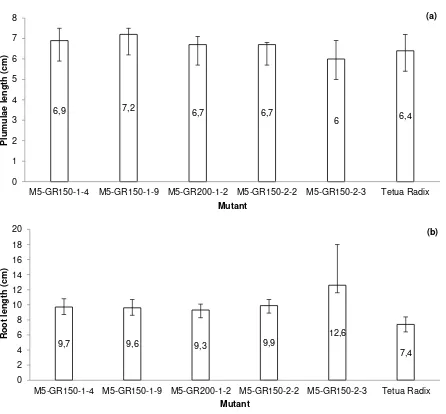
Figure 1. Mean plumula length (a) and root length (b) M5 to a solution of PEG 8000 -0.5 MPa
6,9 7,2 6,7 6,7
6 6,4
0 1 2 3 4 5 6 7 8
M5-GR150-1-4 M5-GR150-1-9 M5-GR200-1-2 M5-GR150-2-2 M5-GR150-2-3 Tetua Radix
Pl
u
mu
lae
len
g
th
(cm)
Mutant
9,7 9,6 9,3 9,9
12,6
7,4
0 2 4 6 8 10 12 14 16 18 20
M5-GR150-1-4 M5-GR150-1-9 M5-GR200-1-2 M5-GR150-2-2 M5-GR150-2-3 Tetua Radix
Root
len
g
th
(cm)
Mutant
(a)
Eries D. Mustikarini et al.: Selection Strategy of Drought Tolerance………..
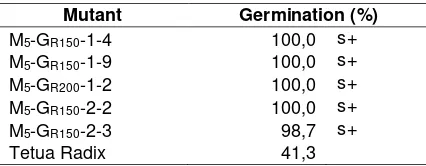
PEG applications on the planting medium decreased the root length, root distribution and volume of roots of rice seedlings (Adachi et al., 2014). Drought-tolerant rice had higher sprouts of fresh weight and dry weight (Ahadiyat, Hidayat, & Susanto, 2012). The selected mutants by using PEG was more efficient because it shortened the selection time. M5-GR150-1-4, M5-GR150-1-9, M5 -GR150-2-2, M5-GR200-1-2, M5-GR150-2-3 mutants were selected as the most tolerant to drought stress by their germination traits (Table 1). The fifth mutant has better character than the Radix accession. The mutants which have more drought tolerance are the mutants with 150 and 200 gray gamma radiation exposure.
Table 1. Mean of germination rate (%) in a solution of PEG 8000 M5 -0.5 MPa
Mutant Germination (%)
M5-GR150-1-4 100,0 s+
M5-GR150-1-9 100,0 s+
M5-GR200-1-2 100,0 s+
M5-GR150-2-2 100,0 s+
M5-GR150-2-3 98,7 s+
Tetua Radix 41,3
Remarks: S+ = significantly higher than the controls based on the test of least significant difference (LSD) 5 %
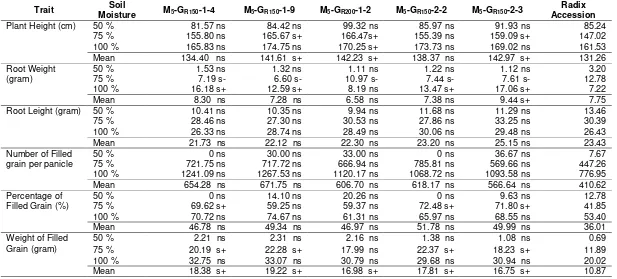
Positive correlation is shown from the results of M5 drought tolerance test with PEG and a decreased soil moisture. The length of M5 plumula and root has a higher value than the Radix accession on the PEG test (Figure 1). The average M5 height and root length after the test with a decreased soil moisture is higher than elders (Table 2).
M5 has shown some indicators of drought stress under the treatment with 75 % soil moisture which decrease its production. Upland rice experienced a decrease in weight up to 100 seed sand dry grain pertillers on soil moisture up to 90% (Supriyanto, 2013). M5-GR150-1-4, M5-GR150 -1-9 and M5-GR150-2-3 mutants have higher filled seed grain and seed weight than Radix accession in the less soil moisture of 75 % (Table 2). According to Bos & Caligari (2008), the arrangement of genes and the complexity of environment affected the interaction between genotype and the environment. The character of M5 was affected with the drought stress. The traits used for the selection of
dried-root weight (Nassir & Adewusi, 2012), and the weight of dry grain (Effendi, 2008). Traits such as number of filled grain and weight of filled seed are important to dried-tolerant mutant selection because of the high correlation with the results.
Lack of water causes the decrease in the number of filled grain and grain weight. Total of crop yield will be low. The decline of filled grain and grain weight that was caused by a lack of water would result in a decline inthe rice yields (Pandey, Kumar, Pandey, & Thongbam, 2014). Tolerant rice varieties would perform a tolerance mechanism to accumulate proline and sugar that play a role in the process of biosynthesis of the substrate, hydrolysis, and energy producing (Maisura, Chozin, Lubis, Junaedi, & Ehara, 2014). Sugar and total chlorophyll content in grain playeda role in maintaining rice yields in dry stress conditions (Zain, Ismail, Mahmood, Puteh, & Ibrahim, 2014). M5-GR150-1-9 filled grain has the highest weight in moisture 100 % and 75 % compared to the other mutants, so it is considered to have the potential for high yield and 75 % tolerance to soil moisture.
Table 2. Mean of the fifth mutant traits (M5) of red rice and Radix accession on impairment testing of soil moisture
Trait Moisture Soil M5-GR150-1-4 M5-GR150-1-9 M5-GR200-1-2 M5-GR150-2-2 M5-GR150-2-3 Accession Radix
Plant Height (cm) 50 % 81.57 ns 84.42 ns 99.32 ns 85.97 ns 91.93 ns 85.24
75 % 155.80 ns 165.67 s+ 166.47s+ 155.39 ns 159.09 s+ 147.02
100 % 165.83 ns 174.75 ns 170.25 s+ 173.73 ns 169.02 ns 161.53
Mean 134.40 ns 141.61 s+ 142.23 s+ 138.37 ns 142.97 s+ 131.26
Root Weight (gram)
50 % 1.53 ns 1.32 ns 1.11 ns 1.22 ns 1.12 ns 3.20
75 % 7.19 s- 6.60 s- 10.97 s- 7.44 s- 7.61 s- 12.78
100 % 16.18 s+ 12.59 s+ 8.19 ns 13.47 s+ 17.06 s+ 7.22
Mean 8.30 ns 7.28 ns 6.58 ns 7.38 ns 9.44 s+ 7.75
Root Leight (gram) 50 % 10.41 ns 10.35 ns 9.94 ns 11.68 ns 11.29 ns 13.46
75 % 28.46 ns 27.30 ns 30.53 ns 27.86 ns 33.25 ns 30.39
100 % 26.33 ns 28.74 ns 28.49 ns 30.06 ns 29.48 ns 26.43
Mean 21.73 ns 22.12 ns 22.30 ns 23.20 ns 25.15 ns 23.43
Number of Filled grain per panicle
50 % 0 ns 30.00 ns 33.00 ns 0 ns 36.67 ns 7.67
75 % 721.75 ns 717.72 ns 666.94 ns 785.81 ns 569.66 ns 447.26
100 % 1241.09 ns 1267.53 ns 1120.17 ns 1068.72 ns 1093.58 ns 776.95
Mean 654.28 ns 671.75 ns 606.70 ns 618.17 ns 566.64 ns 410.62
Percentage of Filled Grain (%)
50 % 0 ns 14.10 ns 20.26 ns 0 ns 9.63 ns 12.78
75 % 69.62 s+ 59.25 ns 59.37 ns 72.48 s+ 71.80 s+ 41.85
100 % 70.72 ns 74.67 ns 61.31 ns 65.97 ns 68.55 ns 53.40
Mean 46.78 ns 49.34 ns 46.97 ns 51.78 ns 49.99 ns 36.01
Weight of Filled Grain (gram)
50 % 2.21 ns 2.31 ns 2.16 ns 1.38 ns 1.08 ns 0.69
75 % 20.19 s+ 22.28 s+ 17.99 ns 22.37 s+ 18.23 s+ 11.89
100 % 32.75 ns 33.07 ns 30.79 ns 29.68 ns 30.94 ns 20.02
Mean 18.38 s+ 19.22 s+ 16.98 s+ 17.81 s+ 16.75 s+ 10.87
Remarks: The numbers were compared to controls on the same line. S+= higher significance than controls, s-= lower significance than controls, and ns = non significance based on the test of least significant difference (LSD) 5 %
95
D
. M
us
tik
arini
et
al.
: Sele
ction
St
ra
tegy
of
D
ro
ught
T
oleran
ce………
……….
Eries D. Mustikarini et al.: Selection Strategy of Drought Tolerance………..
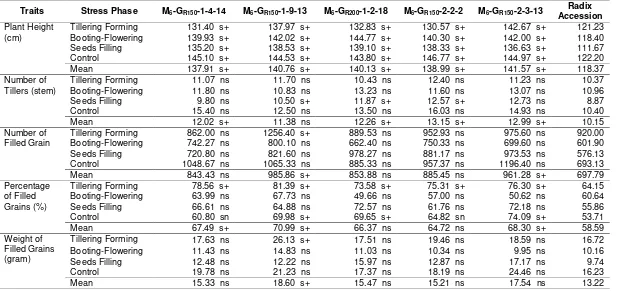
Table 3. Mean traits of the sixth Mutant (M6) of red rice and Radix accession on non irrigation in critical phases of plant
Traits Stress Phase M6-GR150-1-4-14 M6-GR150-1-9-13 M6-GR200-1-2-18 M6-GR150-2-2-2 M6-GR150-2-3-13 Accession Radix
Plant Height (cm)
Tillering Forming 131.40 s+ 137.97 s+ 132.83 s+ 130.57 s+ 142.67 s+ 121.23 Booting-Flowering 139.93 s+ 142.02 s+ 144.77 s+ 140.30 s+ 142.00 s+ 118.40 Seeds Filling 135.20 s+ 138.53 s+ 139.10 s+ 138.33 s+ 136.63 s+ 111.67
Control 145.10 s+ 144.53 s+ 143.80 s+ 146.77 s+ 144.97 s+ 122.20
Mean 137.91 s+ 140.76 s+ 140.13 s+ 138.99 s+ 141.57 s+ 118.37
Number of Tillers (stem)
Tillering Forming 11.07 ns 11.70 ns 10.43 ns 12.40 ns 11.23 ns 10.37 Booting-Flowering 11.80 ns 10.83 ns 13.23 ns 11.60 ns 13.07 ns 10.96
Seeds Filling 9.80 ns 10.50 s+ 11.87 s+ 12.57 s+ 12.73 ns 8.87
Control 15.40 ns 12.50 ns 13.50 ns 16.03 ns 14.93 ns 10.40
Mean 12.02 s+ 11.38 ns 12.26 s+ 13.15 s+ 12.99 s+ 10.15
Number of Filled Grain
Tillering Forming 862.00 ns 1256.40 s+ 889.53 ns 952.93 ns 975.60 ns 920.00 Booting-Flowering 742.27 ns 800.10 ns 662.40 ns 750.33 ns 699.60 ns 601.90 Seeds Filling 720.80 ns 821.60 ns 978.27 ns 881.17 ns 973.53 ns 576.13 Control 1048.67 ns 1065.33 ns 885.33 ns 957.37 ns 1196.40 ns 693.13
Mean 843.43 ns 985.86 s+ 853.88 ns 885.45 ns 961.28 s+ 697.79
Percentage of Filled Grains (%)
Tillering Forming 78.56 s+ 81.39 s+ 73.58 s+ 75.31 s+ 76.30 s+ 64.15 Booting-Flowering 63.99 ns 67.73 ns 49.66 ns 57.00 ns 50.62 ns 60.64
Seeds Filling 66.61 ns 64.88 ns 72.57 ns 61.76 ns 72.18 ns 55.86
Control 60.80 sn 69.98 s+ 69.65 s+ 64.82 sn 74.09 s+ 53.71
Mean 67.49 s+ 70.99 s+ 66.37 ns 64.72 ns 68.30 s+ 58.59
Weight of Filled Grains (gram)
Tillering Forming 17.63 ns 26.13 s+ 17.51 ns 19.46 ns 18.59 ns 16.72 Booting-Flowering 11.43 ns 14.83 ns 11.03 ns 10.34 ns 9.95 ns 10.16
Seeds Filling 12.48 ns 12.22 ns 15.97 ns 12.87 ns 17.17 ns 9.74
Control 19.78 ns 21.23 ns 17.37 ns 18.19 ns 24.46 ns 16.23
Mean 15.33 ns 18.60 s+ 15.47 ns 15.21 ns 17.54 ns 13.22
Remarks: The numbers were compared to controls on the same line. S+= higher significance than controls, s-= lower significance than controls, and ns = non significance based on the test of least significant difference (LSD) 5 %
96
Eries
D
. M
u
s
tik
arini
et
al.
: Selec
tion
Strat
eg
y of
D
ro
ught
T
oleran
ce………
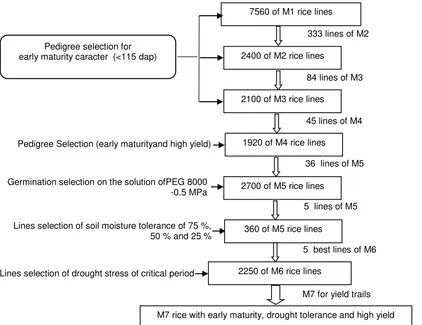
Figure 2. Selection strategy of red rice mutant for superior trait which is tolerant to drought The character of tolerant mutants was having
better results in deficit water conditions. Traits of the number of tillers, number of filled grain, percentage of filled grain, and weight of 100 grains can be used indirectly as selection criteria of red rice grain yield in the drought stress environment (Aryana, Basuki, & Kuswanto, 2011). M6-GR150-1-9-13 is drought tolerant mutant because during the selection process, it was able to survive in drought stress on the germination phase with polyethylene glycol (PEG) -0.5 MPa, 75 % in soil moisture and in drought stress on vegetative phase with higher results than the other mutants. Furthermore, the M6-GR150-1-9-13 mutants can be recommended as a candidate of drought tolerant mutants with yield from 5.23 to 6.61 t ha-1).
The results showed that pedigree selection was the proper selection used to obtain early maturity and high yield mutants. The pedigree of each mutant strains could be certainly known. PEG solutions could be used to decrease the number of mutant lines that should be selected on the germination phase. To prove the tolerance of plants
to drought stress, impairment moisture test or drought stress test could be carried out because it was proven to be able to select mutant lines that are more tolerant to drought stress.
CONCLUSION
Evaluation with PEG produced five superior mutants that were more vigor than the elders. Selection on low humidity showed that M5-GR150 -1-9 produced higher filled grain and weight filled grain than other mutants and elders. The selected red rice lines M5-GR150-1-9-13 had a better tolerance towards a drought than its control. It could be obtained by such mutant strains which have a high yield, early maturing and drought tolerant from the result of six generations gamma irradiation mutant selection.
ACKNOWLEDGEMENT
Gratitude is delivered by the researcher to Competitive Grand of Decentralization Research Program year 2012 and 2015 for research funding. Pedigree Selection (early maturityand high yield)
Germination selection on the solution ofPEG 8000 -0.5 MPa
Lines selection of soil moisture tolerance of 75 %, 50 % and 25 %
Lines selection of drought stress of critical period
7560 of M1 rice lines
2400 of M2 rice lines
2100 of M3 rice lines
1920 of M4 rice lines
333 lines of M2
84 lines of M3
45 lines of M4
2700 of M5 rice lines
36 lines of M5
5 lines of M5
360 of M5 rice lines
2250 of M6 rice lines
5 best lines of M6
M7 rice with early maturity, drought tolerance and high yield M7 for yield trails Pedigree selection for
Eries D. Mustikarini et al.: Selection Strategy of Drought Tolerance………..
REFERENCES
Adachi, Y., Kimura, K., Saigusa, M., Ohyama, T., Takahashi, Y., & Watanabe, H. (2014). Growth promoting effect of L-β-phenyllactic acid on rice (Oryza sativa L.) seedling grown under polyethylene glycol (PEG)-induced water deficit condition. Plant Root, 8, 64-71. http://doi.org/10.3117/ plantroot.8.64
Ahadiyat, Y. R., Hidayat, P., & Susanto, U. (2012). Selection of upland rice genotypes on drought tolerance and P efficiency at laboratory and screen house levels. Journal of Agricultural Technology, 8(2), 453–463. Retrieved from http://www.ijat-aatsea.com/pdf/v8_n2_12_March/5_IJA T_2012_8_2__Yugi_R.pdf
Allard, R. W., & Bradshaw, A. D. (1964). Implications of genotype-environmental interactions in applied plant breeding. Crop Science, 4, 503-508. Retrieved from https://dl. sciencesocieties.org/publications/cs/abst racts/4/5/CS0040050503
Aryana, I G. P. M. (2009). Adaptasi dan stabilitas hasil galur-galur padi beras merah pada tiga lingkungan tumbuh [Adaptation and yield stability of red rice lines in three growing environments]. Jurnal Agronomi Indonesia, 37(2), 95-100. Retrieved from http://jesl.journal.ipb.ac.id/index.php/jurn alagronomi/article/download/1400/498 Aryana, I G. P. M., Basuki, N., & Kuswanto. (2011).
Sidik lintas padi beras merah pada tiga lingkungan tumbuh berbeda [Path analys of red rice at three different growing envi-ronments]. Agroteksos, 21(1), 1-10. Retrieved from http://fp.unram.ac.id/data
/2012/04/21-1_01-Muliarta-Rev-Sudantha.pdf
Asch, F., Dingkuhn, M., Sow, A., & Audebert, A. (2005). Drought-induced changes in rooting patterns and assimilate partitioning between root and shoot in upland rice. Field Crops Research, 93(2–3), 223–236. http://doi. org/10.1016/j.fcr.2004.10.002
Ballo, M., Nio, S. A., Mantiri, F. R., & Pandiangan, D. (2012). Respons morfologis beberapa varietas padi (Oryza sativa L.) terhadap kekeringan pada fase perkecambahan [Morphological response of some rice (Oryza sativa L.) cultivars to water deficit
88-95. Retrieved from http://ejournal. unsrat.ac.id/index.php/bioslogos/article/v iew/1045
Bos, I., & Caligari, P. (2008). Selection methods in plant breeding (2nd ed.). Dordecth, NL: Springer. http://doi.org/10.1007/978-1-4020-6370-1
Chutia, J. & Borah, S. P. (2012). Water stress effects on leaf growth and chlorophyll content but not the grain yield in traditional rice (Oryza sativa Linn.) genotypes of Assam, India. II. Protein and proline status in seedlings under PEG induced water stress. American Journal of Plant Sciences, 3, 971-980. http://doi.org/10.4236/ajps.2012.37115 Degenkolbe, T., Do, P. T., Zuther, E., Repsilber, D.,
Walther, D., Hincha, D. K., & Köhl, K. I. (2009). Expression profiling of rice cultivars differing in their tolerance to long-term drought stress. Plant Molecular Biology, 69(1–2), 133–153. http://doi.org/10.1007/ s11103-008-9412-7
Effendi, Y. (2008). Kajian resistensi beberapa varietas padi gogo (Oryza sativa L.) terhadap cekaman kekeringan [A study of resistance in several varieties of upland rice (Oryza sativa L.) on drought stress] (Master Thesis). Surakarta: Universitas Sebelas Maret. Retrieved from http:// eprints.uns.ac.id/5389/1/1_(7).pdf Farooq, M., Wahid, A., Kobayashi, N., Fujita, D.,
& Basra, S. M. A. (2009). Plant drought stress: Effects, mechanisms and man-agement. Agronomy for Sustainable De-velopment, 29(1), 185–212. http://doi. org/10.1051/agro:2008021
Guimarães, E. P. (2009). Rice Breeding. In M. J. Carena (Ed.), Handbook of plant breeding: Cereals (pp. 99–126). New York, USA: Springer Sciences Publication. http://doi. org/10.1007/978-0-387-72297-9
IAARD. (2012). INPAGO 7: Beras merahnya padi gogo []. AGROINOVASI Sinartani, Edisi 4-10 Juli 2012, No. 3464, 2-5. Retrieved from http://www.litbang.pertanian.go.id/ download/one/277/file/Beras-Merahnya-Padi-Gogo.pdf
ajol.info/index.php/ajb/article/download/5 9184/47486
Kumar, A. (2011). Breeding rice for drought tolerance and adaptation to climate change. Rice Knowledge Management Portal (RKMP) Directorate of Rice Research, 1-29. Retrieved from http://www.rkmp.co.in/
sites/default/files/ris/research-themes/Breeding%20rice%20for%20dro ught%20tolerance%20and%20adaptatio n%20to%20climate%20change.pdf Lestari, E. G., & Mariska, I. (2006). Identifikasi
somaklon padi Gajahmungkur, Towuti dan IR 64 tahan kekeringan menggunakan polyethylene glycol [Drought tolerance identification of Gajahmungkur, Towuti, and IR 64 rice somaclones using poly-ethylene glycol]. Buletin Agronomi, 34(2), 71-78. Retrieved from http://download. portalgaruda.org/article.php?article=841 12&val=194&title=Identifikasi%20Somak lon%20Padi%20Gajahmungkur,%20Tow uti%20dan%20IR%2064%20Tahan%20 Kekeringan%20Menggunakan%20Polye thylene%20Glycol
Maisura, Chozin, M. A., Lubis, I., Junaedi, A., & Ehara, H. (2014). Some physiological character responses of rice under drought conditions in a paddy system. Journal of the International Society for Southeast Asian Agricultural Sciences, 20(1), 104– 114. Retrieved from http://www.issaas. org/journal/v20/01/journal-issaas-v20n1-09-maisura_at_al.pdf
Nassir, A. L., & Adewusi, K. M. (2012). Performance of established and improved interspecific rice genotypes under variable soil moisture. Experimental Agriculture & Horticulture, 12(1), 1-11. Retrieved from http://www. bapress.ca/eah/v1n2/Adesola%20L.%20 Nassir.pdf
Pandey, A., Kumar, A., Pandey, D. S., & Thongbam, P. D. (2014). Rice quality under water stress. Indian Journal of Advances in Plant Research (IJAPR), 1(2), 23-26. Retrieved from https://www.research gate.net/publication/262877652_Rice_q uality_under_water_stress
Sokoto, M. B., & Muhammad, A. (2014). Response of rice varieties to water stress in Sokoto, Sudan Savannah, Nigeria. Journal of
Biosciences and Medicines, 2, 68–74. http://doi.org/10.4236/jbm.2014.21008 Sudharmawan, A. A. K. (2010). Analisis rerata
generasi hasil persilangan dua varietas padi tahan terhadap cekaman kekeringan [Means analysis of generation produced from hybridization of two drought stress resistant rice varieties]. Crop Agro, 3(1), 72-75. http://fp.unram.ac.id/data/2012/
05/10Agung-Vol.3_No.1_Januari-2010.pdf
Supriyanto, B. (2013). Pengaruh cekaman keke-ringan terhadap pertumbuhan dan hasil padi gogo lokal kultivar jambu (Oryza sativa Linn) [Infuences of water stress to growth and yields of Jambu local up land rice (Oryza sativa Linn)]. Jurnal AGRIFOR, XII(1), 77-82. Retrieved from http://down load.portalgaruda.org/article.php?article =183677&val=6381&title=PENGARUH% 20CEKAMAN%20KEKERINGAN%20TE RHADAP%20PERTUMBUHAN%20DAN %20HASIL%20PADI%20GOGO%20LO KAL,%20KULTIVAR%20JAMBU
Syukur, M., Sujiprihati, S., & Yunianti, R. (2010, June 1). Teknik pemuliaan tanaman [Plant breeding technique]. Retrieved from http:// achamad.staff.ipb.ac.id/wp-content/ plugins/as-pdf/M.%20Syukur-Teknik%20 Pemuliaan%20Tanaman.pdf
Utama, M. Z. H. (2015). Budidaya padi pada lahan marjinal, kiat meningkatkan produksi padi [Rice cultivation on marginal land, tips to increase rice production]. Yogyakarta, ID: AndiPublisher.
Zain, N. A. M., Ismail, M. R., Mahmood, M., Puteh, A., & Ibrahim, M. H. (2014). Alleviation of water stress effects on mr220 rice by application of periodical water stress and potassium fertilization. Molecules, 19(2), 1795–1819. http://doi.org/10.3390/mole cules19021795